Section

2

Objectives
•

Analyze the impact of changes in women’s
education on women’s roles in society.

•

Explain what women did to win workers’
rights and to improve family life.

•

Evaluate the tactics women used to win
passage of the Nineteenth Amendment.

Women Make Progress
Section

2

Terms and People
•

Florence Kelley – founded the National
Consumer’s League known as the NCL

•

National Consumer’s League (NCL) – labeled
and publicized “goods produced under fair, safe,
and healthy working conditions”

•

temperance movement – campaign to end the
production, sale, and use of alcohol

•

Margaret Sanger – opened the first birth control
clinic

•

Ida B. Wells – helped to found the National
Association of Colored Women
Women Make Progress
Section

2

Terms and People

(continued)

•

suffrage – the right to vote

•

Carrie Chapman Catt – president of the NAWSA,
campaigned to pass women’s suffrage at both the
state and national levels

•

NAWSA – National American Woman Suffrage
Association

•

Alice Paul – social activist, led women to picket
at the White House

•

Nineteenth Amendment – 1919, granted
women the right to vote
Women Make Progress
Section

2

How did women of the Progressive
Era make progress and win the right
to vote?
1. In the early 1900s, many women were no
longer content playing a limited role in
society. Activists helped bring about
Progressive reforms including women’s
suffrage.
Women would continue the struggle to expand
their roles and rights in the future.

Women Make Progress
Section

2

By the early 1900s, a growing number of
middle-class women wanted to do more
than stay at home as wives and mothers.
Colleges like Pennsylvania’s
Bryn Mawr and New York’s
School of Social Work armed
middle-class women with
education and modern ideas.
However, most poor women
continued to labor long
hours, often under dangerous
or dirty conditions.
Women Make Progress
Section

2

Progressive
reforms
addressed
working
women’s
conditions:

• They worked long hours
in factories and
sweatshops, or as maids,
laundresses or servants.
• They were paid less and
often didn’t get to keep
their wages.
• They were intimidated
and bullied by employers.

Women Make Progress
Section

2

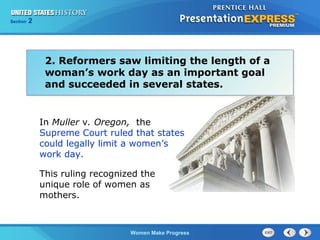
2. Reformers saw limiting the length of a
woman’s work day as an important goal
and succeeded in several states.

In Muller v. Oregon, the
Supreme Court ruled that states
could legally limit a women’s
work day.
This ruling recognized the
unique role of women as
mothers.

Women Make Progress
Section

2

In 1899, Florence Kelley founded the Women’s
Trade Union League which worked for a federal
minimum wage and a national eight-hour workday.

The WTUL also created the
first workers’ strike fund,
which helped support families
who refused to work in
unsafe or unfair conditions.

Women Make Progress
Section

2

Progressives supported the temperance
movement.

3. They felt that alcohol often led
men to spend their earnings on
liquor, neglect their families, and
abuse their wives.

The Woman’s Christian Temperance Union grew
steadily until the passage of the 18th Amendment
which banned the sale and production of alcohol
in 1919.
Women Make Progress
Section

2

In 1916,
Margaret
Sanger opened
the first birth
control clinic.
She believed
that having
fewer children
would lead to
healthier
women.

She was jailed.
The courts
eventually ruled
that doctors
could give out
family planning
information.

Women Make Progress

In 1921,
Sanger
founded the
American Birth
Control League
to make
information
available to
women.
Section

2

African Americans also worked
for women’s rights.

• Ida B. Wells founded the National Association of
Colored Women or NACW in 1896.
• The NACW supported day care centers for the
children of working parents.
• Wells also worked for suffrage, to end lynchings,
and to stop segregation in the Chicago schools.

Women Make Progress
Section

2

4. Ultimately suffrage was seen as the only
way to ensure that government protected
children, fostered education, and supported
family life.
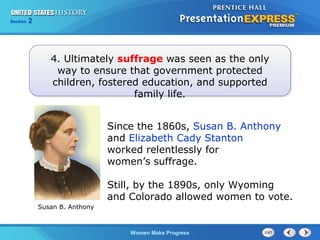
Since the 1860s, Susan B. Anthony
and Elizabeth Cady Stanton
worked relentlessly for
women’s suffrage.
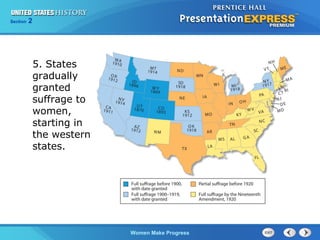
Still, by the 1890s, only Wyoming
and Colorado allowed women to vote.
Susan B. Anthony

Women Make Progress
Section

2

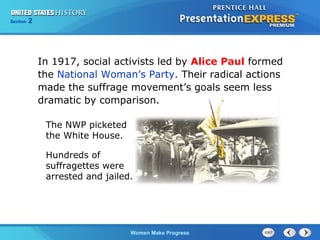
In 1917, social activists led by Alice Paul formed
the National Woman’s Party. Their radical actions
made the suffrage movement’s goals seem less
dramatic by comparison.
The NWP picketed
the White House.
Hundreds of
suffragettes were
arrested and jailed.

Women Make Progress
Section

2

President of the National American Suffrage
Association, Carrie Chapman Catt, promoted a
two-part strategy to gain the vote for women.

1

NAWSA lobbied Congress for a
constitutional amendment.

2

Supporters, called suffragettes,
used the referendum process to
pass state laws.

Women Make Progress
Section

2

Not all
women
supported
suffrage.

The National Association
Opposed to Woman’s Suffrage
feared voting would distract
women from their family roles.
Many men and women were
offended by Paul’s protests in
front of the White House. A mob
shredded her signs and pickets.

Women Make Progress
Section

2

5. States
gradually
granted
suffrage to
women,
starting in
the western
states.

Women Make Progress
Section

2

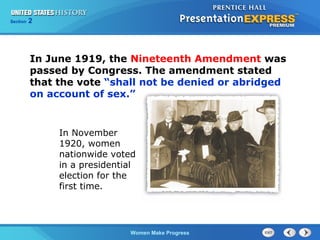
In June 1919, the Nineteenth Amendment was
passed by Congress. The amendment stated
that the vote “shall not be denied or abridged
on account of sex.”

In November
1920, women
nationwide voted
in a presidential
election for the
first time.

Women Make Progress
Section

2

Section Review
QuickTake Quiz

Know It, Show It Quiz

Women Make Progress

US History Ch. 8 Section 2 Notes

  • 1.
    Section 2 Objectives • Analyze the impactof changes in women’s education on women’s roles in society. • Explain what women did to win workers’ rights and to improve family life. • Evaluate the tactics women used to win passage of the Nineteenth Amendment. Women Make Progress
  • 2.
    Section 2 Terms and People • FlorenceKelley – founded the National Consumer’s League known as the NCL • National Consumer’s League (NCL) – labeled and publicized “goods produced under fair, safe, and healthy working conditions” • temperance movement – campaign to end the production, sale, and use of alcohol • Margaret Sanger – opened the first birth control clinic • Ida B. Wells – helped to found the National Association of Colored Women Women Make Progress
  • 3.
    Section 2 Terms and People (continued) • suffrage– the right to vote • Carrie Chapman Catt – president of the NAWSA, campaigned to pass women’s suffrage at both the state and national levels • NAWSA – National American Woman Suffrage Association • Alice Paul – social activist, led women to picket at the White House • Nineteenth Amendment – 1919, granted women the right to vote Women Make Progress
  • 4.
    Section 2 How did womenof the Progressive Era make progress and win the right to vote? 1. In the early 1900s, many women were no longer content playing a limited role in society. Activists helped bring about Progressive reforms including women’s suffrage. Women would continue the struggle to expand their roles and rights in the future. Women Make Progress
  • 5.
    Section 2 By the early1900s, a growing number of middle-class women wanted to do more than stay at home as wives and mothers. Colleges like Pennsylvania’s Bryn Mawr and New York’s School of Social Work armed middle-class women with education and modern ideas. However, most poor women continued to labor long hours, often under dangerous or dirty conditions. Women Make Progress
  • 6.
    Section 2 Progressive reforms addressed working women’s conditions: • They workedlong hours in factories and sweatshops, or as maids, laundresses or servants. • They were paid less and often didn’t get to keep their wages. • They were intimidated and bullied by employers. Women Make Progress
  • 7.
    Section 2 2. Reformers sawlimiting the length of a woman’s work day as an important goal and succeeded in several states. In Muller v. Oregon, the Supreme Court ruled that states could legally limit a women’s work day. This ruling recognized the unique role of women as mothers. Women Make Progress
  • 8.
    Section 2 In 1899, FlorenceKelley founded the Women’s Trade Union League which worked for a federal minimum wage and a national eight-hour workday. The WTUL also created the first workers’ strike fund, which helped support families who refused to work in unsafe or unfair conditions. Women Make Progress
  • 9.
    Section 2 Progressives supported thetemperance movement. 3. They felt that alcohol often led men to spend their earnings on liquor, neglect their families, and abuse their wives. The Woman’s Christian Temperance Union grew steadily until the passage of the 18th Amendment which banned the sale and production of alcohol in 1919. Women Make Progress
  • 10.
    Section 2 In 1916, Margaret Sanger opened thefirst birth control clinic. She believed that having fewer children would lead to healthier women. She was jailed. The courts eventually ruled that doctors could give out family planning information. Women Make Progress In 1921, Sanger founded the American Birth Control League to make information available to women.
  • 11.
    Section 2 African Americans alsoworked for women’s rights. • Ida B. Wells founded the National Association of Colored Women or NACW in 1896. • The NACW supported day care centers for the children of working parents. • Wells also worked for suffrage, to end lynchings, and to stop segregation in the Chicago schools. Women Make Progress
  • 12.
    Section 2 4. Ultimately suffragewas seen as the only way to ensure that government protected children, fostered education, and supported family life. Since the 1860s, Susan B. Anthony and Elizabeth Cady Stanton worked relentlessly for women’s suffrage. Still, by the 1890s, only Wyoming and Colorado allowed women to vote. Susan B. Anthony Women Make Progress
  • 13.
    Section 2 In 1917, socialactivists led by Alice Paul formed the National Woman’s Party. Their radical actions made the suffrage movement’s goals seem less dramatic by comparison. The NWP picketed the White House. Hundreds of suffragettes were arrested and jailed. Women Make Progress
  • 14.
    Section 2 President of theNational American Suffrage Association, Carrie Chapman Catt, promoted a two-part strategy to gain the vote for women. 1 NAWSA lobbied Congress for a constitutional amendment. 2 Supporters, called suffragettes, used the referendum process to pass state laws. Women Make Progress
  • 15.
    Section 2 Not all women supported suffrage. The NationalAssociation Opposed to Woman’s Suffrage feared voting would distract women from their family roles. Many men and women were offended by Paul’s protests in front of the White House. A mob shredded her signs and pickets. Women Make Progress
  • 16.
  • 17.
    Section 2 In June 1919,the Nineteenth Amendment was passed by Congress. The amendment stated that the vote “shall not be denied or abridged on account of sex.” In November 1920, women nationwide voted in a presidential election for the first time. Women Make Progress
  • 18.
    Section 2 Section Review QuickTake Quiz KnowIt, Show It Quiz Women Make Progress