Chapter 25 Section 1 
• Explain how the southern economy changed 
in the late 1800s. 
• Analyze how southern farmers consolidated 
their political power. 
• Describe the experience of African Americans 
in the changing South. 
The Cold War Begins 
Section 1 
The New South 
Objectives
Chapter 25 Section 1 
The Cold WarT Bhee gNinesw South 
Section 1 
Terms and People 
• cash crop – crop such as cotton and tobacco that 
is grown not for its own use but to be sold for cash 
• Farmers’ Alliance – network of farmers’ 
organizations that worked for political and 
economic reforms in the late 1800s 
• Civil Rights Act of 1875 – law that banned 
discrimination in public facilities and transportation
Chapter 25 Section 1 
The Cold WarT Bhee gNinesw South 
Section 1 
How did the southern economy and 
society change after the Civil War? 
1. In the postwar years, railroads crisscrossed 
the South and industries grew. Yet challenges 
remained—for the South’s economy and for 
its people.
Chapter 25 Section 1 
The Cold WarT Bhee gNinesw South 
Section 1 
In the years following the Civil War, southern 
leaders hoped to build a “New South.” 
They worked to modernize the economy by: 
• supporting industries 
• diversifying agriculture
Chapter 25 Section 1 
The Cold WarT Bhee gNinesw South 
Section 1 
2. Textile factories and lumber mills sprang up. 
So did iron, coal, and steel processing plants.
Chapter 25 Section 1 
The Cold WarT Bhee gNinesw South 
Section 1 
Railroad construction boomed. 
New rail lines 
connected urban 
hubs with rural 
areas, cities 
with towns. 
• Railroads moved 
people and products. 
• Cities grew.
Chapter 25 Section 1 
The Cold WarT Bhee gNinesw South 
Section 1 
3. Yet 
economic 
expansion in 
the South 
lagged behind 
the rest of 
the country. 
• War damage was 
extensive. 
• The South lacked a 
well-trained labor force, 
and wages were low. 
• A lack of capital led 
to a dependence on 
northern bankers.
Chapter 25 Section 1 
The Cold WarT Bhee gNinesw South 
Section 1 
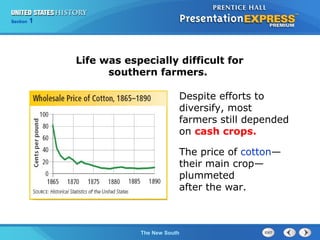
Life was especially difficult for 
southern farmers. 
Despite efforts to 
diversify, most 
farmers still depended 
on cash crops. 
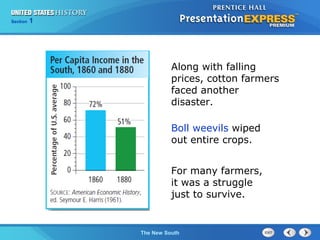
The price of cotton— 
their main crop— 
plummeted 
after the war.
Chapter 25 Section 1 
Along with falling 
prices, cotton farmers 
faced another 
disaster. 
The Cold WarT Bhee gNinesw South 
Section 1 
Boll weevils wiped 
out entire crops. 
For many farmers, 
it was a struggle 
just to survive.
Chapter 25 Section 1 
4. Faced with serious problems, farmers 
joined together to form the Farmers’ 
Alliance. 
The Cold WarT Bhee gNinesw South 
Section 1 
• Worked to negotiate better prices on 
supplies, freight charges, and loan rates 
• Connected farmers in the South and West
Chapter 25 Section 1 
Black southerners made important political and 
economic advances in the postwar years. 
The Cold WarT Bhee gNinesw South 
Section 1 
Most important, they 
gained: 
• the right to vote 
• access to education
Chapter 25 Section 1 
The Cold WarT Bhee gNinesw South 
Section 1 
In time, however, many of the gains 
were reversed. 
• Groups such as the Ku Klux Klan 
terrorized African Americans. 
• Newfound freedoms were 
stripped away. 
• Segregation was enforced.
Chapter 25 Section 1 
The Cold WarT Bhee gNinesw South 
Section 1 
5. The Civil 
Rights Act of 
1875 banned 
discrimination 
in public 
facilities and 
transportation. 
The Supreme 
Court, however, 
ruled in a series 
of cases decided 
in 1883 that such 
decisions were 
local issues. 
Southern towns and cities used the ruling to 
further limit the rights of African Americans.
Chapter 25 Section 1 
The Cold WarT Bhee gNinesw South 
Section 1 
Section Review 
QuickTake Quiz Know It, Show It Quiz

US History Ch. 6 Section 1 Notes

  • 1.
    Chapter 25 Section1 • Explain how the southern economy changed in the late 1800s. • Analyze how southern farmers consolidated their political power. • Describe the experience of African Americans in the changing South. The Cold War Begins Section 1 The New South Objectives
  • 2.
    Chapter 25 Section1 The Cold WarT Bhee gNinesw South Section 1 Terms and People • cash crop – crop such as cotton and tobacco that is grown not for its own use but to be sold for cash • Farmers’ Alliance – network of farmers’ organizations that worked for political and economic reforms in the late 1800s • Civil Rights Act of 1875 – law that banned discrimination in public facilities and transportation
  • 3.
    Chapter 25 Section1 The Cold WarT Bhee gNinesw South Section 1 How did the southern economy and society change after the Civil War? 1. In the postwar years, railroads crisscrossed the South and industries grew. Yet challenges remained—for the South’s economy and for its people.
  • 4.
    Chapter 25 Section1 The Cold WarT Bhee gNinesw South Section 1 In the years following the Civil War, southern leaders hoped to build a “New South.” They worked to modernize the economy by: • supporting industries • diversifying agriculture
  • 5.
    Chapter 25 Section1 The Cold WarT Bhee gNinesw South Section 1 2. Textile factories and lumber mills sprang up. So did iron, coal, and steel processing plants.
  • 6.
    Chapter 25 Section1 The Cold WarT Bhee gNinesw South Section 1 Railroad construction boomed. New rail lines connected urban hubs with rural areas, cities with towns. • Railroads moved people and products. • Cities grew.
  • 7.
    Chapter 25 Section1 The Cold WarT Bhee gNinesw South Section 1 3. Yet economic expansion in the South lagged behind the rest of the country. • War damage was extensive. • The South lacked a well-trained labor force, and wages were low. • A lack of capital led to a dependence on northern bankers.
  • 8.
    Chapter 25 Section1 The Cold WarT Bhee gNinesw South Section 1 Life was especially difficult for southern farmers. Despite efforts to diversify, most farmers still depended on cash crops. The price of cotton— their main crop— plummeted after the war.
  • 9.
    Chapter 25 Section1 Along with falling prices, cotton farmers faced another disaster. The Cold WarT Bhee gNinesw South Section 1 Boll weevils wiped out entire crops. For many farmers, it was a struggle just to survive.
  • 10.
    Chapter 25 Section1 4. Faced with serious problems, farmers joined together to form the Farmers’ Alliance. The Cold WarT Bhee gNinesw South Section 1 • Worked to negotiate better prices on supplies, freight charges, and loan rates • Connected farmers in the South and West
  • 11.
    Chapter 25 Section1 Black southerners made important political and economic advances in the postwar years. The Cold WarT Bhee gNinesw South Section 1 Most important, they gained: • the right to vote • access to education
  • 12.
    Chapter 25 Section1 The Cold WarT Bhee gNinesw South Section 1 In time, however, many of the gains were reversed. • Groups such as the Ku Klux Klan terrorized African Americans. • Newfound freedoms were stripped away. • Segregation was enforced.
  • 13.
    Chapter 25 Section1 The Cold WarT Bhee gNinesw South Section 1 5. The Civil Rights Act of 1875 banned discrimination in public facilities and transportation. The Supreme Court, however, ruled in a series of cases decided in 1883 that such decisions were local issues. Southern towns and cities used the ruling to further limit the rights of African Americans.
  • 14.
    Chapter 25 Section1 The Cold WarT Bhee gNinesw South Section 1 Section Review QuickTake Quiz Know It, Show It Quiz