Section

3

Objectives
• Analyze the planning and impact of the D-Day
invasion of France.
• Understand how the Allies achieved final victory
in Europe.
• Explore the reasons that President Truman
decided to use the atomic bomb against Japan.

TheVictory in Begins and the Pacific
Cold War Europe
Section

3

Terms and People
•

D-Day − June 6, 1944, the day Allied forces
invaded France

•

Battle of the Bulge − German counterattack
that failed, resulting in an Allied victory

•

Harry S. Truman − President during the end of
World War II

•

island hopping − American strategy of
capturing selected islands in the Pacific in a
steady path to Japan

TheVictory in Begins and the Pacific
Cold War Europe
Section

3

Terms and People

(continued)

•

kamikaze − Japanese pilots who deliberately
crashed their planes into American ships

•

Albert Einstein − world-famous scientist who
alerted Roosevelt of the need to develop atomic
weapons

•

Manhattan Project − code name for the program
to develop an atomic bomb

•

J. Robert Oppenheimer − key leader of the
Manhattan Project

TheVictory in Begins and the Pacific
Cold War Europe
Section

3

How did the Allies defeat the Axis
Powers?
1. It took years of hard fighting to reverse
Axis advances and move toward victory.
A new weapon finally ended the war,
changing both warfare and global politics
forever.

TheVictory in Begins and the Pacific
Cold War Europe
Section

3

In 1943, Allied leaders agreed to open a
second front in the war in Europe.
American
and British
troops
would cross
the English
Channel
and invade
France.

• The secret operation
was code-named
Operation Overlord.
• General Dwight
Eisenhower was the
mission’s commander.

TheVictory in Begins and the Pacific
Cold War Europe
Section

3

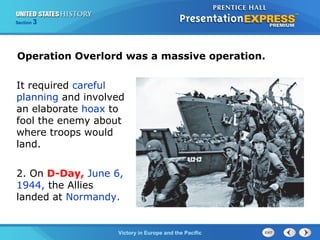
Operation Overlord was a massive operation.
It required careful
planning and involved
an elaborate hoax to
fool the enemy about
where troops would
land.
2. On D-Day, June 6,
1944, the Allies
landed at Normandy.

TheVictory in Begins and the Pacific
Cold War Europe
Section

3

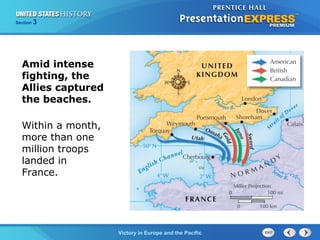
Amid intense
fighting, the
Allies captured
the beaches.
Within a month,
more than one
million troops
landed in
France.

TheVictory in Begins and the Pacific
Cold War Europe
Section

3

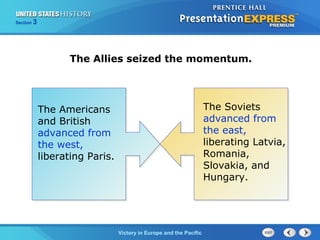
The Allies seized the momentum.

The Americans
and British
advanced from
the west,
liberating Paris.

TheVictory in Begins and the Pacific
Cold War Europe

The Soviets
advanced from
the east,
liberating Latvia,
Romania,
Slovakia, and
Hungary.
Section

3

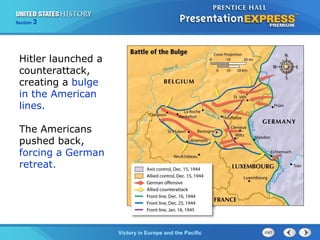
Hitler launched a
counterattack,
creating a bulge
in the American
lines.
The Americans
pushed back,
forcing a German
retreat.

TheVictory in Begins and the Pacific
Cold War Europe
Section

3

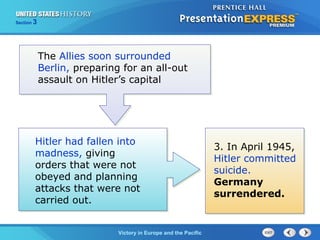
The Allies soon surrounded
Berlin, preparing for an all-out
assault on Hitler’s capital

Hitler had fallen into
madness, giving
orders that were not
obeyed and planning
attacks that were not
carried out.
TheVictory in Begins and the Pacific
Cold War Europe

3. In April 1945,
Hitler committed
suicide.
Germany
surrendered.
Section

3

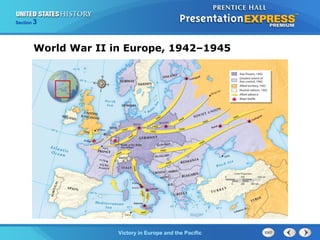
World War II in Europe, 1942–1945

TheVictory in Begins and the Pacific
Cold War Europe
Section

3

4. With the German surrender, the Allies
celebrated V-E Day, hailing their hard-fought
victory in Europe.

FDR did not
live to join the
celebrations.
He died a few
weeks earlier.

The new President was
Harry S. Truman.

TheVictory in Begins and the Pacific
Cold War Europe
Section

3

War still raged in the Pacific, where the
Allies were fighting their way toward
Japan.

• Battles during the island-hopping campaign
were fierce, with high casualties on both sides.
• Kamikazes crashed into American ships.
Japanese troops fought to the death.
• An intense bombing campaign leveled much of
Tokyo. Still, Japan refused to surrender.
TheVictory in Begins and the Pacific
Cold War Europe
Section

3

Early in the
war, FDR had
authorized
scientists to
develop an
atomic bomb.

The top secret
program was
code-named
the
Manhattan
Project.

The bomb
was
successfully
tested in
July 1945.

Now it was up to Truman to decide if and when
to use it.
TheVictory in Begins and the Pacific
Cold War Europe
Section

3

The
Japanese
refused to
surrender.

An invasion of Japan
could cost up to
1,000,000 American
lives.

Truman’s chief priority was to save
American lives.
TheVictory in Begins and the Pacific
Cold War Europe
Section

3

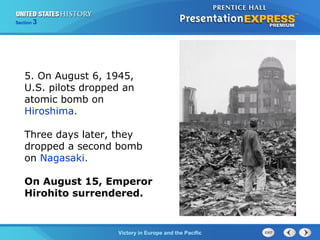
5. On August 6, 1945,
U.S. pilots dropped an
atomic bomb on
Hiroshima.
Three days later, they
dropped a second bomb
on Nagasaki.
On August 15, Emperor
Hirohito surrendered.

TheVictory in Begins and the Pacific
Cold War Europe
Section

3

The Allies celebrated V-J Day, marking
victory in Japan.

The most costly war in history was finally over.

TheVictory in Begins and the Pacific
Cold War Europe
Section

3

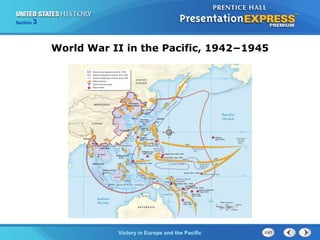
World War II in the Pacific, 1942−1945

TheVictory in Begins and the Pacific
Cold War Europe
Section

3

Section Review
QuickTake Quiz

Know It, Show It Quiz

TheVictory in Begins and the Pacific
Cold War Europe

United States History Ch. 15 Section 3 Notes

  • 1.
    Section 3 Objectives • Analyze theplanning and impact of the D-Day invasion of France. • Understand how the Allies achieved final victory in Europe. • Explore the reasons that President Truman decided to use the atomic bomb against Japan. TheVictory in Begins and the Pacific Cold War Europe
  • 2.
    Section 3 Terms and People • D-Day− June 6, 1944, the day Allied forces invaded France • Battle of the Bulge − German counterattack that failed, resulting in an Allied victory • Harry S. Truman − President during the end of World War II • island hopping − American strategy of capturing selected islands in the Pacific in a steady path to Japan TheVictory in Begins and the Pacific Cold War Europe
  • 3.
    Section 3 Terms and People (continued) • kamikaze− Japanese pilots who deliberately crashed their planes into American ships • Albert Einstein − world-famous scientist who alerted Roosevelt of the need to develop atomic weapons • Manhattan Project − code name for the program to develop an atomic bomb • J. Robert Oppenheimer − key leader of the Manhattan Project TheVictory in Begins and the Pacific Cold War Europe
  • 4.
    Section 3 How did theAllies defeat the Axis Powers? 1. It took years of hard fighting to reverse Axis advances and move toward victory. A new weapon finally ended the war, changing both warfare and global politics forever. TheVictory in Begins and the Pacific Cold War Europe
  • 5.
    Section 3 In 1943, Alliedleaders agreed to open a second front in the war in Europe. American and British troops would cross the English Channel and invade France. • The secret operation was code-named Operation Overlord. • General Dwight Eisenhower was the mission’s commander. TheVictory in Begins and the Pacific Cold War Europe
  • 6.
    Section 3 Operation Overlord wasa massive operation. It required careful planning and involved an elaborate hoax to fool the enemy about where troops would land. 2. On D-Day, June 6, 1944, the Allies landed at Normandy. TheVictory in Begins and the Pacific Cold War Europe
  • 7.
    Section 3 Amid intense fighting, the Alliescaptured the beaches. Within a month, more than one million troops landed in France. TheVictory in Begins and the Pacific Cold War Europe
  • 8.
    Section 3 The Allies seizedthe momentum. The Americans and British advanced from the west, liberating Paris. TheVictory in Begins and the Pacific Cold War Europe The Soviets advanced from the east, liberating Latvia, Romania, Slovakia, and Hungary.
  • 9.
    Section 3 Hitler launched a counterattack, creatinga bulge in the American lines. The Americans pushed back, forcing a German retreat. TheVictory in Begins and the Pacific Cold War Europe
  • 10.
    Section 3 The Allies soonsurrounded Berlin, preparing for an all-out assault on Hitler’s capital Hitler had fallen into madness, giving orders that were not obeyed and planning attacks that were not carried out. TheVictory in Begins and the Pacific Cold War Europe 3. In April 1945, Hitler committed suicide. Germany surrendered.
  • 11.
    Section 3 World War IIin Europe, 1942–1945 TheVictory in Begins and the Pacific Cold War Europe
  • 12.
    Section 3 4. With theGerman surrender, the Allies celebrated V-E Day, hailing their hard-fought victory in Europe. FDR did not live to join the celebrations. He died a few weeks earlier. The new President was Harry S. Truman. TheVictory in Begins and the Pacific Cold War Europe
  • 13.
    Section 3 War still ragedin the Pacific, where the Allies were fighting their way toward Japan. • Battles during the island-hopping campaign were fierce, with high casualties on both sides. • Kamikazes crashed into American ships. Japanese troops fought to the death. • An intense bombing campaign leveled much of Tokyo. Still, Japan refused to surrender. TheVictory in Begins and the Pacific Cold War Europe
  • 14.
    Section 3 Early in the war,FDR had authorized scientists to develop an atomic bomb. The top secret program was code-named the Manhattan Project. The bomb was successfully tested in July 1945. Now it was up to Truman to decide if and when to use it. TheVictory in Begins and the Pacific Cold War Europe
  • 15.
    Section 3 The Japanese refused to surrender. An invasionof Japan could cost up to 1,000,000 American lives. Truman’s chief priority was to save American lives. TheVictory in Begins and the Pacific Cold War Europe
  • 16.
    Section 3 5. On August6, 1945, U.S. pilots dropped an atomic bomb on Hiroshima. Three days later, they dropped a second bomb on Nagasaki. On August 15, Emperor Hirohito surrendered. TheVictory in Begins and the Pacific Cold War Europe
  • 17.
    Section 3 The Allies celebratedV-J Day, marking victory in Japan. The most costly war in history was finally over. TheVictory in Begins and the Pacific Cold War Europe
  • 18.
    Section 3 World War IIin the Pacific, 1942−1945 TheVictory in Begins and the Pacific Cold War Europe
  • 19.
    Section 3 Section Review QuickTake Quiz KnowIt, Show It Quiz TheVictory in Begins and the Pacific Cold War Europe