Upper Urinary tract
Obstruction
Dr. Michael Abdissa
(Assistant Professor of Urology)
For Clinical I medical students
Outline
1. Brief Anatomy
2. Definitions
3. Possible causes
4. Prevalence
5. Clinical presentation
6. Investigations
7. Pathologic changes of obstruction
8. Clinical impact of renal obstruction
9. Treatment of renal obstruction
10. Renal Recovery after Obstruction
1. Brief Anatomy
2.Definitions
• Urinary tract obstruction :- Impedance to urinary flow any where in
urinary tract
• Upper urinary tract Obstruction: Impedance to urinary flow from
upper tract
• Obstructive Uropathy: Impedance to urinary flow any where in urinary
tract resulting in collecting system dilatation and change in structure
• Obstructive nephropathy: Functional kidney abnormality resulting
from OUP
• Hydronephrosis: Dilation of Pelvis and Calyces
• Hydroureteronephrosis: Dilation of Ureter, Pelvis and Calyces
• Calyctasis: Dilation of calyces
Hydronephrosis can be present in the absence of obstruction.
3. Possible causes of obstruction
4.Prevalence
• 10% of all cases of renal failure.
• Autopsy – Prevalence of hydronephrosis was originally estimated to
be 3.1%.
• More prevalent in women between the ages of 20 and 60 years,
• Pregnancy and the development of gynecologic malignancies.
• More prevalent in men after age 60 because of the presence of
prostatic disease
5.Clinical Presentation
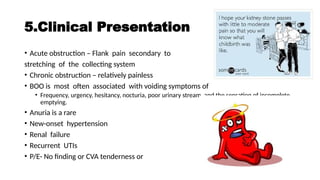
• Acute obstruction – Flank pain secondary to
stretching of the collecting system
• Chronic obstruction – relatively painless
• BOO is most often associated with voiding symptoms of
• Frequency, urgency, hesitancy, nocturia, poor urinary stream, and the sensation of incomplete
emptying.
• Anuria is a rare
• New-onset hypertension
• Renal failure
• Recurrent UTIs
• P/E- No finding or CVA tenderness or
6.Investigations
Urinalysis
• evidence of UTI
• Insight into stone formation – crystals
• Protein and/or cellular casts – medical dx
RFT, CBC, Eelctrolyte
 Ultrasonography
Computed Tomography
• Low dose Non-contrast helical CT (NHCT) has become the imaging
modality of choice for patients suspected of having ureteral obstruction
• Can reveal signs associated with ureteral obstruction even after stone
passage, including
Magnetic Resonance Urography
• Integrates excellent anatomic information with functional data and
avoids ionizing radiation
• Stone detection is poor compared with NCCT
Excretory Urography
• Provides anatomic and functional information
• Largely has been replaced with CTU
Retrograde Pyelography
• Defines ureteral and upper collecting system anatomy
• Can determine the location of an obstructive lesion.
• Most often used in patient who has risk factors for receiving
iodinated contrast material
• Increased risk for UTI/sepsis
Antegrade Pyelography
• Used when retrograde pyelography is not technically feasible or
• When other imaging studies do not adequately define the collecting
system
Nuclear Renography
•The only imaging modality that can provide
noninvasive information about dynamic renal function
•Diuretic renography – study of choice in the evaluation
of the obstructed collecting system
•Most commonly performed using the
radiopharmaceutical technetium-99m–mercaptoacetyl
triglycine (99mTc-MAG3)
7. Pathologic changes of obstruction
Gross Pathologic Findings
• After 42 hours of obstruction
• Dilation of the collecting system
• Blunting of the papillary tips
• Increased weight of the kidney.
• After 7 days of obstruction
• Collecting system dilation and renal weight further increase
• The parenchyma becomes edematous.
• After 12 days of obstruction
• Further collecting system dilation develops
• After 21 to 28 days
• The cortex and medullary tissue become diffusely thinned.
• 6 weeks after obstruction
• Kidney enlarged, with a cystic appearance but lower weight.
Microscopic Pathologic Findings
• Early obstruction
• Changes localized primarily to the tubulointerstitial compartment
• Massive tubular dilation, progressive tubulointerstitial fibrosis, inflammatory
cell infiltration, and apoptotic renal tubular cell death.
• The glomeruli of the kidney are relatively spared.
• Long-standing obstruction
• Results in glomerulosclerosis
• Most likely as a result of chronic inflammation and/or hyperfiltration injury
• If extensive glomerulosclerosis – decrease in renal function
8.Clinical impact of renal obstruction
Hypertension
• More common in the presence of BUO than in the presence of UUO.
• In BUO volume-mediated and reversible
• Less common in patients with UUO
• Mediated by upregulation of renin-angiotensin system.
• HTN is more likely to be reversed after relief of obstruction in patients
with BUO compared to UUO.
Compensatory Renal Growth
• An increase in the number of nephrons or glomeruli does not occur,
• The increase in renal volume is primarily a consequence of cellular
hypertrophy rather than hyperplasia.
• Renal compensatory growth influenced by age and the degree and
duration of obstruction.
• Reduce with increase age
• Directly proportional to the duration of obstruction
• Less prominent with partial rather than complete UUO.
Deterioration of renal function
9. Treatment of renal obstruction
Pain Management
• Opioids
• Rapid onset of analgesia , but may promote nausea and emesis
• Cause excessive sedation, and have the potential to be abused.
• NSAIDs
• Reduce collecting system pressure mediated by a reduction in RBF
• Superior to opioids in managing renal colic and Greater reduction in pain
Less need for “rescue” analgesia
• less emesis than with opioids
NSAIDs should not be used in patients with renal insufficiency,
• Decrease in RBF induced by NSAIDs exacerbate RF
• Tamsulosin
• Facilitate stone passage and reduce the requirement for analgesics
Renal Drainage
• Immediate drainage if obstruction is
• Symptomatic, accompanied by fever, complicated by undrained infection,
• Determined to be high grade, bilateral, or inducing renal failure
• Both percutaneous nephrostomy tubes and internal stents
• Equally effective in relieving an obstructed collecting system
• With similar complication rates.
• Ureteral stenting has not been very effective for treating patients with
extrinsic ureteral obstruction.
• New metallic stents - offer longer indwelling times (3.5 to 11 months)
10.Renal Recovery after Obstruction
• In a canine model of UUO
• Full recovery of renal function occurred after 7 days
• 70% recovery of GFR occurred after 14 days
• 30% after 4 weeks of UUO
• None after 6 weeks of UUO.
• Renal damage can persist despite recovery of renal function.
• Interstitial fibrosis and tubular apoptosis continued to increase after relief of
obstruction.
• In humans, delayed relief of obstruction (>2 weeks) has been
demonstrated to decrease long-term renal function and increase the
risk for hypertension.
• Older age and decreased cortical thickness are predictors of
diminished recovery of renal function after relief of obstruction.
• Profound diuresis and natriuresis accompanies relief of BUO as
opposed to UUO
• Increased volume expansion, accumulation of urea and other osmolytes, and
increased levels of ANP.
• BUO or obstruction of a solitary kidney are at risk for chronic urinary
acidification and concentrating defects
References
• Campbell-walsh urology, 12th
edition
• Robbins and Cotran’s pathologic basis of disease 7th
edition
• Smith’s General urology, 18th
edition
• Uptodate 2018
Thank you

Upper Urinary Tract Obstruction (1).pptx

  • 1.
    Upper Urinary tract Obstruction Dr.Michael Abdissa (Assistant Professor of Urology) For Clinical I medical students
  • 2.
    Outline 1. Brief Anatomy 2.Definitions 3. Possible causes 4. Prevalence 5. Clinical presentation 6. Investigations 7. Pathologic changes of obstruction 8. Clinical impact of renal obstruction 9. Treatment of renal obstruction 10. Renal Recovery after Obstruction
  • 3.
  • 4.
    2.Definitions • Urinary tractobstruction :- Impedance to urinary flow any where in urinary tract • Upper urinary tract Obstruction: Impedance to urinary flow from upper tract • Obstructive Uropathy: Impedance to urinary flow any where in urinary tract resulting in collecting system dilatation and change in structure • Obstructive nephropathy: Functional kidney abnormality resulting from OUP • Hydronephrosis: Dilation of Pelvis and Calyces • Hydroureteronephrosis: Dilation of Ureter, Pelvis and Calyces • Calyctasis: Dilation of calyces Hydronephrosis can be present in the absence of obstruction.
  • 5.
    3. Possible causesof obstruction
  • 6.
    4.Prevalence • 10% ofall cases of renal failure. • Autopsy – Prevalence of hydronephrosis was originally estimated to be 3.1%. • More prevalent in women between the ages of 20 and 60 years, • Pregnancy and the development of gynecologic malignancies. • More prevalent in men after age 60 because of the presence of prostatic disease
  • 7.
    5.Clinical Presentation • Acuteobstruction – Flank pain secondary to stretching of the collecting system • Chronic obstruction – relatively painless • BOO is most often associated with voiding symptoms of • Frequency, urgency, hesitancy, nocturia, poor urinary stream, and the sensation of incomplete emptying. • Anuria is a rare • New-onset hypertension • Renal failure • Recurrent UTIs • P/E- No finding or CVA tenderness or
  • 8.
    6.Investigations Urinalysis • evidence ofUTI • Insight into stone formation – crystals • Protein and/or cellular casts – medical dx RFT, CBC, Eelctrolyte
  • 9.
  • 10.
    Computed Tomography • Lowdose Non-contrast helical CT (NHCT) has become the imaging modality of choice for patients suspected of having ureteral obstruction • Can reveal signs associated with ureteral obstruction even after stone passage, including Magnetic Resonance Urography • Integrates excellent anatomic information with functional data and avoids ionizing radiation • Stone detection is poor compared with NCCT Excretory Urography • Provides anatomic and functional information • Largely has been replaced with CTU
  • 11.
    Retrograde Pyelography • Definesureteral and upper collecting system anatomy • Can determine the location of an obstructive lesion. • Most often used in patient who has risk factors for receiving iodinated contrast material • Increased risk for UTI/sepsis Antegrade Pyelography • Used when retrograde pyelography is not technically feasible or • When other imaging studies do not adequately define the collecting system
  • 12.
    Nuclear Renography •The onlyimaging modality that can provide noninvasive information about dynamic renal function •Diuretic renography – study of choice in the evaluation of the obstructed collecting system •Most commonly performed using the radiopharmaceutical technetium-99m–mercaptoacetyl triglycine (99mTc-MAG3)
  • 13.
    7. Pathologic changesof obstruction Gross Pathologic Findings • After 42 hours of obstruction • Dilation of the collecting system • Blunting of the papillary tips • Increased weight of the kidney. • After 7 days of obstruction • Collecting system dilation and renal weight further increase • The parenchyma becomes edematous. • After 12 days of obstruction • Further collecting system dilation develops • After 21 to 28 days • The cortex and medullary tissue become diffusely thinned.
  • 14.
    • 6 weeksafter obstruction • Kidney enlarged, with a cystic appearance but lower weight. Microscopic Pathologic Findings • Early obstruction • Changes localized primarily to the tubulointerstitial compartment • Massive tubular dilation, progressive tubulointerstitial fibrosis, inflammatory cell infiltration, and apoptotic renal tubular cell death. • The glomeruli of the kidney are relatively spared. • Long-standing obstruction • Results in glomerulosclerosis • Most likely as a result of chronic inflammation and/or hyperfiltration injury • If extensive glomerulosclerosis – decrease in renal function
  • 15.
    8.Clinical impact ofrenal obstruction Hypertension • More common in the presence of BUO than in the presence of UUO. • In BUO volume-mediated and reversible • Less common in patients with UUO • Mediated by upregulation of renin-angiotensin system. • HTN is more likely to be reversed after relief of obstruction in patients with BUO compared to UUO.
  • 16.
    Compensatory Renal Growth •An increase in the number of nephrons or glomeruli does not occur, • The increase in renal volume is primarily a consequence of cellular hypertrophy rather than hyperplasia. • Renal compensatory growth influenced by age and the degree and duration of obstruction. • Reduce with increase age • Directly proportional to the duration of obstruction • Less prominent with partial rather than complete UUO. Deterioration of renal function
  • 17.
    9. Treatment ofrenal obstruction Pain Management • Opioids • Rapid onset of analgesia , but may promote nausea and emesis • Cause excessive sedation, and have the potential to be abused. • NSAIDs • Reduce collecting system pressure mediated by a reduction in RBF • Superior to opioids in managing renal colic and Greater reduction in pain Less need for “rescue” analgesia • less emesis than with opioids NSAIDs should not be used in patients with renal insufficiency, • Decrease in RBF induced by NSAIDs exacerbate RF • Tamsulosin • Facilitate stone passage and reduce the requirement for analgesics
  • 18.
    Renal Drainage • Immediatedrainage if obstruction is • Symptomatic, accompanied by fever, complicated by undrained infection, • Determined to be high grade, bilateral, or inducing renal failure • Both percutaneous nephrostomy tubes and internal stents • Equally effective in relieving an obstructed collecting system • With similar complication rates. • Ureteral stenting has not been very effective for treating patients with extrinsic ureteral obstruction. • New metallic stents - offer longer indwelling times (3.5 to 11 months)
  • 19.
    10.Renal Recovery afterObstruction • In a canine model of UUO • Full recovery of renal function occurred after 7 days • 70% recovery of GFR occurred after 14 days • 30% after 4 weeks of UUO • None after 6 weeks of UUO. • Renal damage can persist despite recovery of renal function. • Interstitial fibrosis and tubular apoptosis continued to increase after relief of obstruction.
  • 20.
    • In humans,delayed relief of obstruction (>2 weeks) has been demonstrated to decrease long-term renal function and increase the risk for hypertension. • Older age and decreased cortical thickness are predictors of diminished recovery of renal function after relief of obstruction. • Profound diuresis and natriuresis accompanies relief of BUO as opposed to UUO • Increased volume expansion, accumulation of urea and other osmolytes, and increased levels of ANP. • BUO or obstruction of a solitary kidney are at risk for chronic urinary acidification and concentrating defects
  • 21.
    References • Campbell-walsh urology,12th edition • Robbins and Cotran’s pathologic basis of disease 7th edition • Smith’s General urology, 18th edition • Uptodate 2018
  • 22.

Editor's Notes

  • #19 The remaining intact nephrons are hypertrophied and there is evidence of substantial glomerular injury