




URINALYSIS
Session Aims Understand indications for urinalysis Gain knowledge of the procedure for urinalysis Understand to implications of abnormal urinalysis results
Urinalysis is…. … the testing of the physical characteristics and composition of freshly voided urine
Indications Composition of urine can change as a result of the disease process Presence of abnormalities in the urine can be a warning sign of illness
Urinalysis can… Provide a baseline on admission Monitor changes as a response to medication Used as a screening test to gather information about the physical status
Characteristics of Urine Odor offensive smelling can indicate infection  acetone/fruity smell in diabetics   Color clear  pale to deep yellow (depending on concentration) due to a pigment derived from the breakdown of Hb altered by diet, or by presence of blood or bile cloudy urine could indicate UTI
pH slightly acidic pH - 6  vary depending on dietary intake bacterial UTI can cause urine to become alkaline Specific Gravity varies from 1.002-1.035
Dipstick/Reagent Tests Strips that have been impregnated with chemicals Chemicals react with abnormal substances in the urine and cause a colour change on the strip Historically-tested for protein and glucose More sophisticated now and able to test for nitrites and leucocytes Potentially removed need for MSU to diagnose UTI - but concerns over accuracy and sensitivity
Preparation Equipment clean container reagent sticks watch with second hand Nurse clean hands gloves & apron Patient explain procedure privacy and dignity
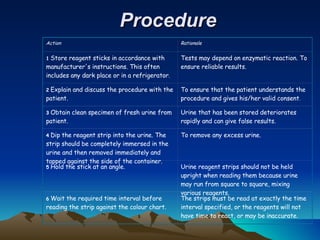
Procedure Action Rationale 1   Store reagent sticks in accordance with manufacturer's instructions. This often includes any dark place or in a refrigerator . Tests may depend on enzymatic reaction. To ensure reliable results.  2   Explain and discuss the procedure with the patient. To ensure that the patient understands the procedure and gives his/her valid consent . 3   Obtain clean specimen of fresh urine from patient. Urine that has been stored deteriorates rapidly and can give false results. 4   Dip the reagent strip into the urine. The strip should be completely immersed in the urine and then removed immediately and tapped against the side of the container. To remove any excess urine.   5   Hold the stick at an angle. Urine reagent strips should not be held upright when reading them because urine may run from square to square, mixing various reagents. 6   Wait the required time interval before reading the strip against the colour chart. The strips must be read at exactly the time interval specified, or the reagents will not have time to react, or may be inaccurate.
Following procedure Dispose of stick in clinical waste bag and dispose of urine safely Dispose / clean container safely Remove gloves and wash hands Discuss results with patient as appropriate Report abnormalities to qualified nurse Document results admission sheet…obs chart…notes
What could the results mean?
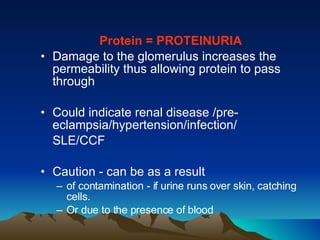
Protein = PROTEINURIA Damage to the glomerulus increases the permeability thus allowing protein to pass through Could indicate renal disease /pre-eclampsia/hypertension/infection/ SLE/CCF Caution - can be as a result  of contamination - if urine runs over skin, catching cells. Or due to the presence of blood
Glucose = GLYCOSURIA Present in diabetes - but only if hyperglycaemic Ketones = KETONURIA Indicate that fat is being used as an energy source Present in uncontrolled diabetes and in patients who have been starved.
Blood(erythrocytes) = HEAMATURIA Found in patients with UTI Bleeding in the urinary tract Trauma Could indicate bladder/prostate or kidney disease/kidney stones Haemoglobin = HAEMOGLOBINURIA Transfusion reaction/haemolytic anaemia
Nitrites Nitrates from diet get converted to nitrites by some bacteria in the urine NB not all bacteria produce nitrites Leucocytes = PYURIA Most sensitive test for UTI ?MSU still needed
Bilirubin = BILIRUBINURIA Bile pigment Can indicates liver disease or bile duct obstruction
 

Urinalysis

  • 1.
  • 2.
    Session Aims Understandindications for urinalysis Gain knowledge of the procedure for urinalysis Understand to implications of abnormal urinalysis results
  • 3.
    Urinalysis is…. …the testing of the physical characteristics and composition of freshly voided urine
  • 4.
    Indications Composition ofurine can change as a result of the disease process Presence of abnormalities in the urine can be a warning sign of illness
  • 5.
    Urinalysis can… Providea baseline on admission Monitor changes as a response to medication Used as a screening test to gather information about the physical status
  • 6.
    Characteristics of UrineOdor offensive smelling can indicate infection acetone/fruity smell in diabetics Color clear pale to deep yellow (depending on concentration) due to a pigment derived from the breakdown of Hb altered by diet, or by presence of blood or bile cloudy urine could indicate UTI
  • 7.
    pH slightly acidicpH - 6 vary depending on dietary intake bacterial UTI can cause urine to become alkaline Specific Gravity varies from 1.002-1.035
  • 8.
    Dipstick/Reagent Tests Stripsthat have been impregnated with chemicals Chemicals react with abnormal substances in the urine and cause a colour change on the strip Historically-tested for protein and glucose More sophisticated now and able to test for nitrites and leucocytes Potentially removed need for MSU to diagnose UTI - but concerns over accuracy and sensitivity
  • 9.
    Preparation Equipment cleancontainer reagent sticks watch with second hand Nurse clean hands gloves & apron Patient explain procedure privacy and dignity
  • 10.
    Procedure Action Rationale1 Store reagent sticks in accordance with manufacturer's instructions. This often includes any dark place or in a refrigerator . Tests may depend on enzymatic reaction. To ensure reliable results. 2 Explain and discuss the procedure with the patient. To ensure that the patient understands the procedure and gives his/her valid consent . 3 Obtain clean specimen of fresh urine from patient. Urine that has been stored deteriorates rapidly and can give false results. 4 Dip the reagent strip into the urine. The strip should be completely immersed in the urine and then removed immediately and tapped against the side of the container. To remove any excess urine. 5 Hold the stick at an angle. Urine reagent strips should not be held upright when reading them because urine may run from square to square, mixing various reagents. 6 Wait the required time interval before reading the strip against the colour chart. The strips must be read at exactly the time interval specified, or the reagents will not have time to react, or may be inaccurate.
  • 11.
    Following procedure Disposeof stick in clinical waste bag and dispose of urine safely Dispose / clean container safely Remove gloves and wash hands Discuss results with patient as appropriate Report abnormalities to qualified nurse Document results admission sheet…obs chart…notes
  • 12.
    What could theresults mean?
  • 13.
    Protein = PROTEINURIADamage to the glomerulus increases the permeability thus allowing protein to pass through Could indicate renal disease /pre-eclampsia/hypertension/infection/ SLE/CCF Caution - can be as a result of contamination - if urine runs over skin, catching cells. Or due to the presence of blood
  • 14.
    Glucose = GLYCOSURIAPresent in diabetes - but only if hyperglycaemic Ketones = KETONURIA Indicate that fat is being used as an energy source Present in uncontrolled diabetes and in patients who have been starved.
  • 15.
    Blood(erythrocytes) = HEAMATURIAFound in patients with UTI Bleeding in the urinary tract Trauma Could indicate bladder/prostate or kidney disease/kidney stones Haemoglobin = HAEMOGLOBINURIA Transfusion reaction/haemolytic anaemia
  • 16.
    Nitrites Nitrates fromdiet get converted to nitrites by some bacteria in the urine NB not all bacteria produce nitrites Leucocytes = PYURIA Most sensitive test for UTI ?MSU still needed
  • 17.
    Bilirubin = BILIRUBINURIABile pigment Can indicates liver disease or bile duct obstruction
  • 18.