URINE ANALYSIS
Urine dipstick
• Screening for disease
• Fresh urine is collected into clean dry
  container
• Reagent strip immersed in the urine
  specimen, ensure all the reagent blocks are
  covered.
• Errors in results
• Three urine samples are shown. The one at the left shows a
  red, cloudy appearance. The one in the center is red but clear.
  The one on the right is yellow, but cloudy.
Parameters in urine dipstick test
•   Glucose
•   Bilirubin
•   Urobilinogen
•   Ketones
•   Specific gravity
•   pH
•   Protein
•   Blood
•   Nitrite
•   Leucocytes
Physical examination of urine
• Volume
  a) physiological factor
  -increase intake of water
  -temperature
  -physical activity
-others due to diuretic drugs, coffee and alcohol
-normal adult urine volume : 600-1200ml/hour
-difference in urine volume due to:
 polyuria, oliguria, anuria and nocturia
• Colour
   - normal : pale yellowish- urochrom pigment
   - abnormal : due to food intake and drugs
Red                      : beets, rhubarb (alkaline urine)
Orange-yellowish         : carrot, antibiotic
Green, blue-green         : drugs eg: amitrypline
Dark brown                : drugs eg: methyldopa, metronidazole

- abnormal : due to pathological
Red/maroon              : rbc, hemoglobin, myoglobin
‘wine-red’              : porphyrin
Dark brown              : melanin, homogentisic acid
Yellowish-brown or
greenish-brown                   : bilirubin, bile pigment
• Odour
 normal: aromatic odour
- Food and drugs causes characteristic odour
  e.g: methyl salicylic, asparagus
- Ketosis : fruity/sweet
- Congenital metabolism disorder : e.g:
  phenylketonuria ‘mousy’
• Appearance/ transparency
Normal:
-Slight turbidity: mucus (in women), squamous
                    epithelial cell
-Turbidity: calcium oxalate, uric acid, amorphous
             phosphate, amorphous urates

Abnormal:
-turbid-red : rbc
-turbid : bacterial or yeast infection
 -milky: lipid
Normal urine composition
•   Urea
-   End product of protein metabolism
-   50% from urine composition
-   25-30 g/24hr
•   Uric acid
-   End product of purine metabolism
-   0.5-1 g/24hr
•   Creatinine
-   Skeletal muscle tissue
• Creatine
- Can be found in muscle tissues in form of
  phosphocreatin
• Sulphur
- Protein intake
• Indican
- Triptophan katabolism in intestine
• Ammonia
- Final product of protein metabolism
•   Chloride
-   Second largest composition found in urine
-   Excreted in form of NaCl : 10-15g/24hr urine
•   Phosphate
-   Protein intake
-   1.1g/24hr urine
Pathological urine composition
•   Glucose
•   Protein
•   Ketones
•   Pus cells
•   Red blood cells
•   Lipid
•   Amino acid
•   Bile pigment
•   Calculi
Microscopic sediment of urine
• Cells
 -rbc, wbc, squamous epithelial cells, urethral epithelial cells
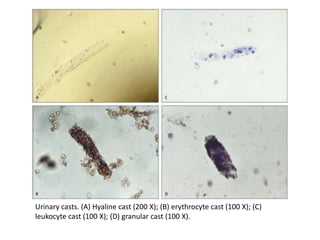
• Casts
- Represent a collection of protein and cellular debris in a
  kidney tubule
- Eg: hyaline : occasionally found in normal urine but their
  number is increased in renal diseases.
- Cellular cast: one or more type of cells are trapped during
  their formation. Eg; pus cell casts, red cell casts, epithelial
  casts, and mixed cellular casts.
- Granular casts : fine granules appear in glomerular and
  tubular renal disease.
Cyrstals
•   Uric asid
•   Amorphous urates
•   Amourphous phosphate
•   Calcium oxalate
•   Triple phosphate
•   Calcium carbonate
•   Tyrosine
•   Leucine
•   Cystine
•   Cholesterol
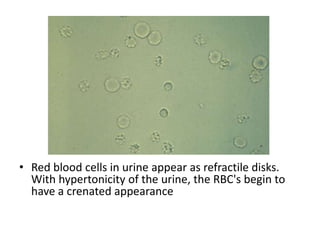
• Red blood cells in urine appear as refractile disks.
  With hypertonicity of the urine, the RBC's begin to
  have a crenated appearance
• These white blood cells in urine have lobed nuclei
  and refractile cytoplasmic granules.
• Large polygonal squamous epithelial cells with small
  nuclei are seen here.
• Oval fat bodies consist of degenerated tubular cells
  containing abundant lipid, which appears refractile.
broad (Figure 3).


Urinary casts. (A) Hyaline cast (200 X); (B) erythrocyte cast (100 X); (C)
leukocyte cast (100 X); (D) granular cast (100 X).
Urinary crystals. (A) Calcium oxalate crystals (arrows; 100 X); (B) uric acid
crystals (100 X); (C) triple phosphate crystals with amorphous phosphates
(400 X); (D) cystine crystals (100 X).
Type of Urine Sample & Collection
Sample            Sampling                Purpose

Morning sample    First urine in the      Pregnancy test,
                  morning                 microscopic test
Random sample     No specific time        Routine screening,
                                          chemical & FEME
Postprandial      2 hours after meal      Determine glucose in
                                          diabetic monitoring
Midstream/clean   Discard first few ml,   Culture
match             collect the rest
2 hours           Within 2 hours period   Determine urobilinogen

24 hours          Within 24 hours period Determine renal
                                         function
Urine analysis
Urine analysis

Urine analysis

  • 1.
  • 2.
    Urine dipstick • Screeningfor disease • Fresh urine is collected into clean dry container • Reagent strip immersed in the urine specimen, ensure all the reagent blocks are covered. • Errors in results
  • 4.
    • Three urinesamples are shown. The one at the left shows a red, cloudy appearance. The one in the center is red but clear. The one on the right is yellow, but cloudy.
  • 5.
    Parameters in urinedipstick test • Glucose • Bilirubin • Urobilinogen • Ketones • Specific gravity • pH • Protein • Blood • Nitrite • Leucocytes
  • 6.
    Physical examination ofurine • Volume a) physiological factor -increase intake of water -temperature -physical activity -others due to diuretic drugs, coffee and alcohol -normal adult urine volume : 600-1200ml/hour -difference in urine volume due to: polyuria, oliguria, anuria and nocturia
  • 7.
    • Colour - normal : pale yellowish- urochrom pigment - abnormal : due to food intake and drugs Red : beets, rhubarb (alkaline urine) Orange-yellowish : carrot, antibiotic Green, blue-green : drugs eg: amitrypline Dark brown : drugs eg: methyldopa, metronidazole - abnormal : due to pathological Red/maroon : rbc, hemoglobin, myoglobin ‘wine-red’ : porphyrin Dark brown : melanin, homogentisic acid Yellowish-brown or greenish-brown : bilirubin, bile pigment
  • 8.
    • Odour normal:aromatic odour - Food and drugs causes characteristic odour e.g: methyl salicylic, asparagus - Ketosis : fruity/sweet - Congenital metabolism disorder : e.g: phenylketonuria ‘mousy’
  • 9.
    • Appearance/ transparency Normal: -Slightturbidity: mucus (in women), squamous epithelial cell -Turbidity: calcium oxalate, uric acid, amorphous phosphate, amorphous urates Abnormal: -turbid-red : rbc -turbid : bacterial or yeast infection -milky: lipid
  • 10.
    Normal urine composition • Urea - End product of protein metabolism - 50% from urine composition - 25-30 g/24hr • Uric acid - End product of purine metabolism - 0.5-1 g/24hr • Creatinine - Skeletal muscle tissue
  • 11.
    • Creatine - Canbe found in muscle tissues in form of phosphocreatin • Sulphur - Protein intake • Indican - Triptophan katabolism in intestine • Ammonia - Final product of protein metabolism
  • 12.
    Chloride - Second largest composition found in urine - Excreted in form of NaCl : 10-15g/24hr urine • Phosphate - Protein intake - 1.1g/24hr urine
  • 13.
    Pathological urine composition • Glucose • Protein • Ketones • Pus cells • Red blood cells • Lipid • Amino acid • Bile pigment • Calculi
  • 14.
    Microscopic sediment ofurine • Cells -rbc, wbc, squamous epithelial cells, urethral epithelial cells • Casts - Represent a collection of protein and cellular debris in a kidney tubule - Eg: hyaline : occasionally found in normal urine but their number is increased in renal diseases. - Cellular cast: one or more type of cells are trapped during their formation. Eg; pus cell casts, red cell casts, epithelial casts, and mixed cellular casts. - Granular casts : fine granules appear in glomerular and tubular renal disease.
  • 15.
    Cyrstals • Uric asid • Amorphous urates • Amourphous phosphate • Calcium oxalate • Triple phosphate • Calcium carbonate • Tyrosine • Leucine • Cystine • Cholesterol
  • 16.
    • Red bloodcells in urine appear as refractile disks. With hypertonicity of the urine, the RBC's begin to have a crenated appearance
  • 17.
    • These whiteblood cells in urine have lobed nuclei and refractile cytoplasmic granules.
  • 18.
    • Large polygonalsquamous epithelial cells with small nuclei are seen here.
  • 19.
    • Oval fatbodies consist of degenerated tubular cells containing abundant lipid, which appears refractile.
  • 20.
    broad (Figure 3). Urinarycasts. (A) Hyaline cast (200 X); (B) erythrocyte cast (100 X); (C) leukocyte cast (100 X); (D) granular cast (100 X).
  • 21.
    Urinary crystals. (A)Calcium oxalate crystals (arrows; 100 X); (B) uric acid crystals (100 X); (C) triple phosphate crystals with amorphous phosphates (400 X); (D) cystine crystals (100 X).
  • 22.
    Type of UrineSample & Collection Sample Sampling Purpose Morning sample First urine in the Pregnancy test, morning microscopic test Random sample No specific time Routine screening, chemical & FEME Postprandial 2 hours after meal Determine glucose in diabetic monitoring Midstream/clean Discard first few ml, Culture match collect the rest 2 hours Within 2 hours period Determine urobilinogen 24 hours Within 24 hours period Determine renal function