


Blood Is specialized bodily fluid Transport through the body of oxygen and carbon dioxide Defense of the body against infection and other foreign materials
Parts of  blood Red Blood Cell -most common type of blood cell  -principal means of delivering oxygen to to the body tissues via the blood -develop in bone marrow -life span is 120 days -normal value 4.2-5.4 million
White Blood Cell -cells of  the immune system  -defending the body against both  infectious and foreign materials  -normal value 4500-10000
Platelet -small cytoplasmic bodies derived from  cell -circulate in the blood and involved in hemostasis leading to the formation of blood clots -normal value 150000-450000
Complete Blood Count One  of the most commonly ordered blood test  Is the calculation of the cellular or formed elements of blood These calculation are determined by special machines that analyze the different components of blood in less than a minute
How is CBC done? Procedure -The skin is wiped clean with an alcohol pad -Then a needle is inserted through the area of  cleansed skin into the patients vein -The blood is then pulled from the needle by a syringe or a connection to a s[ecialed vacuumed vial where it is collected -Then the sample is then taken to the laboratory for analysis
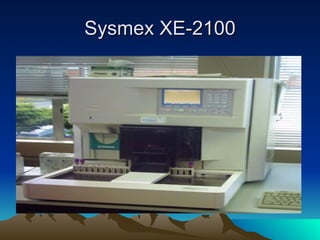
Automated Machine Sysmex XE-2100 -hematology automated analyser  -used to quickly perform full blood  counts and  reticulocyte count  -it can be run on its  own or connected to a blood film making staining unit
Sysmex XE-2100
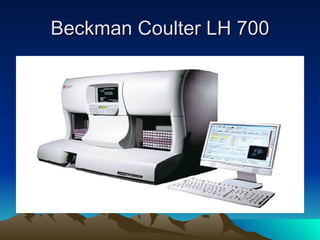
Beckman Coulter LH 700 -hematology automated analyser -use to quickly perform full blood counts  and reticulocyte count
Beckman Coulter LH 700
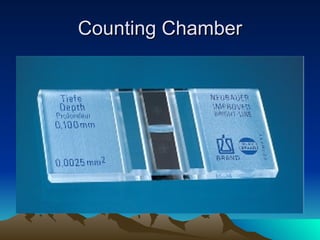
Manual Count Counting chamber -hold a specified volume of diluted blood  -used to calculate the number of red  blood cell and white blood cell
Counting Chamber
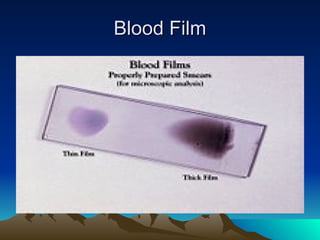
Blood Film -slide made up from a drop of blood -allows the cell to be examined micro- scopically -usually used to investigate hematolo- gical problem
Blood Film
White Blood Cell Count -Is used to determine the presence of an  infection or luekemia -also used to help monitor the body’s response to various treatments and to monitor bone marrow function
White Blood Cell Differential Count -assess the ability of the body to respond to eliminate infection -detects the severity of allergic and drug reaction plus the response to parasitic and other types of infection -essential in evaluating the reaction to viral infections and response to chemotherapy -it can also identify various stages of luekemia
Red Blood Cell Count -used to evaluate any type of decrease and increase in the number of red blood cell as measured per liter of blood.
Platelet Count -require the determination of the number of platelet present and their ability to function correctly.
Fecalysis -refers to a series of laboratory tests done on fecal sample to analyze the condition of a person’s digestive tract -this is performed to check for the presence of any reducing substances such as wbc,sugars,or bile and signs of poor absorption as well as screen for colon cancer
Sample Collection Process for Fecalysis -patient need a stool collection kit to obtain and preserve the sample properly -patient must urinate first to prevent any urine from mixing with his feces -patient must also wear clean gloves to prevent contamination
Normal Result in Fecalysis -the sample must not contain any parasites,virus or bacteria -sample must not containing not more than 2 mg per gram of sugar -patient stool is brown in color and well formed -PH level must be 6
Abnormal Result in Fecalysis -sample contains mucus,blood,parasite,virus,bacteria or pus -sample is containing more than 5 mg per gram of sugar -patient stool is colored green,yellow,white,red and black and in liquid form or extremely hard -PH level range in 5.3- or higher than 6.8
Fecal Occult Blood Test   -is the test used to identify blood in stool by placing a small sample of stool on a chemically treated card,pad or wipe.Then a specialized chemical solution is put on top of the sample. -if the card,pad turn blue there is blood in the stool sample.

Complete Blood Count

  • 1.
    Blood Is specializedbodily fluid Transport through the body of oxygen and carbon dioxide Defense of the body against infection and other foreign materials
  • 2.
    Parts of blood Red Blood Cell -most common type of blood cell -principal means of delivering oxygen to to the body tissues via the blood -develop in bone marrow -life span is 120 days -normal value 4.2-5.4 million
  • 3.
    White Blood Cell-cells of the immune system -defending the body against both infectious and foreign materials -normal value 4500-10000
  • 4.
    Platelet -small cytoplasmicbodies derived from cell -circulate in the blood and involved in hemostasis leading to the formation of blood clots -normal value 150000-450000
  • 5.
    Complete Blood CountOne of the most commonly ordered blood test Is the calculation of the cellular or formed elements of blood These calculation are determined by special machines that analyze the different components of blood in less than a minute
  • 6.
    How is CBCdone? Procedure -The skin is wiped clean with an alcohol pad -Then a needle is inserted through the area of cleansed skin into the patients vein -The blood is then pulled from the needle by a syringe or a connection to a s[ecialed vacuumed vial where it is collected -Then the sample is then taken to the laboratory for analysis
  • 7.
    Automated Machine SysmexXE-2100 -hematology automated analyser -used to quickly perform full blood counts and reticulocyte count -it can be run on its own or connected to a blood film making staining unit
  • 8.
  • 9.
    Beckman Coulter LH700 -hematology automated analyser -use to quickly perform full blood counts and reticulocyte count
  • 10.
  • 11.
    Manual Count Countingchamber -hold a specified volume of diluted blood -used to calculate the number of red blood cell and white blood cell
  • 12.
  • 13.
    Blood Film -slidemade up from a drop of blood -allows the cell to be examined micro- scopically -usually used to investigate hematolo- gical problem
  • 14.
  • 15.
    White Blood CellCount -Is used to determine the presence of an infection or luekemia -also used to help monitor the body’s response to various treatments and to monitor bone marrow function
  • 16.
    White Blood CellDifferential Count -assess the ability of the body to respond to eliminate infection -detects the severity of allergic and drug reaction plus the response to parasitic and other types of infection -essential in evaluating the reaction to viral infections and response to chemotherapy -it can also identify various stages of luekemia
  • 17.
    Red Blood CellCount -used to evaluate any type of decrease and increase in the number of red blood cell as measured per liter of blood.
  • 18.
    Platelet Count -requirethe determination of the number of platelet present and their ability to function correctly.
  • 19.
    Fecalysis -refers toa series of laboratory tests done on fecal sample to analyze the condition of a person’s digestive tract -this is performed to check for the presence of any reducing substances such as wbc,sugars,or bile and signs of poor absorption as well as screen for colon cancer
  • 20.
    Sample Collection Processfor Fecalysis -patient need a stool collection kit to obtain and preserve the sample properly -patient must urinate first to prevent any urine from mixing with his feces -patient must also wear clean gloves to prevent contamination
  • 21.
    Normal Result inFecalysis -the sample must not contain any parasites,virus or bacteria -sample must not containing not more than 2 mg per gram of sugar -patient stool is brown in color and well formed -PH level must be 6
  • 22.
    Abnormal Result inFecalysis -sample contains mucus,blood,parasite,virus,bacteria or pus -sample is containing more than 5 mg per gram of sugar -patient stool is colored green,yellow,white,red and black and in liquid form or extremely hard -PH level range in 5.3- or higher than 6.8
  • 23.
    Fecal Occult BloodTest -is the test used to identify blood in stool by placing a small sample of stool on a chemically treated card,pad or wipe.Then a specialized chemical solution is put on top of the sample. -if the card,pad turn blue there is blood in the stool sample.