Lab Activity 32
Urinalysis
Portland Community College
BI 233
2
Physical Characteristics of Urine
• Color and transparency
• Clear, pale to deep yellow (due to urochrome)
• Concentrated urine has a deeper yellow/amber color
• A red or red-brown (abnormal) color could be from a
food dye, eating fresh beets, a drug, or the presence
of either hemoglobin or myoglobin.
• If the sample contained many red blood cells, it
would be cloudy as well as red.
• Turbidity or cloudiness may be caused by excessive
cellular material or protein in the urine
3
Physical Characteristics of Urine
• Specific gravity measures density of
urine compared to water
• Ranges from 1.001 to 1.035
• 1.001 is dilute
• 1.035 is concentrated
• Is dependent on solute concentration
• > 1.035 is either contaminated or
contains very high levels of glucose
• Patients who have received
radiopaque dyes or dextran can also
have high specific gravity
4
Physical Characteristics of Urine
• Odor
• Fresh urine is slightly aromatic
• Standing urine develops an ammonia odor
• Some drugs and vegetables (asparagus) alter
the usual odor
• Elevated ketones smells fruity or acetone-like
5
Chemical Composition of Urine
• Urine is 95% water and 5% solutes
• Nitrogenous wastes include urea, uric acid,
and creatinine
• Other normal solutes include:
• Sodium, potassium, phosphate, and sulfate ions
• Calcium, magnesium, and bicarbonate ions
• Abnormally high concentrations of any
urinary constituents may indicate pathology
6
Urinalysis
• “Dipstick" method:
chemical reactions
cause color changes on
ten different pads on
the test strip.
1. Leukocytes
2. Nitrite
3. Urobilinogen
4. Protein
5. pH
6. Blood
6. Blood
7. Ketones
8. Bilirubin
9. Glucose
7
Dipstick Urinalysis Interpretation
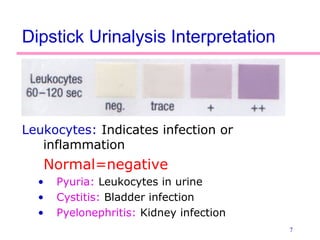
Leukocytes: Indicates infection or
inflammation
Normal=negative
• Pyuria: Leukocytes in urine
• Cystitis: Bladder infection
• Pyelonephritis: Kidney infection
8
Dipstick Urinalysis Interpretation
Nitrite: Might indicate bacterial infection
with gram-negative rods (like E. coli)
Normal=negative
9
Dipstick Urinalysis Interpretation
pH: large range 4.5 to 8.0
• The urine pH should be recorded, although it is seldom
of diagnostic value.
• Diet can alter pH
• Acidic: high protein diet, ketoacidosis
• Alkaline: vegetarian diet, UTI
• Phosphates will precipitate in an alkaline urine, and uric acid
will precipitate in an acidic urine.
10
Dipstick Urinalysis Interpretation
Protein: Usually proteins are too large to pass through
glomerulus (Proteinuria usually represents an
abnormality in the glomerular filtration barrier.)
Normal=negative
• Trace amounts normal in pregnancy or after eating
a lot of protein
• Albuminuria: Albumin in urine
11
Dipstick Urinalysis Interpretation
Glucose: In general the presence of glucose
indicates that the filtered load of glucose
exceeds the maximal tubular reabsorptive
capacity for glucose.
Normal=negative
• Glycosuria: Glucose in urine
12
Dipstick Urinalysis Interpretation
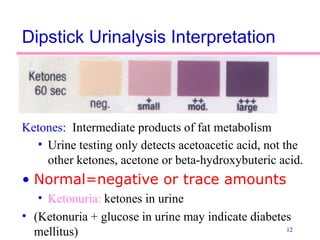
Ketones: Intermediate products of fat metabolism
• Urine testing only detects acetoacetic acid, not the
other ketones, acetone or beta-hydroxybuteric acid.
• Normal=negative or trace amounts
• Ketonuria: ketones in urine
• (Ketonuria + glucose in urine may indicate diabetes
mellitus)
13
Dipstick Urinalysis Interpretation
Urobilinogen: Produced in the intestine from bilirubin.
Normal=small amount
• Absence: renal disease or biliary obstruction
• Increased in any condition that causes an increase in
production or retention of bilirubin
• Hepatitis, cirrhosis or biliary disease
14
Dipstick Urinalysis Interpretation
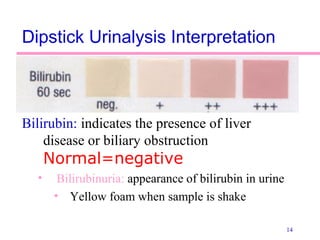
Bilirubin: indicates the presence of liver
disease or biliary obstruction
Normal=negative
• Bilirubinuria: appearance of bilirubin in urine
• Yellow foam when sample is shake
15
Dipstick Urinalysis Interpretation
Blood: Almost always
indicates pathology
because RBC are
too large to pass
through glomerulus
Normal=negative
• Hematuria: Blood in urine
• Possible causes: Kidney stone, infection,
tumor
• Caution: Very common finding in women
because of menstruation.
16
Chemical Analysis
• Sulfates: Normal constituent of urine
• The urinary sulfate is mainly derived from sulfur-
containing amino acids and is therefore determined by
protein intake.
• Phosphates: Normal constituent of urine
• Important for buffering H+
in the collecting duct
• Chlorides: Normal constituent of urine.
• Major extracellular anion.
• Its main purpose is to maintain electrical neutrality,
mostly as a counter-ion to sodium.
• It often accompanies sodium losses and excesses.
17
Chemical Analysis
• Urea: The end product of protein breakdown
• Uric acid: A metabolite of purine breakdown
• Creatinine: Associated with muscle
metabolism of creatine phosphate.
18
Microscopic Examination
Pyuria: WBC in Urine
• Normal:
• Men: <2 WBCs per hi
power field
• Women: <5
• WBC generally indicate
the presence of an
inflammatory process
somewhere along the
course of the urinary
tract
19
Microscopic Examination
Hematuria: RBC in Urine
• RBC's may appear normally
shaped, swollen by dilute
urine or crenated by
concentrated urine.
• The presence of
dysmorphic (odd shaped)
RBC's in urine suggests a
glomerular disease such as a
glomerulonephritis.
Dysmorphic RBC
Crenated RBC
20
Microscopic Examination
Epithelial Cells
• Too many
squamous
cells: suggest
contamination,
poor specimen
collection
21
Microscopic Examination
Epithelial Cells
• Transitional epithelial
cells originate from the
renal pelvis, ureters,
bladder and/or urethra.
• Large sheets of
transitional epithelial
cells can be seen in
bladder cancer.
Squamous epithelial cell
Transitional epithelial cell
22
Microscopic Examination
Bacteria
• Bacteria are common in urine specimens (from
contamination)
• Therefore, microbial organisms found in all but
the most scrupulously collected urines should be
interpreted in view of clinical symptoms.
A = crenated RBC, B = RBC, C =
23
Struvite Crystals
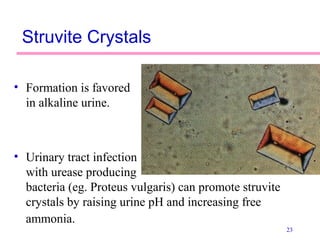
• Formation is favored
in alkaline urine.
• Urinary tract infection
with urease producing
bacteria (eg. Proteus vulgaris) can promote struvite
crystals by raising urine pH and increasing free
ammonia.
24
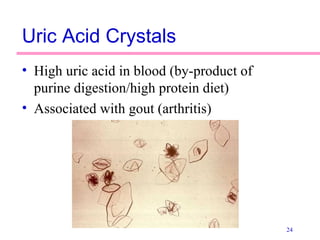
Uric Acid Crystals
• High uric acid in blood (by-product of
purine digestion/high protein diet)
• Associated with gout (arthritis)
25
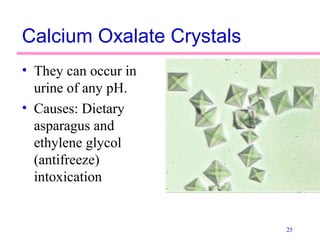
Calcium Oxalate Crystals
• They can occur in
urine of any pH.
• Causes: Dietary
asparagus and
ethylene glycol
(antifreeze)
intoxication
26
Microscopic Examination
Casts
• Casts: hardened cell fragments formed in
the distal convoluted tubules and collecting
ducts
• Usually pathological
• Can only be seen with microscopic
examination
27
Hyaline Casts
• Hyaline casts are
composed primarily
of a mucoprotein
(Tamm-Horsfall
protein) secreted
by tubule cells.
• Causes: Low flow rate, high salt concentration, and
low pH, all of which favor protein denaturation and
precipitation of the Tamm-Horsfall protein.
Hyaline Casts appear Transparent
28
Red Cell Casts
• Red blood cells may stick together and form red
blood cell casts.
• Indicative of glomerulonephritis, with leakage of
RBC's from glomeruli, or severe tubular damage.
29
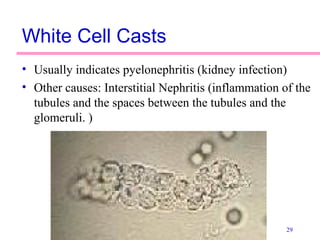
White Cell Casts
• Usually indicates pyelonephritis (kidney infection)
• Other causes: Interstitial Nephritis (inflammation of the
tubules and the spaces between the tubules and the
glomeruli. )
30
The End

Urinalysis

  • 1.
    Lab Activity 32 Urinalysis PortlandCommunity College BI 233
  • 2.
    2 Physical Characteristics ofUrine • Color and transparency • Clear, pale to deep yellow (due to urochrome) • Concentrated urine has a deeper yellow/amber color • A red or red-brown (abnormal) color could be from a food dye, eating fresh beets, a drug, or the presence of either hemoglobin or myoglobin. • If the sample contained many red blood cells, it would be cloudy as well as red. • Turbidity or cloudiness may be caused by excessive cellular material or protein in the urine
  • 3.
    3 Physical Characteristics ofUrine • Specific gravity measures density of urine compared to water • Ranges from 1.001 to 1.035 • 1.001 is dilute • 1.035 is concentrated • Is dependent on solute concentration • > 1.035 is either contaminated or contains very high levels of glucose • Patients who have received radiopaque dyes or dextran can also have high specific gravity
  • 4.
    4 Physical Characteristics ofUrine • Odor • Fresh urine is slightly aromatic • Standing urine develops an ammonia odor • Some drugs and vegetables (asparagus) alter the usual odor • Elevated ketones smells fruity or acetone-like
  • 5.
    5 Chemical Composition ofUrine • Urine is 95% water and 5% solutes • Nitrogenous wastes include urea, uric acid, and creatinine • Other normal solutes include: • Sodium, potassium, phosphate, and sulfate ions • Calcium, magnesium, and bicarbonate ions • Abnormally high concentrations of any urinary constituents may indicate pathology
  • 6.
    6 Urinalysis • “Dipstick" method: chemicalreactions cause color changes on ten different pads on the test strip. 1. Leukocytes 2. Nitrite 3. Urobilinogen 4. Protein 5. pH 6. Blood 6. Blood 7. Ketones 8. Bilirubin 9. Glucose
  • 7.
    7 Dipstick Urinalysis Interpretation Leukocytes:Indicates infection or inflammation Normal=negative • Pyuria: Leukocytes in urine • Cystitis: Bladder infection • Pyelonephritis: Kidney infection
  • 8.
    8 Dipstick Urinalysis Interpretation Nitrite:Might indicate bacterial infection with gram-negative rods (like E. coli) Normal=negative
  • 9.
    9 Dipstick Urinalysis Interpretation pH:large range 4.5 to 8.0 • The urine pH should be recorded, although it is seldom of diagnostic value. • Diet can alter pH • Acidic: high protein diet, ketoacidosis • Alkaline: vegetarian diet, UTI • Phosphates will precipitate in an alkaline urine, and uric acid will precipitate in an acidic urine.
  • 10.
    10 Dipstick Urinalysis Interpretation Protein:Usually proteins are too large to pass through glomerulus (Proteinuria usually represents an abnormality in the glomerular filtration barrier.) Normal=negative • Trace amounts normal in pregnancy or after eating a lot of protein • Albuminuria: Albumin in urine
  • 11.
    11 Dipstick Urinalysis Interpretation Glucose:In general the presence of glucose indicates that the filtered load of glucose exceeds the maximal tubular reabsorptive capacity for glucose. Normal=negative • Glycosuria: Glucose in urine
  • 12.
    12 Dipstick Urinalysis Interpretation Ketones:Intermediate products of fat metabolism • Urine testing only detects acetoacetic acid, not the other ketones, acetone or beta-hydroxybuteric acid. • Normal=negative or trace amounts • Ketonuria: ketones in urine • (Ketonuria + glucose in urine may indicate diabetes mellitus)
  • 13.
    13 Dipstick Urinalysis Interpretation Urobilinogen:Produced in the intestine from bilirubin. Normal=small amount • Absence: renal disease or biliary obstruction • Increased in any condition that causes an increase in production or retention of bilirubin • Hepatitis, cirrhosis or biliary disease
  • 14.
    14 Dipstick Urinalysis Interpretation Bilirubin:indicates the presence of liver disease or biliary obstruction Normal=negative • Bilirubinuria: appearance of bilirubin in urine • Yellow foam when sample is shake
  • 15.
    15 Dipstick Urinalysis Interpretation Blood:Almost always indicates pathology because RBC are too large to pass through glomerulus Normal=negative • Hematuria: Blood in urine • Possible causes: Kidney stone, infection, tumor • Caution: Very common finding in women because of menstruation.
  • 16.
    16 Chemical Analysis • Sulfates:Normal constituent of urine • The urinary sulfate is mainly derived from sulfur- containing amino acids and is therefore determined by protein intake. • Phosphates: Normal constituent of urine • Important for buffering H+ in the collecting duct • Chlorides: Normal constituent of urine. • Major extracellular anion. • Its main purpose is to maintain electrical neutrality, mostly as a counter-ion to sodium. • It often accompanies sodium losses and excesses.
  • 17.
    17 Chemical Analysis • Urea:The end product of protein breakdown • Uric acid: A metabolite of purine breakdown • Creatinine: Associated with muscle metabolism of creatine phosphate.
  • 18.
    18 Microscopic Examination Pyuria: WBCin Urine • Normal: • Men: <2 WBCs per hi power field • Women: <5 • WBC generally indicate the presence of an inflammatory process somewhere along the course of the urinary tract
  • 19.
    19 Microscopic Examination Hematuria: RBCin Urine • RBC's may appear normally shaped, swollen by dilute urine or crenated by concentrated urine. • The presence of dysmorphic (odd shaped) RBC's in urine suggests a glomerular disease such as a glomerulonephritis. Dysmorphic RBC Crenated RBC
  • 20.
    20 Microscopic Examination Epithelial Cells •Too many squamous cells: suggest contamination, poor specimen collection
  • 21.
    21 Microscopic Examination Epithelial Cells •Transitional epithelial cells originate from the renal pelvis, ureters, bladder and/or urethra. • Large sheets of transitional epithelial cells can be seen in bladder cancer. Squamous epithelial cell Transitional epithelial cell
  • 22.
    22 Microscopic Examination Bacteria • Bacteriaare common in urine specimens (from contamination) • Therefore, microbial organisms found in all but the most scrupulously collected urines should be interpreted in view of clinical symptoms. A = crenated RBC, B = RBC, C =
  • 23.
    23 Struvite Crystals • Formationis favored in alkaline urine. • Urinary tract infection with urease producing bacteria (eg. Proteus vulgaris) can promote struvite crystals by raising urine pH and increasing free ammonia.
  • 24.
    24 Uric Acid Crystals •High uric acid in blood (by-product of purine digestion/high protein diet) • Associated with gout (arthritis)
  • 25.
    25 Calcium Oxalate Crystals •They can occur in urine of any pH. • Causes: Dietary asparagus and ethylene glycol (antifreeze) intoxication
  • 26.
    26 Microscopic Examination Casts • Casts:hardened cell fragments formed in the distal convoluted tubules and collecting ducts • Usually pathological • Can only be seen with microscopic examination
  • 27.
    27 Hyaline Casts • Hyalinecasts are composed primarily of a mucoprotein (Tamm-Horsfall protein) secreted by tubule cells. • Causes: Low flow rate, high salt concentration, and low pH, all of which favor protein denaturation and precipitation of the Tamm-Horsfall protein. Hyaline Casts appear Transparent
  • 28.
    28 Red Cell Casts •Red blood cells may stick together and form red blood cell casts. • Indicative of glomerulonephritis, with leakage of RBC's from glomeruli, or severe tubular damage.
  • 29.
    29 White Cell Casts •Usually indicates pyelonephritis (kidney infection) • Other causes: Interstitial Nephritis (inflammation of the tubules and the spaces between the tubules and the glomeruli. )
  • 30.