URIN EXAMINATION
PURPOSE
-To find out metabolic / Endocrine
disturbance
Eg: Metabolic disturbance-Bilirubin in
urin
DM-Endocrine abnormality
-To detect intrinsic conditions –Urinary
tract/ Kidney
Eg: Diseased kidney-Cannot function
normally
- Volume
-Composition of body fluids
- Maintaining acid base balance
Structural elements:-
Leukocytes
RBC
Epithelial cells
Cast cells in urin.
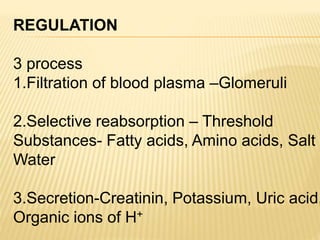
REGULATION
3 process
1.Filtration of blood plasma –Glomeruli
2.Selective reabsorption – Threshold
Substances- Fatty acids, Amino acids, Salt ,
Water
3.Secretion-Creatinin, Potassium, Uric acid,
Organic ions of H+
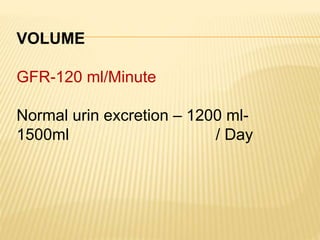
VOLUME
GFR-120 ml/Minute
Normal urin excretion – 1200 ml-
1500ml / Day
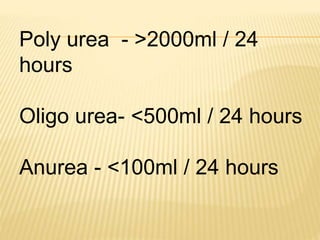
Poly urea - >2000ml / 24
hours
Oligo urea- <500ml / 24 hours
Anurea - <100ml / 24 hours
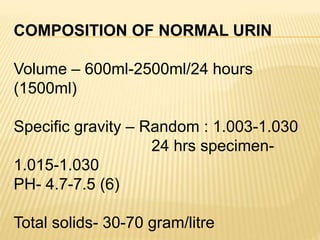
COMPOSITION OF NORMAL URIN
Volume – 600ml-2500ml/24 hours
(1500ml)
Specific gravity – Random : 1.003-1.030
24 hrs specimen-
1.015-1.030
PH- 4.7-7.5 (6)
Total solids- 30-70 gram/litre
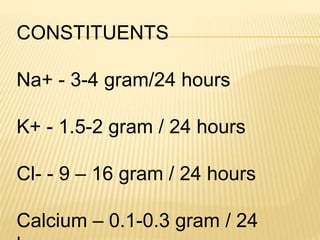
CONSTITUENTS
Na+ - 3-4 gram/24 hours
K+ - 1.5-2 gram / 24 hours
Cl- - 9 – 16 gram / 24 hours
Calcium – 0.1-0.3 gram / 24
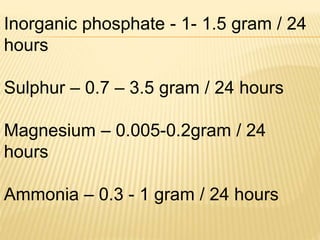
Inorganic phosphate - 1- 1.5 gram / 24
hours
Sulphur – 0.7 – 3.5 gram / 24 hours
Magnesium – 0.005-0.2gram / 24
hours
Ammonia – 0.3 - 1 gram / 24 hours
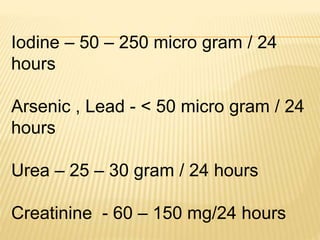
Iodine – 50 – 250 micro gram / 24
hours
Arsenic , Lead - < 50 micro gram / 24
hours
Urea – 25 – 30 gram / 24 hours
Creatinine - 60 – 150 mg/24 hours
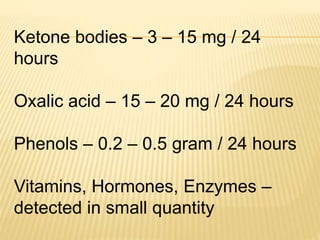
Ketone bodies – 3 – 15 mg / 24
hours
Oxalic acid – 15 – 20 mg / 24 hours
Phenols – 0.2 – 0.5 gram / 24 hours
Vitamins, Hormones, Enzymes –
detected in small quantity
LABOURATORY TESTS
1.Physical examination
2.Chemical examination
3.Microscopic examination
Collection of urin specimen
Type of specimen –
1.First voided mid stream morning urin
More concentrated urin
2.For urgent urin examination
Random urin specimen
Container used for urin
collection :
 Clean & Dry wide mouth
glass / Plastic bottles with
screw cap tops
( Capacity about – 250-
300ml)
 Instruction given to the
patient:
Void directly in to the container
During the collection initial
portion of urin stream is allows
to escape while the mid stream
portion is collected
Specimen from infants & young
children can be collected in a
disposable collection apparatus.
 Qualitative test – First voided
mid stream morning urine
 Quantitative tese – 24 hours
collection
Preservation
Routine urin analysis – should be
examined while fresh (with in 1 hour of
collection)
When urin is kept for longer than 1
hour before analysis- Should be
stored at 2-8 degree centigrade in
refrigerater.
To avoid deterioation of chemical &
cellular material
Prevent multiplication of bacteria.
Recommended preservatives
1.Toluene-2ml/100ml of urin (Effective
if bacteria are already)
2.Formalin-3drops /100ml of urin
(Good for sedimentation, may
precipitate proteins)
3.Thymol-1 small crystal / 100ml of
urin (May interfere with the acid
precipitation test for proteins)
4.Chloroform- 5ml/100ml of urin (
form upper layer)
5.Commercial preservative tablets
these release formaldehyde – 1
tab/30ml of urine (Concentration of
formaldehyde is controlled)
PHYSICAL EXAMINATION
1.Volume
2.Colour
3.Appearence
4.Sediment formation
5.Odour – Ketone bodies : Sweet/
fruity odour
Bacterial
contaminations-Pungent odour
6.Reaction of PH – Phenyl ketone
urin – musty odour
CHEMICAL EXAMINATION
1.Glucose – Benedict’s qualitative test
2.Protein – Heat coagulation test
3.Ketone bodies – Rothera’s test
4.Bile pigments – Fouchet’s test
5.Bile salt – Hay’s test
6.Urobilinogen – Ehrlich’s test
7.Occult blood – Benzididene test
MICROSCOPIC EXAMINATION
1.Leucocytes
2.RBC
3.Casts
4.Mucus threats
5.Yeast cells
6.Bacteria
7.Fat bodies and droplets
9.Crystals
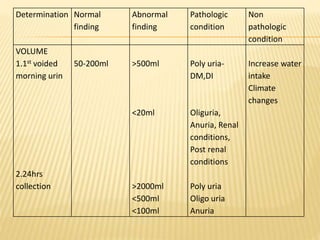
PHYSICAL EXAMINATION
Determination Normal
finding
Abnormal
finding
Pathologic
condition
Non
pathologic
condition
VOLUME
1.1st voided
morning urin
2.24hrs
collection
50-200ml >500ml
<20ml
>2000ml
<500ml
<100ml
Poly uria-
DM,DI
Oliguria,
Anuria, Renal
conditions,
Post renal
conditions
Poly uria
Oligo uria
Anuria
Increase water
intake
Climate
changes
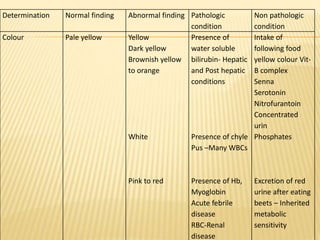
Determination Normal finding Abnormal finding Pathologic
condition
Non pathologic
condition
Colour Pale yellow Yellow
Dark yellow
Brownish yellow
to orange
White
Pink to red
Presence of
water soluble
bilirubin- Hepatic
and Post hepatic
conditions
Presence of chyle
Pus –Many WBCs
Presence of Hb,
Myoglobin
Acute febrile
disease
RBC-Renal
disease
Intake of
following food
yellow colour Vit-
B complex
Senna
Serotonin
Nitrofurantoin
Concentrated
urin
Phosphates
Excretion of red
urine after eating
beets – Inherited
metabolic
sensitivity
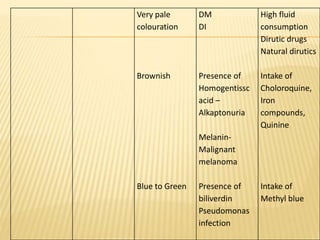
Very pale
colouration
Brownish
Blue to Green
DM
DI
Presence of
Homogentissc
acid –
Alkaptonuria
Melanin-
Malignant
melanoma
Presence of
biliverdin
Pseudomonas
infection
High fluid
consumption
Dirutic drugs
Natural dirutics
Intake of
Choloroquine,
Iron
compounds,
Quinine
Intake of
Methyl blue
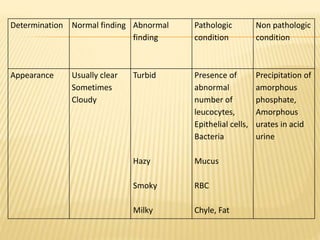
Determination Normal finding Abnormal
finding
Pathologic
condition
Non pathologic
condition
Appearance Usually clear
Sometimes
Cloudy
Turbid
Hazy
Smoky
Milky
Presence of
abnormal
number of
leucocytes,
Epithelial cells,
Bacteria
Mucus
RBC
Chyle, Fat
Precipitation of
amorphous
phosphate,
Amorphous
urates in acid
urine
Determination Normal finding Abnormal
finding
Pathologic
condition
Non pathologic
condition
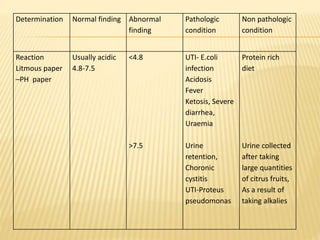
Reaction
Litmous paper
–PH paper
Usually acidic
4.8-7.5
<4.8
>7.5
UTI- E.coli
infection
Acidosis
Fever
Ketosis, Severe
diarrhea,
Uraemia
Urine
retention,
Choronic
cystitis
UTI-Proteus
pseudomonas
Protein rich
diet
Urine collected
after taking
large quantities
of citrus fruits,
As a result of
taking alkalies
Determinati
on
Normal
finding
Abnormal
finding
Pathologic
condition
Non
pathologic
condition
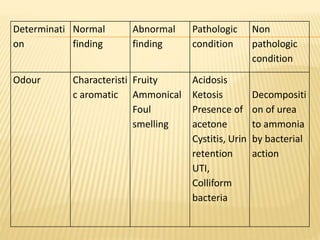
Odour Characteristi
c aromatic
Fruity
Ammonical
Foul
smelling
Acidosis
Ketosis
Presence of
acetone
Cystitis, Urin
retention
UTI,
Colliform
bacteria
Decompositi
on of urea
to ammonia
by bacterial
action
Determination Normal finding Abnormal
finding
Pathologic
condition
Non pathologic
condition
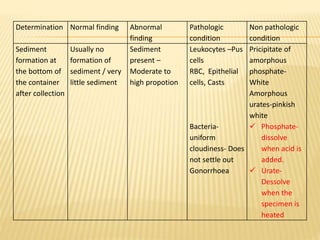
Sediment
formation at
the bottom of
the container
after collection
Usually no
formation of
sediment / very
little sediment
Sediment
present –
Moderate to
high propotion
Leukocytes –Pus
cells
RBC, Epithelial
cells, Casts
Bacteria-
uniform
cloudiness- Does
not settle out
Gonorrhoea
Pricipitate of
amorphous
phosphate-
White
Amorphous
urates-pinkish
white
 Phosphate-
dissolve
when acid is
added.
 Urate-
Dessolve
when the
specimen is
heated
Determination Normal
finding
Abnormal
finding
Pathologic
condition
Non
pathologic
condition
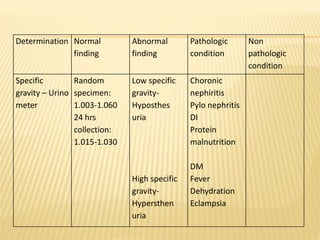
Specific
gravity – Urino
meter
Random
specimen:
1.003-1.060
24 hrs
collection:
1.015-1.030
Low specific
gravity-
Hyposthes
uria
High specific
gravity-
Hypersthen
uria
Choronic
nephiritis
Pylo nephritis
DI
Protein
malnutrition
DM
Fever
Dehydration
Eclampsia
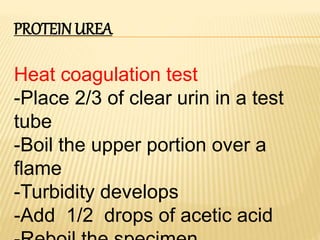
PROTEIN UREA
Heat coagulation test
-Place 2/3 of clear urin in a test
tube
-Boil the upper portion over a
flame
-Turbidity develops
-Add 1/2 drops of acetic acid
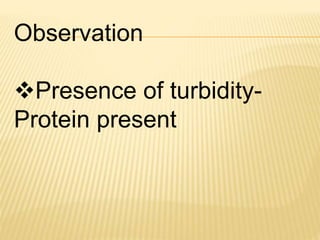
Observation
Presence of turbidity-
Protein present
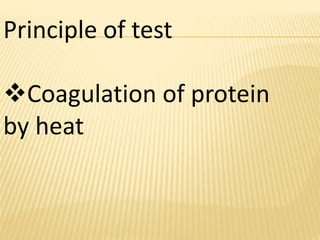
Principle of test
Coagulation of protein
by heat
GLYCOSUREA
Benedict’s qualitative test
Reagent- Benedict’s qualitative
reagent-Blue colour
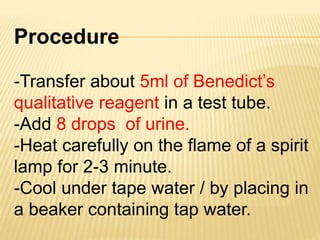
Procedure
-Transfer about 5ml of Benedict’s
qualitative reagent in a test tube.
-Add 8 drops of urine.
-Heat carefully on the flame of a spirit
lamp for 2-3 minute.
-Cool under tape water / by placing in
a beaker containing tap water.
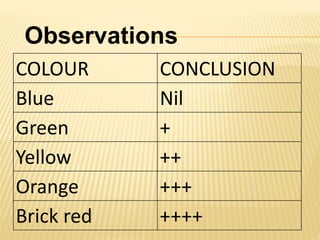
COLOUR CONCLUSION
Blue Nil
Green +
Yellow ++
Orange +++
Brick red ++++
Observations
BILE SALTS
Hay’s test
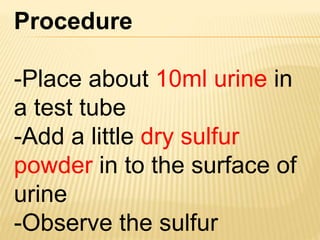
Procedure
-Place about 10ml urine in
a test tube
-Add a little dry sulfur
powder in to the surface of
urine
-Observe the sulfur
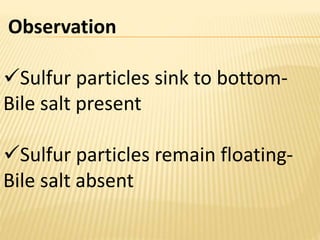
Observation
Sulfur particles sink to bottom-
Bile salt present
Sulfur particles remain floating-
Bile salt absent
Causes
1.Hepatic jaundice
2.Post hepatic jaundice
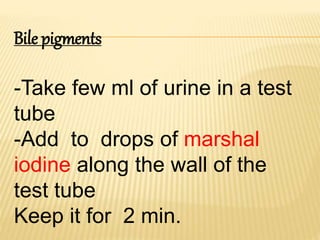
Bile pigments
-Take few ml of urine in a test
tube
-Add to drops of marshal
iodine along the wall of the
test tube
Keep it for 2 min.
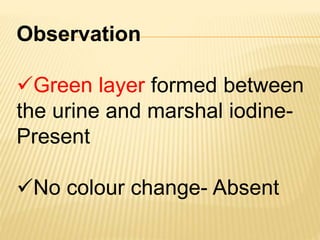
Observation
Green layer formed between
the urine and marshal iodine-
Present
No colour change- Absent
Causes
1.Hepatic jaundice
2.Post hepatic jaundice
Urobilinogen
Ehrlich test.
MICROSCOPIC EXAMINATION
Urin examination.2.docx

Urin examination.2.docx