- DR.AKIF A.B
TIP: Remember muscle locations, it can be asked as a question for identification
Q. Lift off test is done for??
Ans. SUBSCAPULARIS MUSCLE
B
Q.Rotator Interval ??
Ans. Rotator interval is interval between subscapularis and
suprascapularis. Coracohumeral ligament passes through this interval
1) Most common type of shoulder dislocation = Anterior type (subcoracoid> preglenoid)
2) Mechanism of injury for anterior dislocation = abduction and external rotation
3) Position of arm in anterior dislocation = abduction and external rotation
4) Position of arm in posterior dislocation = adduction and internal rotation
5) Most common joint to dislocate = shoulder
6) Least common joint to dislocate = Ankle
7) Tests for anterior shoulder dislocation = Bryant’s test
Callaway’s Test
Dugas test
Hamilton ruler test
Ans.
‘A’ is anterior dislocation and ‘B’ is Posterior dislocation
Explanation:
In anterior dislocation of shoulder, position of shoulder is abducted
and externally rotated and you can see that in xray i.e humerus will be
at an angle to scapula i.e abducted position.
In posterior dislocation, position of shoulder is adducted and
internally rotated, so u can see clearly in xray that humerus is straight
(adducted) and not making any angle.
Anterior dislocation
Line is straight…..so
Posterior dislocation
A Bankart lesion is an injury of the anterior (inferior) glenoid labrum of the
shoulder due to anterior shoulder dislocation. When this happens, a pocket at
the front of the glenoid forms that allows the humeral head to dislocate into it.
Hill–Sachs fracture, is a cortical depression in the posterolateral head of
the humerus. It results from forceful impaction of the humeral head against
the anteroinferior glenoid rim when the shoulder is dislocated anteriorly.
Q. What is Reverse Hill sach’s Lesion??
Ans. It is defect in Antero medial part aspect
of humerus head in posterior dislocation of shoulder
Mnemonic: R – Reverse hill sachs
A – Anterior part of humeral head
M – Medial part of humeral head
P – Posterior dislocation
Q. Muscle crossing shoulder joint = Long head of Biceps
Q. Weakest portion of shoulder joint capsule = Inferior
Shoulder is weakest inferiorly but dislocations are more common
anteriorly since it is the direction of force which decides dislocation but
Never the anatomical weakness
Q. Most common early complication of = Nerve Injury
shoulder dislocation
Q. Most common Nerve Injury in = Axillary N.
shoulder dislocation
Treatment of choice : Reduction techniques : Kocher’s method :best
Stimson’s gravity method
Hippocratic method :old
Neglected shoulder dislocation is always managed Surgically
-Also known as Inferior dislocation of Shoulder.
- caused by severe hyperabduction of force.
- MC Nerve injury associated is : Axillary N.
Anterior Instability : F- Fulcrum test
o
C – Crank test
u
S- surprise test (Most Accurate)
Posterior Instability : Jerk Test
Posterior apprehension test
Posterior clunk test
Push-pull test
Inferior Instability : Sulcus test
S.No. Injury Nerve Involved
1. Shoulder dislocation Axillary
2. Fracture surgical neck humerus Axillary
3. Fracture shaft of humerus Radial
4. Supracondylar fracture AIN>Median>Radial
>Ulnar (AMRU)
5. Medial condyle humerus # Ulnar N.
6. Monteggia # Post. Interosseus N.
7. Volkman ischemic contracture Ant. Interosseus N.
8. Lunate dialocation Median N.
9. Hip dislocation Sciatic N.
10. Knee dislocation Common peroneal
N.
11. Post. Dislocation of shoulder Ulnar N.
-Most common bone to fracture in body.
- MC site of fracture = junction of medial 2/3rd and lateral 1/3rd
- Most common bone fractured during birth
- Treatment: Figure of 8 bandage
Q. Highest bony landmark in shoulder x-ray ??
a) clavicle
b) acromion
c) coracoid
d) head of humerus
Ans. Acromion
Ans.
-A spiral fracture of lower 3rd of humerus is k/a Holstein Lewis fracture
- MC nerve injury is : Radial N.
- Treatment : Hanging cast
Ossification centres :
Capitullum = 2years
Internal(medial) epicondyle = 6years
Radius Head = 4years
Trochlea = 8years
External(Lateral) epicondyle = 12years
Olecranon = 10years
MC elbow injury in children
(MC elbow injury in adults is : Physeal Injury)
MC type : Extension type(98%)
MC type of distal fragment displacement in Extension type: Postero-medial
with internal rotation
Medial(Internal) Rotation/ Medial Tilt/Medial shift
Impaction (proximal shift)
Dorsal displacement/ dorsal tilt
Characteristic displacements
-GARTLAND Classification is used for it
- Treatment : Close Reduction and K wire fixation
- MC complication : Malunion = Cubitus varus or gunstock deformity
- MC Nerve Injury : Anterior Interosseus Nerve ( A>M>R>U )
- 3 point bony relationship is maintained i.e tips of medial and
lateral epicondyle and olecranon
-MC Cause of Volkmann Ischemic
Contracture
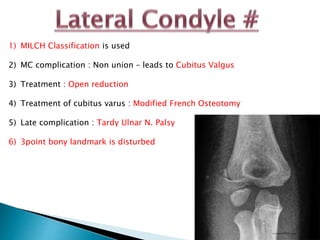
1) MILCH Classification is used
2) MC complication : Non union – leads to Cubitus Valgus
3) Treatment : Open reduction
4) Treatment of cubitus varus : Modified French Osteotomy
5) Late complication : Tardy Ulnar N. Palsy
6) 3point bony landmark is disturbed
Mnemonic: Lets Go For OPeration At Medical college
Lateral
condyle #
Galeazi #
Femur neck#
Olecranon #
Patella#
Articular#
( Involving joint)
Monteggia #
- Calf pressure during walking is = 200-300mmHg
-In compartment Sx, pain on passive stretch ( distal most joint of extremity)
is the first sign
-Peripheral pulses can be normal in compartment syndrome
- MC muscle involved in volkmann ischemic contracture :
Flexor digitorum profundus> flexor pollicis longus
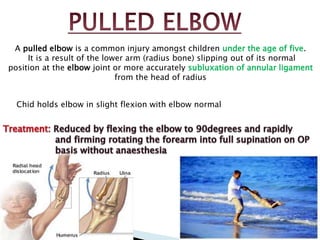
A pulled elbow is a common injury amongst children under the age of five.
It is a result of the lower arm (radius bone) slipping out of its normal
position at the elbow joint or more accurately subluxation of annular ligament
from the head of radius
Chid holds elbow in slight flexion with elbow normal
Q. Treatment for Olecranon # ??
A. Tension Band wiring
-Monteggia fracture is a fracture of the proximal third of the ulna with
dislocation of the proximal radio-ulnar joint
- Bado’s classification
The Galeazzi fracture is a fracture of the radius with dislocation of the
distal radioulnar joint.
AColles' fracture is a fracture of the distal radius in the forearm with dorsal
(posterior) and radial displacement of the wrist and hand.
Displacement : S: Supination
L : lateral displacement
I : Impaction(proximal shift)
P: Posterior displacement
Cast : below elbow
Position: Reverse to displacement
pronation
ulnar deviation
Palmar angulation
Common in elderly menopausal females
Complications : 1) Joint Stiffness : Most common
2) malunion : 2nd most common
3) sudeck’s osteodystrophy
4) carpal tunnel Sx
Reverse of colles
Cast : Above elbow
-Pain in anatomical snuff box
- MC complication : Non union
- Cast : Glass holding cast
Mnemonic: Some Lovers Try Positions That They Can’t Handle
Proximal row
lateral to medial
Distal row
lateral to medial
upper limb Fractures and dislocations

upper limb Fractures and dislocations

  • 1.
  • 3.
    TIP: Remember musclelocations, it can be asked as a question for identification
  • 4.
    Q. Lift offtest is done for??
  • 5.
  • 6.
  • 7.
  • 8.
    Ans. Rotator intervalis interval between subscapularis and suprascapularis. Coracohumeral ligament passes through this interval
  • 10.
    1) Most commontype of shoulder dislocation = Anterior type (subcoracoid> preglenoid) 2) Mechanism of injury for anterior dislocation = abduction and external rotation 3) Position of arm in anterior dislocation = abduction and external rotation 4) Position of arm in posterior dislocation = adduction and internal rotation 5) Most common joint to dislocate = shoulder 6) Least common joint to dislocate = Ankle 7) Tests for anterior shoulder dislocation = Bryant’s test Callaway’s Test Dugas test Hamilton ruler test
  • 15.
    Ans. ‘A’ is anteriordislocation and ‘B’ is Posterior dislocation Explanation: In anterior dislocation of shoulder, position of shoulder is abducted and externally rotated and you can see that in xray i.e humerus will be at an angle to scapula i.e abducted position. In posterior dislocation, position of shoulder is adducted and internally rotated, so u can see clearly in xray that humerus is straight (adducted) and not making any angle.
  • 16.
  • 17.
  • 18.
    A Bankart lesionis an injury of the anterior (inferior) glenoid labrum of the shoulder due to anterior shoulder dislocation. When this happens, a pocket at the front of the glenoid forms that allows the humeral head to dislocate into it.
  • 19.
    Hill–Sachs fracture, isa cortical depression in the posterolateral head of the humerus. It results from forceful impaction of the humeral head against the anteroinferior glenoid rim when the shoulder is dislocated anteriorly.
  • 20.
    Q. What isReverse Hill sach’s Lesion??
  • 21.
    Ans. It isdefect in Antero medial part aspect of humerus head in posterior dislocation of shoulder Mnemonic: R – Reverse hill sachs A – Anterior part of humeral head M – Medial part of humeral head P – Posterior dislocation
  • 22.
    Q. Muscle crossingshoulder joint = Long head of Biceps Q. Weakest portion of shoulder joint capsule = Inferior Shoulder is weakest inferiorly but dislocations are more common anteriorly since it is the direction of force which decides dislocation but Never the anatomical weakness Q. Most common early complication of = Nerve Injury shoulder dislocation Q. Most common Nerve Injury in = Axillary N. shoulder dislocation
  • 23.
    Treatment of choice: Reduction techniques : Kocher’s method :best Stimson’s gravity method Hippocratic method :old Neglected shoulder dislocation is always managed Surgically
  • 27.
    -Also known asInferior dislocation of Shoulder. - caused by severe hyperabduction of force. - MC Nerve injury associated is : Axillary N.
  • 28.
    Anterior Instability :F- Fulcrum test o C – Crank test u S- surprise test (Most Accurate) Posterior Instability : Jerk Test Posterior apprehension test Posterior clunk test Push-pull test Inferior Instability : Sulcus test
  • 29.
    S.No. Injury NerveInvolved 1. Shoulder dislocation Axillary 2. Fracture surgical neck humerus Axillary 3. Fracture shaft of humerus Radial 4. Supracondylar fracture AIN>Median>Radial >Ulnar (AMRU) 5. Medial condyle humerus # Ulnar N. 6. Monteggia # Post. Interosseus N. 7. Volkman ischemic contracture Ant. Interosseus N. 8. Lunate dialocation Median N. 9. Hip dislocation Sciatic N. 10. Knee dislocation Common peroneal N. 11. Post. Dislocation of shoulder Ulnar N.
  • 30.
    -Most common boneto fracture in body. - MC site of fracture = junction of medial 2/3rd and lateral 1/3rd - Most common bone fractured during birth - Treatment: Figure of 8 bandage
  • 31.
    Q. Highest bonylandmark in shoulder x-ray ?? a) clavicle b) acromion c) coracoid d) head of humerus
  • 32.
  • 34.
  • 35.
    -A spiral fractureof lower 3rd of humerus is k/a Holstein Lewis fracture - MC nerve injury is : Radial N. - Treatment : Hanging cast
  • 36.
    Ossification centres : Capitullum= 2years Internal(medial) epicondyle = 6years Radius Head = 4years Trochlea = 8years External(Lateral) epicondyle = 12years Olecranon = 10years
  • 38.
    MC elbow injuryin children (MC elbow injury in adults is : Physeal Injury) MC type : Extension type(98%) MC type of distal fragment displacement in Extension type: Postero-medial with internal rotation Medial(Internal) Rotation/ Medial Tilt/Medial shift Impaction (proximal shift) Dorsal displacement/ dorsal tilt Characteristic displacements
  • 39.
    -GARTLAND Classification isused for it - Treatment : Close Reduction and K wire fixation - MC complication : Malunion = Cubitus varus or gunstock deformity - MC Nerve Injury : Anterior Interosseus Nerve ( A>M>R>U ) - 3 point bony relationship is maintained i.e tips of medial and lateral epicondyle and olecranon -MC Cause of Volkmann Ischemic Contracture
  • 40.
    1) MILCH Classificationis used 2) MC complication : Non union – leads to Cubitus Valgus 3) Treatment : Open reduction 4) Treatment of cubitus varus : Modified French Osteotomy 5) Late complication : Tardy Ulnar N. Palsy 6) 3point bony landmark is disturbed
  • 43.
    Mnemonic: Lets GoFor OPeration At Medical college Lateral condyle # Galeazi # Femur neck# Olecranon # Patella# Articular# ( Involving joint) Monteggia #
  • 44.
    - Calf pressureduring walking is = 200-300mmHg -In compartment Sx, pain on passive stretch ( distal most joint of extremity) is the first sign -Peripheral pulses can be normal in compartment syndrome - MC muscle involved in volkmann ischemic contracture : Flexor digitorum profundus> flexor pollicis longus
  • 45.
    A pulled elbowis a common injury amongst children under the age of five. It is a result of the lower arm (radius bone) slipping out of its normal position at the elbow joint or more accurately subluxation of annular ligament from the head of radius Chid holds elbow in slight flexion with elbow normal
  • 47.
    Q. Treatment forOlecranon # ??
  • 48.
  • 49.
    -Monteggia fracture isa fracture of the proximal third of the ulna with dislocation of the proximal radio-ulnar joint - Bado’s classification
  • 50.
    The Galeazzi fractureis a fracture of the radius with dislocation of the distal radioulnar joint.
  • 51.
    AColles' fracture isa fracture of the distal radius in the forearm with dorsal (posterior) and radial displacement of the wrist and hand.
  • 52.
    Displacement : S:Supination L : lateral displacement I : Impaction(proximal shift) P: Posterior displacement Cast : below elbow Position: Reverse to displacement pronation ulnar deviation Palmar angulation Common in elderly menopausal females
  • 53.
    Complications : 1)Joint Stiffness : Most common 2) malunion : 2nd most common 3) sudeck’s osteodystrophy 4) carpal tunnel Sx
  • 54.
  • 56.
    -Pain in anatomicalsnuff box - MC complication : Non union - Cast : Glass holding cast
  • 58.
    Mnemonic: Some LoversTry Positions That They Can’t Handle Proximal row lateral to medial Distal row lateral to medial