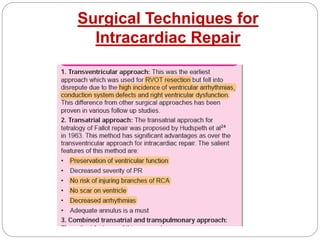
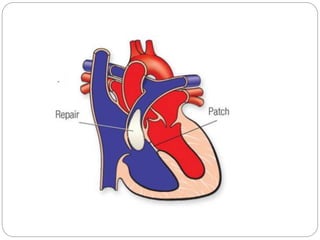
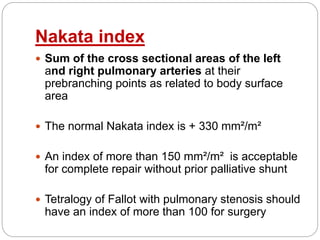
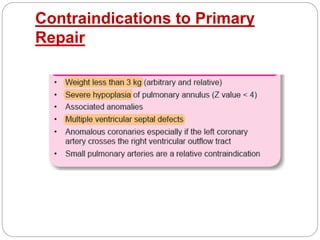
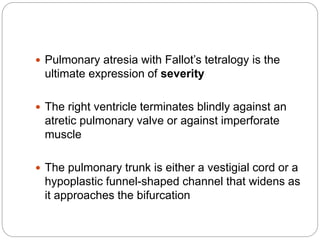
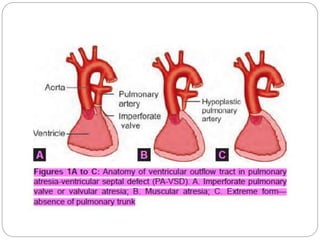
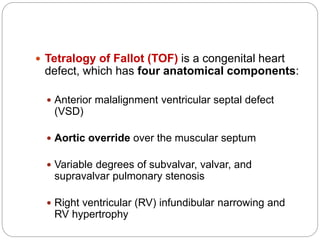
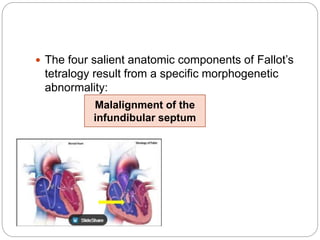
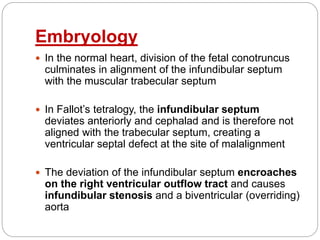
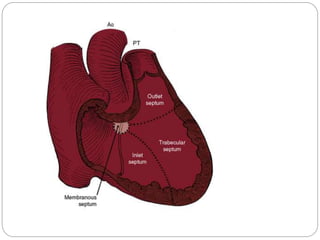
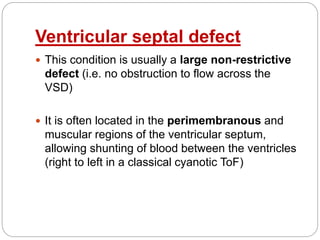
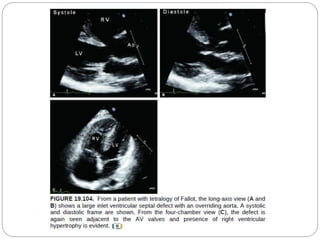
Tetralogy of Fallot is the most common cyanotic heart defect in children, comprising four key anatomical issues: ventricular septal defect, aortic override, pulmonary stenosis, and right ventricular hypertrophy. It generally leads to significant hypoxemia due to right-to-left shunting and is associated with various chromosomal anomalies. Management often involves surgical interventions, especially for symptomatic patients experiencing cyanotic spells.






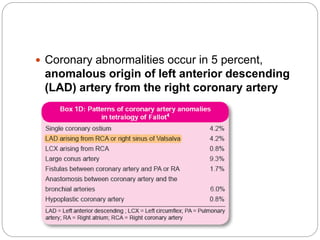
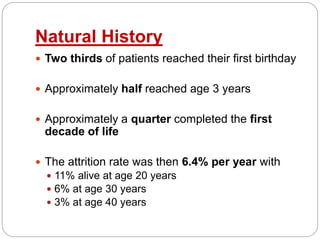
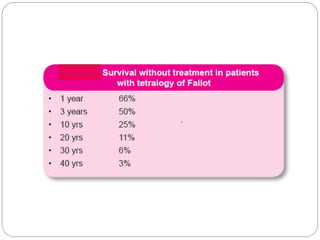
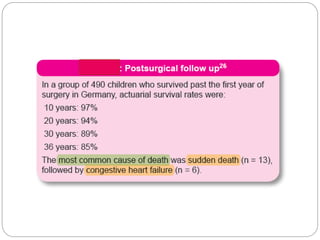


![Fallot-type pulmonary atresia (15%
of ToF)
This type is the severest variant, characterised by
complete atresia (i.e. complete occlusion) of the
pulmonary valve
Therefore, there is no forward flow of blood from the RV
into the pulmonary artery
Intracardiac mixing is essential, and all pulmonary blood
flow must be supplied from the aorta either by a PDA
(‘duct-dependent pulmonary circulation’) or from major
collaterals from the aorta to the pulmonary arteries (major
aortopulmonary collateral arteries, MAPCAs)
In the neonatal period, prostaglandin (either alprostadil
[prostaglandin E1] or dinoprostone [prostaglandin E2]) may
be required acutely to maintain any pulmonary blood flow
through the PDA](https://image.slidesharecdn.com/tof-220916162647-0ec32bec/85/TOF-pptx-28-320.jpg)














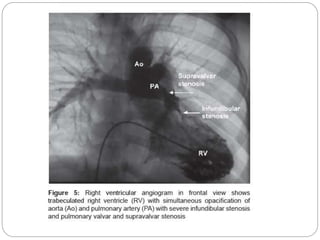
![ Angiographic assessment should be geared
towards the information that is needed; biplane
angiography is ideal
RV angiogram (anteroposterior [AP] cranial, left
anterior oblique [LAO] view) shows simultaneous
opacification of aorta and PA, RVOT obstruction
and PA anatomy](https://image.slidesharecdn.com/tof-220916162647-0ec32bec/85/TOF-pptx-76-320.jpg)