DISLOCATIONS $
SUBLUXATIONS
DR BIPUL BORTHAKUR
PROFFESOR AND HEAD
DEPARTMENT OF ORTHOPAEDICS
ASSAM MEDICAL COLLEGE,DIBRUGARH , ASSAM
OUTLINE
1. Introduction about dislocation
and subluxation
2. Shoulder dislocation
3. Elbow dislocation
4. Hip dislocation
5. Knee dislocation
6. Other dislocation
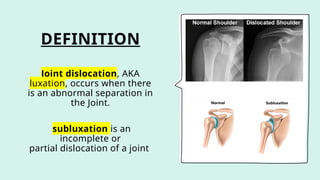
DEFINITION
Joint dislocation, AKA
luxation, occurs when there
is an abnormal separation in
the Joint.
subluxation is an
incomplete or
partial dislocation of a joint
Causes of dislocation
• MCC : Traumatic
• Great and sudden force applied, by either blow or fall, to the joint causes the
bones in the joint to displaced.
Sign and
symptoms
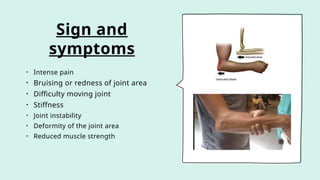
• Intense pain
• Bruising or redness of joint area
• Difficulty moving joint
• Stiffness
• Joint instability
• Deformity of the joint area
• Reduced muscle strength
WORKUP
• Patient's history and physical examination.
• Neurovascular exam ( to r/o neurovascular
injuries)
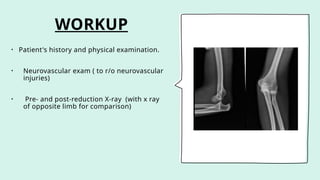
• Pre- and post-reduction X-ray (with x ray
of opposite limb for comparison)
Principle of treatment
• Reduce the dislocated joint as soon as possible under sedation /general
anaesthesia
• Check neurovascular function distally
• Take post reduction radiograph
• Immobilize the joint
Shoulder
dislocati
on
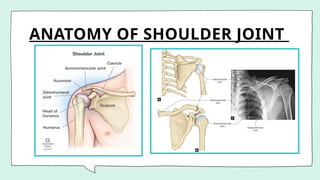
ANATOMY OF SHOULDER JOINT
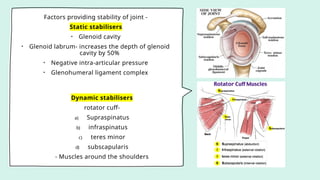
Factors providing stability of joint -
Static stabilisers
• Glenoid cavity
• Glenoid labrum- increases the depth of glenoid
cavity by 50%
• Negative intra-articular pressure
• Glenohumeral ligament complex
Dynamic stabilisers
rotator cuff-
a) Supraspinatus
b) infraspinatus
c) teres minor
d) subscapularis
- Muscles around the shoulders
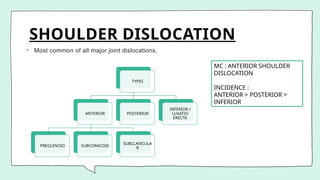
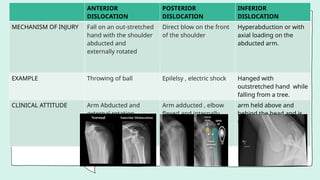
SHOULDER DISLOCATION
• Most common of all major joint dislocations.
TYPES
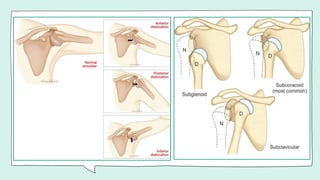
ANTERIOR
PREGLENOID SUBCORACOID
SUBCLAVICULA
R
POSTERIOR
INFERIOR /
LUXATIO
ERECTA
MC : ANTERIOR SHOULDER
DISLOCATION
INCIDENCE :
ANTERIOR > POSTERIOR >
INFERIOR
ANTERIOR
DISLOCATION
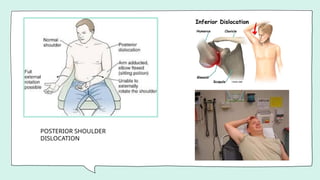
POSTERIOR
DISLOCATION
INFERIOR
DISLOCATION
MECHANISM OF INJURY Fall on an out-stretched
hand with the shoulder
abducted and
externally rotated
Direct blow on the front
of the shoulder
Hyperabduction or with
axial loading on the
abducted arm.
EXAMPLE Throwing of ball Epilelsy , electric shock Hanged with
outstretched hand while
falling from a tree.
CLINICAL ATTITUDE Arm Abducted and
external rotation
Arm adducted , elbow
flexed and internally
rotated
arm held above and
behind the head and is
unable to adduct arm
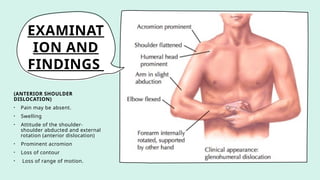
EXAMINAT
ION AND
FINDINGS
(ANTERIOR SHOULDER
DISLOCATION)
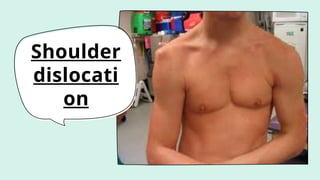
• Pain may be absent.
• Swelling
• Attitude of the shoulder-
shoulder abducted and external
rotation (anterior dislocation)
• Prominent acromion
• Loss of contour
• Loss of range of motion.
POSTERIOR SHOULDER
DISLOCATION
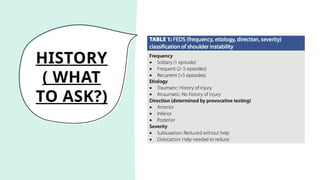
HISTORY
( WHAT
TO ASK?)
PHYSICAL EXAMINATION
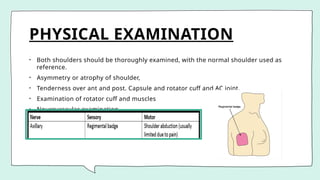
• Both shoulders should be thoroughly examined, with the normal shoulder used as
reference.
• Asymmetry or atrophy of shoulder,
• Tenderness over ant and post. Capsule and rotator cuff and AC joint.
• Examination of rotator cuff and muscles
• Neurovascular examination.
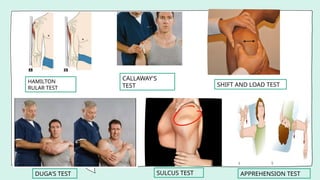
HAMILTON
RULAR TEST
CALLAWAY'S
TEST SHIFT AND LOAD TEST
DUGA'S TEST SULCUS TEST APPREHENSION TEST
INVESTIGATIONS
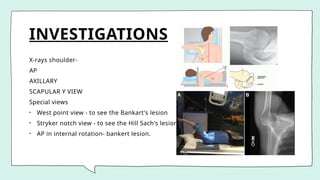
X-rays shoulder-
AP
AXILLARY
SCAPULAR Y VIEW
Special views
• West point view - to see the Bankart's lesion
• Stryker notch view - to see the Hill Sach's lesion
• AP in internal rotation- bankert lesion.
• CT with three dimensional view most sensitive test for detecting and measuring
bone deficiency or retroversion of the glenoid or humerus.
• MRI- imp. For shoft tissue pathology.
• Arthrgraphy-xray or CT arthrography can show capsular laxity, tear, soft tissue
abnormality and bony abnormality.
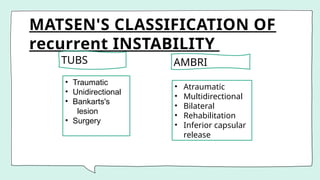
MATSEN'S CLASSIFICATION OF
recurrent INSTABILITY
TUBS
• Traumatic
• Unidirectional
• Bankarts's
lesion
• Surgery
AMBRI
• Atraumatic
• Multidirectional
• Bilateral
• Rehabilitation
• Inferior capsular
release
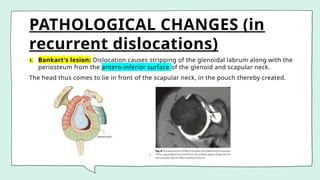
PATHOLOGICAL CHANGES (in
recurrent dislocations)
1. Bankart's lesion: Dislocation causes stripping of the glenoidal labrum along with the
periosteum from the antero-inferior surface of the glenoid and scapular neck.
The head thus comes to lie in front of the scapular neck, in the pouch thereby created.
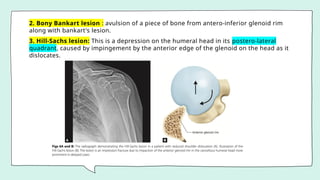
2. Bony Bankart lesion : avulsion of a piece of bone from antero-inferior glenoid rim
along with bankart's lesion.
3. Hill-Sachs lesion: This is a depression on the humeral head in its postero-lateral
quadrant, caused by impingement by the anterior edge of the glenoid on the head as it
dislocates.
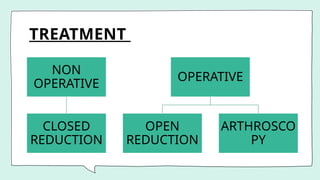
TREATMENT
NON
OPERATIVE
CLOSED
REDUCTION
OPERATIVE
OPEN
REDUCTION
ARTHROSCO
PY
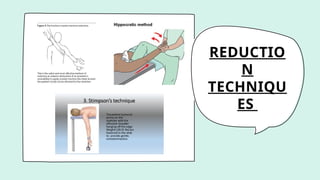
REDUCTIO
N
TECHNIQU
ES
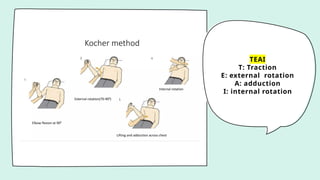
TEAI
T: Traction
E: external rotation
A: adduction
I: internal rotation
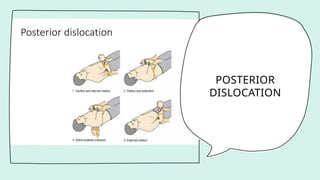
POSTERIOR
DISLOCATION
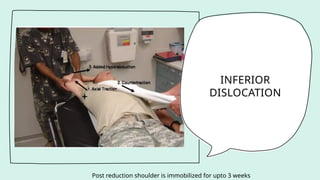
INFERIOR
DISLOCATION
Post reduction shoulder is immobilized for upto 3 weeks
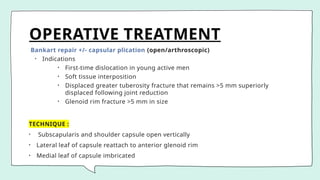
OPERATIVE TREATMENT
Bankart repair +/- capsular plication (open/arthroscopic)
• Indications
• First-time dislocation in young active men
• Soft tissue interposition
• Displaced greater tuberosity fracture that remains >5 mm superiorly
displaced following joint reduction
• Glenoid rim fracture >5 mm in size
TECHNIQUE :
• Subscapularis and shoulder capsule open vertically
• Lateral leaf of capsule reattach to anterior glenoid rim
• Medial leaf of capsule imbricated
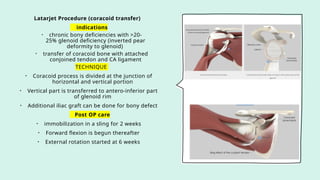
Latarjet Procedure (coracoid transfer)
indications
• chronic bony deficiencies with >20-
25% glenoid deficiency (inverted pear
deformity to glenoid)
• transfer of coracoid bone with attached
conjoined tendon and CA ligament
TECHNIQUE
• Coracoid process is divided at the junction of
horizontal and vertical portion
• Vertical part is transferred to antero-inferior part
of glenoid rim
• Additional iliac graft can be done for bony defect
Post OP care
• immobilization in a sling for 2 weeks
• Forward flexion is begun thereafter
• External rotation started at 6 weeks
Complications
1. Recurrent shoulder dislocation ( M.C. complication)
2. Osseous lesions : Hill-Sachs lesion, Glenoid lip fracture (“bony Bankart lesion”),
Greater tuberosity fracture, Fracture of acromion or coracoid.
3. Soft tissue injuries: Rotator cuff tear (older patients) , Capsular or subscapularis
tendon tears
4. Neurovascular injuries : axillary nerve and artery
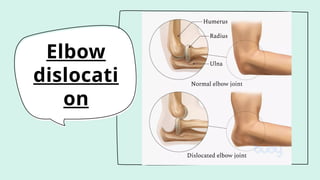
Elbow
dislocati
on
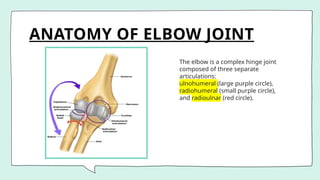
ANATOMY OF ELBOW JOINT
The elbow is a complex hinge joint
composed of three separate
articulations:
ulnohumeral (large purple circle),
radiohumeral (small purple circle),
and radioulnar (red circle).
ELBOW
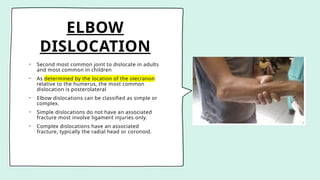
DISLOCATION
• Second most common joint to dislocate in adults
and most common in children
• As determined by the location of the olecranon
relative to the humerus, the most common
dislocation is posterolateral
• Elbow dislocations can be classified as simple or
complex.
• Simple dislocations do not have an associated
fracture most involve ligament injuries only.
• Complex dislocations have an associated
fracture, typically the radial head or coronoid.
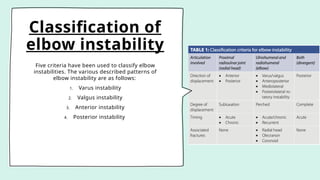
Classification of
elbow instability
Five criteria have been used to classify elbow
instabilities. The various described patterns of
elbow instability are as follows:
1. Varus instability
2. Valgus instability
3. Anterior instability
4. Posterior instability
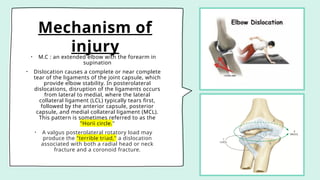
Mechanism of
injury
• M.C : an extended elbow with the forearm in
supination
• Dislocation causes a complete or near complete
tear of the ligaments of the joint capsule, which
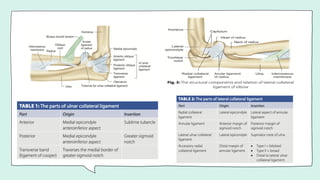
provide elbow stability. In posterolateral
dislocations, disruption of the ligaments occurs
from lateral to medial, where the lateral
collateral ligament (LCL) typically tears first,
followed by the anterior capsule, posterior
capsule, and medial collateral ligament (MCL).
This pattern is sometimes referred to as the
"Horii circle."
• A valgus posterolateral rotatory load may
produce the "terrible triad," a dislocation
associated with both a radial head or neck
fracture and a coronoid fracture.
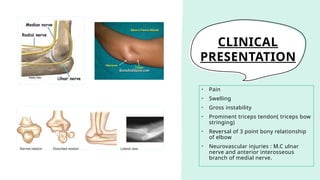
CLINICAL
PRESENTATION
• Pain
• Swelling
• Gross instability
• Prominent triceps tendon( triceps bow
stringing)
• Reversal of 3 point bony relationship
of elbow
• Neurovascular injuries : M.C ulnar
nerve and anterior interosseous
branch of medial nerve.
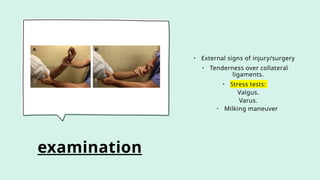
examination
• External signs of injury/surgery
• Tenderness over collateral
ligaments.
• Stress tests:
Valgus.
Varus.
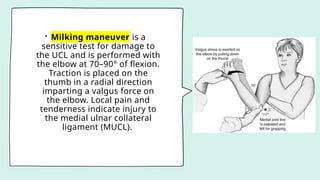
• Milking maneuver
• Milking maneuver is a
sensitive test for damage to
the UCL and is performed with
the elbow at 70–90° of flexion.
Traction is placed on the
thumb in a radial direction
imparting a valgus force on
the elbow. Local pain and
tenderness indicate injury to
the medial ulnar collateral
ligament (MUCL).
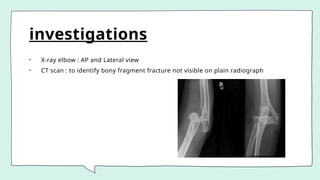
investigations
• X-ray elbow : AP and Lateral view
• CT scan : to identify bony fragment fracture not visible on plain radiograph
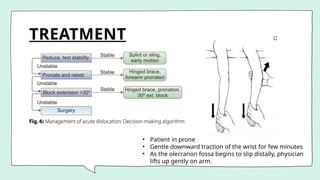
TREATMENT
• Patient in prone
• Gentle downward traction of the wrist for few minutes
• As the olecranon fossa begins to slip distally, physician
lifts up gently on arm.
OPERATIVE METHODS
open reduction internal fixation (ORIF) with ligament repair
Indications
• closed reduction cannot be performed
• often due to entrapped soft tissue or osteochondral fragments
• persistent instability after reduction
• acute complex elbow dislocations (presence of coronoid, radial head, olecranon
fractures)
Technique
ORIF of coronoid, radial head, olecranon fracture if present
ligament repair : perform LCL repair +/- MCL repair depending on intraoperative
stability
Postoperative : elbow requires >50-60° flexion to maintain reduction
Complications
• Early stiffness
• Varus posteromedial instability
• Neurovascular injuries
• Compartment syndrome
• Damage to articular surface
• Recurrent instability
• Heterotopic ossification
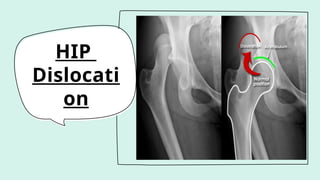
HIP
Dislocati
on
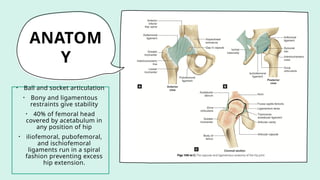
ANATOM
Y
• Ball and socket articulation
• Bony and ligamentous
restraints give stability
• 40% of femoral head
covered by acetabulum in
any position of hip
• iliofemoral, pubofemoral,
and ischiofemoral
ligaments run in a spiral
fashion preventing excess
hip extension.
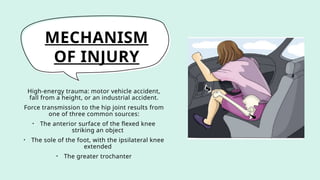
MECHANISM
OF INJURY
High-energy trauma: motor vehicle accident,
fall from a height, or an industrial accident.
Force transmission to the hip joint results from
one of three common sources:
• The anterior surface of the flexed knee
striking an object
• The sole of the foot, with the ipsilateral knee
extended
• The greater trochanter
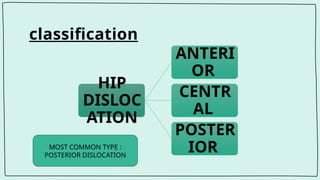
classification
HIP
DISLOC
ATION
ANTERI
OR
CENTR
AL
POSTER
IOR
MOST COMMON TYPE :
POSTERIOR DISLOCATION
CLINICAL
PRESENTATION
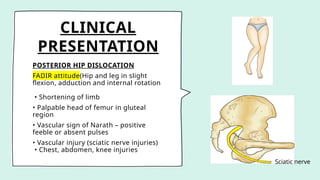
POSTERIOR HIP DISLOCATION
FADIR attitude(Hip and leg in slight
flexion, adduction and internal rotation
• Shortening of limb
• Palpable head of femur in gluteal
region
• Vascular sign of Narath – positive
feeble or absent pulses
• Vascular injury (sciatic nerve injuries)
• Chest, abdomen, knee injuries
Sciatic nerve
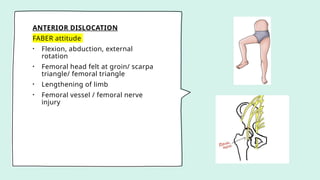
ANTERIOR DISLOCATION
FABER attitude
• Flexion, abduction, external
rotation
• Femoral head felt at groin/ scarpa
triangle/ femoral triangle
• Lengthening of limb
• Femoral vessel / femoral nerve
injury
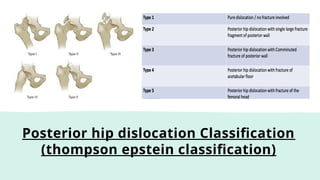
Posterior hip dislocation Classification
(thompson epstein classification)
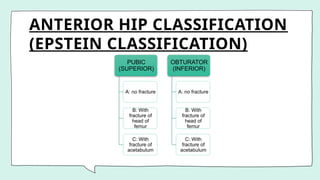
ANTERIOR HIP CLASSIFICATION
(EPSTEIN CLASSIFICATION)
PUBIC
(SUPERIOR)
A: no fracture
B: With
fracture of
head of
femur
C: With
fracture of
acetabulum
OBTURATOR
(INFERIOR)
A: no fracture
B: With
fracture of
head of
femur
C: With
fracture of
acetabulum
• Posterior dislocation of hip is most commonly associated with Posterior wall
acetabular fracture
• Anterior hip dislocation is commonly associated with impaction fractures of femoral
head
• CENTRAL DISLOCATION : Medial position of femoral head after a fracture involving
medial wall of acetabulum of varying type.
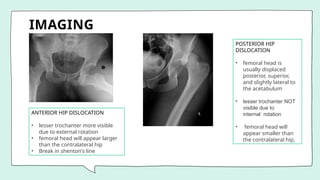
IMAGING
ANTERIOR HIP DISLOCATION
• lesser trochanter more visible
due to external rotation
• femoral head will appear larger
than the contralateral hip
• Break in shenton's line
POSTERIOR HIP
DISLOCATION
• femoral head is
usually displaced
posterior, superior,
and slightly lateral to
the acetabulum
• lesser trochanter NOT
visible due to
internal rotation
• femoral head will
appear smaller than
the contralateral hip,
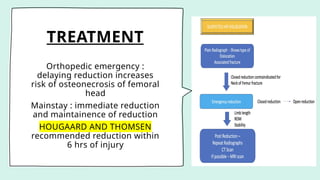
TREATMENT
Orthopedic emergency :
delaying reduction increases
risk of osteonecrosis of femoral
head
Mainstay : immediate reduction
and maintainence of reduction
HOUGAARD AND THOMSEN
recommended reduction within
6 hrs of injury
Reduction techniques
• Stimson method
• Allis technique –Walker modification of Allis technique
• Bigelow
• East Baltimore Lift
• Rochester
• New – PGI Technique
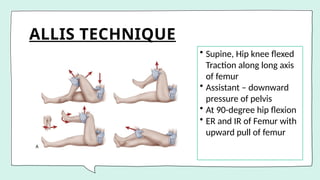
ALLIS TECHNIQUE
• Supine, Hip knee flexed
Traction along long axis
of femur
• Assistant – downward
pressure of pelvis
• At 90-degree hip flexion
• ER and IR of Femur with
upward pull of femur
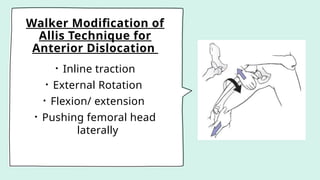
Walker Modification of
Allis Technique for
Anterior Dislocation
• Inline traction
• External Rotation
• Flexion/ extension
• Pushing femoral head
laterally
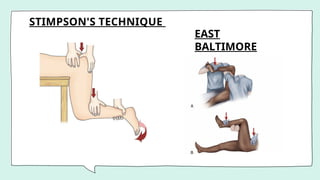
STIMPSON'S TECHNIQUE
EAST
BALTIMORE
LIFT
TECHNIQUE
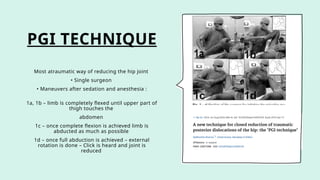
PGI TECHNIQUE
Most atraumatic way of reducing the hip joint
• Single surgeon
• Maneuvers after sedation and anesthesia :
1a, 1b – limb is completely flexed until upper part of
thigh touches the
abdomen
1c – once complete flexion is achieved limb is
abducted as much as possible
1d – once full abduction is achieved – external
rotation is done – Click is heard and joint is
reduced
OPEN REDUCTION
INDICATION
• Irreducible dislocations(2 Closed reduction attempts failed)
• Unstable after CPR
• Intraarticular fragment post reduction
• Fracture of femur head
• Iatrogenic sciatic nerve palsy
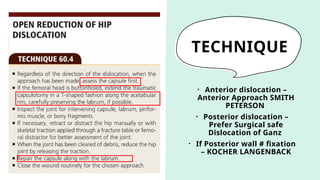
TECHNIQUE
• Anterior dislocation –
Anterior Approach SMITH
PETERSON
• Posterior dislocation –
Prefer Surgical safe
Dislocation of Ganz
• If Posterior wall # fixation
– KOCHER LANGENBACK
AFTER REDUCTION
post reduction
• Check limb length
• Check range of motion
• Check for stability
• Knee and hip flexed 90 degree
• If hip remains stable , Adduction and
IR + posterior force
Most literature suggest - no need
for skeletal or skin traction post
reduction
• Range of motion exercises from
Day 1
• Weight bearing mobilization as
tolerated
complications
EARLY
1. Sciatic nerve injury
2. Femoral nerve
injury
3. Femoral vessels
injury
LATE
1. AVN (>6 hours)
2. Heterotopic
ossification ( anterior >
posterior )
3. Osteoarthritis Instability
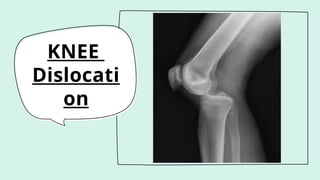
KNEE
Dislocati
on
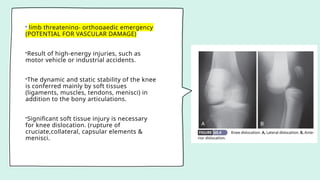
• limb threatening- orthopaedic emergency
(POTENTIAL FOR VASCULAR DAMAGE)
•Result of high-energy injuries, such as
motor vehicle or industrial accidents.
•The dynamic and static stability of the knee
is conferred mainly by soft tissues
(ligaments, muscles, tendons, menisci) in
addition to the bony articulations.
•Significant soft tissue injury is necessary
for knee dislocation. (rupture of
cruciate,collateral, capsular elements &
menisci.
MECHANISM OF INJURY
• High-energy: A motor vehicle accident with a "dashboard" injury.
• Low-energy: athletic injuries, falls in an obese patient.
• Hyperextension with or without varus/valgus leads to anterior dislocation.
• Flexion plus posterior force leads to posterior dislocation (dashboard injury).
• Associated injuries include fractures of the femur, acetabulum, and tibial plateau
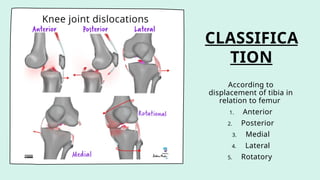
CLASSIFICA
TION
According to
displacement of tibia in
relation to femur
1. Anterior
2. Posterior
3. Medial
4. Lateral
5. Rotatory
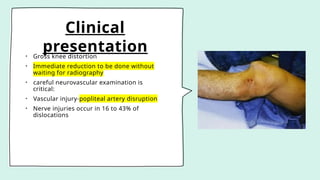
Clinical
presentation
• Gross knee distortion
• Immediate reduction to be done without
waiting for radiography
• careful neurovascular examination is
critical:
• Vascular injury-popliteal artery disruption
• Nerve injuries occur in 16 to 43% of
dislocations
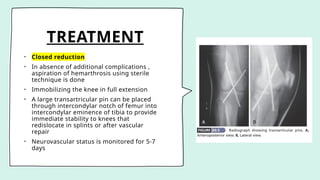
TREATMENT
• Closed reduction
• In absence of additional complications ,
aspiration of hemarthrosis using sterile
technique is done
• Immobilizing the knee in full extension
• A large transartricular pin can be placed
through intercondylar notch of femur into
intercondylar eminence of tibia to provide
immediate stability to knees that
redislocate in splints or after vascular
repair
• Neurovascular status is monitored for 5-7
days
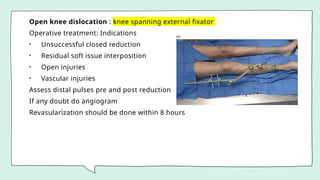
Open knee dislocation : knee spanning external fixator
Operative treatment: Indications
• Unsuccessful closed reduction
• Residual soft issue interposition
• Open injuries
• Vascular injuries
Assess distal pulses pre and post reduction
If any doubt do angiogram
Revasularization should be done within 8 hours
Complications
• Limited range of motion:
• Ligamentous laxity and instability
• Vascular compromise: popliteal artery injury
• Nerve traction injury
OTHER
DISLOCATIONS
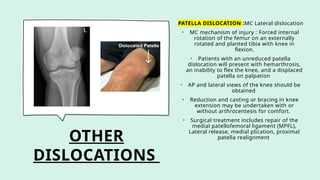
PATELLA DISLOCATION :MC Lateral dislocation
• MC mechanism of injury : Forced internal
rotation of the femur on an externally
rotated and planted tibia with knee in
flexion.
• Patients with an unreduced patella
dislocation will present with hemarthrosis,
an inability to flex the knee, and a displaced
patella on palpation
• AP and lateral views of the knee should be
obtained
• Reduction and casting or bracing in knee
extension may be undertaken with or
without arthrocentesis for comfort.
• Surgical treatment includes repair of the
medial patellofemoral ligament (MPFL),
Lateral release, medial plication, proximal
patella realignment
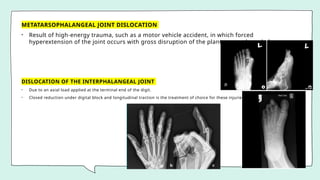
METATARSOPHALANGEAL JOINT DISLOCATION
• Result of high-energy trauma, such as a motor vehicle accident, in which forced
hyperextension of the joint occurs with gross disruption of the plantar capsule and plate.
DISLOCATION OF THE INTERPHALANGEAL JOINT
• Due to an axial load applied at the terminal end of the digit.
• Closed reduction under digital block and longitudinal traction is the treatment of choice for these injuries.
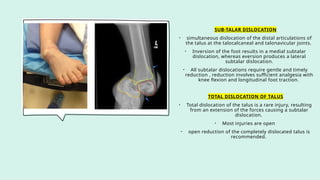
SUB-TALAR DISLOCATION
• simultaneous dislocation of the distal articulations of
the talus at the talocalcaneal and talonavicular joints.
• Inversion of the foot results in a medial subtalar
dislocation, whereas eversion produces a lateral
subtalar dislocation.
• All subtalar dislocations require gentle and timely
reduction , reduction involves sufficient analgesia with
knee flexion and longitudinal foot traction.
TOTAL DISLOCATION OF TALUS
• Total dislocation of the talus is a rare injury, resulting
from an extension of the forces causing a subtalar
dislocation.
• Most injuries are open
• open reduction of the completely dislocated talus is
recommended.
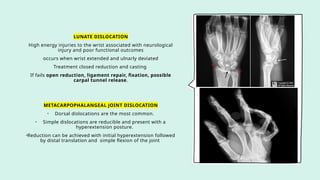
LUNATE DISLOCATION
High energy injuries to the wrist associated with neurological
injury and poor functional outcomes
occurs when wrist extended and ulnarly deviated
Treatment closed reduction and casting
If fails open reduction, ligament repair, fixation, possible
carpal tunnel release.
METACARPOPHALANGEAL JOINT DISLOCATION
• Dorsal dislocations are the most common.
• Simple dislocations are reducible and present with a
hyperextension posture.
•Reduction can be achieved with initial hyperextension followed
by distal translation and simple flexion of the joint
COMMONLY MISSED
DISLOCATIONS
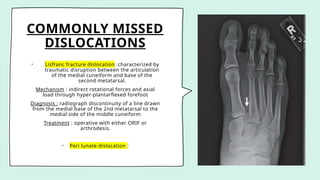
• Lisfranc fracture dislocation :characterized by
traumatic disruption between the articulation
of the medial cuneiform and base of the
second metatarsal.
Mechanism : indirect rotational forces and axial
load through hyper-plantarflexed forefoot
Diagnosis : radiograph discontinuity of a line drawn
from the medial base of the 2nd metatarsal to the
medial side of the middle cuneiform
Treatment : operative with either ORIF or
arthrodesis.
• Peri lunate dislocation :
References
• Campbell's operative orthopaedics (14th edition )
• Rockwood and green's fracture in adults (5th edition)
• Varshnay's essential orthopaedics (3rd edition)
• Handbook of fracture by kenneth Egol ,kenneth J koval (1st SAE)
• www.google.com (image search)
DISLOCATION SUBLUXATION PRESENTATION .PPT

DISLOCATION SUBLUXATION PRESENTATION .PPT

  • 1.
    DISLOCATIONS $ SUBLUXATIONS DR BIPULBORTHAKUR PROFFESOR AND HEAD DEPARTMENT OF ORTHOPAEDICS ASSAM MEDICAL COLLEGE,DIBRUGARH , ASSAM
  • 2.
    OUTLINE 1. Introduction aboutdislocation and subluxation 2. Shoulder dislocation 3. Elbow dislocation 4. Hip dislocation 5. Knee dislocation 6. Other dislocation
  • 3.
    DEFINITION Joint dislocation, AKA luxation,occurs when there is an abnormal separation in the Joint. subluxation is an incomplete or partial dislocation of a joint
  • 4.
    Causes of dislocation •MCC : Traumatic • Great and sudden force applied, by either blow or fall, to the joint causes the bones in the joint to displaced.
  • 5.
    Sign and symptoms • Intensepain • Bruising or redness of joint area • Difficulty moving joint • Stiffness • Joint instability • Deformity of the joint area • Reduced muscle strength
  • 6.
    WORKUP • Patient's historyand physical examination. • Neurovascular exam ( to r/o neurovascular injuries) • Pre- and post-reduction X-ray (with x ray of opposite limb for comparison)
  • 7.
    Principle of treatment •Reduce the dislocated joint as soon as possible under sedation /general anaesthesia • Check neurovascular function distally • Take post reduction radiograph • Immobilize the joint
  • 8.
  • 9.
  • 10.
    Factors providing stabilityof joint - Static stabilisers • Glenoid cavity • Glenoid labrum- increases the depth of glenoid cavity by 50% • Negative intra-articular pressure • Glenohumeral ligament complex Dynamic stabilisers rotator cuff- a) Supraspinatus b) infraspinatus c) teres minor d) subscapularis - Muscles around the shoulders
  • 11.
    SHOULDER DISLOCATION • Mostcommon of all major joint dislocations. TYPES ANTERIOR PREGLENOID SUBCORACOID SUBCLAVICULA R POSTERIOR INFERIOR / LUXATIO ERECTA MC : ANTERIOR SHOULDER DISLOCATION INCIDENCE : ANTERIOR > POSTERIOR > INFERIOR
  • 13.
    ANTERIOR DISLOCATION POSTERIOR DISLOCATION INFERIOR DISLOCATION MECHANISM OF INJURYFall on an out-stretched hand with the shoulder abducted and externally rotated Direct blow on the front of the shoulder Hyperabduction or with axial loading on the abducted arm. EXAMPLE Throwing of ball Epilelsy , electric shock Hanged with outstretched hand while falling from a tree. CLINICAL ATTITUDE Arm Abducted and external rotation Arm adducted , elbow flexed and internally rotated arm held above and behind the head and is unable to adduct arm
  • 14.
    EXAMINAT ION AND FINDINGS (ANTERIOR SHOULDER DISLOCATION) •Pain may be absent. • Swelling • Attitude of the shoulder- shoulder abducted and external rotation (anterior dislocation) • Prominent acromion • Loss of contour • Loss of range of motion.
  • 15.
  • 16.
  • 17.
    PHYSICAL EXAMINATION • Bothshoulders should be thoroughly examined, with the normal shoulder used as reference. • Asymmetry or atrophy of shoulder, • Tenderness over ant and post. Capsule and rotator cuff and AC joint. • Examination of rotator cuff and muscles • Neurovascular examination.
  • 18.
    HAMILTON RULAR TEST CALLAWAY'S TEST SHIFTAND LOAD TEST DUGA'S TEST SULCUS TEST APPREHENSION TEST
  • 19.
    INVESTIGATIONS X-rays shoulder- AP AXILLARY SCAPULAR YVIEW Special views • West point view - to see the Bankart's lesion • Stryker notch view - to see the Hill Sach's lesion • AP in internal rotation- bankert lesion.
  • 20.
    • CT withthree dimensional view most sensitive test for detecting and measuring bone deficiency or retroversion of the glenoid or humerus. • MRI- imp. For shoft tissue pathology. • Arthrgraphy-xray or CT arthrography can show capsular laxity, tear, soft tissue abnormality and bony abnormality.
  • 21.
    MATSEN'S CLASSIFICATION OF recurrentINSTABILITY TUBS • Traumatic • Unidirectional • Bankarts's lesion • Surgery AMBRI • Atraumatic • Multidirectional • Bilateral • Rehabilitation • Inferior capsular release
  • 22.
    PATHOLOGICAL CHANGES (in recurrentdislocations) 1. Bankart's lesion: Dislocation causes stripping of the glenoidal labrum along with the periosteum from the antero-inferior surface of the glenoid and scapular neck. The head thus comes to lie in front of the scapular neck, in the pouch thereby created.
  • 23.
    2. Bony Bankartlesion : avulsion of a piece of bone from antero-inferior glenoid rim along with bankart's lesion. 3. Hill-Sachs lesion: This is a depression on the humeral head in its postero-lateral quadrant, caused by impingement by the anterior edge of the glenoid on the head as it dislocates.
  • 24.
  • 25.
  • 26.
    TEAI T: Traction E: externalrotation A: adduction I: internal rotation
  • 27.
  • 28.
    INFERIOR DISLOCATION Post reduction shoulderis immobilized for upto 3 weeks
  • 29.
    OPERATIVE TREATMENT Bankart repair+/- capsular plication (open/arthroscopic) • Indications • First-time dislocation in young active men • Soft tissue interposition • Displaced greater tuberosity fracture that remains >5 mm superiorly displaced following joint reduction • Glenoid rim fracture >5 mm in size TECHNIQUE : • Subscapularis and shoulder capsule open vertically • Lateral leaf of capsule reattach to anterior glenoid rim • Medial leaf of capsule imbricated
  • 30.
    Latarjet Procedure (coracoidtransfer) indications • chronic bony deficiencies with >20- 25% glenoid deficiency (inverted pear deformity to glenoid) • transfer of coracoid bone with attached conjoined tendon and CA ligament TECHNIQUE • Coracoid process is divided at the junction of horizontal and vertical portion • Vertical part is transferred to antero-inferior part of glenoid rim • Additional iliac graft can be done for bony defect Post OP care • immobilization in a sling for 2 weeks • Forward flexion is begun thereafter • External rotation started at 6 weeks
  • 31.
    Complications 1. Recurrent shoulderdislocation ( M.C. complication) 2. Osseous lesions : Hill-Sachs lesion, Glenoid lip fracture (“bony Bankart lesion”), Greater tuberosity fracture, Fracture of acromion or coracoid. 3. Soft tissue injuries: Rotator cuff tear (older patients) , Capsular or subscapularis tendon tears 4. Neurovascular injuries : axillary nerve and artery
  • 32.
  • 33.
    ANATOMY OF ELBOWJOINT The elbow is a complex hinge joint composed of three separate articulations: ulnohumeral (large purple circle), radiohumeral (small purple circle), and radioulnar (red circle).
  • 35.
    ELBOW DISLOCATION • Second mostcommon joint to dislocate in adults and most common in children • As determined by the location of the olecranon relative to the humerus, the most common dislocation is posterolateral • Elbow dislocations can be classified as simple or complex. • Simple dislocations do not have an associated fracture most involve ligament injuries only. • Complex dislocations have an associated fracture, typically the radial head or coronoid.
  • 36.
    Classification of elbow instability Fivecriteria have been used to classify elbow instabilities. The various described patterns of elbow instability are as follows: 1. Varus instability 2. Valgus instability 3. Anterior instability 4. Posterior instability
  • 37.
    Mechanism of injury • M.C: an extended elbow with the forearm in supination • Dislocation causes a complete or near complete tear of the ligaments of the joint capsule, which provide elbow stability. In posterolateral dislocations, disruption of the ligaments occurs from lateral to medial, where the lateral collateral ligament (LCL) typically tears first, followed by the anterior capsule, posterior capsule, and medial collateral ligament (MCL). This pattern is sometimes referred to as the "Horii circle." • A valgus posterolateral rotatory load may produce the "terrible triad," a dislocation associated with both a radial head or neck fracture and a coronoid fracture.
  • 38.
    CLINICAL PRESENTATION • Pain • Swelling •Gross instability • Prominent triceps tendon( triceps bow stringing) • Reversal of 3 point bony relationship of elbow • Neurovascular injuries : M.C ulnar nerve and anterior interosseous branch of medial nerve.
  • 39.
    examination • External signsof injury/surgery • Tenderness over collateral ligaments. • Stress tests: Valgus. Varus. • Milking maneuver
  • 40.
    • Milking maneuveris a sensitive test for damage to the UCL and is performed with the elbow at 70–90° of flexion. Traction is placed on the thumb in a radial direction imparting a valgus force on the elbow. Local pain and tenderness indicate injury to the medial ulnar collateral ligament (MUCL).
  • 41.
    investigations • X-ray elbow: AP and Lateral view • CT scan : to identify bony fragment fracture not visible on plain radiograph
  • 42.
    TREATMENT • Patient inprone • Gentle downward traction of the wrist for few minutes • As the olecranon fossa begins to slip distally, physician lifts up gently on arm.
  • 43.
    OPERATIVE METHODS open reductioninternal fixation (ORIF) with ligament repair Indications • closed reduction cannot be performed • often due to entrapped soft tissue or osteochondral fragments • persistent instability after reduction • acute complex elbow dislocations (presence of coronoid, radial head, olecranon fractures) Technique ORIF of coronoid, radial head, olecranon fracture if present ligament repair : perform LCL repair +/- MCL repair depending on intraoperative stability Postoperative : elbow requires >50-60° flexion to maintain reduction
  • 44.
    Complications • Early stiffness •Varus posteromedial instability • Neurovascular injuries • Compartment syndrome • Damage to articular surface • Recurrent instability • Heterotopic ossification
  • 45.
  • 46.
    ANATOM Y • Ball andsocket articulation • Bony and ligamentous restraints give stability • 40% of femoral head covered by acetabulum in any position of hip • iliofemoral, pubofemoral, and ischiofemoral ligaments run in a spiral fashion preventing excess hip extension.
  • 47.
    MECHANISM OF INJURY High-energy trauma:motor vehicle accident, fall from a height, or an industrial accident. Force transmission to the hip joint results from one of three common sources: • The anterior surface of the flexed knee striking an object • The sole of the foot, with the ipsilateral knee extended • The greater trochanter
  • 48.
  • 49.
    CLINICAL PRESENTATION POSTERIOR HIP DISLOCATION FADIRattitude(Hip and leg in slight flexion, adduction and internal rotation • Shortening of limb • Palpable head of femur in gluteal region • Vascular sign of Narath – positive feeble or absent pulses • Vascular injury (sciatic nerve injuries) • Chest, abdomen, knee injuries Sciatic nerve
  • 50.
    ANTERIOR DISLOCATION FABER attitude •Flexion, abduction, external rotation • Femoral head felt at groin/ scarpa triangle/ femoral triangle • Lengthening of limb • Femoral vessel / femoral nerve injury
  • 51.
    Posterior hip dislocationClassification (thompson epstein classification)
  • 52.
    ANTERIOR HIP CLASSIFICATION (EPSTEINCLASSIFICATION) PUBIC (SUPERIOR) A: no fracture B: With fracture of head of femur C: With fracture of acetabulum OBTURATOR (INFERIOR) A: no fracture B: With fracture of head of femur C: With fracture of acetabulum
  • 53.
    • Posterior dislocationof hip is most commonly associated with Posterior wall acetabular fracture • Anterior hip dislocation is commonly associated with impaction fractures of femoral head • CENTRAL DISLOCATION : Medial position of femoral head after a fracture involving medial wall of acetabulum of varying type.
  • 54.
    IMAGING ANTERIOR HIP DISLOCATION •lesser trochanter more visible due to external rotation • femoral head will appear larger than the contralateral hip • Break in shenton's line POSTERIOR HIP DISLOCATION • femoral head is usually displaced posterior, superior, and slightly lateral to the acetabulum • lesser trochanter NOT visible due to internal rotation • femoral head will appear smaller than the contralateral hip,
  • 55.
    TREATMENT Orthopedic emergency : delayingreduction increases risk of osteonecrosis of femoral head Mainstay : immediate reduction and maintainence of reduction HOUGAARD AND THOMSEN recommended reduction within 6 hrs of injury
  • 56.
    Reduction techniques • Stimsonmethod • Allis technique –Walker modification of Allis technique • Bigelow • East Baltimore Lift • Rochester • New – PGI Technique
  • 57.
    ALLIS TECHNIQUE • Supine,Hip knee flexed Traction along long axis of femur • Assistant – downward pressure of pelvis • At 90-degree hip flexion • ER and IR of Femur with upward pull of femur
  • 58.
    Walker Modification of AllisTechnique for Anterior Dislocation • Inline traction • External Rotation • Flexion/ extension • Pushing femoral head laterally
  • 59.
  • 60.
    PGI TECHNIQUE Most atraumaticway of reducing the hip joint • Single surgeon • Maneuvers after sedation and anesthesia : 1a, 1b – limb is completely flexed until upper part of thigh touches the abdomen 1c – once complete flexion is achieved limb is abducted as much as possible 1d – once full abduction is achieved – external rotation is done – Click is heard and joint is reduced
  • 61.
    OPEN REDUCTION INDICATION • Irreducibledislocations(2 Closed reduction attempts failed) • Unstable after CPR • Intraarticular fragment post reduction • Fracture of femur head • Iatrogenic sciatic nerve palsy
  • 62.
    TECHNIQUE • Anterior dislocation– Anterior Approach SMITH PETERSON • Posterior dislocation – Prefer Surgical safe Dislocation of Ganz • If Posterior wall # fixation – KOCHER LANGENBACK
  • 63.
    AFTER REDUCTION post reduction •Check limb length • Check range of motion • Check for stability • Knee and hip flexed 90 degree • If hip remains stable , Adduction and IR + posterior force Most literature suggest - no need for skeletal or skin traction post reduction • Range of motion exercises from Day 1 • Weight bearing mobilization as tolerated
  • 64.
    complications EARLY 1. Sciatic nerveinjury 2. Femoral nerve injury 3. Femoral vessels injury LATE 1. AVN (>6 hours) 2. Heterotopic ossification ( anterior > posterior ) 3. Osteoarthritis Instability
  • 65.
  • 66.
    • limb threatening-orthopaedic emergency (POTENTIAL FOR VASCULAR DAMAGE) •Result of high-energy injuries, such as motor vehicle or industrial accidents. •The dynamic and static stability of the knee is conferred mainly by soft tissues (ligaments, muscles, tendons, menisci) in addition to the bony articulations. •Significant soft tissue injury is necessary for knee dislocation. (rupture of cruciate,collateral, capsular elements & menisci.
  • 67.
    MECHANISM OF INJURY •High-energy: A motor vehicle accident with a "dashboard" injury. • Low-energy: athletic injuries, falls in an obese patient. • Hyperextension with or without varus/valgus leads to anterior dislocation. • Flexion plus posterior force leads to posterior dislocation (dashboard injury). • Associated injuries include fractures of the femur, acetabulum, and tibial plateau
  • 68.
    CLASSIFICA TION According to displacement oftibia in relation to femur 1. Anterior 2. Posterior 3. Medial 4. Lateral 5. Rotatory
  • 69.
    Clinical presentation • Gross kneedistortion • Immediate reduction to be done without waiting for radiography • careful neurovascular examination is critical: • Vascular injury-popliteal artery disruption • Nerve injuries occur in 16 to 43% of dislocations
  • 70.
    TREATMENT • Closed reduction •In absence of additional complications , aspiration of hemarthrosis using sterile technique is done • Immobilizing the knee in full extension • A large transartricular pin can be placed through intercondylar notch of femur into intercondylar eminence of tibia to provide immediate stability to knees that redislocate in splints or after vascular repair • Neurovascular status is monitored for 5-7 days
  • 71.
    Open knee dislocation: knee spanning external fixator Operative treatment: Indications • Unsuccessful closed reduction • Residual soft issue interposition • Open injuries • Vascular injuries Assess distal pulses pre and post reduction If any doubt do angiogram Revasularization should be done within 8 hours
  • 72.
    Complications • Limited rangeof motion: • Ligamentous laxity and instability • Vascular compromise: popliteal artery injury • Nerve traction injury
  • 73.
    OTHER DISLOCATIONS PATELLA DISLOCATION :MCLateral dislocation • MC mechanism of injury : Forced internal rotation of the femur on an externally rotated and planted tibia with knee in flexion. • Patients with an unreduced patella dislocation will present with hemarthrosis, an inability to flex the knee, and a displaced patella on palpation • AP and lateral views of the knee should be obtained • Reduction and casting or bracing in knee extension may be undertaken with or without arthrocentesis for comfort. • Surgical treatment includes repair of the medial patellofemoral ligament (MPFL), Lateral release, medial plication, proximal patella realignment
  • 74.
    METATARSOPHALANGEAL JOINT DISLOCATION •Result of high-energy trauma, such as a motor vehicle accident, in which forced hyperextension of the joint occurs with gross disruption of the plantar capsule and plate. DISLOCATION OF THE INTERPHALANGEAL JOINT • Due to an axial load applied at the terminal end of the digit. • Closed reduction under digital block and longitudinal traction is the treatment of choice for these injuries.
  • 75.
    SUB-TALAR DISLOCATION • simultaneousdislocation of the distal articulations of the talus at the talocalcaneal and talonavicular joints. • Inversion of the foot results in a medial subtalar dislocation, whereas eversion produces a lateral subtalar dislocation. • All subtalar dislocations require gentle and timely reduction , reduction involves sufficient analgesia with knee flexion and longitudinal foot traction. TOTAL DISLOCATION OF TALUS • Total dislocation of the talus is a rare injury, resulting from an extension of the forces causing a subtalar dislocation. • Most injuries are open • open reduction of the completely dislocated talus is recommended.
  • 76.
    LUNATE DISLOCATION High energyinjuries to the wrist associated with neurological injury and poor functional outcomes occurs when wrist extended and ulnarly deviated Treatment closed reduction and casting If fails open reduction, ligament repair, fixation, possible carpal tunnel release. METACARPOPHALANGEAL JOINT DISLOCATION • Dorsal dislocations are the most common. • Simple dislocations are reducible and present with a hyperextension posture. •Reduction can be achieved with initial hyperextension followed by distal translation and simple flexion of the joint
  • 77.
    COMMONLY MISSED DISLOCATIONS • Lisfrancfracture dislocation :characterized by traumatic disruption between the articulation of the medial cuneiform and base of the second metatarsal. Mechanism : indirect rotational forces and axial load through hyper-plantarflexed forefoot Diagnosis : radiograph discontinuity of a line drawn from the medial base of the 2nd metatarsal to the medial side of the middle cuneiform Treatment : operative with either ORIF or arthrodesis. • Peri lunate dislocation :
  • 78.
    References • Campbell's operativeorthopaedics (14th edition ) • Rockwood and green's fracture in adults (5th edition) • Varshnay's essential orthopaedics (3rd edition) • Handbook of fracture by kenneth Egol ,kenneth J koval (1st SAE) • www.google.com (image search)

Editor's Notes

  • #9 The shoulder girdle is composed of three bones (clavicle, scapula, and proximal humerus) and four articular surfaces (sternoclavicular [SC], acromioclavicular [AC], glenohumeral, and scapulothoracic)