INTRODUCTION
 Coronary heart disease (CHD) remains a leading cause of death worldwide,
accounting for 16% of total deaths globally
Pathophysiology
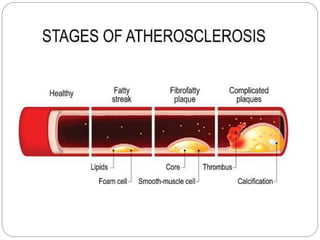
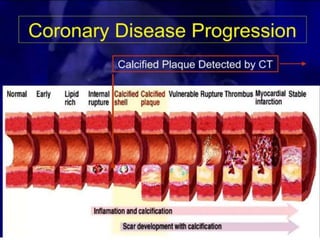
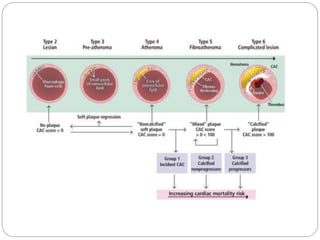
 Atherosclerosis plays a central role, with early fatty streaks progressing to late
complex atheromas
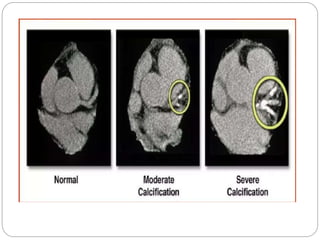
 Vascular calcification, the pathogenic and process of ectopic bone production,
specifically was shown to strongly correlate with degree of atherosclerosis (both
calcified and noncalcified)
 Vascular calcification was shown independently to predict cardiovascular
morbidity and mortality
 These associations, combined with the radio-opaque appearance of calcium
hydroxyappatite on CT images, have led to extensive investigation of the
quantification, or scoring, of coronary artery calcium (CAC).
 CAC scoring has emerged as a widely available and powerful tool for
stratifying cardiovascular risk, predicting patient outcomes, and guiding
preventive therapy
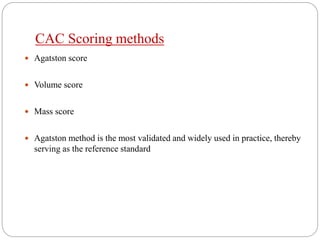
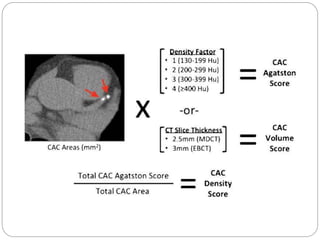
CAC Scoring methods
 Agatston score
 Volume score
 Mass score
 Agatston method is the most validated and widely used in practice, thereby
serving as the reference standard
Absolute versus Percentile CAC Scoring
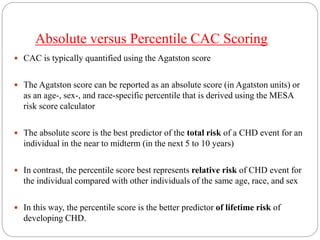
 CAC is typically quantified using the Agatston score
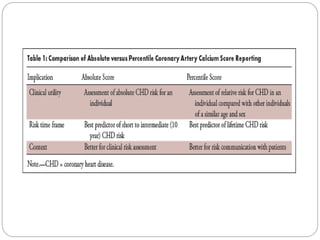
 The Agatston score can be reported as an absolute score (in Agatston units) or
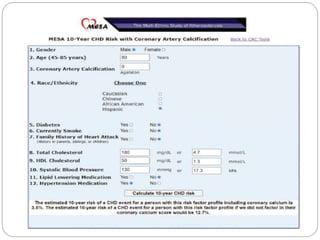
as an age-, sex-, and race-specific percentile that is derived using the MESA
risk score calculator
 The absolute score is the best predictor of the total risk of a CHD event for an
individual in the near to midterm (in the next 5 to 10 years)
 In contrast, the percentile score best represents relative risk of CHD event for
the individual compared with other individuals of the same age, race, and sex
 In this way, the percentile score is the better predictor of lifetime risk of
developing CHD.
Pitfalls of Interpreting CAC Scoring CT
Scans and Potential Solutions
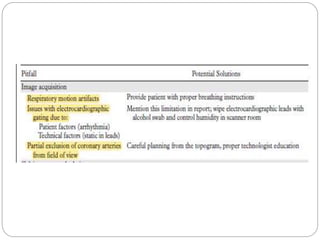
Respiratory Motion Artifacts
 With regard to image acquisition, respiratory motion artifacts are a common
problem that can hinder image quality
 Technologists should take precaution of this and ensure that proper breathing
instructions are relayed to the patient before the initiation of scanning
Electrocardiographic Gating
 Can arise during image acquisition owing to patient
factors such as arrhythmias and/or technical factors
such as static in ECG leads
Technical Issues
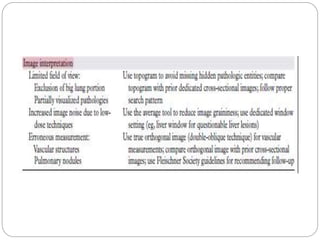
 Partial exclusion of coronary arteries from the field of
view can sometimes occur
 Can be avoided by educating the technologist
regarding careful planning of image boundaries from
the topogram
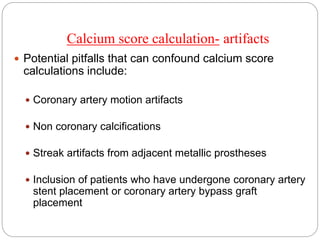
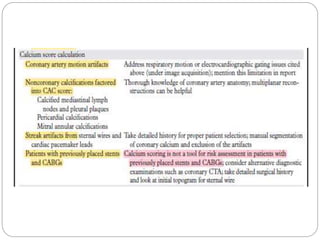
Calcium score calculation- artifacts
 Potential pitfalls that can confound calcium score
calculations include:
 Coronary artery motion artifacts
 Non coronary calcifications
 Streak artifacts from adjacent metallic prostheses
 Inclusion of patients who have undergone coronary artery
stent placement or coronary artery bypass graft
placement
CAC Score as a Tool to Guide
Statin Therapy
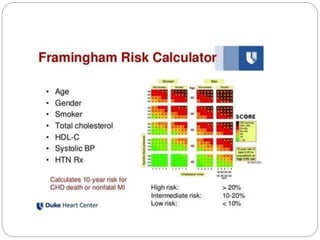
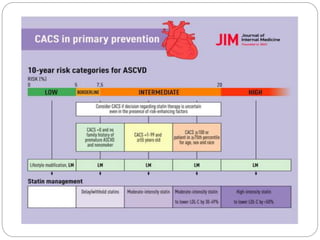
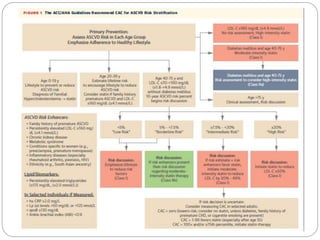
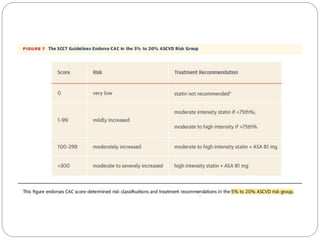
 The 10-year ASCVD risk is combined with the CAC score to guide primary
prevention with statins
 The current recommendation is to incorporate the CAC score as a decision-
making tool to reclassify risk and guide statin therapy in patients older than 40
years who have borderline to intermediate (5%–20%) 10- year ASCVD risk
 For patients with a risk of less than 5%, statin treatment is not recommended;
as an exception, statin treatment may be recommended for select patients in this
group with risk factors and a strong CAD family history
 For patients with a greater than 20% risk, statin treatment is recommended
regardless of the CAC score
CAC Tool to Guide
Aspirin therapy
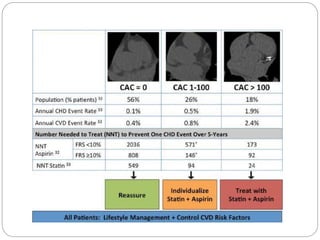
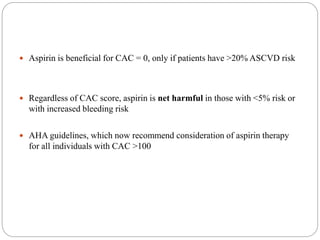
 Aspirin is beneficial for CAC = 0, only if patients have >20% ASCVD risk
 Regardless of CAC score, aspirin is net harmful in those with <5% risk or
with increased bleeding risk
 AHA guidelines, which now recommend consideration of aspirin therapy
for all individuals with CAC >100
CAC in Special Groups
CHRONIC KIDNEY DISEASE
 In CKD pts, a significantly more pronounced, disseminated, and fast-
progressing calcification of the vascular system (includes the coronary arteries)
 Coronary artery calcification develops early after the onset of CKD and is
closely a/w mineral and bone disorders, which include but are not limited to
secondary hyperparathyroidism
 Factors such as inflammation and obesity, commonly seen in CKD, lead to the
acceleration of atherosclerotic plaques in the arteries
 The ESC adds that active management instead of risk assessment by CAC is of
more vital importance for CKD pts
 The ACC/AHA note that CKD is already a risk enhancer. If there is still
uncertainty regarding risk estimate, American guidelines allow for reclassifying
up or down with CAC
DIABETES MELLITUS
 Individuals with diabetes present with a risk for CV events comparable to those
for patients with an actual ASCVD history
 the presence of any CAC in individuals with DM equates with a higher risk of
all-cause mortality, and CAC scoring becomes of vital importance as a risk
stratifier
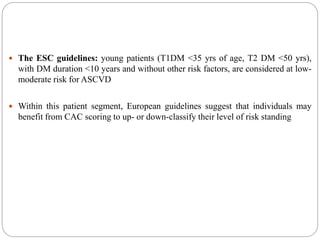
 The ESC guidelines: young patients (T1DM <35 yrs of age, T2 DM <50 yrs),
with DM duration <10 years and without other risk factors, are considered at low-
moderate risk for ASCVD
 Within this patient segment, European guidelines suggest that individuals may
benefit from CAC scoring to up- or down-classify their level of risk standing
 ACC/AHA and denotes that intermediate risk factors, including impaired fasting
glucose (in men at or older than 50 years of age and women at or older than 60
years of age) along with a risk modifier of CAC >0, favor the use of statins
CAC AMONG OLDER AGE GROUPS
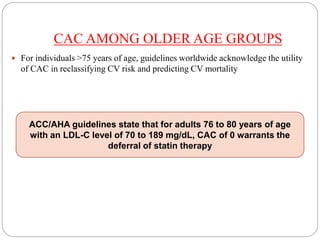
 For individuals >75 years of age, guidelines worldwide acknowledge the utility
of CAC in reclassifying CV risk and predicting CV mortality
ACC/AHA guidelines state that for adults 76 to 80 years of age
with an LDL-C level of 70 to 189 mg/dL, CAC of 0 warrants the
deferral of statin therapy
CAC AMONG YOUNGER AGE GROUPS
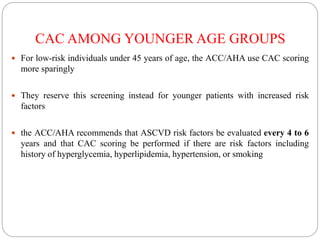
 For low-risk individuals under 45 years of age, the ACC/AHA use CAC scoring
more sparingly
 They reserve this screening instead for younger patients with increased risk
factors
 the ACC/AHA recommends that ASCVD risk factors be evaluated every 4 to 6
years and that CAC scoring be performed if there are risk factors including
history of hyperglycemia, hyperlipidemia, hypertension, or smoking
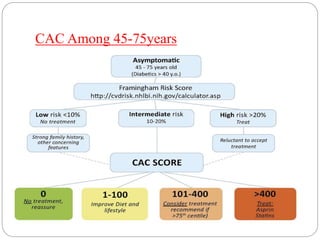
CAC Among 45-75years
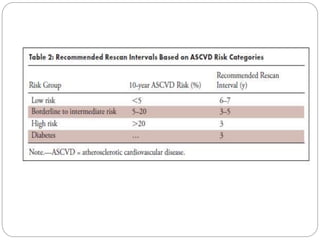
 In patients with a CAC score of 0 on the index scan
 Consider recommending repeat CAC testing in 5–7 years for low-risk
individuals
 3–5 years for intermediate-risk individuals
 Approximately 3 years for high-risk individuals or those with diabetes
New CAC Score Group: CAC of Greater than 1000
 CAC scores of greater than 300 or greater than 400 have been traditionally
recognized as the highest risk classification of CAC
 There are a unique group of individuals with CAC scores of greater than 1000,
many of whom are asymptomatic at the time of scanning
 high CAC values are heavily influenced by CAC density, which may be a/ w more
favorable prognosis, as denser CAC are more indicative of stable plaques, which
are less prone to rupture
 very high CAC scores of greater than 1000 was found to have greater CAC
area and more extra-coronary calcium, and a/w higher risk of CVD, CHD,
cancer, and all-cause mortality than those with CAC scores of 400–999
 These patients have found to have as much risk as those in secondary prevention
( prior MI ) suggesting that even more aggressive management of modifiable
risk factors might be warranted in this subgroup of individuals
CAC scores of greater than 1000 should be
considered a distinct very high-risk group and
should be identified as such on score reports
Recommendation
s
CAC Distribution within the Coronary Arteries
 Another consideration when scoring and reporting CAC is the CAC distribution
within the coronary tree
 For a given absolute CAC score, compared with single vessel CAC, CAC in
multiple vessels is associated with higher risk of mortality
 In limited circumstances it is important to note the vessel affected, as CAC
involving the left main was a/w increased mortality risk
 the Agatston score does not factor in the distribution of CAC, like the calcium
coverage score, take CAC distribution into consideration but are less
reproducible and require much longer reading time than the Agatston score,
limiting their incremental value
 Currently, a simple expression of the number of coronary arteries with CAC and
whether there is CAC in the left main is sufficient to enhance risk discrimination
When reporting CAC scores, the number of coronary arteries with
CAC should be noted within the report (0–4, including the left
main)
Presence of left main CAC should also be noted in the study
conclusions.
Recommendation
s
Advantages of CAC
 Rapid
 Doesn’t require contrast
 Reproducible
 Prognostic significance
Disadvantages of CAC
 Cost
 Radiation exposure
Contraindications
 Pregnancy
 Prior MI/ PCI/ CABG
 Resting heart rate > 90/min
 Cardiac implants including mechanical valves,
pacemaker wires or stents
Take Home Messages
When to consider CAC testing?
In intermediate-risk or selected borderline-risk adults, if the decision about statin
use remains uncertain, it is reasonable to use a CAC score in the decision to
withhold, postpone or initiate statin therapy.
Emphasis on "power of zero:" use of CAC testing to
identify low risk patients
As opposed to risk enhancers and screening tools that may be used to identify
higher risk patients, CAC testing is now mostly used for identifying lower risk
patients among those who would otherwise be candidates for statin therapy but
who have a preference to avoid such therapy.
CAC may also be useful in older individuals
The new guideline also supports the utility of CAC measurement in
identifying the absence of atherosclerotic plaque in older adults
Specifically, the guideline states that in adults 76 to 80 years of age with an
LDL-C level of 70 to 189 mg/dL, it may be reasonable to measure CAC to
reclassify those with a CAC score of zero to avoid statin therapy.
Must interpret CAC test results in context of overall
patient risk
A CAC score of zero can be helpful in reclassifying risk to a lower risk
group
However, a score of zero does not imply zero risk, and the results of the
test should always be incorporated with other known risk factors
It is for this reason that CAC testing is not recommended in high risk
patients (i.e., 10-year ASCVD risk ≥20%), and that at times clinicians and
patients may elect to initiate statin therapy despite a CAC of zero.
THANK YOU

CT calcium score.pptx

  • 2.
    INTRODUCTION  Coronary heartdisease (CHD) remains a leading cause of death worldwide, accounting for 16% of total deaths globally
  • 3.
    Pathophysiology  Atherosclerosis playsa central role, with early fatty streaks progressing to late complex atheromas  Vascular calcification, the pathogenic and process of ectopic bone production, specifically was shown to strongly correlate with degree of atherosclerosis (both calcified and noncalcified)
  • 5.
     Vascular calcificationwas shown independently to predict cardiovascular morbidity and mortality  These associations, combined with the radio-opaque appearance of calcium hydroxyappatite on CT images, have led to extensive investigation of the quantification, or scoring, of coronary artery calcium (CAC).  CAC scoring has emerged as a widely available and powerful tool for stratifying cardiovascular risk, predicting patient outcomes, and guiding preventive therapy
  • 8.
    CAC Scoring methods Agatston score  Volume score  Mass score  Agatston method is the most validated and widely used in practice, thereby serving as the reference standard
  • 16.
    Absolute versus PercentileCAC Scoring  CAC is typically quantified using the Agatston score  The Agatston score can be reported as an absolute score (in Agatston units) or as an age-, sex-, and race-specific percentile that is derived using the MESA risk score calculator  The absolute score is the best predictor of the total risk of a CHD event for an individual in the near to midterm (in the next 5 to 10 years)  In contrast, the percentile score best represents relative risk of CHD event for the individual compared with other individuals of the same age, race, and sex  In this way, the percentile score is the better predictor of lifetime risk of developing CHD.
  • 18.
    Pitfalls of InterpretingCAC Scoring CT Scans and Potential Solutions
  • 19.
    Respiratory Motion Artifacts With regard to image acquisition, respiratory motion artifacts are a common problem that can hinder image quality  Technologists should take precaution of this and ensure that proper breathing instructions are relayed to the patient before the initiation of scanning
  • 20.
    Electrocardiographic Gating  Canarise during image acquisition owing to patient factors such as arrhythmias and/or technical factors such as static in ECG leads
  • 21.
    Technical Issues  Partialexclusion of coronary arteries from the field of view can sometimes occur  Can be avoided by educating the technologist regarding careful planning of image boundaries from the topogram
  • 23.
    Calcium score calculation-artifacts  Potential pitfalls that can confound calcium score calculations include:  Coronary artery motion artifacts  Non coronary calcifications  Streak artifacts from adjacent metallic prostheses  Inclusion of patients who have undergone coronary artery stent placement or coronary artery bypass graft placement
  • 26.
    CAC Score asa Tool to Guide Statin Therapy
  • 27.
     The 10-yearASCVD risk is combined with the CAC score to guide primary prevention with statins  The current recommendation is to incorporate the CAC score as a decision- making tool to reclassify risk and guide statin therapy in patients older than 40 years who have borderline to intermediate (5%–20%) 10- year ASCVD risk  For patients with a risk of less than 5%, statin treatment is not recommended; as an exception, statin treatment may be recommended for select patients in this group with risk factors and a strong CAD family history  For patients with a greater than 20% risk, statin treatment is recommended regardless of the CAC score
  • 32.
    CAC Tool toGuide Aspirin therapy
  • 35.
     Aspirin isbeneficial for CAC = 0, only if patients have >20% ASCVD risk  Regardless of CAC score, aspirin is net harmful in those with <5% risk or with increased bleeding risk  AHA guidelines, which now recommend consideration of aspirin therapy for all individuals with CAC >100
  • 37.
  • 38.
    CHRONIC KIDNEY DISEASE In CKD pts, a significantly more pronounced, disseminated, and fast- progressing calcification of the vascular system (includes the coronary arteries)  Coronary artery calcification develops early after the onset of CKD and is closely a/w mineral and bone disorders, which include but are not limited to secondary hyperparathyroidism  Factors such as inflammation and obesity, commonly seen in CKD, lead to the acceleration of atherosclerotic plaques in the arteries
  • 39.
     The ESCadds that active management instead of risk assessment by CAC is of more vital importance for CKD pts  The ACC/AHA note that CKD is already a risk enhancer. If there is still uncertainty regarding risk estimate, American guidelines allow for reclassifying up or down with CAC
  • 40.
    DIABETES MELLITUS  Individualswith diabetes present with a risk for CV events comparable to those for patients with an actual ASCVD history  the presence of any CAC in individuals with DM equates with a higher risk of all-cause mortality, and CAC scoring becomes of vital importance as a risk stratifier
  • 41.
     The ESCguidelines: young patients (T1DM <35 yrs of age, T2 DM <50 yrs), with DM duration <10 years and without other risk factors, are considered at low- moderate risk for ASCVD  Within this patient segment, European guidelines suggest that individuals may benefit from CAC scoring to up- or down-classify their level of risk standing
  • 42.
     ACC/AHA anddenotes that intermediate risk factors, including impaired fasting glucose (in men at or older than 50 years of age and women at or older than 60 years of age) along with a risk modifier of CAC >0, favor the use of statins
  • 43.
    CAC AMONG OLDERAGE GROUPS  For individuals >75 years of age, guidelines worldwide acknowledge the utility of CAC in reclassifying CV risk and predicting CV mortality ACC/AHA guidelines state that for adults 76 to 80 years of age with an LDL-C level of 70 to 189 mg/dL, CAC of 0 warrants the deferral of statin therapy
  • 44.
    CAC AMONG YOUNGERAGE GROUPS  For low-risk individuals under 45 years of age, the ACC/AHA use CAC scoring more sparingly  They reserve this screening instead for younger patients with increased risk factors  the ACC/AHA recommends that ASCVD risk factors be evaluated every 4 to 6 years and that CAC scoring be performed if there are risk factors including history of hyperglycemia, hyperlipidemia, hypertension, or smoking
  • 45.
  • 47.
     In patientswith a CAC score of 0 on the index scan  Consider recommending repeat CAC testing in 5–7 years for low-risk individuals  3–5 years for intermediate-risk individuals  Approximately 3 years for high-risk individuals or those with diabetes
  • 49.
    New CAC ScoreGroup: CAC of Greater than 1000  CAC scores of greater than 300 or greater than 400 have been traditionally recognized as the highest risk classification of CAC  There are a unique group of individuals with CAC scores of greater than 1000, many of whom are asymptomatic at the time of scanning  high CAC values are heavily influenced by CAC density, which may be a/ w more favorable prognosis, as denser CAC are more indicative of stable plaques, which are less prone to rupture
  • 50.
     very highCAC scores of greater than 1000 was found to have greater CAC area and more extra-coronary calcium, and a/w higher risk of CVD, CHD, cancer, and all-cause mortality than those with CAC scores of 400–999  These patients have found to have as much risk as those in secondary prevention ( prior MI ) suggesting that even more aggressive management of modifiable risk factors might be warranted in this subgroup of individuals
  • 51.
    CAC scores ofgreater than 1000 should be considered a distinct very high-risk group and should be identified as such on score reports Recommendation s
  • 52.
    CAC Distribution withinthe Coronary Arteries  Another consideration when scoring and reporting CAC is the CAC distribution within the coronary tree  For a given absolute CAC score, compared with single vessel CAC, CAC in multiple vessels is associated with higher risk of mortality  In limited circumstances it is important to note the vessel affected, as CAC involving the left main was a/w increased mortality risk
  • 53.
     the Agatstonscore does not factor in the distribution of CAC, like the calcium coverage score, take CAC distribution into consideration but are less reproducible and require much longer reading time than the Agatston score, limiting their incremental value  Currently, a simple expression of the number of coronary arteries with CAC and whether there is CAC in the left main is sufficient to enhance risk discrimination
  • 54.
    When reporting CACscores, the number of coronary arteries with CAC should be noted within the report (0–4, including the left main) Presence of left main CAC should also be noted in the study conclusions. Recommendation s
  • 55.
    Advantages of CAC Rapid  Doesn’t require contrast  Reproducible  Prognostic significance
  • 56.
    Disadvantages of CAC Cost  Radiation exposure
  • 57.
    Contraindications  Pregnancy  PriorMI/ PCI/ CABG  Resting heart rate > 90/min  Cardiac implants including mechanical valves, pacemaker wires or stents
  • 59.
    Take Home Messages Whento consider CAC testing? In intermediate-risk or selected borderline-risk adults, if the decision about statin use remains uncertain, it is reasonable to use a CAC score in the decision to withhold, postpone or initiate statin therapy. Emphasis on "power of zero:" use of CAC testing to identify low risk patients As opposed to risk enhancers and screening tools that may be used to identify higher risk patients, CAC testing is now mostly used for identifying lower risk patients among those who would otherwise be candidates for statin therapy but who have a preference to avoid such therapy.
  • 60.
    CAC may alsobe useful in older individuals The new guideline also supports the utility of CAC measurement in identifying the absence of atherosclerotic plaque in older adults Specifically, the guideline states that in adults 76 to 80 years of age with an LDL-C level of 70 to 189 mg/dL, it may be reasonable to measure CAC to reclassify those with a CAC score of zero to avoid statin therapy.
  • 61.
    Must interpret CACtest results in context of overall patient risk A CAC score of zero can be helpful in reclassifying risk to a lower risk group However, a score of zero does not imply zero risk, and the results of the test should always be incorporated with other known risk factors It is for this reason that CAC testing is not recommended in high risk patients (i.e., 10-year ASCVD risk ≥20%), and that at times clinicians and patients may elect to initiate statin therapy despite a CAC of zero.
  • 62.