FRACTURES         0F LOWER LIMB  BYVishnu Mohan
TopicsMechanism of fractures
  fracture of femur
  fracture of patella
 Tibial and fibular Fractures.
 Ankle fractures
 fracture of foot
 Fracture of pelvis.fracturesA bone fracture is a medical condition in which there is a break in the continuity of the bone
Types     Closed{simple}     open{compound}     Compression     Complete     Incomplete     Linear     Transverse     Oblique     Spiral     Impacted     comminuted
Mechanism of fracturesLower limb fracture is  a result of a high energy trauma  except in elderly people or  diseased bones		Types of fracture  are depend on position of limb during impaction and magnitude of forces applied.
femurUpper end
shaft
Lower endFractures of head of femurThe head and neck of the femur is primarily intended for transmission of body weight efficiently with minimum bone mass.
- Mechanism : - Minimal trauma in old people with                                                                                                                                                                osteoporosis- High energy trauma in young adults .
TypesIntracapsularExtracapsular
  Intracapsular typessubcapital- just distal to femoral head     Transcervical– at the middle of                               femoral neck
Extracapsular typesIntertrochanteric- passes between                                   two trochanterspertrochanteric –passes through the                          two trochanters,one                        or both of which may                        be seperatedSubtrochanteric -2or3 inches below                              lesser trochanter
 incomplete fracture of the neck(so called abducted or impacted)
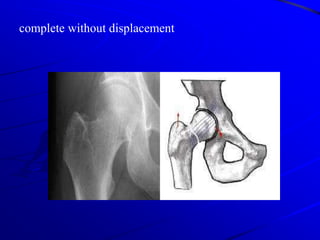
complete without displacement
this is a complete femoral neck fracture with fulldisplacement: the proximal fragment is free and liescorrectly in the acetabulum so that the trabeculae appear normally aligned
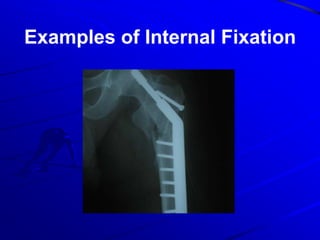
    - Management :- Immobilization with traction until surgery            - Surgery: indicated to stabilize the fracture to help healing,            - Internal fixation by, angled plate , condylar plate or                multiple pins .            - Arthroplasty
ArthroplastySurgical reconstruction or replacement of degenerated joint
Examples of Internal Fixation
Fracture of Femoral Shaft :- Mechanism :- High energy trauma , falling from height        - Management :               - Closed reduction ( In children )               - Open reduction internal fixation by plate and screws                 or interlocking nail .( In adult)               - External fixator .
                             Open reduction of a fracture involves making an incision in the skin and putting the fractured bones together and stabilizing with screws or plates or rods. Closed reduction means just that: no incision made, the fracture is manipulated under a type of X-ray machine called fluoroscopy or just by feel and a cast is then usually applied. Open usually leads to quicker healing because the fragments are held together. Closed has the advantage of avoiding an operation but the healing can be slower because the bones are not rigidly held together.
External fixator
splint  a rigid or flexible appliance for fixation of displaced or movable partsThomas splintA long leg splint that extends from a ring at the hip to beyond the foot, allowing traction to a fractured leg, and is used in emergencies and for transportation.
(B), Thomas knee splint.
PATELLAR   FRACTURES
 The patella, also known as the knee cap or kneepan circular-triangular bone It is the largest sesamoid bone in the human body.
PATELLAR   FRACTURES   Caused by direct injury or by indirect injury   The type of fracture is different in both    Treatment is also different
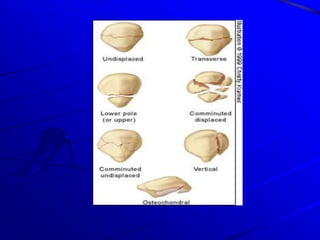
Types   1.direct [stellate]    2.indirect [transverse]
Direct Mechanism- a fall on patella, heavy object falling across the knee Inspection- knee joint is extremely swollen, in slightly flexed position Palpation-   effusion in the knee joint is easily                     determined
X ray-  shows fracture lines running radialy. There may or              may not be any displacement             full extension of the knee joint is possible in  majority of cases.
Treatment 1.When there is crack fracture with no displacement    operation is not needed 2. Even slight displacement patellectomy is the                 treatment of choice, irregular articular surface of           patella  will damage the femoral articular cartilage        and lead to osteoarthritis early in age
pattellectomy   An operation to remove the         patella.
Indirect Mechanism- when a person slips on leg with the                      other leg in a semi flexed positionInspection- there is swelling but is less than direct                    fracture Palpation-   one can feel the fracture line and even                     gap between the segments                     the patient is unable extend the knee and is also unable to lift the leg
Treatment 1.Undisplaced crack fracture by plaster       cylinder 2.With separation{in middle}                          a) internal fixation                           b) patellectomy
Fracture Tibia & Fibula:- Mechanism :-Direct trauma , falling .        - Management :               - Closed reduction & cast immobilization .               - Open reduction internal fixation by plate                  and screws or inter locking nail .
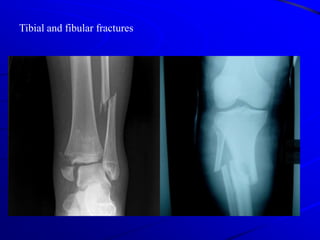
Tibial and fibular fractures
Fractures of the Ankle
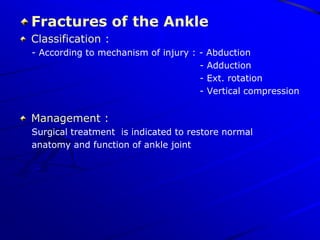
Fractures of the AnkleClassification :    - According to mechanism of injury : - Abduction                                                          - Adduction                                                          - Ext. rotation                                                          - Vertical compressionManagement :Surgical treatment  is indicated to restore normal    anatomy and function of ankle joint
Examples of Internal Fixation
Fractures of foot
Fractures of calcaneum Mechanism - fall from height degree of displacement also varies                          according to the violence TypesChip fractures- rare typeSplit fractures- split in to two fragmentsCrush fractures- the portion which articulates with                          talus is completely crushed
Functional treatment                a crepe bandage is applied, the foot is elevated and active exercises are encouraged from the beginning. Majority of patients return to full activity within 6 months.
Fractures of metatarsal bones
Mechanism – from direct violence usually at the neck  Treatment - mainly functional method  Stress fracture{march fracture} – due tolong march or overuse                     mostly in 2nd metatarsal
Pelvis Fractures
Pelvis – three bones make up each side of             the pelvis. (ilium, ishium,and pubis).           They are connected to the sacrum               by ligaments.
Causes…Elderly people with osteoporosis.May fracture pelvis during a fall. These injuries do not usually damage the structural integrity of the pelvic ring, but may fracture an individual bone.

FRACTURES 0F LOWER LIMB

  • 1.
    FRACTURES 0F LOWER LIMB BYVishnu Mohan
  • 2.
  • 3.
    fractureof femur
  • 4.
    fractureof patella
  • 5.
    Tibial andfibular Fractures.
  • 6.
  • 7.
  • 8.
    Fracture ofpelvis.fracturesA bone fracture is a medical condition in which there is a break in the continuity of the bone
  • 9.
    Types Closed{simple} open{compound} Compression Complete Incomplete Linear Transverse Oblique Spiral Impacted comminuted
  • 14.
    Mechanism of fracturesLowerlimb fracture is a result of a high energy trauma except in elderly people or diseased bones Types of fracture are depend on position of limb during impaction and magnitude of forces applied.
  • 15.
  • 16.
  • 17.
    Lower endFractures ofhead of femurThe head and neck of the femur is primarily intended for transmission of body weight efficiently with minimum bone mass.
  • 18.
    - Mechanism :- Minimal trauma in old people with osteoporosis- High energy trauma in young adults .
  • 19.
  • 20.
    Intracapsulartypessubcapital- just distal to femoral head Transcervical– at the middle of femoral neck
  • 21.
    Extracapsular typesIntertrochanteric- passesbetween two trochanterspertrochanteric –passes through the two trochanters,one or both of which may be seperatedSubtrochanteric -2or3 inches below lesser trochanter
  • 23.
    incomplete fractureof the neck(so called abducted or impacted)
  • 24.
  • 25.
    this is acomplete femoral neck fracture with fulldisplacement: the proximal fragment is free and liescorrectly in the acetabulum so that the trabeculae appear normally aligned
  • 26.
    - Management :- Immobilization with traction until surgery - Surgery: indicated to stabilize the fracture to help healing, - Internal fixation by, angled plate , condylar plate or multiple pins . - Arthroplasty
  • 27.
    ArthroplastySurgical reconstruction orreplacement of degenerated joint
  • 28.
  • 29.
    Fracture of FemoralShaft :- Mechanism :- High energy trauma , falling from height - Management : - Closed reduction ( In children ) - Open reduction internal fixation by plate and screws or interlocking nail .( In adult) - External fixator .
  • 30.
    Open reduction of a fracture involves making an incision in the skin and putting the fractured bones together and stabilizing with screws or plates or rods. Closed reduction means just that: no incision made, the fracture is manipulated under a type of X-ray machine called fluoroscopy or just by feel and a cast is then usually applied. Open usually leads to quicker healing because the fragments are held together. Closed has the advantage of avoiding an operation but the healing can be slower because the bones are not rigidly held together.
  • 31.
  • 33.
    splint  a rigid orflexible appliance for fixation of displaced or movable partsThomas splintA long leg splint that extends from a ring at the hip to beyond the foot, allowing traction to a fractured leg, and is used in emergencies and for transportation.
  • 34.
  • 35.
    PATELLAR FRACTURES
  • 36.
    The patella, alsoknown as the knee cap or kneepan circular-triangular bone It is the largest sesamoid bone in the human body.
  • 37.
    PATELLAR FRACTURES Caused by direct injury or by indirect injury The type of fracture is different in both Treatment is also different
  • 38.
    Types 1.direct [stellate] 2.indirect [transverse]
  • 39.
    Direct Mechanism- afall on patella, heavy object falling across the knee Inspection- knee joint is extremely swollen, in slightly flexed position Palpation- effusion in the knee joint is easily determined
  • 40.
    X ray- shows fracture lines running radialy. There may or may not be any displacement full extension of the knee joint is possible in majority of cases.
  • 41.
    Treatment 1.When thereis crack fracture with no displacement operation is not needed 2. Even slight displacement patellectomy is the treatment of choice, irregular articular surface of patella will damage the femoral articular cartilage and lead to osteoarthritis early in age
  • 42.
    pattellectomy An operation to remove the patella.
  • 43.
    Indirect Mechanism- whena person slips on leg with the other leg in a semi flexed positionInspection- there is swelling but is less than direct fracture Palpation- one can feel the fracture line and even gap between the segments the patient is unable extend the knee and is also unable to lift the leg
  • 44.
    Treatment 1.Undisplaced crackfracture by plaster cylinder 2.With separation{in middle} a) internal fixation b) patellectomy
  • 46.
    Fracture Tibia &Fibula:- Mechanism :-Direct trauma , falling . - Management : - Closed reduction & cast immobilization . - Open reduction internal fixation by plate and screws or inter locking nail .
  • 49.
  • 50.
  • 51.
    Fractures of theAnkleClassification : - According to mechanism of injury : - Abduction - Adduction - Ext. rotation - Vertical compressionManagement :Surgical treatment is indicated to restore normal anatomy and function of ankle joint
  • 53.
  • 54.
  • 56.
    Fractures of calcaneumMechanism - fall from height degree of displacement also varies according to the violence TypesChip fractures- rare typeSplit fractures- split in to two fragmentsCrush fractures- the portion which articulates with talus is completely crushed
  • 57.
    Functional treatment a crepe bandage is applied, the foot is elevated and active exercises are encouraged from the beginning. Majority of patients return to full activity within 6 months.
  • 58.
  • 59.
    Mechanism – fromdirect violence usually at the neck Treatment - mainly functional method Stress fracture{march fracture} – due tolong march or overuse mostly in 2nd metatarsal
  • 60.
  • 61.
    Pelvis – threebones make up each side of the pelvis. (ilium, ishium,and pubis). They are connected to the sacrum by ligaments.
  • 62.
    Causes…Elderly people withosteoporosis.May fracture pelvis during a fall. These injuries do not usually damage the structural integrity of the pelvic ring, but may fracture an individual bone.