Cell Cycle & Differentiation Chapter 3 Unit 1
The Cell Cycle A set of events that occur during a cell’s lifetime From the time a cell is “born” until it divides Cycle is repeated for each cell Includes: Growth Preparation Division
The Cell Cycle
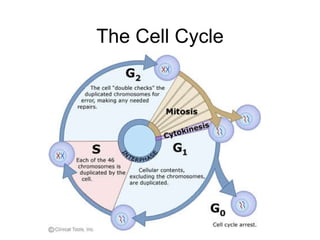
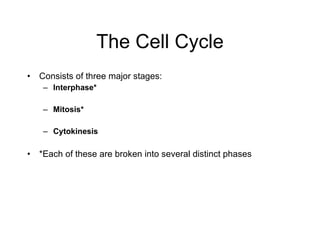
The Cell Cycle Consists of three major stages: Interphase* Mitosis* Cytokinesis *Each of these are broken into several distinct phases
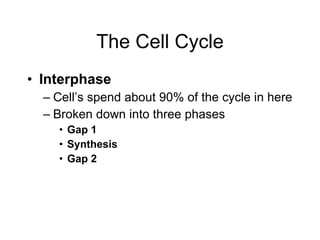
The Cell Cycle Interphase Cell’s spend about 90% of the cycle in here Broken down into three phases Gap 1  Synthesis Gap 2
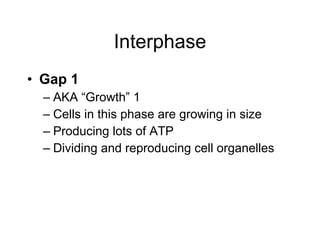
Interphase Gap 1 AKA “Growth” 1 Cells in this phase are growing in size Producing lots of ATP Dividing and reproducing cell organelles
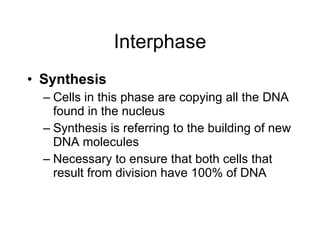
Interphase Synthesis Cells in this phase are copying all the DNA found in the nucleus Synthesis is referring to the building of new DNA molecules Necessary to ensure that both cells that result from division have 100% of DNA
Interphase Gap 2 AKA “Growth” 2 Cells in the phase are checking to make sure their DNA has been replicated correctly Check to make sure organelles are copied
The Cell Cycle Assuming everything is ready at the G2 phase, the cell will proceed to division Cell division in humans is called  mitosis Has four phases Prophase Metaphase Anaphase Telophase
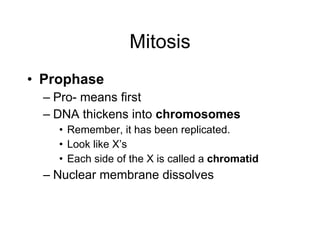
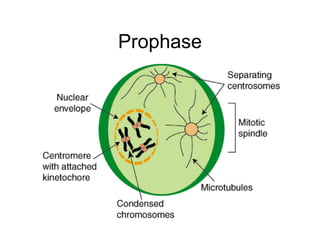
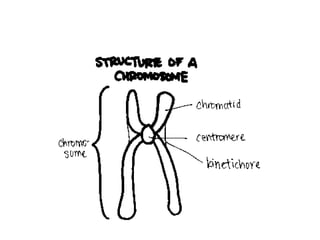
Mitosis Prophase Pro- means first DNA thickens into  chromosomes Remember, it has been replicated. Look like X’s Each side of the X is called a  chromatid Nuclear membrane dissolves
Prophase
 
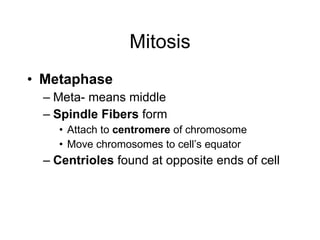
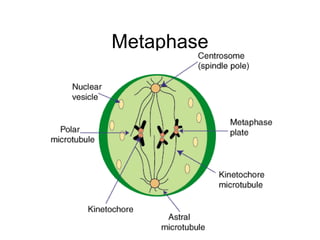
Mitosis Metaphase Meta- means middle Spindle Fibers  form Attach to  centromere  of chromosome Move chromosomes to cell’s equator Centrioles  found at opposite ends of cell
Metaphase
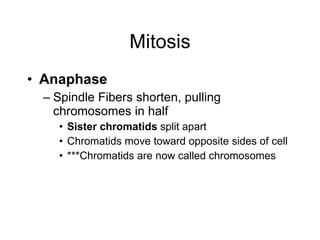
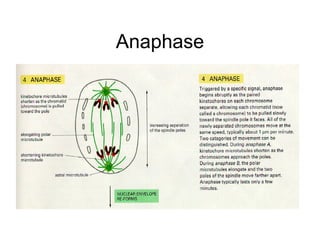
Mitosis Anaphase Spindle Fibers shorten, pulling chromosomes in half Sister chromatids  split apart Chromatids move toward opposite sides of cell ***Chromatids are now called chromosomes
Anaphase
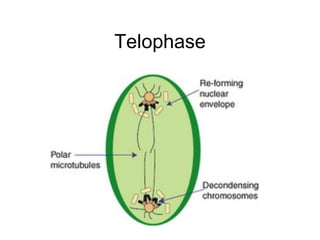
Mitosis Telophase Chromosomes reach the cell’s poles Two new nuclei form…one around each set of chromosomes at opposite ends Chromosomes unwind Spindle fibers dissolve
Telophase
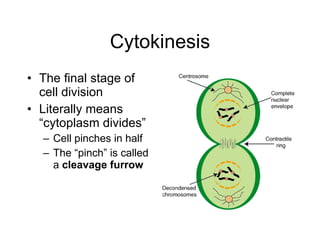
Cytokinesis The final stage of cell division Literally means “cytoplasm divides” Cell pinches in half The “pinch” is called a  cleavage furrow
Differentiation Humans are conceived when a sperm and egg unite, forming a single-celled  zygote Zygotes are unspecialized When we are born, we have more than 260 specialized cell types How???  Differentiation
Differentiation Cells specialize by  differentiating  into certain cell types They turn off parts of DNA that they don’t need Use only the parts of DNA that are needed to become a specific cell *Cells that are specialized generally can’t change and become other cell types
Differentiation Stem Cells Unspecialized cells that can can become ANY type of cell in the body Stem cells found in every organ in body Stimulated to divide when… Growth is needed Damage needs to be repaired
Differentiation When a stem cell divides… Two cells are produced through  mitosis One cell is a new stem cell (unspecialized) One cell is called a  progenitor cell Somewhat specialized Will divide many more times, with each daughter cell become more and more specialized *Cells “decide” to become specialized at the  end of the G1 phase  of cell cycle See Page 69 in textbook!!!
Apoptosis Defined as programmed  cell death Happens at the end of  G1  in cell cycle Occurs for many reasons Sculpting organs from overgrown tissue in the fetus Removes webbing between fingers as fetus Destroys skin cells following a sunburn

Cell differentiation notes

  • 1.
    Cell Cycle &Differentiation Chapter 3 Unit 1
  • 2.
    The Cell CycleA set of events that occur during a cell’s lifetime From the time a cell is “born” until it divides Cycle is repeated for each cell Includes: Growth Preparation Division
  • 3.
  • 4.
    The Cell CycleConsists of three major stages: Interphase* Mitosis* Cytokinesis *Each of these are broken into several distinct phases
  • 5.
    The Cell CycleInterphase Cell’s spend about 90% of the cycle in here Broken down into three phases Gap 1 Synthesis Gap 2
  • 6.
    Interphase Gap 1AKA “Growth” 1 Cells in this phase are growing in size Producing lots of ATP Dividing and reproducing cell organelles
  • 7.
    Interphase Synthesis Cellsin this phase are copying all the DNA found in the nucleus Synthesis is referring to the building of new DNA molecules Necessary to ensure that both cells that result from division have 100% of DNA
  • 8.
    Interphase Gap 2AKA “Growth” 2 Cells in the phase are checking to make sure their DNA has been replicated correctly Check to make sure organelles are copied
  • 9.
    The Cell CycleAssuming everything is ready at the G2 phase, the cell will proceed to division Cell division in humans is called mitosis Has four phases Prophase Metaphase Anaphase Telophase
  • 10.
    Mitosis Prophase Pro-means first DNA thickens into chromosomes Remember, it has been replicated. Look like X’s Each side of the X is called a chromatid Nuclear membrane dissolves
  • 11.
  • 12.
  • 13.
    Mitosis Metaphase Meta-means middle Spindle Fibers form Attach to centromere of chromosome Move chromosomes to cell’s equator Centrioles found at opposite ends of cell
  • 14.
  • 15.
    Mitosis Anaphase SpindleFibers shorten, pulling chromosomes in half Sister chromatids split apart Chromatids move toward opposite sides of cell ***Chromatids are now called chromosomes
  • 16.
  • 17.
    Mitosis Telophase Chromosomesreach the cell’s poles Two new nuclei form…one around each set of chromosomes at opposite ends Chromosomes unwind Spindle fibers dissolve
  • 18.
  • 19.
    Cytokinesis The finalstage of cell division Literally means “cytoplasm divides” Cell pinches in half The “pinch” is called a cleavage furrow
  • 20.
    Differentiation Humans areconceived when a sperm and egg unite, forming a single-celled zygote Zygotes are unspecialized When we are born, we have more than 260 specialized cell types How??? Differentiation
  • 21.
    Differentiation Cells specializeby differentiating into certain cell types They turn off parts of DNA that they don’t need Use only the parts of DNA that are needed to become a specific cell *Cells that are specialized generally can’t change and become other cell types
  • 22.
    Differentiation Stem CellsUnspecialized cells that can can become ANY type of cell in the body Stem cells found in every organ in body Stimulated to divide when… Growth is needed Damage needs to be repaired
  • 23.
    Differentiation When astem cell divides… Two cells are produced through mitosis One cell is a new stem cell (unspecialized) One cell is called a progenitor cell Somewhat specialized Will divide many more times, with each daughter cell become more and more specialized *Cells “decide” to become specialized at the end of the G1 phase of cell cycle See Page 69 in textbook!!!
  • 24.
    Apoptosis Defined asprogrammed cell death Happens at the end of G1 in cell cycle Occurs for many reasons Sculpting organs from overgrown tissue in the fetus Removes webbing between fingers as fetus Destroys skin cells following a sunburn