The Cell Division Cycle
Alena Prašnická
Cell division
“Where a cell arises, there must be a previous cell, just as animals can only arise
from animals and plants from plants.”
◦ Rudolf Virchow in 1858
reproduction of cells is carried out as the sequence of reactions in which the cell
duplicates its contents and divides into two cells - cell cycle
Cell division
Unicellular organism
• production of a complete new organism
Multicellular organism
• reproduction of individuals
• embryonic development of the individuals
• repair processes
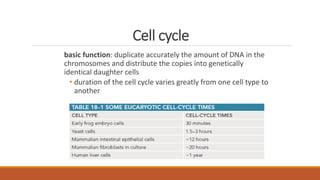
Cell cycle
basic function: duplicate accurately the amount of DNA in the
chromosomes and distribute the copies into genetically
identical daughter cells
• duration of the cell cycle varies greatly from one cell type to
another
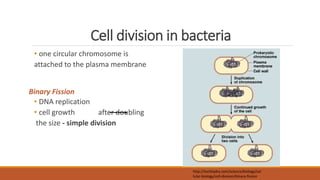
Cell division in bacteria
• one circular chromosome is
attached to the plasma membrane
Binary Fission
• DNA replication
• cell growth after doubling
the size - simple division
http://techhydra.com/science/biology/cel
lular-biology/cell-division/binary-fission
Cell division – eucaryotic cell
more complicated then cell division in bacteria
• genetic information in nucleus
• cytoskeleton
• organelles
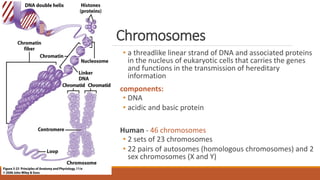
Chromosomes
• a threadlike linear strand of DNA and associated proteins
in the nucleus of eukaryotic cells that carries the genes
and functions in the transmission of hereditary
information
components:
• DNA
• acidic and basic protein
Human - 46 chromosomes
• 2 sets of 23 chromosomes
• 22 pairs of autosomes (homologous chromosomes) and 2
sex chromosomes (X and Y)
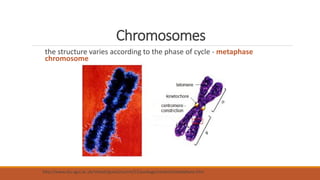
Chromosomes
the structure varies according to the phase of cycle - metaphase
chromosome
http://www.elu.sgul.ac.uk/rehash/guest/scorm/53/package/content/metaphase.htm
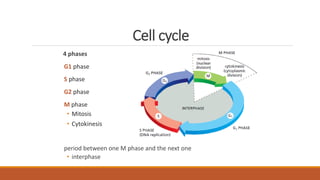
Cell cycle
4 phases
G1 phase
S phase
G2 phase
M phase
• Mitosis
• Cytokinesis
period between one M phase and the next one
• interphase
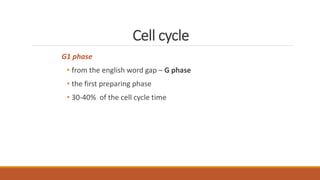
Cell cycle
G1 phase
• from the english word gap – G phase
• the first preparing phase
• 30-40% of the cell cycle time
Cell cycle
G1 phase
• cell grows in size and synthesizes:
RNA, proteins
nucleotides
enzymes for replication
organelles
mitochondia, chloroplasts, centriols
ER, GA – fragmentation : distribution of organelles fragments
forming organelles in the daughter cells
GO phase
Cell cycle
S phase
• synthetic phase
• nuclear DNA replication
• 30-50% of the cell cycle time
Cell cycle
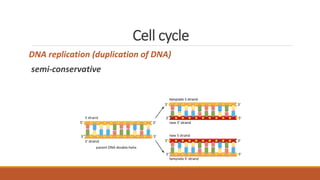
DNA replication (duplication of DNA)
semi-conservative
Cell cycle
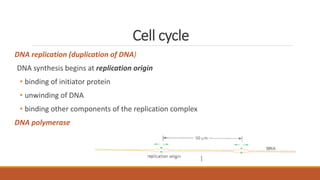
DNA replication (duplication of DNA)
DNA synthesis begins at replication origin
• binding of initiator protein
• unwinding of DNA
• binding other components of the replication complex
DNA polymerase
Cell cycle
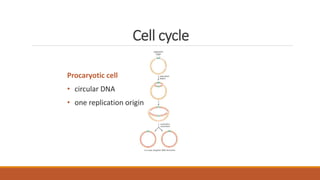
Procaryotic cell
• circular DNA
• one replication origin
Cell cycle
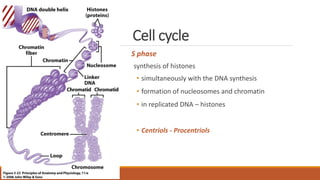
S phase
synthesis of histones
• simultaneously with the DNA synthesis
• formation of nucleosomes and chromatin
• in replicated DNA – histones
• Centriols - Procentriols
Cell cycle
G2 phase
• the second preparing phase
• 10-20% of the cell cycle time
• cell continue in growing
• synthesis of RNA, protein
preparing for mitotic cell division
Cell cycle
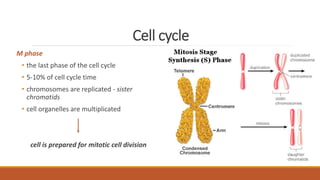
M phase
• the last phase of the cell cycle
• 5-10% of cell cycle time
• chromosomes are replicated - sister
chromatids
• cell organelles are multiplicated
cell is prepared for mitotic cell division
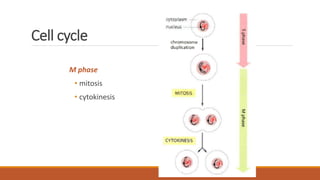
Cell cycle
M phase
• mitosis
• cytokinesis
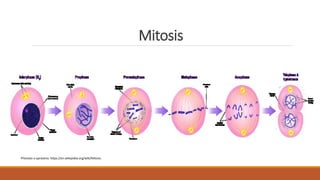
Mitosis
Převzato a upraveno: https://en.wikipedia.org/wiki/Mitosis
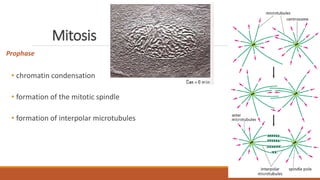
Mitosis
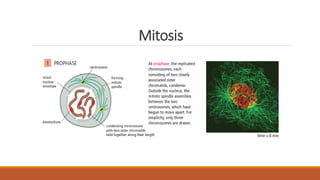
Prophase
• chromatin condensation
• formation of the mitotic spindle
• formation of interpolar microtubules
Mitosis
Mitosis
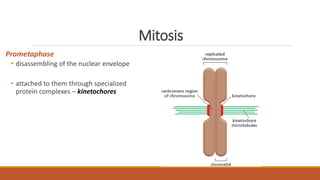
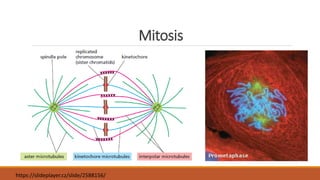
Prometaphase
• disassembling of the nuclear envelope
• attached to them through specialized
protein complexes – kinetochores
Mitosis
https://slideplayer.cz/slide/2588156/
Mitosis
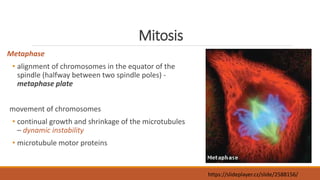
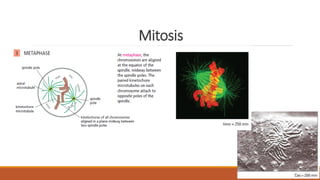
Metaphase
• alignment of chromosomes in the equator of the
spindle (halfway between two spindle poles) -
metaphase plate
movement of chromosomes
• continual growth and shrinkage of the microtubules
– dynamic instability
• microtubule motor proteins
https://slideplayer.cz/slide/2588156/
Mitosis
Mitosis
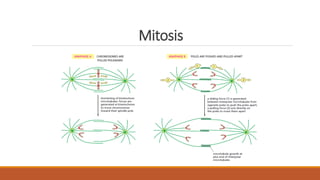
Anaphase
• segregation of chromosomes - two identical sets of chromosomes
Anaphase A – shortening of kinetochore tubules
Anaphase B – spindle poles move apart
Mitosis
Mitosis
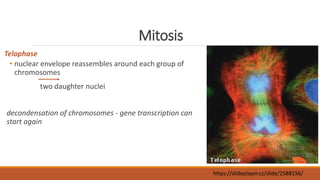
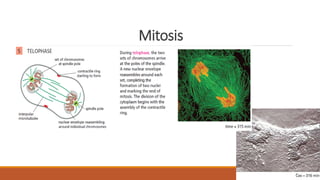
Telophase
• nuclear envelope reassembles around each group of
chromosomes
two daughter nuclei
decondensation of chromosomes - gene transcription can
start again
https://slideplayer.cz/slide/2588156/
Mitosis
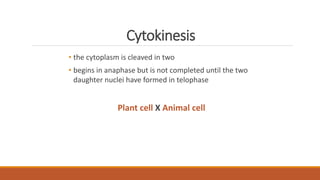
Cytokinesis
• the cytoplasm is cleaved in two
• begins in anaphase but is not completed until the two
daughter nuclei have formed in telophase
Plant cell X Animal cell
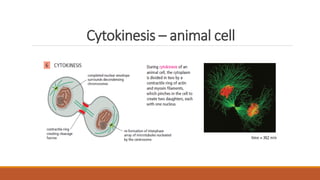
Cytokinesis – animal cell
during anaphase is formed cleavage furrow
• vertical to the axis of the mitotic spindle
• formed between the two groups of daughter
chromosomes
contractile ring
• composed mainly of actin filaments and myosin filaments
• divides cell into two daugther cells
Cytokinesis – animal cell
symmetric cytokinesis = symmetric division of cytoplasm together with
organelles
• distribution of organelles – random
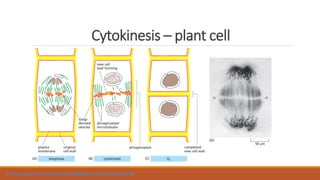
Cytokinesis – plant cell
https://www.youtube.com/watch?v=C6hn3sA0ip0&list=UUcSThfV7yiW9I5hXBnEk9Zg
Cytokinesis – plant cell
plant cell – cell wall
• new cell wall starts to assemble in the cytoplasm between the
two sets of segregated chromosomes at the start of telophase
Phragmoplast - a structure that is formed in the equator of the
old mitotic spindle
• along microtubules are transported vesicles carrying material
for the wall
derived from the Golgi apparatus
carry polysaccharides, glycoproteins
• grows from the center towards the cell surface
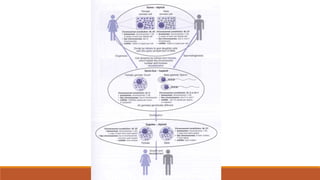
Meiosis
• type of cell division that reduces the number of chromosomes in the parent cell by
half and produces four gamete cells
• meiosis begins in specialized diploid germ-line cells in the ovaries or testes
these cells contain two copies of each chromosome, one inherited from the father organism (the
paternal homolog) and one from mother (the maternal homolog) – homologous chromosomes
Gamete cell - haploid cell n – single set of chromosomes
Somatic cell - diploid cell 2n – two sets of chromosomes, one from the mother and the
other from the father
Meiosis
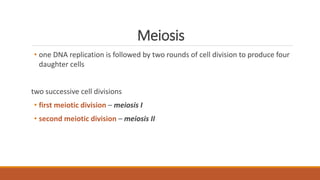
• one DNA replication is followed by two rounds of cell division to produce four
daughter cells
two successive cell divisions
• first meiotic division – meiosis I
• second meiotic division – meiosis II
Meiosis
Meiosis I
Prophase
• takes place in the nucleus with an intact membrane – only
chromosomes undergo changes
5 phases
◦ Leptotene
◦ Zygotene
◦ Pachytene
◦ Diplotene
◦ Diakinesis
Meiosis
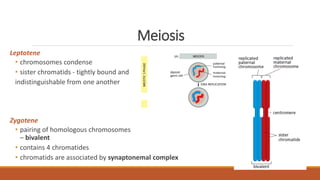
Leptotene
• chromosomes condense
• sister chromatids - tightly bound and
indistinguishable from one another
Zygotene
• pairing of homologous chromosomes
– bivalent
• contains 4 chromatides
• chromatids are associated by synaptonemal complex
Meiosis
Pachytene
• bivalent consists of four sister chromatids
nonsister chromatids of homologous chromosomes may exchange segments -
Crossing-over
• multienzyme systems responsible for chromatid recombination – in
synaptonemal complex
Meiosis
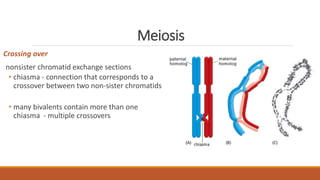
Crossing over
nonsister chromatid exchange sections
• chiasma - connection that corresponds to a
crossover between two non-sister chromatids
• many bivalents contain more than one
chiasma - multiple crossovers
Meiosis
Diplotene
• degradation of synaptonemal complex and partial
separation of homologous chromosomes
Diakinesis
• nuclear envelope begins to disappear
• centrosomes are moving towards the poles of the cell
Meiosis
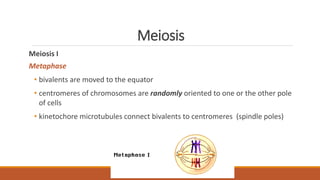
Meiosis I
Metaphase
• bivalents are moved to the equator
• centromeres of chromosomes are randomly oriented to one or the other pole
of cells
• kinetochore microtubules connect bivalents to centromeres (spindle poles)
Meiosis
Meiosis I
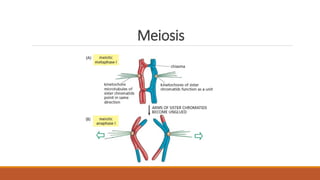
Anaphase
• segregation of homologous chromosomes - destrucion of bivalents
• complete set of chromosomes formed by recombination from the original
maternal and paternal chromosomes gets to each pole of the cell
Meiosis
Meiosis
Meiosis I
Telophase
• finish the division of nucleus and cytokinesis
Meiosis
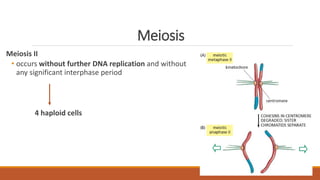
Meiosis II
• occurs without further DNA replication and without
any significant interphase period
4 haploid cells
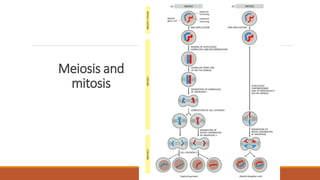
Meiosis and
mitosis
Cellular differentiation
• multicellular organisms consist of cells structurally and
functionally different
• the process of specialization - differentiation
Cellular differentiation
genetic basis of differentiation
• all cells have same genetic background – genetic
information for all types of differentiated cells is in
zygote
Cellular differentiation
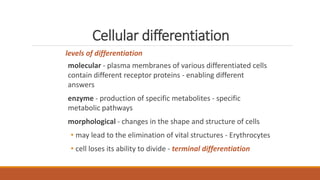
levels of differentiation
molecular - plasma membranes of various differentiated cells
contain different receptor proteins - enabling different
answers
enzyme - production of specific metabolites - specific
metabolic pathways
morphological - changes in the shape and structure of cells
• may lead to the elimination of vital structures - Erythrocytes
• cell loses its ability to divide - terminal differentiation
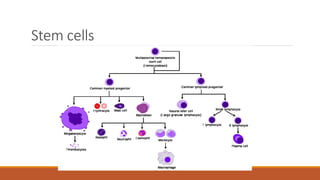
Stem cells
Cellular differentiation
irreversibility of differentiation ??
• dedifferentiation in plants - a plant callus can evolve whole
plant
• partial dedifferentiation - tissue regeneration
the subject of intense research
Thank you for your attention

12 - The Cell Division Cycle

  • 1.
    The Cell DivisionCycle Alena Prašnická
  • 2.
    Cell division “Where acell arises, there must be a previous cell, just as animals can only arise from animals and plants from plants.” ◦ Rudolf Virchow in 1858 reproduction of cells is carried out as the sequence of reactions in which the cell duplicates its contents and divides into two cells - cell cycle
  • 3.
    Cell division Unicellular organism •production of a complete new organism Multicellular organism • reproduction of individuals • embryonic development of the individuals • repair processes
  • 4.
    Cell cycle basic function:duplicate accurately the amount of DNA in the chromosomes and distribute the copies into genetically identical daughter cells • duration of the cell cycle varies greatly from one cell type to another
  • 5.
    Cell division inbacteria • one circular chromosome is attached to the plasma membrane Binary Fission • DNA replication • cell growth after doubling the size - simple division http://techhydra.com/science/biology/cel lular-biology/cell-division/binary-fission
  • 6.
    Cell division –eucaryotic cell more complicated then cell division in bacteria • genetic information in nucleus • cytoskeleton • organelles
  • 7.
    Chromosomes • a threadlikelinear strand of DNA and associated proteins in the nucleus of eukaryotic cells that carries the genes and functions in the transmission of hereditary information components: • DNA • acidic and basic protein Human - 46 chromosomes • 2 sets of 23 chromosomes • 22 pairs of autosomes (homologous chromosomes) and 2 sex chromosomes (X and Y)
  • 8.
    Chromosomes the structure variesaccording to the phase of cycle - metaphase chromosome http://www.elu.sgul.ac.uk/rehash/guest/scorm/53/package/content/metaphase.htm
  • 9.
    Cell cycle 4 phases G1phase S phase G2 phase M phase • Mitosis • Cytokinesis period between one M phase and the next one • interphase
  • 10.
    Cell cycle G1 phase •from the english word gap – G phase • the first preparing phase • 30-40% of the cell cycle time
  • 11.
    Cell cycle G1 phase •cell grows in size and synthesizes: RNA, proteins nucleotides enzymes for replication organelles mitochondia, chloroplasts, centriols ER, GA – fragmentation : distribution of organelles fragments forming organelles in the daughter cells GO phase
  • 12.
    Cell cycle S phase •synthetic phase • nuclear DNA replication • 30-50% of the cell cycle time
  • 13.
    Cell cycle DNA replication(duplication of DNA) semi-conservative
  • 14.
    Cell cycle DNA replication(duplication of DNA) DNA synthesis begins at replication origin • binding of initiator protein • unwinding of DNA • binding other components of the replication complex DNA polymerase
  • 15.
    Cell cycle Procaryotic cell •circular DNA • one replication origin
  • 16.
    Cell cycle S phase synthesisof histones • simultaneously with the DNA synthesis • formation of nucleosomes and chromatin • in replicated DNA – histones • Centriols - Procentriols
  • 17.
    Cell cycle G2 phase •the second preparing phase • 10-20% of the cell cycle time • cell continue in growing • synthesis of RNA, protein preparing for mitotic cell division
  • 18.
    Cell cycle M phase •the last phase of the cell cycle • 5-10% of cell cycle time • chromosomes are replicated - sister chromatids • cell organelles are multiplicated cell is prepared for mitotic cell division
  • 19.
    Cell cycle M phase •mitosis • cytokinesis
  • 20.
    Mitosis Převzato a upraveno:https://en.wikipedia.org/wiki/Mitosis
  • 21.
    Mitosis Prophase • chromatin condensation •formation of the mitotic spindle • formation of interpolar microtubules
  • 22.
  • 23.
    Mitosis Prometaphase • disassembling ofthe nuclear envelope • attached to them through specialized protein complexes – kinetochores
  • 24.
  • 25.
    Mitosis Metaphase • alignment ofchromosomes in the equator of the spindle (halfway between two spindle poles) - metaphase plate movement of chromosomes • continual growth and shrinkage of the microtubules – dynamic instability • microtubule motor proteins https://slideplayer.cz/slide/2588156/
  • 26.
  • 27.
    Mitosis Anaphase • segregation ofchromosomes - two identical sets of chromosomes Anaphase A – shortening of kinetochore tubules Anaphase B – spindle poles move apart
  • 28.
  • 29.
    Mitosis Telophase • nuclear envelopereassembles around each group of chromosomes two daughter nuclei decondensation of chromosomes - gene transcription can start again https://slideplayer.cz/slide/2588156/
  • 30.
  • 31.
    Cytokinesis • the cytoplasmis cleaved in two • begins in anaphase but is not completed until the two daughter nuclei have formed in telophase Plant cell X Animal cell
  • 32.
  • 33.
    Cytokinesis – animalcell during anaphase is formed cleavage furrow • vertical to the axis of the mitotic spindle • formed between the two groups of daughter chromosomes contractile ring • composed mainly of actin filaments and myosin filaments • divides cell into two daugther cells
  • 34.
    Cytokinesis – animalcell symmetric cytokinesis = symmetric division of cytoplasm together with organelles • distribution of organelles – random
  • 35.
    Cytokinesis – plantcell https://www.youtube.com/watch?v=C6hn3sA0ip0&list=UUcSThfV7yiW9I5hXBnEk9Zg
  • 36.
    Cytokinesis – plantcell plant cell – cell wall • new cell wall starts to assemble in the cytoplasm between the two sets of segregated chromosomes at the start of telophase Phragmoplast - a structure that is formed in the equator of the old mitotic spindle • along microtubules are transported vesicles carrying material for the wall derived from the Golgi apparatus carry polysaccharides, glycoproteins • grows from the center towards the cell surface
  • 37.
    Meiosis • type ofcell division that reduces the number of chromosomes in the parent cell by half and produces four gamete cells • meiosis begins in specialized diploid germ-line cells in the ovaries or testes these cells contain two copies of each chromosome, one inherited from the father organism (the paternal homolog) and one from mother (the maternal homolog) – homologous chromosomes Gamete cell - haploid cell n – single set of chromosomes Somatic cell - diploid cell 2n – two sets of chromosomes, one from the mother and the other from the father
  • 38.
    Meiosis • one DNAreplication is followed by two rounds of cell division to produce four daughter cells two successive cell divisions • first meiotic division – meiosis I • second meiotic division – meiosis II
  • 39.
    Meiosis Meiosis I Prophase • takesplace in the nucleus with an intact membrane – only chromosomes undergo changes 5 phases ◦ Leptotene ◦ Zygotene ◦ Pachytene ◦ Diplotene ◦ Diakinesis
  • 40.
    Meiosis Leptotene • chromosomes condense •sister chromatids - tightly bound and indistinguishable from one another Zygotene • pairing of homologous chromosomes – bivalent • contains 4 chromatides • chromatids are associated by synaptonemal complex
  • 41.
    Meiosis Pachytene • bivalent consistsof four sister chromatids nonsister chromatids of homologous chromosomes may exchange segments - Crossing-over • multienzyme systems responsible for chromatid recombination – in synaptonemal complex
  • 42.
    Meiosis Crossing over nonsister chromatidexchange sections • chiasma - connection that corresponds to a crossover between two non-sister chromatids • many bivalents contain more than one chiasma - multiple crossovers
  • 43.
    Meiosis Diplotene • degradation ofsynaptonemal complex and partial separation of homologous chromosomes Diakinesis • nuclear envelope begins to disappear • centrosomes are moving towards the poles of the cell
  • 44.
    Meiosis Meiosis I Metaphase • bivalentsare moved to the equator • centromeres of chromosomes are randomly oriented to one or the other pole of cells • kinetochore microtubules connect bivalents to centromeres (spindle poles)
  • 45.
    Meiosis Meiosis I Anaphase • segregationof homologous chromosomes - destrucion of bivalents • complete set of chromosomes formed by recombination from the original maternal and paternal chromosomes gets to each pole of the cell
  • 46.
  • 47.
    Meiosis Meiosis I Telophase • finishthe division of nucleus and cytokinesis
  • 48.
    Meiosis Meiosis II • occurswithout further DNA replication and without any significant interphase period 4 haploid cells
  • 49.
  • 51.
    Cellular differentiation • multicellularorganisms consist of cells structurally and functionally different • the process of specialization - differentiation
  • 52.
    Cellular differentiation genetic basisof differentiation • all cells have same genetic background – genetic information for all types of differentiated cells is in zygote
  • 53.
    Cellular differentiation levels ofdifferentiation molecular - plasma membranes of various differentiated cells contain different receptor proteins - enabling different answers enzyme - production of specific metabolites - specific metabolic pathways morphological - changes in the shape and structure of cells • may lead to the elimination of vital structures - Erythrocytes • cell loses its ability to divide - terminal differentiation
  • 54.
  • 55.
    Cellular differentiation irreversibility ofdifferentiation ?? • dedifferentiation in plants - a plant callus can evolve whole plant • partial dedifferentiation - tissue regeneration the subject of intense research
  • 56.
    Thank you foryour attention