1
Three Phase Controlled
Rectifiers
2
3 Phase Controlled Rectifiers
• Operate from 3 phase ac supply voltage.
• They provide higher dc output voltage.
• Higher dc output power.
• Higher output voltage ripple frequency.
• Filtering requirements are simplified for
smoothing out load voltage and load
current.
3
• Extensively used in high power variable
speed industrial dc drives.
• Three single phase half-wave converters
can be connected together to form a three
phase half-wave converter.
4
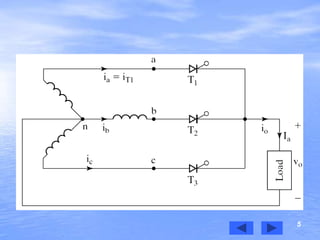
3-Phase Half Wave Converter
(3-Pulse Converter)
with RL Load
Continuous & Constant
Load Current Operation
5
6
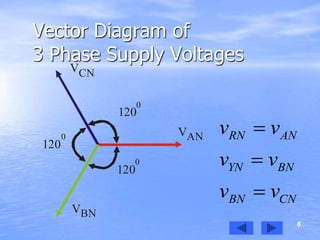
Vector Diagram of
3 Phase Supply Voltages
VAN
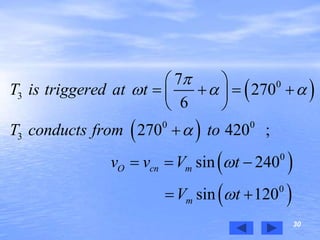
VCN
VBN
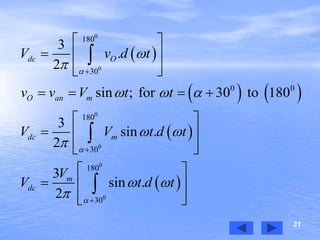
120
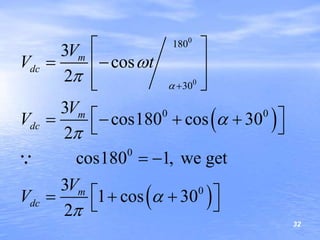
0
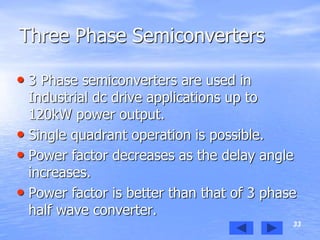
120
0
120
0 RN AN
YN BN
BN CN
v v
v v
v v



7
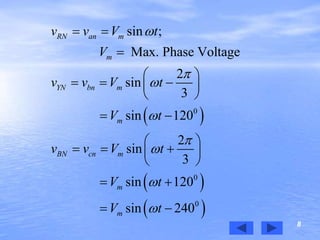
3 Phase Supply Voltage
Equations
We deifine three line to neutral voltages
(3 phase voltages) as follows
8
 
 
 
0
0
0
sin ;
Max. Phase Voltage
2
sin
3
sin 120
2
sin
3
sin 120
sin 240
RN an m
m
YN bn m
m
BN cn m
m
m
v v V t
V
v v V t
V t
v v V t
V t
V t








 

 
   
 
 
 
   
 
 
 
9
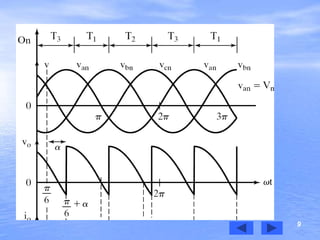
van vbn vcn van
10
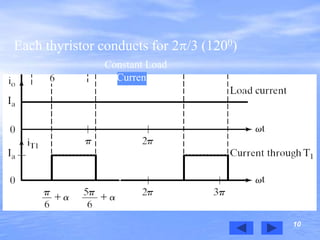
io=Ia
Constant Load
Current
Ia
Ia
Each thyristor conducts for 2/3 (1200)
11
To Derive an Expression for
the Average Output Voltage of
a 3-Phase Half Wave
Converter with RL Load for
Continuous Load Current
12
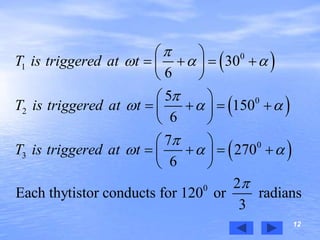
 
 
 
0
1
0
2
0
3
0
30
6
5
150
6
7
270
6
2
Each thytistor conducts for 120 or radians
3
T is triggered at t
T is triggered at t
T is triggered at t

  

  

  

 
    
 
 
    
 
 
    
 
13
 
5
6
6
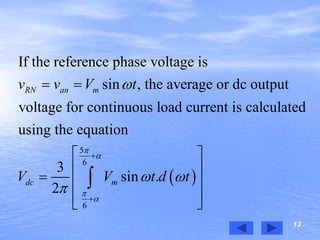
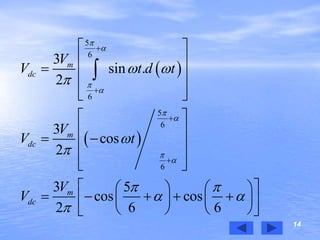
If the reference phase voltage is
sin , the average or dc output
voltage for continuous load current is calculated
using the equation
3
sin .
2
RN an m
dc m
v v V t
V V t d t





 



 
 
 
  
  

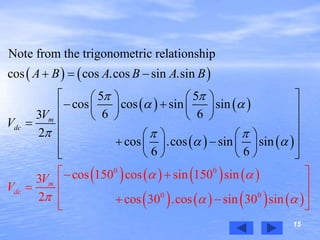
14
 
 
5
6
6
5
6
6
3
sin .
2
3
cos
2
3 5
cos cos
2 6 6
m
dc
m
dc
m
dc
V
V t d t
V
V t
V
V








 



 
 





 
 
  
  
 
 
  
  
    
        
    

15
   
   
   
       
   
0 0
0
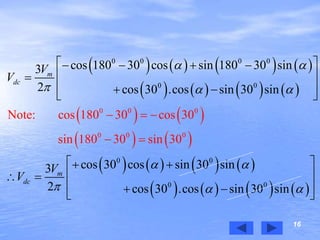
Note from the trigonometric relationship
cos cos .cos sin .sin
5 5
cos cos sin sin
6 63
2
co
cos 150 cos sin 150 sin3
2 cos 30
s .cos sin sin
6 6
.cos
m
dc
m
dc
A
V
V
B A B A B
V
V
 
 
  




 
  
    
     
    
    
     
   





    0
sin 30 sin 
 
 
 
 
16
       
       
   
   
       
       
0 0
0 0 0 0
0 0
0 0
0
0
0
0
0 0
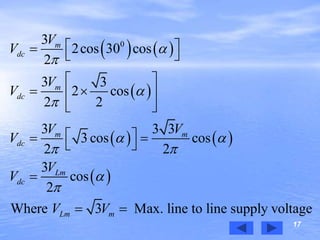
Note: cos 1
cos 180 30 cos sin 180 30 sin3
2 cos 30 .cos sin 30 sin
cos 30 cos sin 30 sin3
2 cos 30 .cos sin 30 s
80 30 cos 30
sin 180 30 sin 30
in
m
dc
m
dc
V
V
V
V
 
  
 
  
 
    
 
   
  
  
  




17
   
 
   
 
03
2cos 30 cos
2
3 3
2 cos
2 2
3 3 3
3 cos cos
2 2
3
cos
2
Where 3 Max. line to line supply voltage
m
dc
m
dc
m m
dc
Lm
dc
Lm m
V
V
V
V
V V
V
V
V
V V




 
 


   
 
  
 
   

 
18
 max
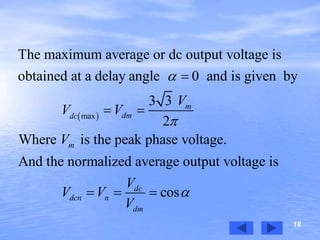
The maximum average or dc output voltage is
obtained at a delay angle 0 and is given by
3 3
2
Where is the peak phase voltage.
And the normalized average output voltage is
m
dmdc
m
d
dcn n
V
V V
V
V
V V



 
  cosc
dmV

19
   
 
1
5 2
6
2 2
6
1
2
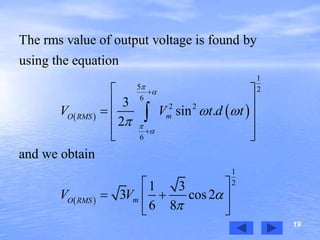
The rms value of output voltage is found by
using the equation
3
sin .
2
and we obtain
1 3
3 cos2
6 8
mO RMS
mO RMS
V V t d t
V V




 





 
 
  
  
 
  
 

20
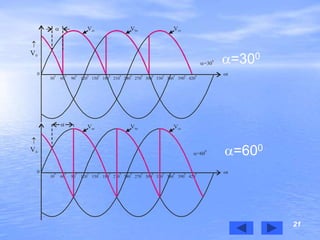
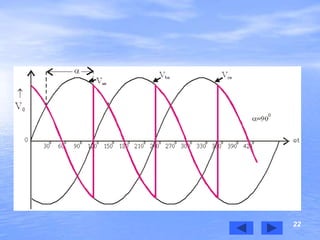
3 Phase Half Wave
Controlled Rectifier Output
Voltage Waveforms For RL Load
at Different Trigger Angles
21
0
0
30
0
30
0
60
0
60
0
90
0
90
0
120
0
120
0
150
0
150
0
180
0
180
0
210
0
210
0
240
0
240
0
270
0
270
0
300
0
300
0
330
0
330
0
360
0
360
0
390
0
390
0
420
0
420
0
Van

V0

V0
Van


=30
0
=60
0
Vbn
Vbn
Vcn
Vcn
t
t
=300
=600
22
=900
23
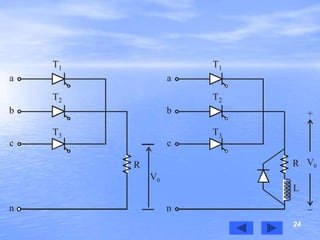
3 Phase Half Wave
Controlled Rectifier With
R Load and RL Load with FWD
24
a a
b b
c c
R
V0
L
R V0
+

T1
T2
T3
n n
T1
T2
T3
25
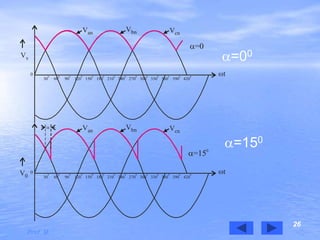
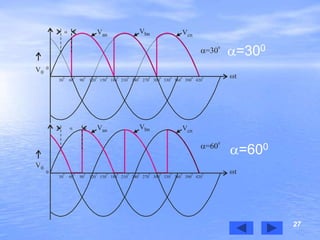
3 Phase Half Wave
Controlled Rectifier Output
Voltage Waveforms For R Load
or RL Load with FWD
at Different Trigger Angles
26
Prof. M.
0
0
30
0
30
0
60
0
60
0
90
0
90
0
120
0
120
0
150
0
150
0
180
0
180
0
210
0
210
0
240
0
240
0
270
0
270
0
300
0
300
0
330
0
330
0
360
0
360
0
390
0
390
0
420
0
420
0
Vs
V0
Van

=0
=150
Vbn Vcn
t
Van
Vbn Vcn
t
=00
=150
27
0
0
30
0
30
0
60
0
60
0
90
0
90
0
120
0
120
0
150
0
150
0
180
0
180
0
210
0
210
0
240
0
240
0
270
0
270
0
300
0
300
0
330
0
330
0
360
0
360
0
390
0
390
0
420
0
420
0


V0
=30
0
Van
Vbn Vcn
t
V0
=600
Van
Vbn Vcn
t
=300
=600
28
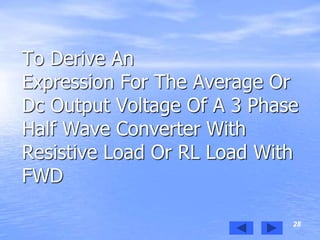
To Derive An
Expression For The Average Or
Dc Output Voltage Of A 3 Phase
Half Wave Converter With
Resistive Load Or RL Load With
FWD
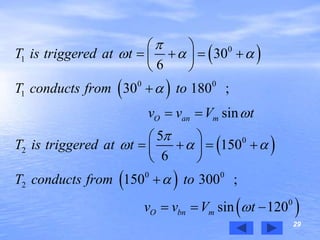
29
 
 
 
 
 
0
1
0 0
1
0
2
0 0
2
0
30
6
30 180 ;
sin
5
150
6
150 300 ;
sin 120
O an m
O bn m
T is triggered at t
T conducts from to
v v V t
T is triggered at t
T conducts from to
v v V t

  



  


 
    
 

 
 
    
 

  
30
 
 
 
 
0
3
0 0
3
0
0
7
270
6
270 420 ;
sin 240
sin 120
O cn m
m
T is triggered at t
T conducts from to
v v V t
V t

  



 
    
 

  
 
31
 
   
 
 
0
0
0
0
0
0
180
30
0 0
180
30
180
30
3
.
2
sin ; for 30 to 180
3
sin .
2
3
sin .
2
dc O
O an m
dc m
m
dc
V v d t
v v V t t
V V t d t
V
V t d t





  
 

 




 
  
  
   
 
  
  
 
  
  



32
 
 
0
0
180
30
0 0
0
0
3
cos
2
3
cos180 cos 30
2
cos180 1, we get
3
1 cos 30
2
m
dc
m
dc
m
dc
V
V t
V
V
V
V








 
  
  
     
 
    
33
Three Phase Semiconverters
• 3 Phase semiconverters are used in
Industrial dc drive applications up to
120kW power output.
• Single quadrant operation is possible.
• Power factor decreases as the delay angle
increases.
• Power factor is better than that of 3 phase
half wave converter.
34
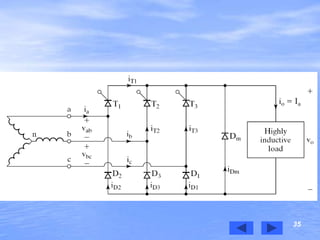
3 Phase Half Controlled Bridge
Converter
(Semi Converter) with Highly
Inductive Load & Continuous
Ripple free Load Current
35
36
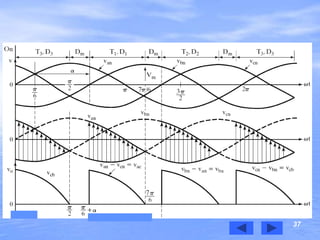
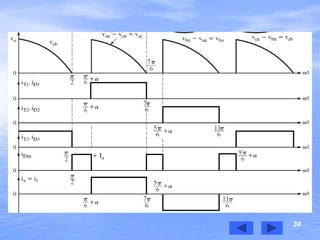
Wave forms of 3 Phase
Semiconverter for  > 600
37
38
39
0 0
1
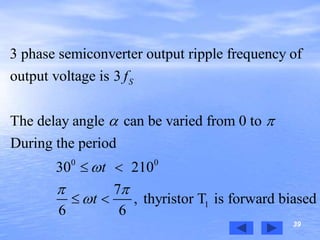
3 phase semiconverter output ripple frequency of
output voltage is 3
The delay angle can be varied from 0 to
During the period
30 210
7
, thyristor T is forward biased
6 6
Sf
t
t
 

 

 
 
40
1
1 1
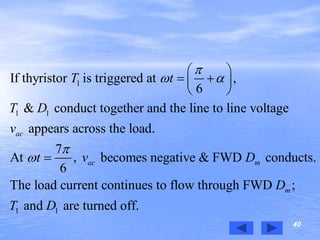
If thyristor is triggered at ,
6
& conduct together and the line to line voltage
appears across the load.
7
At , becomes negative & FWD conducts.
6
The load current contin
ac
ac m
T t
T D
v
t v D

 


 
  
 

1 1
ues to flow through FWD ;
and are turned off.
mD
T D
41
1
2
1 2
If FWD is not used the would continue to
conduct until the thyristor is triggered at
5
, and Free wheeling action would
6
be accomplished through & .
If the delay angle , e
3
mD T
T
t
T D

 


 
  
 
 ach thyristor conducts
2
for and the FWD does not conduct.
3
mD

42
 
 
 
0
0
0
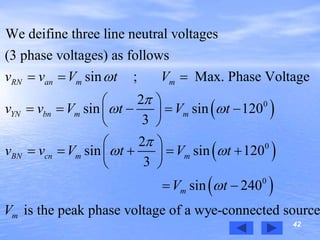
We deifine three line neutral voltages
(3 phase voltages) as follows
sin ; Max. Phase Voltage
2
sin sin 120
3
2
sin sin 120
3
sin 240
RN an m m
YN bn m m
BN cn m m
m
v v V t V
v v V t V t
v v V t V t
V t
V


 

 

  
 
     
 
 
     
 
 
is the peak phase voltage of a wye-connected sourcem
43
 
 
 
 
3 sin
6
5
3 sin
6
3 sin
2
3 sin
6
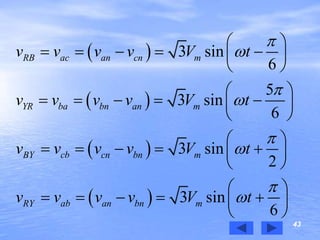
RB ac an cn m
YR ba bn an m
BY cb cn bn m
RY ab an bn m
v v v v V t
v v v v V t
v v v v V t
v v v v V t








 
     
 
 
     
 
 
     
 
 
     
 
44
Wave forms of 3 Phase
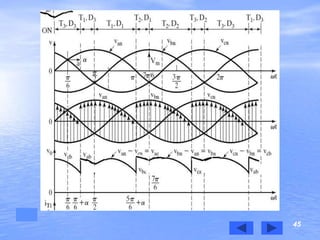
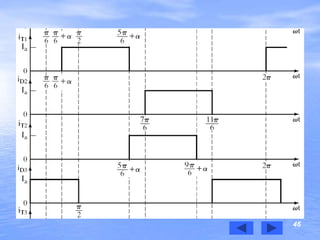
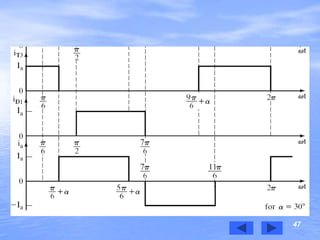
Semiconverter for   600
45
46
47
48
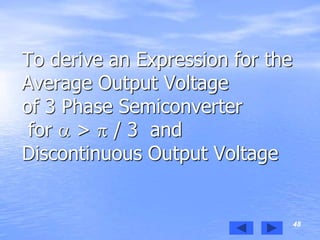
To derive an Expression for the
Average Output Voltage
of 3 Phase Semiconverter
for  >  / 3 and
Discontinuous Output Voltage
49
 
 
7
6
6
7
6
6
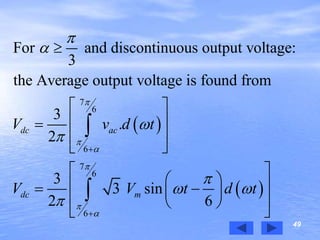
For and discontinuous output voltage:
3
the Average output voltage is found from
3
.
2
3
3 sin
2 6
dc ac
dc m
V v d t
V V t d t











 




 
 
 
 
 
    
  
 


50
 
 
 max
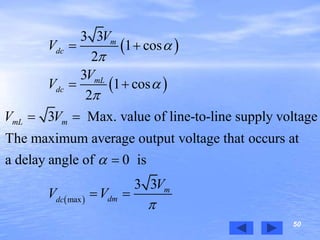
3 3
1 cos
2
3
1 cos
2
3 Max. value of line-to-line supply voltage
The maximum average output voltage that occurs at
a delay angle of 0 is
3 3
m
dc
mL
dc
mL m
m
dmdc
V
V
V
V
V V
V
V V






 
 
 

 
51
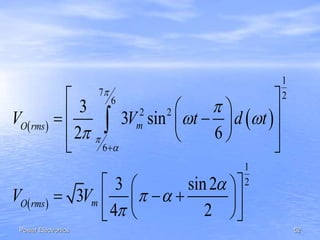
 
   
1
7 26
2
6
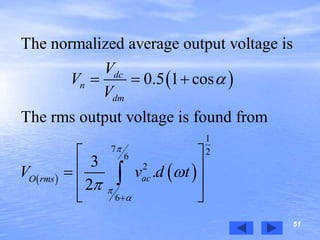
The normalized average output voltage is
0.5 1 cos
The rms output voltage is found from
3
.
2
dc
n
dm
acO rms
V
V
V
V v d t







  
 
 
 
 

Power Electronics 52
   
 
1
7 26
2 2
6
1
2
3
3 sin
2 6
3 sin2
3
4 2
mO rms
mO rms
V V t d t
V V




 


 


 
    
  
 
  
    
  

53
Average or DC Output Voltage
of a 3-Phase Semiconverter for
 / 3,
and Continuous Output Voltage
54
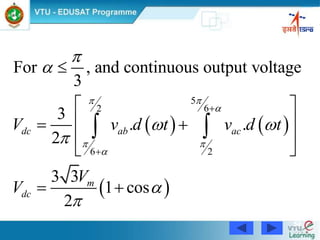
   
 
5
62
6 2
For , and continuous output voltage
3
3
. .
2
3 3
1 cos
2
dc ab ac
m
dc
V v d t v d t
V
V


 



 






 
  
 
 
 
 
55
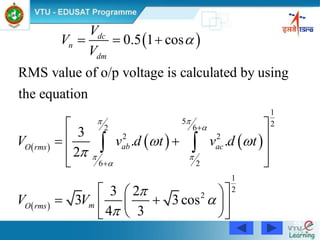
 
     
 
1
5 262
2 2
6 2
1
2
2
0.5 1 cos
RMS value of o/p voltage is calculated by using
the equation
3
. .
2
3 2
3 3 cos
4 3
dc
n
dm
ab acO rms
mO rms
V
V
V
V v d t v d t
V V


 


 






  
 
  
 
 
  
   
  
 
56
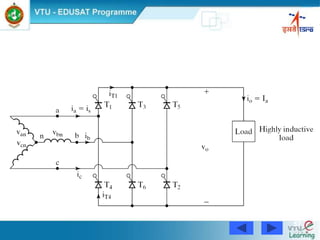
Three Phase Full Converter
• 3 Phase Fully Controlled Full Wave Bridge
Converter.
• Known as a 6-pulse converter.
• Used in industrial applications up to
120kW output power.
• Two quadrant operation is possible.
57
58
59
60
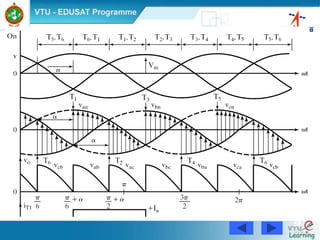
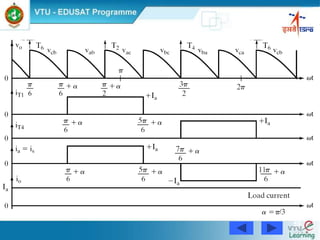
• The thyristors are triggered at an interval
of  / 3.
• The frequency of output ripple voltage is
6fS.
• T1 is triggered at t = (/6 + ), T6 is
already conducting when T1 is turned ON.
• During the interval (/6 + ) to (/2 + ),
T1 and T6 conduct together & the output
load voltage is equal to vab = (van – vbn)
61
• T2 is triggered at t = (/2 + ), T6 turns
off naturally as it is reverse biased as soon
as T2 is triggered.
• During the interval (/2 + ) to (5/6 +
), T1 and T2 conduct together & the
output load voltage vO = vac = (van – vcn)
• Thyristors are numbered in the order in
which they are triggered.
• The thyristor triggering sequence is 12,
23, 34, 45, 56, 61, 12, 23, 34, ………
62
 
 
 
0
0
0
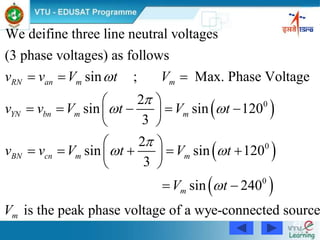
We deifine three line neutral voltages
(3 phase voltages) as follows
sin ; Max. Phase Voltage
2
sin sin 120
3
2
sin sin 120
3
sin 240
RN an m m
YN bn m m
BN cn m m
m
v v V t V
v v V t V t
v v V t V t
V t
V


 

 

  
 
     
 
 
     
 
 
is the peak phase voltage of a wye-connected sourcem
63
 
 
 
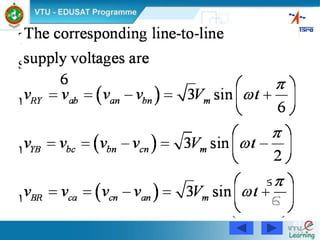
The corresponding line-to-line
supply voltages are
3 sin
6
3 sin
2
3 sin
2
RY ab an bn m
YB bc bn cn m
BR ca cn an m
v v v v V t
v v v v V t
v v v v V t






 
     
 
 
     
 
 
     
 
64
To Derive An Expression For The Average
Output Voltage Of 3-phase Full Converter
With Highly Inductive Load Assuming
Continuous And Constant Load Current
65
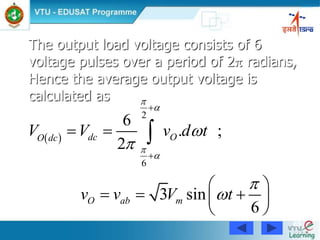
 
2
6
6
. ;
2
3 sin
6
dc OO dc
O ab m
V V v d t
v v V t










 
 
   
 

The output load voltage consists of 6
voltage pulses over a period of 2 radians,
Hence the average output voltage is
calculated as
66
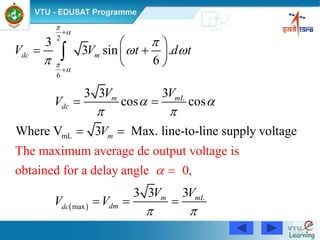
 
2
6
mL
max
3
3 sin .
6
3 3 3
cos cos
Where V 3 Max. line-to-line supply vo
The maximum average dc output voltage is
obtained for a delay angle
ltage
3 3
0,
3
dc m
m mL
dc
m
m m
dmdc
V V t d t
V V
V
V
V V
V V





 

 






 
  
 
 



  

L

67
   
1
2
2
2
6
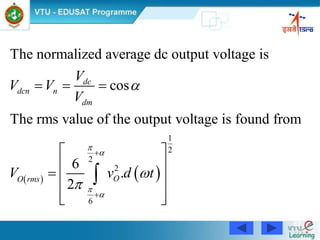
The normalized average dc output voltage is
cos
The rms value of the output voltage is found from
6
.
2
dc
dcn n
dm
OO rms
V
V V
V
V v d t









  
 
 
  
  

68
   
   
 
1
2
2
2
6
1
2
2
2 2
6
1
2
6
.
2
3
3 sin .
2 6
1 3 3
3 cos2
2 4
abO rms
mO rms
mO rms
V v d t
V V t d t
V V











 







 
 
  
  
 
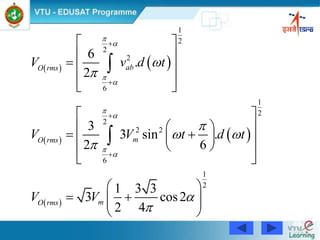
  
    
  
 
   
 


Power Electronics 69
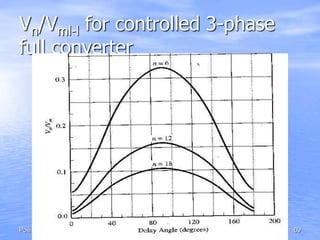
Vn/Vml-l for controlled 3-phase
full converter
Power Electronics 70
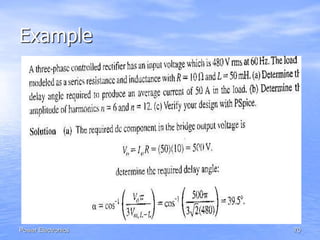
Example
Power Electronics 71
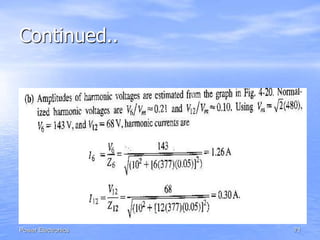
Continued..
72
Three Phase Dual Converters
• For four quadrant operation in many
industrial variable speed dc drives , 3
phase dual converters are used.
• Used for applications up to 2 mega watt
output power level.
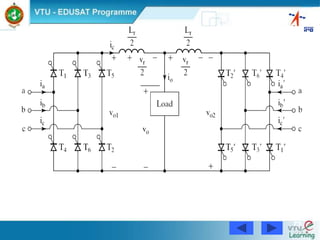
• Dual converter consists of two 3 phase full
converters which are connected in parallel
& in opposite directions across a common
load.
73
74
75
76
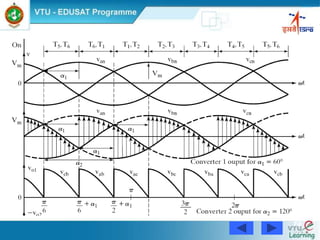
Outputs of Converters 1 & 2
• During the interval (/6 + 1) to (/2 +
1), the line to line voltage vab appears
across the output of converter 1 and vbc
appears across the output of converter 2
77
 
 
 
0
0
0
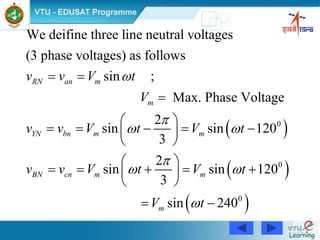
We deifine three line neutral voltages
(3 phase voltages) as follows
sin ;
Max. Phase Voltage
2
sin sin 120
3
2
sin sin 120
3
sin 240
RN an m
m
YN bn m m
BN cn m m
m
v v V t
V
v v V t V t
v v V t V t
V t


 

 

 

 
     
 
 
     
 
 
78
 
 
 
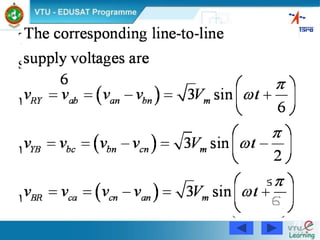
The corresponding line-to-line
supply voltages are
3 sin
6
3 sin
2
3 sin
2
RY ab an bn m
YB bc bn cn m
BR ca cn an m
v v v v V t
v v v v V t
v v v v V t






 
     
 
 
     
 
 
     
 
79
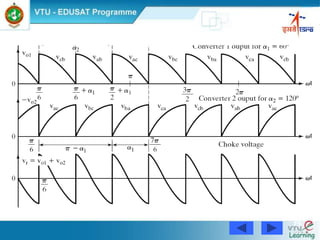
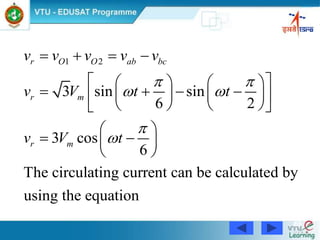
• If vO1 and vO2 are the output voltages of
converters 1 and 2 respectively, the
instantaneous voltage across the current
limiting inductor during the interval
(/6 + 1)  t  (/2 + 1) is given by
To obtain an Expression for the
Circulating Current
80
1 2
3 sin sin
6 2
3 cos
6
The circulating current can be calculated by
using the equation
r O O ab bc
r m
r m
v v v v v
v V t t
v V t
 
 


   
    
       
    
 
  
 
81
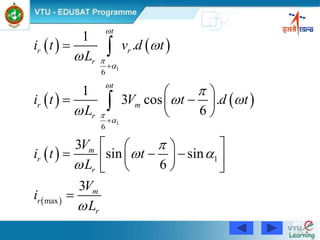
   
   
 
 
1
1
6
6
1
max
1
.
1
3 cos .
6
3
sin sin
6
3
t
r r
r
t
r m
r
m
r
r
m
r
r
i t v d t
L
i t V t d t
L
V
i t t
L
V
i
L









 


 





 
  
 
  
    
  



82
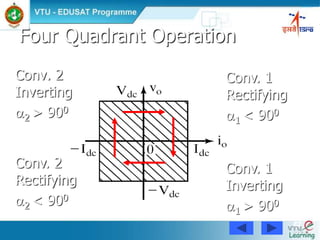
Four Quadrant Operation
Conv. 2
Inverting
2 > 900
Conv. 2
Rectifying
2 < 900
Conv. 1
Rectifying
1 < 900
Conv. 1
Inverting
1 > 900
83
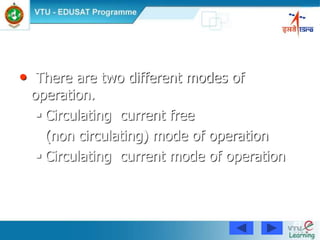
• There are two different modes of
operation.
 Circulating current free
(non circulating) mode of operation
 Circulating current mode of operation
84
Non Circulating
Current Mode Of Operation
• In this mode of operation only one
converter is switched on at a time
• When the converter 1 is switched on,
For 1 < 900 the converter 1 operates in
the Rectification mode
Vdc is positive, Idc is positive and hence the
average load power Pdc is positive.
• Power flows from ac source to the load
85
• When the converter 1 is on,
For 1 > 900 the converter 1 operates in
the Inversion mode
Vdc is negative, Idc is positive and the
average load power Pdc is negative.
• Power flows from load circuit to ac source.
86
• When the converter 2 is switched on,
For 2 < 900 the converter 2 operates in
the Rectification mode
Vdc is negative, Idc is negative and the
average load power Pdc is positive.
• The output load voltage & load current
reverse when converter 2 is on.
• Power flows from ac source to the load
87
• When the converter 2 is switched on,
For 2 > 900 the converter 2 operates in
the Inversion mode
Vdc is positive, Idc is negative and the
average load power Pdc is negative.
• Power flows from load to the ac source.
• Energy is supplied from the load circuit to
the ac supply.
88
Circulating Current
Mode Of Operation
• Both the converters are switched on at the
same time.
• One converter operates in the rectification
mode while the other operates in the
inversion mode.
• Trigger angles 1 & 2 are adjusted such
that (1 + 2) = 1800
89
• When 1 < 900, converter 1 operates as a
controlled rectifier. 2 is made greater
than 900 and converter 2 operates as an
Inverter.
• Vdc is positive & Idc is positive and Pdc is
positive.
90
• When 2 < 900, converter 2 operates as a
controlled rectifier. 1 is made greater
than 900 and converter 1 operates as an
Inverter.
• Vdc is negative & Idc is negative and Pdc is
positive.

Unit-2 Three Phase controlled converter

  • 1.
  • 2.
    2 3 Phase ControlledRectifiers • Operate from 3 phase ac supply voltage. • They provide higher dc output voltage. • Higher dc output power. • Higher output voltage ripple frequency. • Filtering requirements are simplified for smoothing out load voltage and load current.
  • 3.
    3 • Extensively usedin high power variable speed industrial dc drives. • Three single phase half-wave converters can be connected together to form a three phase half-wave converter.
  • 4.
    4 3-Phase Half WaveConverter (3-Pulse Converter) with RL Load Continuous & Constant Load Current Operation
  • 5.
  • 6.
    6 Vector Diagram of 3Phase Supply Voltages VAN VCN VBN 120 0 120 0 120 0 RN AN YN BN BN CN v v v v v v   
  • 7.
    7 3 Phase SupplyVoltage Equations We deifine three line to neutral voltages (3 phase voltages) as follows
  • 8.
    8      0 0 0 sin ; Max. Phase Voltage 2 sin 3 sin 120 2 sin 3 sin 120 sin 240 RN an m m YN bn m m BN cn m m m v v V t V v v V t V t v v V t V t V t                                 
  • 9.
  • 10.
  • 11.
    11 To Derive anExpression for the Average Output Voltage of a 3-Phase Half Wave Converter with RL Load for Continuous Load Current
  • 12.
    12      0 1 0 2 0 3 0 30 6 5 150 6 7 270 6 2 Each thytistor conducts for 120 or radians 3 T is triggered at t T is triggered at t T is triggered at t                                        
  • 13.
    13   5 6 6 If thereference phase voltage is sin , the average or dc output voltage for continuous load current is calculated using the equation 3 sin . 2 RN an m dc m v v V t V V t d t                       
  • 14.
    14     5 6 6 5 6 6 3 sin. 2 3 cos 2 3 5 cos cos 2 6 6 m dc m dc m dc V V t d t V V t V V                                                              
  • 15.
    15                        0 0 0 Note from the trigonometric relationship cos cos .cos sin .sin 5 5 cos cos sin sin 6 63 2 co cos 150 cos sin 150 sin3 2 cos 30 s .cos sin sin 6 6 .cos m dc m dc A V V B A B A B V V                                                         0 sin 30 sin         
  • 16.
    16                                        0 0 0 0 0 0 0 0 0 0 0 0 0 0 0 0 Note: cos 1 cos 180 30 cos sin 180 30 sin3 2 cos 30 .cos sin 30 sin cos 30 cos sin 30 sin3 2 cos 30 .cos sin 30 s 80 30 cos 30 sin 180 30 sin 30 in m dc m dc V V V V                                    
  • 17.
    17            03 2cos 30 cos 2 3 3 2 cos 2 2 3 3 3 3 cos cos 2 2 3 cos 2 Where 3 Max. line to line supply voltage m dc m dc m m dc Lm dc Lm m V V V V V V V V V V V                            
  • 18.
    18  max The maximumaverage or dc output voltage is obtained at a delay angle 0 and is given by 3 3 2 Where is the peak phase voltage. And the normalized average output voltage is m dmdc m d dcn n V V V V V V V        cosc dmV 
  • 19.
    19      1 5 2 6 2 2 6 1 2 The rms value of output voltage is found by using the equation 3 sin . 2 and we obtain 1 3 3 cos2 6 8 mO RMS mO RMS V V t d t V V                             
  • 20.
    20 3 Phase HalfWave Controlled Rectifier Output Voltage Waveforms For RL Load at Different Trigger Angles
  • 21.
  • 22.
  • 23.
    23 3 Phase HalfWave Controlled Rectifier With R Load and RL Load with FWD
  • 24.
    24 a a b b cc R V0 L R V0 +  T1 T2 T3 n n T1 T2 T3
  • 25.
    25 3 Phase HalfWave Controlled Rectifier Output Voltage Waveforms For R Load or RL Load with FWD at Different Trigger Angles
  • 26.
  • 27.
  • 28.
    28 To Derive An ExpressionFor The Average Or Dc Output Voltage Of A 3 Phase Half Wave Converter With Resistive Load Or RL Load With FWD
  • 29.
    29          0 1 0 0 1 0 2 0 0 2 0 30 6 30 180 ; sin 5 150 6 150 300 ; sin 120 O an m O bn m T is triggered at t T conducts from to v v V t T is triggered at t T conducts from to v v V t                                     
  • 30.
    30        0 3 0 0 3 0 0 7 270 6 270 420 ; sin 240 sin 120 O cn m m T is triggered at t T conducts from to v v V t V t                      
  • 31.
    31          0 0 0 0 0 0 180 30 0 0 180 30 180 30 3 . 2 sin ; for 30 to 180 3 sin . 2 3 sin . 2 dc O O an m dc m m dc V v d t v v V t t V V t d t V V t d t                                                
  • 32.
    32     0 0 180 30 00 0 0 3 cos 2 3 cos180 cos 30 2 cos180 1, we get 3 1 cos 30 2 m dc m dc m dc V V t V V V V                             
  • 33.
    33 Three Phase Semiconverters •3 Phase semiconverters are used in Industrial dc drive applications up to 120kW power output. • Single quadrant operation is possible. • Power factor decreases as the delay angle increases. • Power factor is better than that of 3 phase half wave converter.
  • 34.
    34 3 Phase HalfControlled Bridge Converter (Semi Converter) with Highly Inductive Load & Continuous Ripple free Load Current
  • 35.
  • 36.
    36 Wave forms of3 Phase Semiconverter for  > 600
  • 37.
  • 38.
  • 39.
    39 0 0 1 3 phasesemiconverter output ripple frequency of output voltage is 3 The delay angle can be varied from 0 to During the period 30 210 7 , thyristor T is forward biased 6 6 Sf t t          
  • 40.
    40 1 1 1 If thyristoris triggered at , 6 & conduct together and the line to line voltage appears across the load. 7 At , becomes negative & FWD conducts. 6 The load current contin ac ac m T t T D v t v D              1 1 ues to flow through FWD ; and are turned off. mD T D
  • 41.
    41 1 2 1 2 If FWDis not used the would continue to conduct until the thyristor is triggered at 5 , and Free wheeling action would 6 be accomplished through & . If the delay angle , e 3 mD T T t T D              ach thyristor conducts 2 for and the FWD does not conduct. 3 mD 
  • 42.
    42      0 0 0 We deifine three line neutral voltages (3 phase voltages) as follows sin ; Max. Phase Voltage 2 sin sin 120 3 2 sin sin 120 3 sin 240 RN an m m YN bn m m BN cn m m m v v V t V v v V t V t v v V t V t V t V                                  is the peak phase voltage of a wye-connected sourcem
  • 43.
    43        3 sin 6 5 3 sin 6 3 sin 2 3 sin 6 RB ac an cn m YR ba bn an m BY cb cn bn m RY ab an bn m v v v v V t v v v v V t v v v v V t v v v v V t                                                
  • 44.
    44 Wave forms of3 Phase Semiconverter for   600
  • 45.
  • 46.
  • 47.
  • 48.
    48 To derive anExpression for the Average Output Voltage of 3 Phase Semiconverter for  >  / 3 and Discontinuous Output Voltage
  • 49.
    49     7 6 6 7 6 6 Forand discontinuous output voltage: 3 the Average output voltage is found from 3 . 2 3 3 sin 2 6 dc ac dc m V v d t V V t d t                                       
  • 50.
    50     max 3 3 1 cos 2 3 1 cos 2 3 Max. value of line-to-line supply voltage The maximum average output voltage that occurs at a delay angle of 0 is 3 3 m dc mL dc mL m m dmdc V V V V V V V V V               
  • 51.
    51      1 7 26 2 6 The normalized average output voltage is 0.5 1 cos The rms output voltage is found from 3 . 2 dc n dm acO rms V V V V v d t                   
  • 52.
    Power Electronics 52      1 7 26 2 2 6 1 2 3 3 sin 2 6 3 sin2 3 4 2 mO rms mO rms V V t d t V V                                    
  • 53.
    53 Average or DCOutput Voltage of a 3-Phase Semiconverter for  / 3, and Continuous Output Voltage
  • 54.
    54      5 62 6 2 For , and continuous output voltage 3 3 . . 2 3 3 1 cos 2 dc ab ac m dc V v d t v d t V V                            
  • 55.
    55          1 5 262 2 2 6 2 1 2 2 0.5 1 cos RMS value of o/p voltage is calculated by using the equation 3 . . 2 3 2 3 3 cos 4 3 dc n dm ab acO rms mO rms V V V V v d t v d t V V                                      
  • 56.
    56 Three Phase FullConverter • 3 Phase Fully Controlled Full Wave Bridge Converter. • Known as a 6-pulse converter. • Used in industrial applications up to 120kW output power. • Two quadrant operation is possible.
  • 57.
  • 58.
  • 59.
  • 60.
    60 • The thyristorsare triggered at an interval of  / 3. • The frequency of output ripple voltage is 6fS. • T1 is triggered at t = (/6 + ), T6 is already conducting when T1 is turned ON. • During the interval (/6 + ) to (/2 + ), T1 and T6 conduct together & the output load voltage is equal to vab = (van – vbn)
  • 61.
    61 • T2 istriggered at t = (/2 + ), T6 turns off naturally as it is reverse biased as soon as T2 is triggered. • During the interval (/2 + ) to (5/6 + ), T1 and T2 conduct together & the output load voltage vO = vac = (van – vcn) • Thyristors are numbered in the order in which they are triggered. • The thyristor triggering sequence is 12, 23, 34, 45, 56, 61, 12, 23, 34, ………
  • 62.
    62      0 0 0 We deifine three line neutral voltages (3 phase voltages) as follows sin ; Max. Phase Voltage 2 sin sin 120 3 2 sin sin 120 3 sin 240 RN an m m YN bn m m BN cn m m m v v V t V v v V t V t v v V t V t V t V                                  is the peak phase voltage of a wye-connected sourcem
  • 63.
    63      The corresponding line-to-line supply voltages are 3 sin 6 3 sin 2 3 sin 2 RY ab an bn m YB bc bn cn m BR ca cn an m v v v v V t v v v v V t v v v v V t                                    
  • 64.
    64 To Derive AnExpression For The Average Output Voltage Of 3-phase Full Converter With Highly Inductive Load Assuming Continuous And Constant Load Current
  • 65.
    65   2 6 6 . ; 2 3sin 6 dc OO dc O ab m V V v d t v v V t                      The output load voltage consists of 6 voltage pulses over a period of 2 radians, Hence the average output voltage is calculated as
  • 66.
    66   2 6 mL max 3 3 sin. 6 3 3 3 cos cos Where V 3 Max. line-to-line supply vo The maximum average dc output voltage is obtained for a delay angle ltage 3 3 0, 3 dc m m mL dc m m m dmdc V V t d t V V V V V V V V                                 L 
  • 67.
    67    1 2 2 2 6 The normalized average dc output voltage is cos The rms value of the output voltage is found from 6 . 2 dc dcn n dm OO rms V V V V V v d t                       
  • 68.
    68          1 2 2 2 6 1 2 2 2 2 6 1 2 6 . 2 3 3 sin . 2 6 1 3 3 3 cos2 2 4 abO rms mO rms mO rms V v d t V V t d t V V                                                     
  • 69.
    Power Electronics 69 Vn/Vml-lfor controlled 3-phase full converter
  • 70.
  • 71.
  • 72.
    72 Three Phase DualConverters • For four quadrant operation in many industrial variable speed dc drives , 3 phase dual converters are used. • Used for applications up to 2 mega watt output power level. • Dual converter consists of two 3 phase full converters which are connected in parallel & in opposite directions across a common load.
  • 73.
  • 74.
  • 75.
  • 76.
    76 Outputs of Converters1 & 2 • During the interval (/6 + 1) to (/2 + 1), the line to line voltage vab appears across the output of converter 1 and vbc appears across the output of converter 2
  • 77.
    77      0 0 0 We deifine three line neutral voltages (3 phase voltages) as follows sin ; Max. Phase Voltage 2 sin sin 120 3 2 sin sin 120 3 sin 240 RN an m m YN bn m m BN cn m m m v v V t V v v V t V t v v V t V t V t                                 
  • 78.
    78      The corresponding line-to-line supply voltages are 3 sin 6 3 sin 2 3 sin 2 RY ab an bn m YB bc bn cn m BR ca cn an m v v v v V t v v v v V t v v v v V t                                    
  • 79.
    79 • If vO1and vO2 are the output voltages of converters 1 and 2 respectively, the instantaneous voltage across the current limiting inductor during the interval (/6 + 1)  t  (/2 + 1) is given by To obtain an Expression for the Circulating Current
  • 80.
    80 1 2 3 sinsin 6 2 3 cos 6 The circulating current can be calculated by using the equation r O O ab bc r m r m v v v v v v V t t v V t                                   
  • 81.
    81            1 1 6 6 1 max 1 . 1 3 cos . 6 3 sin sin 6 3 t r r r t r m r m r r m r r i t v d t L i t V t d t L V i t t L V i L                                         
  • 82.
    82 Four Quadrant Operation Conv.2 Inverting 2 > 900 Conv. 2 Rectifying 2 < 900 Conv. 1 Rectifying 1 < 900 Conv. 1 Inverting 1 > 900
  • 83.
    83 • There aretwo different modes of operation.  Circulating current free (non circulating) mode of operation  Circulating current mode of operation
  • 84.
    84 Non Circulating Current ModeOf Operation • In this mode of operation only one converter is switched on at a time • When the converter 1 is switched on, For 1 < 900 the converter 1 operates in the Rectification mode Vdc is positive, Idc is positive and hence the average load power Pdc is positive. • Power flows from ac source to the load
  • 85.
    85 • When theconverter 1 is on, For 1 > 900 the converter 1 operates in the Inversion mode Vdc is negative, Idc is positive and the average load power Pdc is negative. • Power flows from load circuit to ac source.
  • 86.
    86 • When theconverter 2 is switched on, For 2 < 900 the converter 2 operates in the Rectification mode Vdc is negative, Idc is negative and the average load power Pdc is positive. • The output load voltage & load current reverse when converter 2 is on. • Power flows from ac source to the load
  • 87.
    87 • When theconverter 2 is switched on, For 2 > 900 the converter 2 operates in the Inversion mode Vdc is positive, Idc is negative and the average load power Pdc is negative. • Power flows from load to the ac source. • Energy is supplied from the load circuit to the ac supply.
  • 88.
    88 Circulating Current Mode OfOperation • Both the converters are switched on at the same time. • One converter operates in the rectification mode while the other operates in the inversion mode. • Trigger angles 1 & 2 are adjusted such that (1 + 2) = 1800
  • 89.
    89 • When 1< 900, converter 1 operates as a controlled rectifier. 2 is made greater than 900 and converter 2 operates as an Inverter. • Vdc is positive & Idc is positive and Pdc is positive.
  • 90.
    90 • When 2< 900, converter 2 operates as a controlled rectifier. 1 is made greater than 900 and converter 1 operates as an Inverter. • Vdc is negative & Idc is negative and Pdc is positive.