INTRODUCTION
 The power flow into a load can be controlled by
varying the rms value of the load voltage.
 This can be accomplished by thyristors, and this type
of power circuit is known as ac voltage controllers.
AC
Voltage
Controller
V0(RMS)
fS
Variable AC
RMSO/PVoltage
AC
Input
Voltage
fs
Vs
fs
TYPE OF AC VOLTAGE CONTROLLERS
 Classification based on the type of input ac supply:
Single Phase AC Controllers
Three Phase AC Controllers
 Each type of controller may be sub divided into:
Unidirectional or half wave ac controller
Bi-directional or full wave ac controller
 In brief different types of ac voltage controllers are:
Single phase half wave ac voltage controller (uni-directional controller)
Single phase full wave ac voltage controller (bi-directional controller)
Three phase half wave ac voltage controller (uni-directional controller)
Three phase full wave ac voltage controller (bi-directional controller)
APPLICATIONS OF AC VOLTAGE CONTROLLERS
 Lighting / Illumination control in ac power circuits.
 Induction heating.
 Industrial heating & Domestic heating.
 Transformers tap changing (on load transformer tap
changing).
 Speed control of induction motors (single phase and
poly phase ac induction motor control).
 AC magnet controls.
AC VOLTAGE CONTROL TECHNIQUES
 two types of control are normally used:
 On-off Control
 Phase angle control
 In on-off control, thyristor switches connect the load to the
ac source for a few cycles of the input voltage and then
disconnected for a few cycles.
 In phase control, thyristor switches connect the load to the ac
source for a portion of each cycle.
COMMUTATION
 Since the input voltage is ac, thyristors are line
commutated.
 Typically phase control thyristors which are cheaper
are used.
 For applications up to 400 Hz, TRIACs are used.
PRINCIPLE OF ON-OFF CONTROL
(INTEGRAL CYCLE CONTROL)
 This type of control is applied in applications which
have high mechanical inertia and high thermal time
constant.
 Typical examples are industrial heating and speed
control of motors.
Note that k is called the duty cycle, and the power
factor and output voltage vary with the square root of
k.
kV
nm
n
VV
tdtV
mn
n
V
ssrmso
srmso












 
2/1
2
0
22
)(sin2
)(2



If the input voltage is connected to load for n cycles and
is disconnected for m cycles, the output load voltage is
found from:
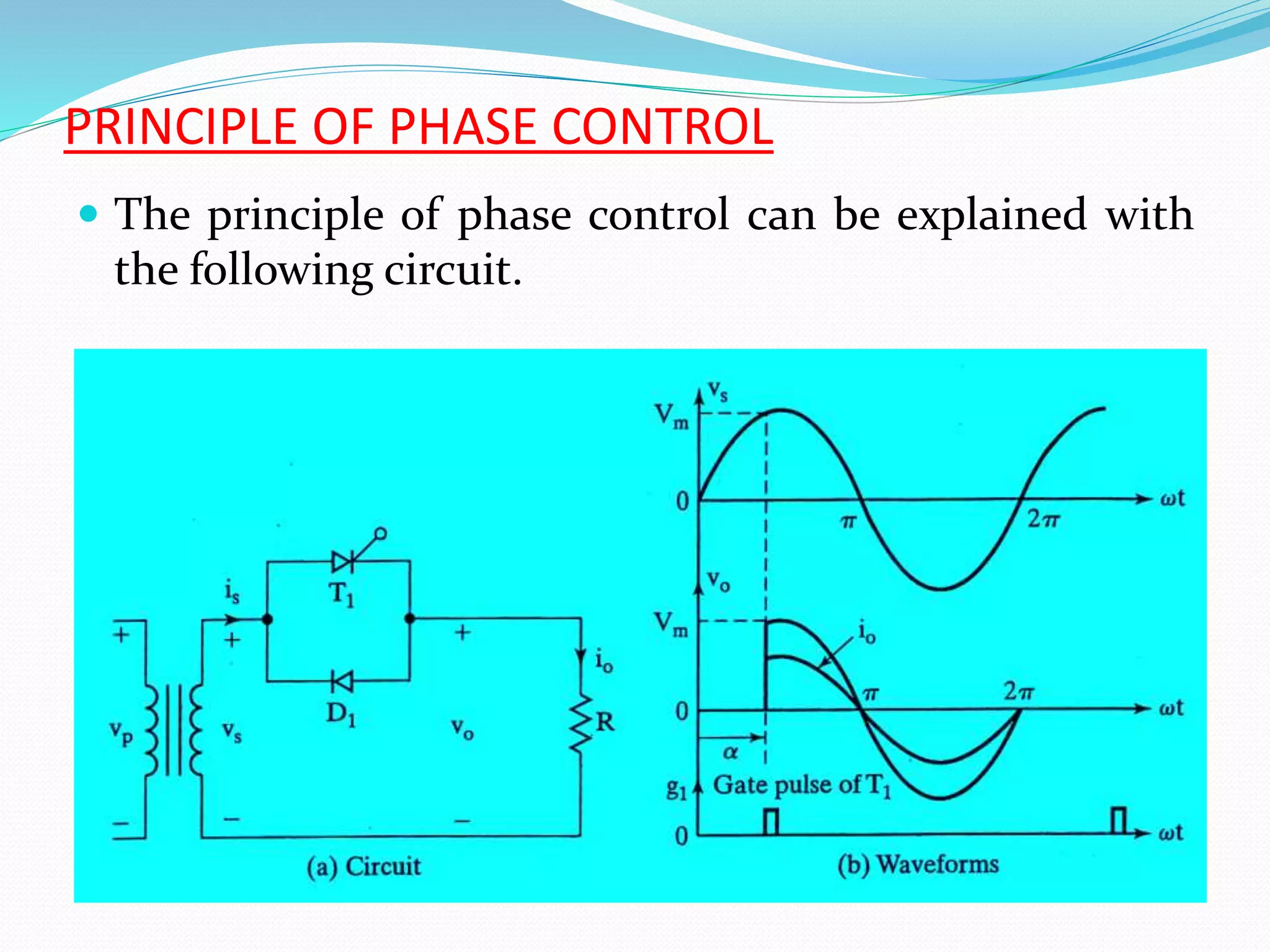
PRINCIPLE OF PHASE CONTROL
 The principle of phase control can be explained with
the following circuit.
 Due to the presence of diode D1, the control range is
limited.
 The rms output voltage can only be varied between
70.7 to 100%.
 The output voltage and input current are asymmetrical
and contain a dc component.
 This circuit is a single-phase half-wave controller and
is suitable only for low power resistive loads, such as
heating and lighting.
 Since the power flow is controlled during the positive
half-cycle of input voltage, this type of controller is
also known as unidirectional controller.
 The rms value of the output voltage is :
 The average value of the output voltage is:
2/1
2/122
2
22
)]
2
2sin
2(
2
1
[
)]}(sin2)(sin2[
2
1
{










 
so
sso
VV
tdtVtdtVV
)1(cos
2
2
)](sin2)(sin2[
2
1 2

 








s
o
ssdc
V
V
tdtVtdtVV
SINGLE-PHASE BIDIRECTIONAL CONTROLLERS WITH
RESISTIVE LOADS
 The problem of dc input current can be prevented by
using bidirectional or full-wave control.
 The firing pulse of T1 and T2 are 180 degrees apart.
 The rms value of the output voltage is:
 By varying α from 0 to π, Vo can be varied from Vs to 0.
2/1
2/1
22
2
2sin
(
1
)(sin2
2
2











 







so
so
VV
tdtVV
SINGLE-PHASE CONTROLLERS WITH INDUCTIVE LOAD
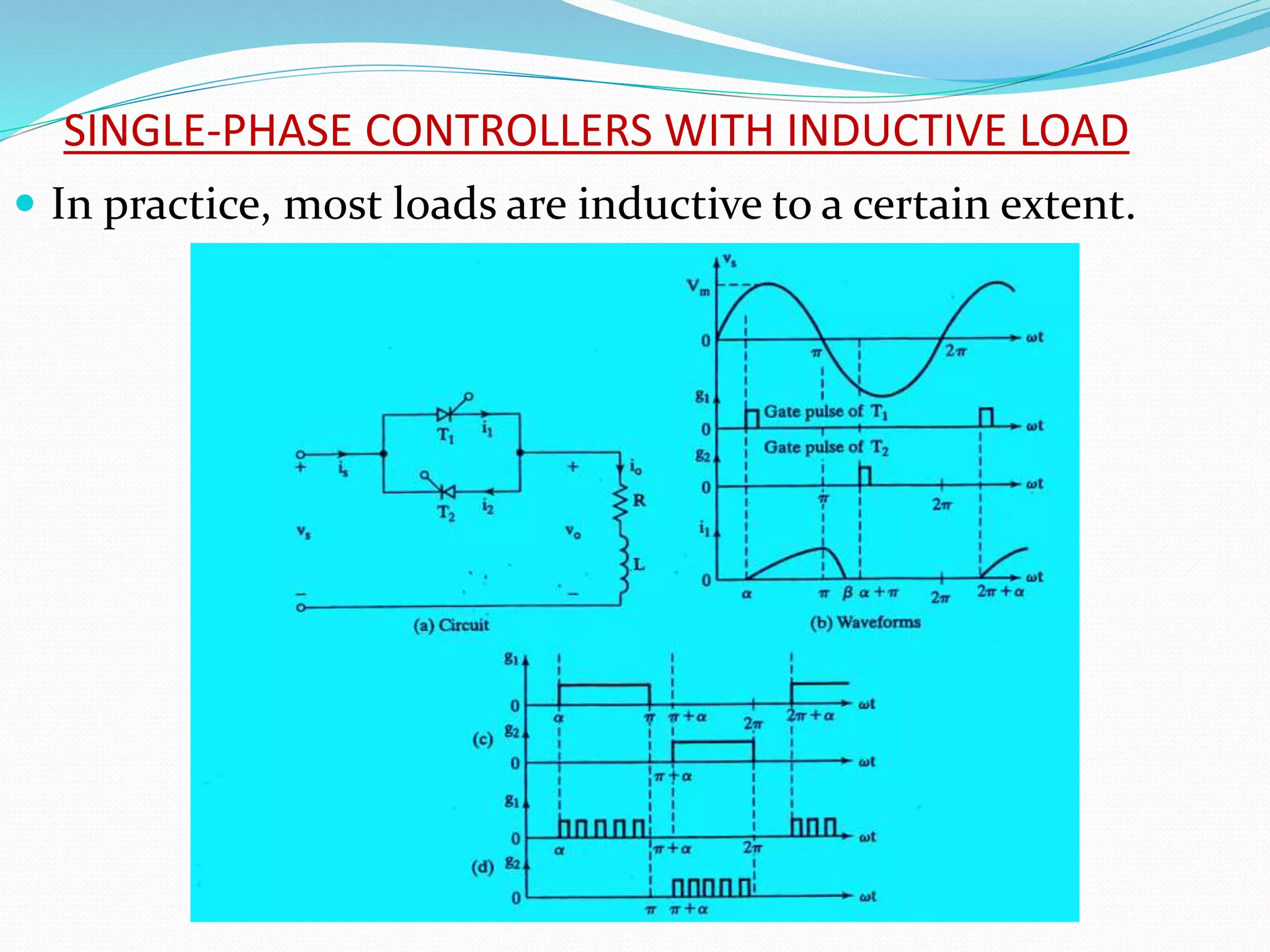
 In practice, most loads are inductive to a certain extent.
 The gating signals of thyristors could be short pulses for a
controller with a resistive load.
 However, they are not suitable for inductive loads.
 When thyristor T2 is fired, thyristor T1 is still conducting due
to the inductive load.
 By the time the current of T1 falls to zero and T1 is turned off,
the gate current of T2 has already ceased.
 Consequently, T2 will not be turned on.
 This difficulty can be resolved by using a continuous gate
signal with a duration of π - α.
 However a continuous gate pulse increases the
switching loss of thyristors.
 In practice a train of pulses with short duration are
used to overcome the loss problem.
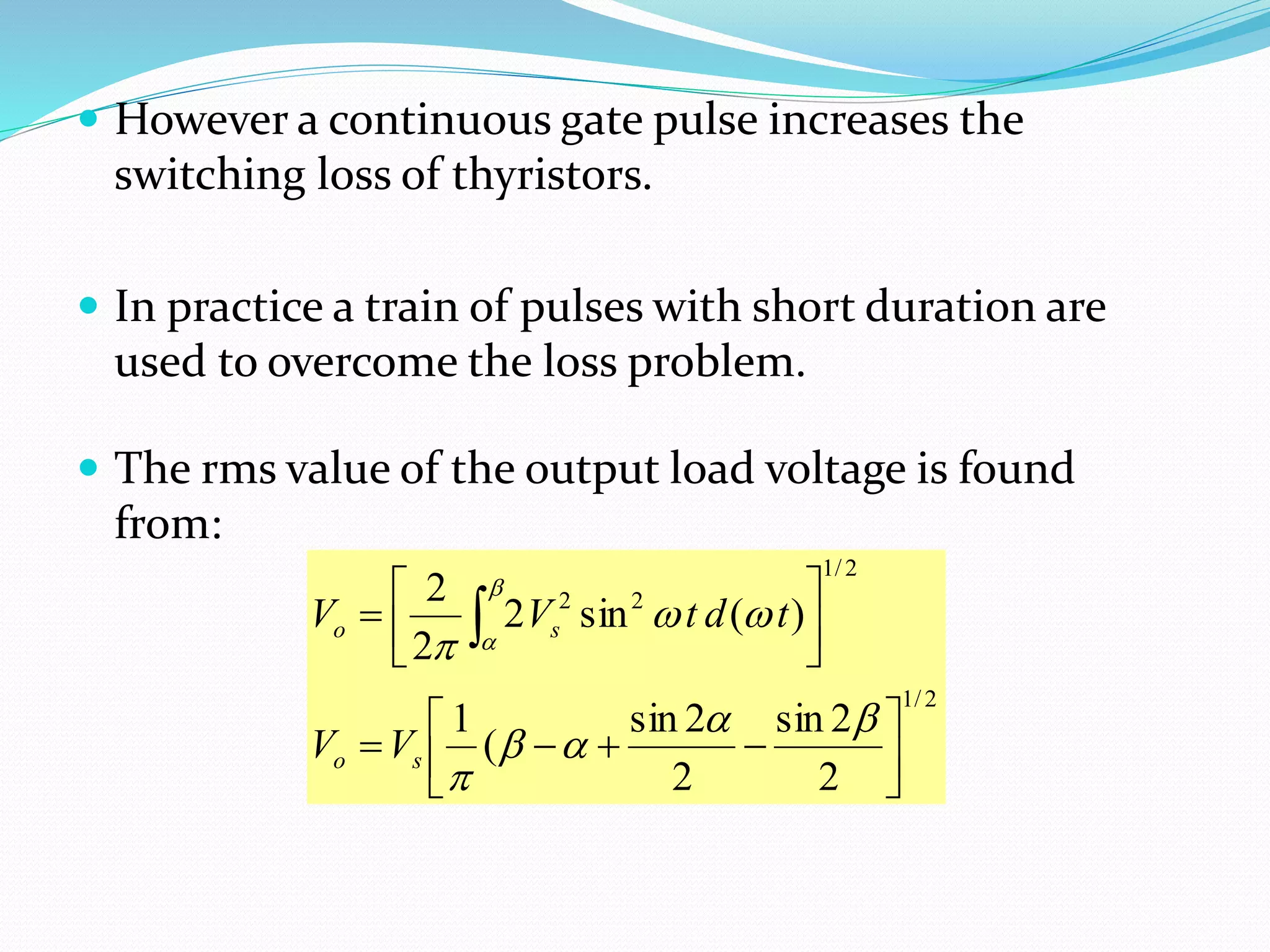
 The rms value of the output load voltage is found
from:
2/1
2/1
22
2
2sin
2
2sin
(
1
)(sin2
2
2











 







so
so
VV
tdtVV
THREE-PHASE FULL-WAVE CONTROLLERS
 The unidirectional controllers, which contain dc input
current and higher harmonic content due to the
asymmetrical nature of the output voltage waveform,
are not normally used in ac motor drives.
 A three-phase bidirectional control is commonly used.
30o
 For 0 < α < 60o:
 For 60o < α < 90o:
 For 90o < α < 150o:
2/1
)
8
2sin
46
(
1
6 








so VV
2/1
)
16
2cos3
16
2sin3
12
(
1
6 








so VV
2/1
)
16
2cos3
16
2sin
424
5
(
1
6 








so VV
THREE-PHASE BIDIRECTIONAL DELTA-CONNECTED
CONTROLLERS
 If the terminals of a three-phase system are accessible, the
control elements (SCRs) and load may be connected in delta.
 Since the phase current in a normal three-phase delta
system is only 1/√3 of the line current, the current ratings
of the thyristors are less.
 The following figure shows the waveforms for a delay angle
of 120 degrees.
60o
 For resistive loads:
2/1
2
2sin
(
1










so VV
CYCLOCONVERTERS
 The ac voltage controllers provide a variable output
voltage, but the frequency of the output voltage is
fixed.
 In addition the harmonic content is high at low ac
voltages (high α).
 A variable output voltage at variable frequency can be
obtained from a two stage conversion.
 First the fixed ac is converted to a variable dc
(controlled rectifier), and then the variable dc is
converted to a variable ac at variable frequency
(inverter).
 However, the cycloconverter can eliminate the need of
one or more intermediate converters.
 A cycloconverter is a direct frequency changer that
converts ac power at one frequency to ac power at
another frequency by ac-ac conversion.
 Cycloconverters are naturally commutated and the
maximum output frequency is a fraction of the source
frequency.
 Therefore, cycloconverters are low speed ac motor
drives in ranges up to 15 MW with frequencies from 0 to
20 Hz.
SINGLE-PHASE CYCLOCONVERTERS
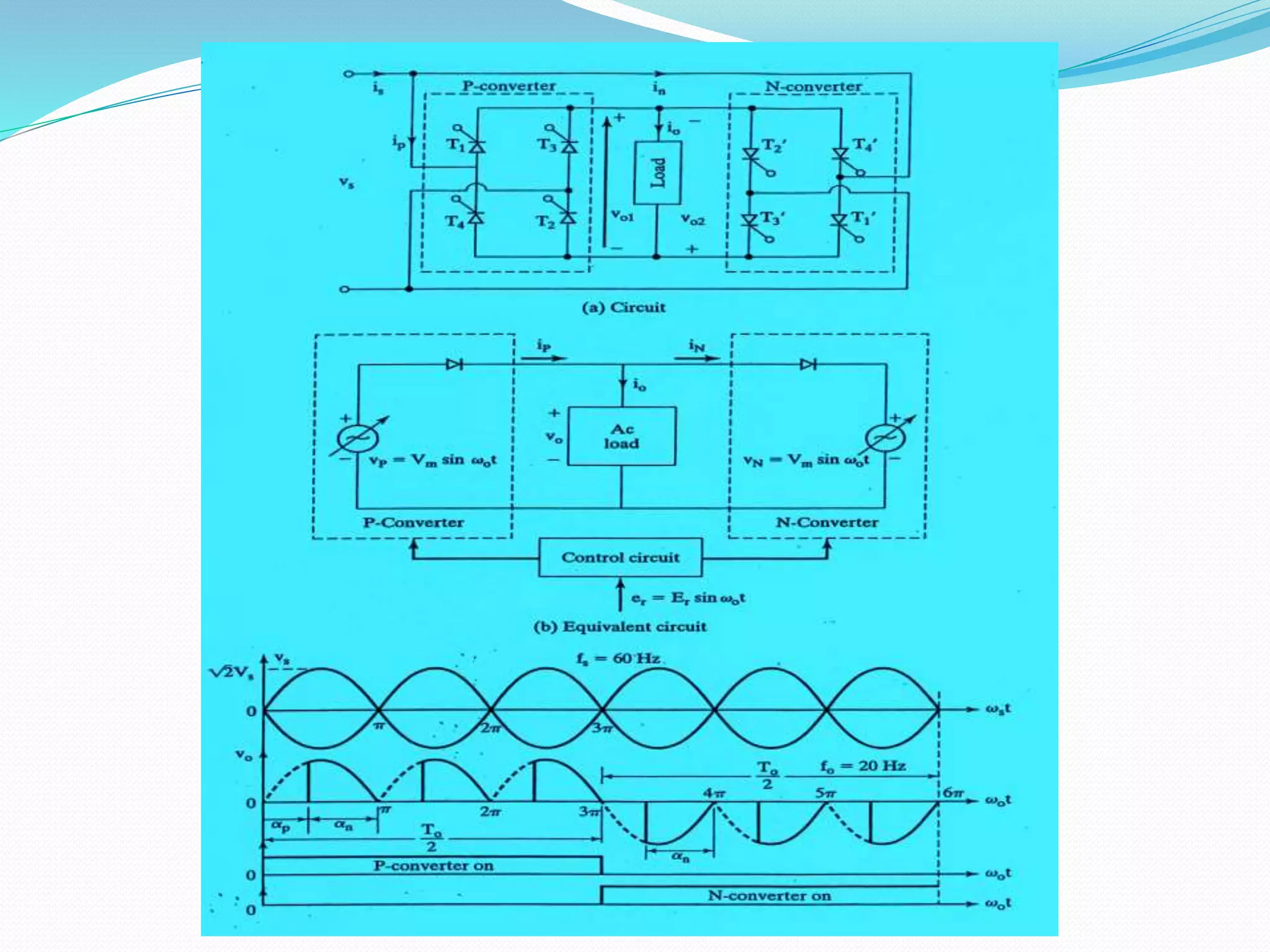
 The principle of operation of single-phase cycloconverters
can be explained with the following figure.
 First, two single-phase controlled converters are operated
as bridge rectifiers.
 Their delay angles are such that the output voltage of one
converter is equal and opposite to that of the other
converter.
 If αp is the delay angle of positive converter, the delay
angle of the negative converter is: αn = π – αp
THREE-PHASE CYCLOCONVERTER
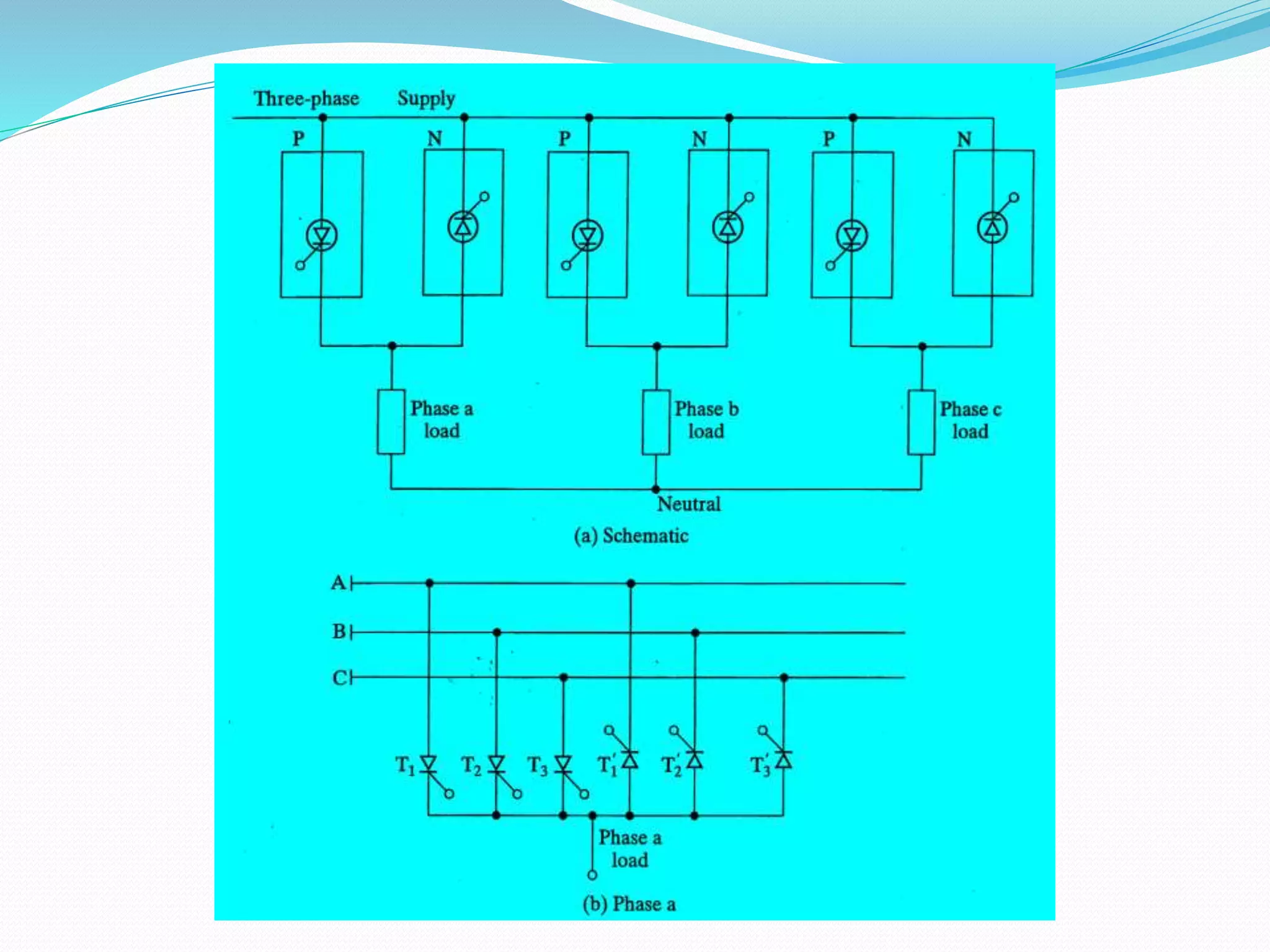
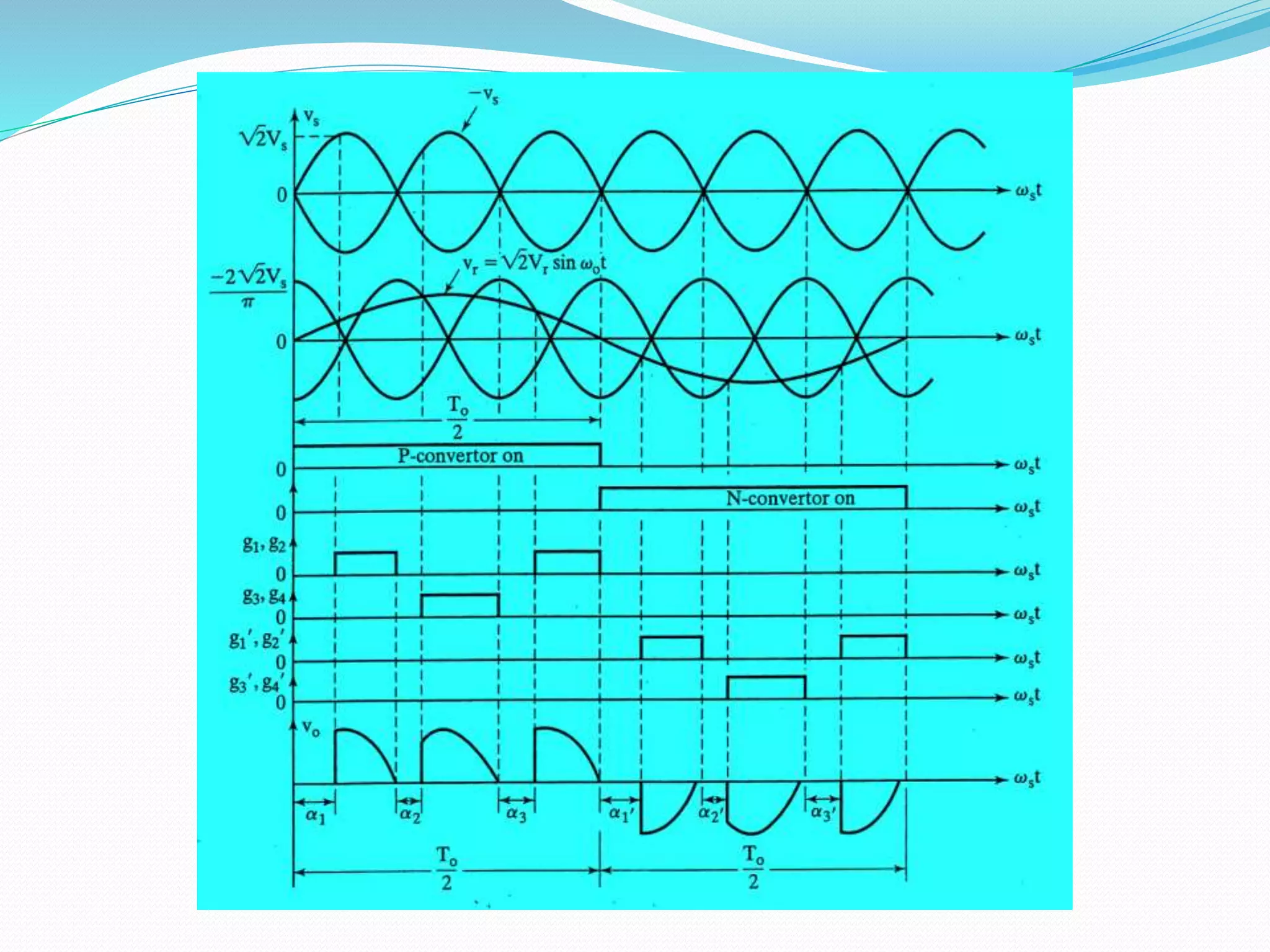
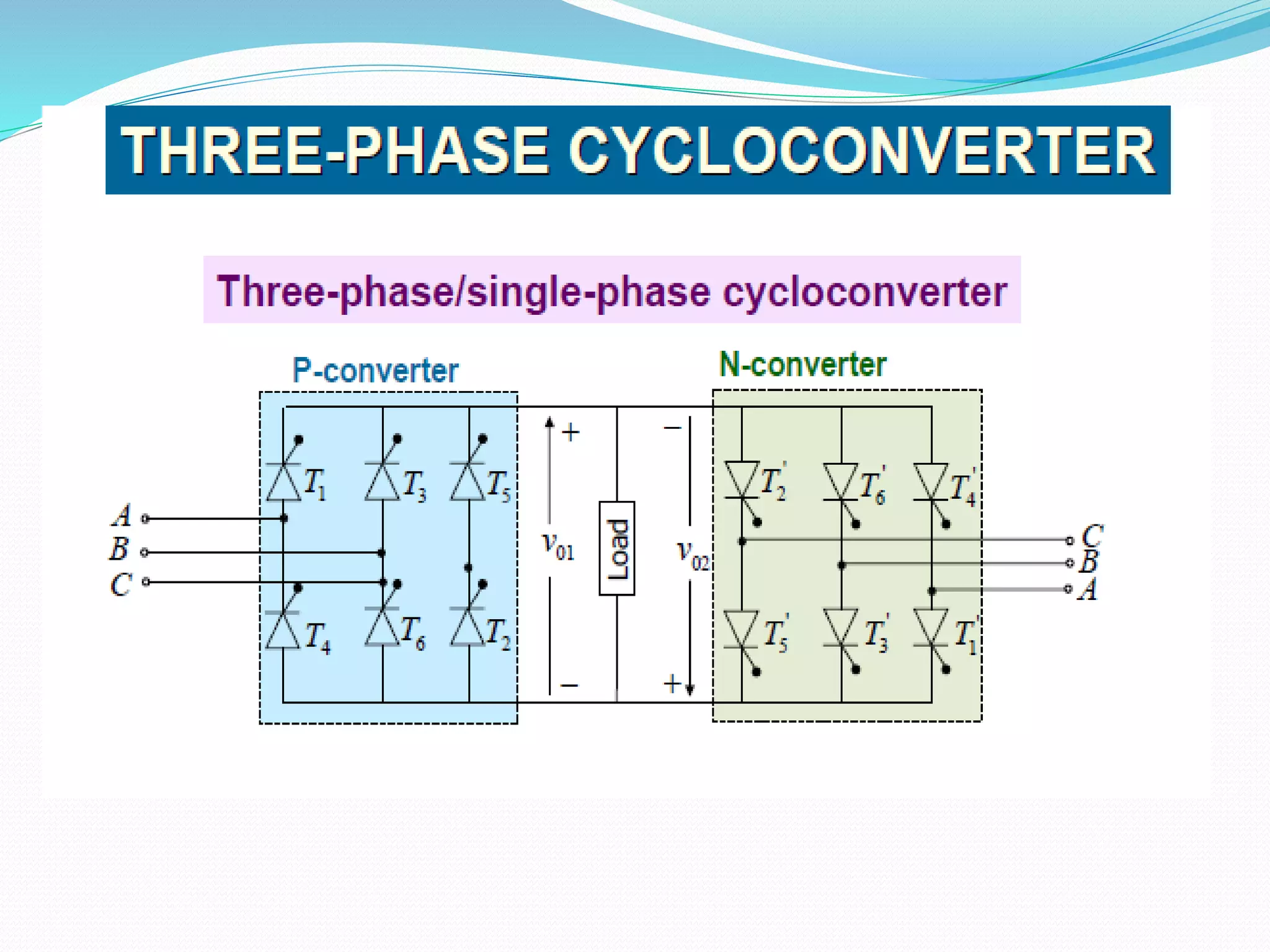
 The circuit diagram of a three-phase/single phase
cycloconverter is shown next.
 The synthesis of output waveform for an output
frequency of 12 Hz is also in this figure.
 The cycloconverter of previous figure can be extended
to feed a three-phase load, by having six three-phase
converters.
 If six full-wave three-phase converters are used, 36
thyristors would be required.
REDUCTION OF OUTPUT HARMONICS
 The output voltage of cycloconverters is basically made up of segments
of input voltages.
 The average value of a segment depends on the delay angle for that
segment.
 If the delay angles of segments were varied in such a way that the
average values of segments corresponds as closely as possible to the
variations of desired sinusoidal output voltage, the harmonics on the
output voltage can be minimized.
 The delay angles for segments can be generated by
comparing a cosine signal at the source frequency with an
ideal sinusoidal reference voltage at the output frequency.
 The following figure shows generation of the gating signals
for the cycloconverter.
Unit-5 AC-AC Cycloconverter

Unit-5 AC-AC Cycloconverter

  • 2.
    INTRODUCTION  The powerflow into a load can be controlled by varying the rms value of the load voltage.  This can be accomplished by thyristors, and this type of power circuit is known as ac voltage controllers. AC Voltage Controller V0(RMS) fS Variable AC RMSO/PVoltage AC Input Voltage fs Vs fs
  • 3.
    TYPE OF ACVOLTAGE CONTROLLERS  Classification based on the type of input ac supply: Single Phase AC Controllers Three Phase AC Controllers  Each type of controller may be sub divided into: Unidirectional or half wave ac controller Bi-directional or full wave ac controller  In brief different types of ac voltage controllers are: Single phase half wave ac voltage controller (uni-directional controller) Single phase full wave ac voltage controller (bi-directional controller) Three phase half wave ac voltage controller (uni-directional controller) Three phase full wave ac voltage controller (bi-directional controller)
  • 4.
    APPLICATIONS OF ACVOLTAGE CONTROLLERS  Lighting / Illumination control in ac power circuits.  Induction heating.  Industrial heating & Domestic heating.  Transformers tap changing (on load transformer tap changing).  Speed control of induction motors (single phase and poly phase ac induction motor control).  AC magnet controls.
  • 5.
    AC VOLTAGE CONTROLTECHNIQUES  two types of control are normally used:  On-off Control  Phase angle control  In on-off control, thyristor switches connect the load to the ac source for a few cycles of the input voltage and then disconnected for a few cycles.  In phase control, thyristor switches connect the load to the ac source for a portion of each cycle.
  • 6.
    COMMUTATION  Since theinput voltage is ac, thyristors are line commutated.  Typically phase control thyristors which are cheaper are used.  For applications up to 400 Hz, TRIACs are used.
  • 7.
    PRINCIPLE OF ON-OFFCONTROL (INTEGRAL CYCLE CONTROL)
  • 8.
     This typeof control is applied in applications which have high mechanical inertia and high thermal time constant.  Typical examples are industrial heating and speed control of motors.
  • 9.
    Note that kis called the duty cycle, and the power factor and output voltage vary with the square root of k. kV nm n VV tdtV mn n V ssrmso srmso               2/1 2 0 22 )(sin2 )(2    If the input voltage is connected to load for n cycles and is disconnected for m cycles, the output load voltage is found from:
  • 10.
    PRINCIPLE OF PHASECONTROL  The principle of phase control can be explained with the following circuit.
  • 11.
     Due tothe presence of diode D1, the control range is limited.  The rms output voltage can only be varied between 70.7 to 100%.  The output voltage and input current are asymmetrical and contain a dc component.
  • 12.
     This circuitis a single-phase half-wave controller and is suitable only for low power resistive loads, such as heating and lighting.  Since the power flow is controlled during the positive half-cycle of input voltage, this type of controller is also known as unidirectional controller.
  • 13.
     The rmsvalue of the output voltage is :  The average value of the output voltage is: 2/1 2/122 2 22 )] 2 2sin 2( 2 1 [ )]}(sin2)(sin2[ 2 1 {             so sso VV tdtVtdtVV )1(cos 2 2 )](sin2)(sin2[ 2 1 2            s o ssdc V V tdtVtdtVV
  • 14.
    SINGLE-PHASE BIDIRECTIONAL CONTROLLERSWITH RESISTIVE LOADS  The problem of dc input current can be prevented by using bidirectional or full-wave control.
  • 15.
     The firingpulse of T1 and T2 are 180 degrees apart.  The rms value of the output voltage is:  By varying α from 0 to π, Vo can be varied from Vs to 0. 2/1 2/1 22 2 2sin ( 1 )(sin2 2 2                     so so VV tdtVV
  • 16.
    SINGLE-PHASE CONTROLLERS WITHINDUCTIVE LOAD  In practice, most loads are inductive to a certain extent.
  • 17.
     The gatingsignals of thyristors could be short pulses for a controller with a resistive load.  However, they are not suitable for inductive loads.  When thyristor T2 is fired, thyristor T1 is still conducting due to the inductive load.  By the time the current of T1 falls to zero and T1 is turned off, the gate current of T2 has already ceased.  Consequently, T2 will not be turned on.  This difficulty can be resolved by using a continuous gate signal with a duration of π - α.
  • 18.
     However acontinuous gate pulse increases the switching loss of thyristors.  In practice a train of pulses with short duration are used to overcome the loss problem.  The rms value of the output load voltage is found from: 2/1 2/1 22 2 2sin 2 2sin ( 1 )(sin2 2 2                     so so VV tdtVV
  • 19.
    THREE-PHASE FULL-WAVE CONTROLLERS The unidirectional controllers, which contain dc input current and higher harmonic content due to the asymmetrical nature of the output voltage waveform, are not normally used in ac motor drives.  A three-phase bidirectional control is commonly used.
  • 20.
  • 21.
     For 0< α < 60o:  For 60o < α < 90o:  For 90o < α < 150o: 2/1 ) 8 2sin 46 ( 1 6          so VV 2/1 ) 16 2cos3 16 2sin3 12 ( 1 6          so VV 2/1 ) 16 2cos3 16 2sin 424 5 ( 1 6          so VV
  • 22.
    THREE-PHASE BIDIRECTIONAL DELTA-CONNECTED CONTROLLERS If the terminals of a three-phase system are accessible, the control elements (SCRs) and load may be connected in delta.
  • 23.
     Since thephase current in a normal three-phase delta system is only 1/√3 of the line current, the current ratings of the thyristors are less.  The following figure shows the waveforms for a delay angle of 120 degrees.
  • 24.
  • 25.
     For resistiveloads: 2/1 2 2sin ( 1           so VV
  • 26.
    CYCLOCONVERTERS  The acvoltage controllers provide a variable output voltage, but the frequency of the output voltage is fixed.  In addition the harmonic content is high at low ac voltages (high α).  A variable output voltage at variable frequency can be obtained from a two stage conversion.
  • 27.
     First thefixed ac is converted to a variable dc (controlled rectifier), and then the variable dc is converted to a variable ac at variable frequency (inverter).  However, the cycloconverter can eliminate the need of one or more intermediate converters.  A cycloconverter is a direct frequency changer that converts ac power at one frequency to ac power at another frequency by ac-ac conversion.
  • 28.
     Cycloconverters arenaturally commutated and the maximum output frequency is a fraction of the source frequency.  Therefore, cycloconverters are low speed ac motor drives in ranges up to 15 MW with frequencies from 0 to 20 Hz.
  • 29.
    SINGLE-PHASE CYCLOCONVERTERS  Theprinciple of operation of single-phase cycloconverters can be explained with the following figure.  First, two single-phase controlled converters are operated as bridge rectifiers.  Their delay angles are such that the output voltage of one converter is equal and opposite to that of the other converter.  If αp is the delay angle of positive converter, the delay angle of the negative converter is: αn = π – αp
  • 31.
    THREE-PHASE CYCLOCONVERTER  Thecircuit diagram of a three-phase/single phase cycloconverter is shown next.  The synthesis of output waveform for an output frequency of 12 Hz is also in this figure.
  • 33.
     The cycloconverterof previous figure can be extended to feed a three-phase load, by having six three-phase converters.  If six full-wave three-phase converters are used, 36 thyristors would be required.
  • 35.
    REDUCTION OF OUTPUTHARMONICS  The output voltage of cycloconverters is basically made up of segments of input voltages.  The average value of a segment depends on the delay angle for that segment.  If the delay angles of segments were varied in such a way that the average values of segments corresponds as closely as possible to the variations of desired sinusoidal output voltage, the harmonics on the output voltage can be minimized.
  • 36.
     The delayangles for segments can be generated by comparing a cosine signal at the source frequency with an ideal sinusoidal reference voltage at the output frequency.  The following figure shows generation of the gating signals for the cycloconverter.