Shri Sad Vidya Mandal Institute
Of Technology
Subject :- Electrical Power System-2
Topic :- Power Flow Throuh Transmission Lines
Guided by:-
Pr. N. Kalpana Ray
1
Of Semester :-
Ⅵ
2
Presented by Enrol. No.
Hitesh Patel 150450109011
Rajiv Jha 150450109012
Jainil Joshi 150450109013
Pratik Joshi 150450109014
Shri Sad Vidya Mandal Institute
Of Technology
Date:- 21-02-
2018
We will be seeing…
 Introduction.
 Power flow through transmission line.
 Single - line diagram of three phase transmission.
 Derivation.
 Circle diagram
 Analytical method.
 Graphical method.
 Summary.
3
Introduction
 The electric power generated in the generating station is transmitted using
transmission lines.
 Transmission lines are conductors designed to carry electricity over a long
distances with minimum losses and distortion.
 The parameters associated with these transmission lines are inductance,
capacitance, resistance and conductance.
4
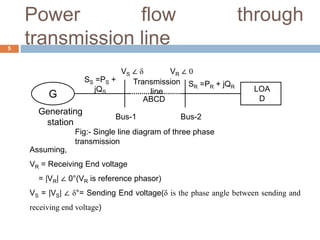
Power flow through
transmission line
G
Generating
station
VS ∠ δ VR ∠ 0
SS =PS +
jQS
SR =PR + jQR
LOA
D
Transmission
line
ABCD
Bus-1 Bus-2
Fig:- Single line diagram of three phase
transmission
Assuming,
VR = Receiving End voltage
= |VR| ∠ 0°(VR is reference phasor)
VS = |VS| ∠ δ°= Sending End voltage(δ is the phase angle between sending and
receiving end voltage)
5
Power flow through
transmission line
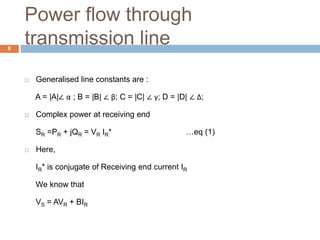
 Generalised line constants are :
A = |A|∠ α ; B = |B| ∠ β; C = |C| ∠ γ; D = |D| ∠ Δ;
 Complex power at receiving end
SR =PR + jQR = VR IR*
 Here,
IR* is conjugate of Receiving end current IR
We know that
VS = AVR + BIR
…eq (1)
6
Power flow through
transmission line
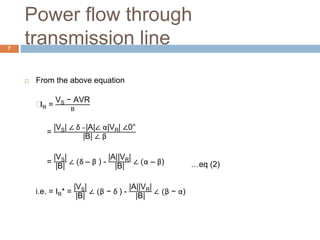
 From the above equation
⸫IR =
VS − AVR
B
=
|VS| ∠ δ −|A|∠ α|VR| ∠0°
|B| ∠ β
=
|VS|
|B|
∠ (δ – β ) -
|A||VR|
|B|
∠ (α – β)
i.e. = IR* =
|VS|
|B|
∠ (β − δ ) -
|A||VR|
|B|
∠ (β − α)
…eq (2)
7
Power flow through
transmission line
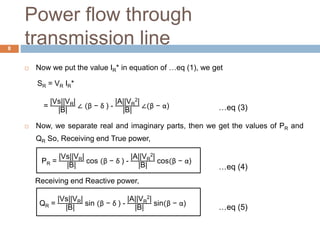
 Now we put the value IR* in equation of …eq (1), we get
SR = VR IR*
=
|Vs||VR|
|B|
∠ (β − δ ) -
|A||VR
2|
|B|
∠(β − α)
 Now, we separate real and imaginary parts, then we get the values of PR and
QR So, Receiving end True power,
PR =
|Vs||VR|
|B|
cos (β − δ ) -
|A||VR
2|
|B|
cos(β − α)
Receiving end Reactive power,
QR =
|Vs||VR|
|B|
sin (β − δ ) -
|A||VR
2|
|B|
sin(β − α)
…eq (4)
…eq (3)
…eq (5)
8
Power flow through
transmission line
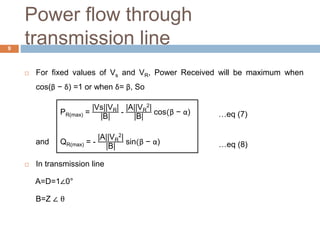
 For fixed values of Vs and VR, Power Received will be maximum when
cos(β − δ) =1 or when δ= β, So
PR(max) =
|Vs||VR|
|B|
-
|A||VR
2|
|B|
cos(β − α)
and QR(max) = -
|A||VR
2|
|B|
sin(β − α)
 In transmission line
A=D=1∠0°
B=Z ∠ θ
…eq (8)
…eq (7)
9
Power flow through
transmission line
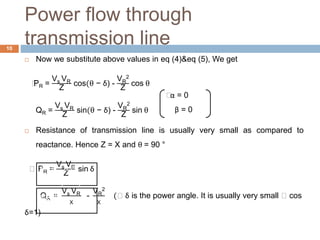
 Now we substitute above values in eq (4)&eq (5), We get
⸫PR =
Vs VR
Z
cos(θ − δ) -
VR
2
Z
cos θ
QR =
Vs VR
Z
sin(θ − δ) -
VR
2
Z
sin θ
 Resistance of transmission line is usually very small as compared to
reactance. Hence Z = X and θ = 90 °
⸫ PR =
Vs VR
Z
sin δ
QR =
Vs VR
X
-
VR
2
X
(⸫ δ is the power angle. It is usually very small ⸫ cos
δ=1)
⸫α = 0
β = 0
δ is the power
angle. It is
usually very
small
10
Methods Of Finding The
Performance Of Transmission Line.11
 Basically two methods
 Analytical method.
 Graphical method.
 Analytical methods are found to be laborious, while graphical method is
convenient.
 Graphical method or circle diagram are helpful for determination of active
power P, Reactive power Q, power angle δ and power factor for given load
condition.
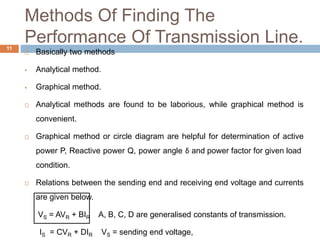
 Relations between the sending end and receiving end voltage and currents
are given below.
VS = AVR + BIR A, B, C, D are generalised constants of transmission.
IS = CVR + DIR VS = sending end voltage,
Methods Of Finding The
Performance Of Transmission Line.12
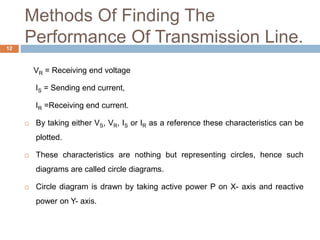
VR = Receiving end voltage
IS = Sending end current,
IR =Receiving end current.
 By taking either VS, VR, IS or IR as a reference these characteristics can be
plotted.
 These characteristics are nothing but representing circles, hence such
diagrams are called circle diagrams.
 Circle diagram is drawn by taking active power P on X- axis and reactive
power on Y- axis.
Receiving End Power Circle
Diagram :13
 Receiving end true power – Horizontal coordinates
 Reactive power component – Vertical coordinates
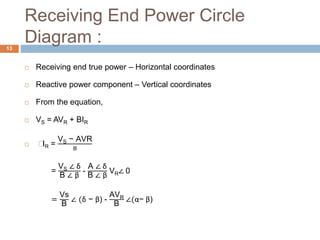
 From the equation,
 VS = AVR + BIR
 ⸫IR =
VS − AVR
B
=
VS ∠ δ
B ∠ β
-
A ∠ δ
B ∠ β
VR∠ 0
=
Vs
B
∠ (δ − β) -
AVR
B
∠(α− β)
Receiving End Power Circle
Diagram :14
 IR* =
|Vs|
|B|
∠ (β − δ ) -
|A||VR|
|B|
∠ (β − α)
 Volt- ampere at the receiving end will be
SR = PR + jQR = VR IR*
=
|Vs||VR|
|B|
∠ (β − δ ) -
|A||VR|2
|B|
∠(β − α)
=
|Vs||VR|
|B|
[cos (β − δ ) + j sin (β − δ )] -
|A||VR|2
|B|
[ cos(β − α)+j sin (β − δ )]
SR =
|Vs||VR|
|B|
cos (β − δ ) -
|A||VR|2
|B|
cos(β − α) +
|Vs||VR|
|B|
j sin (β − δ ) -
|A||VR|2
|B|
j sin (β − δ )
Receiving End Power Circle
Diagram :15
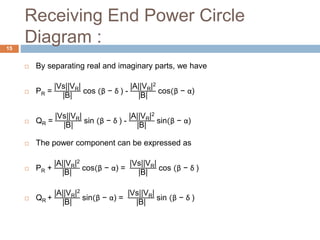
 By separating real and imaginary parts, we have
 PR =
|Vs||VR|
|B|
cos (β − δ ) -
|A||VR|2
|B|
cos(β − α)
 QR =
|Vs||VR|
|B|
sin (β − δ ) -
|A||VR|2
|B|
sin(β − α)
 The power component can be expressed as
 PR +
|A||VR|2
|B|
cos(β − α) =
|Vs||VR|
|B|
cos (β − δ )
 QR +
|A||VR|2
|B|
sin(β − α) =
|Vs||VR|
|B|
sin (β − δ )
Receiving End Power Circle
Diagram :16
 Squaring and adding these equations will give
{PR +
|A||VR|2
|B|
cos(β − α)}2 + {QR +
|A||VR|2
|B|
sin(β − α) }2
=
|Vs|2|VR|2
|B|
{ cos2(β − δ )+ sin2(β − α)}
=
|Vs|2|VR|2
|B|
 It is an equation of a circle. The coordinates of centre of a circle are:
 X-coordinate of the circle = -
|A||VR|2
|B|
cos(β − α)
 Y- coordinate of the circle = -
|A||VR|2
|B|
sin(β − α)
 Radius of the circle =
|Vs||VR|
|B|
Construction of circle diagram:
17
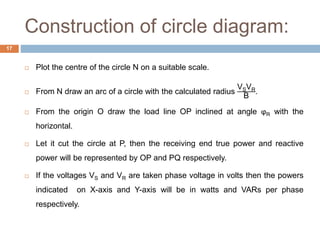
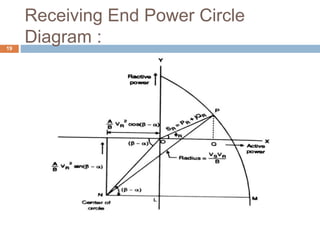
 Plot the centre of the circle N on a suitable scale.
 From N draw an arc of a circle with the calculated radius
VSVR
B
.
 From the origin O draw the load line OP inclined at angle ϕR with the
horizontal.
 Let it cut the circle at P, then the receiving end true power and reactive
power will be represented by OP and PQ respectively.
 If the voltages VS and VR are taken phase voltage in volts then the powers
indicated on X-axis and Y-axis will be in watts and VARs per phase
respectively.
Construction of circle diagram:
18
 If the voltages VS and VR are taken line voltage in volts then the powers
indicated on X-axis and Y-axis will be in watts and VARs for all three
phases respectively.
 If the VS and VR are taken from line to line and in kV then the power
indicated will be in MW and MVAR and for all the three phases.
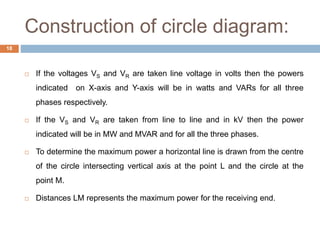
 To determine the maximum power a horizontal line is drawn from the centre
of the circle intersecting vertical axis at the point L and the circle at the
point M.
 Distances LM represents the maximum power for the receiving end.
Receiving End Power Circle
Diagram :19
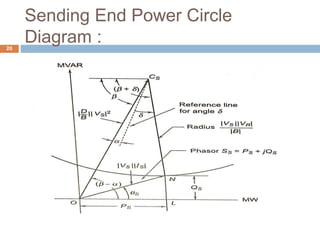
Sending End Power Circle
Diagram :20
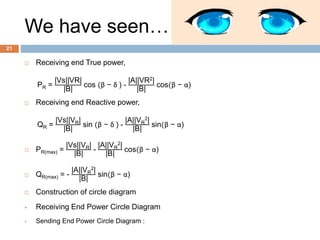
We have seen…
 Receiving end True power,
PR =
|Vs||VR|
|B|
cos (β − δ ) -
|A||VR2|
|B|
cos(β − α)
 Receiving end Reactive power,
QR =
|Vs||VR|
|B|
sin (β − δ ) -
|A||VR
2|
|B|
sin(β − α)
 PR(max) =
|Vs||VR|
|B|
-
|A||VR
2|
|B|
cos(β − α)
 QR(max) = -
|A||VR
2|
|B|
sin(β − α)
 Construction of circle diagram
 Receiving End Power Circle Diagram
 Sending End Power Circle Diagram :
21
Power flow through transmission line.

Power flow through transmission line.

  • 1.
    Shri Sad VidyaMandal Institute Of Technology Subject :- Electrical Power System-2 Topic :- Power Flow Throuh Transmission Lines Guided by:- Pr. N. Kalpana Ray 1
  • 2.
    Of Semester :- Ⅵ 2 Presentedby Enrol. No. Hitesh Patel 150450109011 Rajiv Jha 150450109012 Jainil Joshi 150450109013 Pratik Joshi 150450109014 Shri Sad Vidya Mandal Institute Of Technology Date:- 21-02- 2018
  • 3.
    We will beseeing…  Introduction.  Power flow through transmission line.  Single - line diagram of three phase transmission.  Derivation.  Circle diagram  Analytical method.  Graphical method.  Summary. 3
  • 4.
    Introduction  The electricpower generated in the generating station is transmitted using transmission lines.  Transmission lines are conductors designed to carry electricity over a long distances with minimum losses and distortion.  The parameters associated with these transmission lines are inductance, capacitance, resistance and conductance. 4
  • 5.
    Power flow through transmissionline G Generating station VS ∠ δ VR ∠ 0 SS =PS + jQS SR =PR + jQR LOA D Transmission line ABCD Bus-1 Bus-2 Fig:- Single line diagram of three phase transmission Assuming, VR = Receiving End voltage = |VR| ∠ 0°(VR is reference phasor) VS = |VS| ∠ δ°= Sending End voltage(δ is the phase angle between sending and receiving end voltage) 5
  • 6.
    Power flow through transmissionline  Generalised line constants are : A = |A|∠ α ; B = |B| ∠ β; C = |C| ∠ γ; D = |D| ∠ Δ;  Complex power at receiving end SR =PR + jQR = VR IR*  Here, IR* is conjugate of Receiving end current IR We know that VS = AVR + BIR …eq (1) 6
  • 7.
    Power flow through transmissionline  From the above equation ⸫IR = VS − AVR B = |VS| ∠ δ −|A|∠ α|VR| ∠0° |B| ∠ β = |VS| |B| ∠ (δ – β ) - |A||VR| |B| ∠ (α – β) i.e. = IR* = |VS| |B| ∠ (β − δ ) - |A||VR| |B| ∠ (β − α) …eq (2) 7
  • 8.
    Power flow through transmissionline  Now we put the value IR* in equation of …eq (1), we get SR = VR IR* = |Vs||VR| |B| ∠ (β − δ ) - |A||VR 2| |B| ∠(β − α)  Now, we separate real and imaginary parts, then we get the values of PR and QR So, Receiving end True power, PR = |Vs||VR| |B| cos (β − δ ) - |A||VR 2| |B| cos(β − α) Receiving end Reactive power, QR = |Vs||VR| |B| sin (β − δ ) - |A||VR 2| |B| sin(β − α) …eq (4) …eq (3) …eq (5) 8
  • 9.
    Power flow through transmissionline  For fixed values of Vs and VR, Power Received will be maximum when cos(β − δ) =1 or when δ= β, So PR(max) = |Vs||VR| |B| - |A||VR 2| |B| cos(β − α) and QR(max) = - |A||VR 2| |B| sin(β − α)  In transmission line A=D=1∠0° B=Z ∠ θ …eq (8) …eq (7) 9
  • 10.
    Power flow through transmissionline  Now we substitute above values in eq (4)&eq (5), We get ⸫PR = Vs VR Z cos(θ − δ) - VR 2 Z cos θ QR = Vs VR Z sin(θ − δ) - VR 2 Z sin θ  Resistance of transmission line is usually very small as compared to reactance. Hence Z = X and θ = 90 ° ⸫ PR = Vs VR Z sin δ QR = Vs VR X - VR 2 X (⸫ δ is the power angle. It is usually very small ⸫ cos δ=1) ⸫α = 0 β = 0 δ is the power angle. It is usually very small 10
  • 11.
    Methods Of FindingThe Performance Of Transmission Line.11  Basically two methods  Analytical method.  Graphical method.  Analytical methods are found to be laborious, while graphical method is convenient.  Graphical method or circle diagram are helpful for determination of active power P, Reactive power Q, power angle δ and power factor for given load condition.  Relations between the sending end and receiving end voltage and currents are given below. VS = AVR + BIR A, B, C, D are generalised constants of transmission. IS = CVR + DIR VS = sending end voltage,
  • 12.
    Methods Of FindingThe Performance Of Transmission Line.12 VR = Receiving end voltage IS = Sending end current, IR =Receiving end current.  By taking either VS, VR, IS or IR as a reference these characteristics can be plotted.  These characteristics are nothing but representing circles, hence such diagrams are called circle diagrams.  Circle diagram is drawn by taking active power P on X- axis and reactive power on Y- axis.
  • 13.
    Receiving End PowerCircle Diagram :13  Receiving end true power – Horizontal coordinates  Reactive power component – Vertical coordinates  From the equation,  VS = AVR + BIR  ⸫IR = VS − AVR B = VS ∠ δ B ∠ β - A ∠ δ B ∠ β VR∠ 0 = Vs B ∠ (δ − β) - AVR B ∠(α− β)
  • 14.
    Receiving End PowerCircle Diagram :14  IR* = |Vs| |B| ∠ (β − δ ) - |A||VR| |B| ∠ (β − α)  Volt- ampere at the receiving end will be SR = PR + jQR = VR IR* = |Vs||VR| |B| ∠ (β − δ ) - |A||VR|2 |B| ∠(β − α) = |Vs||VR| |B| [cos (β − δ ) + j sin (β − δ )] - |A||VR|2 |B| [ cos(β − α)+j sin (β − δ )] SR = |Vs||VR| |B| cos (β − δ ) - |A||VR|2 |B| cos(β − α) + |Vs||VR| |B| j sin (β − δ ) - |A||VR|2 |B| j sin (β − δ )
  • 15.
    Receiving End PowerCircle Diagram :15  By separating real and imaginary parts, we have  PR = |Vs||VR| |B| cos (β − δ ) - |A||VR|2 |B| cos(β − α)  QR = |Vs||VR| |B| sin (β − δ ) - |A||VR|2 |B| sin(β − α)  The power component can be expressed as  PR + |A||VR|2 |B| cos(β − α) = |Vs||VR| |B| cos (β − δ )  QR + |A||VR|2 |B| sin(β − α) = |Vs||VR| |B| sin (β − δ )
  • 16.
    Receiving End PowerCircle Diagram :16  Squaring and adding these equations will give {PR + |A||VR|2 |B| cos(β − α)}2 + {QR + |A||VR|2 |B| sin(β − α) }2 = |Vs|2|VR|2 |B| { cos2(β − δ )+ sin2(β − α)} = |Vs|2|VR|2 |B|  It is an equation of a circle. The coordinates of centre of a circle are:  X-coordinate of the circle = - |A||VR|2 |B| cos(β − α)  Y- coordinate of the circle = - |A||VR|2 |B| sin(β − α)  Radius of the circle = |Vs||VR| |B|
  • 17.
    Construction of circlediagram: 17  Plot the centre of the circle N on a suitable scale.  From N draw an arc of a circle with the calculated radius VSVR B .  From the origin O draw the load line OP inclined at angle ϕR with the horizontal.  Let it cut the circle at P, then the receiving end true power and reactive power will be represented by OP and PQ respectively.  If the voltages VS and VR are taken phase voltage in volts then the powers indicated on X-axis and Y-axis will be in watts and VARs per phase respectively.
  • 18.
    Construction of circlediagram: 18  If the voltages VS and VR are taken line voltage in volts then the powers indicated on X-axis and Y-axis will be in watts and VARs for all three phases respectively.  If the VS and VR are taken from line to line and in kV then the power indicated will be in MW and MVAR and for all the three phases.  To determine the maximum power a horizontal line is drawn from the centre of the circle intersecting vertical axis at the point L and the circle at the point M.  Distances LM represents the maximum power for the receiving end.
  • 19.
    Receiving End PowerCircle Diagram :19
  • 20.
    Sending End PowerCircle Diagram :20
  • 21.
    We have seen… Receiving end True power, PR = |Vs||VR| |B| cos (β − δ ) - |A||VR2| |B| cos(β − α)  Receiving end Reactive power, QR = |Vs||VR| |B| sin (β − δ ) - |A||VR 2| |B| sin(β − α)  PR(max) = |Vs||VR| |B| - |A||VR 2| |B| cos(β − α)  QR(max) = - |A||VR 2| |B| sin(β − α)  Construction of circle diagram  Receiving End Power Circle Diagram  Sending End Power Circle Diagram : 21