Chapter 3
Controlled Rectifier
1
Single-Phase Half-wave Controlled
Converter – R Load
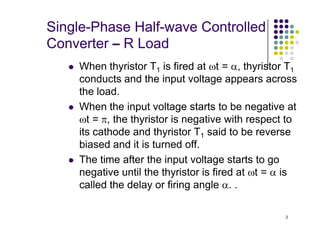
 When thyristor T1 is fired at ωt = α, thyristor T1
conducts and the input voltage appears across
the load.
 When the input voltage starts to be negative at
ωt = π, the thyristor is negative with respect to
2
ωt = π, the thyristor is negative with respect to
its cathode and thyristor T1 said to be reverse
biased and it is turned off.
 The time after the input voltage starts to go
negative until the thyristor is fired at ωt = α is
called the delay or firing angle α. .
Single-Phase Half-wave Controlled
Converters
3
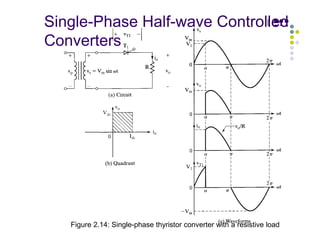
Figure 2.14: Single-phase thyristor converter with a resistive load
Single-Phase Half-wave Controlled
Converter – R Load
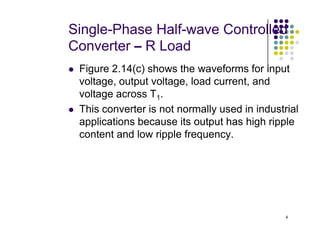
 Figure 2.14(c) shows the waveforms for input
voltage, output voltage, load current, and
voltage across T1.
 This converter is not normally used in industrial
applications because its output has high ripple
4
applications because its output has high ripple
content and low ripple frequency.
Single-Phase Half-wave Controlled
Converter – R Load (π
π
π
π in radian )
 If Vm is the peak input voltage, the average
output voltage Vdc can be found from.
 The maximum output voltage Vdm is (a=0)
( ) [ ] ( )
α
π
ω
π
ω
ω
π
π
α
π
α
cos
1
2
cos
2
sin
2
1
+
=
−
=
= ∫
m
m
m
dc
V
t
V
t
td
V
V
5
 The maximum output voltage Vdm is (a=0)
 The normalized output voltage
π
m
dm
V
V =
( )
α
cos
1
5
.
0 +
=
=
dm
dc
n
V
V
V
Single-Phase Half-wave Controlled
Converter – R Load
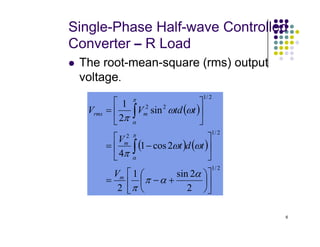
 The root-mean-square (rms) output
voltage.
( )
2
/
1
2
2
sin
2
1






= ∫ ω
ω
π
π
α
m
rms t
td
V
V
6
( ) ( )
2
/
1
2
/
1
2
2
2
sin
1
2
2
cos
1
4












+
−
=






−
=


∫
α
α
π
π
ω
ω
π
π
α
α
m
m
V
t
d
t
V
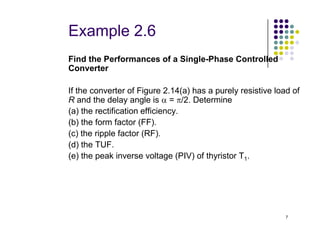
Example 2.6
Find the Performances of a Single-Phase Controlled
Converter
If the converter of Figure 2.14(a) has a purely resistive load of
R and the delay angle is α = π/2. Determine
(a) the rectification efficiency.
(b) the form factor (FF).
7
(b) the form factor (FF).
(c) the ripple factor (RF).
(d) the TUF.
(e) the peak inverse voltage (PIV) of thyristor T1.
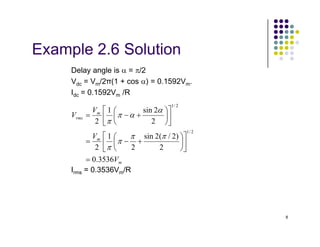
Example 2.6 Solution
Delay angle is α = π/2
Vdc = Vm/2π(1 + cos α) = 0.1592Vm.
Idc = 0.1592Vm /R
m
rms
V
V
2
2
sin
1
2
2
/
1












+
−
=
α
α
π
π
8
Irms = 0.3536Vm/R
m
m
V
V
3536
.
0
2
)
2
/
(
2
sin
2
1
2
2
2
2
/
1
=












+
−
=

 

π
π
π
π
π
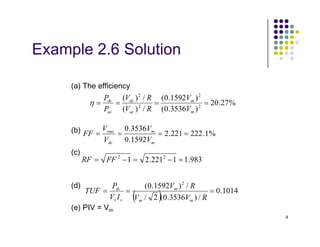
Example 2.6 Solution
(a) The efficiency
%
27
.
20
)
3536
.
0
(
)
1592
.
0
(
/
)
(
/
)
(
2
2
2
2
=
=
=
=
m
m
ac
dc
ac
dc
V
V
R
V
R
V
P
P
η
9
(b)
(c)
(d)
(e) PIV = Vm
%
1
.
222
221
.
2
1592
.
0
3536
.
0
=
=
=
=
m
m
dc
rms
V
V
V
V
FF
983
.
1
1
221
.
2
1 2
2
=
−
=
−
= FF
RF
( ) 1014
.
0
/
)
3536
.
0
(
2
/
/
)
1592
.
0
( 2
=
=
=
R
V
V
R
V
I
V
P
TUF
m
m
m
s
s
dc
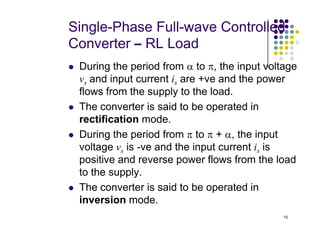
Single-Phase Full-wave Controlled
Converter – RL Load
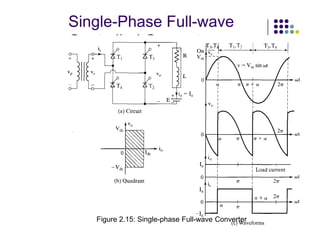
 During the period from α to π, the input voltage
vs and input current is are +ve and the power
flows from the supply to the load.
 The converter is said to be operated in
rectification mode.
10
rectification mode.
 During the period from π to π + α, the input
voltage vs is -ve and the input current is is
positive and reverse power flows from the load
to the supply.
 The converter is said to be operated in
inversion mode.
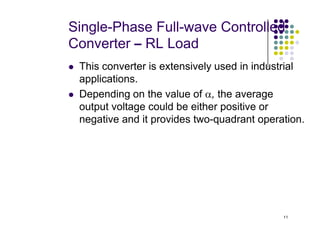
Single-Phase Full-wave Controlled
Converter – RL Load
 This converter is extensively used in industrial
applications.
 Depending on the value of α, the average
output voltage could be either positive or
negative and it provides two-quadrant operation.
11
negative and it provides two-quadrant operation.
Single-Phase Full-wave
Controlled Converters
 .
12
Figure 2.15: Single-phase Full-wave Converter
Single-Phase Full-wave Controlled
Converter – RL Load
 The average output voltage
The rms value of the output voltage
( ) [ ] α
π
ω
π
ω
ω
π
α
π
α
α
π
α
cos
2
cos
2
2
sin
2
2 m
m
m
dc
V
t
V
t
td
V
V =
−
=
=
+
+
∫
13
 The rms value of the output voltage
( )
( ) ( ) s
m
m
m
rms
V
V
t
d
t
V
t
td
V
V
=
=






−
=






=
∫
∫
+
+
2
2
cos
1
2
sin
2
2
2
/
1
2
2
/
1
2
2
α
π
α
α
π
α
ω
ω
π
ω
ω
π
Single-Phase Full-wave Controlled
Converter – RL Load
 The load current iL.
mode 1 : when T1 and T2 conduct [α ≤ ωt ≤ (α + π)]
( ) ( ) ( )( )
t
L
R
s
L
s
L e
Z
V
R
E
I
R
E
t
Z
V
i −








−
−
+
+
−
−
= ω
α
θ
α
θ
ω /
/
0 sin
2
sin
2
for
14
 The steady-state condition iL (ωt = π + α) = IL1 =
IL0.




( ) ( ) ( )( )
( )( )
R
E
e
e
Z
V
I
I L
R
L
R
s
L
L −
−
−
−
−
−
=
= −
−
ω
π
ω
π
θ
α
θ
α
/
/
/
/
1
0
1
sin
sin
2
0
0 ≥
L
I
Single-Phase Full-wave Controlled
Converter – RL Load
 The rms current.
mode 1 : when T1 and T2 conduct [α ≤ ωt ≤ (α + π)]
( )
2
/
1
2
2
1






= ∫
+α
π
α
ω
π
t
d
i
I L
R
15
 The rms output current.
 The average current


( ) R
R
R
rms I
I
I
I 2
2
/
1
2
2
=
+
=
( )
∫
+
=
α
π
α
ω
π
t
d
i
I L
A
2
1
Single-Phase Full-wave Controlled
Converter – RL Load
 The average output current.
mode 1 : when T1 and T2 conduct [α ≤ ωt ≤ (α + π)]
A
A
A
dc I
I
I
I 2
=
+
=
16
Example 2.7
Finding the Current Ratings of Single-Phase Controlled
Full Converter with an RL load
The single-phase full converter of Figure 215(a) has a RL load
having L = 6.5 mH, R = 0.5 Ω, and E = 10 V. The input voltage
is Vs = 120 V at (rms) 60 Hz. Determine
(a) the load current I at ωt = α = 60°.
17
(a) the load current IL0 at ωt = α = 60°.
(b) the average thyristor current IA.
(c) the rms thyristor current IR.
(d) the rms output current Irms.
(e) the average output current Idc.
(f) the critical delay angle αc.
2.10 Principle of Three-
phase Half-wave
Controlled Converter
18
Principle of Three-phase Half-wave
Controlled Converter
 Three-phase converters provide higher
average output voltage and in addition the
frequency of the ripples on the output voltage
is higher compared with that of single-phase
converters.
As a result, the filtering requirements for
19
 As a result, the filtering requirements for
smoothing out the load current and load
voltage are simpler.
 For these reasons, three-phase converters
are used extensively in high-power variable-
speed drives.
20
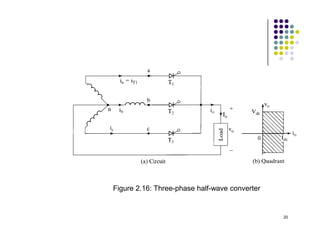
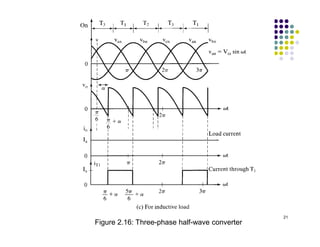
Figure 2.16: Three-phase half-wave converter
21
Figure 2.16: Three-phase half-wave converter
Principle of Three-phase Half-wave
Controlled Converter
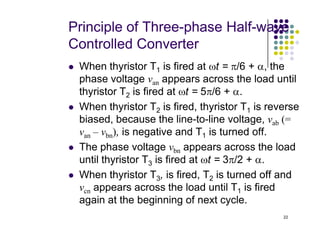
 When thyristor T1 is fired at ωt = π/6 + α, the
phase voltage van appears across the load until
thyristor T2 is fired at ωt = 5π/6 + α.
 When thyristor T2 is fired, thyristor T1 is reverse
biased, because the line-to-line voltage, vab (=
22
biased, because the line-to-line voltage, vab (=
van – vbn), is negative and T1 is turned off.
 The phase voltage vbn appears across the load
until thyristor T3 is fired at ωt = 3π/2 + α.
 When thyristor T3, is fired, T2 is turned off and
vcn appears across the load until T1 is fired
again at the beginning of next cycle.
Principle of Three-phase Half-wave
Controlled Converter
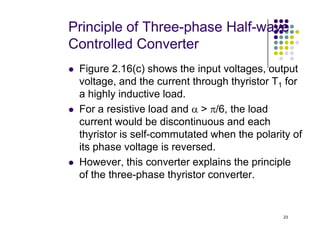
 Figure 2.16(c) shows the input voltages, output
voltage, and the current through thyristor T1 for
a highly inductive load.
 For a resistive load and α  π/6, the load
current would be discontinuous and each
23
current would be discontinuous and each
thyristor is self-commutated when the polarity of
its phase voltage is reversed.
 However, this converter explains the principle
of the three-phase thyristor converter.
Principle of Three-phase Half-wave
Controlled Converter
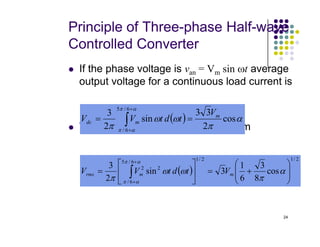
 If the phase voltage is van = Vm sin ωt average
output voltage for a continuous load current is
The rms output voltage is found from
( ) α
π
ω
ω
π
α
π
cos
2
3
3
sin
2
3
6
/
5
m
m
dc
V
t
d
t
V
V =
= ∫
+
24
 The rms output voltage is found from
( ) α
π
ω
ω
π α
π
cos
2
sin
2 6
/
m
dc t
d
t
V
V =
= ∫+
( )
2
/
1
2
/
1
6
/
5
6
/
2
2
cos
8
3
6
1
3
sin
2
3








+
=






= ∫
+
+
α
π
ω
ω
π
α
π
α
π
m
m
rms V
t
d
t
V
V
Principle of Three-phase Half-wave
Controlled Converter
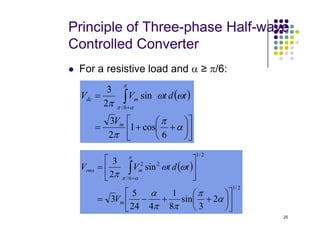
 For a resistive load and α ≥ π/6:
( )








+
+
=
= ∫+
α
π
ω
ω
π
π
α
π
cos
1
3
sin
2
3
6
/
m
m
dc
V
t
d
t
V
V
25












+
+
= α
π
π 6
cos
1
2
3 m
V
( )
2
/
1
2
/
1
6
/
2
2
2
3
sin
8
1
4
24
5
3
sin
2
3












+
+
−
=






= ∫+
α
π
π
π
α
ω
ω
π
π
α
π
m
m
rms
V
t
d
t
V
V
Three-Phase Full-wave Controlled
Converters
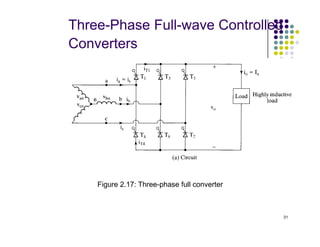
 Figure 2.17(a) shows a full-converter circuit with
a highly inductive load.
 This circuit is known as a three-phase bridge.
 The thyristors are fired at an interval of π/3.
 The frequency of output ripple voltage is 6fs
26
 The frequency of output ripple voltage is 6fs
and the filtering requirement is less than that of
half-wave converters.
 At ωt = π/6 + α, thyristor T6 is already
conducting and thyristor T1 is turned on.
Three-Phase Full-wave Controlled
Converters
 During interval (π/6 + α) ≤ ωt ≤ (π/2 + α),
thyristors T1 and T6 conduct and the line-to-line
voltage vab(= van – vbn) appears across the load.
 At ωt = π/2 + α, thyristor T2 is fired and thyristor
T6 is reversed biased immediately.
 T6 is turned off due to natural commutation.
27
 T6 is turned off due to natural commutation.
 During interval (π/2 + α) ≤ ωt ≤ (5π/6 + α),
thyristors T1 and T2 conduct and the line-to-line
voltage vac appears across the load.
Three-Phase Full-wave Controlled
Converters
 If the thyristors are numbered, as shown in
Figure 2.17(a), the firing sequence is 12, 23, 34,
45, 56, and 61.
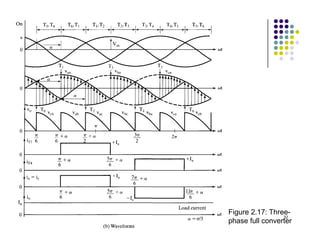
 Figure 2.17(b) shows the waveforms for input
voltage, output voltage, input current, and
28
voltage, output voltage, input current, and
currents through thyristors.
Three-Phase Full-wave Controlled
Converters
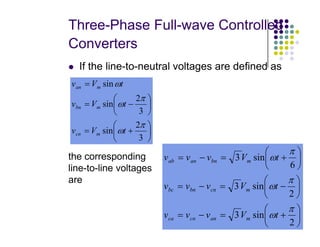
 If the line-to-neutral voltages are defined as








−
=
=
2
3
2
sin
sin
π
π
ω
ω
t
V
v
t
V
v
m
bn
m
an
29






+
=
3
2
sin
π
ωt
V
v m
cn






+
=
−
=






−
=
−
=






+
=
−
=
2
sin
3
2
sin
3
6
sin
3
π
ω
π
ω
π
ω
t
V
v
v
v
t
V
v
v
v
t
V
v
v
v
m
an
cn
ca
m
cn
bn
bc
m
bn
an
ab
the corresponding
line-to-line voltages
are
Three-Phase Full-wave Controlled
Converters
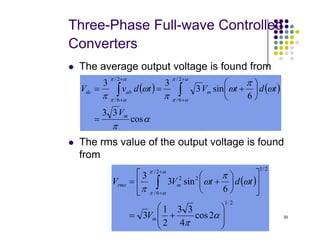
 The average output voltage is found from
( ) ( )
α
π
ω
π
ω
π
ω
π
α
π
α
π
α
π
α
π
cos
3
3
6
sin
3
3
3
2
/
6
/
2
/
6
/
m
m
ab
dc
V
t
d
t
V
t
d
v
V
=






+
=
= ∫
∫
+
+
+
+
30
 The rms value of the output voltage is found
from
α
π
cos
=
( )
2
/
1
2
/
1
2
/
6
/
2
2
2
cos
4
3
3
2
1
3
6
sin
3
3








+
=












+
= ∫
+
+
α
π
ω
π
ω
π
α
π
α
π
m
m
rms
V
t
d
t
V
V
Three-Phase Full-wave Controlled
Converters
31
Figure 2.17: Three-phase full converter
32
Figure 2.17: Three-
phase full converter
Three-Phase Full-wave Controlled
Converters
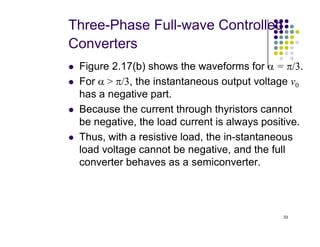
 Figure 2.17(b) shows the waveforms for α = π/3.
 For α  π/3, the instantaneous output voltage v0
has a negative part.
 Because the current through thyristors cannot
be negative, the load current is always positive.
33
be negative, the load current is always positive.
 Thus, with a resistive load, the in-stantaneous
load voltage cannot be negative, and the full
converter behaves as a semiconverter.
Q1
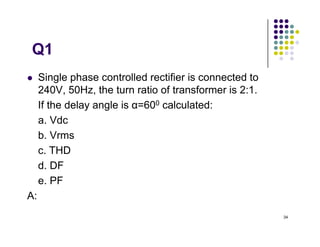
 Single phase controlled rectifier is connected to
240V, 50Hz, the turn ratio of transformer is 2:1.
If the delay angle is α=600 calculated:
a. Vdc
34
a. Vdc
b. Vrms
c. THD
d. DF
e. PF
A:54.02V,120V,(Is1=0.9Ia,Ia=Is, THD=48.34%),0.5,0.45
Q2
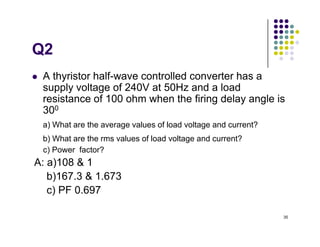
 A thyristor half-wave controlled converter has a
supply voltage of 240V at 50Hz and a load
resistance of 100 ohm when the firing delay angle is
300
a) What are the average values of load voltage and current?
35
a) What are the average values of load voltage and current?
b) What are the rms values of load voltage and current?
c) Power factor?
A: a)108  1
b)167.3  1.673
c) PF 0.697

Chapter 3 Controlled Rectifier.pdf

  • 1.
  • 2.
    Single-Phase Half-wave Controlled Converter– R Load When thyristor T1 is fired at ωt = α, thyristor T1 conducts and the input voltage appears across the load. When the input voltage starts to be negative at ωt = π, the thyristor is negative with respect to 2 ωt = π, the thyristor is negative with respect to its cathode and thyristor T1 said to be reverse biased and it is turned off. The time after the input voltage starts to go negative until the thyristor is fired at ωt = α is called the delay or firing angle α. .
  • 3.
    Single-Phase Half-wave Controlled Converters 3 Figure2.14: Single-phase thyristor converter with a resistive load
  • 4.
    Single-Phase Half-wave Controlled Converter– R Load Figure 2.14(c) shows the waveforms for input voltage, output voltage, load current, and voltage across T1. This converter is not normally used in industrial applications because its output has high ripple 4 applications because its output has high ripple content and low ripple frequency.
  • 5.
    Single-Phase Half-wave Controlled Converter– R Load (π π π π in radian ) If Vm is the peak input voltage, the average output voltage Vdc can be found from. The maximum output voltage Vdm is (a=0) ( ) [ ] ( ) α π ω π ω ω π π α π α cos 1 2 cos 2 sin 2 1 + = − = = ∫ m m m dc V t V t td V V 5 The maximum output voltage Vdm is (a=0) The normalized output voltage π m dm V V = ( ) α cos 1 5 . 0 + = = dm dc n V V V
  • 6.
    Single-Phase Half-wave Controlled Converter– R Load The root-mean-square (rms) output voltage. ( ) 2 / 1 2 2 sin 2 1       = ∫ ω ω π π α m rms t td V V 6 ( ) ( ) 2 / 1 2 / 1 2 2 2 sin 1 2 2 cos 1 4             + − =       − =   ∫ α α π π ω ω π π α α m m V t d t V
  • 7.
    Example 2.6 Find thePerformances of a Single-Phase Controlled Converter If the converter of Figure 2.14(a) has a purely resistive load of R and the delay angle is α = π/2. Determine (a) the rectification efficiency. (b) the form factor (FF). 7 (b) the form factor (FF). (c) the ripple factor (RF). (d) the TUF. (e) the peak inverse voltage (PIV) of thyristor T1.
  • 8.
    Example 2.6 Solution Delayangle is α = π/2 Vdc = Vm/2π(1 + cos α) = 0.1592Vm. Idc = 0.1592Vm /R m rms V V 2 2 sin 1 2 2 / 1             + − = α α π π 8 Irms = 0.3536Vm/R m m V V 3536 . 0 2 ) 2 / ( 2 sin 2 1 2 2 2 2 / 1 =             + − =     π π π π π
  • 9.
    Example 2.6 Solution (a)The efficiency % 27 . 20 ) 3536 . 0 ( ) 1592 . 0 ( / ) ( / ) ( 2 2 2 2 = = = = m m ac dc ac dc V V R V R V P P η 9 (b) (c) (d) (e) PIV = Vm % 1 . 222 221 . 2 1592 . 0 3536 . 0 = = = = m m dc rms V V V V FF 983 . 1 1 221 . 2 1 2 2 = − = − = FF RF ( ) 1014 . 0 / ) 3536 . 0 ( 2 / / ) 1592 . 0 ( 2 = = = R V V R V I V P TUF m m m s s dc
  • 10.
    Single-Phase Full-wave Controlled Converter– RL Load During the period from α to π, the input voltage vs and input current is are +ve and the power flows from the supply to the load. The converter is said to be operated in rectification mode. 10 rectification mode. During the period from π to π + α, the input voltage vs is -ve and the input current is is positive and reverse power flows from the load to the supply. The converter is said to be operated in inversion mode.
  • 11.
    Single-Phase Full-wave Controlled Converter– RL Load This converter is extensively used in industrial applications. Depending on the value of α, the average output voltage could be either positive or negative and it provides two-quadrant operation. 11 negative and it provides two-quadrant operation.
  • 12.
    Single-Phase Full-wave Controlled Converters . 12 Figure 2.15: Single-phase Full-wave Converter
  • 13.
    Single-Phase Full-wave Controlled Converter– RL Load The average output voltage The rms value of the output voltage ( ) [ ] α π ω π ω ω π α π α α π α cos 2 cos 2 2 sin 2 2 m m m dc V t V t td V V = − = = + + ∫ 13 The rms value of the output voltage ( ) ( ) ( ) s m m m rms V V t d t V t td V V = =       − =       = ∫ ∫ + + 2 2 cos 1 2 sin 2 2 2 / 1 2 2 / 1 2 2 α π α α π α ω ω π ω ω π
  • 14.
    Single-Phase Full-wave Controlled Converter– RL Load The load current iL. mode 1 : when T1 and T2 conduct [α ≤ ωt ≤ (α + π)] ( ) ( ) ( )( ) t L R s L s L e Z V R E I R E t Z V i −         − − + + − − = ω α θ α θ ω / / 0 sin 2 sin 2 for 14 The steady-state condition iL (ωt = π + α) = IL1 = IL0.     ( ) ( ) ( )( ) ( )( ) R E e e Z V I I L R L R s L L − − − − − − = = − − ω π ω π θ α θ α / / / / 1 0 1 sin sin 2 0 0 ≥ L I
  • 15.
    Single-Phase Full-wave Controlled Converter– RL Load The rms current. mode 1 : when T1 and T2 conduct [α ≤ ωt ≤ (α + π)] ( ) 2 / 1 2 2 1       = ∫ +α π α ω π t d i I L R 15 The rms output current. The average current   ( ) R R R rms I I I I 2 2 / 1 2 2 = + = ( ) ∫ + = α π α ω π t d i I L A 2 1
  • 16.
    Single-Phase Full-wave Controlled Converter– RL Load The average output current. mode 1 : when T1 and T2 conduct [α ≤ ωt ≤ (α + π)] A A A dc I I I I 2 = + = 16
  • 17.
    Example 2.7 Finding theCurrent Ratings of Single-Phase Controlled Full Converter with an RL load The single-phase full converter of Figure 215(a) has a RL load having L = 6.5 mH, R = 0.5 Ω, and E = 10 V. The input voltage is Vs = 120 V at (rms) 60 Hz. Determine (a) the load current I at ωt = α = 60°. 17 (a) the load current IL0 at ωt = α = 60°. (b) the average thyristor current IA. (c) the rms thyristor current IR. (d) the rms output current Irms. (e) the average output current Idc. (f) the critical delay angle αc.
  • 18.
    2.10 Principle ofThree- phase Half-wave Controlled Converter 18
  • 19.
    Principle of Three-phaseHalf-wave Controlled Converter Three-phase converters provide higher average output voltage and in addition the frequency of the ripples on the output voltage is higher compared with that of single-phase converters. As a result, the filtering requirements for 19 As a result, the filtering requirements for smoothing out the load current and load voltage are simpler. For these reasons, three-phase converters are used extensively in high-power variable- speed drives.
  • 20.
    20 Figure 2.16: Three-phasehalf-wave converter
  • 21.
    21 Figure 2.16: Three-phasehalf-wave converter
  • 22.
    Principle of Three-phaseHalf-wave Controlled Converter When thyristor T1 is fired at ωt = π/6 + α, the phase voltage van appears across the load until thyristor T2 is fired at ωt = 5π/6 + α. When thyristor T2 is fired, thyristor T1 is reverse biased, because the line-to-line voltage, vab (= 22 biased, because the line-to-line voltage, vab (= van – vbn), is negative and T1 is turned off. The phase voltage vbn appears across the load until thyristor T3 is fired at ωt = 3π/2 + α. When thyristor T3, is fired, T2 is turned off and vcn appears across the load until T1 is fired again at the beginning of next cycle.
  • 23.
    Principle of Three-phaseHalf-wave Controlled Converter Figure 2.16(c) shows the input voltages, output voltage, and the current through thyristor T1 for a highly inductive load. For a resistive load and α π/6, the load current would be discontinuous and each 23 current would be discontinuous and each thyristor is self-commutated when the polarity of its phase voltage is reversed. However, this converter explains the principle of the three-phase thyristor converter.
  • 24.
    Principle of Three-phaseHalf-wave Controlled Converter If the phase voltage is van = Vm sin ωt average output voltage for a continuous load current is The rms output voltage is found from ( ) α π ω ω π α π cos 2 3 3 sin 2 3 6 / 5 m m dc V t d t V V = = ∫ + 24 The rms output voltage is found from ( ) α π ω ω π α π cos 2 sin 2 6 / m dc t d t V V = = ∫+ ( ) 2 / 1 2 / 1 6 / 5 6 / 2 2 cos 8 3 6 1 3 sin 2 3         + =       = ∫ + + α π ω ω π α π α π m m rms V t d t V V
  • 25.
    Principle of Three-phaseHalf-wave Controlled Converter For a resistive load and α ≥ π/6: ( )         + + = = ∫+ α π ω ω π π α π cos 1 3 sin 2 3 6 / m m dc V t d t V V 25             + + = α π π 6 cos 1 2 3 m V ( ) 2 / 1 2 / 1 6 / 2 2 2 3 sin 8 1 4 24 5 3 sin 2 3             + + − =       = ∫+ α π π π α ω ω π π α π m m rms V t d t V V
  • 26.
    Three-Phase Full-wave Controlled Converters Figure 2.17(a) shows a full-converter circuit with a highly inductive load. This circuit is known as a three-phase bridge. The thyristors are fired at an interval of π/3. The frequency of output ripple voltage is 6fs 26 The frequency of output ripple voltage is 6fs and the filtering requirement is less than that of half-wave converters. At ωt = π/6 + α, thyristor T6 is already conducting and thyristor T1 is turned on.
  • 27.
    Three-Phase Full-wave Controlled Converters During interval (π/6 + α) ≤ ωt ≤ (π/2 + α), thyristors T1 and T6 conduct and the line-to-line voltage vab(= van – vbn) appears across the load. At ωt = π/2 + α, thyristor T2 is fired and thyristor T6 is reversed biased immediately. T6 is turned off due to natural commutation. 27 T6 is turned off due to natural commutation. During interval (π/2 + α) ≤ ωt ≤ (5π/6 + α), thyristors T1 and T2 conduct and the line-to-line voltage vac appears across the load.
  • 28.
    Three-Phase Full-wave Controlled Converters If the thyristors are numbered, as shown in Figure 2.17(a), the firing sequence is 12, 23, 34, 45, 56, and 61. Figure 2.17(b) shows the waveforms for input voltage, output voltage, input current, and 28 voltage, output voltage, input current, and currents through thyristors.
  • 29.
    Three-Phase Full-wave Controlled Converters If the line-to-neutral voltages are defined as         − = = 2 3 2 sin sin π π ω ω t V v t V v m bn m an 29       + = 3 2 sin π ωt V v m cn       + = − =       − = − =       + = − = 2 sin 3 2 sin 3 6 sin 3 π ω π ω π ω t V v v v t V v v v t V v v v m an cn ca m cn bn bc m bn an ab the corresponding line-to-line voltages are
  • 30.
    Three-Phase Full-wave Controlled Converters The average output voltage is found from ( ) ( ) α π ω π ω π ω π α π α π α π α π cos 3 3 6 sin 3 3 3 2 / 6 / 2 / 6 / m m ab dc V t d t V t d v V =       + = = ∫ ∫ + + + + 30 The rms value of the output voltage is found from α π cos = ( ) 2 / 1 2 / 1 2 / 6 / 2 2 2 cos 4 3 3 2 1 3 6 sin 3 3         + =             + = ∫ + + α π ω π ω π α π α π m m rms V t d t V V
  • 31.
  • 32.
  • 33.
    Three-Phase Full-wave Controlled Converters Figure 2.17(b) shows the waveforms for α = π/3. For α π/3, the instantaneous output voltage v0 has a negative part. Because the current through thyristors cannot be negative, the load current is always positive. 33 be negative, the load current is always positive. Thus, with a resistive load, the in-stantaneous load voltage cannot be negative, and the full converter behaves as a semiconverter.
  • 34.
    Q1 Single phasecontrolled rectifier is connected to 240V, 50Hz, the turn ratio of transformer is 2:1. If the delay angle is α=600 calculated: a. Vdc 34 a. Vdc b. Vrms c. THD d. DF e. PF A:54.02V,120V,(Is1=0.9Ia,Ia=Is, THD=48.34%),0.5,0.45
  • 35.
    Q2 A thyristorhalf-wave controlled converter has a supply voltage of 240V at 50Hz and a load resistance of 100 ohm when the firing delay angle is 300 a) What are the average values of load voltage and current? 35 a) What are the average values of load voltage and current? b) What are the rms values of load voltage and current? c) Power factor? A: a)108 1 b)167.3 1.673 c) PF 0.697