Single Phase AC voltage controller
with RL load
Introduction
• AC voltage controllers are thyristors devices that convert a fixed
alternating voltage directly into variable alternating voltage without
change in frequency.
• The voltage control is accomplished either by:
(i) phase control under natural commutation using pairs of silicon-
controlled rectifiers (SCRs) or triacs; or
(ii) by on/off control under forced commutation using fully
controlled GTOs, power transistors, IGBTs, MCTs, etc.
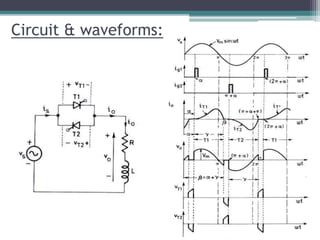
Circuit & waveforms:
Working
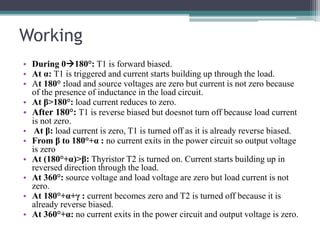
• During 0180°: T1 is forward biased.
• At α: T1 is triggered and current starts building up through the load.
• At 180° :load and source voltages are zero but current is not zero because
of the presence of inductance in the load circuit.
• At β>180°: load current reduces to zero.
• After 180°: T1 is reverse biased but doesnot turn off because load current
is not zero.
• At β: load current is zero, T1 is turned off as it is already reverse biased.
• From β to 180°+α : no current exits in the power circuit so output voltage
is zero
• At (180°+α)>β: Thyristor T2 is turned on. Current starts building up in
reversed direction through the load.
• At 360°: source voltage and load voltage are zero but load current is not
zero.
• At 180°+α+γ : current becomes zero and T2 is turned off because it is
already reverse biased.
• At 360°+α: no current exits in the power circuit and output voltage is zero.
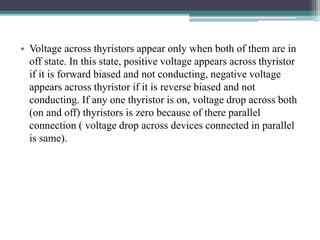
• Voltage across thyristors appear only when both of them are in
off state. In this state, positive voltage appears across thyristor
if it is forward biased and not conducting, negative voltage
appears across thyristor if it is reverse biased and not
conducting. If any one thyristor is on, voltage drop across both
(on and off) thyristors is zero because of there parallel
connection ( voltage drop across devices connected in parallel
is same).
Numerical
A single phase voltage controller is employed to control the power
flow from 230V, 50Hz source into a load circuit consisting of
R=3Ω and wL=4 Ω. Calculate:
a) The control range for the firing angle.
b) The maximum value of rms load.
c) Maximum power and power factor.
d) The maximum values of average and rms thyristor currents.
Solution:
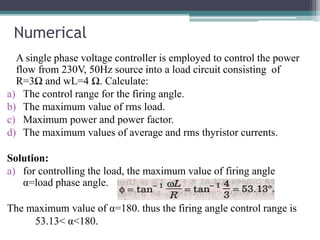
a) for controlling the load, the maximum value of firing angle
α=load phase angle.
The maximum value of α=180. thus the firing angle control range is
53.13< α<180.
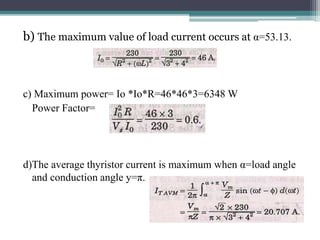
b) The maximum value of load current occurs at α=53.13.
c) Maximum power= Io *Io*R=46*46*3=6348 W
Power Factor=
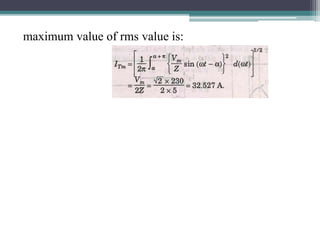
d)The average thyristor current is maximum when α=load angle
and conduction angle y=π.
maximum value of rms value is:
THANK YOU

Single phase ac voltage controller

  • 1.
    Single Phase ACvoltage controller with RL load
  • 2.
    Introduction • AC voltagecontrollers are thyristors devices that convert a fixed alternating voltage directly into variable alternating voltage without change in frequency. • The voltage control is accomplished either by: (i) phase control under natural commutation using pairs of silicon- controlled rectifiers (SCRs) or triacs; or (ii) by on/off control under forced commutation using fully controlled GTOs, power transistors, IGBTs, MCTs, etc.
  • 3.
  • 4.
    Working • During 0180°:T1 is forward biased. • At α: T1 is triggered and current starts building up through the load. • At 180° :load and source voltages are zero but current is not zero because of the presence of inductance in the load circuit. • At β>180°: load current reduces to zero. • After 180°: T1 is reverse biased but doesnot turn off because load current is not zero. • At β: load current is zero, T1 is turned off as it is already reverse biased. • From β to 180°+α : no current exits in the power circuit so output voltage is zero • At (180°+α)>β: Thyristor T2 is turned on. Current starts building up in reversed direction through the load. • At 360°: source voltage and load voltage are zero but load current is not zero. • At 180°+α+γ : current becomes zero and T2 is turned off because it is already reverse biased. • At 360°+α: no current exits in the power circuit and output voltage is zero.
  • 5.
    • Voltage acrossthyristors appear only when both of them are in off state. In this state, positive voltage appears across thyristor if it is forward biased and not conducting, negative voltage appears across thyristor if it is reverse biased and not conducting. If any one thyristor is on, voltage drop across both (on and off) thyristors is zero because of there parallel connection ( voltage drop across devices connected in parallel is same).
  • 6.
    Numerical A single phasevoltage controller is employed to control the power flow from 230V, 50Hz source into a load circuit consisting of R=3Ω and wL=4 Ω. Calculate: a) The control range for the firing angle. b) The maximum value of rms load. c) Maximum power and power factor. d) The maximum values of average and rms thyristor currents. Solution: a) for controlling the load, the maximum value of firing angle α=load phase angle. The maximum value of α=180. thus the firing angle control range is 53.13< α<180.
  • 7.
    b) The maximumvalue of load current occurs at α=53.13. c) Maximum power= Io *Io*R=46*46*3=6348 W Power Factor= d)The average thyristor current is maximum when α=load angle and conduction angle y=π.
  • 8.
    maximum value ofrms value is:
  • 9.