4/18/2024 1
Dr NSR/AP/ECE/PSNACET/BEEE/R2022/AU
4/18/2024 2
Dr NSR/AP/ECE/PSNACET/BEEE/R2022/AU
semiconductor
 semiconductor, any of a class of crystalline solids
intermediate in electrical conductivity between
a conductor and an insulator.
4/18/2024 Dr NSR/AP/ECE/PSNACET/BEEE/R2022/AU 3
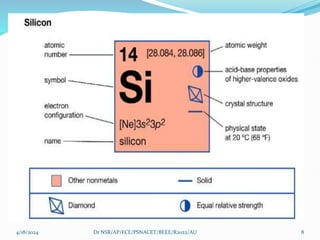
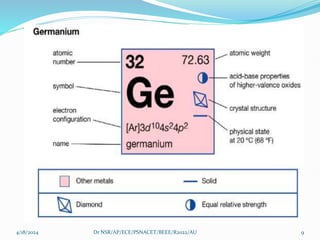
Semiconductor materials
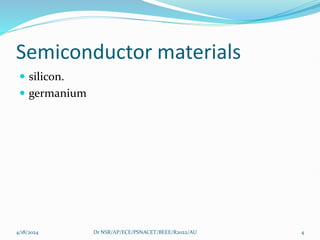
 silicon.
 germanium
4/18/2024 Dr NSR/AP/ECE/PSNACET/BEEE/R2022/AU 4
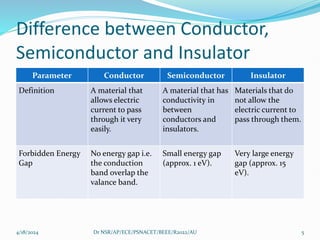
Difference between Conductor,
Semiconductor and Insulator
Parameter Conductor Semiconductor Insulator
Definition A material that
allows electric
current to pass
through it very
easily.
A material that has
conductivity in
between
conductors and
insulators.
Materials that do
not allow the
electric current to
pass through them.
Forbidden Energy
Gap
No energy gap i.e.
the conduction
band overlap the
valance band.
Small energy gap
(approx. 1 eV).
Very large energy
gap (approx. 15
eV).
4/18/2024 Dr NSR/AP/ECE/PSNACET/BEEE/R2022/AU 5
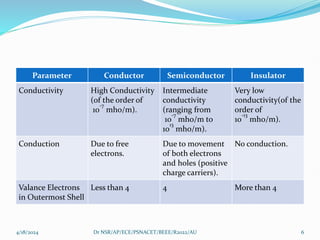
Parameter Conductor Semiconductor Insulator
Conductivity High Conductivity
(of the order of
10
-7
mho/m).
Intermediate
conductivity
(ranging from
10
-7
mho/m to
10
13
mho/m).
Very low
conductivity(of the
order of
10
-13
mho/m).
Conduction Due to free
electrons.
Due to movement
of both electrons
and holes (positive
charge carriers).
No conduction.
Valance Electrons
in Outermost Shell
Less than 4 4 More than 4
4/18/2024 Dr NSR/AP/ECE/PSNACET/BEEE/R2022/AU 6
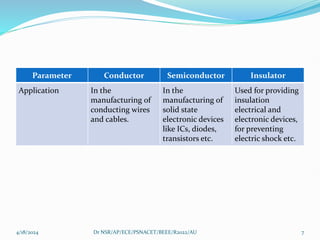
Parameter Conductor Semiconductor Insulator
Application In the
manufacturing of
conducting wires
and cables.
In the
manufacturing of
solid state
electronic devices
like ICs, diodes,
transistors etc.
Used for providing
insulation
electrical and
electronic devices,
for preventing
electric shock etc.
4/18/2024 Dr NSR/AP/ECE/PSNACET/BEEE/R2022/AU 7
4/18/2024 Dr NSR/AP/ECE/PSNACET/BEEE/R2022/AU 8
4/18/2024 Dr NSR/AP/ECE/PSNACET/BEEE/R2022/AU 9
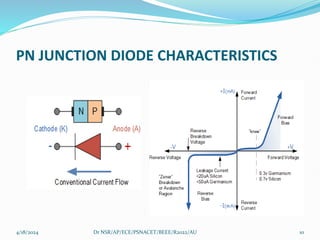
PN JUNCTION DIODE CHARACTERISTICS
4/18/2024 10
Dr NSR/AP/ECE/PSNACET/BEEE/R2022/AU
APPLICATION OF PN JUNCTION DIODE
 Switches
 Rectifiers
 Power supplies
 Clippers and clampers
 Digital systems
 Communication systems
4/18/2024 11
Dr NSR/AP/ECE/PSNACET/BEEE/R2022/AU
ZENER DIODE CHARACTERISTICS AND
APPLICATIONS
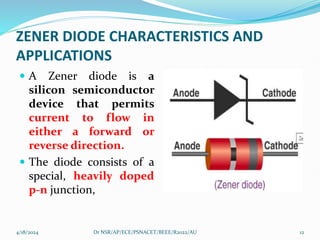
 A Zener diode is a
silicon semiconductor
device that permits
current to flow in
either a forward or
reverse direction.
 The diode consists of a
special, heavily doped
p-n junction,
4/18/2024 12
Dr NSR/AP/ECE/PSNACET/BEEE/R2022/AU
ZENER DIODE CHARACTERISTICS AND
APPLICATIONS
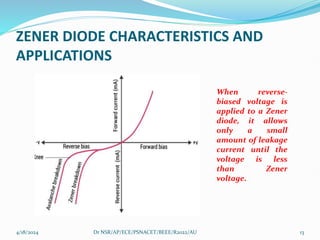
When reverse-
biased voltage is
applied to a Zener
diode, it allows
only a small
amount of leakage
current until the
voltage is less
than Zener
voltage.
4/18/2024 13
Dr NSR/AP/ECE/PSNACET/BEEE/R2022/AU
ZENER DIODE APPLICATIONS
 Zener diode as a voltage regulator:
 Zener diode in over-voltage protection:
 Zener diode in clipping circuits:
4/18/2024 14
Dr NSR/AP/ECE/PSNACET/BEEE/R2022/AU
Types of rectifiers
4/18/2024 Dr NSR/AP/ECE/PSNACET/BEEE/R2022/AU 15
BIPOLAR TRANSISTOR - BIASING
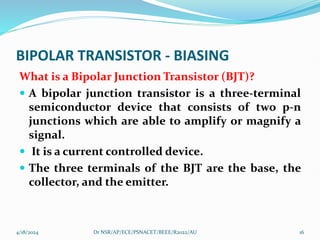
What is a Bipolar Junction Transistor (BJT)?
 A bipolar junction transistor is a three-terminal
semiconductor device that consists of two p-n
junctions which are able to amplify or magnify a
signal.
 It is a current controlled device.
 The three terminals of the BJT are the base, the
collector, and the emitter.
4/18/2024 16
Dr NSR/AP/ECE/PSNACET/BEEE/R2022/AU
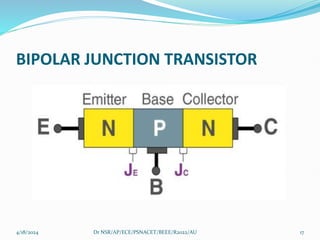
BIPOLAR JUNCTION TRANSISTOR
4/18/2024 17
Dr NSR/AP/ECE/PSNACET/BEEE/R2022/AU
CONSTRUCTION OF BIPOLAR JUNCTION
TRANSISTOR
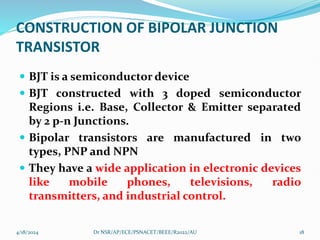
 BJT is a semiconductor device
 BJT constructed with 3 doped semiconductor
Regions i.e. Base, Collector & Emitter separated
by 2 p-n Junctions.
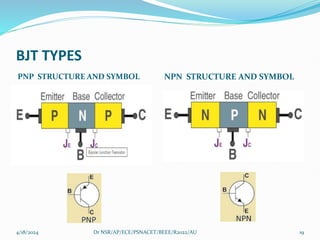
 Bipolar transistors are manufactured in two
types, PNP and NPN
 They have a wide application in electronic devices
like mobile phones, televisions, radio
transmitters, and industrial control.
4/18/2024 18
Dr NSR/AP/ECE/PSNACET/BEEE/R2022/AU
BJT TYPES
PNP STRUCTURE AND SYMBOL NPN STRUCTURE AND SYMBOL
4/18/2024 19
Dr NSR/AP/ECE/PSNACET/BEEE/R2022/AU
What are the applications of BJT?
 It is used as an amplifier
 It is used as an oscillator
 It is used as a demodulator
4/18/2024 20
Dr NSR/AP/ECE/PSNACET/BEEE/R2022/AU
BIASING
 Biasing is the process of providing DC voltage
which helps in the functioning of the circuit.
4/18/2024 21
Dr NSR/AP/ECE/PSNACET/BEEE/R2022/AU
BIASING
What happens if the transistor is not biased
properly?
 The work efficiency of the transistor reduces
 There will be a distortion in the output signal
 The operating point may shift
 Transistor parameters will change
4/18/2024 22
Dr NSR/AP/ECE/PSNACET/BEEE/R2022/AU
TYPES OF BJT BIASING
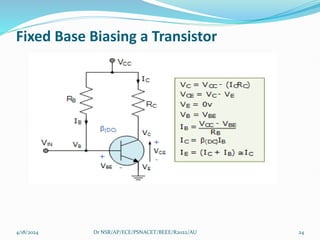
 Fixed Base Biasing a Transistor
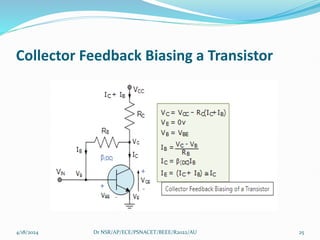
 Collector Feedback Biasing a Transistor
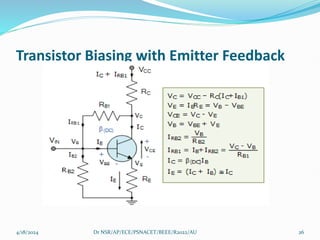
 Transistor Biasing with Emitter Feedback
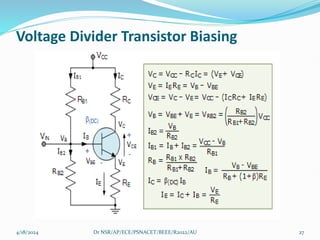
 Voltage Divider Transistor Biasing
4/18/2024 23
Dr NSR/AP/ECE/PSNACET/BEEE/R2022/AU
Fixed Base Biasing a Transistor
4/18/2024 24
Dr NSR/AP/ECE/PSNACET/BEEE/R2022/AU
Collector Feedback Biasing a Transistor
4/18/2024 25
Dr NSR/AP/ECE/PSNACET/BEEE/R2022/AU
Transistor Biasing with Emitter Feedback
4/18/2024 26
Dr NSR/AP/ECE/PSNACET/BEEE/R2022/AU
Voltage Divider Transistor Biasing
4/18/2024 27
Dr NSR/AP/ECE/PSNACET/BEEE/R2022/AU
JFET TYPES IV CHARACTERISTICS AND
APPLICATIONS
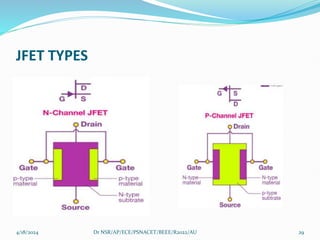
 JFET or Junction Field Effect Transistor is a unipolar
voltage-controlled semiconductor device with three
terminals: source, drain, and gate.
 JFETs are commonly used as switches and amplifiers.
4/18/2024 28
Dr NSR/AP/ECE/PSNACET/BEEE/R2022/AU
JFET TYPES
4/18/2024 Dr NSR/AP/ECE/PSNACET/BEEE/R2022/AU 29
JFET CONSTRUCTION
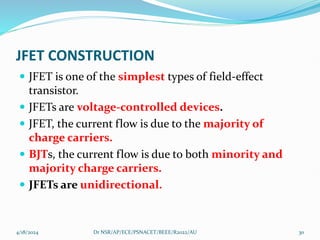
 JFET is one of the simplest types of field-effect
transistor.
 JFETs are voltage-controlled devices.
 JFET, the current flow is due to the majority of
charge carriers.
 BJTs, the current flow is due to both minority and
majority charge carriers.
 JFETs are unidirectional.
4/18/2024 Dr NSR/AP/ECE/PSNACET/BEEE/R2022/AU 30
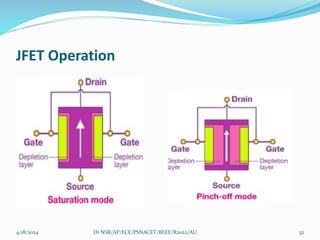
JFET Operation
 JFET by comparing it to a garden hose pipe.
 Water flows smoothly through a garden hose pipe if
there is no obstruction, but if we squeeze the pipe
slightly, the water flow slows down.
 This is precisely how a JFET works. Here the hose is
analogous to JFET, and the water flow is equivalent to a
current.
4/18/2024 Dr NSR/AP/ECE/PSNACET/BEEE/R2022/AU 31
JFET Operation
4/18/2024 Dr NSR/AP/ECE/PSNACET/BEEE/R2022/AU 32
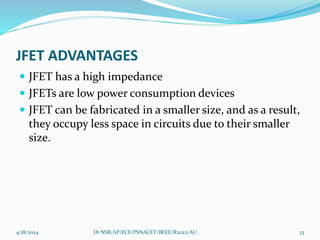
JFET ADVANTAGES
 JFET has a high impedance
 JFETs are low power consumption devices
 JFET can be fabricated in a smaller size, and as a result,
they occupy less space in circuits due to their smaller
size.
4/18/2024 Dr NSR/AP/ECE/PSNACET/BEEE/R2022/AU 33
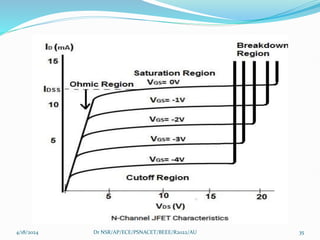
JFET CHARACTERISTICS
 Fast switching.
 For low frequency operation, source and drain can be
interchanged.
 Gate voltage that controls drain current.
 Single majority carrier.
 Small in size.
 High “Z” input.
4/18/2024 Dr NSR/AP/ECE/PSNACET/BEEE/R2022/AU 34
4/18/2024 Dr NSR/AP/ECE/PSNACET/BEEE/R2022/AU 35
JFET APPLICATIONS
 Switch
 Chopper
 Buffer
 Oscillatory circuits
 Cascade amplifiers
4/18/2024 Dr NSR/AP/ECE/PSNACET/BEEE/R2022/AU 36
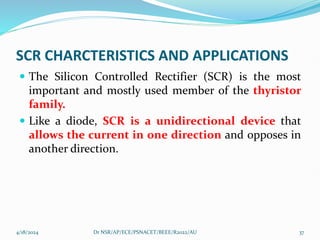
SCR CHARCTERISTICS AND APPLICATIONS
 The Silicon Controlled Rectifier (SCR) is the most
important and mostly used member of the thyristor
family.
 Like a diode, SCR is a unidirectional device that
allows the current in one direction and opposes in
another direction.
4/18/2024 Dr NSR/AP/ECE/PSNACET/BEEE/R2022/AU 37
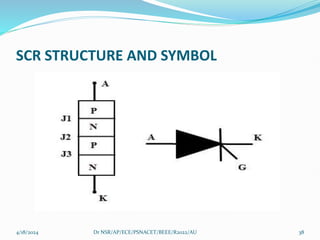
SCR STRUCTURE AND SYMBOL
4/18/2024 Dr NSR/AP/ECE/PSNACET/BEEE/R2022/AU 38
SCR CONSTRUCTION
4/18/2024 Dr NSR/AP/ECE/PSNACET/BEEE/R2022/AU 39
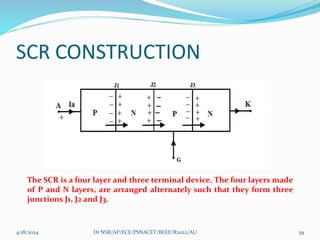
The SCR is a four layer and three terminal device. The four layers made
of P and N layers, are arranged alternately such that they form three
junctions J1, J2 and J3.
Working or Modes of Operation of SCR
 Forward blocking Mode
 Forward Conduction Mode and
 Reverse Blocking Mode
4/18/2024 Dr NSR/AP/ECE/PSNACET/BEEE/R2022/AU 40
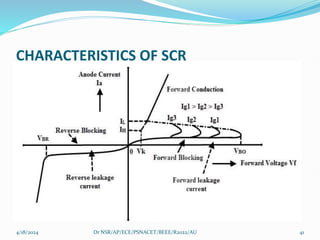
CHARACTERISTICS OF SCR
4/18/2024 Dr NSR/AP/ECE/PSNACET/BEEE/R2022/AU 41
SCR APPLICATIONS
 SCR can be used for different applications like
rectification,
 regulation of power
 inversion,
4/18/2024 Dr NSR/AP/ECE/PSNACET/BEEE/R2022/AU 42
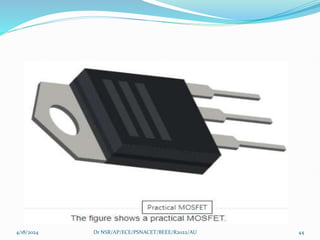
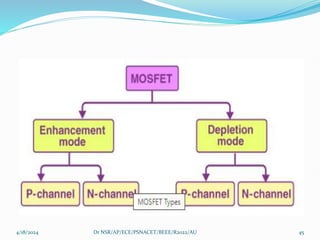
MOSFET CHARCTERISTICS AND
APPLICATIONS
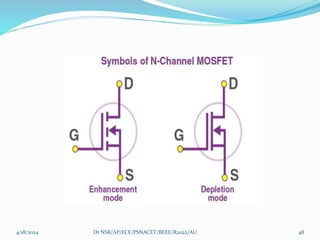
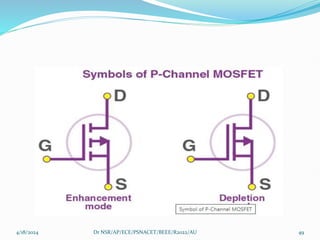
 What is a MOSFET?
 Metal Oxide Silicon Field Effect Transistors commonly known as
MOSFETs are electronic devices used to switch or amplify
voltages in circuits.
 It is a current controlled device and is constructed by three
terminals.
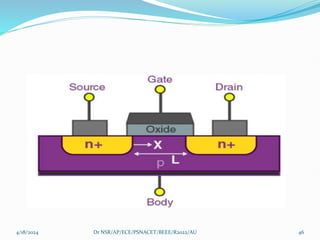
 The terminals of MOSFET are named as follows:
 Source
 Gate
 Drain
 Body
4/18/2024 Dr NSR/AP/ECE/PSNACET/BEEE/R2022/AU 43
4/18/2024 Dr NSR/AP/ECE/PSNACET/BEEE/R2022/AU 44
4/18/2024 Dr NSR/AP/ECE/PSNACET/BEEE/R2022/AU 45
4/18/2024 Dr NSR/AP/ECE/PSNACET/BEEE/R2022/AU 46
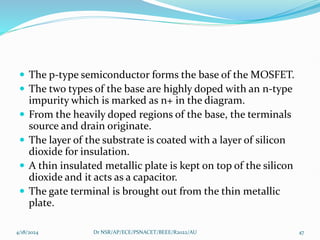
 The p-type semiconductor forms the base of the MOSFET.
 The two types of the base are highly doped with an n-type
impurity which is marked as n+ in the diagram.
 From the heavily doped regions of the base, the terminals
source and drain originate.
 The layer of the substrate is coated with a layer of silicon
dioxide for insulation.
 A thin insulated metallic plate is kept on top of the silicon
dioxide and it acts as a capacitor.
 The gate terminal is brought out from the thin metallic
plate.
4/18/2024 Dr NSR/AP/ECE/PSNACET/BEEE/R2022/AU 47
4/18/2024 Dr NSR/AP/ECE/PSNACET/BEEE/R2022/AU 48
4/18/2024 Dr NSR/AP/ECE/PSNACET/BEEE/R2022/AU 49
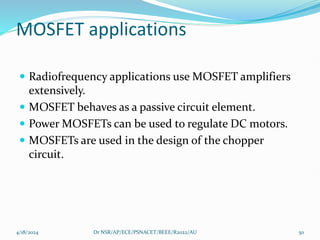
MOSFET applications
 Radiofrequency applications use MOSFET amplifiers
extensively.
 MOSFET behaves as a passive circuit element.
 Power MOSFETs can be used to regulate DC motors.
 MOSFETs are used in the design of the chopper
circuit.
4/18/2024 Dr NSR/AP/ECE/PSNACET/BEEE/R2022/AU 50
Advantages of MOSFET
 MOSFETs operate at greater efficiency at lower
voltages.
 Absence of gate current results in high input
impedance producing high switching speed.
 Disadvantages of MOSFET
 MOSFETs are vulnerable to damage by electrostatic
charges due to the thin oxide layer.
 Overload voltages make MOSFETs unstable.
4/18/2024 Dr NSR/AP/ECE/PSNACET/BEEE/R2022/AU 51
4/18/2024 Dr NSR/AP/ECE/PSNACET/BEEE/R2022/AU 52
4/18/2024 Dr NSR/AP/ECE/PSNACET/BEEE/R2022/AU 53

UNIT III ANALOG ELECTRONICS (BASIC ELECTRONICS)

  • 1.
  • 2.
  • 3.
    semiconductor  semiconductor, anyof a class of crystalline solids intermediate in electrical conductivity between a conductor and an insulator. 4/18/2024 Dr NSR/AP/ECE/PSNACET/BEEE/R2022/AU 3
  • 4.
    Semiconductor materials  silicon. germanium 4/18/2024 Dr NSR/AP/ECE/PSNACET/BEEE/R2022/AU 4
  • 5.
    Difference between Conductor, Semiconductorand Insulator Parameter Conductor Semiconductor Insulator Definition A material that allows electric current to pass through it very easily. A material that has conductivity in between conductors and insulators. Materials that do not allow the electric current to pass through them. Forbidden Energy Gap No energy gap i.e. the conduction band overlap the valance band. Small energy gap (approx. 1 eV). Very large energy gap (approx. 15 eV). 4/18/2024 Dr NSR/AP/ECE/PSNACET/BEEE/R2022/AU 5
  • 6.
    Parameter Conductor SemiconductorInsulator Conductivity High Conductivity (of the order of 10 -7 mho/m). Intermediate conductivity (ranging from 10 -7 mho/m to 10 13 mho/m). Very low conductivity(of the order of 10 -13 mho/m). Conduction Due to free electrons. Due to movement of both electrons and holes (positive charge carriers). No conduction. Valance Electrons in Outermost Shell Less than 4 4 More than 4 4/18/2024 Dr NSR/AP/ECE/PSNACET/BEEE/R2022/AU 6
  • 7.
    Parameter Conductor SemiconductorInsulator Application In the manufacturing of conducting wires and cables. In the manufacturing of solid state electronic devices like ICs, diodes, transistors etc. Used for providing insulation electrical and electronic devices, for preventing electric shock etc. 4/18/2024 Dr NSR/AP/ECE/PSNACET/BEEE/R2022/AU 7
  • 8.
  • 9.
  • 10.
    PN JUNCTION DIODECHARACTERISTICS 4/18/2024 10 Dr NSR/AP/ECE/PSNACET/BEEE/R2022/AU
  • 11.
    APPLICATION OF PNJUNCTION DIODE  Switches  Rectifiers  Power supplies  Clippers and clampers  Digital systems  Communication systems 4/18/2024 11 Dr NSR/AP/ECE/PSNACET/BEEE/R2022/AU
  • 12.
    ZENER DIODE CHARACTERISTICSAND APPLICATIONS  A Zener diode is a silicon semiconductor device that permits current to flow in either a forward or reverse direction.  The diode consists of a special, heavily doped p-n junction, 4/18/2024 12 Dr NSR/AP/ECE/PSNACET/BEEE/R2022/AU
  • 13.
    ZENER DIODE CHARACTERISTICSAND APPLICATIONS When reverse- biased voltage is applied to a Zener diode, it allows only a small amount of leakage current until the voltage is less than Zener voltage. 4/18/2024 13 Dr NSR/AP/ECE/PSNACET/BEEE/R2022/AU
  • 14.
    ZENER DIODE APPLICATIONS Zener diode as a voltage regulator:  Zener diode in over-voltage protection:  Zener diode in clipping circuits: 4/18/2024 14 Dr NSR/AP/ECE/PSNACET/BEEE/R2022/AU
  • 15.
    Types of rectifiers 4/18/2024Dr NSR/AP/ECE/PSNACET/BEEE/R2022/AU 15
  • 16.
    BIPOLAR TRANSISTOR -BIASING What is a Bipolar Junction Transistor (BJT)?  A bipolar junction transistor is a three-terminal semiconductor device that consists of two p-n junctions which are able to amplify or magnify a signal.  It is a current controlled device.  The three terminals of the BJT are the base, the collector, and the emitter. 4/18/2024 16 Dr NSR/AP/ECE/PSNACET/BEEE/R2022/AU
  • 17.
    BIPOLAR JUNCTION TRANSISTOR 4/18/202417 Dr NSR/AP/ECE/PSNACET/BEEE/R2022/AU
  • 18.
    CONSTRUCTION OF BIPOLARJUNCTION TRANSISTOR  BJT is a semiconductor device  BJT constructed with 3 doped semiconductor Regions i.e. Base, Collector & Emitter separated by 2 p-n Junctions.  Bipolar transistors are manufactured in two types, PNP and NPN  They have a wide application in electronic devices like mobile phones, televisions, radio transmitters, and industrial control. 4/18/2024 18 Dr NSR/AP/ECE/PSNACET/BEEE/R2022/AU
  • 19.
    BJT TYPES PNP STRUCTUREAND SYMBOL NPN STRUCTURE AND SYMBOL 4/18/2024 19 Dr NSR/AP/ECE/PSNACET/BEEE/R2022/AU
  • 20.
    What are theapplications of BJT?  It is used as an amplifier  It is used as an oscillator  It is used as a demodulator 4/18/2024 20 Dr NSR/AP/ECE/PSNACET/BEEE/R2022/AU
  • 21.
    BIASING  Biasing isthe process of providing DC voltage which helps in the functioning of the circuit. 4/18/2024 21 Dr NSR/AP/ECE/PSNACET/BEEE/R2022/AU
  • 22.
    BIASING What happens ifthe transistor is not biased properly?  The work efficiency of the transistor reduces  There will be a distortion in the output signal  The operating point may shift  Transistor parameters will change 4/18/2024 22 Dr NSR/AP/ECE/PSNACET/BEEE/R2022/AU
  • 23.
    TYPES OF BJTBIASING  Fixed Base Biasing a Transistor  Collector Feedback Biasing a Transistor  Transistor Biasing with Emitter Feedback  Voltage Divider Transistor Biasing 4/18/2024 23 Dr NSR/AP/ECE/PSNACET/BEEE/R2022/AU
  • 24.
    Fixed Base Biasinga Transistor 4/18/2024 24 Dr NSR/AP/ECE/PSNACET/BEEE/R2022/AU
  • 25.
    Collector Feedback Biasinga Transistor 4/18/2024 25 Dr NSR/AP/ECE/PSNACET/BEEE/R2022/AU
  • 26.
    Transistor Biasing withEmitter Feedback 4/18/2024 26 Dr NSR/AP/ECE/PSNACET/BEEE/R2022/AU
  • 27.
    Voltage Divider TransistorBiasing 4/18/2024 27 Dr NSR/AP/ECE/PSNACET/BEEE/R2022/AU
  • 28.
    JFET TYPES IVCHARACTERISTICS AND APPLICATIONS  JFET or Junction Field Effect Transistor is a unipolar voltage-controlled semiconductor device with three terminals: source, drain, and gate.  JFETs are commonly used as switches and amplifiers. 4/18/2024 28 Dr NSR/AP/ECE/PSNACET/BEEE/R2022/AU
  • 29.
    JFET TYPES 4/18/2024 DrNSR/AP/ECE/PSNACET/BEEE/R2022/AU 29
  • 30.
    JFET CONSTRUCTION  JFETis one of the simplest types of field-effect transistor.  JFETs are voltage-controlled devices.  JFET, the current flow is due to the majority of charge carriers.  BJTs, the current flow is due to both minority and majority charge carriers.  JFETs are unidirectional. 4/18/2024 Dr NSR/AP/ECE/PSNACET/BEEE/R2022/AU 30
  • 31.
    JFET Operation  JFETby comparing it to a garden hose pipe.  Water flows smoothly through a garden hose pipe if there is no obstruction, but if we squeeze the pipe slightly, the water flow slows down.  This is precisely how a JFET works. Here the hose is analogous to JFET, and the water flow is equivalent to a current. 4/18/2024 Dr NSR/AP/ECE/PSNACET/BEEE/R2022/AU 31
  • 32.
    JFET Operation 4/18/2024 DrNSR/AP/ECE/PSNACET/BEEE/R2022/AU 32
  • 33.
    JFET ADVANTAGES  JFEThas a high impedance  JFETs are low power consumption devices  JFET can be fabricated in a smaller size, and as a result, they occupy less space in circuits due to their smaller size. 4/18/2024 Dr NSR/AP/ECE/PSNACET/BEEE/R2022/AU 33
  • 34.
    JFET CHARACTERISTICS  Fastswitching.  For low frequency operation, source and drain can be interchanged.  Gate voltage that controls drain current.  Single majority carrier.  Small in size.  High “Z” input. 4/18/2024 Dr NSR/AP/ECE/PSNACET/BEEE/R2022/AU 34
  • 35.
  • 36.
    JFET APPLICATIONS  Switch Chopper  Buffer  Oscillatory circuits  Cascade amplifiers 4/18/2024 Dr NSR/AP/ECE/PSNACET/BEEE/R2022/AU 36
  • 37.
    SCR CHARCTERISTICS ANDAPPLICATIONS  The Silicon Controlled Rectifier (SCR) is the most important and mostly used member of the thyristor family.  Like a diode, SCR is a unidirectional device that allows the current in one direction and opposes in another direction. 4/18/2024 Dr NSR/AP/ECE/PSNACET/BEEE/R2022/AU 37
  • 38.
    SCR STRUCTURE ANDSYMBOL 4/18/2024 Dr NSR/AP/ECE/PSNACET/BEEE/R2022/AU 38
  • 39.
    SCR CONSTRUCTION 4/18/2024 DrNSR/AP/ECE/PSNACET/BEEE/R2022/AU 39 The SCR is a four layer and three terminal device. The four layers made of P and N layers, are arranged alternately such that they form three junctions J1, J2 and J3.
  • 40.
    Working or Modesof Operation of SCR  Forward blocking Mode  Forward Conduction Mode and  Reverse Blocking Mode 4/18/2024 Dr NSR/AP/ECE/PSNACET/BEEE/R2022/AU 40
  • 41.
    CHARACTERISTICS OF SCR 4/18/2024Dr NSR/AP/ECE/PSNACET/BEEE/R2022/AU 41
  • 42.
    SCR APPLICATIONS  SCRcan be used for different applications like rectification,  regulation of power  inversion, 4/18/2024 Dr NSR/AP/ECE/PSNACET/BEEE/R2022/AU 42
  • 43.
    MOSFET CHARCTERISTICS AND APPLICATIONS What is a MOSFET?  Metal Oxide Silicon Field Effect Transistors commonly known as MOSFETs are electronic devices used to switch or amplify voltages in circuits.  It is a current controlled device and is constructed by three terminals.  The terminals of MOSFET are named as follows:  Source  Gate  Drain  Body 4/18/2024 Dr NSR/AP/ECE/PSNACET/BEEE/R2022/AU 43
  • 44.
  • 45.
  • 46.
  • 47.
     The p-typesemiconductor forms the base of the MOSFET.  The two types of the base are highly doped with an n-type impurity which is marked as n+ in the diagram.  From the heavily doped regions of the base, the terminals source and drain originate.  The layer of the substrate is coated with a layer of silicon dioxide for insulation.  A thin insulated metallic plate is kept on top of the silicon dioxide and it acts as a capacitor.  The gate terminal is brought out from the thin metallic plate. 4/18/2024 Dr NSR/AP/ECE/PSNACET/BEEE/R2022/AU 47
  • 48.
  • 49.
  • 50.
    MOSFET applications  Radiofrequencyapplications use MOSFET amplifiers extensively.  MOSFET behaves as a passive circuit element.  Power MOSFETs can be used to regulate DC motors.  MOSFETs are used in the design of the chopper circuit. 4/18/2024 Dr NSR/AP/ECE/PSNACET/BEEE/R2022/AU 50
  • 51.
    Advantages of MOSFET MOSFETs operate at greater efficiency at lower voltages.  Absence of gate current results in high input impedance producing high switching speed.  Disadvantages of MOSFET  MOSFETs are vulnerable to damage by electrostatic charges due to the thin oxide layer.  Overload voltages make MOSFETs unstable. 4/18/2024 Dr NSR/AP/ECE/PSNACET/BEEE/R2022/AU 51
  • 52.
  • 53.