Unit III
Starting methods
DC MOTOR STARTERS
 Voltage equation of a DC motor is
V = Eb + IaRa
 Ia = (V - Eb) /Ra
 A large current flows through the armature
during starting.
 This current is large enough to damage the
armature circuit.
DC Motor Starters
 3 point starter,
 4 point starter,
 2 point starter
 No-load release coil starter,
 Thyristor controller starter .
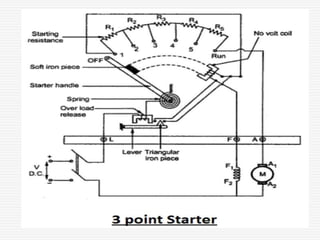
3 Point starter
 'L' Line terminal. (Connected to positive of
supply.)
 'A' Armature terminal. (Connected to the
armature winding.)
 'F' Field terminal. (Connected to the field
winding.)
Draw backs of 3 Point starter
 To increase the speed of the motor field
resistance can be increased.
 Therefore current through shunt field is
reduced.
 Field current becomes very low which results in
holding electromagnet too weak to overcome the
force exerted by the spring.
 .
 The holding magnet may release the arm of the
starter during the normal operation of the
motor and thus disconnect the motor from the
line
 This is not desirable. A four point starter is thus
used.
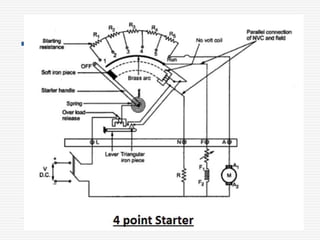
4 Point starter
 L' Line terminal. (Connected to positive of
supply.)
 'A' Armature terminal. (Connected to the
armature winding.)
 'F' Field terminal. (Connected to the field
winding.)
 Like in the case of the 3 point starter, and in
addition to it there is, a 4th point N. (Connected
to the No Voltage Coil NVC)
4 Point starter
 The remarkable difference in case of a 4 point
starter is that the No Voltage Coil is connected
independently across the supply through the
fourth terminal called 'N‘.
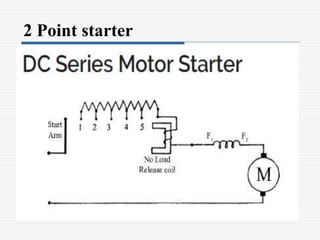
2 Point starter
2 Point starter
 The start arm is simply moved towards right to
start the motor.
 Thus, maximum resistance is connected in series
with the armature during starting
 Then gradually decreased as the start arm
moves towards right.
 This starter is sometimes also called as a 2 point
starter.
 The no load release coil holds the start arm to
the run position and leaves it when the voltage is
lost.
Starters for three phase induction
motor
 Directly switched ON, motor take 5 to 7 times of
full load current
 Damage the motor
 High voltage drop in the line
 So, starters are necessary
Types of induction motor starters
1. DOL starter
2. Primary resister starter
3. Autotransformer starter
4. Star delta starter
5. Rotor resistance starter
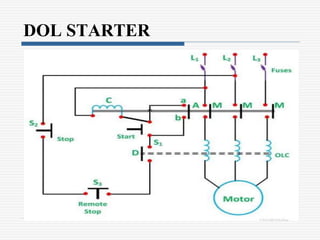
DOL STARTER
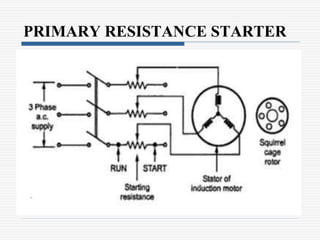
PRIMARY RESISTANCE STARTER
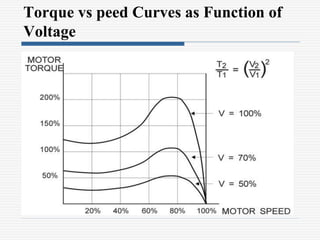
Torque vs peed Curves as Function of
Voltage
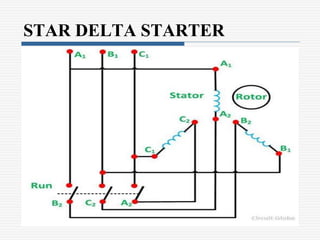
STAR DELTA STARTER
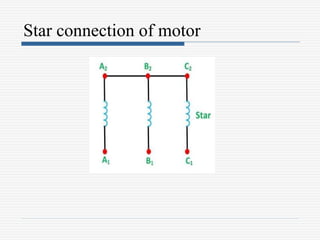
Star connection of motor
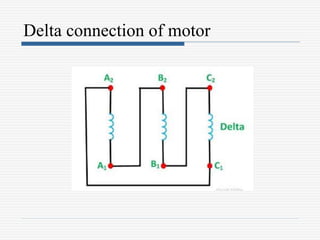
Delta connection of motor
 Started with star connection
 Run with delta connection
 Reduced voltage applied at the time of starting due
to star connection
 Full voltage applied to the motor ,when rotor speed
reaches 80% of rated speed with delta connection
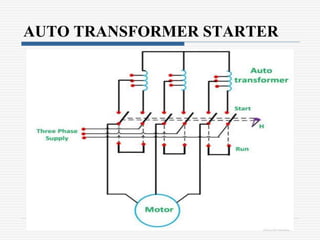
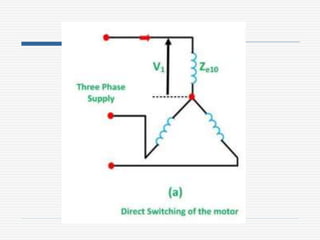
AUTO TRANSFORMER STARTER
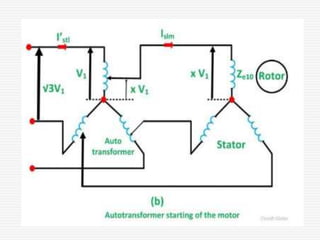
Operation of autotransformer
 Handle at start position
 The motor is connected through the auto
transformer
 Reduced voltage is applied
 Starting current reduced
 When the motor gets of 80% of the normal
speed,handle is moved to RUN condition
 Then the motor receives full line voltage
advantages
 Reduced line current
 Smooth starting
 High acceleration
Disadvantages
 Higher cost
 It is used large rated motor only
Over load protection(OLR)
 Whenever motor overloaded
 The OLR(over load relay coil) is energised
 Hence the supply switched OFF
Low voltage protection
 When supply voltage goes low or falls
 Under voltage relay coil deenergizes and release
the handle to OFF position
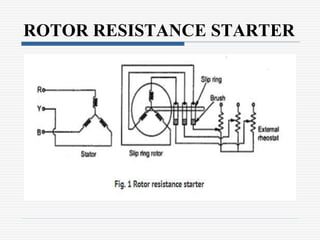
ROTOR RESISTANCE STARTER
 This starter only used for slip ring motor
 External resistance connected in the rotor terminals
 Motor always started with full supply voltage
 The resitances is gradually cut out of the rotor
circuit as the motor gathers speed
iii Assignment questions
1.Draw and explain the following DC motor starters
a.2 point starter
b.3 point starter
c.4 point starter
2.Draw and explain the following induction motor
starters
a.DOL starter
b.Star delta starter
c.Auto transformer starter
d.Rotor resistance starter

Dc motor starters

  • 1.
  • 2.
    DC MOTOR STARTERS Voltage equation of a DC motor is V = Eb + IaRa  Ia = (V - Eb) /Ra  A large current flows through the armature during starting.  This current is large enough to damage the armature circuit.
  • 3.
    DC Motor Starters 3 point starter,  4 point starter,  2 point starter  No-load release coil starter,  Thyristor controller starter .
  • 5.
    3 Point starter 'L' Line terminal. (Connected to positive of supply.)  'A' Armature terminal. (Connected to the armature winding.)  'F' Field terminal. (Connected to the field winding.)
  • 6.
    Draw backs of3 Point starter  To increase the speed of the motor field resistance can be increased.  Therefore current through shunt field is reduced.  Field current becomes very low which results in holding electromagnet too weak to overcome the force exerted by the spring.  .
  • 7.
     The holdingmagnet may release the arm of the starter during the normal operation of the motor and thus disconnect the motor from the line  This is not desirable. A four point starter is thus used.
  • 9.
    4 Point starter L' Line terminal. (Connected to positive of supply.)  'A' Armature terminal. (Connected to the armature winding.)  'F' Field terminal. (Connected to the field winding.)  Like in the case of the 3 point starter, and in addition to it there is, a 4th point N. (Connected to the No Voltage Coil NVC)
  • 10.
    4 Point starter The remarkable difference in case of a 4 point starter is that the No Voltage Coil is connected independently across the supply through the fourth terminal called 'N‘.
  • 11.
  • 12.
    2 Point starter The start arm is simply moved towards right to start the motor.  Thus, maximum resistance is connected in series with the armature during starting  Then gradually decreased as the start arm moves towards right.  This starter is sometimes also called as a 2 point starter.  The no load release coil holds the start arm to the run position and leaves it when the voltage is lost.
  • 13.
    Starters for threephase induction motor  Directly switched ON, motor take 5 to 7 times of full load current  Damage the motor  High voltage drop in the line  So, starters are necessary
  • 14.
    Types of inductionmotor starters 1. DOL starter 2. Primary resister starter 3. Autotransformer starter 4. Star delta starter 5. Rotor resistance starter
  • 15.
  • 16.
  • 17.
    Torque vs peedCurves as Function of Voltage
  • 18.
  • 19.
  • 20.
  • 21.
     Started withstar connection  Run with delta connection  Reduced voltage applied at the time of starting due to star connection  Full voltage applied to the motor ,when rotor speed reaches 80% of rated speed with delta connection
  • 22.
  • 25.
    Operation of autotransformer Handle at start position  The motor is connected through the auto transformer  Reduced voltage is applied  Starting current reduced  When the motor gets of 80% of the normal speed,handle is moved to RUN condition  Then the motor receives full line voltage
  • 26.
    advantages  Reduced linecurrent  Smooth starting  High acceleration
  • 27.
    Disadvantages  Higher cost It is used large rated motor only
  • 28.
    Over load protection(OLR) Whenever motor overloaded  The OLR(over load relay coil) is energised  Hence the supply switched OFF
  • 29.
    Low voltage protection When supply voltage goes low or falls  Under voltage relay coil deenergizes and release the handle to OFF position
  • 30.
  • 31.
     This starteronly used for slip ring motor  External resistance connected in the rotor terminals  Motor always started with full supply voltage  The resitances is gradually cut out of the rotor circuit as the motor gathers speed
  • 32.
    iii Assignment questions 1.Drawand explain the following DC motor starters a.2 point starter b.3 point starter c.4 point starter 2.Draw and explain the following induction motor starters a.DOL starter b.Star delta starter c.Auto transformer starter d.Rotor resistance starter