Three Phase
Transformer
Presented by:
Rizwan Yaseen 2017-EE-432
Zeeshan Saeed 2017-EE-414
Muhammad Hamad 2017-EE-404
Muhammad Zeeshan 2017-EE-402
Outline
 Three Phase Transformer
 Why do we want three phase transformer?
 Construction of Three Phase Transformers
 Core Type Construction
 Shell Type Construction
 Working of Three Phase Transformers
 Three Phase Transformer Connections
 Calculations
 Power Rating
 No. of turns per volt
 Selection of suitable wire
 Losses in transformer
 Advantages of Three Phase Transformers
 Disadvantages of Three Phase Transformers
 Applications of three phase transformer
 Conclusion
Three Phase Transformer
 Three phase transformers are used
to step-up or step-down the high
voltages in various stages of power
transmission system.
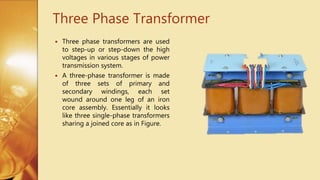
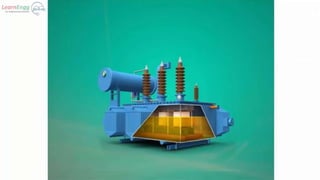
 A three-phase transformer is made
of three sets of primary and
secondary windings, each set
wound around one leg of an iron
core assembly. Essentially it looks
like three single-phase transformers
sharing a joined core as in Figure.
Why do we want three phase transformer?
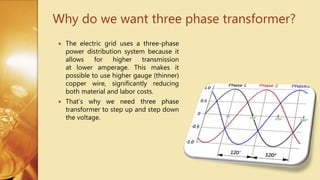
 The electric grid uses a three-phase
power distribution system because it
allows for higher transmission
at lower amperage. This makes it
possible to use higher gauge (thinner)
copper wire, significantly reducing
both material and labor costs.
 That’s why we need three phase
transformer to step up and step down
the voltage.
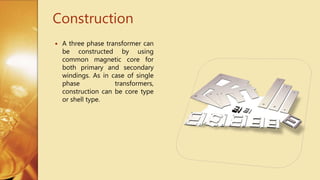
Construction
 A three phase transformer can
be constructed by using
common magnetic core for
both primary and secondary
windings. As in case of single
phase transformers,
construction can be core type
or shell type.
Types of construction
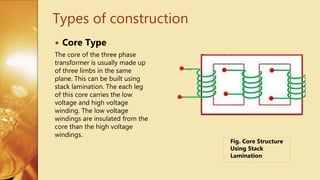
 Core Type
The core of the three phase
transformer is usually made up
of three limbs in the same
plane. This can be built using
stack lamination. The each leg
of this core carries the low
voltage and high voltage
winding. The low voltage
windings are insulated from the
core than the high voltage
windings.
Fig. Core Structure
Using Stack
Lamination
Types of construction
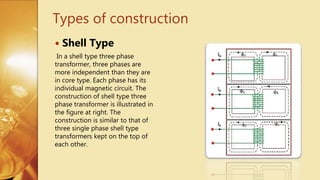
 Shell Type
In a shell type three phase
transformer, three phases are
more independent than they are
in core type. Each phase has its
individual magnetic circuit. The
construction of shell type three
phase transformer is illustrated in
the figure at right. The
construction is similar to that of
three single phase shell type
transformers kept on the top of
each other.
Working of Three Phase Transformer
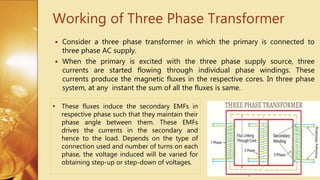
 Consider a three phase transformer in which the primary is connected to
three phase AC supply.
 When the primary is excited with the three phase supply source, three
currents are started flowing through individual phase windings. These
currents produce the magnetic fluxes in the respective cores. In three phase
system, at any instant the sum of all the fluxes is same.
• These fluxes induce the secondary EMFs in
respective phase such that they maintain their
phase angle between them. These EMFs
drives the currents in the secondary and
hence to the load. Depends on the type of
connection used and number of turns on each
phase, the voltage induced will be varied for
obtaining step-up or step-down of voltages.
Connections of three phase transformer
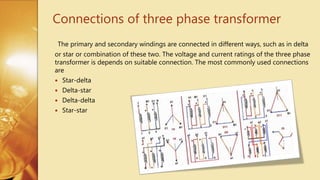
The primary and secondary windings are connected in different ways, such as in delta
or star or combination of these two. The voltage and current ratings of the three phase
transformer is depends on suitable connection. The most commonly used connections
are
 Star-delta
 Delta-star
 Delta-delta
 Star-star
Star-Delta Connection
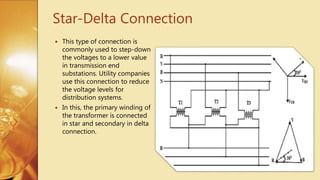
 This type of connection is
commonly used to step-down
the voltages to a lower value
in transmission end
substations. Utility companies
use this connection to reduce
the voltage levels for
distribution systems.
 In this, the primary winding of
the transformer is connected
in star and secondary in delta
connection.
Delta-star Connection
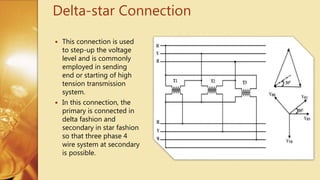
 This connection is used
to step-up the voltage
level and is commonly
employed in sending
end or starting of high
tension transmission
system.
 In this connection, the
primary is connected in
delta fashion and
secondary in star fashion
so that three phase 4
wire system at secondary
is possible.
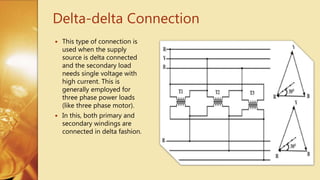
Delta-delta Connection
 This type of connection is
used when the supply
source is delta connected
and the secondary load
needs single voltage with
high current. This is
generally employed for
three phase power loads
(like three phase motor).
 In this, both primary and
secondary windings are
connected in delta fashion.
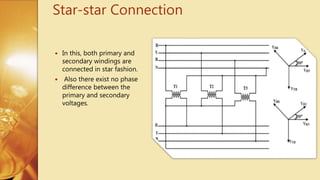
Star-star Connection
 In this, both primary and
secondary windings are
connected in star fashion.
 Also there exist no phase
difference between the
primary and secondary
voltages.
Power Rating
 We are going to design a 250 VA step down three phase transformer of 440V to
74V. Necessary calculations along with formulae are given in the next slides.
 As we are going to design small transformer (of small power rating) so we are
neglecting core and copper losses as they doesn’t matters in small transformers and
seriously considered in designing power transformers (high power rating transforms
Calculations of a Transformer
 As, we are going to design a practical transformer so we must consider the core
available in market. The standard Bobbins available in market practically is 1”x1”,
1.25”x1.5”, 1.5”x1.5” and so on. We took nearest core area available to our
calculation. We took bobbin of 1.875 inch sq. (1.25”x1.5”) or 0.0012065 meter
square. We have the core area. We can calculate turns per volts using this area by
following:
 Putting f=50 Hz; B = 1.2 wb/(m^2); A= 0.0012065 m^2,
we got:
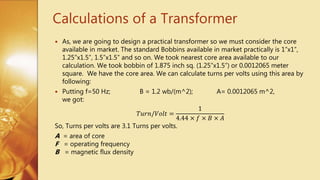
𝑇𝑢𝑟𝑛/𝑉𝑜𝑙𝑡 =
1
4.44 × 𝑓 × 𝐵 × 𝐴
So, Turns per volts are 3.1 Turns per volts.
A = area of core
F = operating frequency
B = magnetic flux density
Calculations of a Transformer
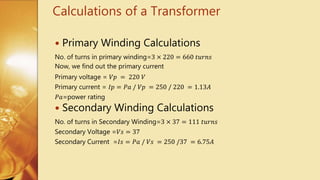
 Primary Winding Calculations
No. of turns in primary winding=3 × 220 = 660 𝑡𝑢𝑟𝑛𝑠
Now, we find out the primary current
Primary voltage = 𝑉𝑝 = 220 𝑉
Primary current = 𝐼𝑝 = 𝑃𝑎 / 𝑉𝑝 = 250 / 220 = 1.13𝐴
𝑃𝑎=power rating
 Secondary Winding Calculations
No. of turns in Secondary Winding=3 × 37 = 111 𝑡𝑢𝑟𝑛𝑠
Secondary Voltage =𝑉𝑠 = 37
Secondary Current =𝐼𝑠 = 𝑃𝑎 / 𝑉𝑠 = 250 /37 = 6.75𝐴
Selection of Suitable wire
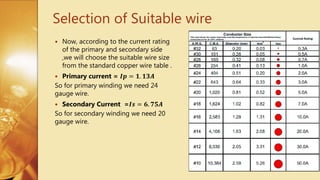
 Now, according to the current rating
of the primary and secondary side
,we will choose the suitable wire size
from the standard copper wire table .
 Primary current = 𝑰𝒑 = 𝟏. 𝟏𝟑𝑨
So for primary winding we need 24
gauge wire.
 Secondary Current =𝑰𝒔 = 𝟔. 𝟕𝟓𝑨
So for secondary winding we need 20
gauge wire.
Losses in Transformer
There are various types of losses in the transformer such as
 Iron losses,
Iron losses are caused by the alternating flux in the core of the transformer as this loss
occurs in the core it is also known as Core loss.
 Copper losses
The copper loss occur because of the transformer winding resistance.
 Hysteresis losses
The hysteresis losses occur because of the variation of the magnetization in the core
of the transformer
 Eddy current losses
When the flux links with a closed circuit, an EMF is induced in the core. Since the core
is made of conducting material, the EMF circulates currents within the body of the
material, it produces a loss (𝐼2 𝑅 loss) in the magnetic material known as an Eddy
Current Loss.
Advantages of three phase transformer
There are numerous advantages of using a 3-phase transformer , some of which have
been listed below:
 Inexpensive: Compared to a Single-Phase transformer the 3 phase
transformer comes at a cheaper price. It has a low cost when compared with the
three units of single-phase transformers.
 Lightweight: Not only is the transformer lightweight, it is also smaller than the
single-phase transformer in size which means that it also occupies less space.
 Assembly in least time: It is extremely easy to assemble. We can get a single
phase supply from a 3-phase transformer, while the opposite is not possible.
 Higher efficiency: The 3-phase transformer performs its functions more efficiently
and delivers more power than the single-phase transformer.
 Easier to install: The 3-phase transformers are pre-wired and ready to install; thus
makes the installation process very easy and smooth.
 Easy transportation: In order to provide the same output, the material used for
building the core of the transformer is very little as compared to a bank of three
single phase transformers. Not only is transportation easy but also reduces
transportation cost
Disadvantages of three phase transformer
Although they have many advantages over their single-phase counterparts,
they don’t come without their disadvantages.
 Greater cost of standby units: The individual cost of the standby units is
high and makes it difficult to repair or fix any malfunctions. In a 3-phase
transformer, a common core is shared by all three units. Therefore if the unit
is defective or is damaged, the entire three-phase transformer has to be
shut down.
 Cost of repair: The cost to repair a 3-phase transformer is higher since
changing each individual component is expensive. Hence, to restore the
service, the spare unit cost is more when compared to a single-phase
transformer.
 Reduced capacity: Since the 3-phase transformers are self-cooled, the
capacity of the transformer is also reduced simultaneously.
 Fault correction: In case there is a fault in any of the phases of the 3 phase
transformers, the fault is transferred to the other two phases. As a result, the
whole unit needs replacement.
Applications of three phase transformer
 It step up the level of voltage at generation side
before transmission and distribution.
 In distribution side, for commercial or domestic
use of electricity, transformer step down (
decries) the level of voltage
For example form 11kV to 220 V single phase and
440 V three phase.
 The Current Transformer and Potential
Transformer also used in power system and the
industry
 So these were the simple uses and application of
transformer.
Conclusion
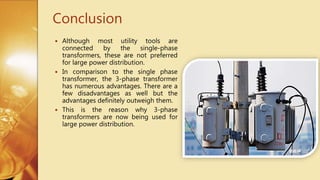
 Although most utility tools are
connected by the single-phase
transformers, these are not preferred
for large power distribution.
 In comparison to the single phase
transformer, the 3-phase transformer
has numerous advantages. There are a
few disadvantages as well but the
advantages definitely outweigh them.
 This is the reason why 3-phase
transformers are now being used for
large power distribution.
If you have any question in your mind,
you are free to ask?

Three phase transformer

  • 1.
    Three Phase Transformer Presented by: RizwanYaseen 2017-EE-432 Zeeshan Saeed 2017-EE-414 Muhammad Hamad 2017-EE-404 Muhammad Zeeshan 2017-EE-402
  • 2.
    Outline  Three PhaseTransformer  Why do we want three phase transformer?  Construction of Three Phase Transformers  Core Type Construction  Shell Type Construction  Working of Three Phase Transformers  Three Phase Transformer Connections  Calculations  Power Rating  No. of turns per volt  Selection of suitable wire  Losses in transformer  Advantages of Three Phase Transformers  Disadvantages of Three Phase Transformers  Applications of three phase transformer  Conclusion
  • 3.
    Three Phase Transformer Three phase transformers are used to step-up or step-down the high voltages in various stages of power transmission system.  A three-phase transformer is made of three sets of primary and secondary windings, each set wound around one leg of an iron core assembly. Essentially it looks like three single-phase transformers sharing a joined core as in Figure.
  • 4.
    Why do wewant three phase transformer?  The electric grid uses a three-phase power distribution system because it allows for higher transmission at lower amperage. This makes it possible to use higher gauge (thinner) copper wire, significantly reducing both material and labor costs.  That’s why we need three phase transformer to step up and step down the voltage.
  • 5.
    Construction  A threephase transformer can be constructed by using common magnetic core for both primary and secondary windings. As in case of single phase transformers, construction can be core type or shell type.
  • 6.
    Types of construction Core Type The core of the three phase transformer is usually made up of three limbs in the same plane. This can be built using stack lamination. The each leg of this core carries the low voltage and high voltage winding. The low voltage windings are insulated from the core than the high voltage windings. Fig. Core Structure Using Stack Lamination
  • 7.
    Types of construction Shell Type In a shell type three phase transformer, three phases are more independent than they are in core type. Each phase has its individual magnetic circuit. The construction of shell type three phase transformer is illustrated in the figure at right. The construction is similar to that of three single phase shell type transformers kept on the top of each other.
  • 9.
    Working of ThreePhase Transformer  Consider a three phase transformer in which the primary is connected to three phase AC supply.  When the primary is excited with the three phase supply source, three currents are started flowing through individual phase windings. These currents produce the magnetic fluxes in the respective cores. In three phase system, at any instant the sum of all the fluxes is same. • These fluxes induce the secondary EMFs in respective phase such that they maintain their phase angle between them. These EMFs drives the currents in the secondary and hence to the load. Depends on the type of connection used and number of turns on each phase, the voltage induced will be varied for obtaining step-up or step-down of voltages.
  • 10.
    Connections of threephase transformer The primary and secondary windings are connected in different ways, such as in delta or star or combination of these two. The voltage and current ratings of the three phase transformer is depends on suitable connection. The most commonly used connections are  Star-delta  Delta-star  Delta-delta  Star-star
  • 11.
    Star-Delta Connection  Thistype of connection is commonly used to step-down the voltages to a lower value in transmission end substations. Utility companies use this connection to reduce the voltage levels for distribution systems.  In this, the primary winding of the transformer is connected in star and secondary in delta connection.
  • 12.
    Delta-star Connection  Thisconnection is used to step-up the voltage level and is commonly employed in sending end or starting of high tension transmission system.  In this connection, the primary is connected in delta fashion and secondary in star fashion so that three phase 4 wire system at secondary is possible.
  • 13.
    Delta-delta Connection  Thistype of connection is used when the supply source is delta connected and the secondary load needs single voltage with high current. This is generally employed for three phase power loads (like three phase motor).  In this, both primary and secondary windings are connected in delta fashion.
  • 14.
    Star-star Connection  Inthis, both primary and secondary windings are connected in star fashion.  Also there exist no phase difference between the primary and secondary voltages.
  • 15.
    Power Rating  Weare going to design a 250 VA step down three phase transformer of 440V to 74V. Necessary calculations along with formulae are given in the next slides.  As we are going to design small transformer (of small power rating) so we are neglecting core and copper losses as they doesn’t matters in small transformers and seriously considered in designing power transformers (high power rating transforms
  • 16.
    Calculations of aTransformer  As, we are going to design a practical transformer so we must consider the core available in market. The standard Bobbins available in market practically is 1”x1”, 1.25”x1.5”, 1.5”x1.5” and so on. We took nearest core area available to our calculation. We took bobbin of 1.875 inch sq. (1.25”x1.5”) or 0.0012065 meter square. We have the core area. We can calculate turns per volts using this area by following:  Putting f=50 Hz; B = 1.2 wb/(m^2); A= 0.0012065 m^2, we got: 𝑇𝑢𝑟𝑛/𝑉𝑜𝑙𝑡 = 1 4.44 × 𝑓 × 𝐵 × 𝐴 So, Turns per volts are 3.1 Turns per volts. A = area of core F = operating frequency B = magnetic flux density
  • 17.
    Calculations of aTransformer  Primary Winding Calculations No. of turns in primary winding=3 × 220 = 660 𝑡𝑢𝑟𝑛𝑠 Now, we find out the primary current Primary voltage = 𝑉𝑝 = 220 𝑉 Primary current = 𝐼𝑝 = 𝑃𝑎 / 𝑉𝑝 = 250 / 220 = 1.13𝐴 𝑃𝑎=power rating  Secondary Winding Calculations No. of turns in Secondary Winding=3 × 37 = 111 𝑡𝑢𝑟𝑛𝑠 Secondary Voltage =𝑉𝑠 = 37 Secondary Current =𝐼𝑠 = 𝑃𝑎 / 𝑉𝑠 = 250 /37 = 6.75𝐴
  • 18.
    Selection of Suitablewire  Now, according to the current rating of the primary and secondary side ,we will choose the suitable wire size from the standard copper wire table .  Primary current = 𝑰𝒑 = 𝟏. 𝟏𝟑𝑨 So for primary winding we need 24 gauge wire.  Secondary Current =𝑰𝒔 = 𝟔. 𝟕𝟓𝑨 So for secondary winding we need 20 gauge wire.
  • 19.
    Losses in Transformer Thereare various types of losses in the transformer such as  Iron losses, Iron losses are caused by the alternating flux in the core of the transformer as this loss occurs in the core it is also known as Core loss.  Copper losses The copper loss occur because of the transformer winding resistance.  Hysteresis losses The hysteresis losses occur because of the variation of the magnetization in the core of the transformer  Eddy current losses When the flux links with a closed circuit, an EMF is induced in the core. Since the core is made of conducting material, the EMF circulates currents within the body of the material, it produces a loss (𝐼2 𝑅 loss) in the magnetic material known as an Eddy Current Loss.
  • 20.
    Advantages of threephase transformer There are numerous advantages of using a 3-phase transformer , some of which have been listed below:  Inexpensive: Compared to a Single-Phase transformer the 3 phase transformer comes at a cheaper price. It has a low cost when compared with the three units of single-phase transformers.  Lightweight: Not only is the transformer lightweight, it is also smaller than the single-phase transformer in size which means that it also occupies less space.  Assembly in least time: It is extremely easy to assemble. We can get a single phase supply from a 3-phase transformer, while the opposite is not possible.  Higher efficiency: The 3-phase transformer performs its functions more efficiently and delivers more power than the single-phase transformer.  Easier to install: The 3-phase transformers are pre-wired and ready to install; thus makes the installation process very easy and smooth.  Easy transportation: In order to provide the same output, the material used for building the core of the transformer is very little as compared to a bank of three single phase transformers. Not only is transportation easy but also reduces transportation cost
  • 21.
    Disadvantages of threephase transformer Although they have many advantages over their single-phase counterparts, they don’t come without their disadvantages.  Greater cost of standby units: The individual cost of the standby units is high and makes it difficult to repair or fix any malfunctions. In a 3-phase transformer, a common core is shared by all three units. Therefore if the unit is defective or is damaged, the entire three-phase transformer has to be shut down.  Cost of repair: The cost to repair a 3-phase transformer is higher since changing each individual component is expensive. Hence, to restore the service, the spare unit cost is more when compared to a single-phase transformer.  Reduced capacity: Since the 3-phase transformers are self-cooled, the capacity of the transformer is also reduced simultaneously.  Fault correction: In case there is a fault in any of the phases of the 3 phase transformers, the fault is transferred to the other two phases. As a result, the whole unit needs replacement.
  • 22.
    Applications of threephase transformer  It step up the level of voltage at generation side before transmission and distribution.  In distribution side, for commercial or domestic use of electricity, transformer step down ( decries) the level of voltage For example form 11kV to 220 V single phase and 440 V three phase.  The Current Transformer and Potential Transformer also used in power system and the industry  So these were the simple uses and application of transformer.
  • 23.
    Conclusion  Although mostutility tools are connected by the single-phase transformers, these are not preferred for large power distribution.  In comparison to the single phase transformer, the 3-phase transformer has numerous advantages. There are a few disadvantages as well but the advantages definitely outweigh them.  This is the reason why 3-phase transformers are now being used for large power distribution.
  • 24.
    If you haveany question in your mind, you are free to ask?