Logarithmic Functions
Chapter 4 Inverse, Exponential, and Logarithmic
Functions
Concepts & Objectives
 Logarithmic Functions
 Solve an exponential equation with any positive base,
using base 10 logarithms
 Use the definition of logarithm to find the logarithm,
base, or argument, if the other two are given.
 Use the properties of logarithms to transform
expressions and solve equations.
Exponents Revisited
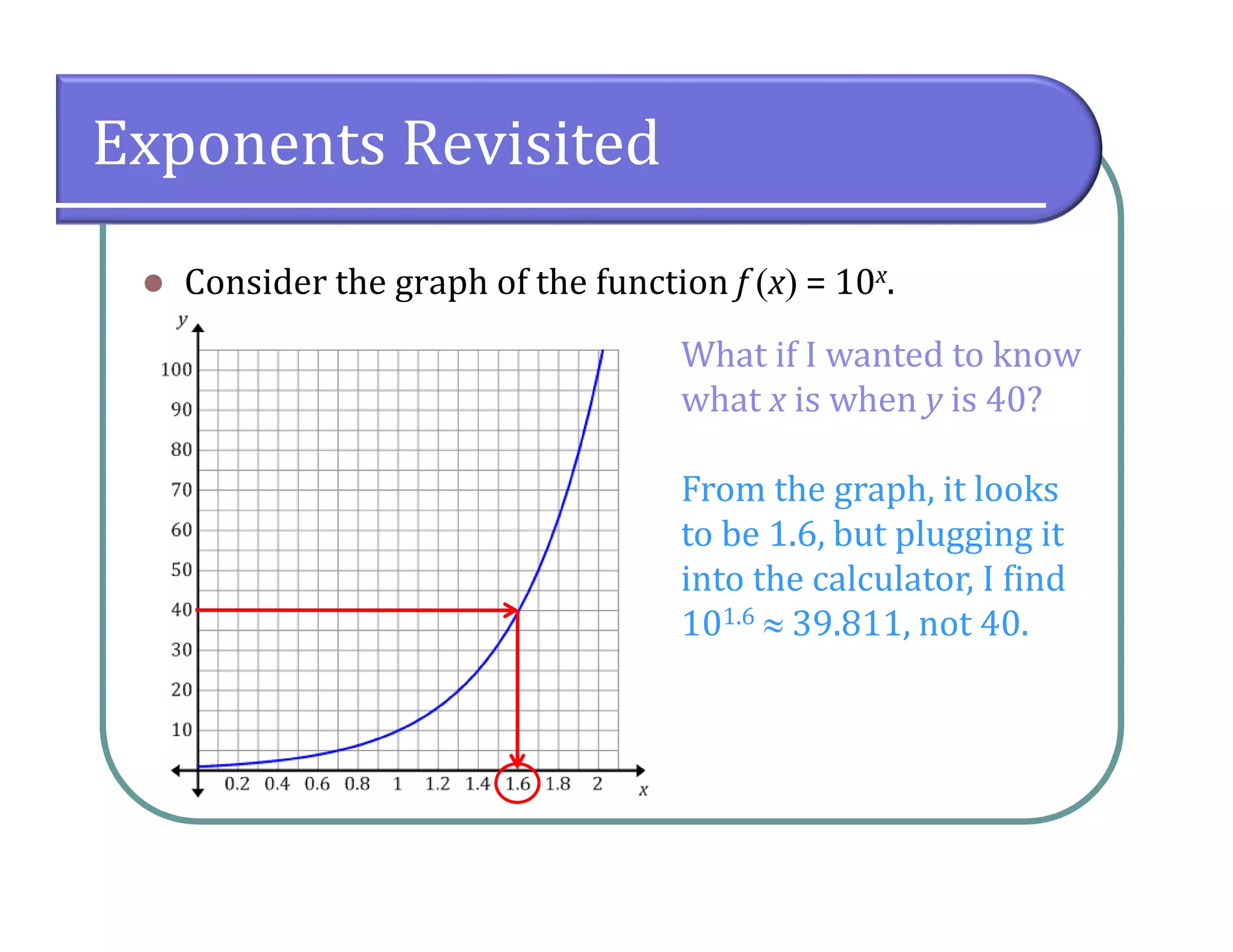
 Consider the graph of the function f x = 10x.
What if I wanted to know
what x is when y is 40?
From the graph, it looks
to be 1.6, but plugging it
into the calculator, I find
101.6  39.811, not 40.
Exponents Revisited (cont.)
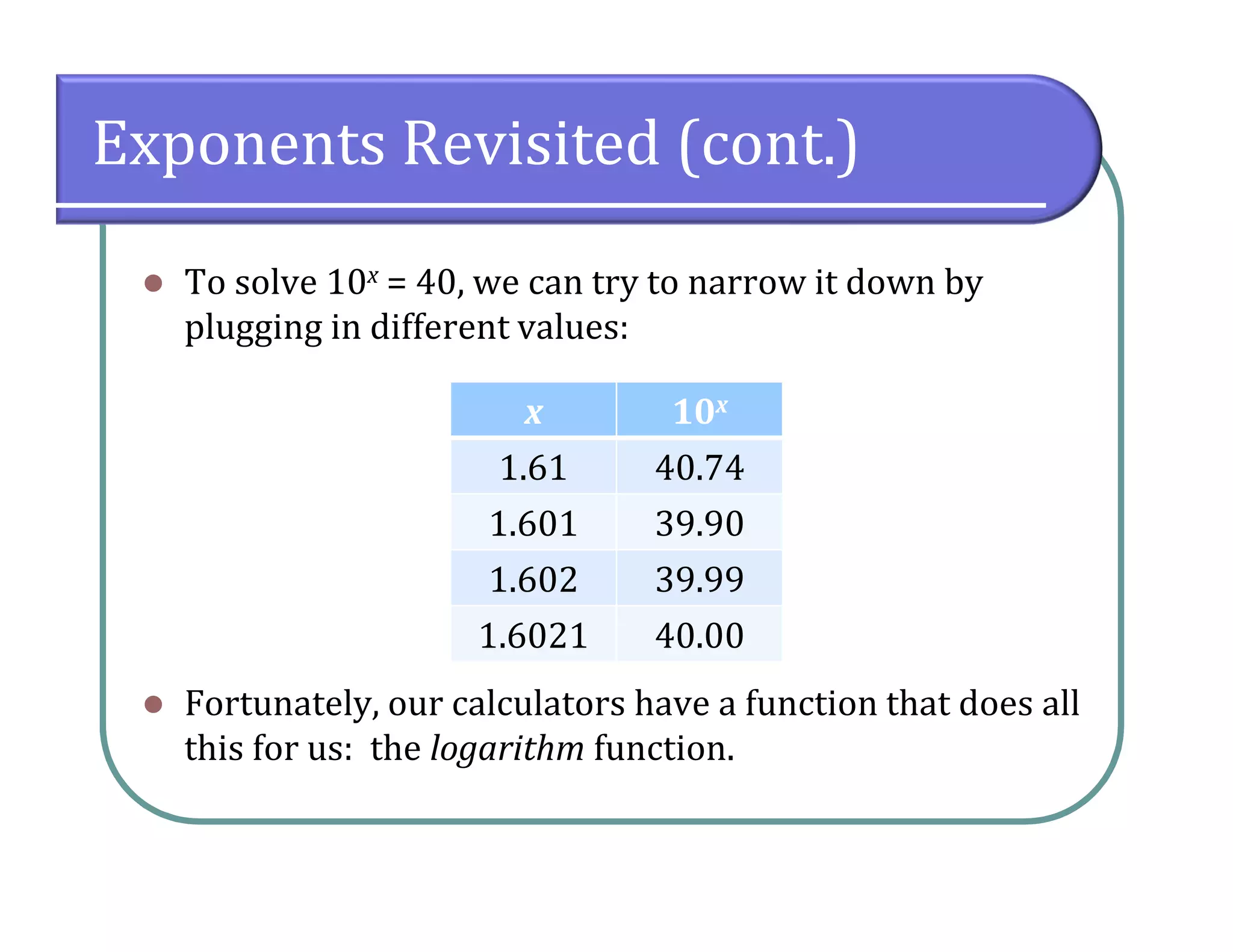
 To solve 10x = 40, we can try to narrow it down by
plugging in different values:
 Fortunately, our calculators have a function that does all
this for us: the logarithm function.
x 10x
1.61 40.74
x 10x
1.61 40.74
1.601 39.90
x 10x
1.61 40.74
1.601 39.90
1.602 39.99
x 10x
1.61 40.74
1.601 39.90
1.602 39.99
1.6021 40.00
Base 10 Logarithm
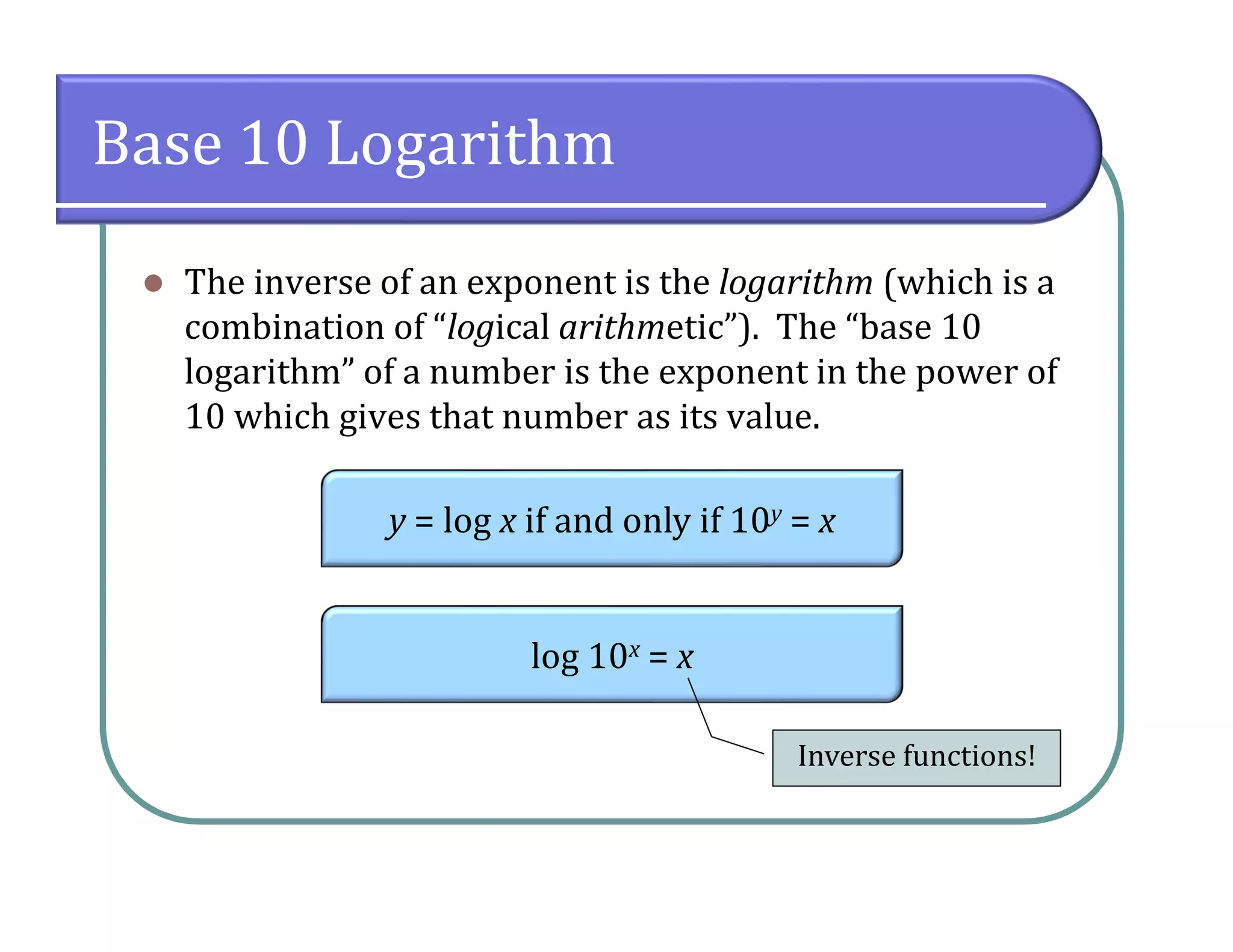
 The inverse of an exponent is the logarithm (which is a
combination of “logical arithmetic”). The “base 10
logarithm” of a number is the exponent in the power of
10 which gives that number as its value.
y = log x if and only if 10y = x
log 10x = x
Inverse functions!
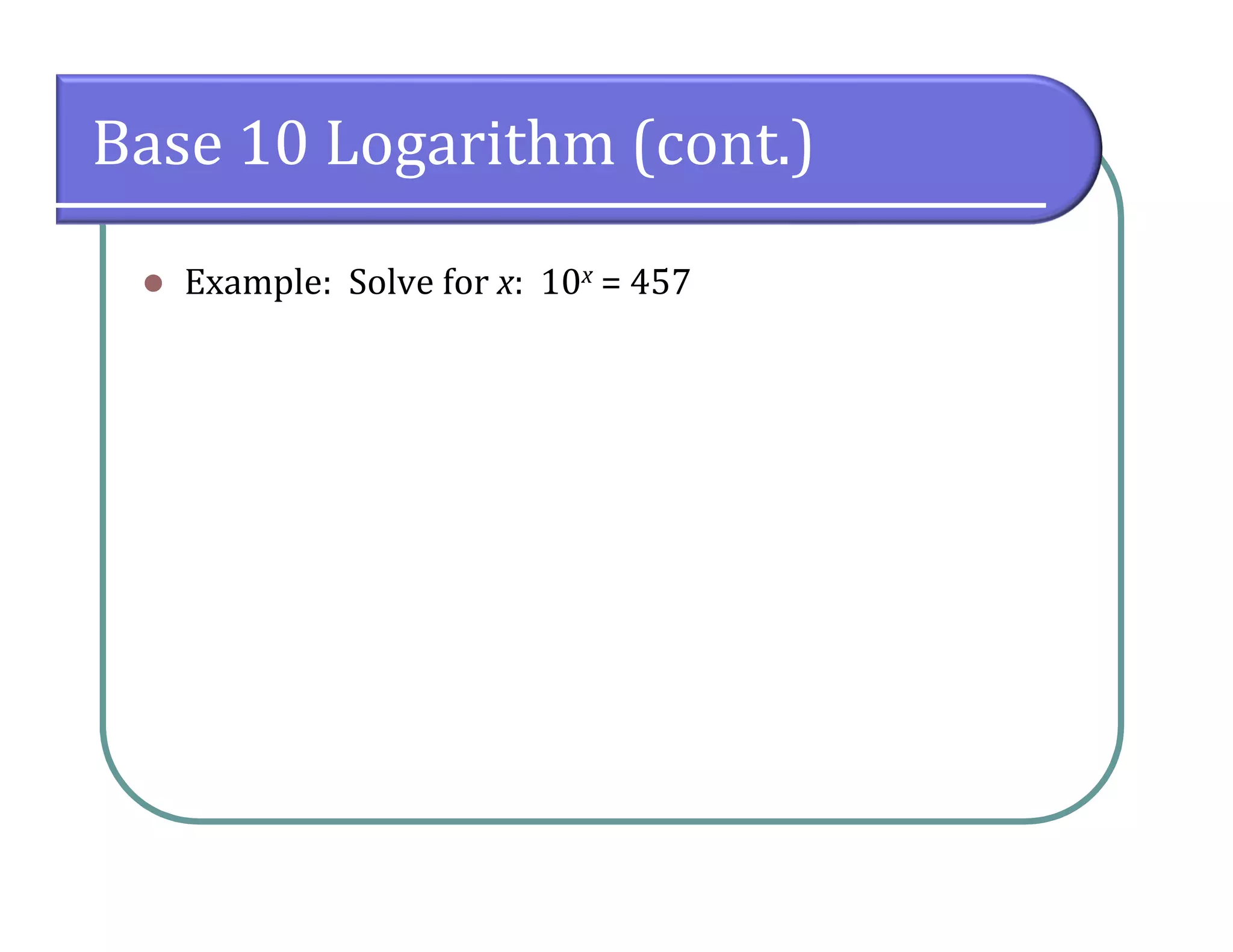
Base 10 Logarithm (cont.)
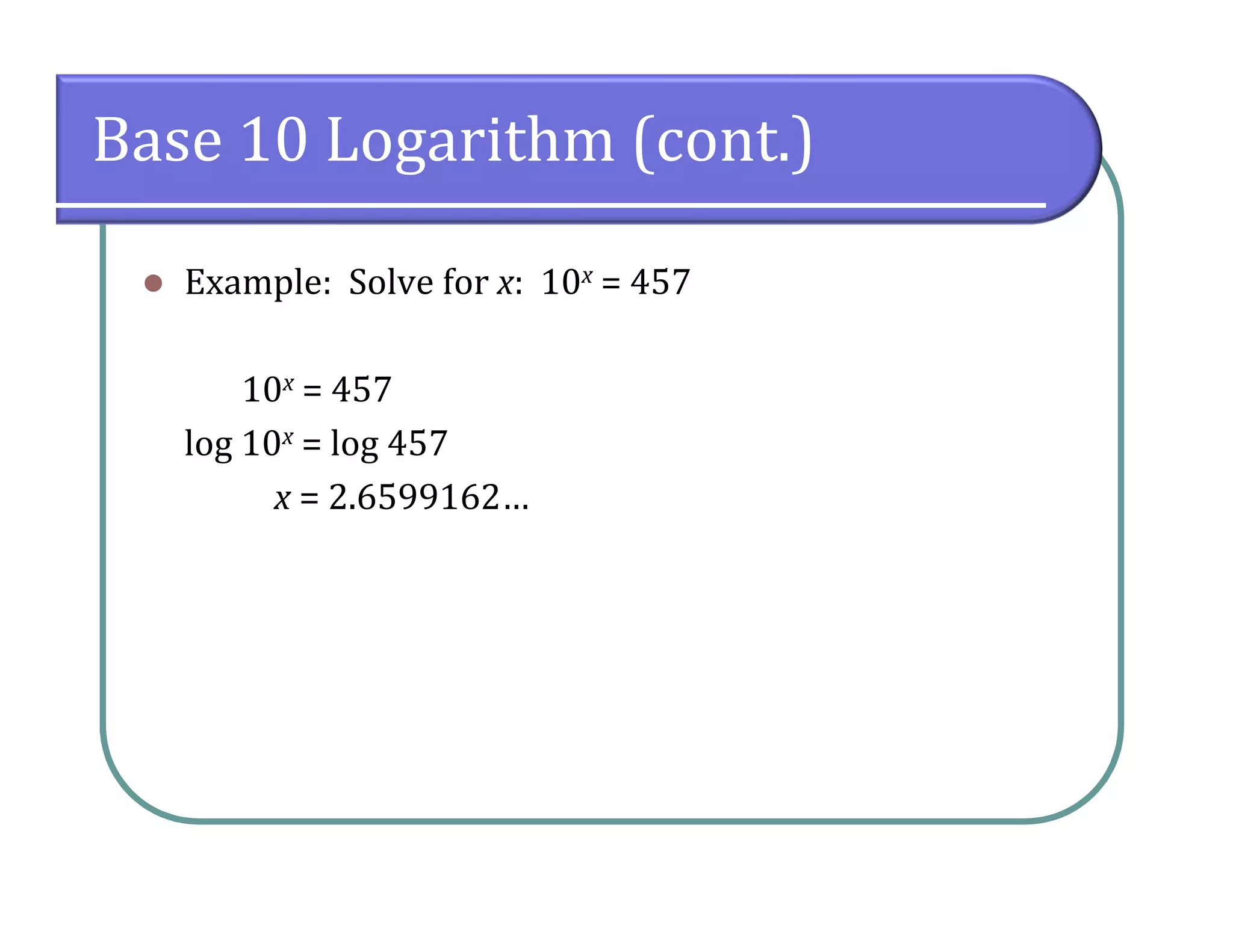
 Example: Solve for x: 10x = 457
Base 10 Logarithm (cont.)
 Example: Solve for x: 10x = 457
10x = 457
log 10x = log 457
x = 2.6599162…
Logarithms With Other Bases
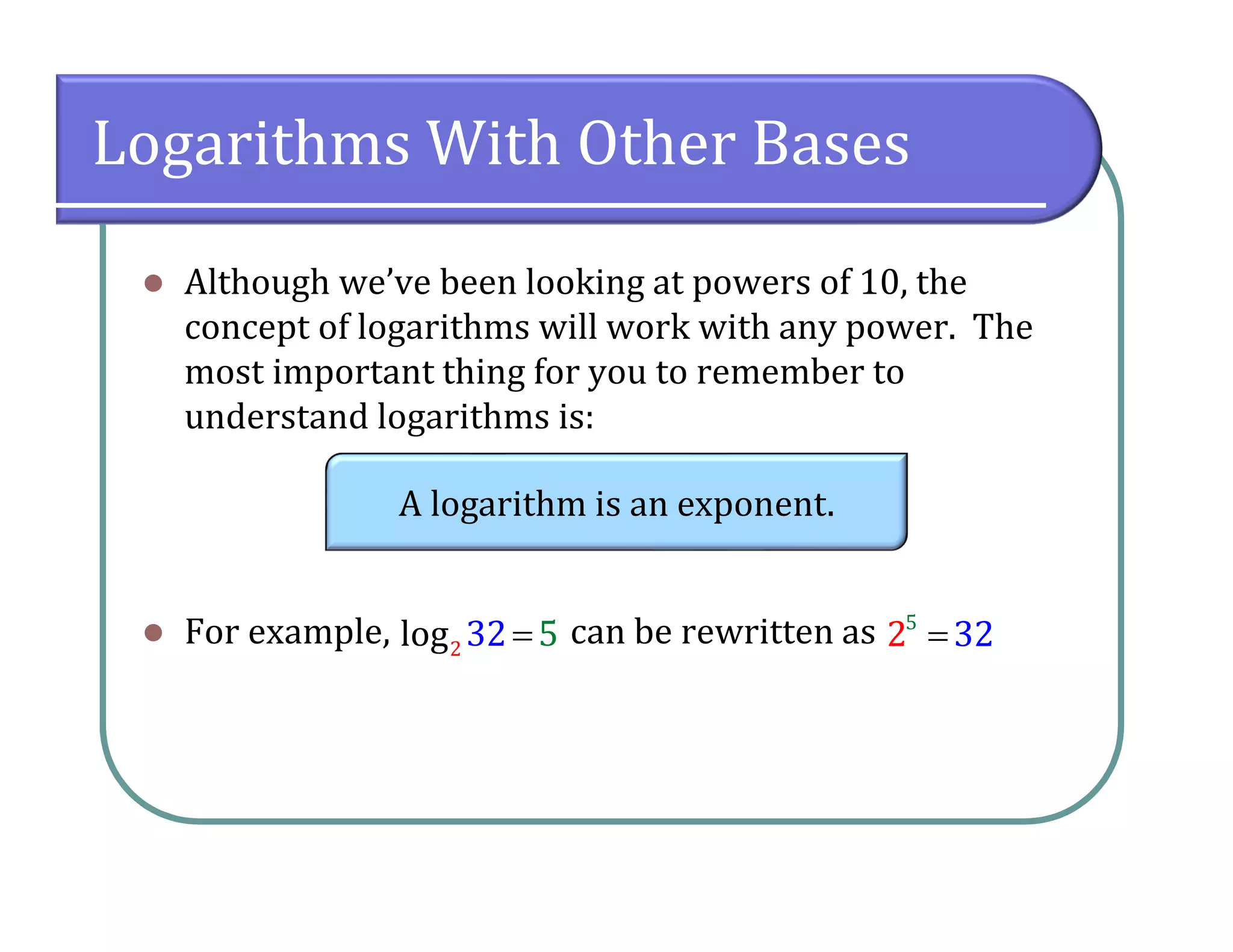
 Although we’ve been looking at powers of 10, the
concept of logarithms will work with any power. The
most important thing for you to remember to
understand logarithms is:
 For example, can be rewritten as
A logarithm is an exponent.
2log 32 5 5
2 32
Logarithms
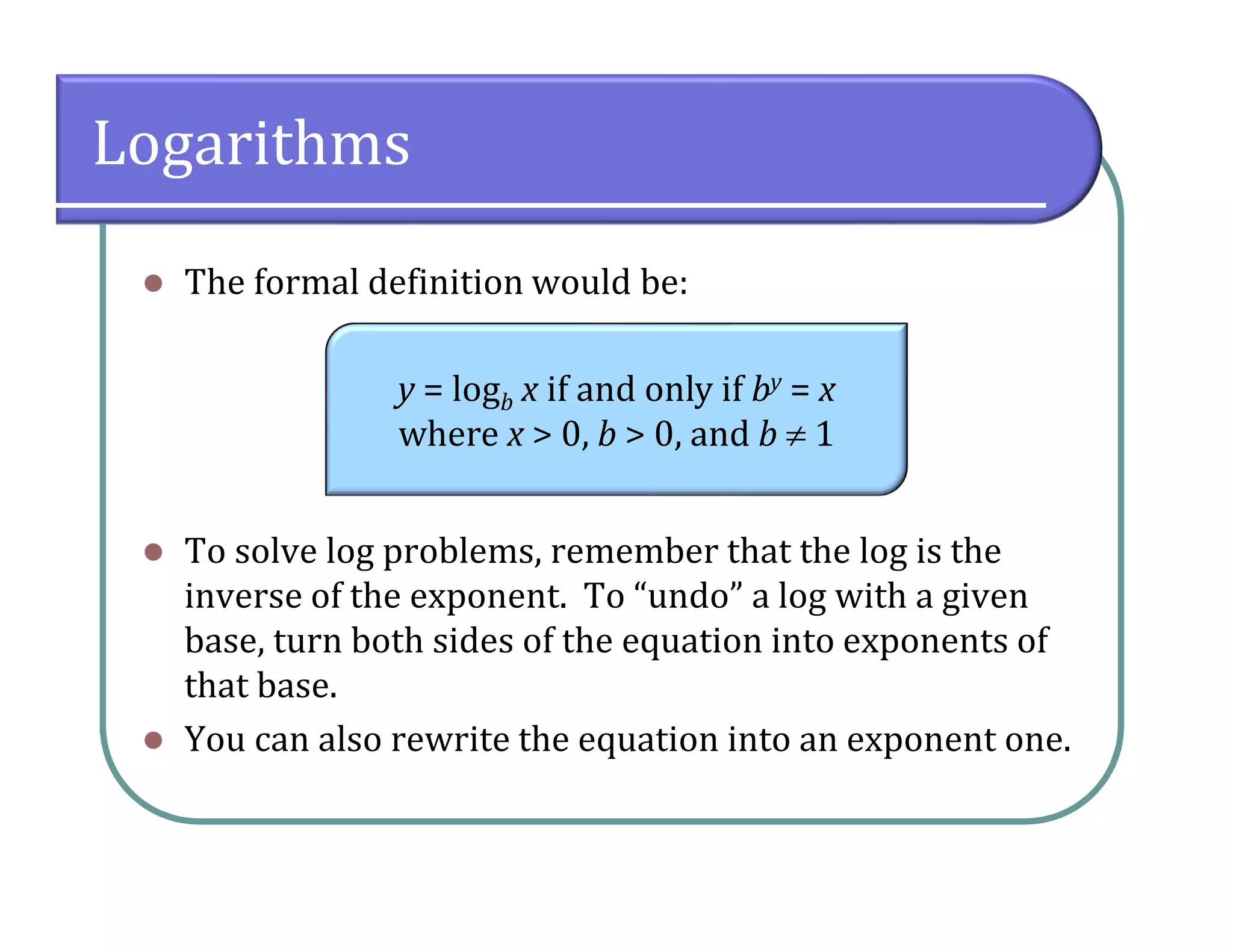
 The formal definition would be:
 To solve log problems, remember that the log is the
inverse of the exponent. To “undo” a log with a given
base, turn both sides of the equation into exponents of
that base.
 You can also rewrite the equation into an exponent one.
y = logb x if and only if by = x
where x > 0, b > 0, and b  1
Examples
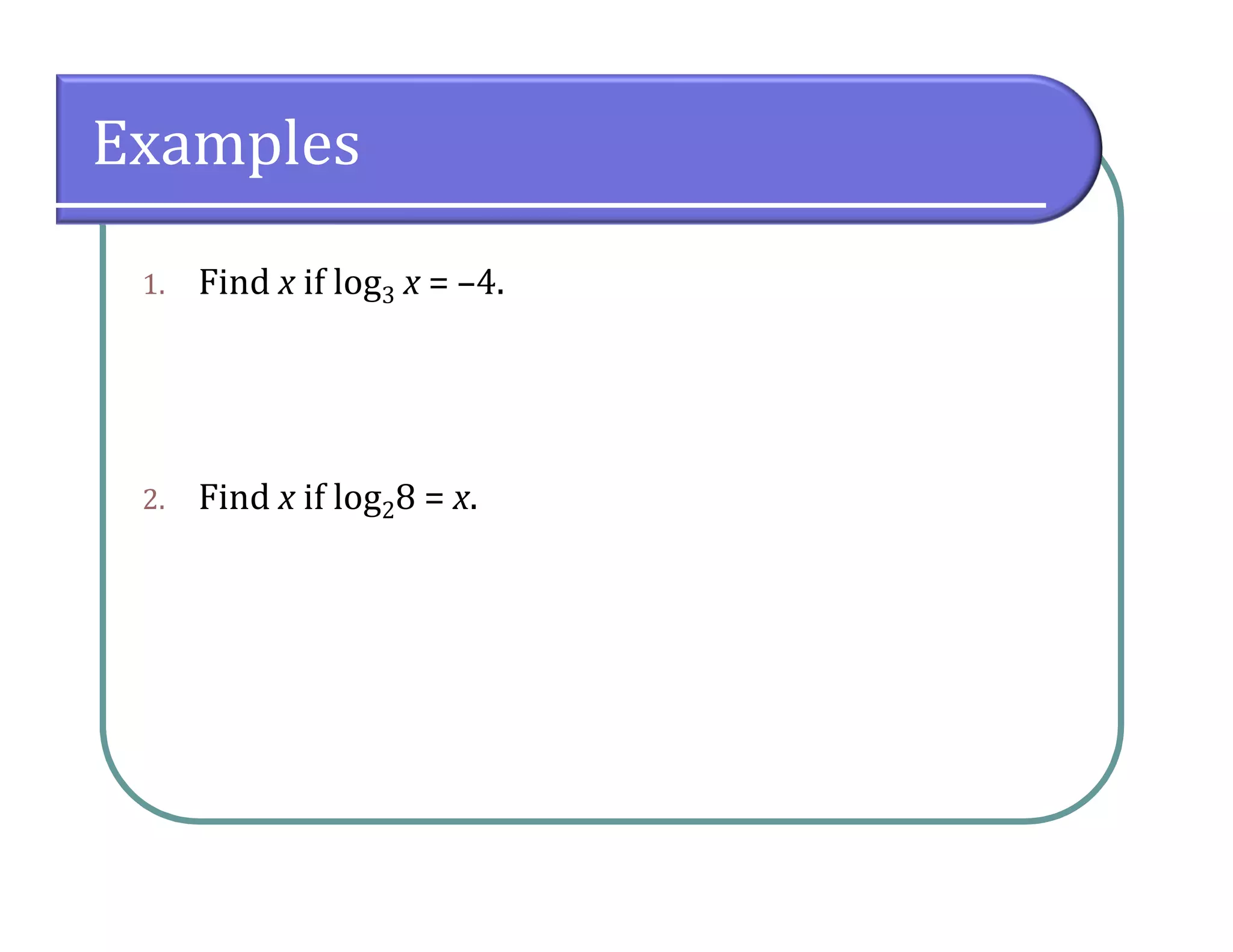
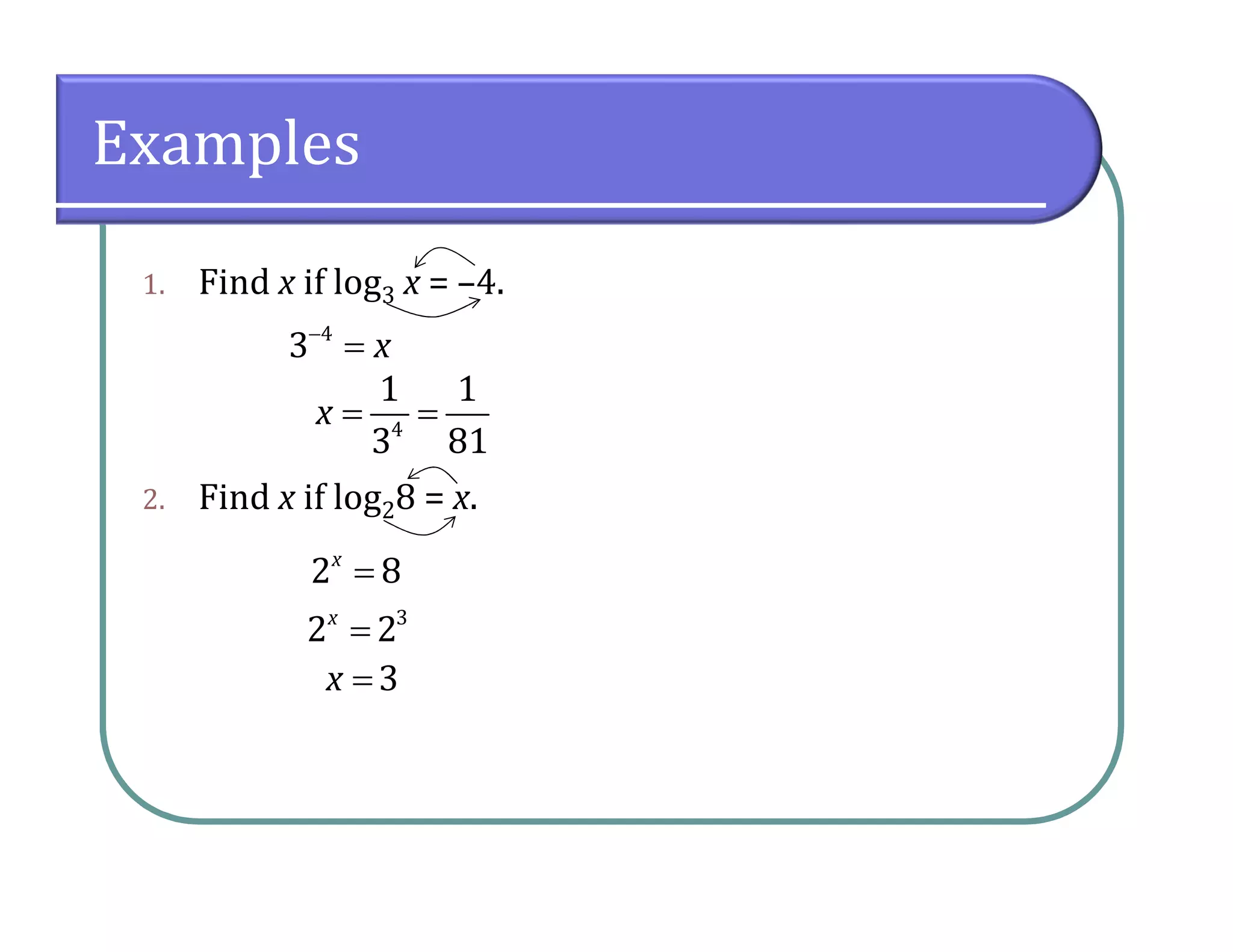
1. Find x if log3 x = –4.
2. Find x if log28 = x.
Examples
1. Find x if log3 x = –4.
2. Find x if log28 = x.
4
3 x

4
1 1
3 81
x  
2 8x

3
2 2x

3x 
Examples (cont.)
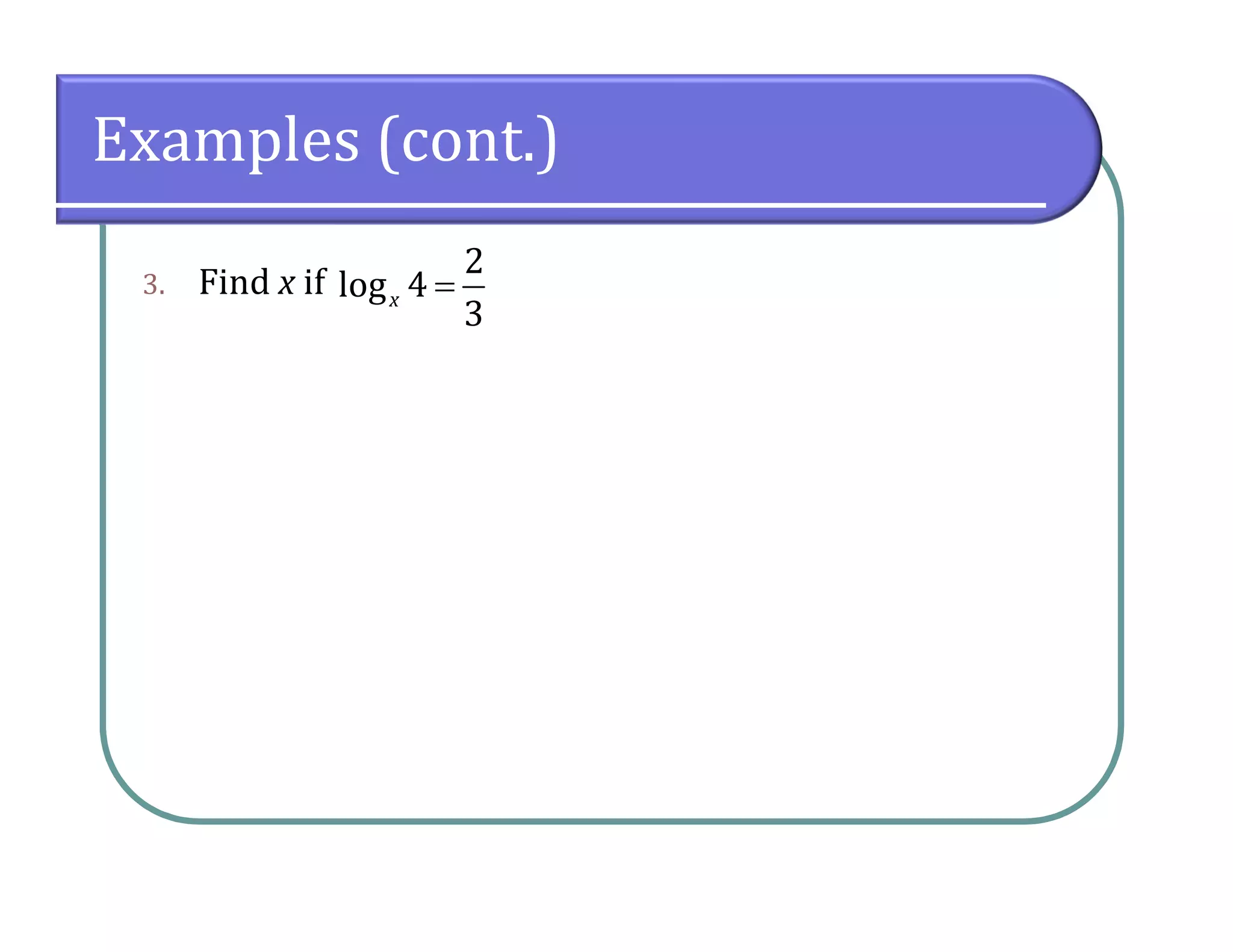
3. Find x if
2
log 4
3
x 
Examples (cont.)
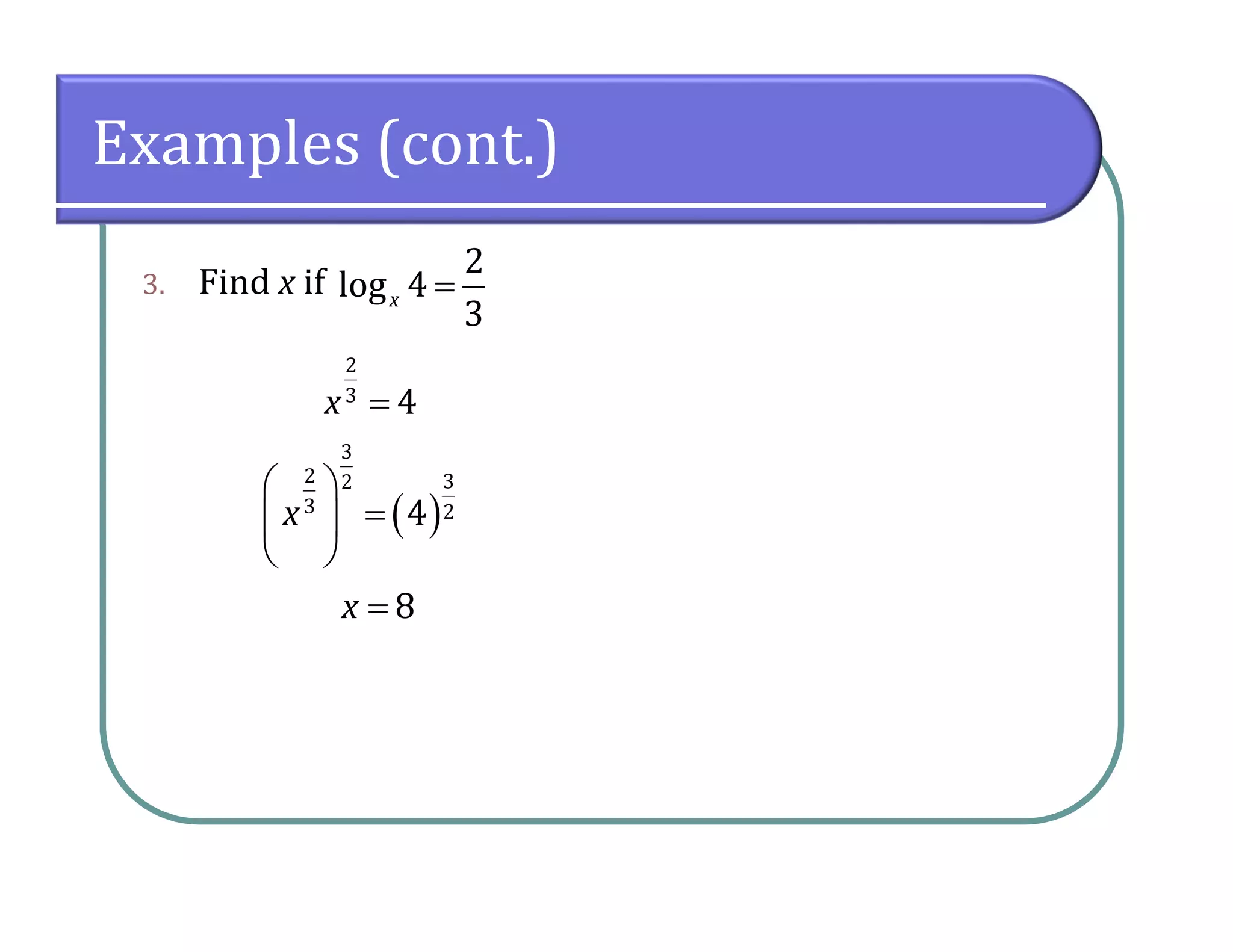
3. Find x if
2
log 4
3
x 
2
3
4x 
 
3
2 32
3 24x
 
 
 
8x 
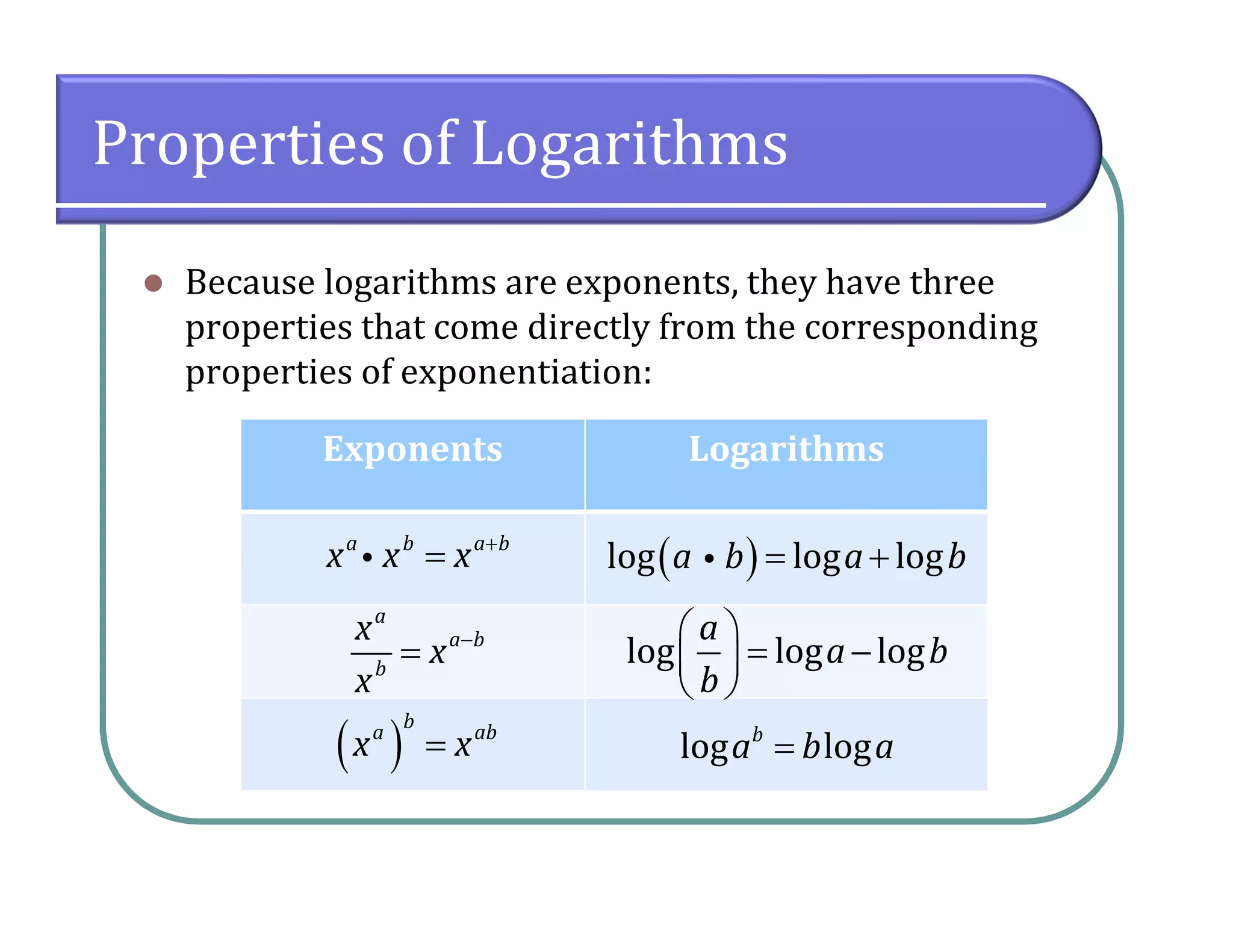
Properties of Logarithms
 Because logarithms are exponents, they have three
properties that come directly from the corresponding
properties of exponentiation:
Exponents Logarithms
a b a b
x x x 
i
a
a b
b
x
x
x


 
b
a ab
x x
 log log loga b a b i
log log log
a
a b
b
 
  
 
log logb
a b a
Examples
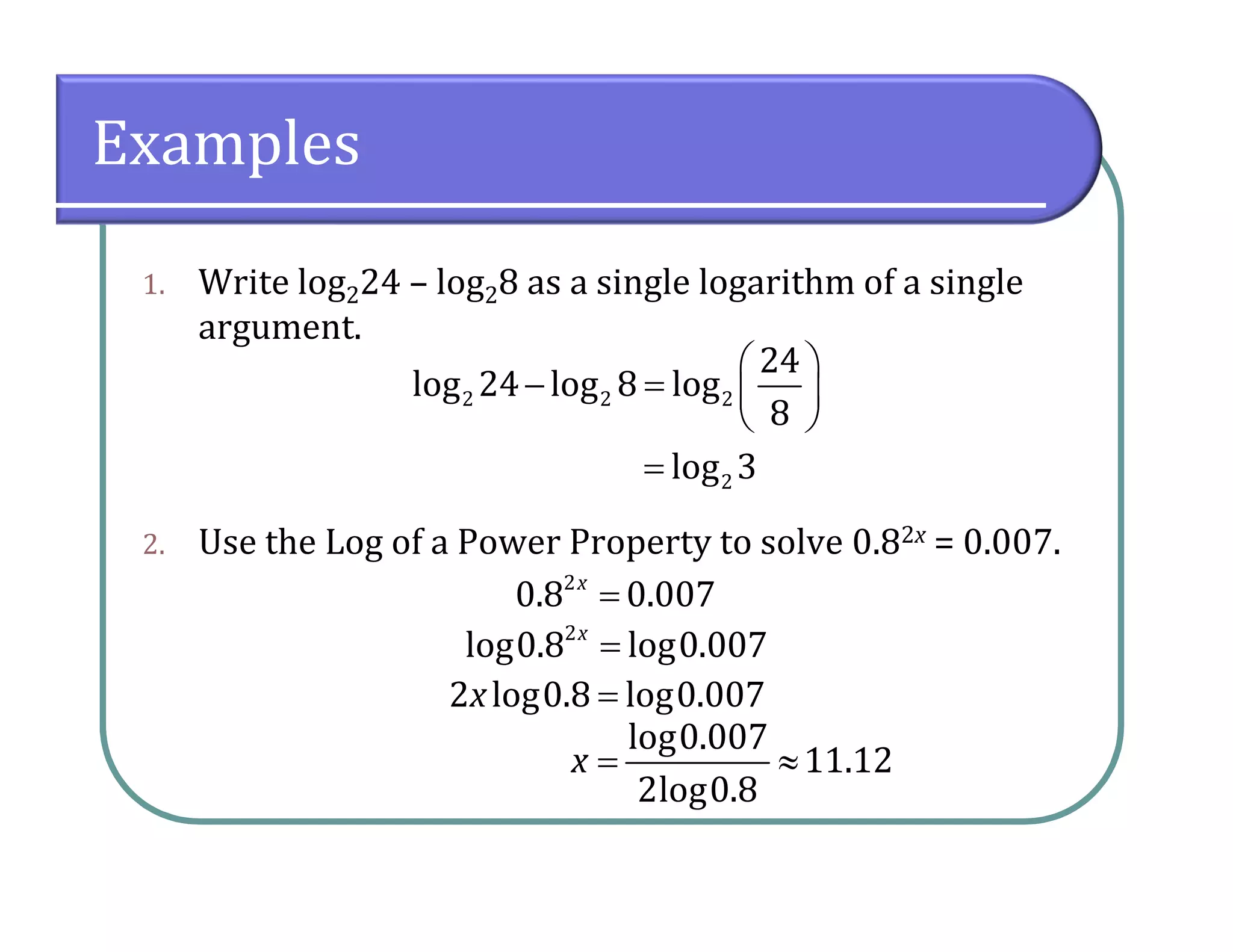
1. Write log224 – log28 as a single logarithm of a single
argument.
2. Use the Log of a Power Property to solve 0.82x = 0.007.
Examples
1. Write log224 – log28 as a single logarithm of a single
argument.
2. Use the Log of a Power Property to solve 0.82x = 0.007.
2 2 2
24
log 24 log 8 log
8
 
   
 
2log 3
2
log0.8 log0.007x

2 log0.8 log0.007x 
log0.007
11.12
2log0.8
x  
2
0.8 0.007x
Exponents Revisited Again
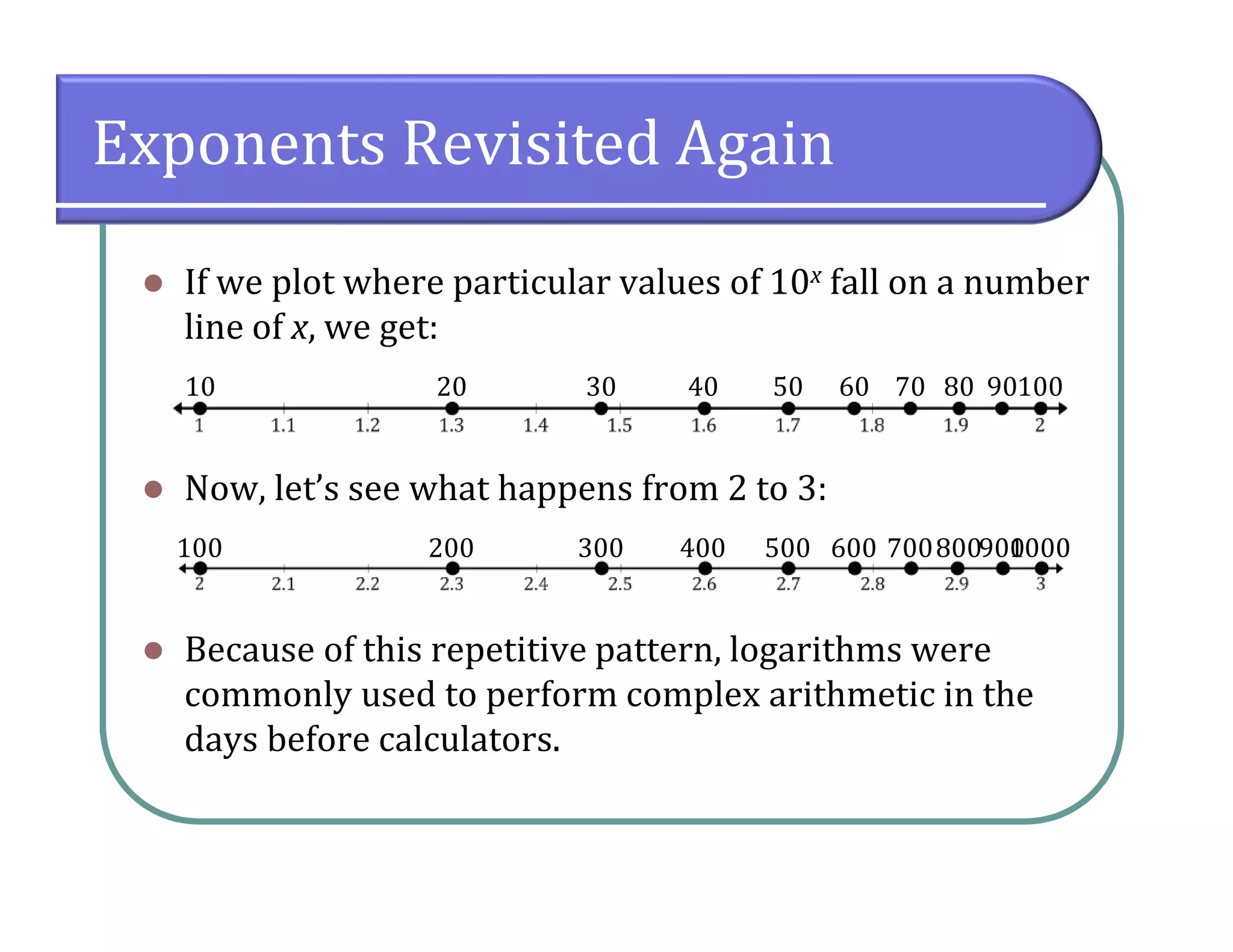
 If we plot where particular values of 10x fall on a number
line of x, we get:
 Now, let’s see what happens from 2 to 3:
 Because of this repetitive pattern, logarithms were
commonly used to perform complex arithmetic in the
days before calculators.
1010 2010 20 3010 20 30 4010 20 30 40 5010 20 30 40 50 6010 20 30 40 50 60 7010 20 30 40 50 60 70 8010 20 30 40 50 60 70 80 9010 20 30 40 50 60 70 80 90100
100 200 300 400 500 600 7008009001000
Classwork
 College Algebra
 Page 442: 14-26 (even), page 429: 72-78 (even),
page 413: 60-66 (even)

4.3 Logarithmic Functions

  • 1.
    Logarithmic Functions Chapter 4Inverse, Exponential, and Logarithmic Functions
  • 2.
    Concepts & Objectives Logarithmic Functions  Solve an exponential equation with any positive base, using base 10 logarithms  Use the definition of logarithm to find the logarithm, base, or argument, if the other two are given.  Use the properties of logarithms to transform expressions and solve equations.
  • 3.
    Exponents Revisited  Considerthe graph of the function f x = 10x. What if I wanted to know what x is when y is 40? From the graph, it looks to be 1.6, but plugging it into the calculator, I find 101.6  39.811, not 40.
  • 4.
    Exponents Revisited (cont.) To solve 10x = 40, we can try to narrow it down by plugging in different values:  Fortunately, our calculators have a function that does all this for us: the logarithm function. x 10x 1.61 40.74 x 10x 1.61 40.74 1.601 39.90 x 10x 1.61 40.74 1.601 39.90 1.602 39.99 x 10x 1.61 40.74 1.601 39.90 1.602 39.99 1.6021 40.00
  • 5.
    Base 10 Logarithm The inverse of an exponent is the logarithm (which is a combination of “logical arithmetic”). The “base 10 logarithm” of a number is the exponent in the power of 10 which gives that number as its value. y = log x if and only if 10y = x log 10x = x Inverse functions!
  • 6.
    Base 10 Logarithm(cont.)  Example: Solve for x: 10x = 457
  • 7.
    Base 10 Logarithm(cont.)  Example: Solve for x: 10x = 457 10x = 457 log 10x = log 457 x = 2.6599162…
  • 8.
    Logarithms With OtherBases  Although we’ve been looking at powers of 10, the concept of logarithms will work with any power. The most important thing for you to remember to understand logarithms is:  For example, can be rewritten as A logarithm is an exponent. 2log 32 5 5 2 32
  • 9.
    Logarithms  The formaldefinition would be:  To solve log problems, remember that the log is the inverse of the exponent. To “undo” a log with a given base, turn both sides of the equation into exponents of that base.  You can also rewrite the equation into an exponent one. y = logb x if and only if by = x where x > 0, b > 0, and b  1
  • 10.
    Examples 1. Find xif log3 x = –4. 2. Find x if log28 = x.
  • 11.
    Examples 1. Find xif log3 x = –4. 2. Find x if log28 = x. 4 3 x  4 1 1 3 81 x   2 8x  3 2 2x  3x 
  • 12.
    Examples (cont.) 3. Findx if 2 log 4 3 x 
  • 13.
    Examples (cont.) 3. Findx if 2 log 4 3 x  2 3 4x    3 2 32 3 24x       8x 
  • 14.
    Properties of Logarithms Because logarithms are exponents, they have three properties that come directly from the corresponding properties of exponentiation: Exponents Logarithms a b a b x x x  i a a b b x x x     b a ab x x  log log loga b a b i log log log a a b b        log logb a b a
  • 15.
    Examples 1. Write log224– log28 as a single logarithm of a single argument. 2. Use the Log of a Power Property to solve 0.82x = 0.007.
  • 16.
    Examples 1. Write log224– log28 as a single logarithm of a single argument. 2. Use the Log of a Power Property to solve 0.82x = 0.007. 2 2 2 24 log 24 log 8 log 8         2log 3 2 log0.8 log0.007x  2 log0.8 log0.007x  log0.007 11.12 2log0.8 x   2 0.8 0.007x
  • 17.
    Exponents Revisited Again If we plot where particular values of 10x fall on a number line of x, we get:  Now, let’s see what happens from 2 to 3:  Because of this repetitive pattern, logarithms were commonly used to perform complex arithmetic in the days before calculators. 1010 2010 20 3010 20 30 4010 20 30 40 5010 20 30 40 50 6010 20 30 40 50 60 7010 20 30 40 50 60 70 8010 20 30 40 50 60 70 80 9010 20 30 40 50 60 70 80 90100 100 200 300 400 500 600 7008009001000
  • 18.
    Classwork  College Algebra Page 442: 14-26 (even), page 429: 72-78 (even), page 413: 60-66 (even)