• This Slideshow was developed to accompany the textbook
• Big Ideas Algebra 2
• By Larson, R., Boswell
• 2022 K12 (National Geographic/Cengage)
• Some examples and diagrams are taken from the textbook.
Slides created by
Richard Wright, Andrews Academy
rwright@andrews.edu
• Using Properties of Rational Exponents
• 𝑥𝑚
⋅ 𝑥𝑛
= 𝑥𝑚+𝑛
(Product Property)
• 𝑥𝑦 𝑚
= 𝑥𝑚
𝑦𝑚
(Power of a Product Property)
• 𝑥𝑚 𝑛
= 𝑥𝑚𝑛
(Power of a Power Property)
•
𝑥𝑚
𝑥𝑛 = 𝑥𝑚−𝑛
(Quotient Property)
•
𝑥
𝑦
𝑚
=
𝑥𝑚
𝑦𝑚 (Power of a Quotient Property)
• 𝑥−𝑚
=
1
𝑥𝑚 (Negative Exponent Property)
• Simplify the expression. Write your
answer using only positive
exponents.
• Example 292#3
•
3𝑤
2𝑥
4
• Try 292#1
• 6𝑏0
• e
• Called the natural base
• Named after Leonard Euler who discovered it
• (Pronounced “oil-er”)
• Found by putting really big numbers into 1 +
1
𝑛
𝑛
= 2.718281828459…
• Irrational number like π
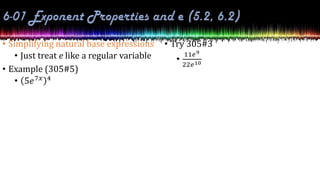
• Simplifying natural base expressions
• Just treat e like a regular variable
• Example (305#5)
• 5𝑒7𝑥 4
• Try 305#3
•
11𝑒9
22𝑒10
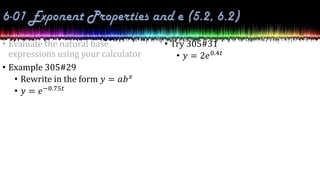
• Evaluate the natural base
expressions using your calculator
• Example 305#29
• Rewrite in the form 𝑦 = 𝑎𝑏𝑥
• 𝑦 = 𝑒−0.75𝑡
• Try 305#31
• 𝑦 = 2𝑒0.4𝑡
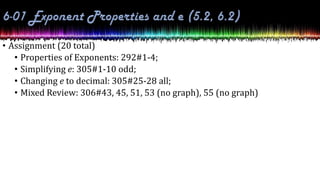
• Assignment (20 total)
• Properties of Exponents: 292#1-4;
• Simplifying e: 305#1-10 odd;
• Changing e to decimal: 305#25-28 all;
• Mixed Review: 306#43, 45, 51, 53 (no graph), 55 (no graph)
WRIGHT
Work with a partner.
Calculate how much time you will spend on your homework the last week of
the 36-week school year. You start with 1 second of homework on week one
and double the time every week.
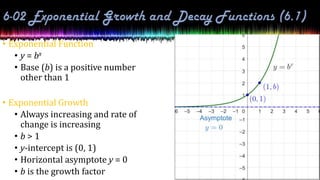
• Exponential Function
• y = bx
• Base (b) is a positive number
other than 1
• Exponential Growth
• Always increasing and rate of
change is increasing
• b > 1
• y-intercept is (0, 1)
• Horizontal asymptote y = 0
• b is the growth factor
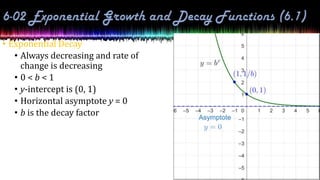
• Exponential Decay
• Always decreasing and rate of
change is decreasing
• 0 < b < 1
• y-intercept is (0, 1)
• Horizontal asymptote y = 0
• b is the decay factor
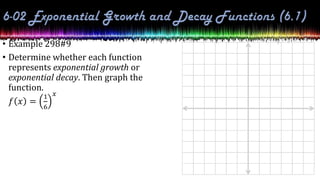
• Example 298#9
• Determine whether each function
represents exponential growth or
exponential decay. Then graph the
function.
𝑓 𝑥 =
1
6
𝑥
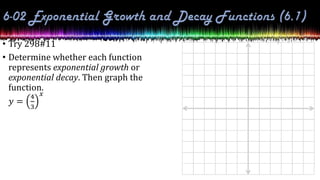
• Try 298#11
• Determine whether each function
represents exponential growth or
exponential decay. Then graph the
function.
𝑦 =
4
3
𝑥
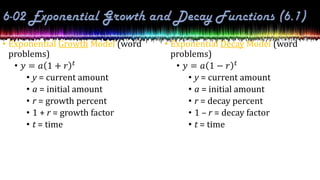
• Exponential Growth Model (word
problems)
• 𝑦 = 𝑎 1 + 𝑟 𝑡
• y = current amount
• a = initial amount
• r = growth percent
• 1 + r = growth factor
• t = time
• Exponential Decay Model (word
problems)
• 𝑦 = 𝑎 1 − 𝑟 𝑡
• y = current amount
• a = initial amount
• r = decay percent
• 1 – r = decay factor
• t = time
• Example: 298#20
• The population P (in millions) of Peru during a recent decade can be
approximated by 𝑃 = 28.22 1.01 𝑡, where t is the number of years since
the beginning of the decade.
• (a) Determine whether the model represents exponential growth or decay
• (b) identify the annual percent increase or decrease in population
• (c) Estimate when the population was about 30 million
• Try 298#19
• The value of a mountain bike y (in dollars) can be approximated by the model
𝑦 = 200 0.65 𝑡, where t is the number of years since the bike was purchased.
• (a) Determine whether the model represents exponential growth or decay
• (b) Identify the annual percent increase or decrease
• (c) Estimate when the value of the bike will be $50
• Compound Interest
• 𝐴 = 𝑃 1 +
𝑟
𝑛
𝑛𝑡
• A = amount at time t
• P = principle (initial amount)
• r = annual rate
• n = number of times interest is
compounded per year
• Example: 299#39
• Find the balance in the account
earning compound interest after 6
years when the principle is $3500.
r = 2.16%, compounded quarterly
• Try 299#41
• Assignment: 20 total
• Graphing Exponential Growth and Decay: 298#7-15 odd
• Exponential Growth and Decay Models: 298#19-22, 44
• Compound Interest: 299#35, 39, 40, 41, 42
• Mixed Review: 300#53, 54, 55, 61, 63
• Logarithms are exponents
• log𝑏 𝑎 = exponent of b to get a
• Example: 312#13
• log3 81
• Try 312#15
• log3 3
• Calculator has two logs
• Common Log: log = log10
• Natural Log: ln = log𝑒
• (Some calculators can do log of any
base.)
• Example: 312#23
• log 6
• Try 312#25
• ln
1
3
• Definition of Logarithm with Base b
•log𝑏 𝑦 = 𝑥 ⇔ 𝑏𝑥
= 𝑦
• Read as “log base b of y equals x”
• Logs = exponents!!
• Logs and exponentials are inverses
• They undo each other
• They cancel each other out
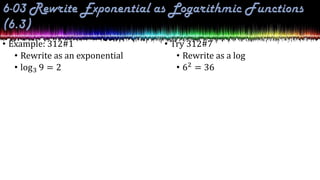
• Example: 312#1
• Rewrite as an exponential
• log3 9 = 2
• Try 312#7
• Rewrite as a log
• 62 = 36
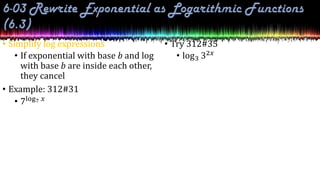
• Simplify log expressions
• If exponential with base b and log
with base b are inside each other,
they cancel
• Example: 312#31
• 7log7 𝑥
• Try 312#35
• log3 32𝑥
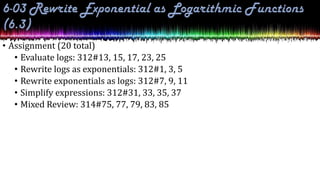
• Assignment (20 total)
• Evaluate logs: 312#13, 15, 17, 23, 25
• Rewrite logs as exponentials: 312#1, 3, 5
• Rewrite exponentials as logs: 312#7, 9, 11
• Simplify expressions: 312#31, 33, 35, 37
• Mixed Review: 314#75, 77, 79, 83, 85
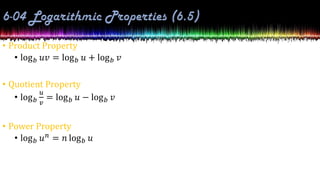
• Product Property
• log𝑏 𝑢𝑣 = log𝑏 𝑢 + log𝑏 𝑣
• Quotient Property
• log𝑏
𝑢
𝑣
= log𝑏 𝑢 − log𝑏 𝑣
• Power Property
• log𝑏 𝑢𝑛 = 𝑛 log𝑏 𝑢
• Expand logarithms
• Rewrite as several logs
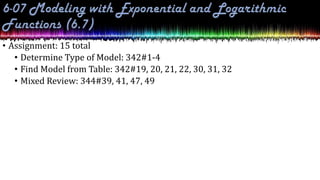
• Example: 327#13
• log 10𝑥5
• Try 327#15
• ln
𝑥
3𝑦
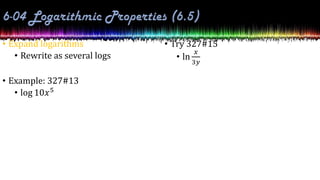
• Condense logs
• Try to write as a single log
• Example: 327#25
• log5 4 +
1
3
log5 𝑥
• Try 327#23
• 6 ln 𝑥 + 4 ln 𝑦
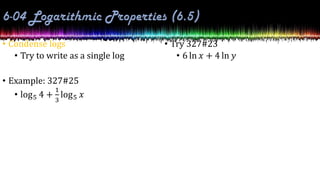
• Change-of-Base Formula
• log𝑐 𝑢 =
log𝑏 𝑢
log𝑏 𝑐
• This lets you evaluate any log on a
calculator
• Example: 327#31
• Evaluate log9 15
• Try 327#29
• Evaluate log4 7
• Assignment: 20 total
• Expand logs: 327#11-17 odd
• Condense logs: 327#21-27 odd
• Change-of-base formula: 327#29-35 odd
• Problem Solving: 327#37-38 (Use 𝐿 = 10 log
𝐼
10−12)
• Mixed Review: 328#46, 47, 51, 57, 59, 61
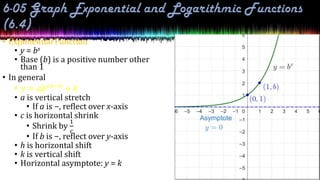
• Exponential Function
• y = bx
• Base (b) is a positive number other
than 1
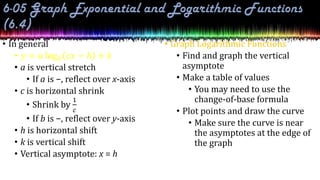
• In general
• 𝑦 = 𝑎𝑏𝑐𝑥−ℎ
+ 𝑘
• a is vertical stretch
• If a is −, reflect over x-axis
• c is horizontal shrink
• Shrink by
1
𝑐
• If b is −, reflect over y-axis
• h is horizontal shift
• k is vertical shift
• Horizontal asymptote: y = k
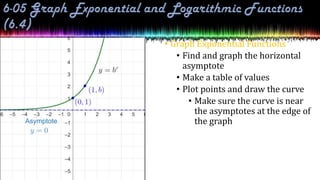
• Graph Exponential Functions
• Find and graph the horizontal
asymptote
• Make a table of values
• Plot points and draw the curve
• Make sure the curve is near
the asymptotes at the edge of
the graph
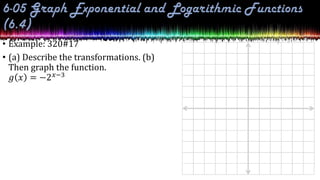
• Example: 320#17
• (a) Describe the transformations. (b)
Then graph the function.
𝑔 𝑥 = −2𝑥−3
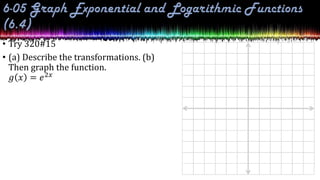
• Try 320#15
• (a) Describe the transformations. (b)
Then graph the function.
𝑔 𝑥 = 𝑒2𝑥
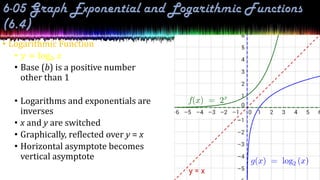
• Logarithmic Function
• 𝑦 = log𝑏 𝑥
• Base (b) is a positive number
other than 1
• Logarithms and exponentials are
inverses
• x and y are switched
• Graphically, reflected over y = x
• Horizontal asymptote becomes
vertical asymptote
• In general
• 𝑦 = 𝑎 log𝑏 𝑐𝑥 − ℎ + 𝑘
• a is vertical stretch
• If a is −, reflect over x-axis
• c is horizontal shrink
• Shrink by
1
𝑐
• If b is −, reflect over y-axis
• h is horizontal shift
• k is vertical shift
• Vertical asymptote: x = h
• Graph Logarithmic Functions
• Find and graph the vertical
asymptote
• Make a table of values
• You may need to use the
change-of-base formula
• Plot points and draw the curve
• Make sure the curve is near
the asymptotes at the edge of
the graph
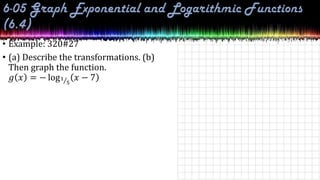
• Example: 320#27
• (a) Describe the transformations. (b)
Then graph the function.
𝑔 𝑥 = − log1
5
𝑥 − 7
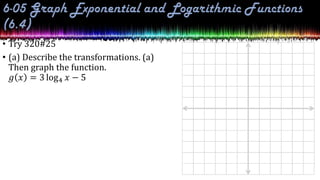
• Try 320#25
• (a) Describe the transformations. (a)
Then graph the function.
𝑔 𝑥 = 3 log4 𝑥 − 5
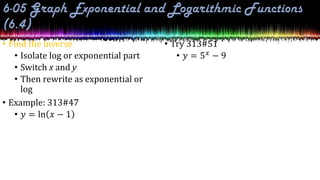
• Find the inverse
• Isolate log or exponential part
• Switch x and y
• Then rewrite as exponential or
log
• Example: 313#47
• 𝑦 = ln 𝑥 − 1
• Try 313#51
• 𝑦 = 5𝑥 − 9
• Assignment: 15 total
• Graph Exponential Functions: 320#15, 17, 21
• Graph Logarithmic Functions: 313#57, 59; 320#25, 27
• Find Inverses: 313#43, 45, 47, 51
• Mixed Review: 322# 53, 55, 62, 65
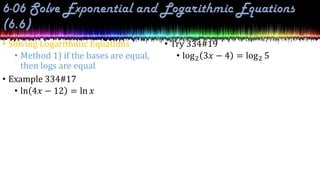
• Solving Exponential Equations
• Method 1) if the bases are equal,
then exponents are equal
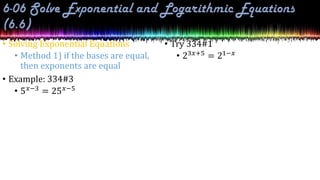
• Example: 334#3
• 5𝑥−3 = 25𝑥−5
• Try 334#1
• 23𝑥+5 = 21−𝑥
• Solving Exponential Equations
• Method 2) take log of both sides
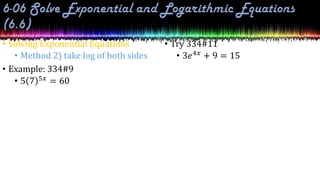
• Example: 334#9
• 5 7 5𝑥 = 60
• Try 334#11
• 3𝑒4𝑥 + 9 = 15
• Solving Logarithmic Equations
• Method 1) if the bases are equal,
then logs are equal
• Example 334#17
• ln 4𝑥 − 12 = ln 𝑥
• Try 334#19
• log2 3𝑥 − 4 = log2 5
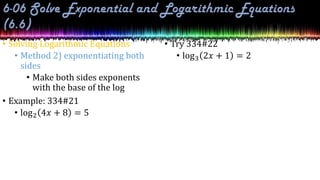
• Solving Logarithmic Equations
• Method 2) exponentiating both
sides
• Make both sides exponents
with the base of the log
• Example: 334#21
• log2 4𝑥 + 8 = 5
• Try 334#22
• log3 2𝑥 + 1 = 2
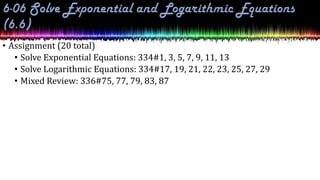
• Assignment (20 total)
• Solve Exponential Equations: 334#1, 3, 5, 7, 9, 11, 13
• Solve Logarithmic Equations: 334#17, 19, 21, 22, 23, 25, 27, 29
• Mixed Review: 336#75, 77, 79, 83, 87
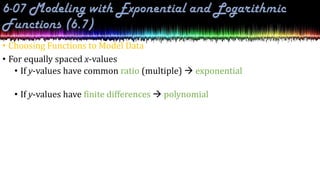
• Choosing Functions to Model Data
• For equally spaced x-values
• If y-values have common ratio (multiple)  exponential
• If y-values have finite differences  polynomial
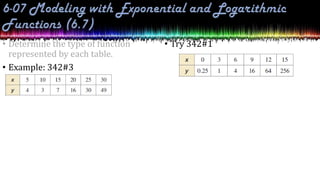
• Try 342#1
• Determine the type of function
represented by each table.
• Example: 342#3
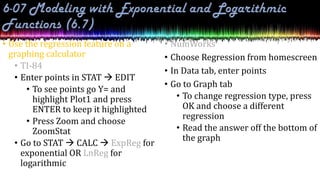
• Use the regression feature on a
graphing calculator
• TI-84
• Enter points in STAT  EDIT
• To see points go Y= and
highlight Plot1 and press
ENTER to keep it highlighted
• Press Zoom and choose
ZoomStat
• Go to STAT  CALC  ExpReg for
exponential OR LnReg for
logarithmic
• NumWorks
• Choose Regression from homescreen
• In Data tab, enter points
• Go to Graph tab
• To change regression type, press
OK and choose a different
regression
• Read the answer off the bottom of
the graph
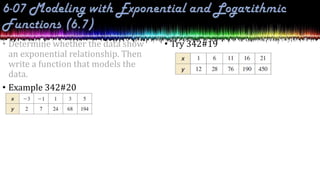
• Determine whether the data show
an exponential relationship. Then
write a function that models the
data.
• Example 342#20
• Try 342#19
• Assignment: 15 total
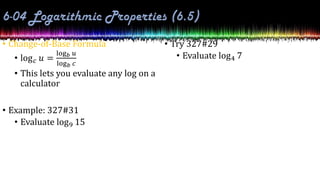
• Determine Type of Model: 342#1-4
• Find Model from Table: 342#19, 20, 21, 22, 30, 31, 32
• Mixed Review: 344#39, 41, 47, 49

Algebra 2 06 Exponential and Logarithmic Functions 2.pptx

  • 2.
    • This Slideshowwas developed to accompany the textbook • Big Ideas Algebra 2 • By Larson, R., Boswell • 2022 K12 (National Geographic/Cengage) • Some examples and diagrams are taken from the textbook. Slides created by Richard Wright, Andrews Academy rwright@andrews.edu
  • 4.
    • Using Propertiesof Rational Exponents • 𝑥𝑚 ⋅ 𝑥𝑛 = 𝑥𝑚+𝑛 (Product Property) • 𝑥𝑦 𝑚 = 𝑥𝑚 𝑦𝑚 (Power of a Product Property) • 𝑥𝑚 𝑛 = 𝑥𝑚𝑛 (Power of a Power Property) • 𝑥𝑚 𝑥𝑛 = 𝑥𝑚−𝑛 (Quotient Property) • 𝑥 𝑦 𝑚 = 𝑥𝑚 𝑦𝑚 (Power of a Quotient Property) • 𝑥−𝑚 = 1 𝑥𝑚 (Negative Exponent Property)
  • 5.
    • Simplify theexpression. Write your answer using only positive exponents. • Example 292#3 • 3𝑤 2𝑥 4 • Try 292#1 • 6𝑏0
  • 6.
    • e • Calledthe natural base • Named after Leonard Euler who discovered it • (Pronounced “oil-er”) • Found by putting really big numbers into 1 + 1 𝑛 𝑛 = 2.718281828459… • Irrational number like π
  • 7.
    • Simplifying naturalbase expressions • Just treat e like a regular variable • Example (305#5) • 5𝑒7𝑥 4 • Try 305#3 • 11𝑒9 22𝑒10
  • 8.
    • Evaluate thenatural base expressions using your calculator • Example 305#29 • Rewrite in the form 𝑦 = 𝑎𝑏𝑥 • 𝑦 = 𝑒−0.75𝑡 • Try 305#31 • 𝑦 = 2𝑒0.4𝑡
  • 9.
    • Assignment (20total) • Properties of Exponents: 292#1-4; • Simplifying e: 305#1-10 odd; • Changing e to decimal: 305#25-28 all; • Mixed Review: 306#43, 45, 51, 53 (no graph), 55 (no graph)
  • 13.
  • 14.
    Work with apartner. Calculate how much time you will spend on your homework the last week of the 36-week school year. You start with 1 second of homework on week one and double the time every week.
  • 15.
    • Exponential Function •y = bx • Base (b) is a positive number other than 1 • Exponential Growth • Always increasing and rate of change is increasing • b > 1 • y-intercept is (0, 1) • Horizontal asymptote y = 0 • b is the growth factor
  • 16.
    • Exponential Decay •Always decreasing and rate of change is decreasing • 0 < b < 1 • y-intercept is (0, 1) • Horizontal asymptote y = 0 • b is the decay factor
  • 17.
    • Example 298#9 •Determine whether each function represents exponential growth or exponential decay. Then graph the function. 𝑓 𝑥 = 1 6 𝑥
  • 18.
    • Try 298#11 •Determine whether each function represents exponential growth or exponential decay. Then graph the function. 𝑦 = 4 3 𝑥
  • 19.
    • Exponential GrowthModel (word problems) • 𝑦 = 𝑎 1 + 𝑟 𝑡 • y = current amount • a = initial amount • r = growth percent • 1 + r = growth factor • t = time • Exponential Decay Model (word problems) • 𝑦 = 𝑎 1 − 𝑟 𝑡 • y = current amount • a = initial amount • r = decay percent • 1 – r = decay factor • t = time
  • 20.
    • Example: 298#20 •The population P (in millions) of Peru during a recent decade can be approximated by 𝑃 = 28.22 1.01 𝑡, where t is the number of years since the beginning of the decade. • (a) Determine whether the model represents exponential growth or decay • (b) identify the annual percent increase or decrease in population • (c) Estimate when the population was about 30 million
  • 21.
    • Try 298#19 •The value of a mountain bike y (in dollars) can be approximated by the model 𝑦 = 200 0.65 𝑡, where t is the number of years since the bike was purchased. • (a) Determine whether the model represents exponential growth or decay • (b) Identify the annual percent increase or decrease • (c) Estimate when the value of the bike will be $50
  • 22.
    • Compound Interest •𝐴 = 𝑃 1 + 𝑟 𝑛 𝑛𝑡 • A = amount at time t • P = principle (initial amount) • r = annual rate • n = number of times interest is compounded per year • Example: 299#39 • Find the balance in the account earning compound interest after 6 years when the principle is $3500. r = 2.16%, compounded quarterly • Try 299#41
  • 23.
    • Assignment: 20total • Graphing Exponential Growth and Decay: 298#7-15 odd • Exponential Growth and Decay Models: 298#19-22, 44 • Compound Interest: 299#35, 39, 40, 41, 42 • Mixed Review: 300#53, 54, 55, 61, 63
  • 25.
    • Logarithms areexponents • log𝑏 𝑎 = exponent of b to get a • Example: 312#13 • log3 81 • Try 312#15 • log3 3
  • 26.
    • Calculator hastwo logs • Common Log: log = log10 • Natural Log: ln = log𝑒 • (Some calculators can do log of any base.) • Example: 312#23 • log 6 • Try 312#25 • ln 1 3
  • 27.
    • Definition ofLogarithm with Base b •log𝑏 𝑦 = 𝑥 ⇔ 𝑏𝑥 = 𝑦 • Read as “log base b of y equals x” • Logs = exponents!! • Logs and exponentials are inverses • They undo each other • They cancel each other out
  • 28.
    • Example: 312#1 •Rewrite as an exponential • log3 9 = 2 • Try 312#7 • Rewrite as a log • 62 = 36
  • 29.
    • Simplify logexpressions • If exponential with base b and log with base b are inside each other, they cancel • Example: 312#31 • 7log7 𝑥 • Try 312#35 • log3 32𝑥
  • 30.
    • Assignment (20total) • Evaluate logs: 312#13, 15, 17, 23, 25 • Rewrite logs as exponentials: 312#1, 3, 5 • Rewrite exponentials as logs: 312#7, 9, 11 • Simplify expressions: 312#31, 33, 35, 37 • Mixed Review: 314#75, 77, 79, 83, 85
  • 32.
    • Product Property •log𝑏 𝑢𝑣 = log𝑏 𝑢 + log𝑏 𝑣 • Quotient Property • log𝑏 𝑢 𝑣 = log𝑏 𝑢 − log𝑏 𝑣 • Power Property • log𝑏 𝑢𝑛 = 𝑛 log𝑏 𝑢
  • 33.
    • Expand logarithms •Rewrite as several logs • Example: 327#13 • log 10𝑥5 • Try 327#15 • ln 𝑥 3𝑦
  • 34.
    • Condense logs •Try to write as a single log • Example: 327#25 • log5 4 + 1 3 log5 𝑥 • Try 327#23 • 6 ln 𝑥 + 4 ln 𝑦
  • 35.
    • Change-of-Base Formula •log𝑐 𝑢 = log𝑏 𝑢 log𝑏 𝑐 • This lets you evaluate any log on a calculator • Example: 327#31 • Evaluate log9 15 • Try 327#29 • Evaluate log4 7
  • 36.
    • Assignment: 20total • Expand logs: 327#11-17 odd • Condense logs: 327#21-27 odd • Change-of-base formula: 327#29-35 odd • Problem Solving: 327#37-38 (Use 𝐿 = 10 log 𝐼 10−12) • Mixed Review: 328#46, 47, 51, 57, 59, 61
  • 38.
    • Exponential Function •y = bx • Base (b) is a positive number other than 1 • In general • 𝑦 = 𝑎𝑏𝑐𝑥−ℎ + 𝑘 • a is vertical stretch • If a is −, reflect over x-axis • c is horizontal shrink • Shrink by 1 𝑐 • If b is −, reflect over y-axis • h is horizontal shift • k is vertical shift • Horizontal asymptote: y = k
  • 39.
    • Graph ExponentialFunctions • Find and graph the horizontal asymptote • Make a table of values • Plot points and draw the curve • Make sure the curve is near the asymptotes at the edge of the graph
  • 40.
    • Example: 320#17 •(a) Describe the transformations. (b) Then graph the function. 𝑔 𝑥 = −2𝑥−3
  • 41.
    • Try 320#15 •(a) Describe the transformations. (b) Then graph the function. 𝑔 𝑥 = 𝑒2𝑥
  • 42.
    • Logarithmic Function •𝑦 = log𝑏 𝑥 • Base (b) is a positive number other than 1 • Logarithms and exponentials are inverses • x and y are switched • Graphically, reflected over y = x • Horizontal asymptote becomes vertical asymptote
  • 43.
    • In general •𝑦 = 𝑎 log𝑏 𝑐𝑥 − ℎ + 𝑘 • a is vertical stretch • If a is −, reflect over x-axis • c is horizontal shrink • Shrink by 1 𝑐 • If b is −, reflect over y-axis • h is horizontal shift • k is vertical shift • Vertical asymptote: x = h • Graph Logarithmic Functions • Find and graph the vertical asymptote • Make a table of values • You may need to use the change-of-base formula • Plot points and draw the curve • Make sure the curve is near the asymptotes at the edge of the graph
  • 44.
    • Example: 320#27 •(a) Describe the transformations. (b) Then graph the function. 𝑔 𝑥 = − log1 5 𝑥 − 7
  • 45.
    • Try 320#25 •(a) Describe the transformations. (a) Then graph the function. 𝑔 𝑥 = 3 log4 𝑥 − 5
  • 46.
    • Find theinverse • Isolate log or exponential part • Switch x and y • Then rewrite as exponential or log • Example: 313#47 • 𝑦 = ln 𝑥 − 1 • Try 313#51 • 𝑦 = 5𝑥 − 9
  • 47.
    • Assignment: 15total • Graph Exponential Functions: 320#15, 17, 21 • Graph Logarithmic Functions: 313#57, 59; 320#25, 27 • Find Inverses: 313#43, 45, 47, 51 • Mixed Review: 322# 53, 55, 62, 65
  • 49.
    • Solving ExponentialEquations • Method 1) if the bases are equal, then exponents are equal • Example: 334#3 • 5𝑥−3 = 25𝑥−5 • Try 334#1 • 23𝑥+5 = 21−𝑥
  • 50.
    • Solving ExponentialEquations • Method 2) take log of both sides • Example: 334#9 • 5 7 5𝑥 = 60 • Try 334#11 • 3𝑒4𝑥 + 9 = 15
  • 51.
    • Solving LogarithmicEquations • Method 1) if the bases are equal, then logs are equal • Example 334#17 • ln 4𝑥 − 12 = ln 𝑥 • Try 334#19 • log2 3𝑥 − 4 = log2 5
  • 52.
    • Solving LogarithmicEquations • Method 2) exponentiating both sides • Make both sides exponents with the base of the log • Example: 334#21 • log2 4𝑥 + 8 = 5 • Try 334#22 • log3 2𝑥 + 1 = 2
  • 53.
    • Assignment (20total) • Solve Exponential Equations: 334#1, 3, 5, 7, 9, 11, 13 • Solve Logarithmic Equations: 334#17, 19, 21, 22, 23, 25, 27, 29 • Mixed Review: 336#75, 77, 79, 83, 87
  • 55.
    • Choosing Functionsto Model Data • For equally spaced x-values • If y-values have common ratio (multiple)  exponential • If y-values have finite differences  polynomial
  • 56.
    • Try 342#1 •Determine the type of function represented by each table. • Example: 342#3
  • 57.
    • Use theregression feature on a graphing calculator • TI-84 • Enter points in STAT  EDIT • To see points go Y= and highlight Plot1 and press ENTER to keep it highlighted • Press Zoom and choose ZoomStat • Go to STAT  CALC  ExpReg for exponential OR LnReg for logarithmic • NumWorks • Choose Regression from homescreen • In Data tab, enter points • Go to Graph tab • To change regression type, press OK and choose a different regression • Read the answer off the bottom of the graph
  • 58.
    • Determine whetherthe data show an exponential relationship. Then write a function that models the data. • Example 342#20 • Try 342#19
  • 59.
    • Assignment: 15total • Determine Type of Model: 342#1-4 • Find Model from Table: 342#19, 20, 21, 22, 30, 31, 32 • Mixed Review: 344#39, 41, 47, 49

Editor's Notes

  • #2 Chapter 6
  • #6  3𝑤 2𝑥 4 = 3 4 𝑤 4 2 4 𝑥 4 = 81 𝑤 4 16 𝑥 4 6 𝑏 0 =6·1=6
  • #8  5 𝑒 7𝑥 4 = 5 4 𝑒 7𝑥·4 =625 𝑒 28𝑥 11 𝑒 9 22 𝑒 10 = 1 2 𝑒 9−10 = 1 2 𝑒 −1 = 1 2𝑒
  • #9 𝑦= 𝑒 −0.75𝑡 = 𝑒 −0.75 𝑡 = 0.472 𝑡 𝑦=2 𝑒 0.4𝑡 =2 𝑒 0.4 𝑡 =2 1.492 𝑡
  • #13 How much work will be done the last week of school? Formula is 2n-1 Plug in 36: 236-1 = 3.436x10¹⁰ seconds  9544371.769 hours  397682.157 days  1088.8 years
  • #15  2 35
  • #18 b = 1/6 < 1 exponential decay
  • #19 b = 4/3 > 1 exponential growth
  • #21 Base is 1.01 > 1 growth 1.01 = 1 + r  0.01 = r = 1% 30=28.22 1.01 𝑡 1.063= 1.01 𝑡 log 1.01 1.063 = log 1.01 1.01 𝑡 6.15=𝑡 about 6.2 years since the beginning of the decade
  • #22 Base = 0.65 < 1 decay 0.65 = 1 – r  -0.35 = -r  r = 0.35 = 35% 50=200 0.65 𝑡 0.25= 0.65 𝑡 log 0.65 0.25 = log 0.65 0.65 𝑡 3.22=𝑡 about 3.2 years after it was purchased
  • #23 𝐴=𝑃 1+ 𝑟 𝑛 𝑛𝑡 𝐴=3500 1+ 0.0216 4 4 6 =$3982.92 𝐴=3500 1+ 0.0126 12 12 6 =$3688.56
  • #26  log 3 81 3 𝑥 =81 𝑥=4 Can use trial and error log 3 3 3 𝑥 =3 𝑥=1
  • #27  log 6 =0.778 ln 1 3 =−1.099
  • #28 32 = 9 80 = 1 5-2 = 1/25
  • #29  log 3 9 =2 Base = 3, exponent = 2, other = 9 3 2 =9 6 2 =36 Base = 6, exponent = 2, other = 36 log 6 36 =2
  • #30  7 log 7 𝑥 = 7 log 7 𝑥 =𝑥 log 3 3 2𝑥 = log 3 3 2𝑥 =2𝑥
  • #34  log 10 𝑥 5 Product property log 10 + log 𝑥 5 Power property log 10 +5 log 𝑥 Simplify 1+5 log 𝑥 ln 𝑥 3𝑦 Quotient and power properties ln 𝑥 − ln 3 − ln 𝑦
  • #35  log 5 4 + 1 3 log 5 𝑥 Power Property log 5 4 + log 5 𝑥 1 3 Product Property log 5 4 𝑥 1 3 Write as radical (because of fractional exponent) log 5 4 3 𝑥 6 ln 𝑥 +4 ln 𝑦 Power Property ln 𝑥 6 + ln 𝑦 4 Product property ln 𝑥 6 𝑦 4
  • #36  log 9 15 = log 15 log 9 =1.232 log 4 7 = log 7 log 4 =1.404
  • #41 Transformations: a = -1, h = 3, k = 0 Reflection in x-axis (−a) and shift 3 to right Horizontal asymptote: y = 0
  • #42 Transformations: a = 1, c = 2, h = 0, k = 0 Horizontal shrink by factor of 1/2 Horizontal asymptote: y = 0
  • #44 To put in calculator, you might need to use change-of-base formula 𝑦= log 3 𝑥 𝑦= log 𝑥 log 3
  • #45 Transformations: a = -1, h = 7, k = 0 Reflection in x-axis (−a) and shift 7 to right Vertical asymptote: x = 7
  • #46 Transformations: a = 3, h = 0, k = -5 Vertical stretch by factor of 3; vertical shift up 5 Vertical asymptote: x = 0
  • #47 𝑦= ln 𝑥−1 𝑥= ln 𝑦−1 Base = e, exponent = x, other = y – 1 𝑦−1= 𝑒 𝑥 𝑦= 𝑒 𝑥 +1 𝑦= 5 𝑥 −9 𝑦−9= 5 𝑥 𝑥−9= 5 𝑦 Base = 5, exponent = y, other x – 9 𝑦= log 5 𝑥−9
  • #50  5 𝑥−3 = 25 𝑥−5 Write at same base 5 𝑥−3 = 5 2 𝑥−5 Since bases are same, exponents are the same 𝑥−3=2 𝑥−5 𝑥−3=2𝑥−10 −3=𝑥−10 7=𝑥 2 3𝑥+5 = 2 1−𝑥 Since bases are same, exponents are the same 3𝑥+5=1−𝑥 4𝑥+5=1 4𝑥=−4 𝑥=−1
  • #51 5 7 5𝑥 =60 7 5𝑥 =12 Log both side with base 7 log 7 7 5𝑥 = log 7 12 5𝑥= log 7 12 𝑥= log 7 12 5 ≈0.255 3 𝑒 4𝑥 +9=15 3 𝑒 4𝑥 =6 𝑒 4𝑥 =2 Log both sides with base e ln 𝑒 4𝑥 = ln 2 4𝑥= ln 2 𝑥= ln 2 4 ≈0.173
  • #52  ln 4𝑥−12 = ln 𝑥 Since logs are the same, the stuff in logs are the same 4𝑥−12=𝑥 −12=−3𝑥 4=𝑥 log 2 3𝑥−4 = log 2 5 Since logs are the same, the stuff in the logs are the same 3𝑥−4=5 3𝑥=9 𝑥=3
  • #53  log 2 4𝑥+8 =5 Exponentiate with base 2 2 log 2 4𝑥+8 = 2 5 4𝑥+8=32 4𝑥=24 𝑥=6 log 3 2𝑥+1 =2 Exponentiate with base 3 3 log 3 2𝑥+1 = 3 2 2𝑥+1=9 2𝑥=8 𝑥=4
  • #57 Finite differences 4 3 7 16 30 49 -1 4 9 14 19 5 5 5 5 2rd order differences are constant  quadratic Common ratio r = 4  exponential
  • #59 Use technology 𝑦=11.12 1.77 𝑥 𝑦=8.88 1.21 𝑥