Definition:
“The practice or process by which an undesirable
organism is controlled by means of another organism”
OR
In other words, Microbial control
is both a naturally occurring process (which we can exploit)
and the purposeful use of one organism to control another.
Definition:
“Any agent capable of causing disease in the plants”
The term pathogen is usually restricted to living agents,
which include;
• Viruses
• Bacteria
• Fungi
• Protozoa
and certain insect larval stages.
Definition:
“The use of micro-organisms to control plant
pathogens”
 There are many microbes which are being used for
biocontrol
 Three most important which are being used are;
 Bacillus thuringiensis
 Agrobacterium radiobacter
 Trichoderma
 This term was first coined by Harry Smith.
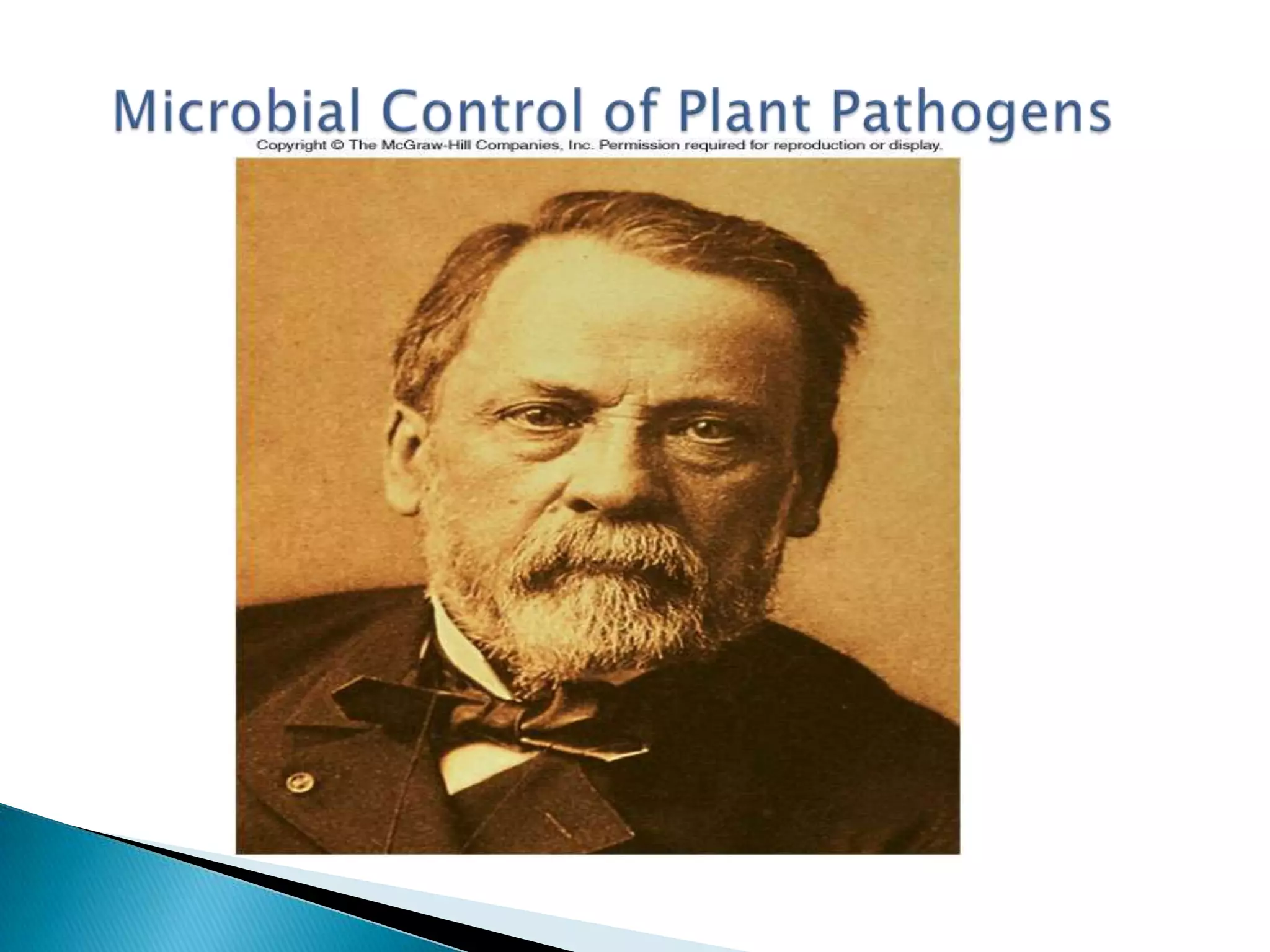
 Louis Pasteur also contributed a lot in this field.
• Showed microbes caused fermentation
• Studied spoilage and introduced “Pasteurization” to prevent it
• Used cotton plugs in his cultures to prevent air borne
contamination, devised Aseptic Technique.
 It is “Environment Friendly” cause no pollution in the
environment
 It tends to keep the natural environment at balance
 In practice, Microbial control can be achieved by three
methods
 Inundative Release
 Bio pesticide Approach
 Management and manipulation of the environment
 Trichoderma are fungi that are present in nearly all soils.
 They found in diverse habitats.
 In soil, they frequently are the most prevalent culturable
fungi.
 They are classified as Imperfect Fungi.
 They found in the form of colonies.
 Colonies are often uncoloured But sometimes give Buff,
Yellow, Amber or yellow-Green colour.
 It is Bio-fungicide.
 Rapid growth in culture.
 They reproduce themselves by Chlamydospores hence are a
fastest way to control fungi.
 The use of Trichoderma as microbial control was recognized in
early 1930’s.
 Commercial production of Trichoderma for the protection and
production enhancement of crops is in progress including;
 United States of America
 India
 Israel
 New Zealand
 Sweden
 One of the most characteristics of Trichoderma is their ability to
parasitize other fungi.
 It is therefore It is not surprising Weindling ascribed Microbial
control by Trichoderma lignorum of citrus seedling disease,
incited by Rhizoctonia solani, to mycoparasitism.
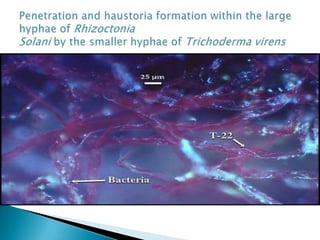
 The mycoparasitism of R. solani hyphae by the hyphae of the
Rizoctonia solani Includes;
 Coiling of hyphae around pathogen hyphae
 Penetration of hyphae into pathogen
 Dissolution of the host cytoplasm
 This phenomenon occurred regardless of the supply of
external nutrients to the host or Mycoparasite.
o Although he considered the possibility that under certain
circumstances T. lignorum might act as a competitor for
nutrients with R. solani.
o He much favored Mycoparasitism as the principal mechanism
for microbial control.
 Two years later, Weindling reported that a strain of T.
lignorum produced a “Lethal Principle”
 Secretion of Antibiotic into the surrounding medium, allowing
parasitic activity by microbial agent is called Lethal principle.
 In 1941 the “lethal principle”, demonstrated as it was toxic to
both R. solani and Sclerotinia Americana, and Weindling
named it Gliotoxin.
 Later research clarified that it is not T.lignorum, but
Gliocladium virens, a species that has recently been renamed
Trichoderma virens.
 If mycoparasitism and antibiotics are not the principal
mechanisms in the Microbial control process, Then what?
 One mechanism that has gained adherents in recent years is
that of competition through Rhizosphere competence
 Rhizosphere competence is important because a Microbial
control agent cannot compete for space and nutrients if it is
unable to grow in the Rhizosphere
 Trichoderma species are either added to the soil
OR
 Applied as seed treatments
o It grow readily along with the developing root system of the
treated plant
o This can be shown easily by simply plating surfacesterilized
root segments from treated plants on an agar medium
o After a suitable incubation period, the fungus can be seen
growing from virtually all parts of the root
 The difficulty in viewing competition through Rhizosphere
competence is that strains of T. koningii that are excellent
root colonizers exhibit little or no Microbial control activity
against R. solani on cotton seedlings
 One concept that is associated with competition and
Rhizosphere competence, the replacement of endogenous
fungi on the root surface, can be difficult to demonstrate.
 Trichoderma species are often able to suppress the growth of
endogenous fungi on an agar medium and therefore mask
their presence
o If these same cultures are incubated at 40°C, a temperature at
which T. virens will not grow, the pathogen grows readily
from many parts of the root system
o This may also occur with other Trichoderma species and
other pathogens
o But it is not easily demonstrated because growth of the
Microbial control agent can’t be suppressed without
suppressing the pathogen
• One idea that has been advanced is that enzymes such as
chitinases and/or glucanases produced by the Microbial
control agent are responsible for suppression of the plant
pathogen
• These enzymes function by breaking down the
polysaccharides, chitin, and glucans that are responsible for
the rigidity of fungal cell walls, thereby destroying cell wall
integrity
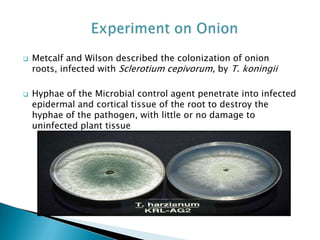
 Metcalf and Wilson described the colonization of onion
roots, infected with Sclerotium cepivorum, by T. koningii
 Hyphae of the Microbial control agent penetrate into infected
epidermal and cortical tissue of the root to destroy the
hyphae of the pathogen, with little or no damage to
uninfected plant tissue
 The protease enzymes break down hydrolytic enzymes into
peptide chains and/or their constituent amino acids and
thereby destroy their capacity to act on plant cells
 Lorito further expanded this concept by combining a number
of antifungal compounds with several kinds of hydrolytic
enzymes and applying them to Propagules of B. cinerea and
Fusarium oxysporum
 Synergism occurred in all cases, but the level depended on
the antifungal activity of the enzyme
 Synergism was lower when the enzyme was added after the
antifungal compound
 This Indicates that cell wall degradation was needed in order
to establish the interaction
• Another mechanism proposed to explain biocontrol activity
by Trichoderma species is that of induction of resistance in
the host plant by treatment with the microbial control agent
• Interestingly, the plant defense became muted with time and
began to resemble a symbiotic mycorrhizal association
• Biocontrol activity against R. solani was highly correlated with
induction of terpenoids synthesis in cotton roots by
Trichoderma species, even among strains of T. virens that
were deficient for mycoparasitism and antibiotic production
 In addition to terpenoids synthesis, treatment of cotton roots
with T. virens also induced significantly higher levels of
peroxidase activity than that found in control roots
 Peroxidase activity and terpenoids levels in seedling
hypocotyls were not significantly different from those found
in the controls. In this case, plant defense responses
appeared to be confined to the root system
 One unique mechanism employed by Trichoderma species to
effect biological control that does not fit neatly into any of
the categories previously mentioned was recently discovered
 Disease control could be effected by wild-type strains or by
mutant strains that were deficient for mycoparasitism,
antibiotic production, and induction of terpenoids synthesis
in cotton roots
 If, however, pathogen Propagules were induced to germinate
by artificial means, none of the above treatments gave
effective control of the disease
 Trichoderma species exhibit other characteristics during
interactions with host plants that may contribute to disease
resistance or tolerance
 These characteristics manifest themselves by increases in
plant root and shoot growth, resistance to biotic and abiotic
stresses, and changes in the nutritional status of the plant
 At maturity, the treated plants had larger stem diameters and
increased yields of grain and silage
o The results have shown that not all the mechanisms and
characteristics deemed necessary for optimum Microbial
control are found in the same organism
o Very often those strains that have the capacity to produce
enzymes and antibiotics that are associated with Microbial
control
o There are not the ones that have good storage qualities or
function well at temperature and moisture levels where
pathogens flourish

 The mechanisms employed by biocontrol agents to effect
biological control of plant diseases are many and complex,
and their use varies with the kind of biocontrol agent,
pathogen, and host plant involved in the interaction
 Mechanisms are also influenced by the soil type, by the
temperature, pH, and moisture of the plant and soil
environment, and by other members of the micoflora
 Our knowledge of the complexity of these systems is
currently limited by our ability to perceive them, and a great
deal of research will have to be undertaken in order to fathom
exactly what is taking place during the Microbial control
process
What we observe and define Microbial control
as;
 The combination of a number of different
mechanisms working synergistically to
achieve disease control
Microbial control of plant pathogens

Microbial control of plant pathogens

  • 2.
    Definition: “The practice orprocess by which an undesirable organism is controlled by means of another organism” OR In other words, Microbial control is both a naturally occurring process (which we can exploit) and the purposeful use of one organism to control another.
  • 3.
    Definition: “Any agent capableof causing disease in the plants” The term pathogen is usually restricted to living agents, which include; • Viruses • Bacteria • Fungi • Protozoa and certain insect larval stages.
  • 4.
    Definition: “The use ofmicro-organisms to control plant pathogens”  There are many microbes which are being used for biocontrol  Three most important which are being used are;  Bacillus thuringiensis  Agrobacterium radiobacter  Trichoderma
  • 5.
     This termwas first coined by Harry Smith.  Louis Pasteur also contributed a lot in this field. • Showed microbes caused fermentation • Studied spoilage and introduced “Pasteurization” to prevent it • Used cotton plugs in his cultures to prevent air borne contamination, devised Aseptic Technique.
  • 6.
     It is“Environment Friendly” cause no pollution in the environment  It tends to keep the natural environment at balance
  • 7.
     In practice,Microbial control can be achieved by three methods  Inundative Release  Bio pesticide Approach  Management and manipulation of the environment
  • 8.
     Trichoderma arefungi that are present in nearly all soils.  They found in diverse habitats.  In soil, they frequently are the most prevalent culturable fungi.  They are classified as Imperfect Fungi.  They found in the form of colonies.  Colonies are often uncoloured But sometimes give Buff, Yellow, Amber or yellow-Green colour.
  • 9.
     It isBio-fungicide.  Rapid growth in culture.  They reproduce themselves by Chlamydospores hence are a fastest way to control fungi.
  • 10.
     The useof Trichoderma as microbial control was recognized in early 1930’s.  Commercial production of Trichoderma for the protection and production enhancement of crops is in progress including;  United States of America  India  Israel  New Zealand  Sweden
  • 11.
     One ofthe most characteristics of Trichoderma is their ability to parasitize other fungi.  It is therefore It is not surprising Weindling ascribed Microbial control by Trichoderma lignorum of citrus seedling disease, incited by Rhizoctonia solani, to mycoparasitism.  The mycoparasitism of R. solani hyphae by the hyphae of the Rizoctonia solani Includes;  Coiling of hyphae around pathogen hyphae  Penetration of hyphae into pathogen  Dissolution of the host cytoplasm
  • 12.
     This phenomenonoccurred regardless of the supply of external nutrients to the host or Mycoparasite. o Although he considered the possibility that under certain circumstances T. lignorum might act as a competitor for nutrients with R. solani. o He much favored Mycoparasitism as the principal mechanism for microbial control.
  • 13.
     Two yearslater, Weindling reported that a strain of T. lignorum produced a “Lethal Principle”  Secretion of Antibiotic into the surrounding medium, allowing parasitic activity by microbial agent is called Lethal principle.  In 1941 the “lethal principle”, demonstrated as it was toxic to both R. solani and Sclerotinia Americana, and Weindling named it Gliotoxin.  Later research clarified that it is not T.lignorum, but Gliocladium virens, a species that has recently been renamed Trichoderma virens.
  • 15.
     If mycoparasitismand antibiotics are not the principal mechanisms in the Microbial control process, Then what?  One mechanism that has gained adherents in recent years is that of competition through Rhizosphere competence  Rhizosphere competence is important because a Microbial control agent cannot compete for space and nutrients if it is unable to grow in the Rhizosphere
  • 16.
     Trichoderma speciesare either added to the soil OR  Applied as seed treatments
  • 17.
    o It growreadily along with the developing root system of the treated plant o This can be shown easily by simply plating surfacesterilized root segments from treated plants on an agar medium o After a suitable incubation period, the fungus can be seen growing from virtually all parts of the root
  • 18.
     The difficultyin viewing competition through Rhizosphere competence is that strains of T. koningii that are excellent root colonizers exhibit little or no Microbial control activity against R. solani on cotton seedlings  One concept that is associated with competition and Rhizosphere competence, the replacement of endogenous fungi on the root surface, can be difficult to demonstrate.  Trichoderma species are often able to suppress the growth of endogenous fungi on an agar medium and therefore mask their presence
  • 19.
    o If thesesame cultures are incubated at 40°C, a temperature at which T. virens will not grow, the pathogen grows readily from many parts of the root system o This may also occur with other Trichoderma species and other pathogens o But it is not easily demonstrated because growth of the Microbial control agent can’t be suppressed without suppressing the pathogen
  • 20.
    • One ideathat has been advanced is that enzymes such as chitinases and/or glucanases produced by the Microbial control agent are responsible for suppression of the plant pathogen • These enzymes function by breaking down the polysaccharides, chitin, and glucans that are responsible for the rigidity of fungal cell walls, thereby destroying cell wall integrity
  • 21.
     Metcalf andWilson described the colonization of onion roots, infected with Sclerotium cepivorum, by T. koningii  Hyphae of the Microbial control agent penetrate into infected epidermal and cortical tissue of the root to destroy the hyphae of the pathogen, with little or no damage to uninfected plant tissue
  • 22.
     The proteaseenzymes break down hydrolytic enzymes into peptide chains and/or their constituent amino acids and thereby destroy their capacity to act on plant cells  Lorito further expanded this concept by combining a number of antifungal compounds with several kinds of hydrolytic enzymes and applying them to Propagules of B. cinerea and Fusarium oxysporum  Synergism occurred in all cases, but the level depended on the antifungal activity of the enzyme
  • 23.
     Synergism waslower when the enzyme was added after the antifungal compound  This Indicates that cell wall degradation was needed in order to establish the interaction
  • 24.
    • Another mechanismproposed to explain biocontrol activity by Trichoderma species is that of induction of resistance in the host plant by treatment with the microbial control agent • Interestingly, the plant defense became muted with time and began to resemble a symbiotic mycorrhizal association • Biocontrol activity against R. solani was highly correlated with induction of terpenoids synthesis in cotton roots by Trichoderma species, even among strains of T. virens that were deficient for mycoparasitism and antibiotic production
  • 25.
     In additionto terpenoids synthesis, treatment of cotton roots with T. virens also induced significantly higher levels of peroxidase activity than that found in control roots  Peroxidase activity and terpenoids levels in seedling hypocotyls were not significantly different from those found in the controls. In this case, plant defense responses appeared to be confined to the root system
  • 26.
     One uniquemechanism employed by Trichoderma species to effect biological control that does not fit neatly into any of the categories previously mentioned was recently discovered  Disease control could be effected by wild-type strains or by mutant strains that were deficient for mycoparasitism, antibiotic production, and induction of terpenoids synthesis in cotton roots  If, however, pathogen Propagules were induced to germinate by artificial means, none of the above treatments gave effective control of the disease
  • 27.
     Trichoderma speciesexhibit other characteristics during interactions with host plants that may contribute to disease resistance or tolerance  These characteristics manifest themselves by increases in plant root and shoot growth, resistance to biotic and abiotic stresses, and changes in the nutritional status of the plant  At maturity, the treated plants had larger stem diameters and increased yields of grain and silage
  • 28.
    o The resultshave shown that not all the mechanisms and characteristics deemed necessary for optimum Microbial control are found in the same organism o Very often those strains that have the capacity to produce enzymes and antibiotics that are associated with Microbial control o There are not the ones that have good storage qualities or function well at temperature and moisture levels where pathogens flourish 
  • 29.
     The mechanismsemployed by biocontrol agents to effect biological control of plant diseases are many and complex, and their use varies with the kind of biocontrol agent, pathogen, and host plant involved in the interaction  Mechanisms are also influenced by the soil type, by the temperature, pH, and moisture of the plant and soil environment, and by other members of the micoflora  Our knowledge of the complexity of these systems is currently limited by our ability to perceive them, and a great deal of research will have to be undertaken in order to fathom exactly what is taking place during the Microbial control process
  • 30.
    What we observeand define Microbial control as;  The combination of a number of different mechanisms working synergistically to achieve disease control