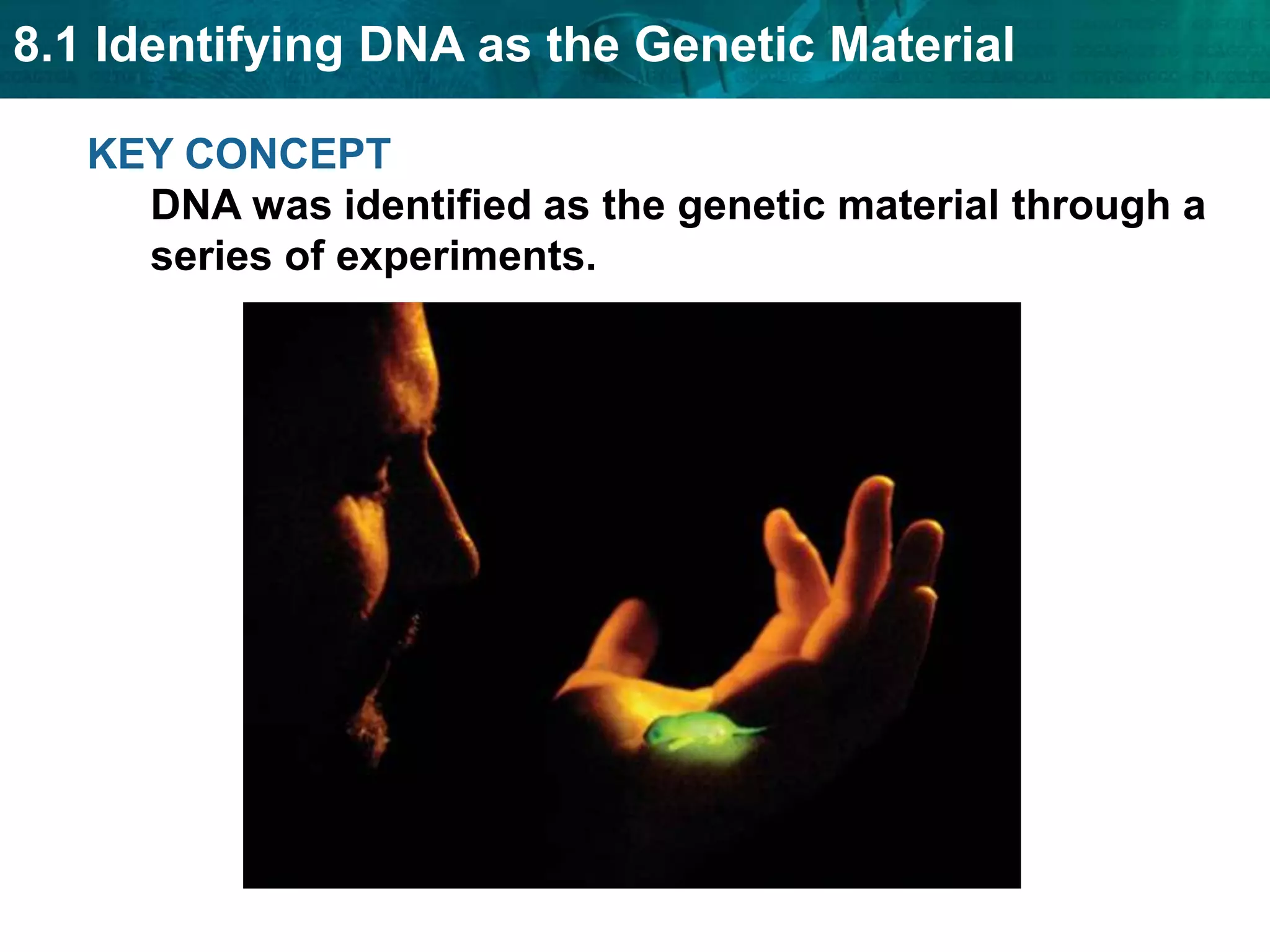
KEY CONCEPT DNA was identified as the genetic material through a series of experiments.
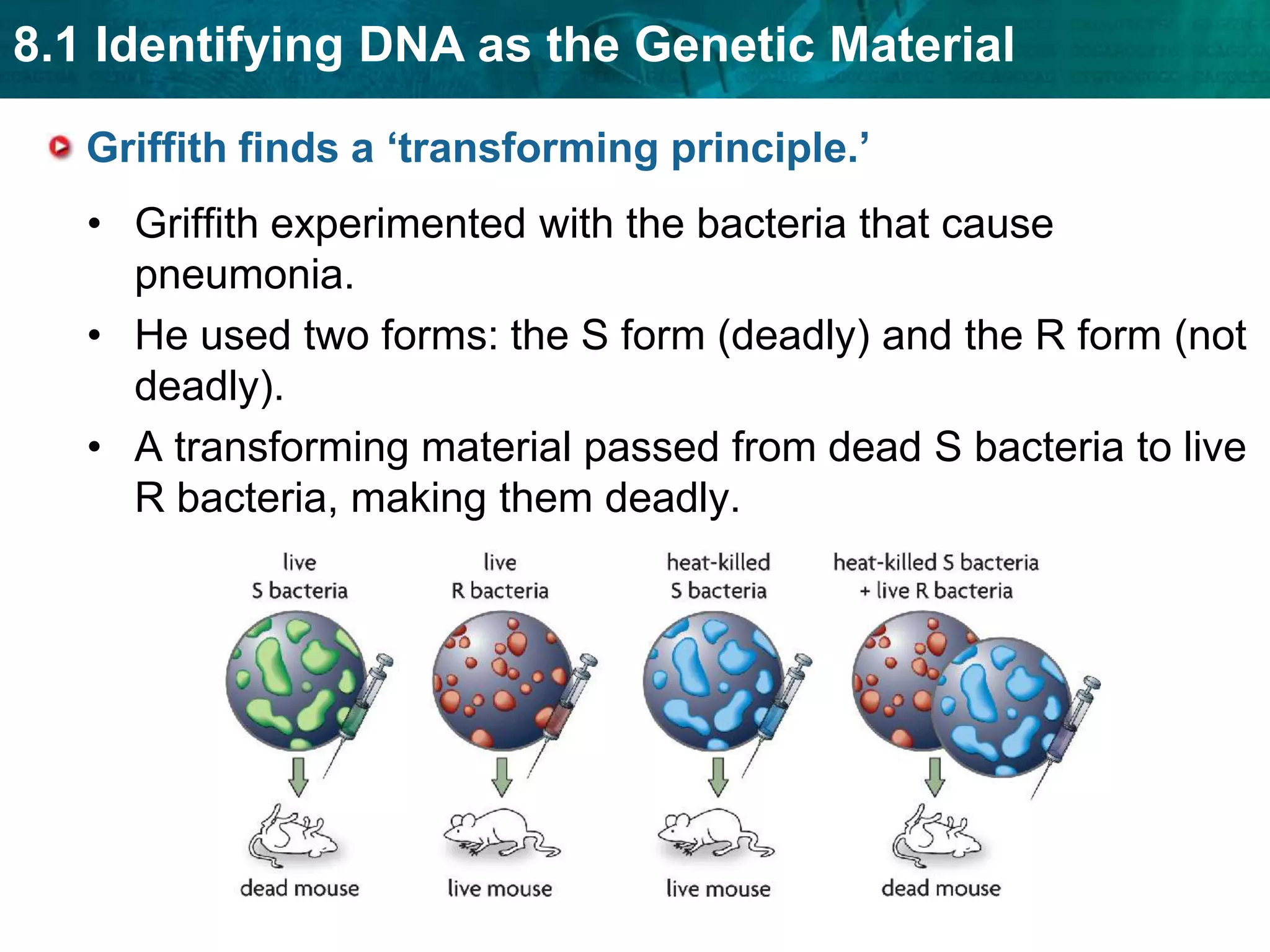
Griffith finds a ‘transforming principle.’ Griffith experimented with the bacteria that cause pneumonia.He used two forms: the S form (deadly) and the R form (not deadly).A transforming material passed from dead S bacteria to live R bacteria, making them deadly.
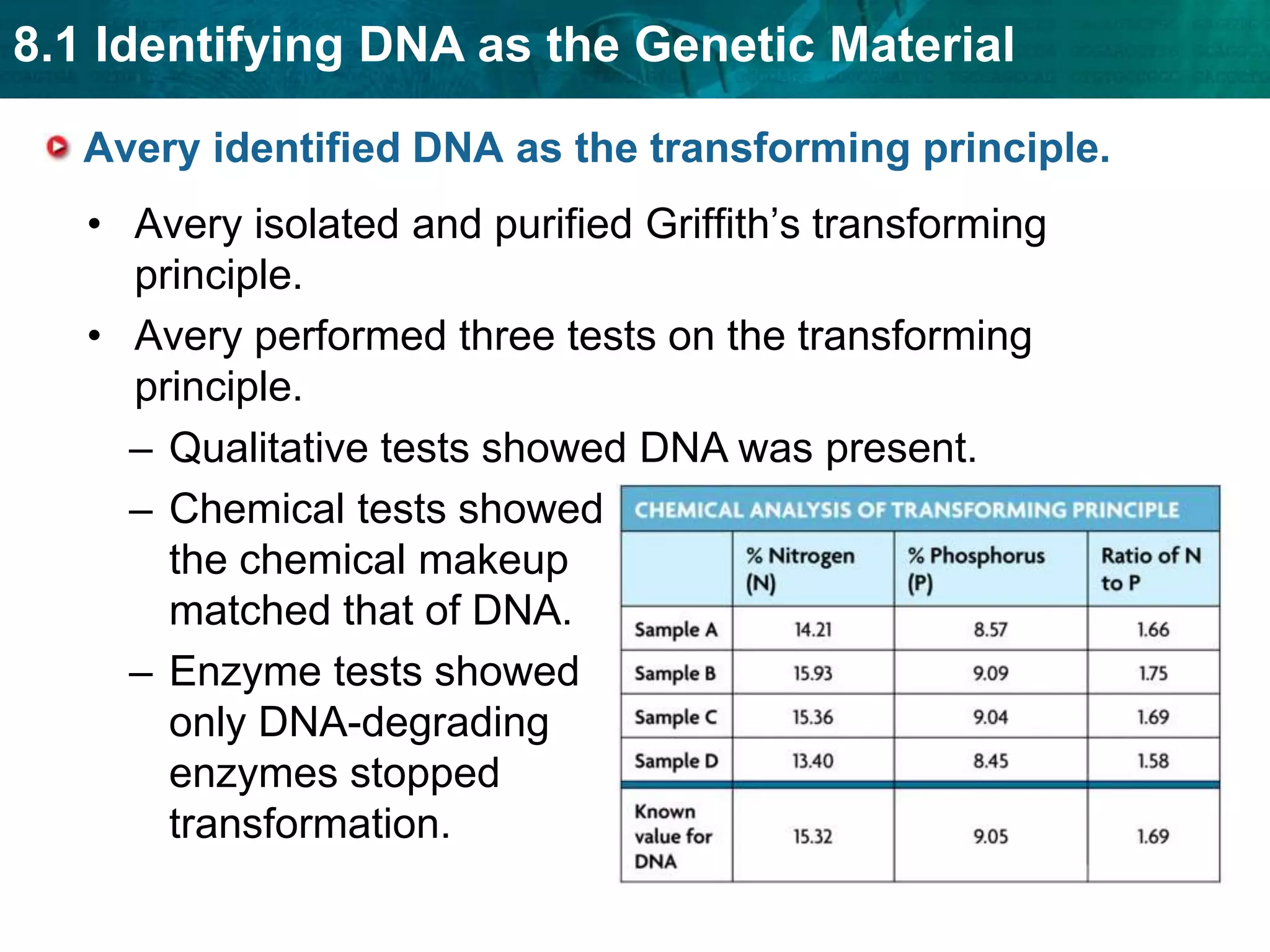
Avery identified DNA as the transforming principle.     Avery isolated and purified Griffith’s transforming principle.Avery performed three tests on the transforming principle.Qualitative tests showed DNA was present.
Chemical tests showedthe chemical makeupmatched that of DNA.
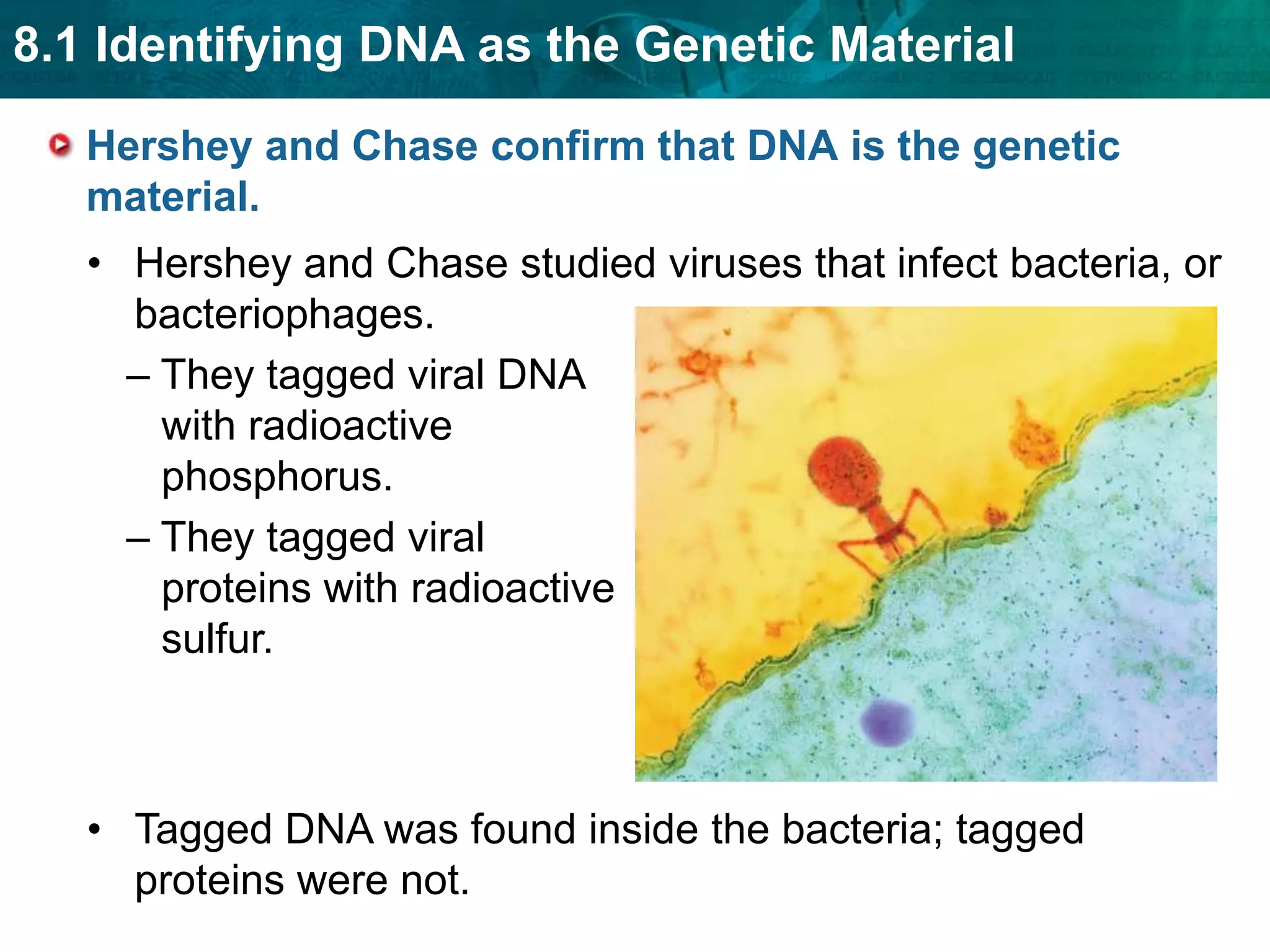
Enzyme tests showedonly DNA-degradingenzymes stoppedtransformation.Hershey and Chase confirm that DNA is the genetic material. Hershey and Chase studied viruses that infect bacteria, or bacteriophages.  They tagged viral DNA   with radioactive   phosphorus.
 They tagged viral   proteins with radioactive   sulfur.
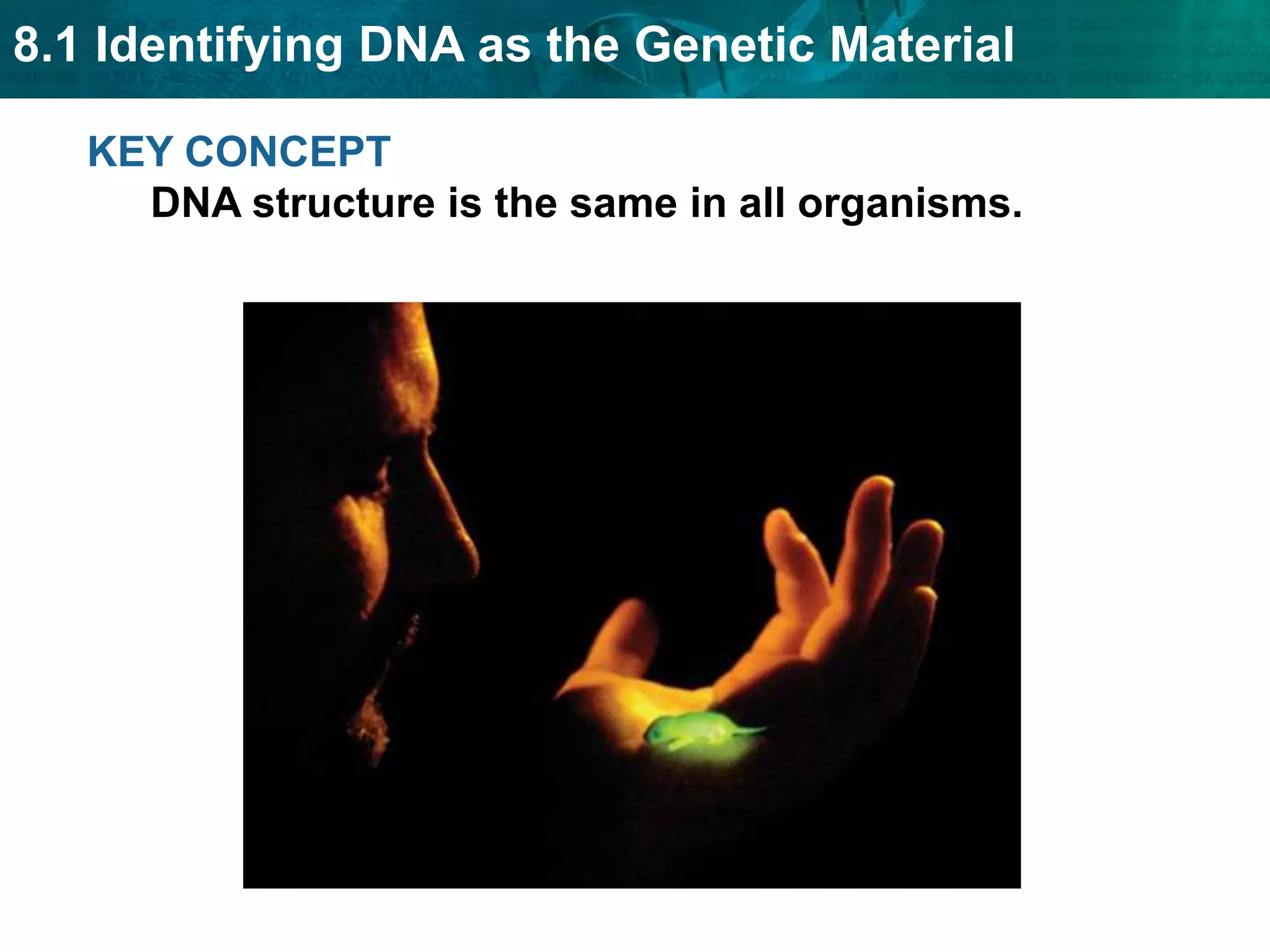
Tagged DNA was found inside the bacteria; tagged proteins were not.KEY CONCEPT DNA structure is the same in all organisms.
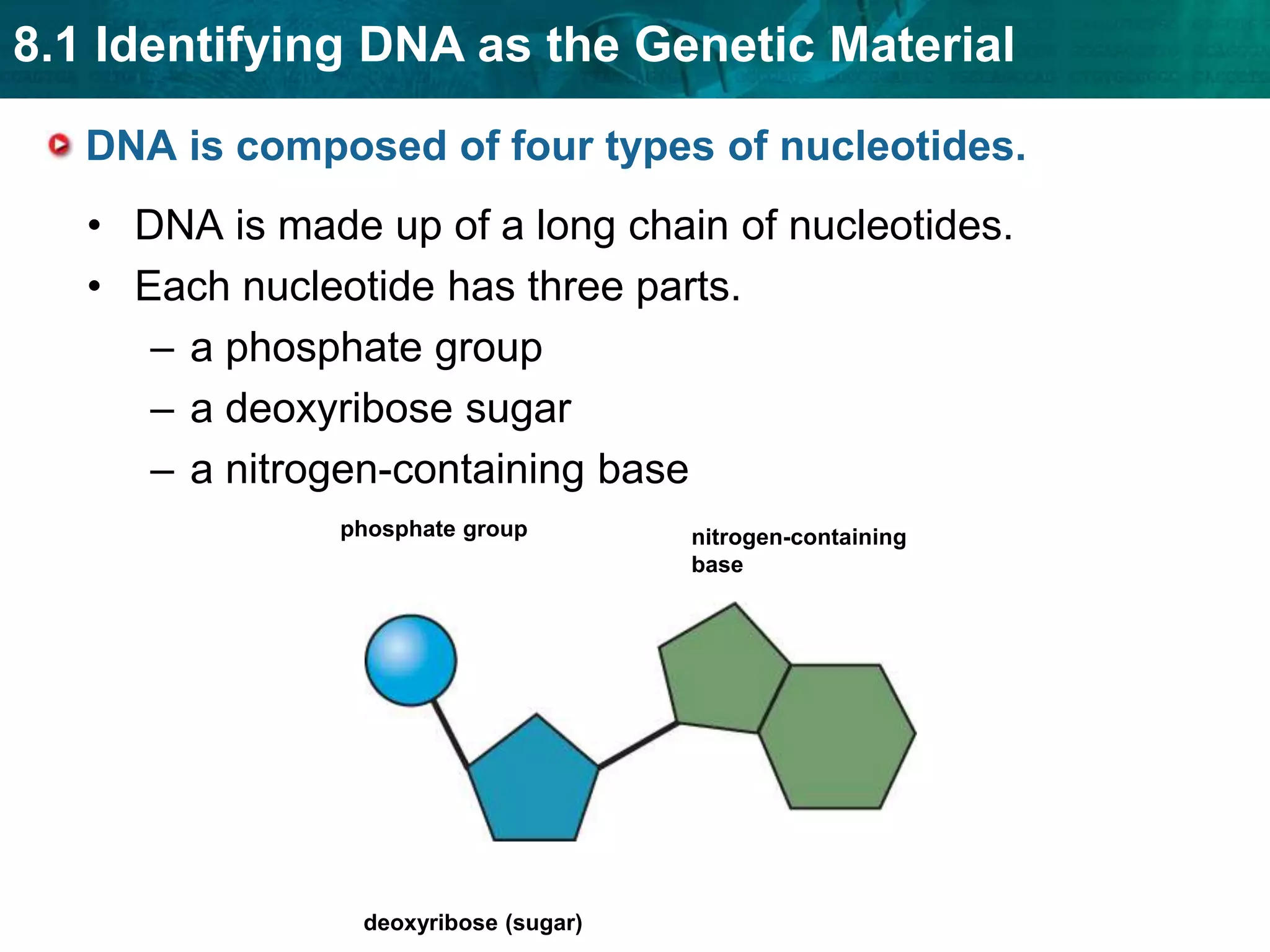
phosphate groupnitrogen-containingbasedeoxyribose (sugar)DNA is composed of four types of nucleotides.DNA is made up of a long chain of nucleotides.Each nucleotide has three parts.a phosphate groupa deoxyribose sugara nitrogen-containing base
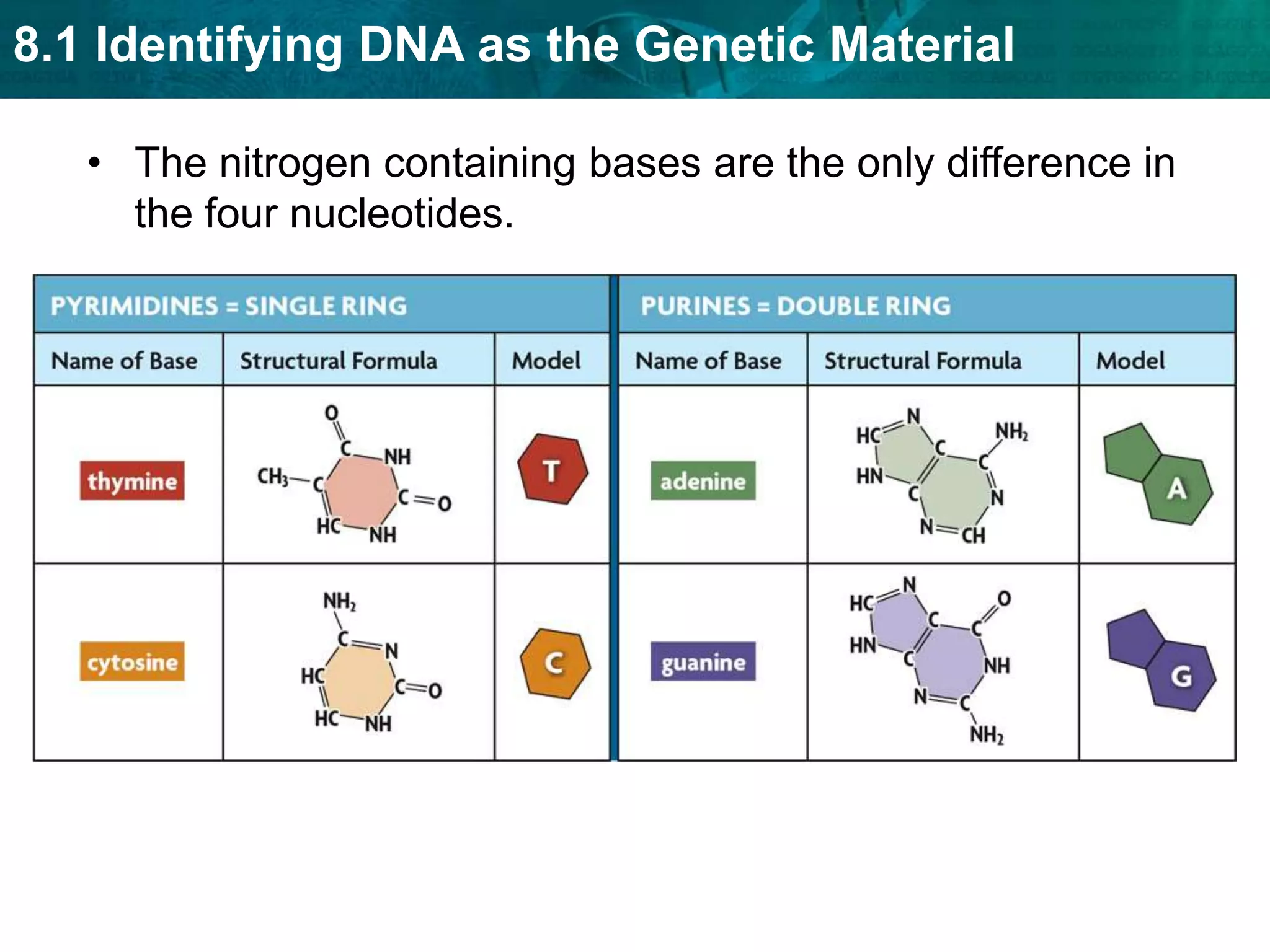
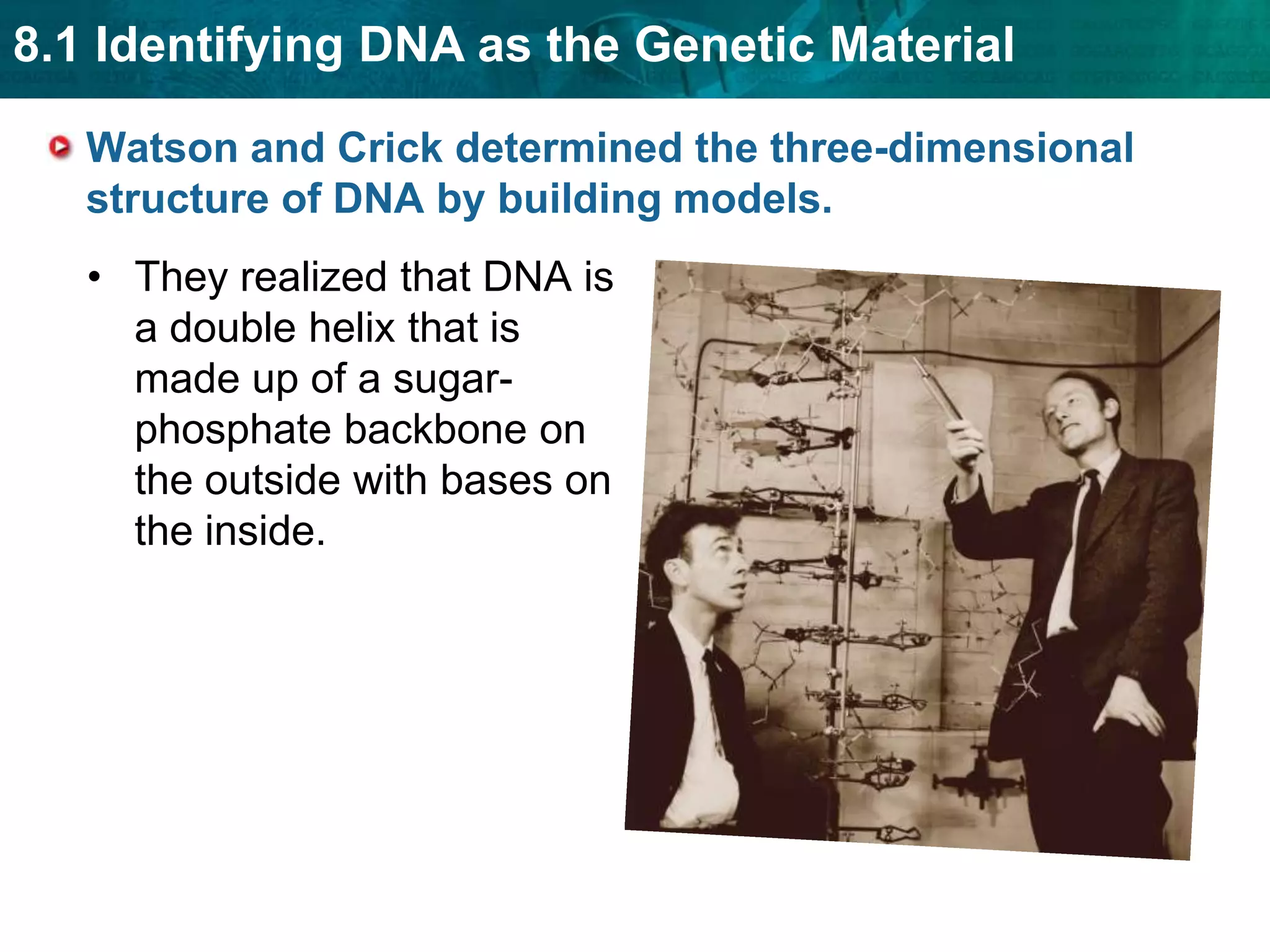
The nitrogen containing bases are the only difference in the four nucleotides. Watson and Crick determined the three-dimensional structure of DNA by building models. They realized that DNA is a double helix that is made up of a sugar-phosphate backbone on the outside with bases on the inside.
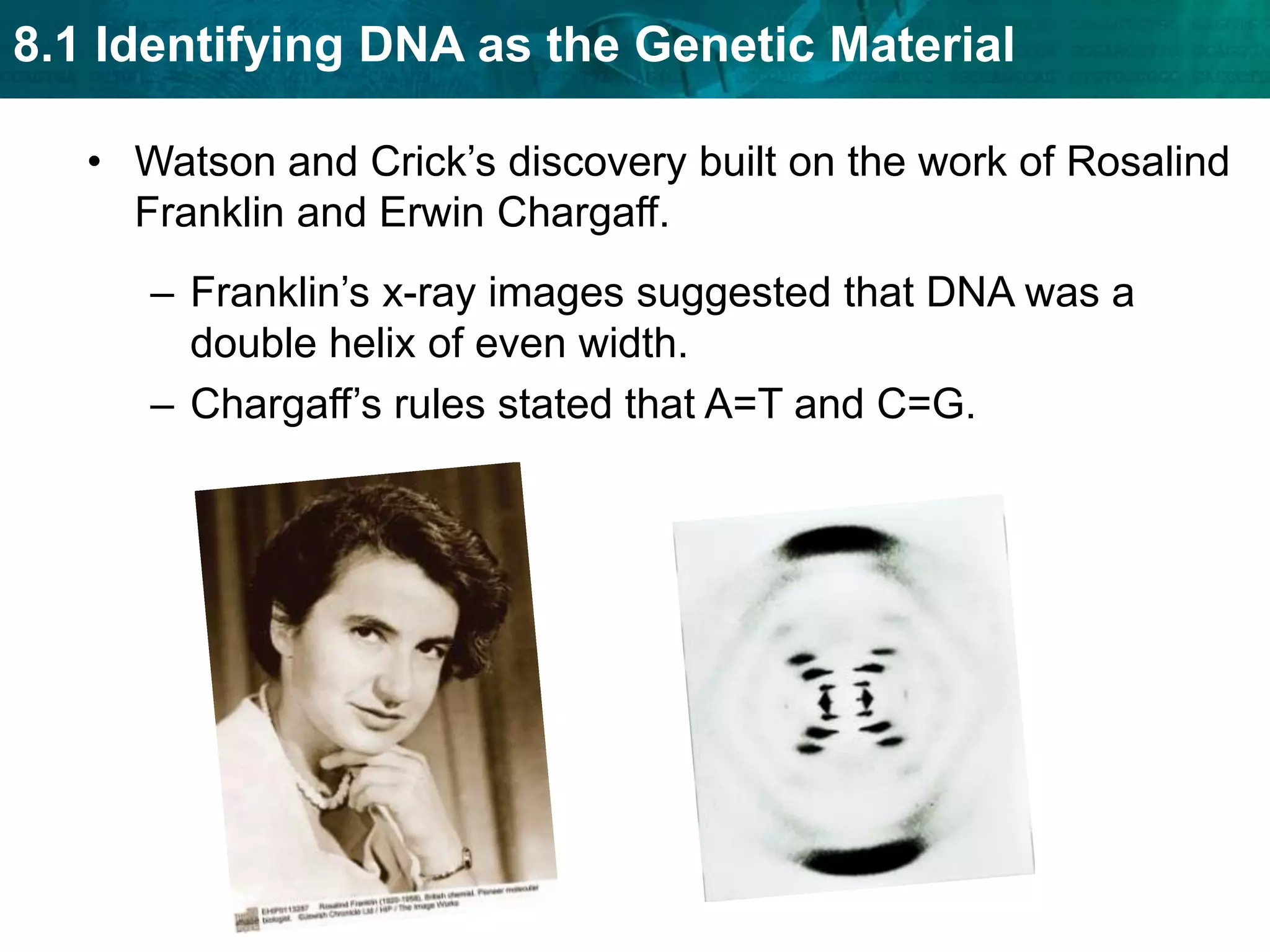
Watson and Crick’s discovery built on the work of Rosalind Franklin and Erwin Chargaff.
Franklin’s x-ray images suggested that DNA was a double helix of even width.
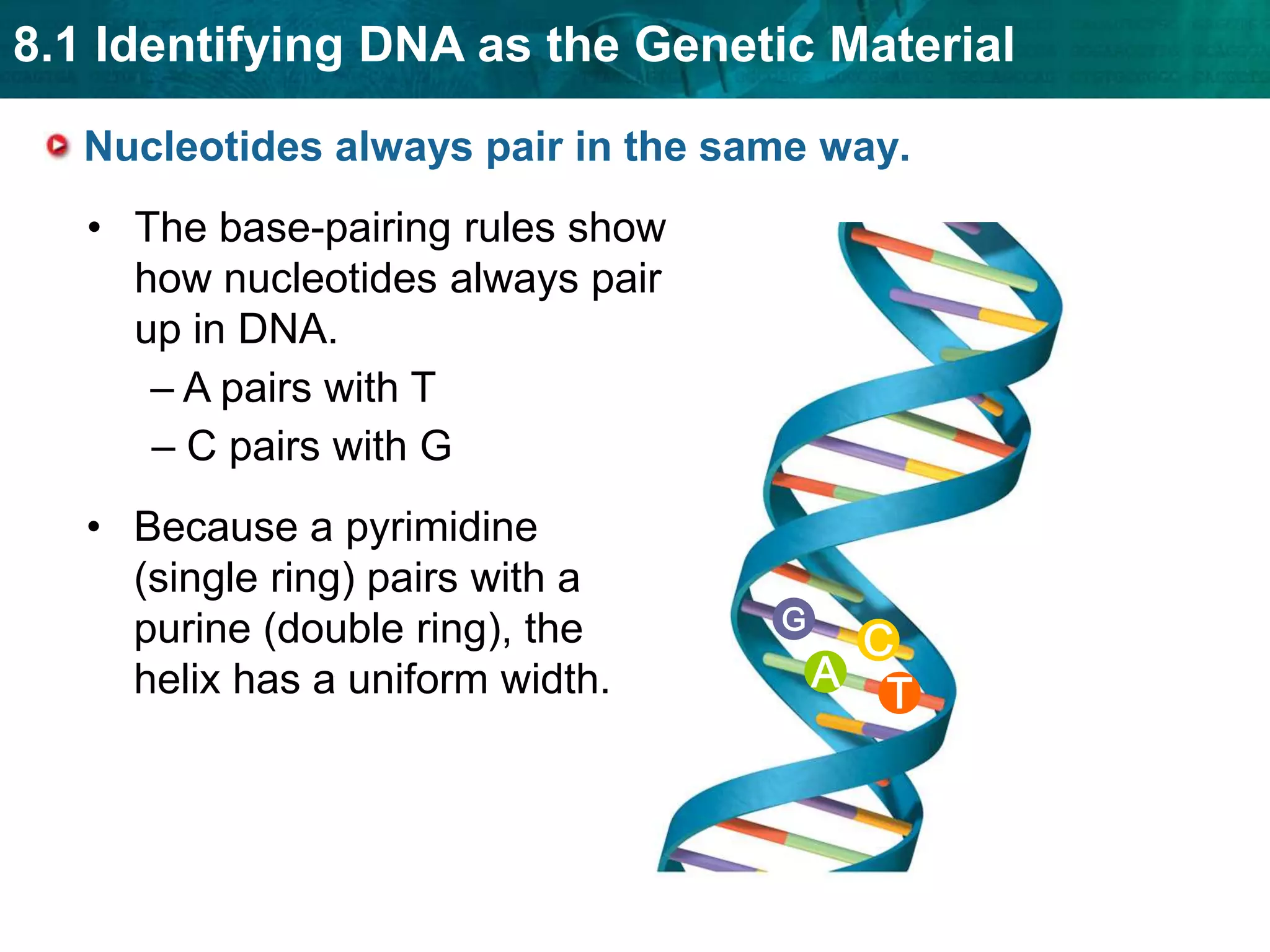
Chargaff’s rules stated that A=T and C=G.GCATNucleotides always pair in the same way. The base-pairing rules show how nucleotides always pair up in DNA. A pairs with T
 C pairs with G
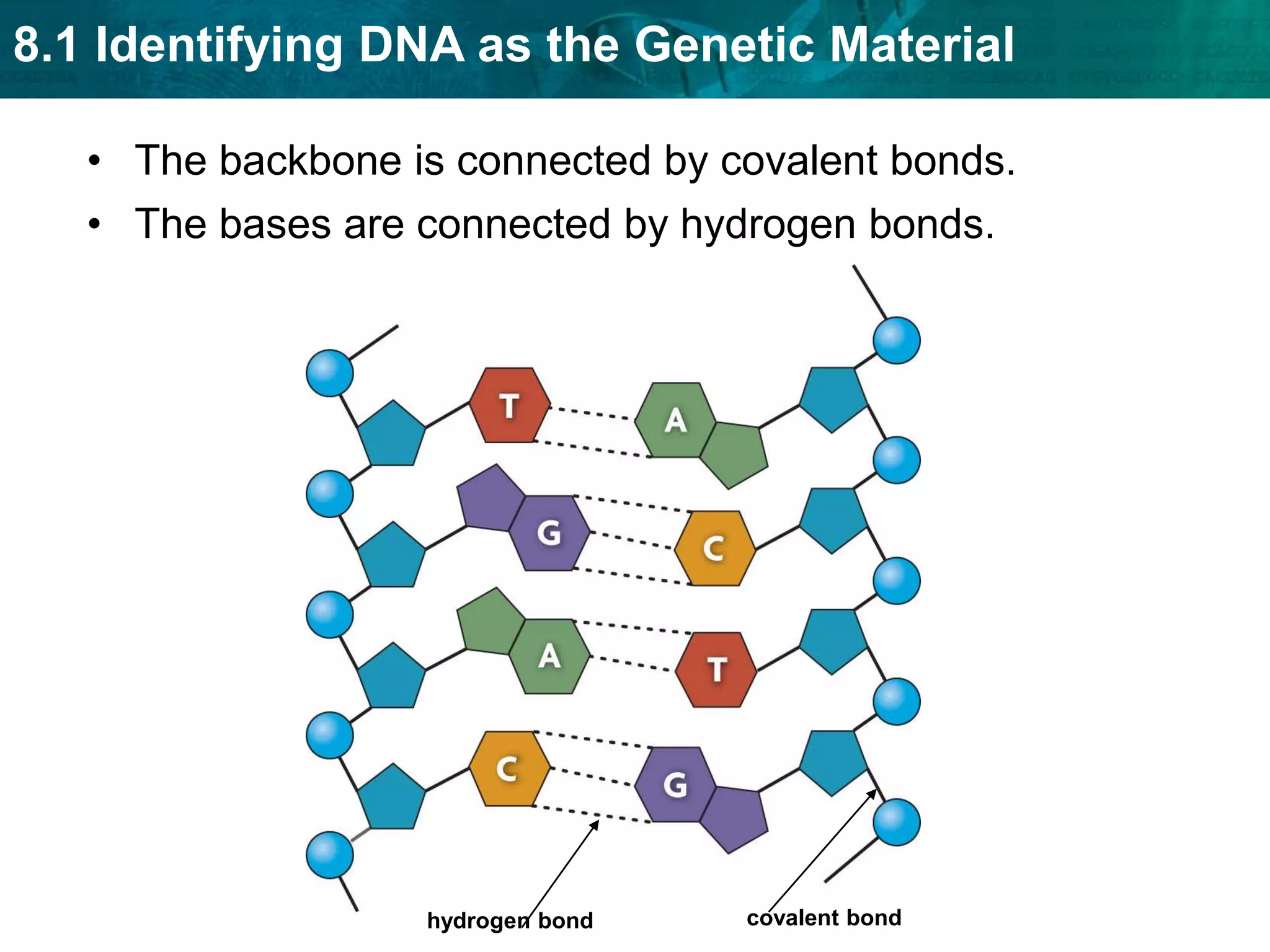
Because a pyrimidine (single ring) pairs with a purine (double ring), the helix has a uniform width.covalent bondhydrogen bondThe backbone is connected by covalent bonds.
The bases are connected by hydrogen bonds.KEY CONCEPT DNA replication copies the genetic information of a cell.
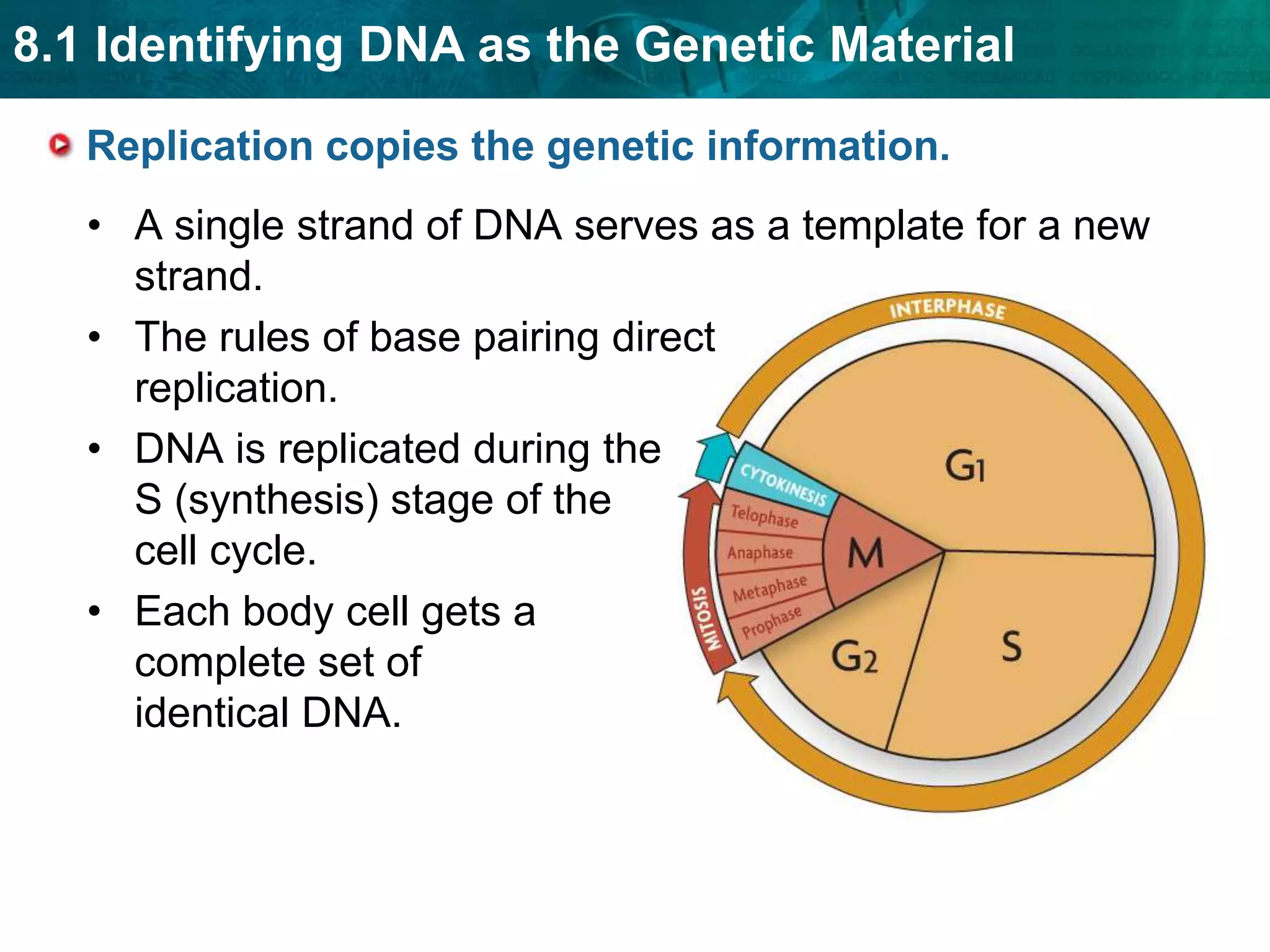
Replication copies the genetic information. A single strand of DNA serves as a template for a new strand.The rules of base pairing directreplication.DNA is replicated during theS (synthesis) stage of thecell cycle.Each body cell gets acomplete set ofidentical DNA.
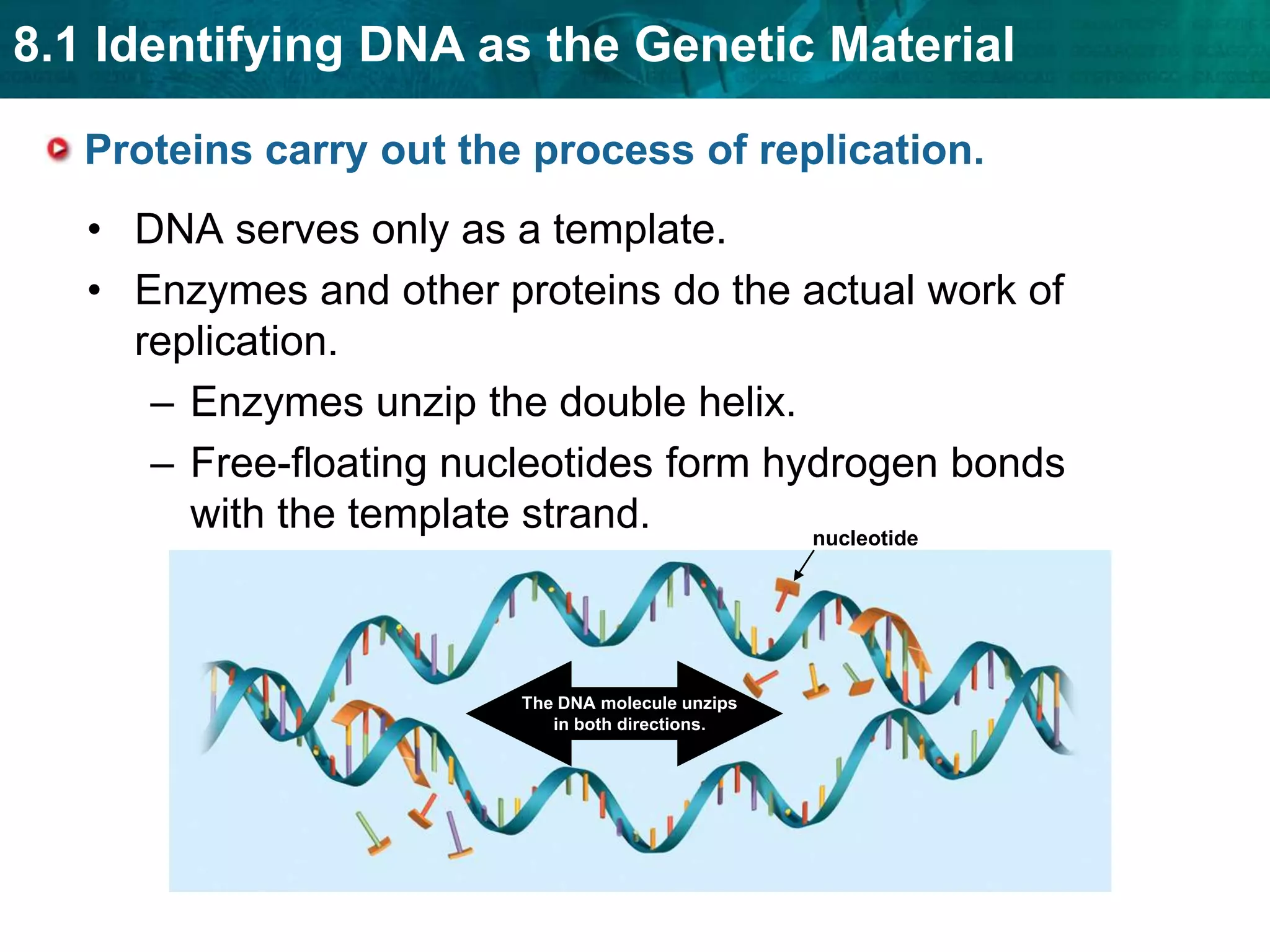
nucleotideThe DNA molecule unzips in both directions.Proteins carry out the process of replication. DNA serves only as a template. Enzymes and other proteins do the actual work of replication.Enzymes unzip the double helix.Free-floating nucleotides form hydrogen bonds with the template strand.
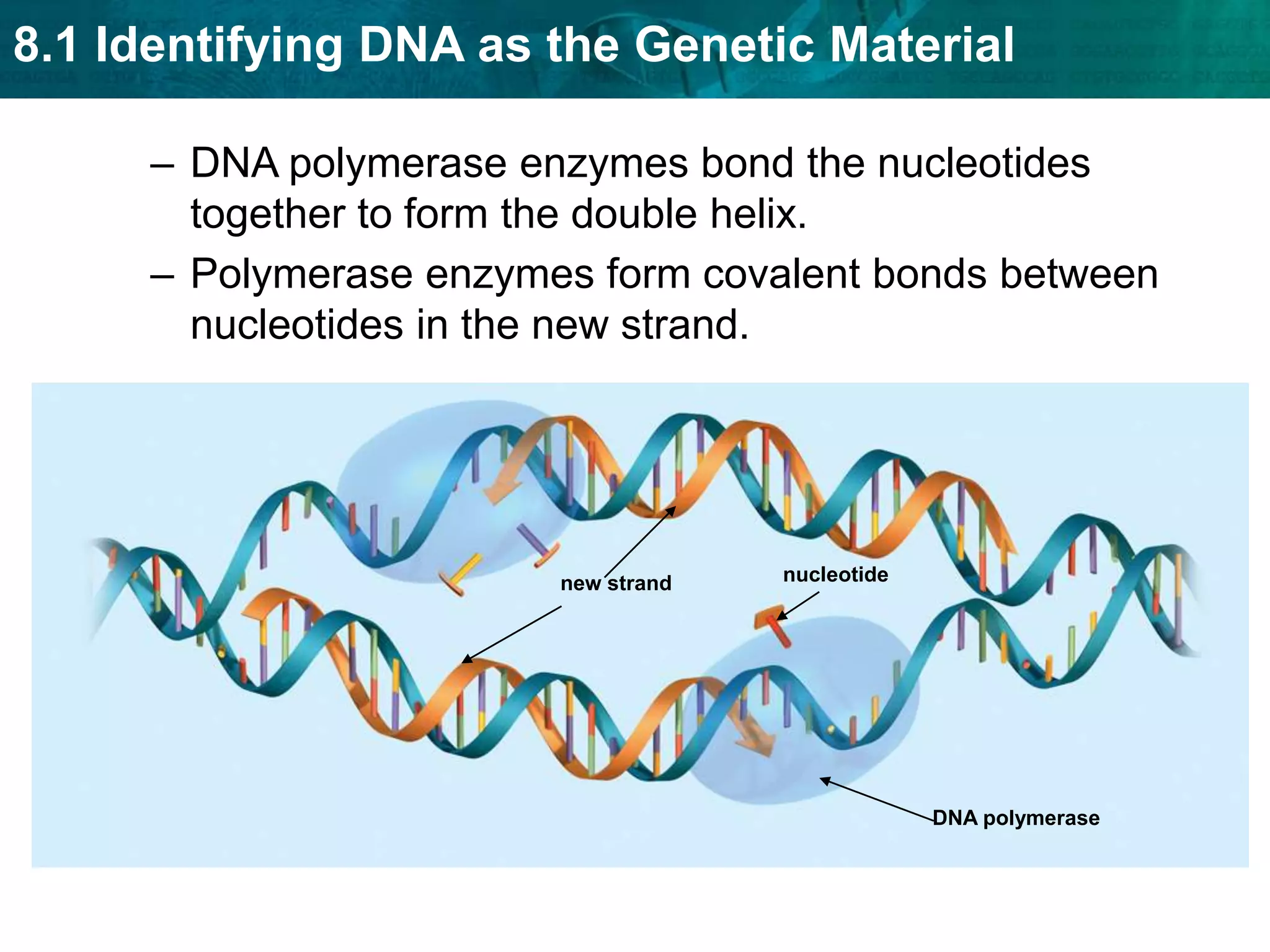
nucleotidenew strandDNA polymeraseDNA polymerase enzymes bond the nucleotides together to form the double helix.
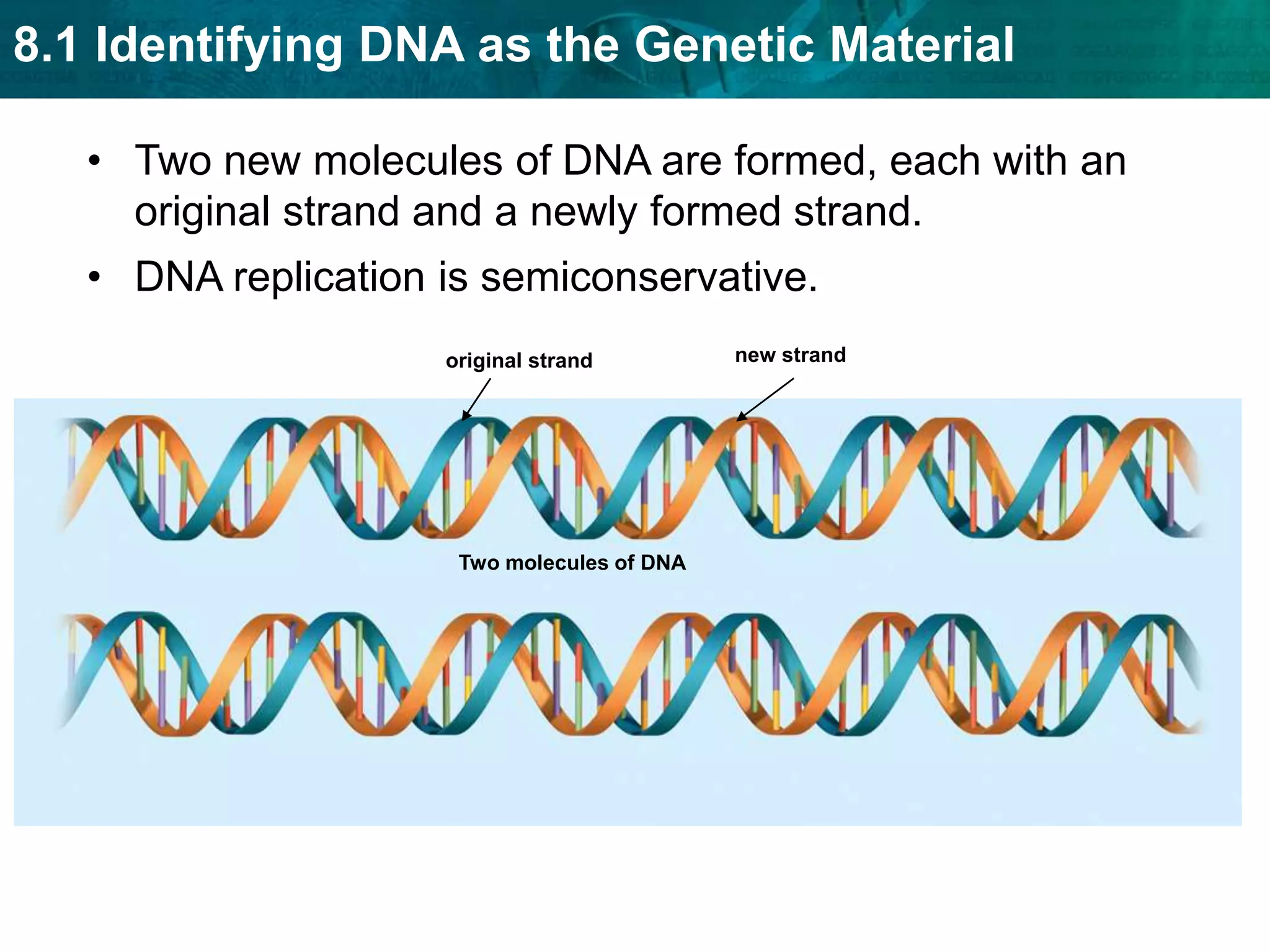
Polymerase enzymes form covalent bonds between nucleotides in the new strand.new strandoriginal strandTwo molecules of DNATwo new molecules of DNA are formed, each with an original strand and a newly formed strand.
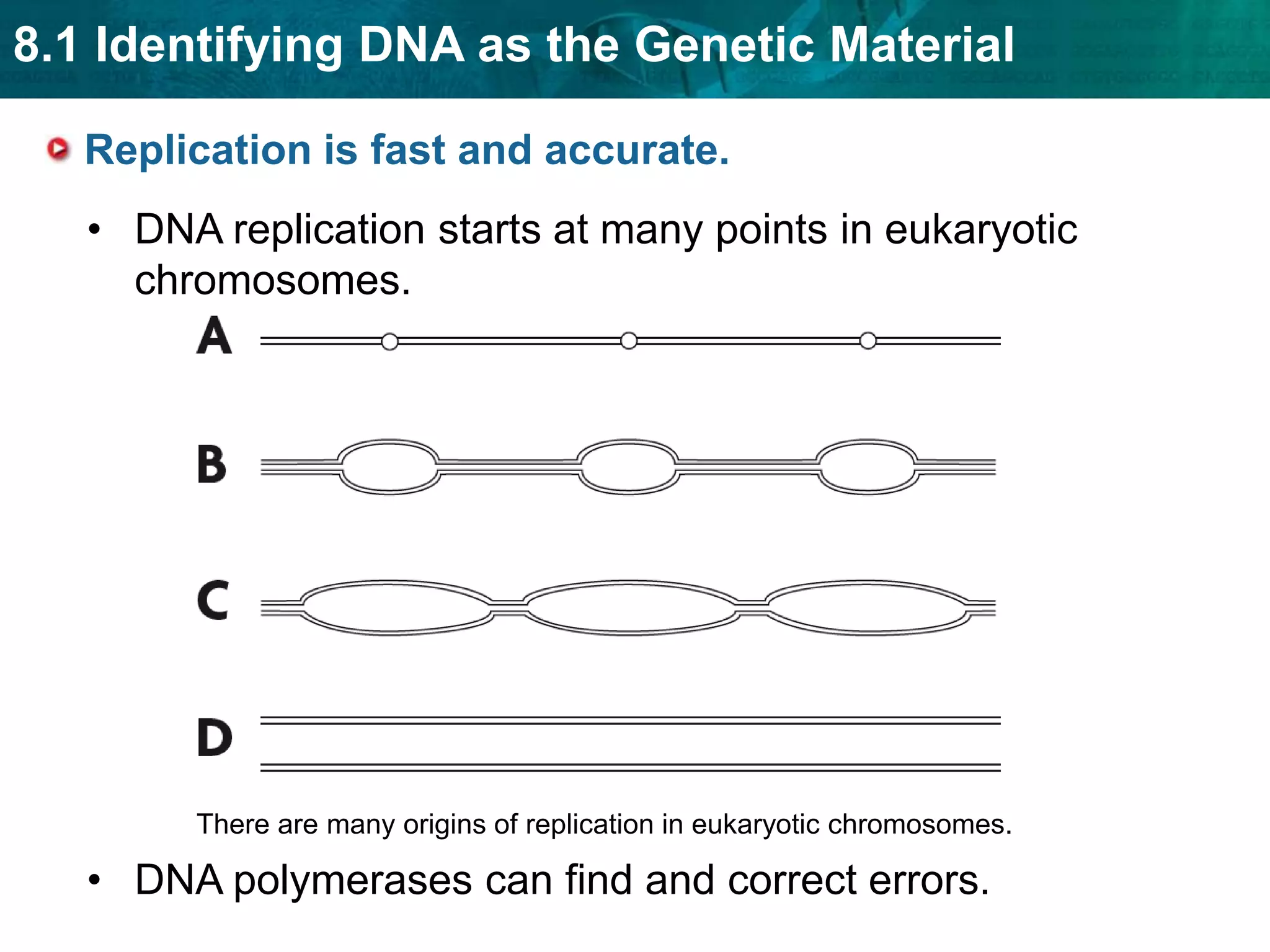
DNA replication is semiconservative. There are many origins of replication in eukaryotic chromosomes.Replication is fast and accurate.DNA replication starts at many points in eukaryotic chromosomes.
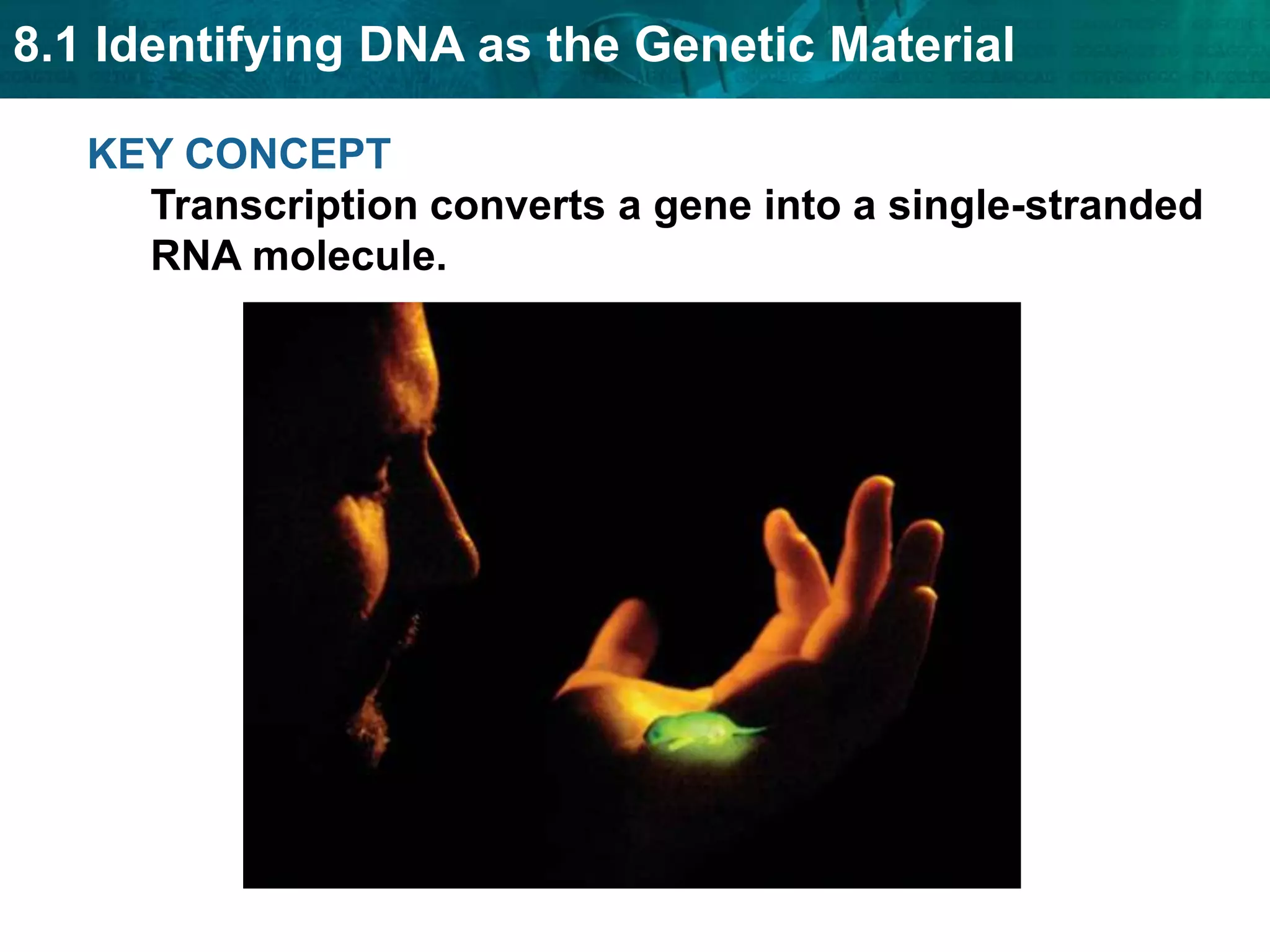
DNA polymerases can find and correct errors.KEY CONCEPT Transcription converts a gene into a single-stranded RNA molecule.
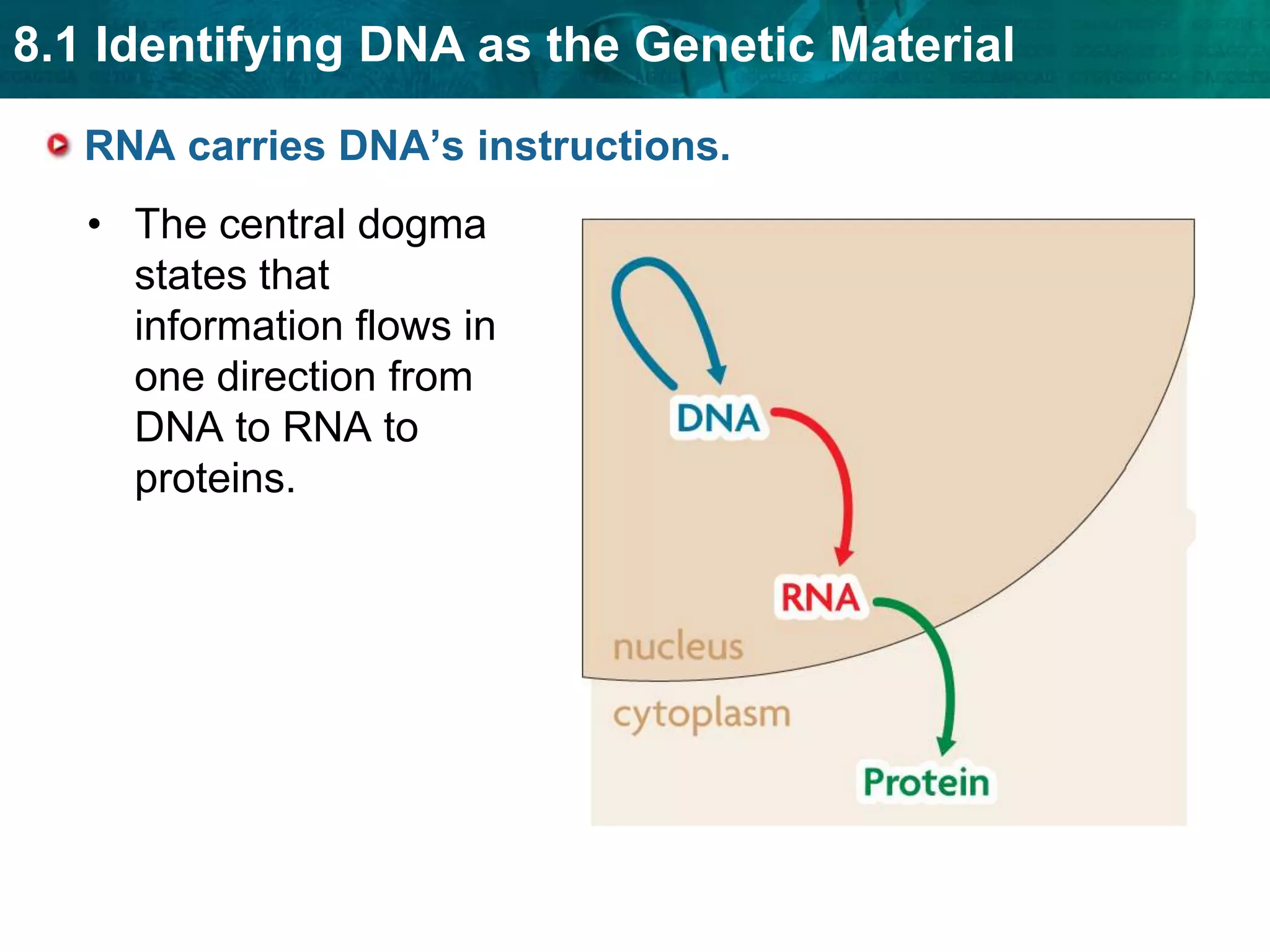
RNA carries DNA’s instructions. The central dogma states that information flows in one direction from DNA to RNA to proteins.
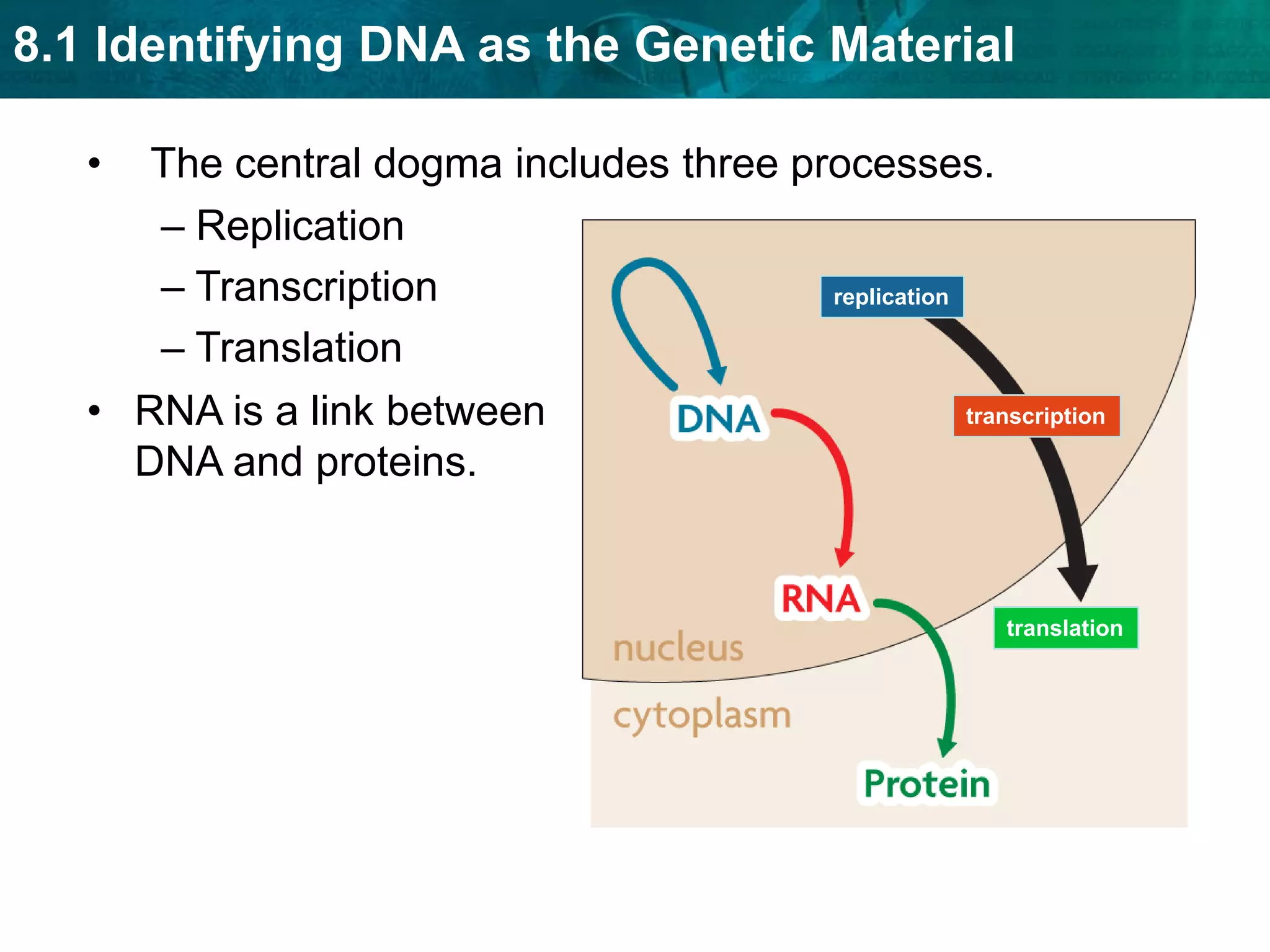
replicationtranscriptiontranslationThe central dogma includes three processes.
 Replication
 Transcription
 Translation
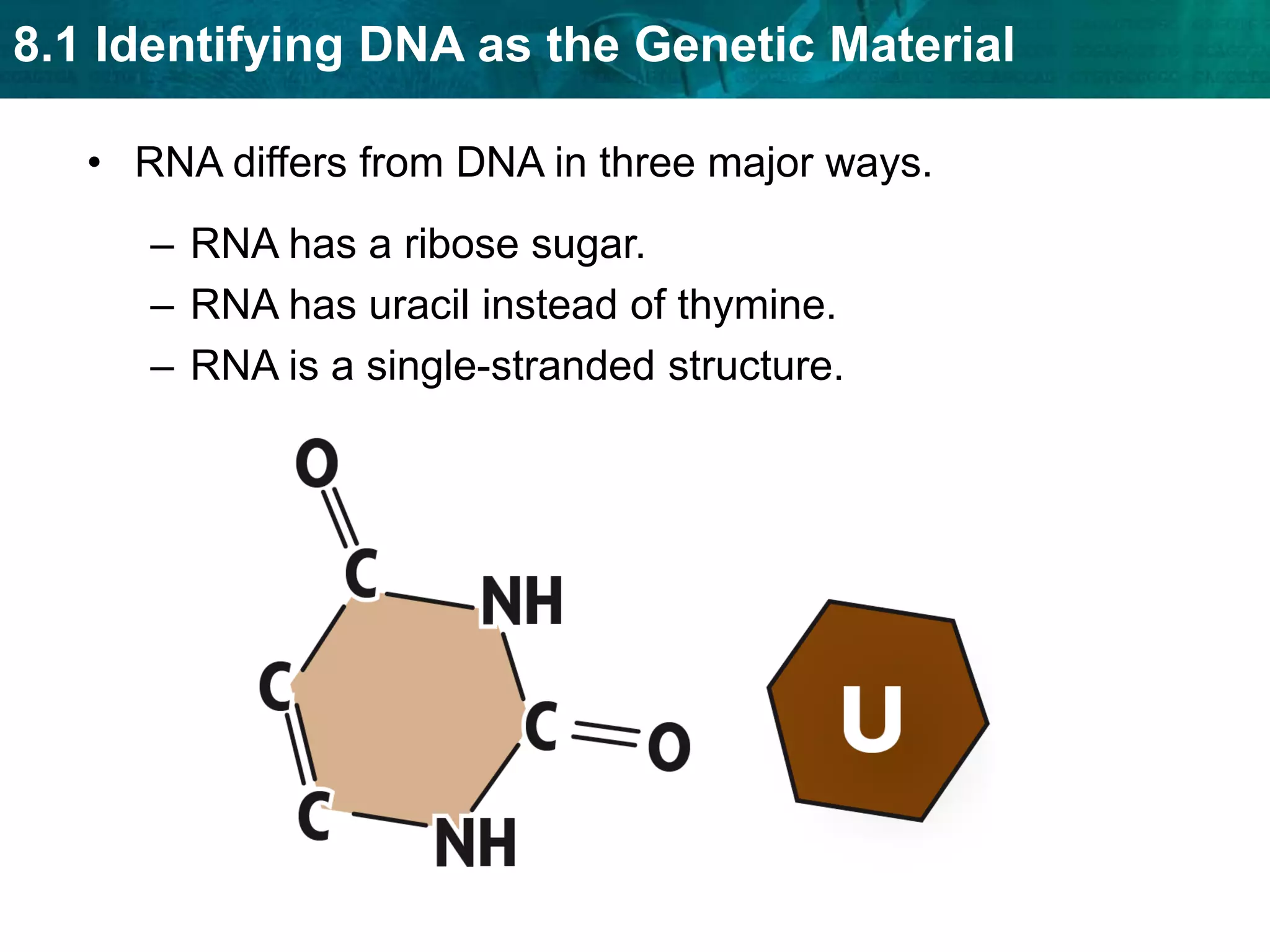
RNA is a link between DNA and proteins.RNA differs from DNA in three major ways.

Unit 8 Dna Replication And Transcription

  • 1.
    KEY CONCEPT DNAwas identified as the genetic material through a series of experiments.
  • 2.
    Griffith finds a‘transforming principle.’ Griffith experimented with the bacteria that cause pneumonia.He used two forms: the S form (deadly) and the R form (not deadly).A transforming material passed from dead S bacteria to live R bacteria, making them deadly.
  • 3.
    Avery identified DNAas the transforming principle. Avery isolated and purified Griffith’s transforming principle.Avery performed three tests on the transforming principle.Qualitative tests showed DNA was present.
  • 4.
    Chemical tests showedthechemical makeupmatched that of DNA.
  • 5.
    Enzyme tests showedonlyDNA-degradingenzymes stoppedtransformation.Hershey and Chase confirm that DNA is the genetic material. Hershey and Chase studied viruses that infect bacteria, or bacteriophages. They tagged viral DNA with radioactive phosphorus.
  • 6.
    They taggedviral proteins with radioactive sulfur.
  • 7.
    Tagged DNA wasfound inside the bacteria; tagged proteins were not.KEY CONCEPT DNA structure is the same in all organisms.
  • 8.
    phosphate groupnitrogen-containingbasedeoxyribose (sugar)DNAis composed of four types of nucleotides.DNA is made up of a long chain of nucleotides.Each nucleotide has three parts.a phosphate groupa deoxyribose sugara nitrogen-containing base
  • 9.
    The nitrogen containingbases are the only difference in the four nucleotides. Watson and Crick determined the three-dimensional structure of DNA by building models. They realized that DNA is a double helix that is made up of a sugar-phosphate backbone on the outside with bases on the inside.
  • 10.
    Watson and Crick’sdiscovery built on the work of Rosalind Franklin and Erwin Chargaff.
  • 11.
    Franklin’s x-ray imagessuggested that DNA was a double helix of even width.
  • 12.
    Chargaff’s rules statedthat A=T and C=G.GCATNucleotides always pair in the same way. The base-pairing rules show how nucleotides always pair up in DNA. A pairs with T
  • 13.
    C pairswith G
  • 14.
    Because a pyrimidine(single ring) pairs with a purine (double ring), the helix has a uniform width.covalent bondhydrogen bondThe backbone is connected by covalent bonds.
  • 15.
    The bases areconnected by hydrogen bonds.KEY CONCEPT DNA replication copies the genetic information of a cell.
  • 16.
    Replication copies thegenetic information. A single strand of DNA serves as a template for a new strand.The rules of base pairing directreplication.DNA is replicated during theS (synthesis) stage of thecell cycle.Each body cell gets acomplete set ofidentical DNA.
  • 17.
    nucleotideThe DNA moleculeunzips in both directions.Proteins carry out the process of replication. DNA serves only as a template. Enzymes and other proteins do the actual work of replication.Enzymes unzip the double helix.Free-floating nucleotides form hydrogen bonds with the template strand.
  • 18.
    nucleotidenew strandDNA polymeraseDNApolymerase enzymes bond the nucleotides together to form the double helix.
  • 19.
    Polymerase enzymes formcovalent bonds between nucleotides in the new strand.new strandoriginal strandTwo molecules of DNATwo new molecules of DNA are formed, each with an original strand and a newly formed strand.
  • 20.
    DNA replication issemiconservative. There are many origins of replication in eukaryotic chromosomes.Replication is fast and accurate.DNA replication starts at many points in eukaryotic chromosomes.
  • 21.
    DNA polymerases canfind and correct errors.KEY CONCEPT Transcription converts a gene into a single-stranded RNA molecule.
  • 22.
    RNA carries DNA’sinstructions. The central dogma states that information flows in one direction from DNA to RNA to proteins.
  • 23.
  • 24.
  • 25.
  • 26.
  • 27.
    RNA is alink between DNA and proteins.RNA differs from DNA in three major ways.
  • 28.
    RNA has aribose sugar.
  • 29.
    RNA has uracilinstead of thymine.
  • 30.
    RNA is asingle-stranded structure.Transcription makes three types of RNA. Transcription copies DNA to make a strand of RNA.
  • 31.
  • 32.
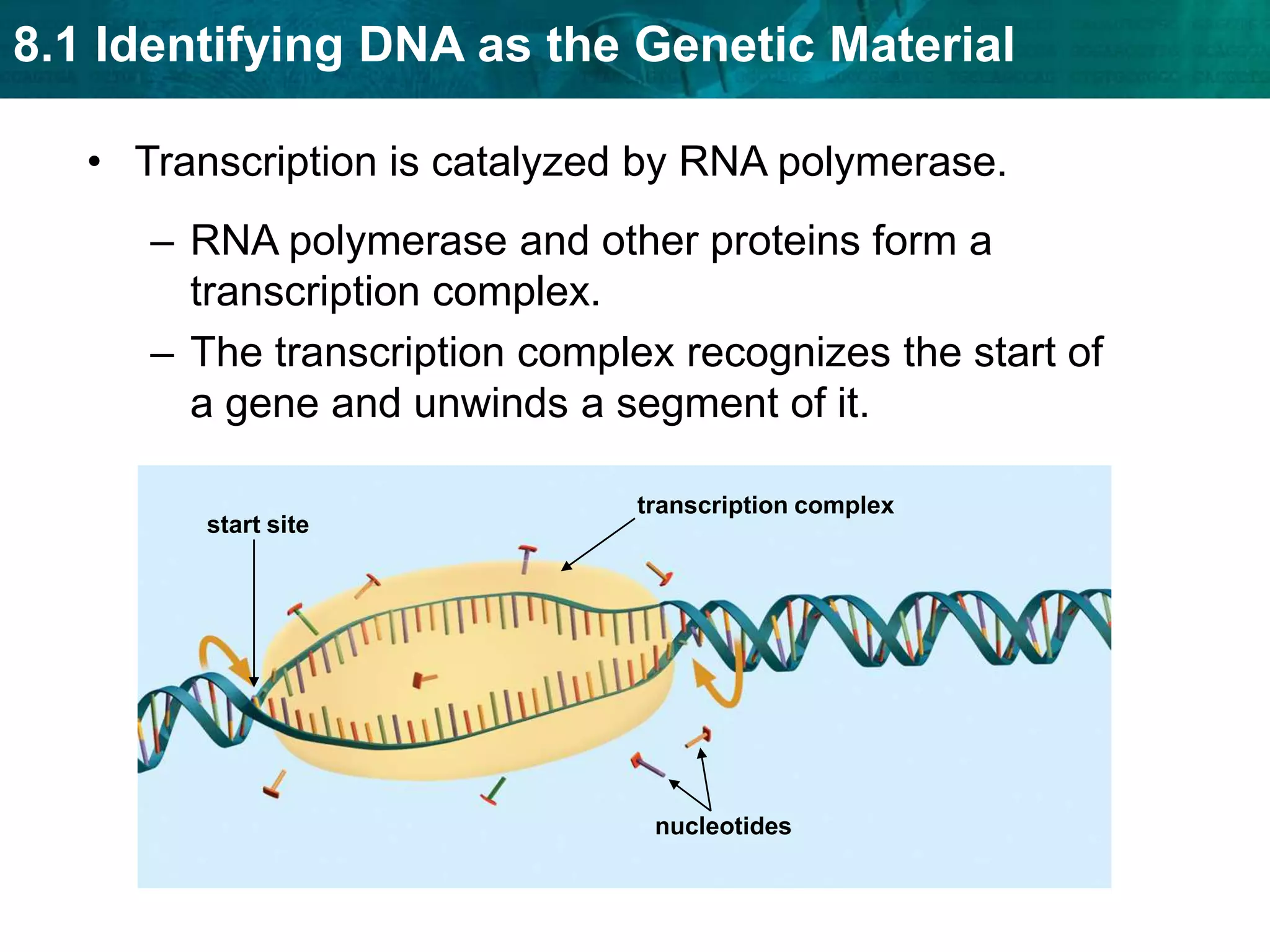
    RNA polymerase andother proteins form a transcription complex.
  • 33.
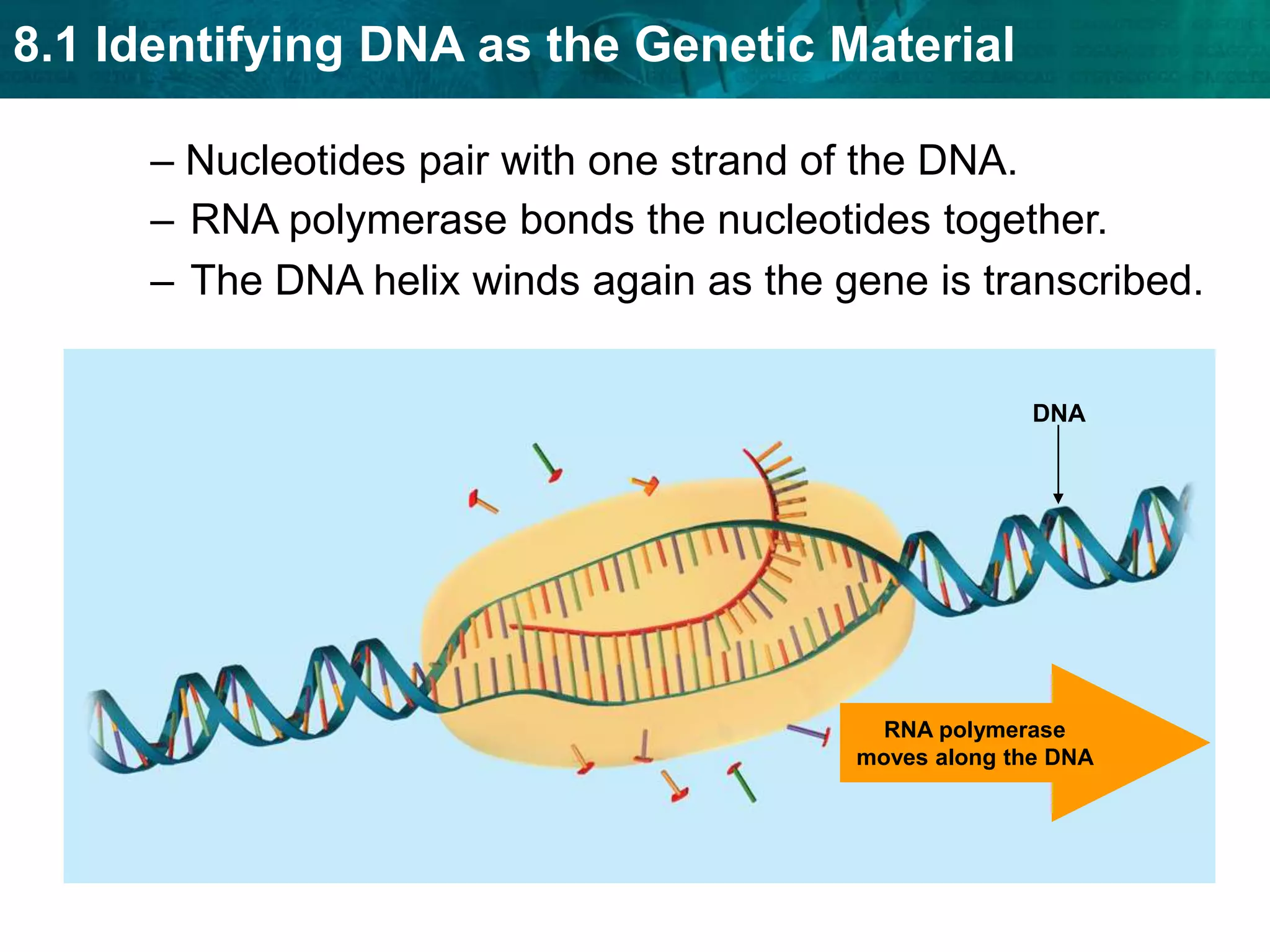
    The transcription complexrecognizes the start of a gene and unwinds a segment of it.DNARNA polymerase moves along the DNA Nucleotides pair with one strand of the DNA.
  • 34.
    RNA polymerase bondsthe nucleotides together.
  • 35.
    The DNA helixwinds again as the gene is transcribed.RNA The RNA strand detaches from the DNA once the gene is transcribed.Transcription makes three types of RNA.
  • 36.
    Messenger RNA (mRNA)carries the message that will be translated to form a protein.
  • 37.
    Ribosomal RNA (rRNA)forms part of ribosomes where proteins are made.
  • 38.
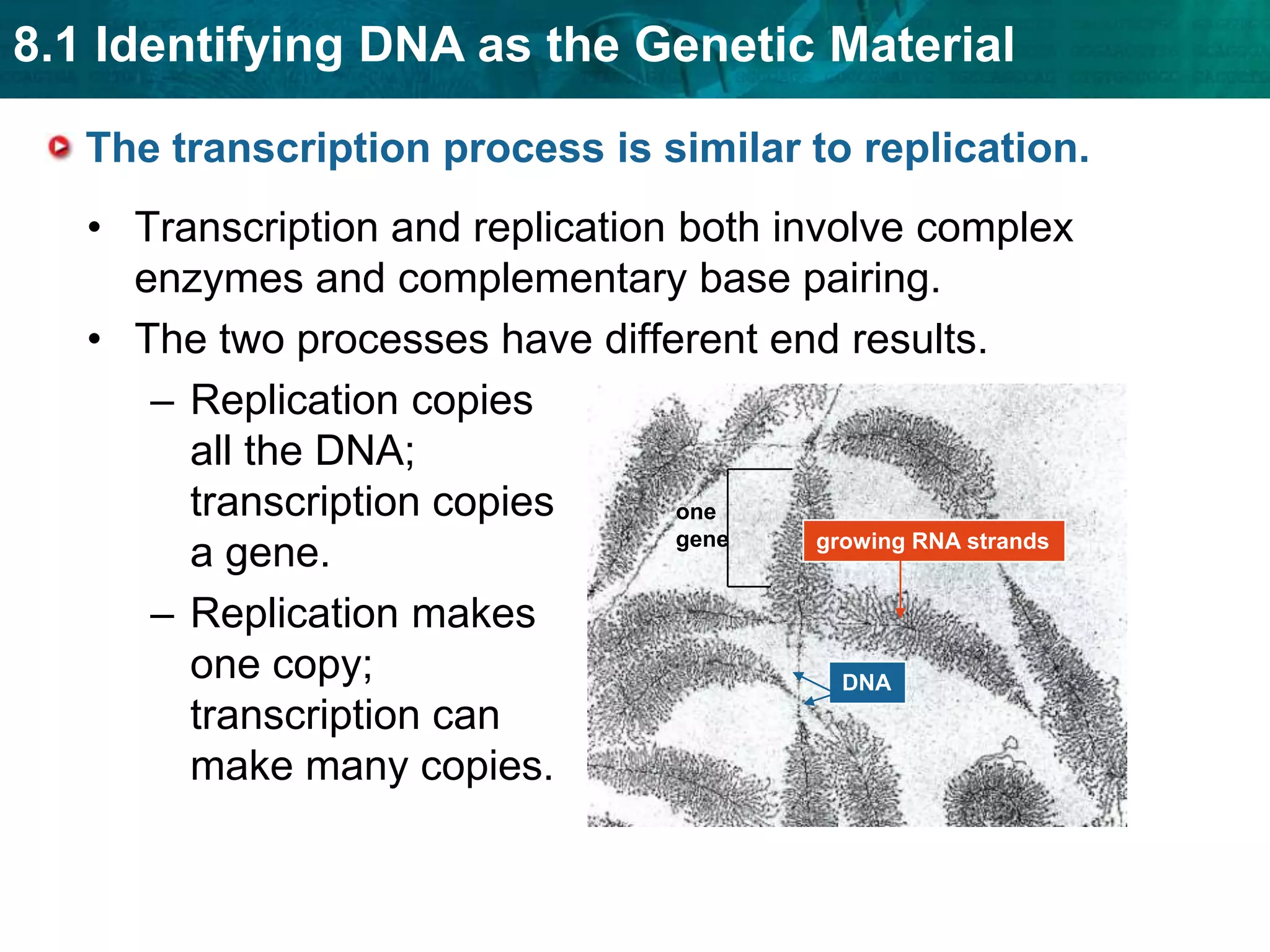
    Transfer RNA (tRNA)brings amino acids from the cytoplasm to a ribosome.onegenegrowing RNA strandsDNAThe transcription process is similar to replication. Transcription and replication both involve complex enzymes and complementary base pairing.The two processes have different end results.Replication copiesall the DNA;transcription copiesa gene.Replication makesone copy;transcription canmake many copies.