5.1 The Cell Cycle

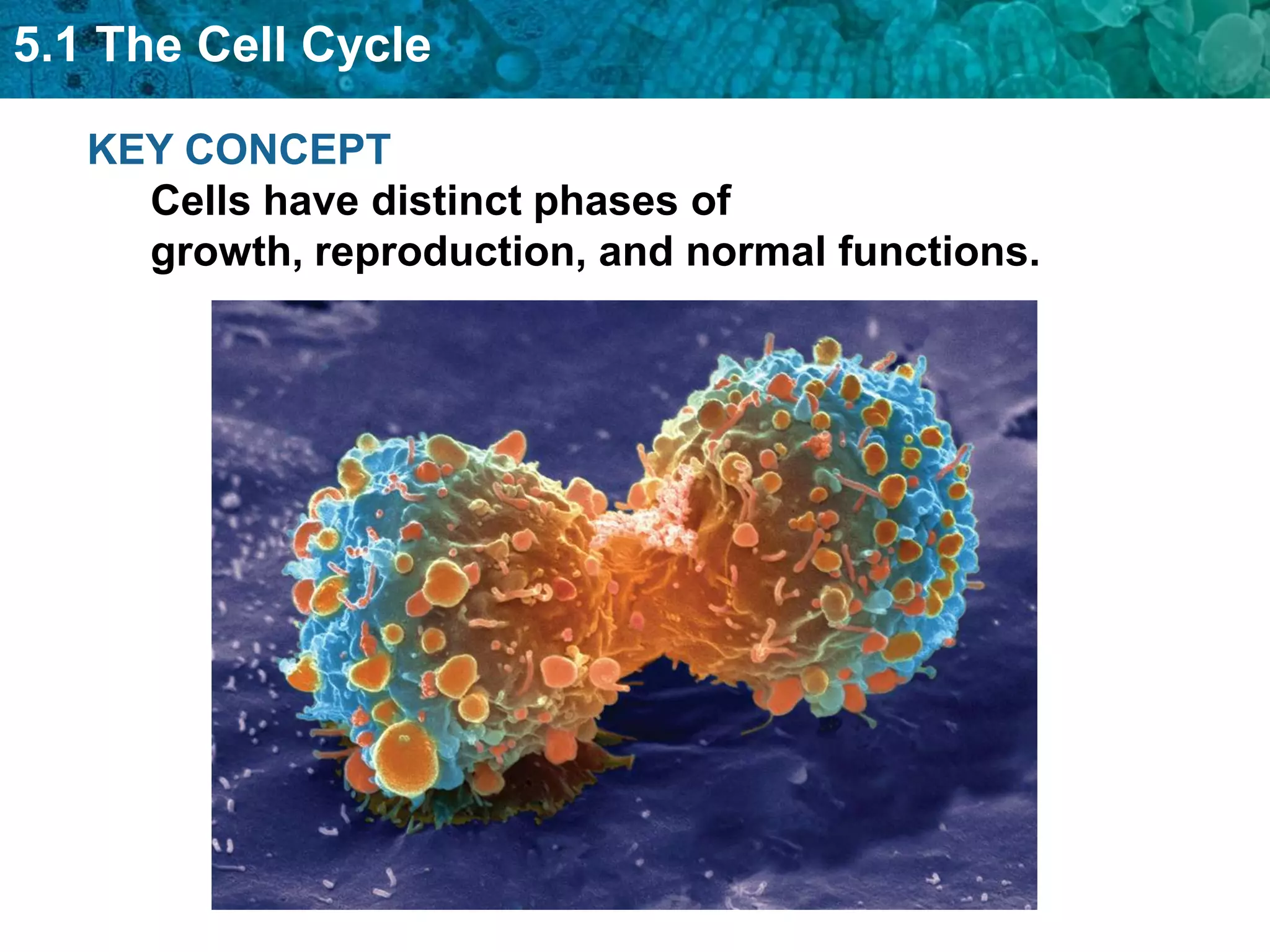
   KEY CONCEPT
     Cells have distinct phases of
     growth, reproduction, and normal functions.
5.1 The Cell Cycle

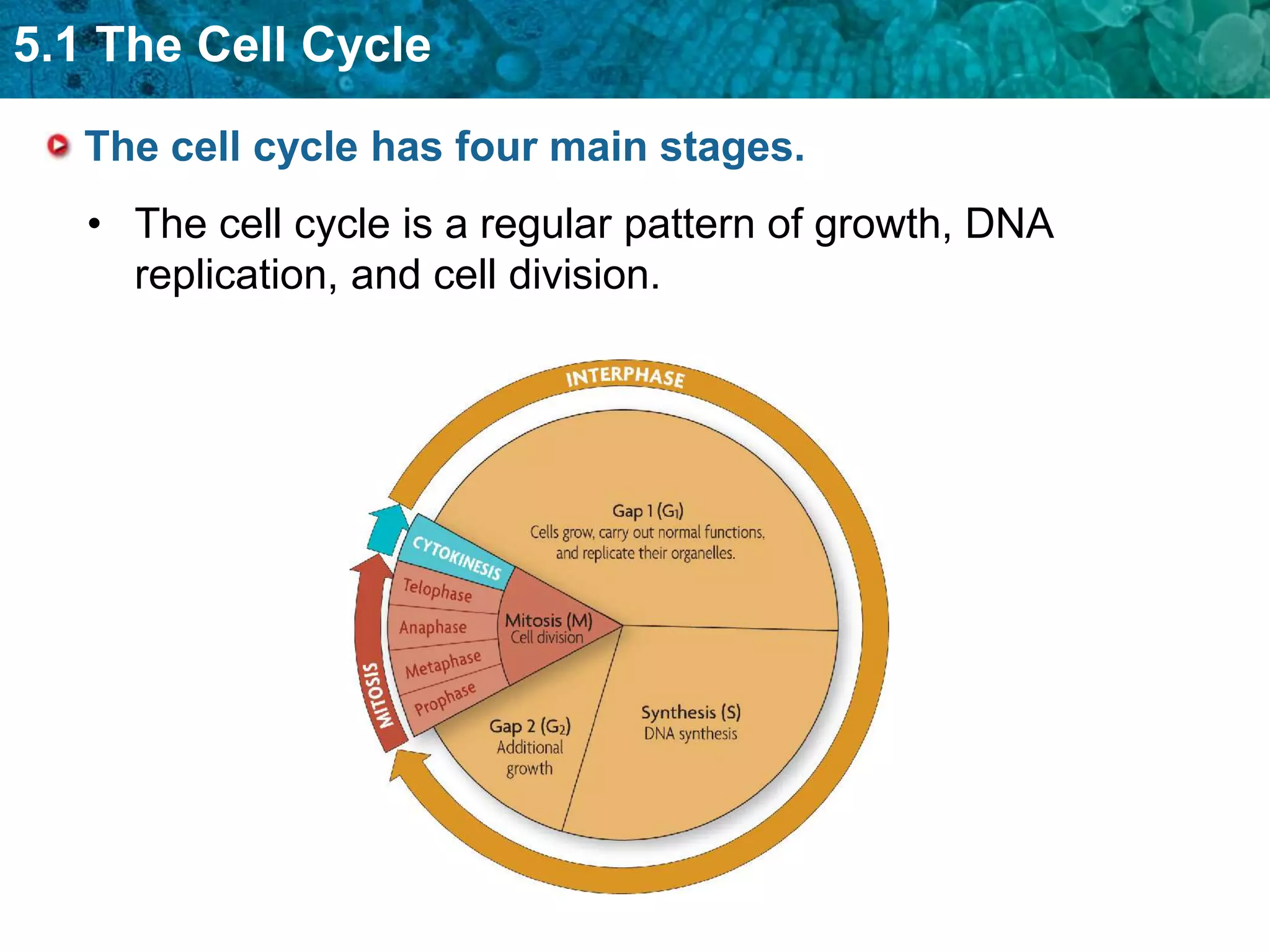
   The cell cycle has four main stages.
   • The cell cycle is a regular pattern of growth, DNA
     replication, and cell division.
5.1 The Cell Cycle

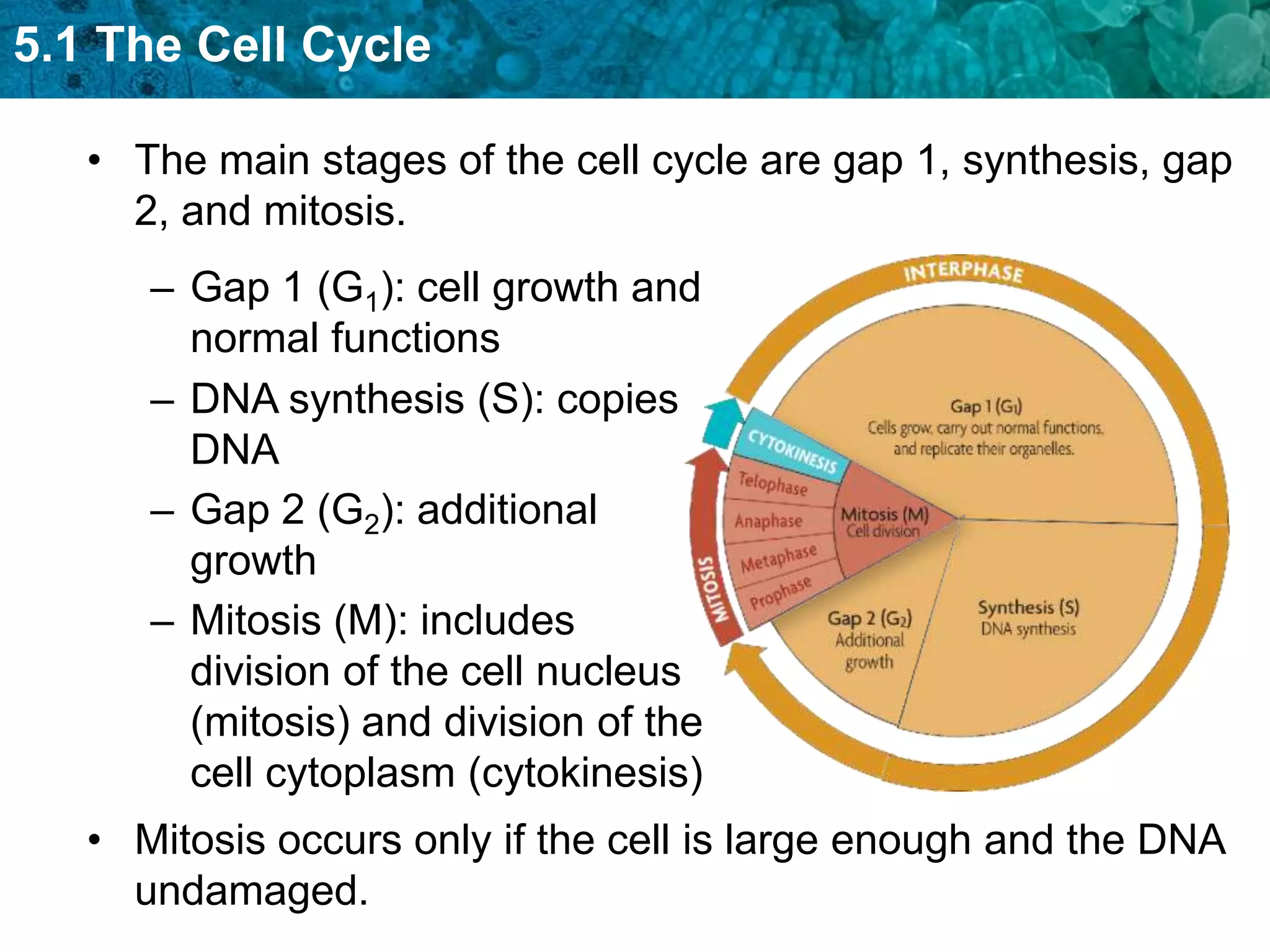
   • The main stages of the cell cycle are gap 1, synthesis, gap
     2, and mitosis.
      – Gap 1 (G1): cell growth and
        normal functions
      – DNA synthesis (S): copies
        DNA
      – Gap 2 (G2): additional
        growth
      – Mitosis (M): includes
        division of the cell nucleus
        (mitosis) and division of the
        cell cytoplasm (cytokinesis)
   • Mitosis occurs only if the cell is large enough and the DNA
     undamaged.
5.1 The Cell Cycle

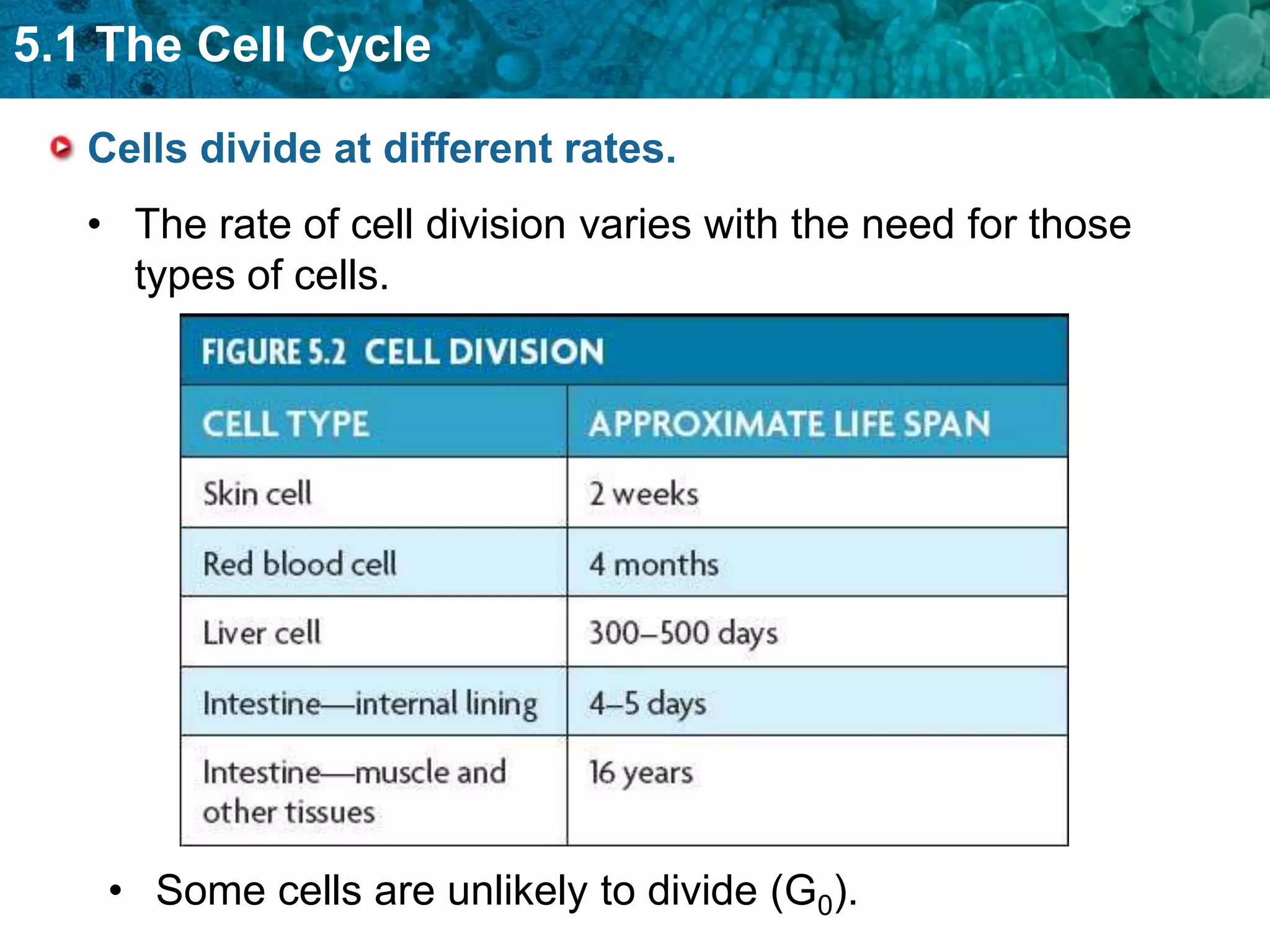
   Cells divide at different rates.
   • The rate of cell division varies with the need for those
     types of cells.


    • Some cells are unlikely to divide (G0).
5.1 The Cell Cycle

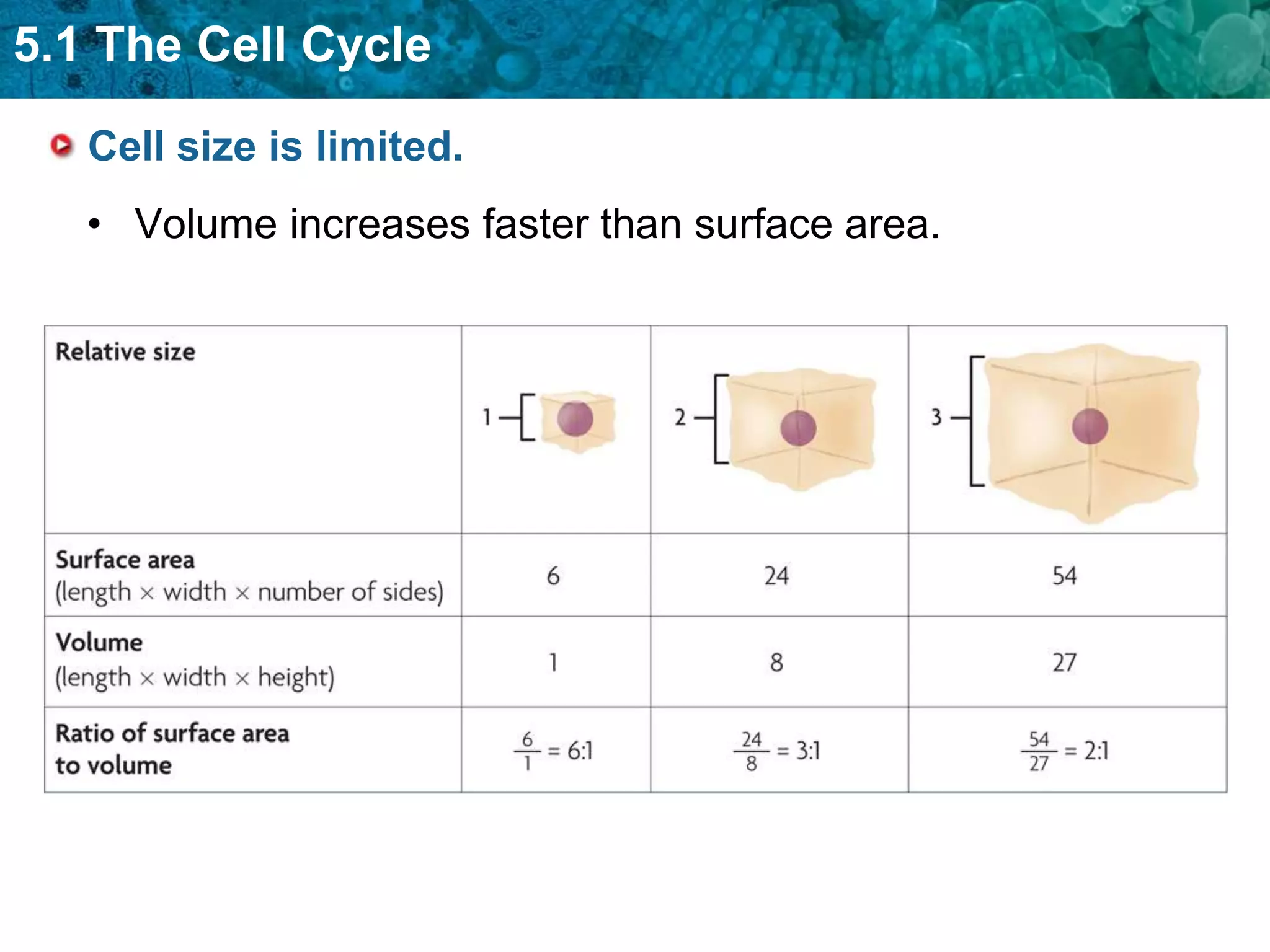
   Cell size is limited.
   • Volume increases faster than surface area.
5.1 The Cell Cycle

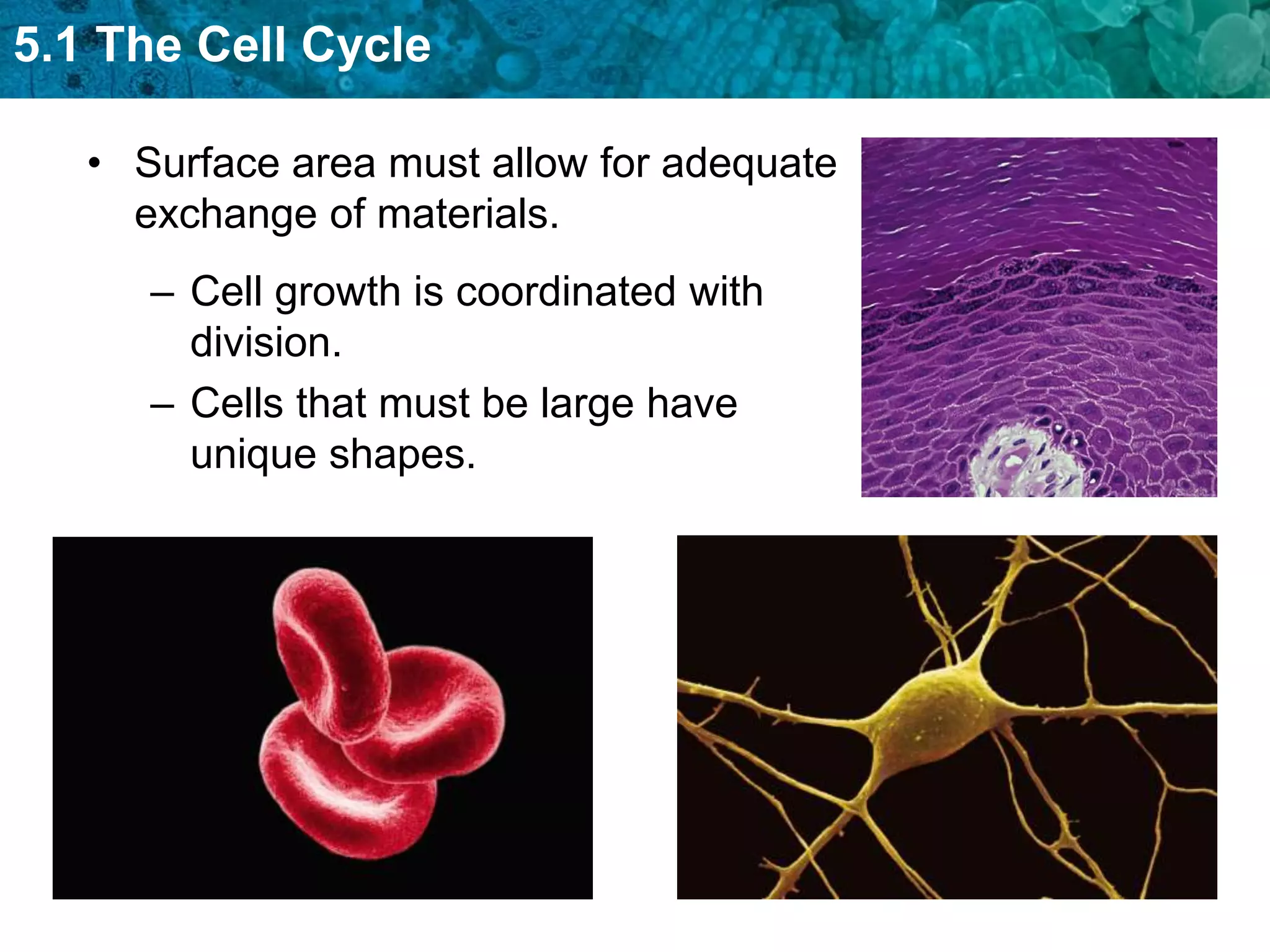
   • Surface area must allow for adequate
     exchange of materials.
      – Cell growth is coordinated with
        division.
      – Cells that must be large have
        unique shapes.
5.1 The Cell Cycle

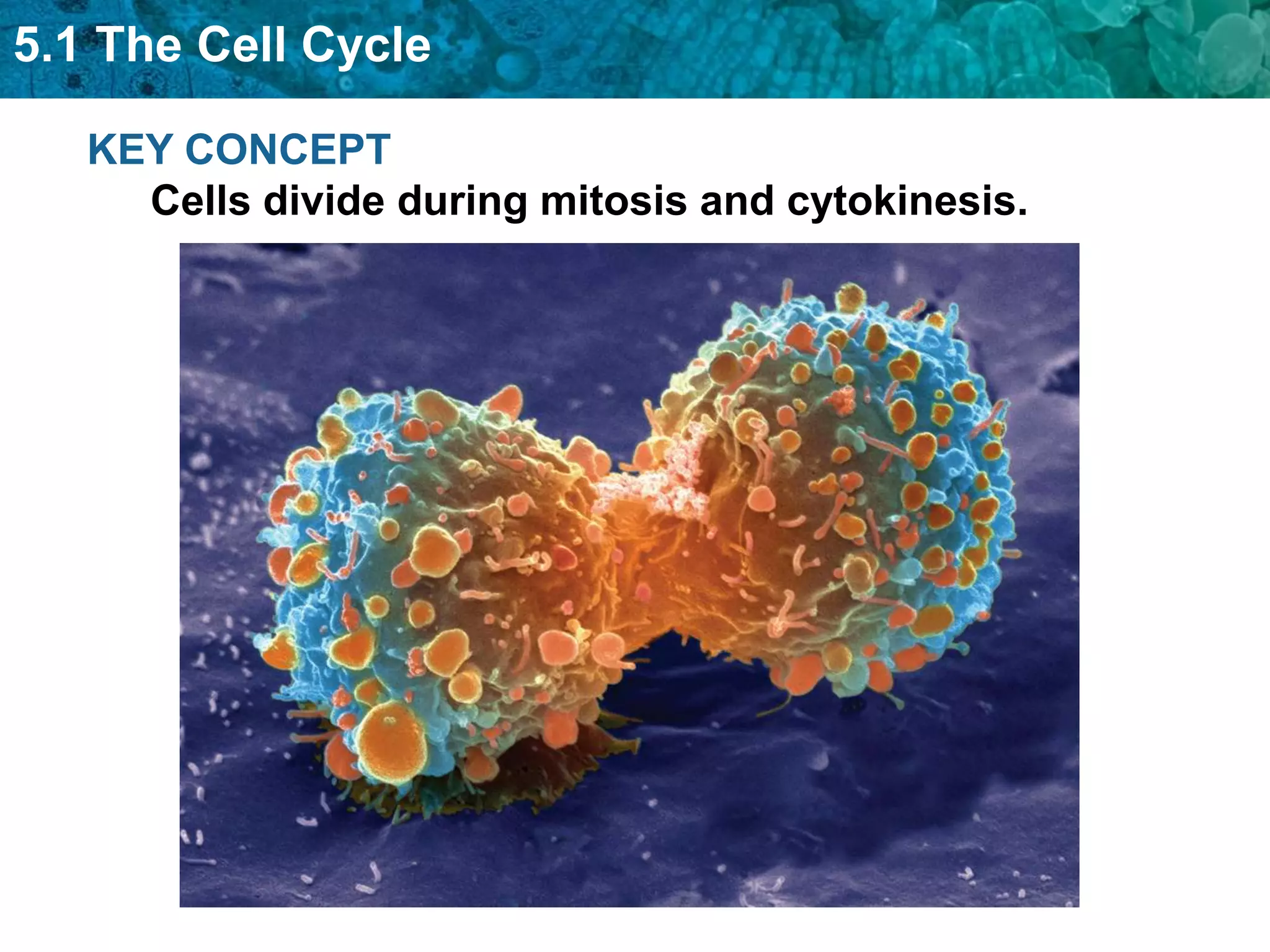
   KEY CONCEPT
     Cells divide during mitosis and cytokinesis.
5.1 The Cell Cycle

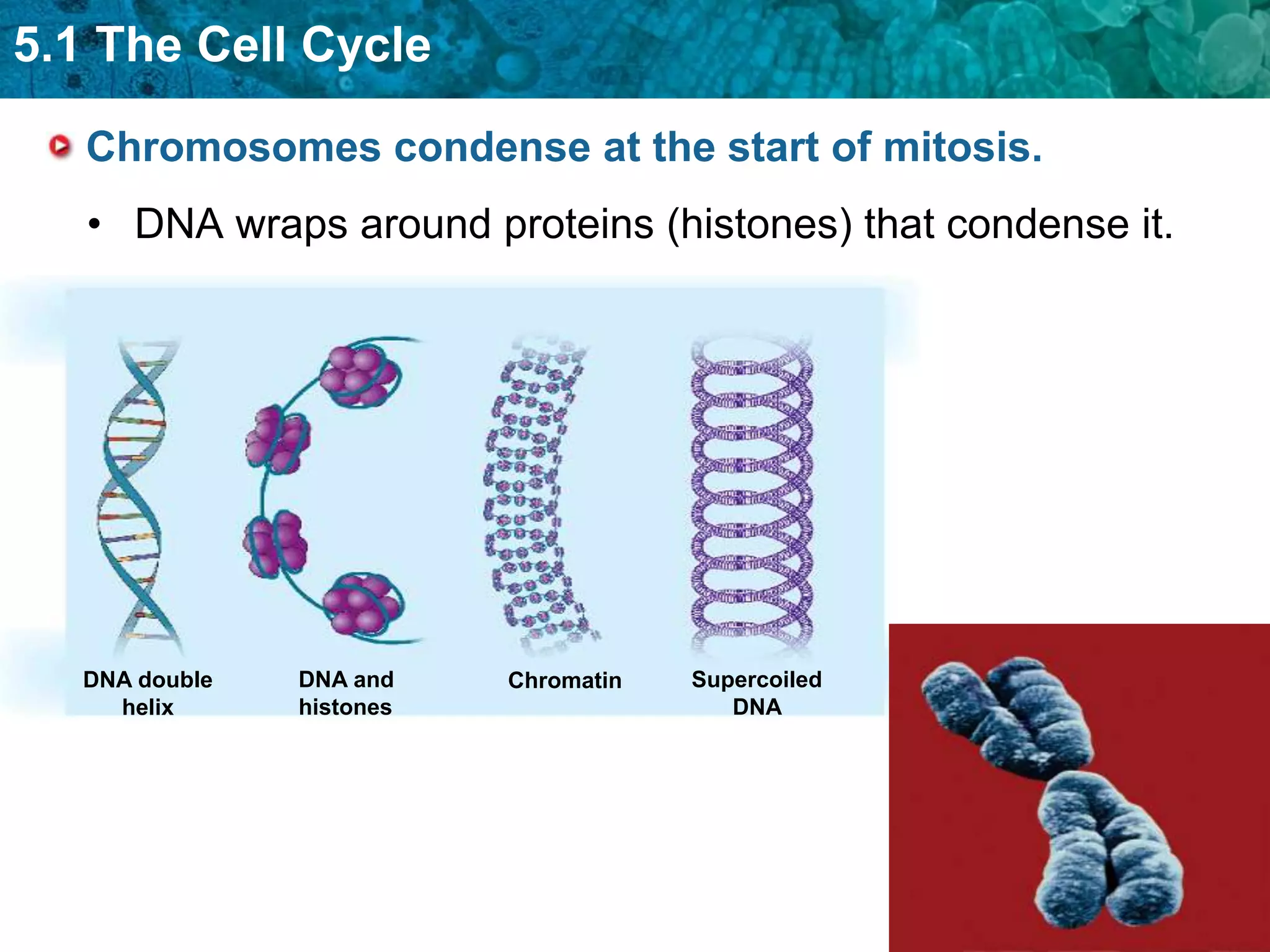
   Chromosomes condense at the start of mitosis.
   • DNA wraps around proteins (histones) that condense it.


   DNA double   DNA and    Chromatin   Supercoiled
     helix      histones                  DNA
5.1 The Cell Cycle

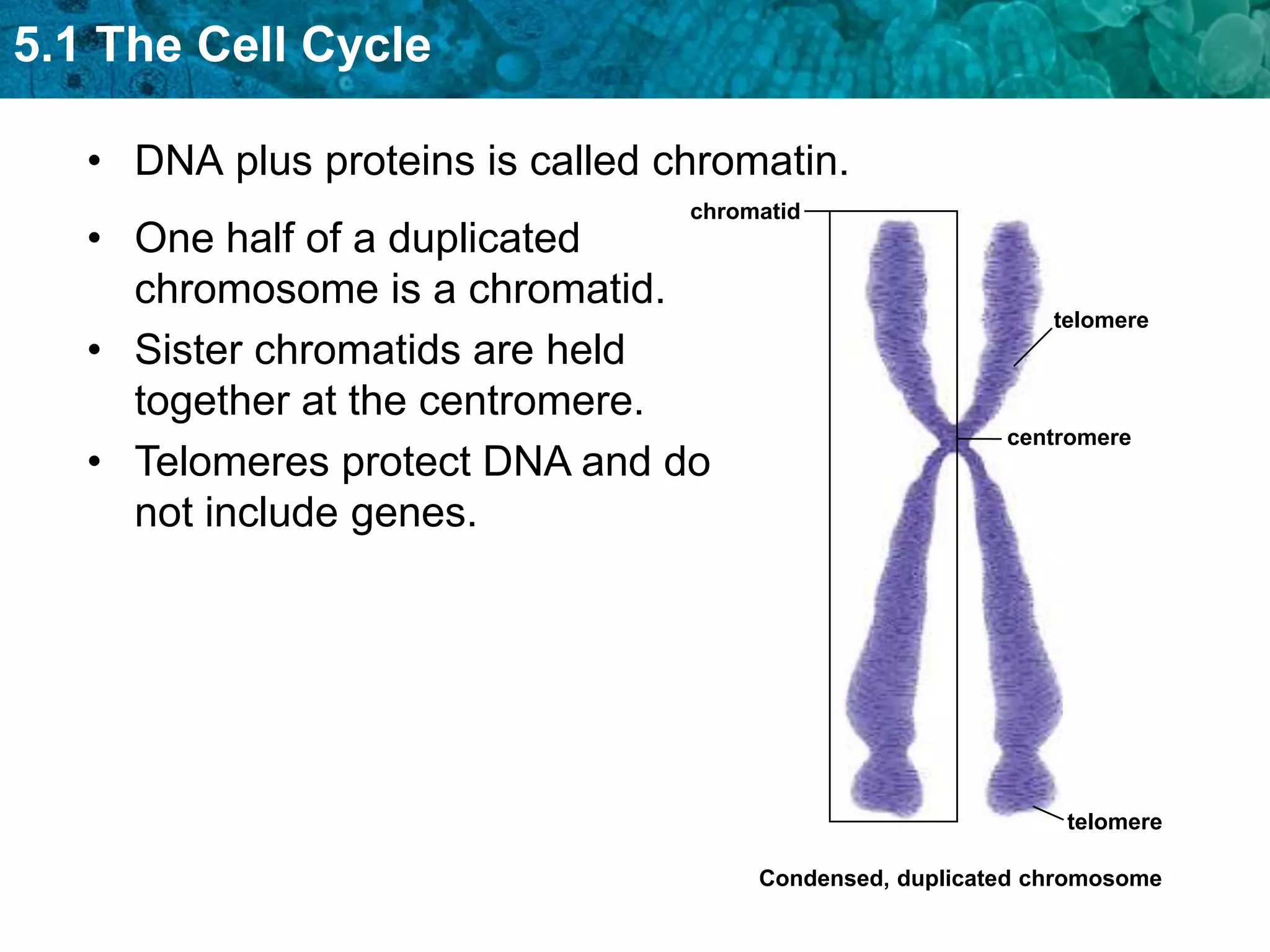
   • DNA plus proteins is called chromatin.
                                  chromatid
   • One half of a duplicated
     chromosome is a chromatid.
                                                              telomere
   • Sister chromatids are held
     together at the centromere.
                                                          centromere
   • Telomeres protect DNA and do
     not include genes.


                                                               telomere

                                       Condensed, duplicated chromosome
5.1 The Cell Cycle

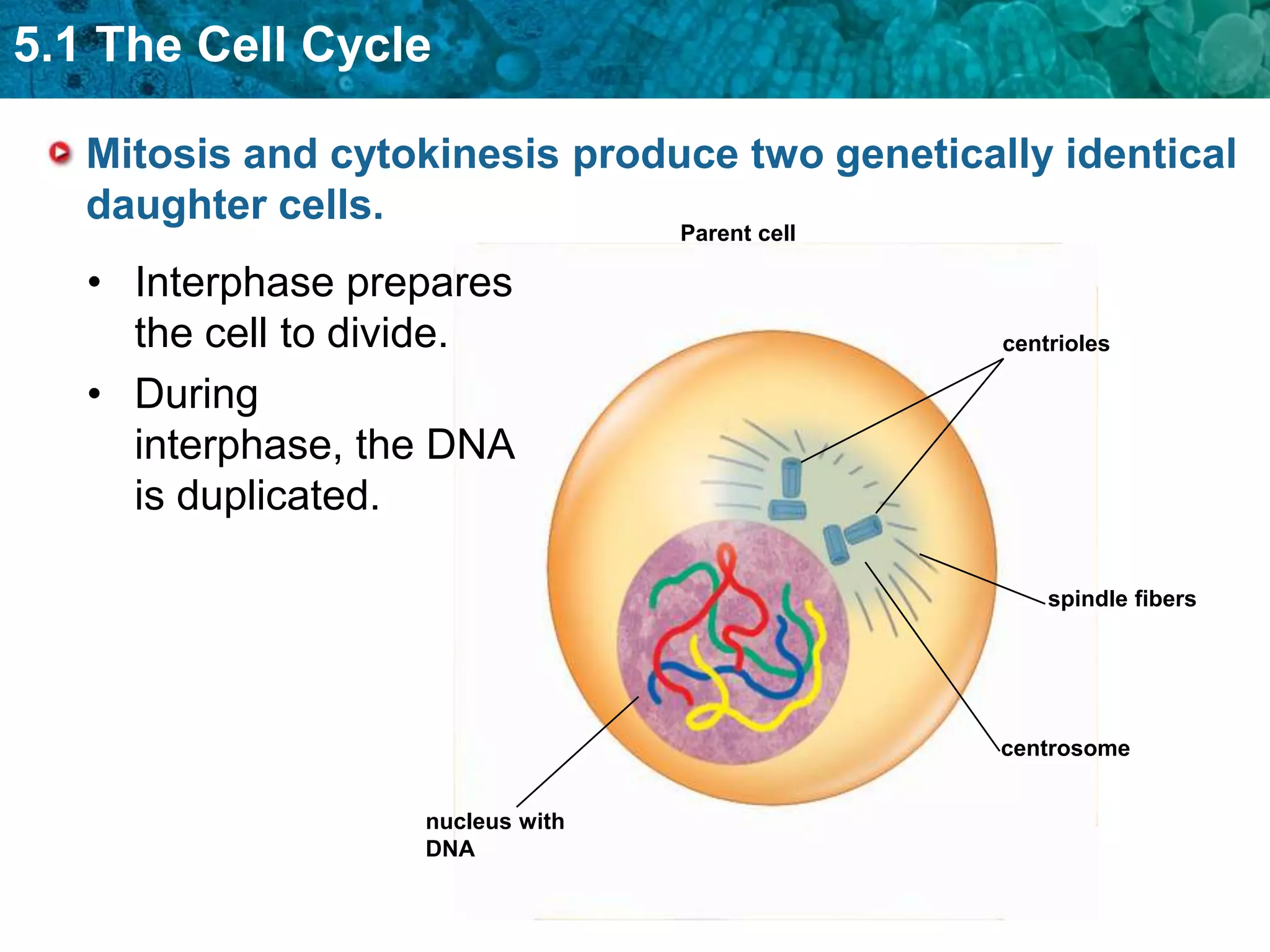
   Mitosis and cytokinesis produce two genetically identical
   daughter cells.
                                  Parent cell

   • Interphase prepares
     the cell to divide.                        centrioles

   • During
     interphase, the DNA
     is duplicated.

                                                    spindle fibers


                                                centrosome


                   nucleus with
                   DNA
5.1 The Cell Cycle

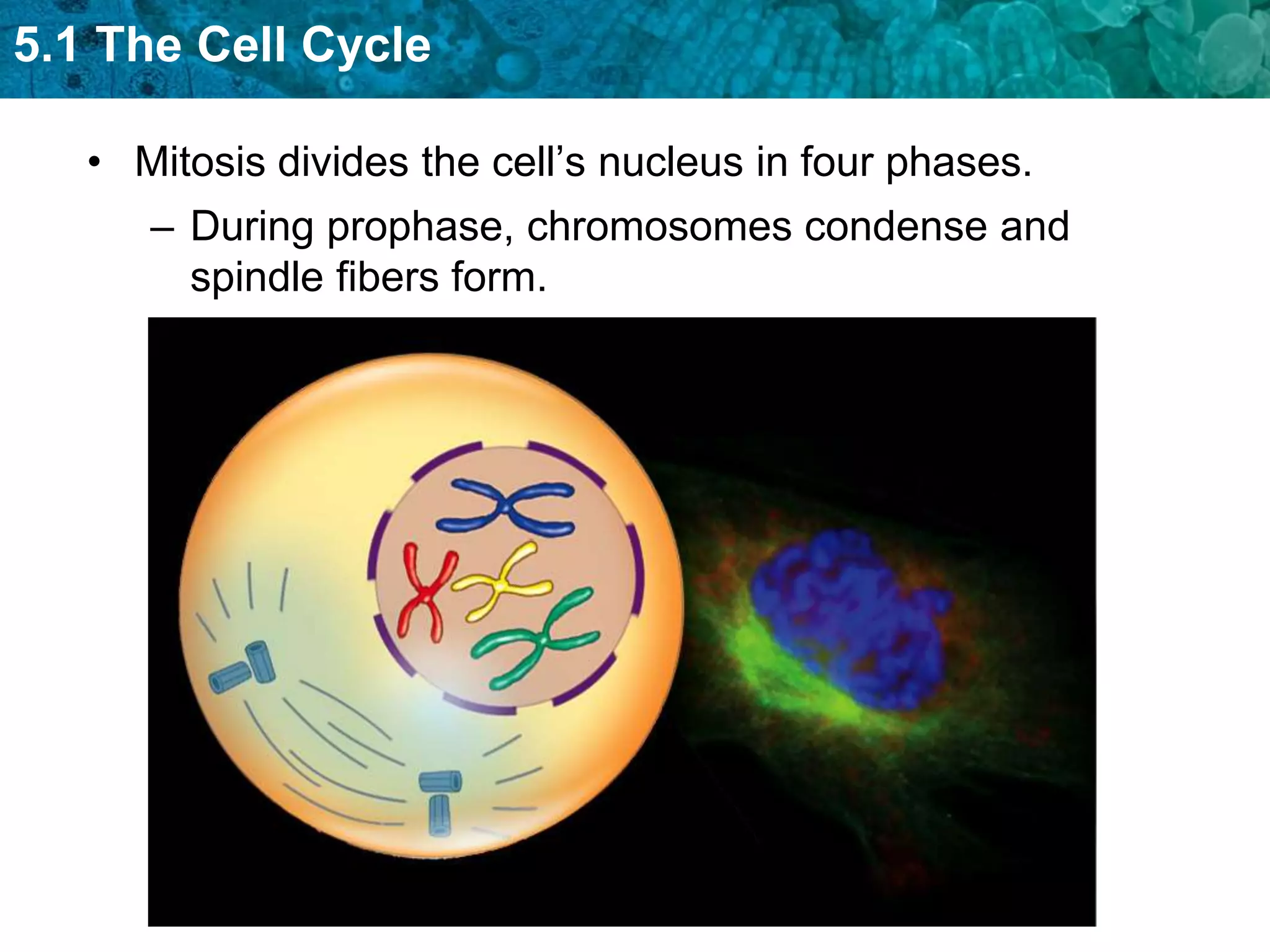
   • Mitosis divides the cell’s nucleus in four phases.
      – During prophase, chromosomes condense and
        spindle fibers form.
5.1 The Cell Cycle

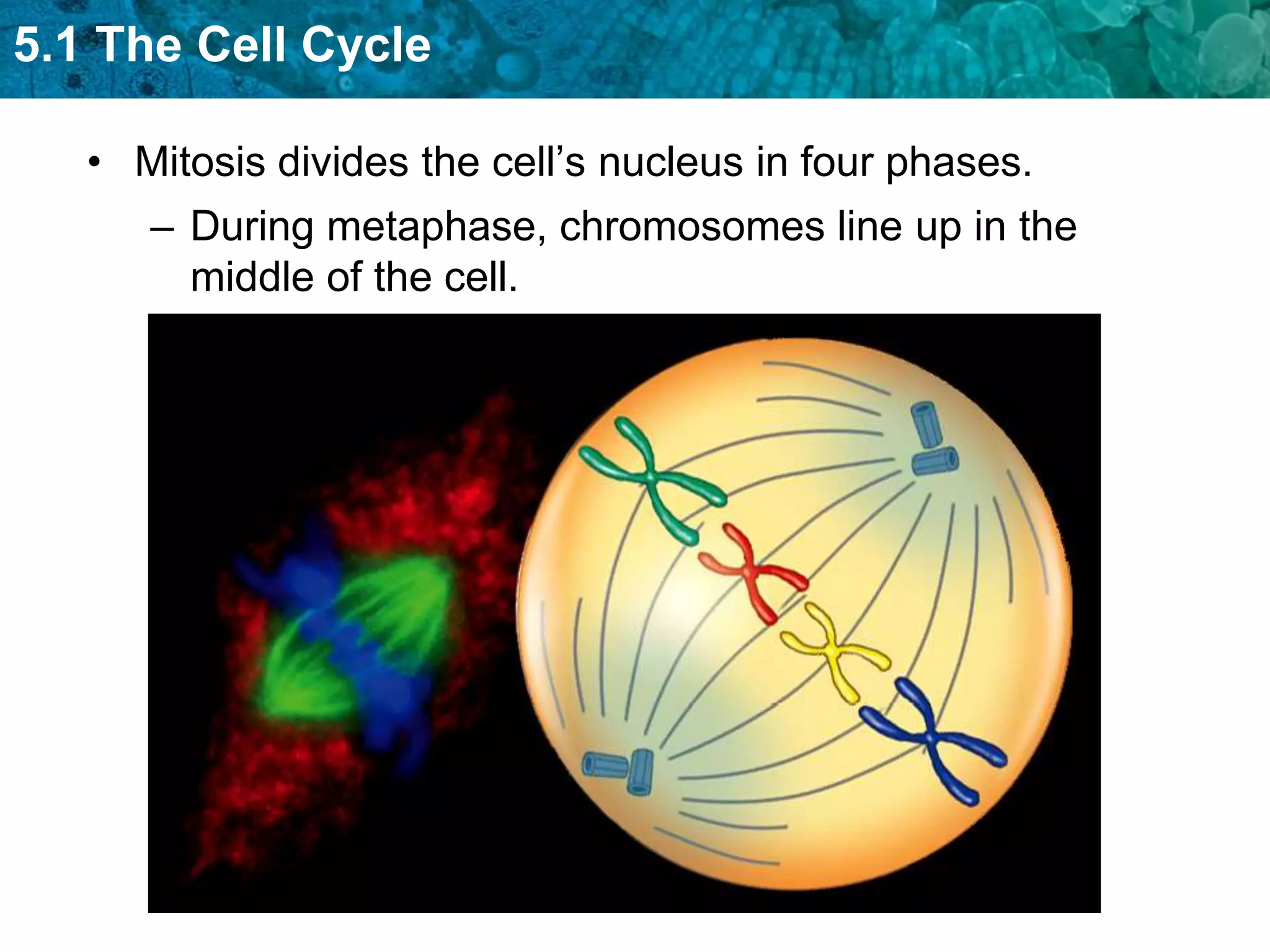
   • Mitosis divides the cell’s nucleus in four phases.
      – During metaphase, chromosomes line up in the
        middle of the cell.
5.1 The Cell Cycle

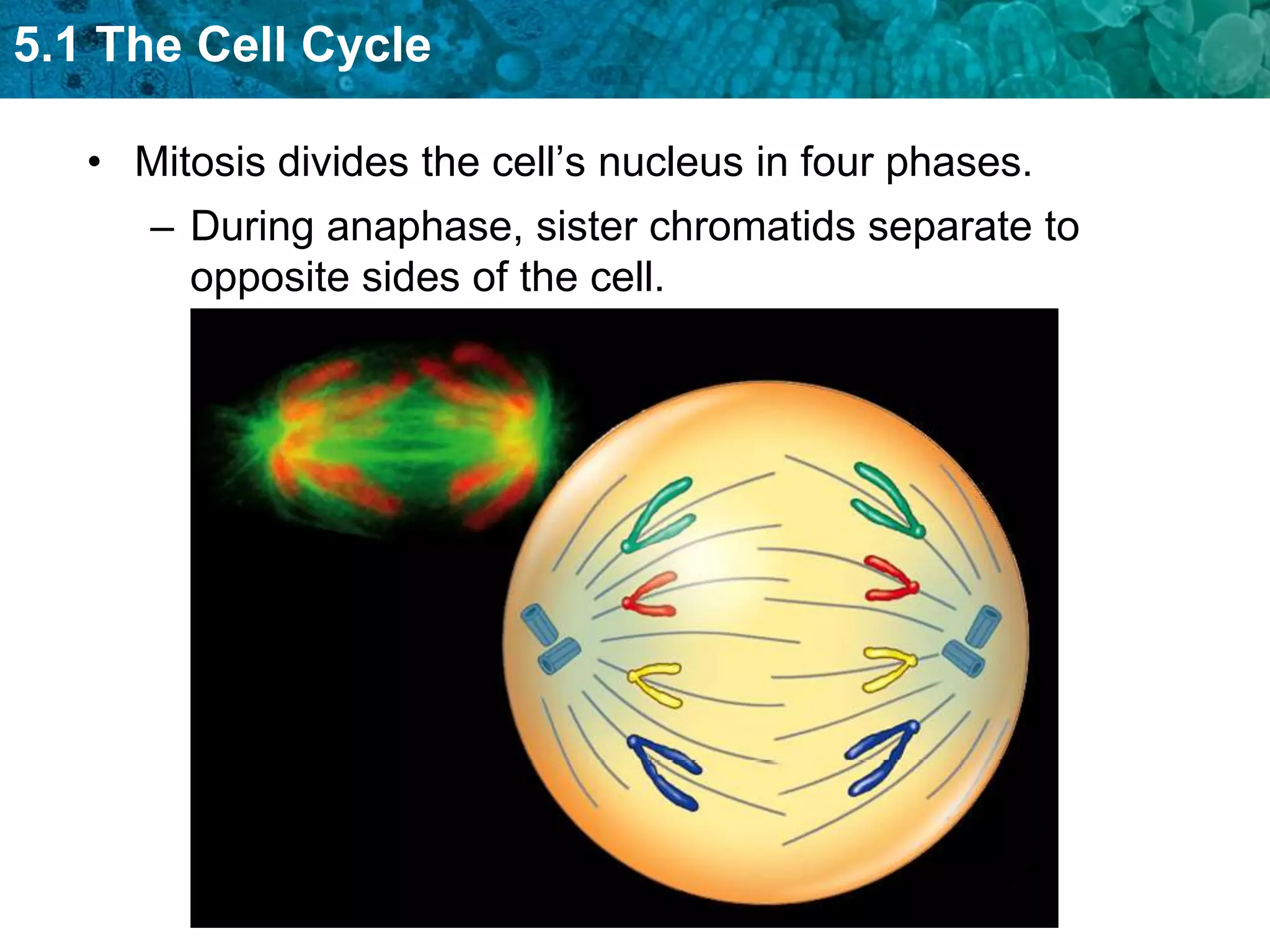
   • Mitosis divides the cell’s nucleus in four phases.
      – During anaphase, sister chromatids separate to
        opposite sides of the cell.
5.1 The Cell Cycle

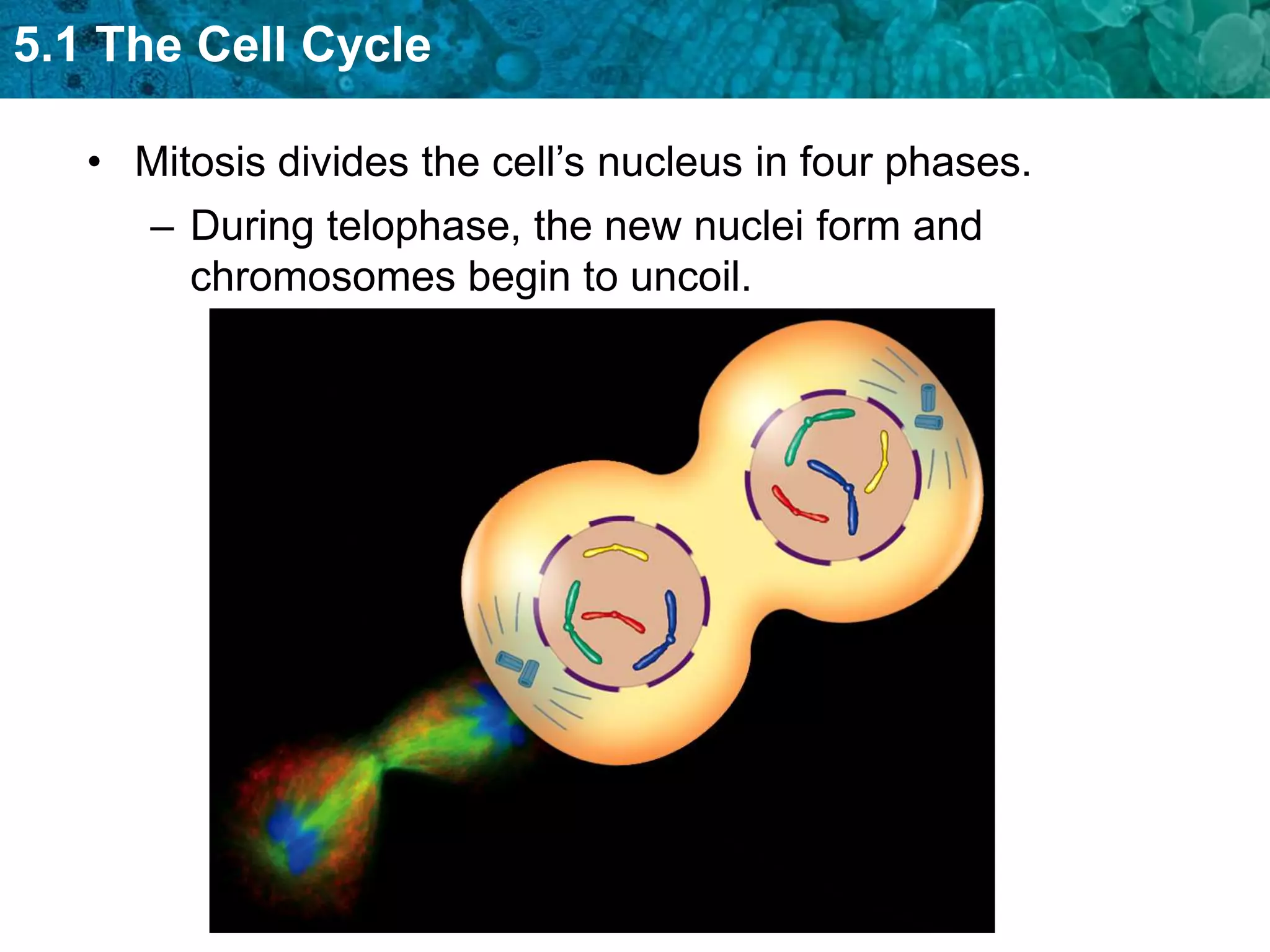
   • Mitosis divides the cell’s nucleus in four phases.
      – During telophase, the new nuclei form and
        chromosomes begin to uncoil.
5.1 The Cell Cycle

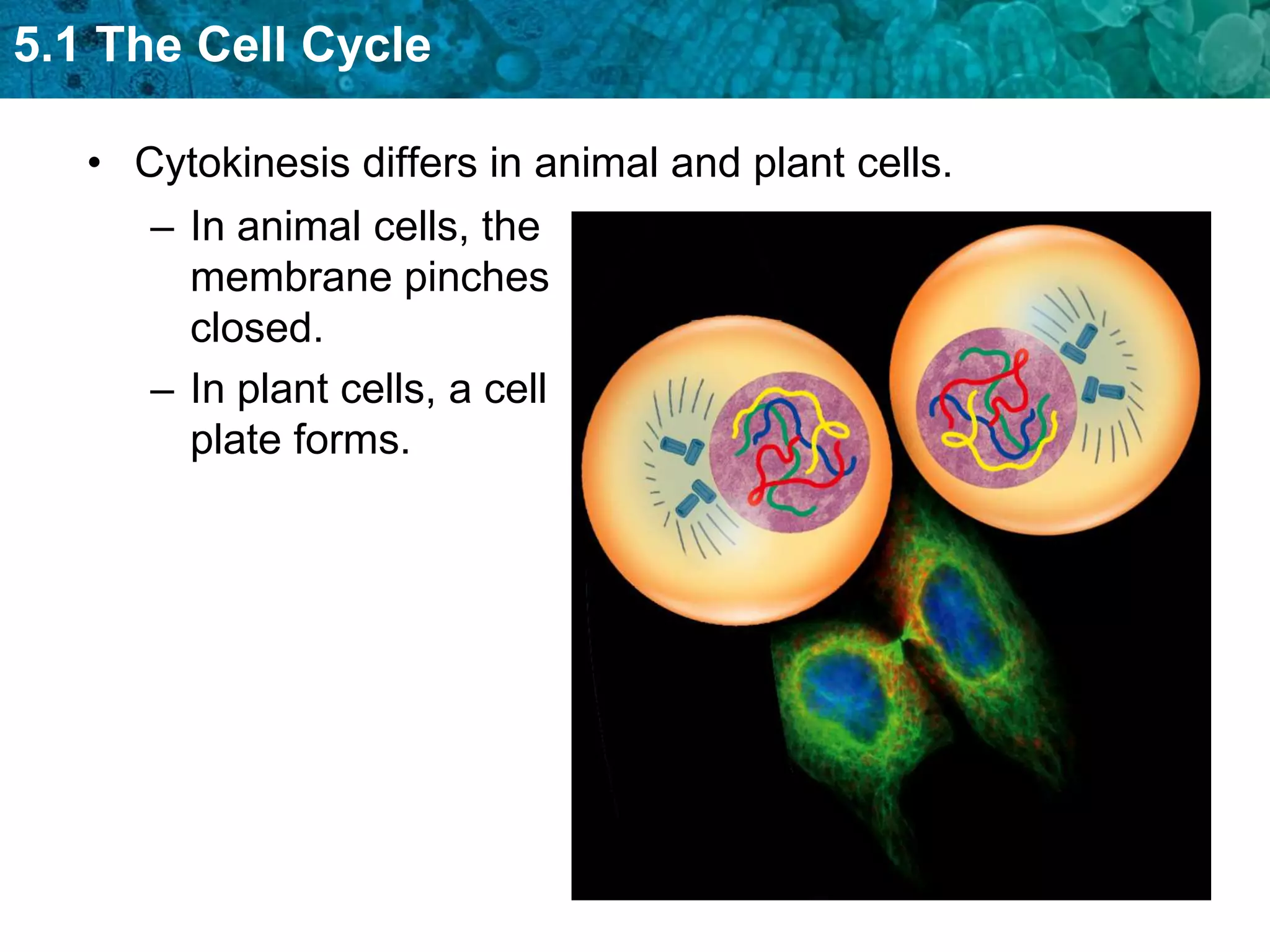
   • Cytokinesis differs in animal and plant cells.
      – In animal cells, the
        membrane pinches
        closed.
      – In plant cells, a cell
        plate forms.
5.1 The Cell Cycle

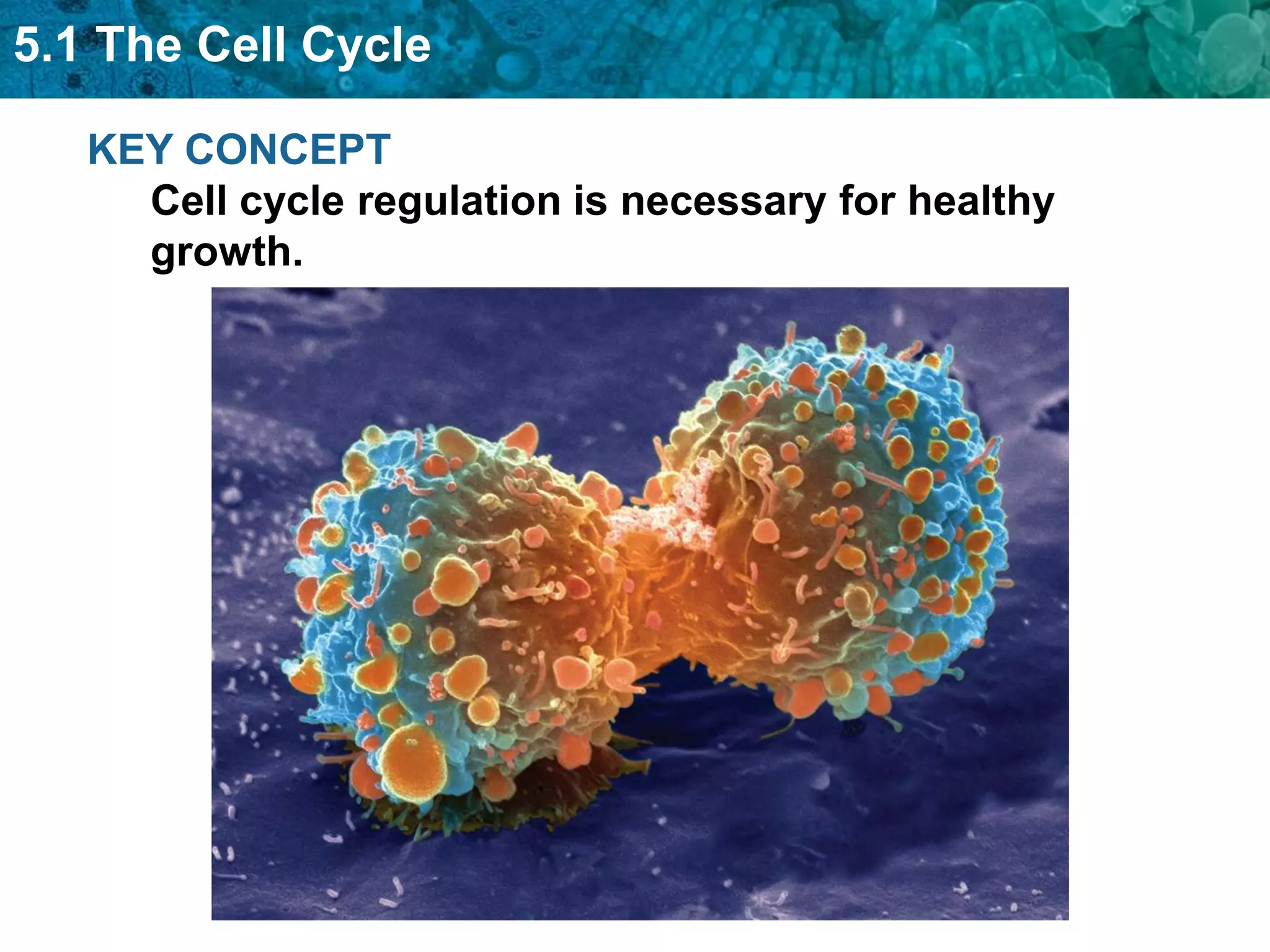
   KEY CONCEPT
     Cell cycle regulation is necessary for healthy
     growth.
5.1 The Cell Cycle

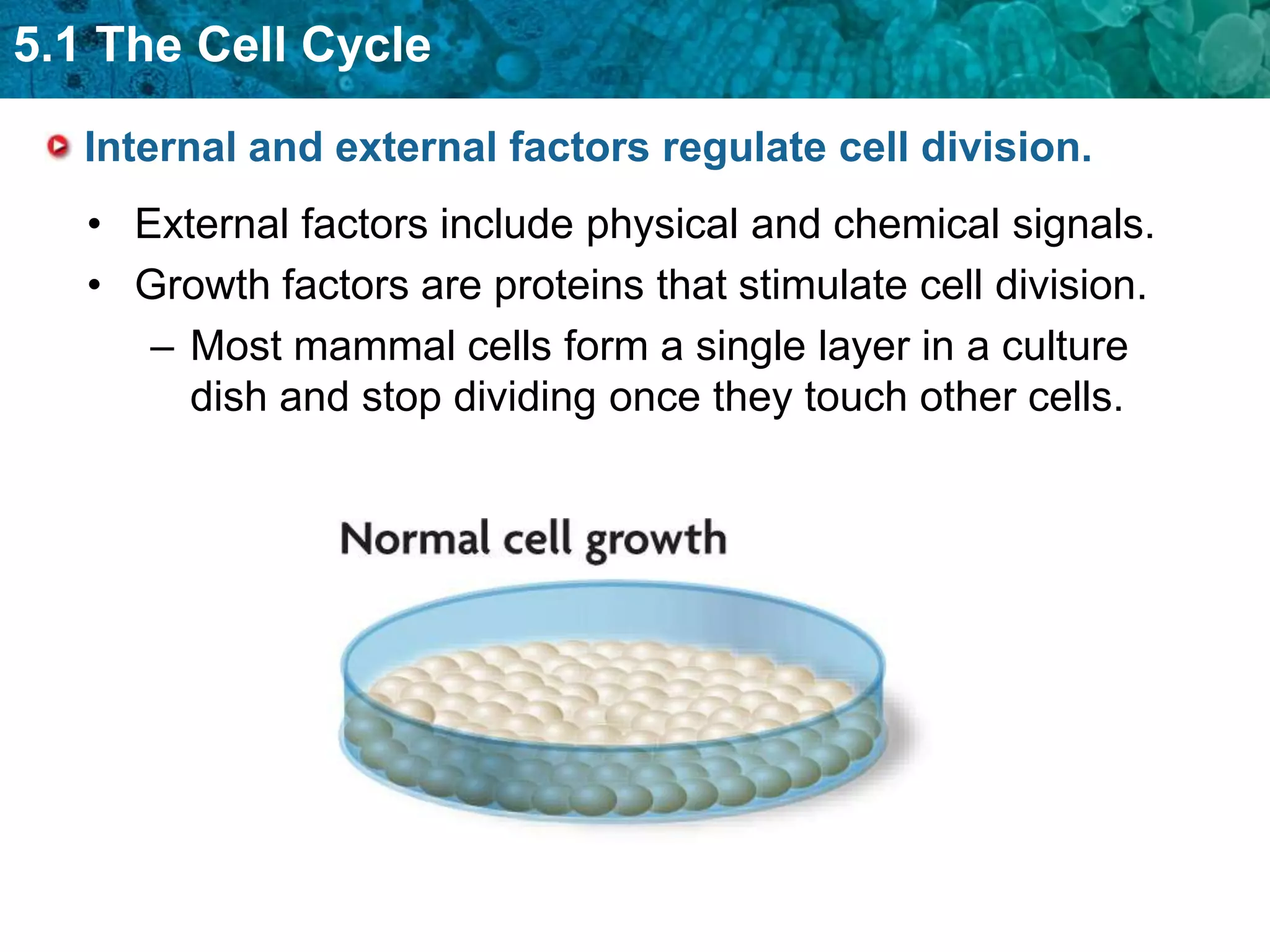
   Internal and external factors regulate cell division.
   • External factors include physical and chemical signals.
   • Growth factors are proteins that stimulate cell division.
      – Most mammal cells form a single layer in a culture
        dish and stop dividing once they touch other cells.
5.1 The Cell Cycle

   • Two of the most important internal factors are kinases
     and cyclins.


   • External factors trigger internal factors, which affect the
     cell cycle.
5.1 The Cell Cycle

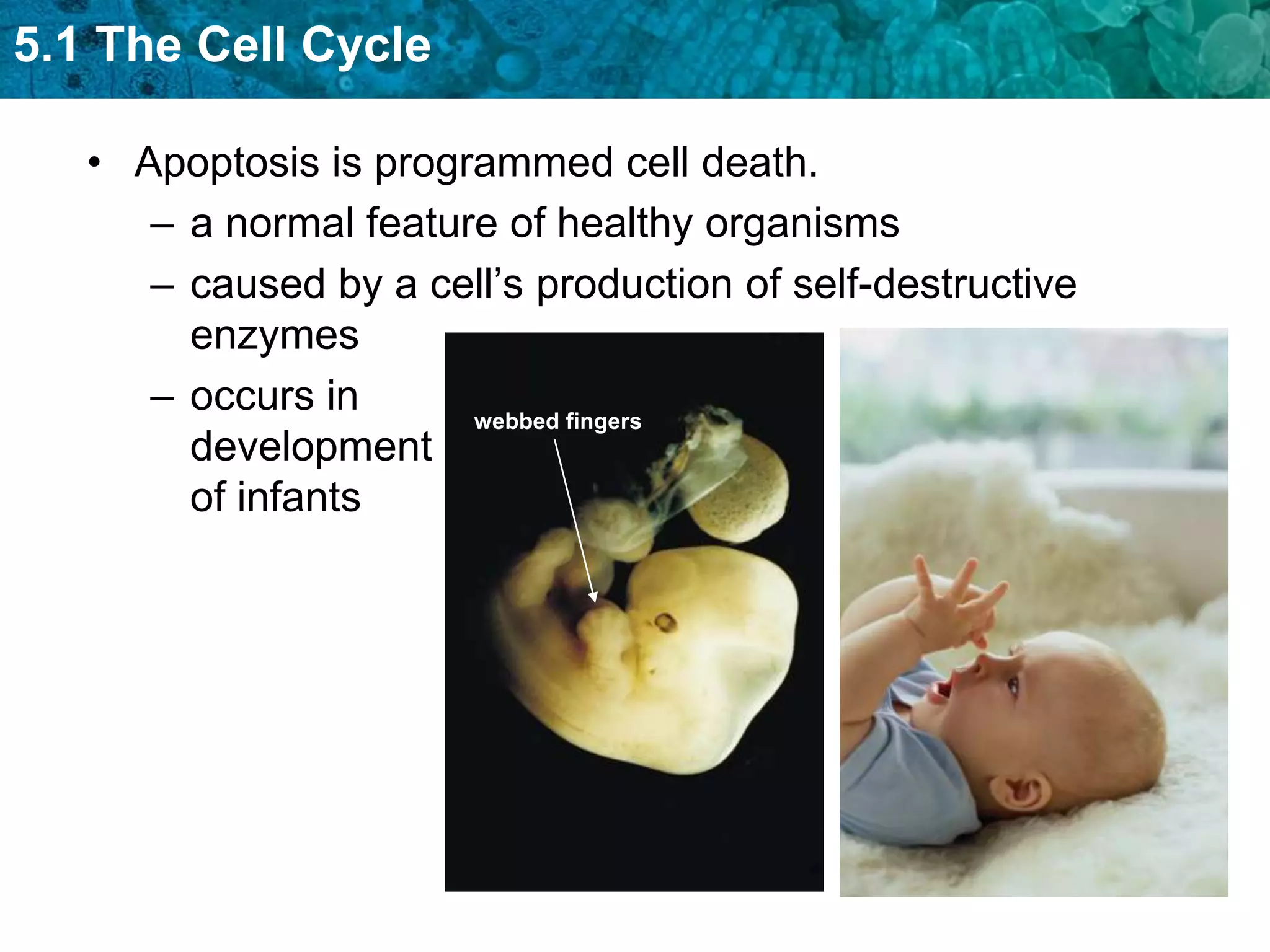
   • Apoptosis is programmed cell death.
      – a normal feature of healthy organisms
      – caused by a cell’s production of self-destructive
        enzymes
      – occurs in      webbed fingers
        development
        of infants
5.1 The Cell Cycle
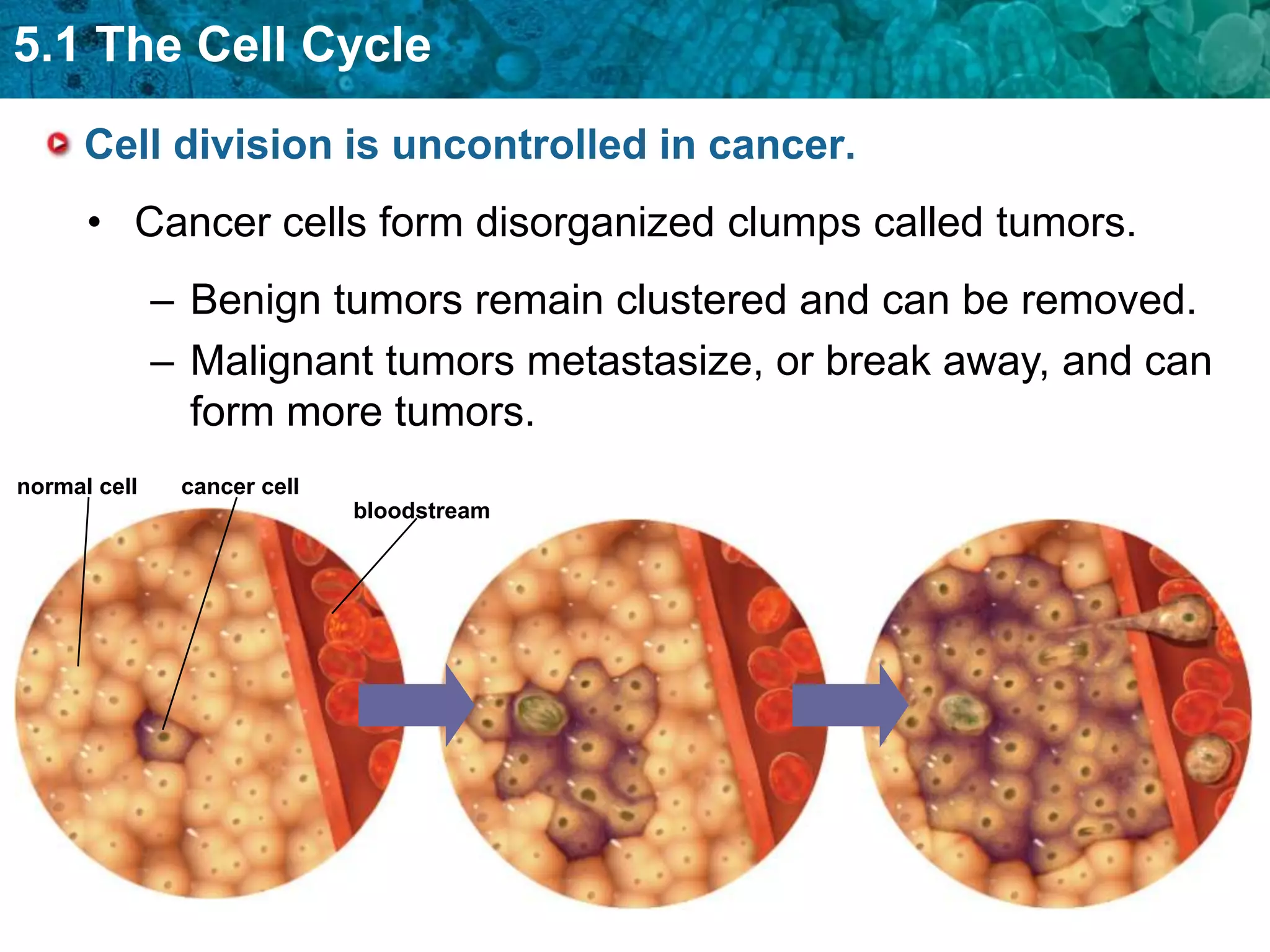
      Cell division is uncontrolled in cancer.
      • Cancer cells form disorganized clumps called tumors.
              – Benign tumors remain clustered and can be removed.
              – Malignant tumors metastasize, or break away, and can
                form more tumors.
normal cell    cancer cell
                             bloodstream
5.1 The Cell Cycle

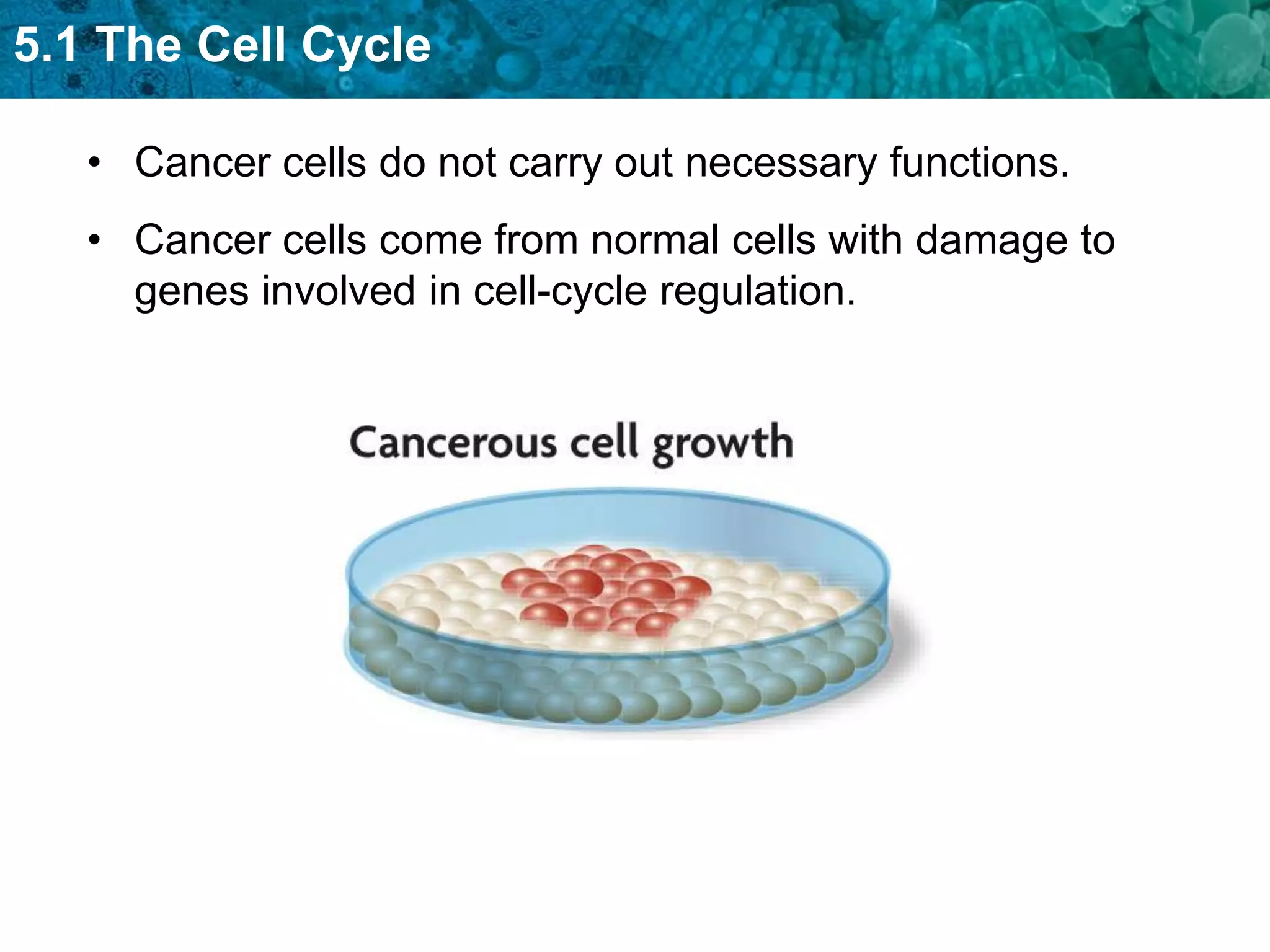
   • Cancer cells do not carry out necessary functions.
   • Cancer cells come from normal cells with damage to
     genes involved in cell-cycle regulation.
5.1 The Cell Cycle

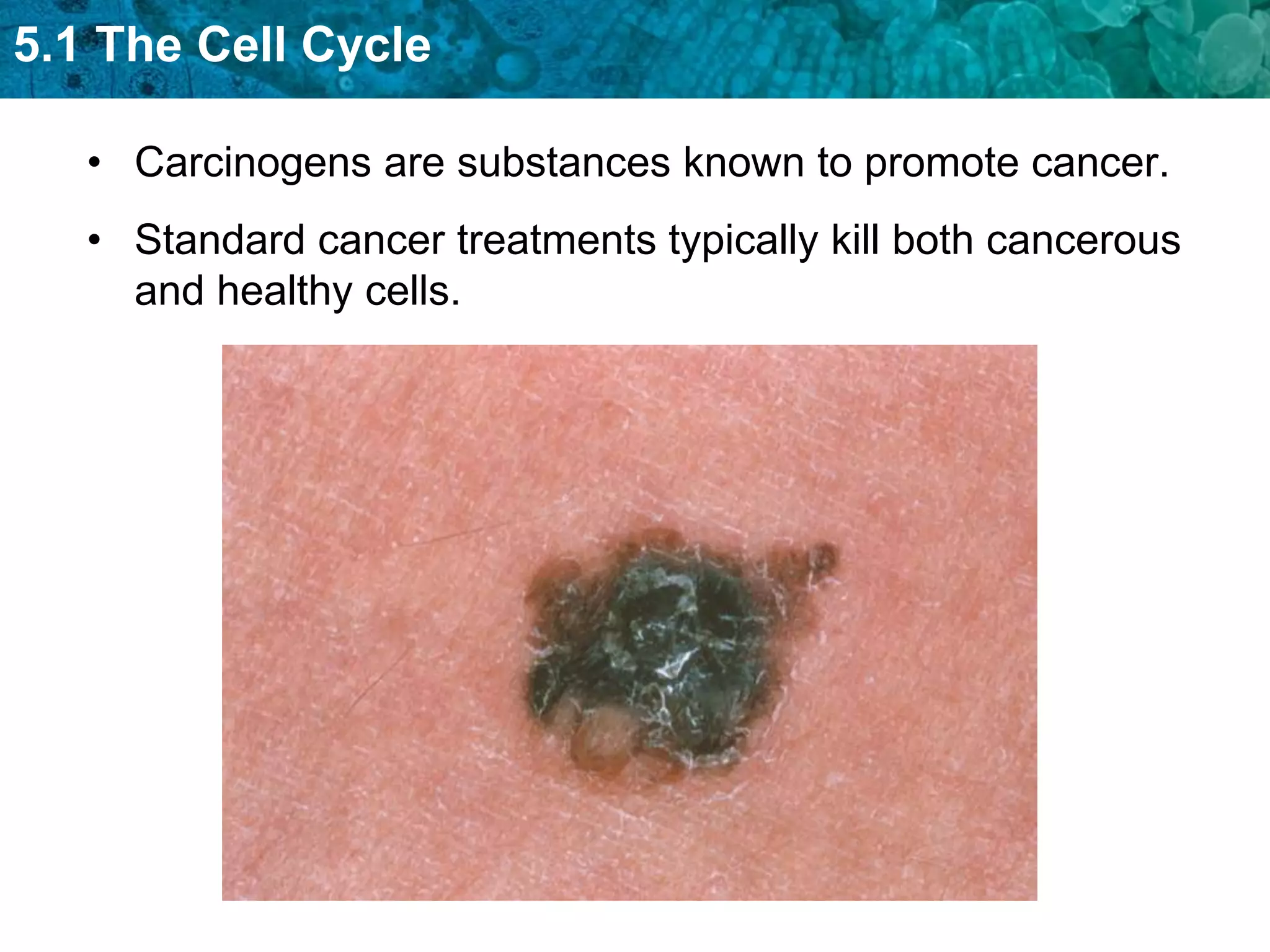
   • Carcinogens are substances known to promote cancer.
   • Standard cancer treatments typically kill both cancerous
     and healthy cells.
5.1 The Cell Cycle

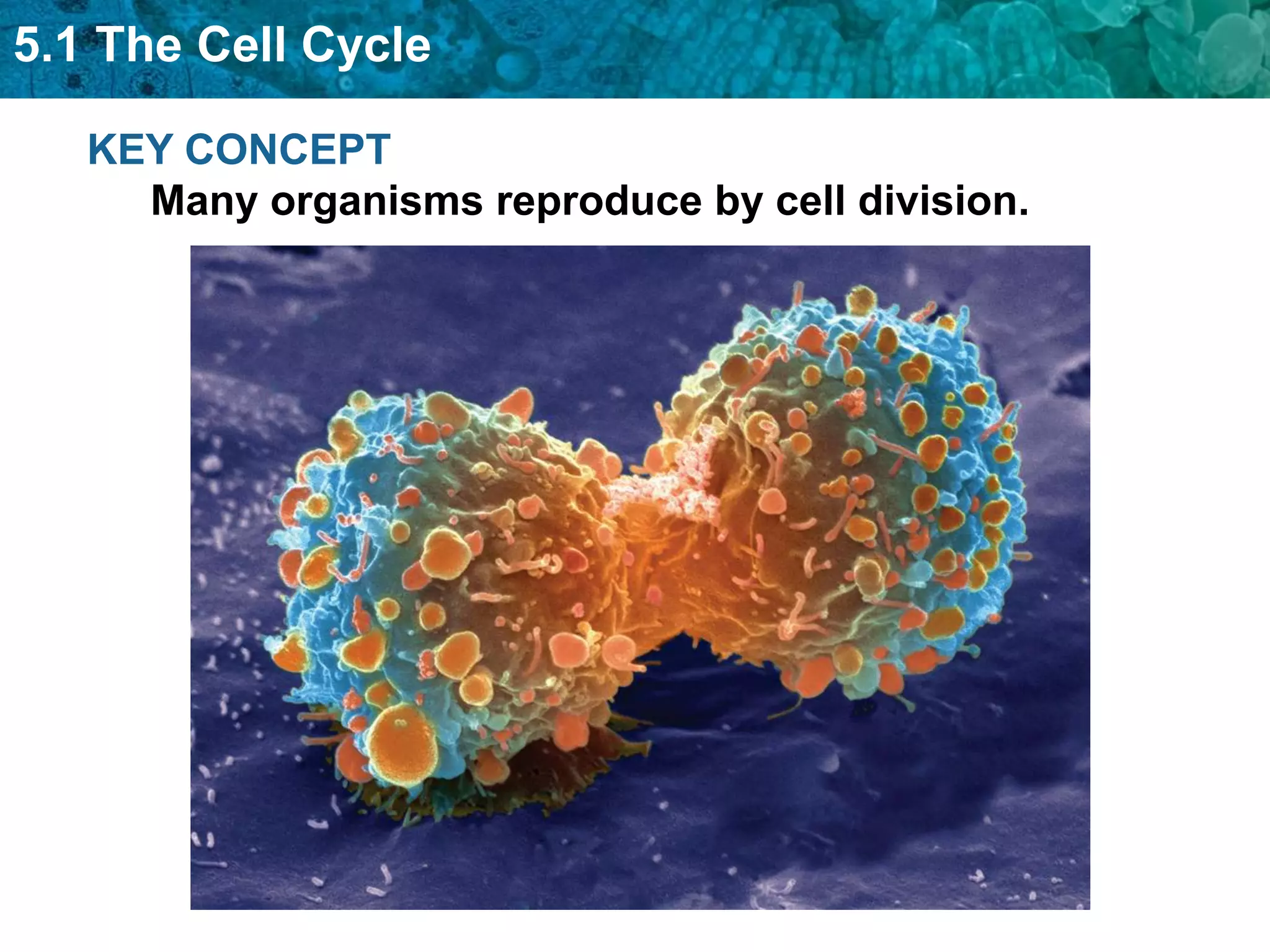
   KEY CONCEPT
     Many organisms reproduce by cell division.
5.1 The Cell Cycle
   Binary fission is similar in function to mitosis.
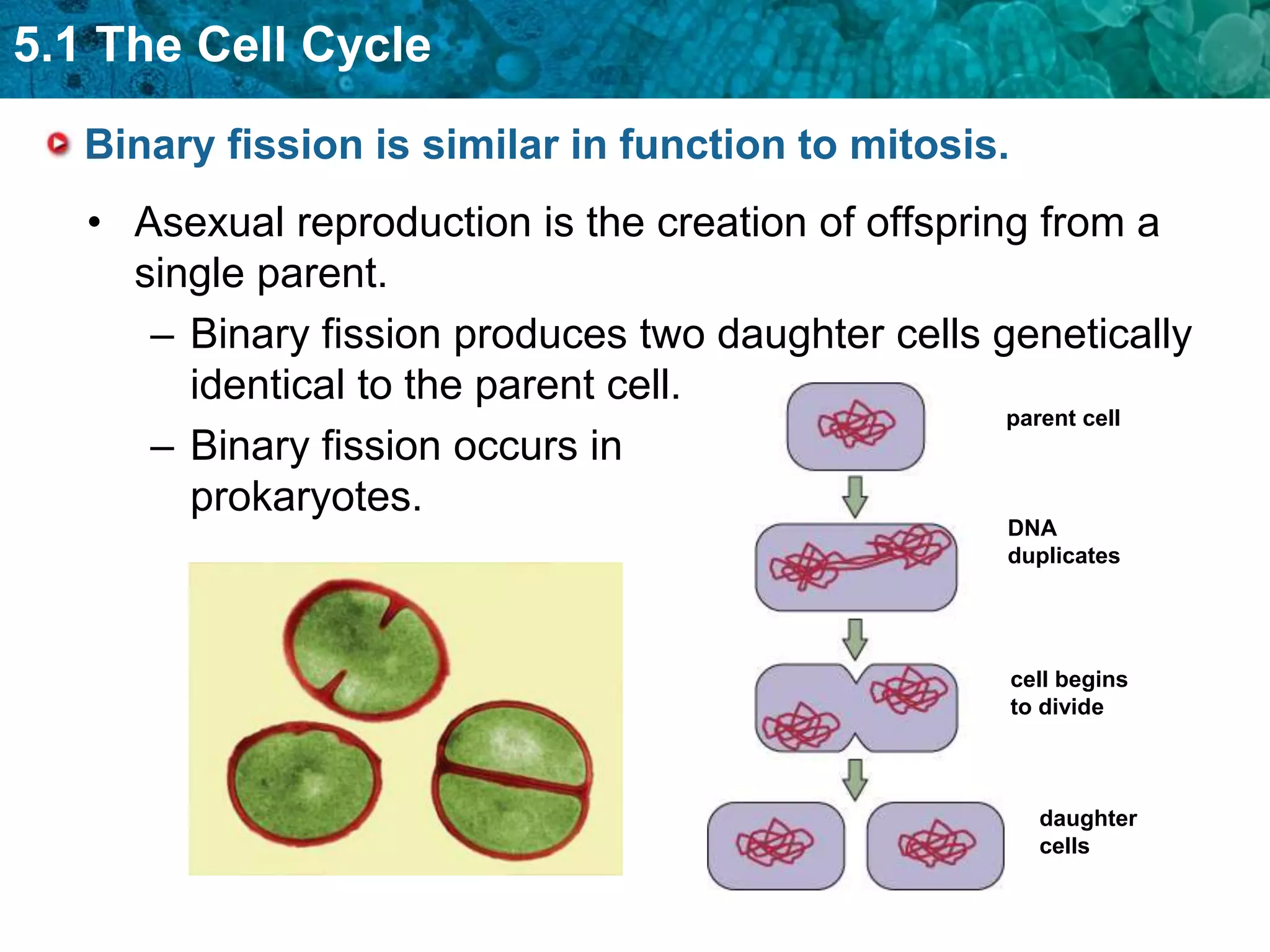
   • Asexual reproduction is the creation of offspring from a
     single parent.
      – Binary fission produces two daughter cells genetically
        identical to the parent cell.
                                                     parent cell
      – Binary fission occurs in
        prokaryotes.
                                                     DNA
                                                     duplicates


                                                       cell begins
                                                       to divide


                                                         daughter
                                                         cells
5.1 The Cell Cycle

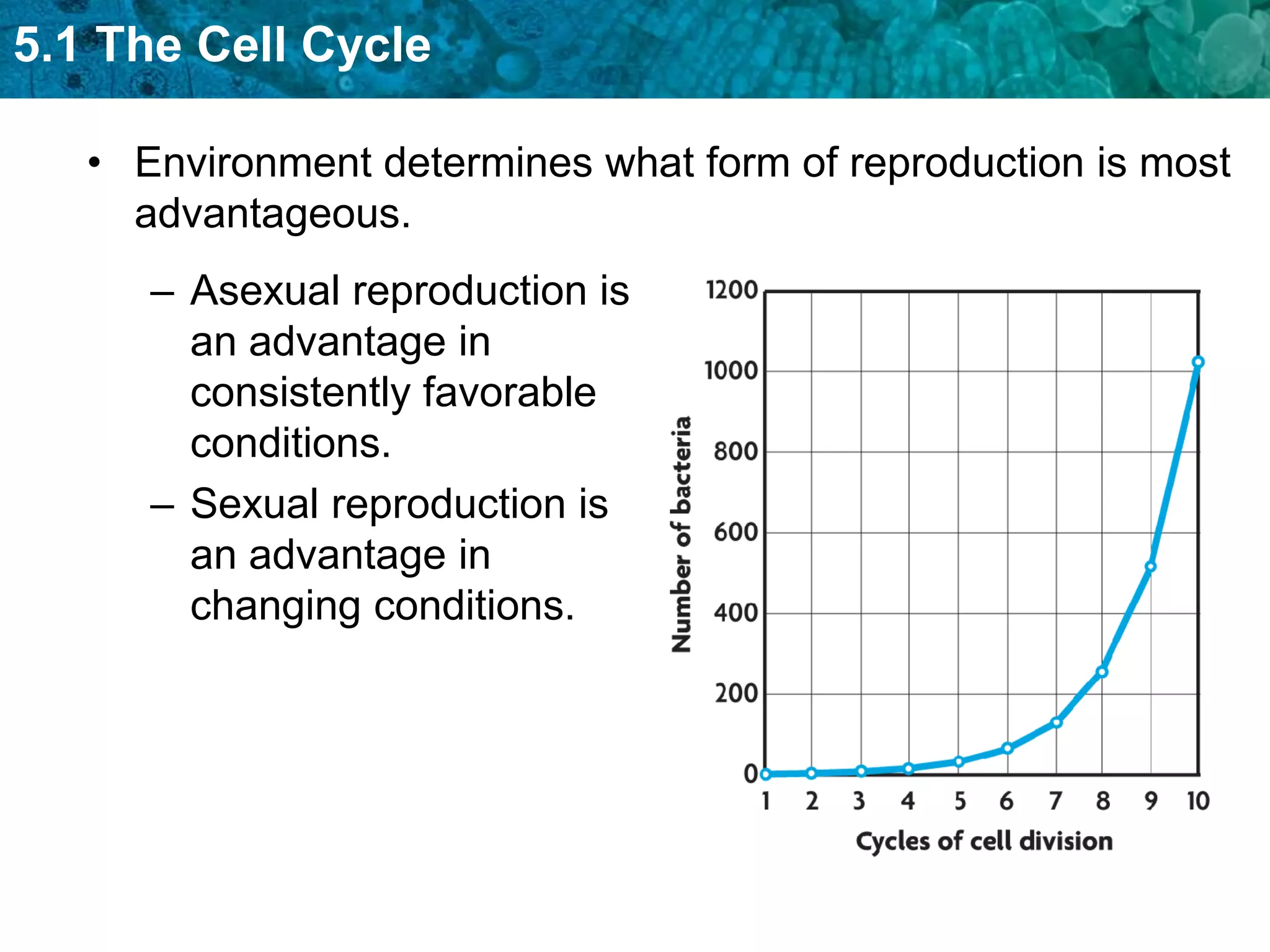
   • Environment determines what form of reproduction is most
     advantageous.
      – Asexual reproduction is
        an advantage in
        consistently favorable
        conditions.
      – Sexual reproduction is
        an advantage in
        changing conditions.
5.1 The Cell Cycle
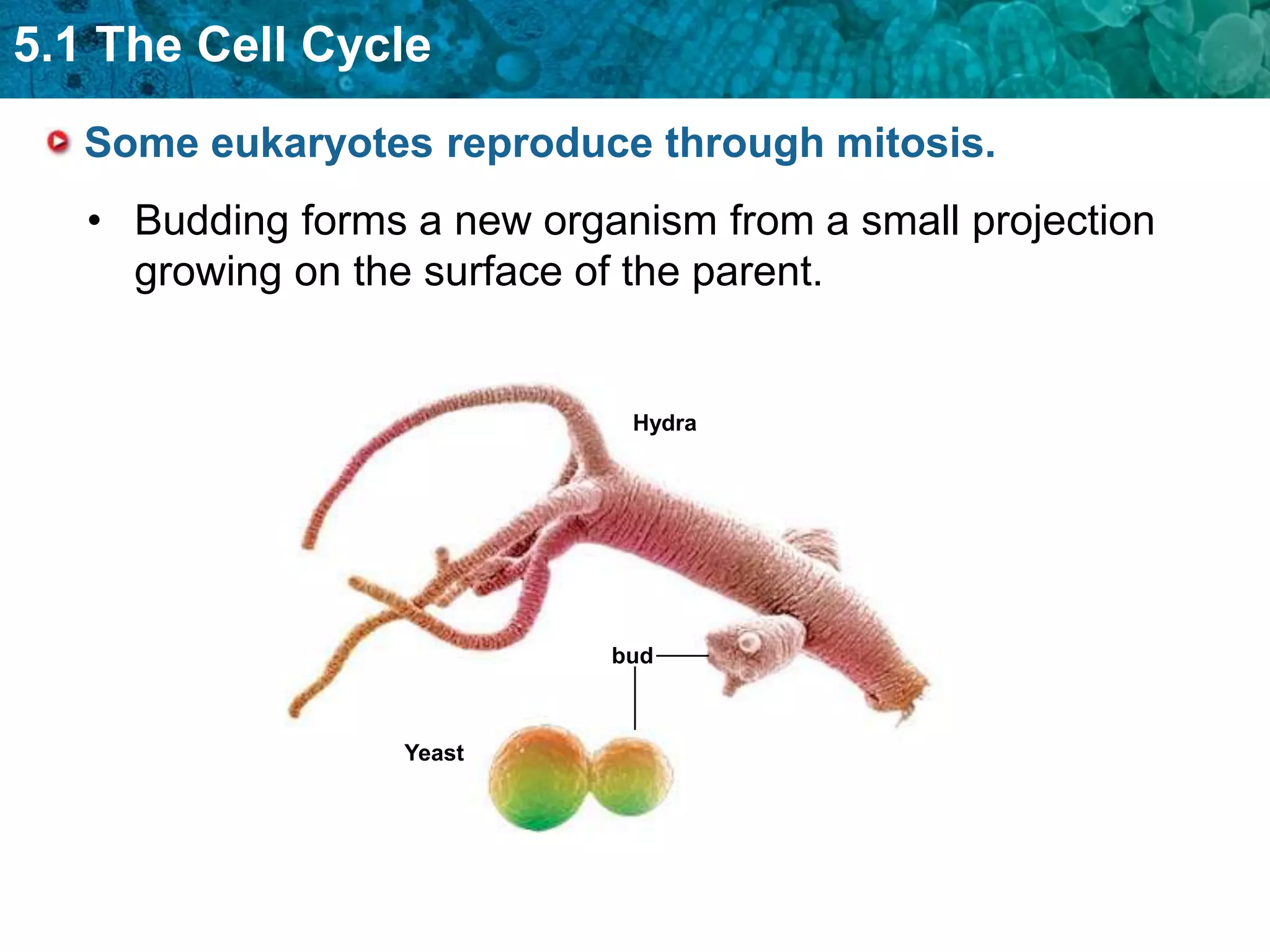
   Some eukaryotes reproduce through mitosis.
   • Budding forms a new organism from a small projection
     growing on the surface of the parent.


                              Hydra


                             bud


                   Yeast
5.1 The Cell Cycle

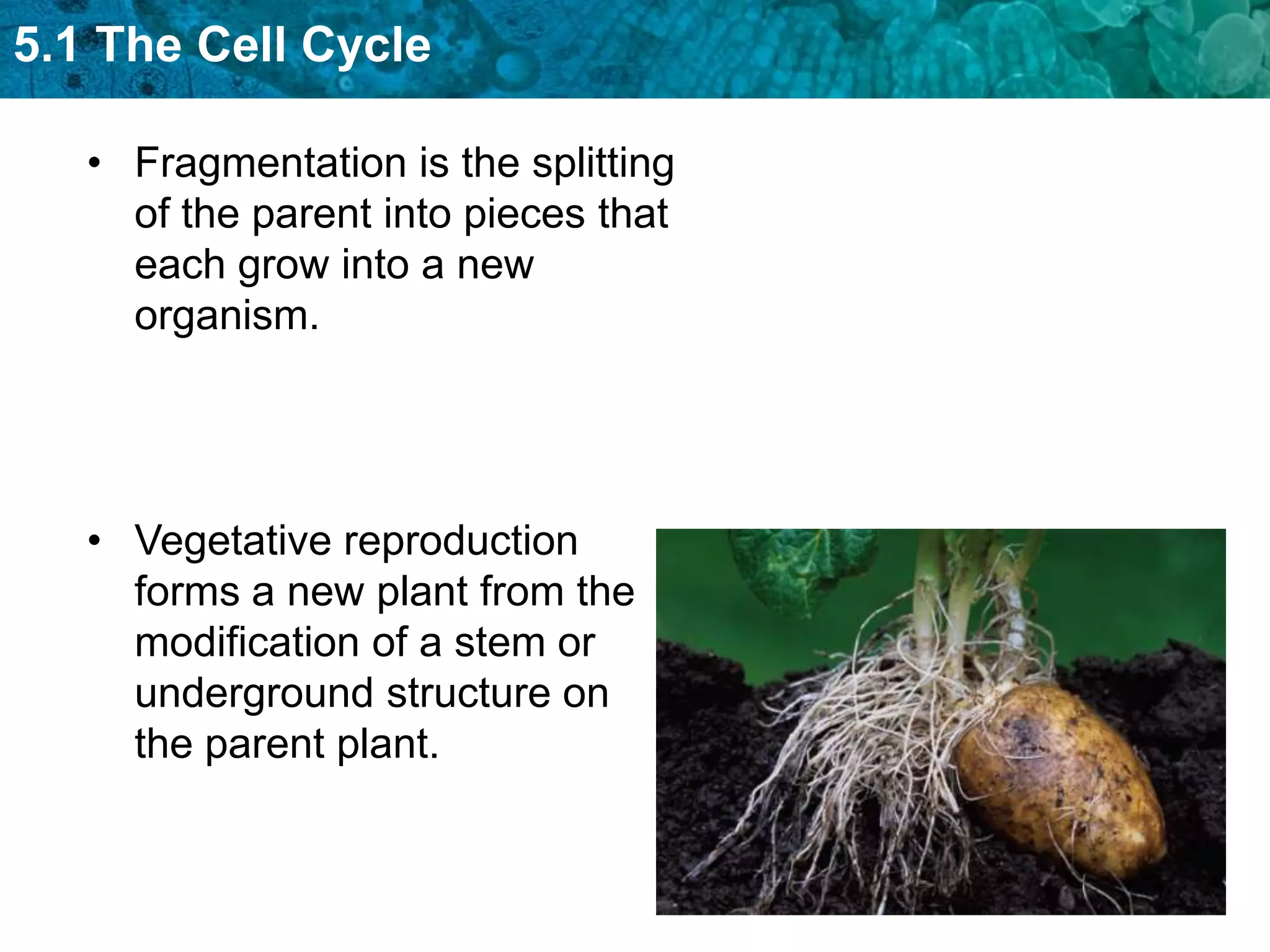
   • Fragmentation is the splitting
     of the parent into pieces that
     each grow into a new
     organism.


   • Vegetative reproduction
     forms a new plant from the
     modification of a stem or
     underground structure on
     the parent plant.
5.1 The Cell Cycle

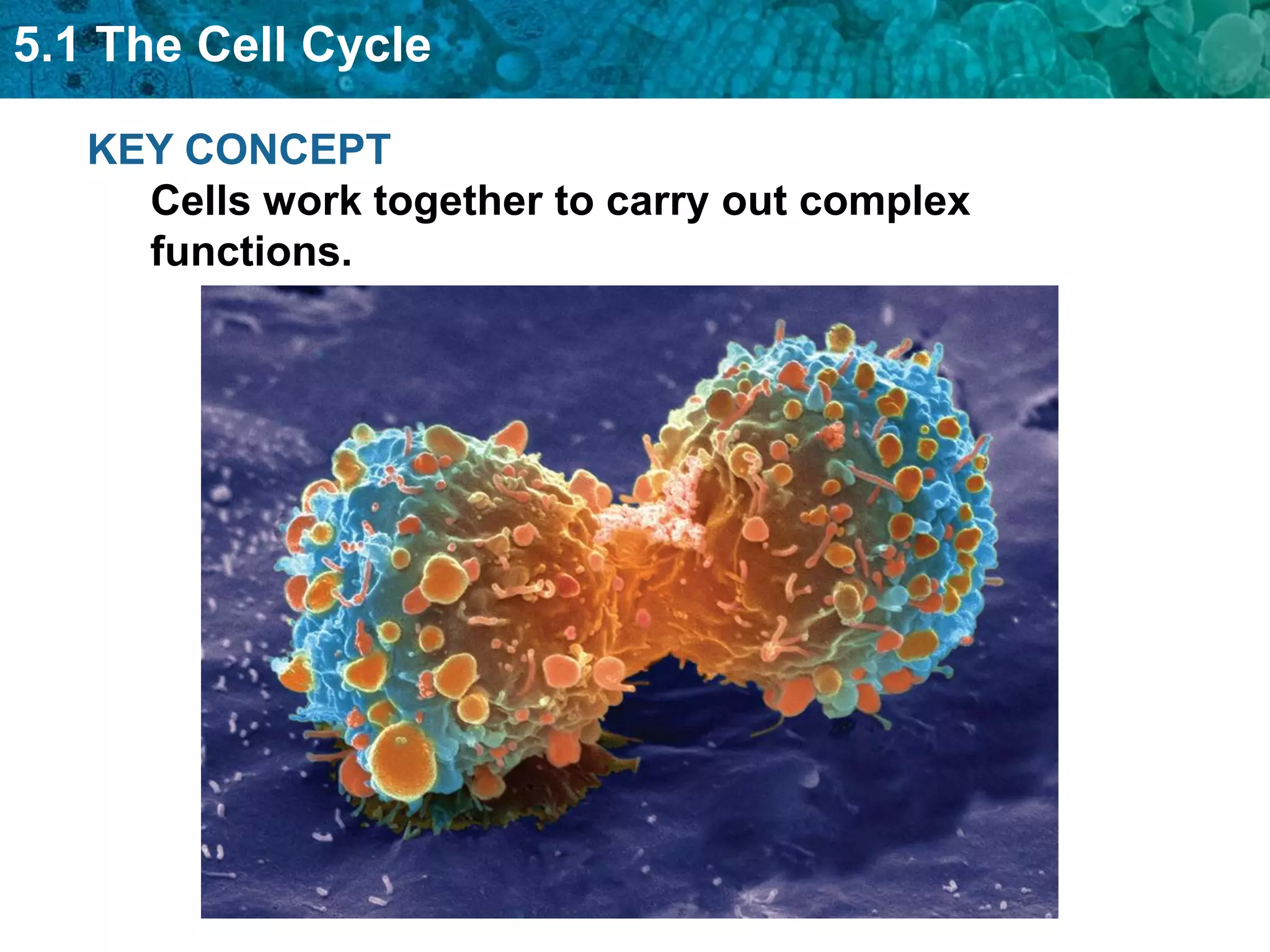
   KEY CONCEPT
     Cells work together to carry out complex
     functions.
5.1 The Cell Cycle

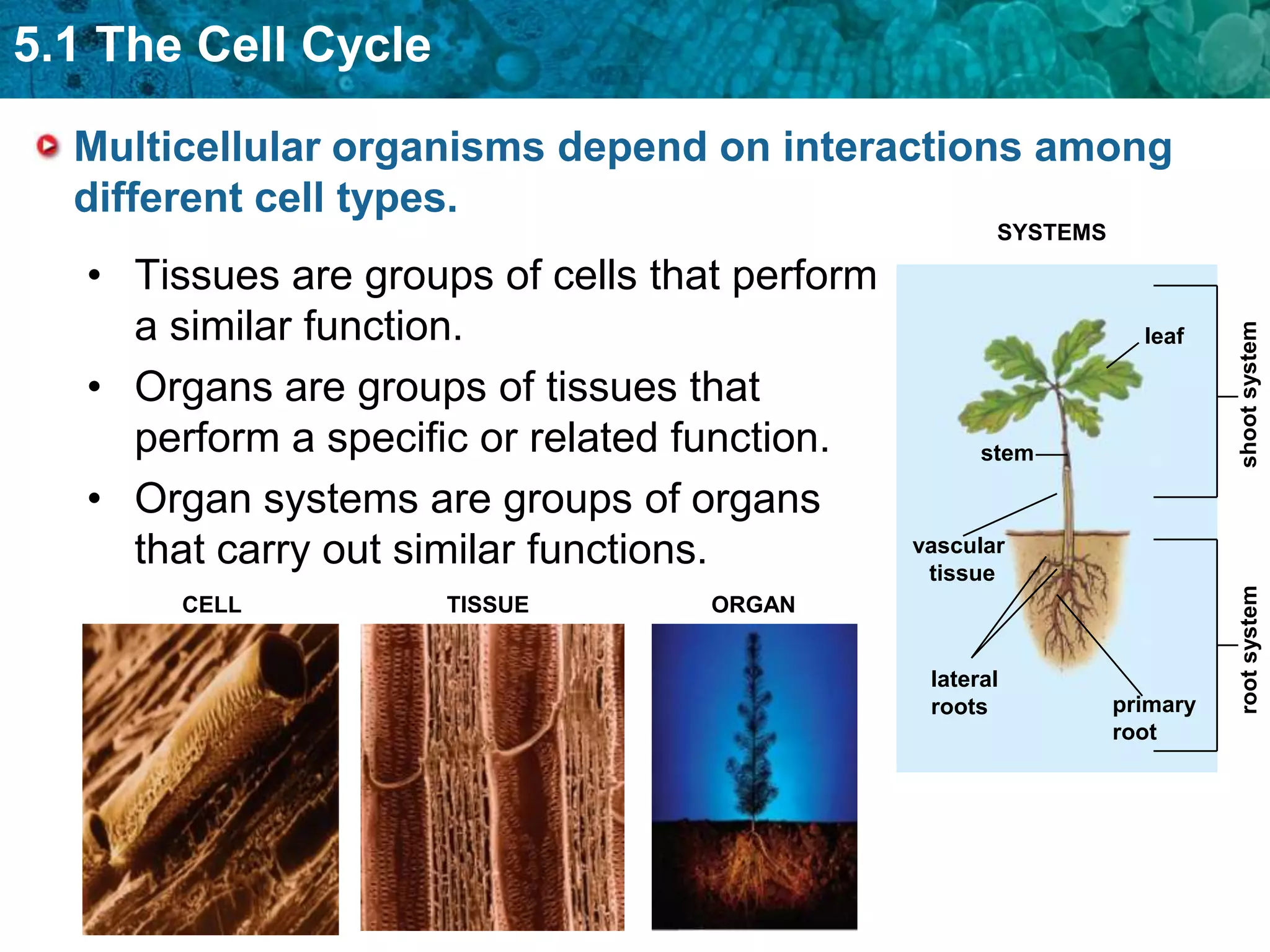
  Multicellular organisms depend on interactions among
  different cell types.
                                                       SYSTEMS

   • Tissues are groups of cells that perform
     a similar function.


                                                                           shoot system
                                                                   leaf

   • Organs are groups of tissues that
     perform a specific or related function.          stem

   • Organ systems are groups of organs
     that carry out similar functions.          vascular
                                                 tissue


                                                                           root system
        CELL          TISSUE        ORGAN


                                                 lateral
                                                 roots           primary
                                                                 root
5.1 The Cell Cycle
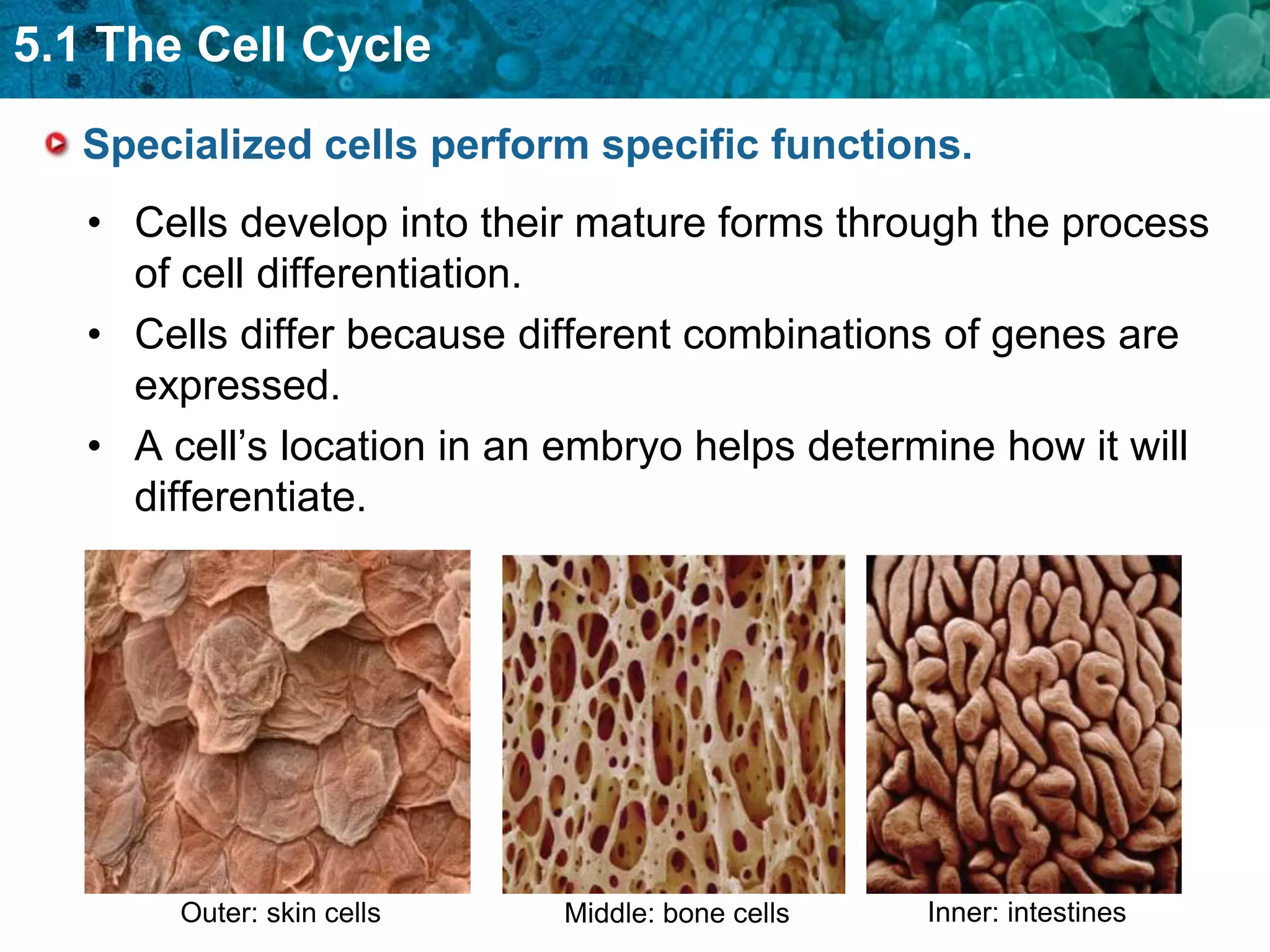
  Specialized cells perform specific functions.
   • Cells develop into their mature forms through the process
     of cell differentiation.
   • Cells differ because different combinations of genes are
     expressed.
   • A cell’s location in an embryo helps determine how it will
     differentiate.


       Outer: skin cells    Middle: bone cells   Inner: intestines
5.1 The Cell Cycle

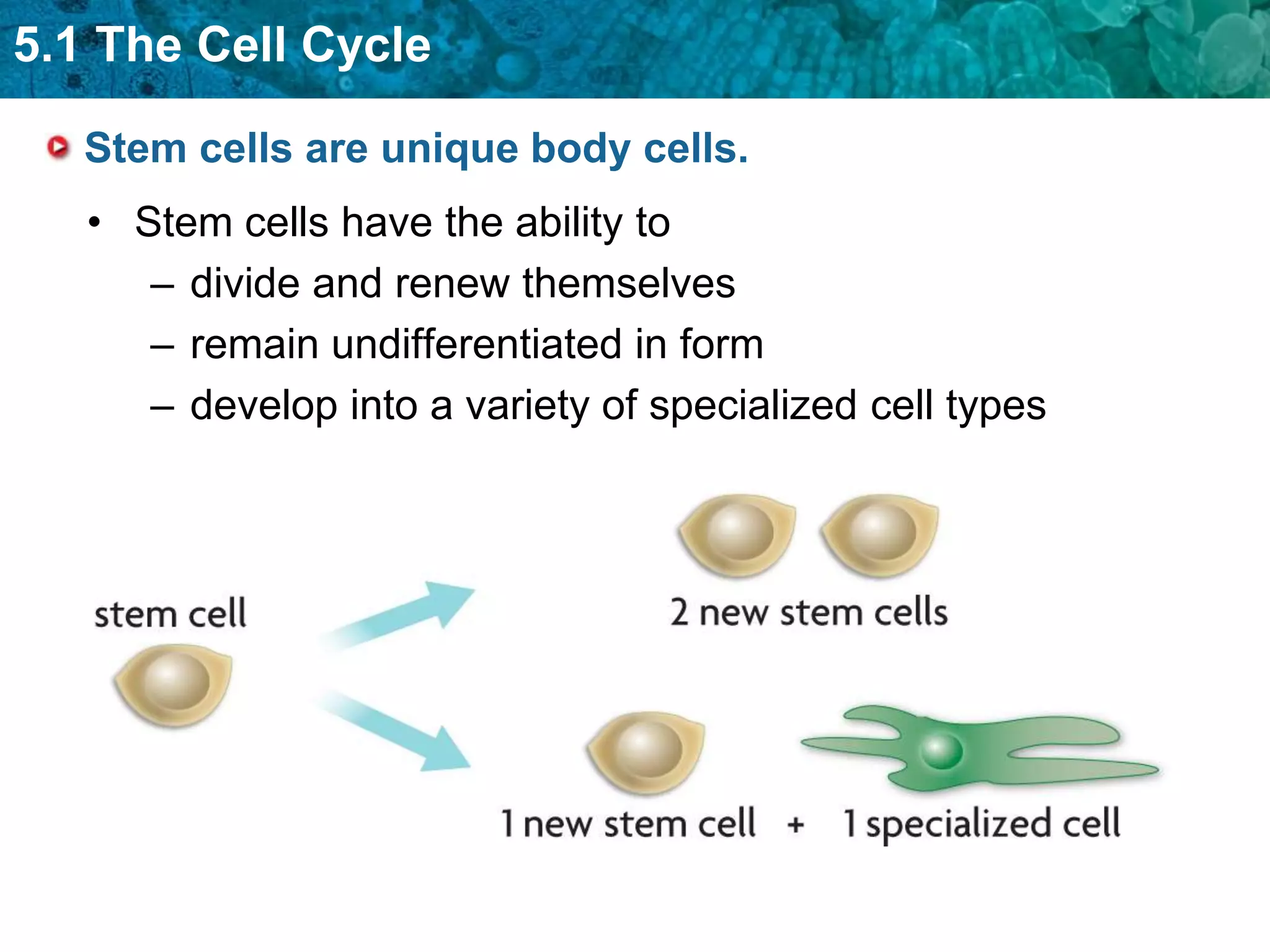
   Stem cells are unique body cells.
   • Stem cells have the ability to
      – divide and renew themselves
      – remain undifferentiated in form
      – develop into a variety of specialized cell types
5.1 The Cell Cycle

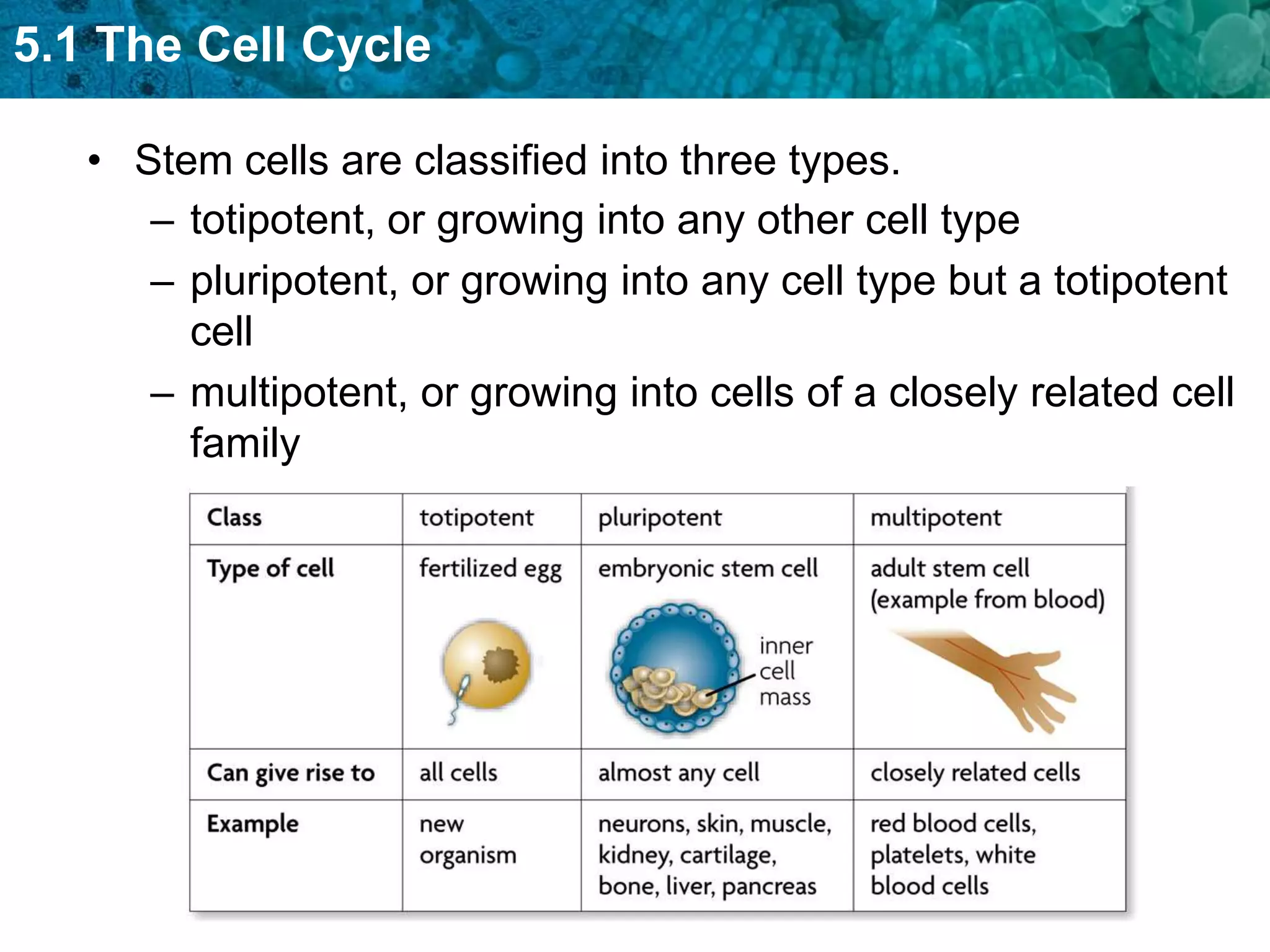
   • Stem cells are classified into three types.
      – totipotent, or growing into any other cell type
      – pluripotent, or growing into any cell type but a totipotent
        cell
      – multipotent, or growing into cells of a closely related cell
        family
5.1 The Cell Cycle

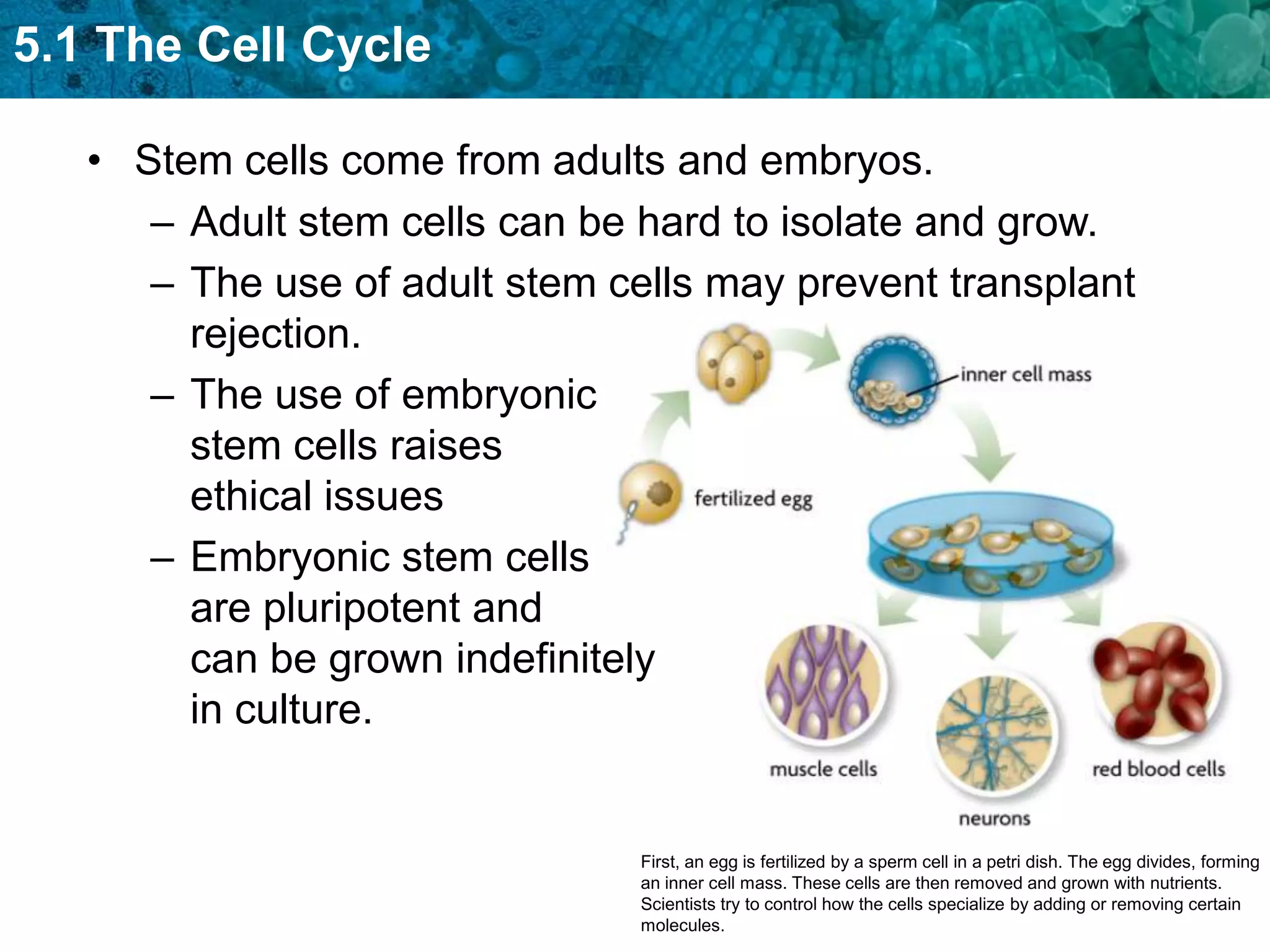
   • Stem cells come from adults and embryos.
      – Adult stem cells can be hard to isolate and grow.
      – The use of adult stem cells may prevent transplant
        rejection.
      – The use of embryonic
        stem cells raises
        ethical issues
      – Embryonic stem cells
        are pluripotent and
        can be grown indefinitely
        in culture.


                                First, an egg is fertilized by a sperm cell in a petri dish. The egg divides, forming
                                an inner cell mass. These cells are then removed and grown with nutrients.
                                Scientists try to control how the cells specialize by adding or removing certain
                                molecules.
5.1 The Cell Cycle

   • The use of stem cells offers many currently realized and
     potential benefits.
      – Stem cells are used to treat leukemia and lymphoma.
      – Stem cells may cure disease or replace damaged
        organs.
      – Stem cells may revolutionize the drug development
        process.

Unit 5 The Cell Cycle And Mitosis

  • 1.
    5.1 The CellCycle KEY CONCEPT Cells have distinct phases of growth, reproduction, and normal functions.
  • 2.
    5.1 The CellCycle The cell cycle has four main stages. • The cell cycle is a regular pattern of growth, DNA replication, and cell division.
  • 3.
    5.1 The CellCycle • The main stages of the cell cycle are gap 1, synthesis, gap 2, and mitosis. – Gap 1 (G1): cell growth and normal functions – DNA synthesis (S): copies DNA – Gap 2 (G2): additional growth – Mitosis (M): includes division of the cell nucleus (mitosis) and division of the cell cytoplasm (cytokinesis) • Mitosis occurs only if the cell is large enough and the DNA undamaged.
  • 4.
    5.1 The CellCycle Cells divide at different rates. • The rate of cell division varies with the need for those types of cells. • Some cells are unlikely to divide (G0).
  • 5.
    5.1 The CellCycle Cell size is limited. • Volume increases faster than surface area.
  • 6.
    5.1 The CellCycle • Surface area must allow for adequate exchange of materials. – Cell growth is coordinated with division. – Cells that must be large have unique shapes.
  • 7.
    5.1 The CellCycle KEY CONCEPT Cells divide during mitosis and cytokinesis.
  • 8.
    5.1 The CellCycle Chromosomes condense at the start of mitosis. • DNA wraps around proteins (histones) that condense it. DNA double DNA and Chromatin Supercoiled helix histones DNA
  • 9.
    5.1 The CellCycle • DNA plus proteins is called chromatin. chromatid • One half of a duplicated chromosome is a chromatid. telomere • Sister chromatids are held together at the centromere. centromere • Telomeres protect DNA and do not include genes. telomere Condensed, duplicated chromosome
  • 10.
    5.1 The CellCycle Mitosis and cytokinesis produce two genetically identical daughter cells. Parent cell • Interphase prepares the cell to divide. centrioles • During interphase, the DNA is duplicated. spindle fibers centrosome nucleus with DNA
  • 11.
    5.1 The CellCycle • Mitosis divides the cell’s nucleus in four phases. – During prophase, chromosomes condense and spindle fibers form.
  • 12.
    5.1 The CellCycle • Mitosis divides the cell’s nucleus in four phases. – During metaphase, chromosomes line up in the middle of the cell.
  • 13.
    5.1 The CellCycle • Mitosis divides the cell’s nucleus in four phases. – During anaphase, sister chromatids separate to opposite sides of the cell.
  • 14.
    5.1 The CellCycle • Mitosis divides the cell’s nucleus in four phases. – During telophase, the new nuclei form and chromosomes begin to uncoil.
  • 15.
    5.1 The CellCycle • Cytokinesis differs in animal and plant cells. – In animal cells, the membrane pinches closed. – In plant cells, a cell plate forms.
  • 16.
    5.1 The CellCycle KEY CONCEPT Cell cycle regulation is necessary for healthy growth.
  • 17.
    5.1 The CellCycle Internal and external factors regulate cell division. • External factors include physical and chemical signals. • Growth factors are proteins that stimulate cell division. – Most mammal cells form a single layer in a culture dish and stop dividing once they touch other cells.
  • 18.
    5.1 The CellCycle • Two of the most important internal factors are kinases and cyclins. • External factors trigger internal factors, which affect the cell cycle.
  • 19.
    5.1 The CellCycle • Apoptosis is programmed cell death. – a normal feature of healthy organisms – caused by a cell’s production of self-destructive enzymes – occurs in webbed fingers development of infants
  • 20.
    5.1 The CellCycle Cell division is uncontrolled in cancer. • Cancer cells form disorganized clumps called tumors. – Benign tumors remain clustered and can be removed. – Malignant tumors metastasize, or break away, and can form more tumors. normal cell cancer cell bloodstream
  • 21.
    5.1 The CellCycle • Cancer cells do not carry out necessary functions. • Cancer cells come from normal cells with damage to genes involved in cell-cycle regulation.
  • 22.
    5.1 The CellCycle • Carcinogens are substances known to promote cancer. • Standard cancer treatments typically kill both cancerous and healthy cells.
  • 23.
    5.1 The CellCycle KEY CONCEPT Many organisms reproduce by cell division.
  • 24.
    5.1 The CellCycle Binary fission is similar in function to mitosis. • Asexual reproduction is the creation of offspring from a single parent. – Binary fission produces two daughter cells genetically identical to the parent cell. parent cell – Binary fission occurs in prokaryotes. DNA duplicates cell begins to divide daughter cells
  • 25.
    5.1 The CellCycle • Environment determines what form of reproduction is most advantageous. – Asexual reproduction is an advantage in consistently favorable conditions. – Sexual reproduction is an advantage in changing conditions.
  • 26.
    5.1 The CellCycle Some eukaryotes reproduce through mitosis. • Budding forms a new organism from a small projection growing on the surface of the parent. Hydra bud Yeast
  • 27.
    5.1 The CellCycle • Fragmentation is the splitting of the parent into pieces that each grow into a new organism. • Vegetative reproduction forms a new plant from the modification of a stem or underground structure on the parent plant.
  • 28.
    5.1 The CellCycle KEY CONCEPT Cells work together to carry out complex functions.
  • 29.
    5.1 The CellCycle Multicellular organisms depend on interactions among different cell types. SYSTEMS • Tissues are groups of cells that perform a similar function. shoot system leaf • Organs are groups of tissues that perform a specific or related function. stem • Organ systems are groups of organs that carry out similar functions. vascular tissue root system CELL TISSUE ORGAN lateral roots primary root
  • 30.
    5.1 The CellCycle Specialized cells perform specific functions. • Cells develop into their mature forms through the process of cell differentiation. • Cells differ because different combinations of genes are expressed. • A cell’s location in an embryo helps determine how it will differentiate. Outer: skin cells Middle: bone cells Inner: intestines
  • 31.
    5.1 The CellCycle Stem cells are unique body cells. • Stem cells have the ability to – divide and renew themselves – remain undifferentiated in form – develop into a variety of specialized cell types
  • 32.
    5.1 The CellCycle • Stem cells are classified into three types. – totipotent, or growing into any other cell type – pluripotent, or growing into any cell type but a totipotent cell – multipotent, or growing into cells of a closely related cell family
  • 33.
    5.1 The CellCycle • Stem cells come from adults and embryos. – Adult stem cells can be hard to isolate and grow. – The use of adult stem cells may prevent transplant rejection. – The use of embryonic stem cells raises ethical issues – Embryonic stem cells are pluripotent and can be grown indefinitely in culture. First, an egg is fertilized by a sperm cell in a petri dish. The egg divides, forming an inner cell mass. These cells are then removed and grown with nutrients. Scientists try to control how the cells specialize by adding or removing certain molecules.
  • 34.
    5.1 The CellCycle • The use of stem cells offers many currently realized and potential benefits. – Stem cells are used to treat leukemia and lymphoma. – Stem cells may cure disease or replace damaged organs. – Stem cells may revolutionize the drug development process.