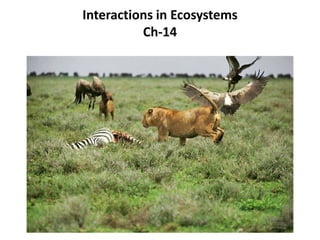

Interactions in Ecosystems
Ch-14
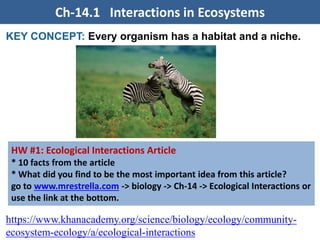
KEY CONCEPT: Every organism has a habitat and a niche.
Ch-14.1 Interactions in Ecosystems
https://www.khanacademy.org/science/biology/ecology/community-
ecosystem-ecology/a/ecological-interactions
HW #1: Ecological Interactions Article
• 15 facts from the article
* What did you find to be the most important idea from this article?
go to www.mrestrella.com -> biology -> Ch-14 -> Ecological Interactions
or use the link at the bottom.
• If you don’t have internet access, pick up an article after-school by
3:15pm.
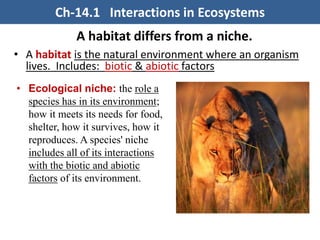
A habitat differs from a niche.
• A habitat is the natural environment where an organism
lives. Includes: biotic & abiotic factors
• Ecological niche: the role a
species has in its environment;
how it meets its needs for food,
shelter, how it survives, how it
reproduces. A species' niche
includes all of its interactions
with the biotic and abiotic
factors of its environment.
Ch-14.1 Interactions in Ecosystems
Resource availability gives structure to a community.
• Species can share habitats and resources.
• Competition occurs when two species use resources in
the same way (have similar niches).
Ch-14.1 Interactions in Ecosystems
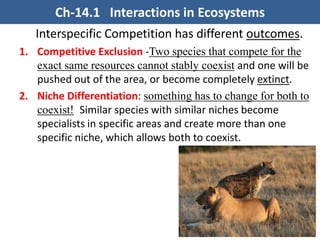
Interspecific Competition has different outcomes.
1. Competitive Exclusion -Two species that compete for the
exact same resources cannot stably coexist and one will be
pushed out of the area, or become completely extinct.
2. Niche Differentiation (Partitioning): something has to
change for both to coexist! Similar species with similar
niches become specialists in specific areas and create
more than one specific niche, which allows both to
coexist.
Ch-14.1 Interactions in Ecosystems
• Ecological equivalents are species that occupy similar
niches but live in different geographical regions.
Madagascar
South America
Ch-14.1 Interactions in Ecosystems
1. What is the difference between an
ecological niche and habitat?
2. Using a T-Chart, Place the following
words under niche or habitat
food, hunting methods, other lions,
trees, pond, zebra, sand,
temperature, grass, savanna,
wildebeest, mating selection, water
requirement, prey selection.
3. What is competitive exclusion?
4. What are ecological equivalents?
5. Give an example of how a habitat
affects an organism’s niche?
Study Guide Review 14.1
T-Chart
niche habitat
1. What is the difference between an
ecological niche and habitat? Niche is
the organism’s role, how they affect their
habitat and other organisms.
2. Using a T-Chart, Place the following
words under niche or habitat
food, hunting methods, other lions,
trees, pond, zebra, sand,
temperature, grass, savanna,
wildebeest, mating selection, water
requirement, prey selection.
3. What is competitive exclusion?
4. What are two outcomes of interspecific
competition?
5. What are ecological equivalents?
6. Give an example of how a habitat affects
an organism’s niche?
Study Guide Review 14.1
T-Chart
Niche Habitat
Hunting Food
Mating Lions
Water Req. Trees
Prey Sel. Pond
Sand
Temp.
Grass
Sav.
Quiz next time!
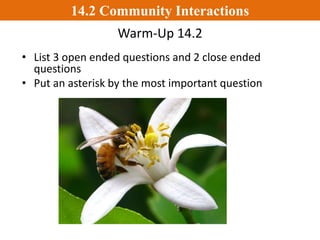
Warm-Up 14.2
• List 3 open ended questions and 2 close ended
questions
• Put an asterisk by the most important question
14.2 Community Interactions
KEY CONCEPT
Organisms interact as individuals and as populations.
14.2 Community Interactions
Competition and predation are two important ways
in which organisms interact.
• Competition occurs
when two organisms
compete for the
same limited resource.
– Intraspecific
competition: between
the same type of species.
Ex. Two tigers.
– Interspecific
competition: between
two different types of
species. Ex. A lion and a
hyena.
14.2 Community Interactions
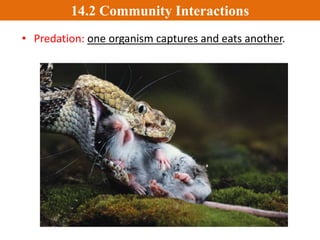
• Predation: one organism captures and eats another.
14.2 Community Interactions
• There are three major types of symbiotic relationships.
Symbiosis In The Sea
14.2 Community Interactions
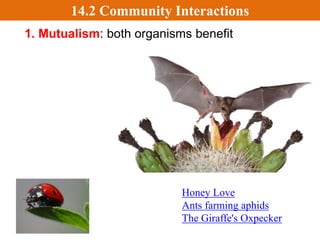
1. Mutualism: both organisms benefit
Honey Love
Giraffe's Oxpecker
14.2 Community Interactions
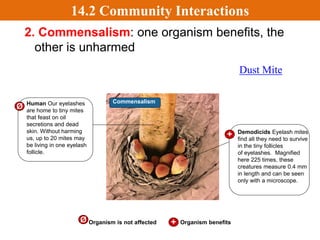
2. Commensalism: one organism benefits, the
other is unharmed
Human Our eyelashes
are home to tiny mites
that feast on oil
secretions and dead
skin. Without harming
us, up to 20 mites may
be living in one eyelash
follicle.
Demodicids Eyelash mites
find all they need to survive
in the tiny follicles
of eyelashes. Magnified
here 225 times, these
creatures measure 0.4 mm
in length and can be seen
only with a microscope.
+
Organism benefits+
Ø
Ø Organism is not affected
Commensalism
Dust Mite Under Scope
14.2 Community Interactions
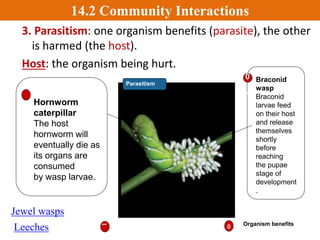
3. Parasitism: one organism benefits (parasite), the other
is harmed (the host).
Host: the organism that is hurt.
Organism benefits0
_
Hornworm
caterpillar
The host
hornworm will
eventually die as
its organs are
consumed
by wasp larvae.
Braconid
wasp
Braconid
larvae feed
on their host
and release
themselves
shortly
before
reaching
the pupae
stage of
development
.
_
Parasitism
+
0
Jewel wasps
Leeches
14.2 Community Interactions
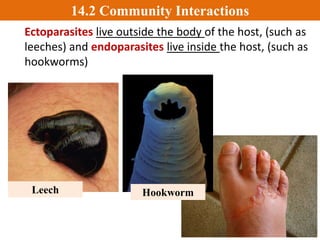
Ectoparasites live outside the body of the host, (such as
leeches) and endoparasites live inside the host, (such as
hookworms)
Leech Hookworm
14.2 Community Interactions
There will be a
quiz on this!
What?!!!
Parasites And Humans
HW #2: Niches & Competition Article
• 10 facts from the article
* What did you find to be the most important idea from this
article?
go to www.mrestrella.com -> biology -> Ch-14 -> Ecological
Interactions or use the link at the bottom.
• If you don’t have internet access, pick up an article after-school by
3:15pm.
https://www.khanacademy.org/science/biology/ecology/community-
ecosystem-ecology/a/niches-competition
1. Next to each sentence write either intraspecific or interspecific.
Which do you think it is?
A. Two squirrels race up a tree to reach a hidden pile of food.
B. A hyena chases off a vulture to eat.
C. Shrubs and grasses compete for sunlight
D. Bears hunting for fish fight for space with each other.
E. Male sheep butt heads violently for the females.
2. Mutualism
3. Commensalism
4. Parasitism
5. How is parasitism similar to and how is it different from predation?
6. What is the difference between endoparasites and ectoparasites?
14.2 Review
KEY CONCEPT
Each population has a density, a dispersion, and a
reproductive strategy.
14.3 Population Density & Distribution
Population density is the number of individuals that live in
a defined area.
• Scientists can calculate population density.
14.3 Population Density & Distribution
• Population dispersion refers to how a population is spread in an
area.
Clumped
dispersion
Uniform
dispersion
Random
dispersion
14.3 Population Density & Distribution
Populations Distribution
Reproductive Strategies
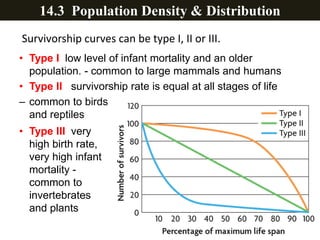
Survivorship curves can be type I, II or III.
Type I low level of infant mortality and an older
population. - common to large mammals and humans
Type II survivorship rate is equal at all stages of life
– common to birds
and reptiles
Type III very high
birth rate, very
high infant
mortality -common
to invertebrates
and plants
14.3 Population Density & Distribution
1. What is the formula for population density?
2. What might cause the density of deer to
increase?
3. Sketch three boxes and in each one draw and
label the three types of population dispersion
patterns.
4. Give two reasons why a population might live in a
clumped dispersion.
5. Give two reasons why a population. might live in
a uniform dispersion.
6. What is a reproductive strategy? What makes
reproductive strategies different?
7. What is the difference between population
dispersion and popn. Density?
14.3 Review
14.3 quiz next time I don’t think
I’m ready
HW: Niche Video
1-9. facts from the video
10. What did you find to be the most important idea from this
video?
https://www.youtube.com/watch?v=7twZJ9xDwkY
Niches
Warm-Up 14.4
List 3 open-ended and 2 close-ended questions.
Place an asterisk to the left of your most important one.
KEY CONCEPT: Populations grow in predictable patterns.
14.4 Populations & Growth Patterns
• The size of a population is
always changing.
• Four factors affect the size of
a population.
• Immigration: new
members of a species
coming into an area.
• Births: newborns added to
a population.
• Emigration: members of a
species leaving the area.
• Deaths: members of a
species that died.
14.4 Populations & Growth Patterns
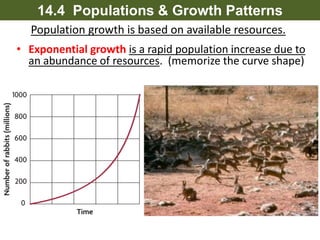
Population growth is based on available resources.
Exponential growth is a rapid population increase due to an
abundance of resources. (memorize the curve shape)
14.4 Populations & Growth Patterns
Logistic growth is due to a population facing limited
resources. (Learn the curve)
14.4 Populations & Growth Patterns
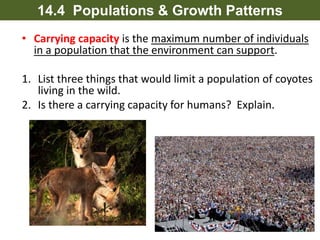
Carrying capacity is the maximum number of
individuals in a population that the environment
can support.
14.4 Populations & Growth Patterns
CW: 14.4 Review Questions
1. List three things that would limit a population of coyotes living in
the wild.
2. Is there a carrying capacity for humans? Explain.
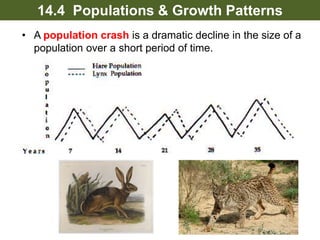
A population crash is a dramatic decline in the size of a
population over a short period of time.
14.4 Populations & Growth Patterns
Ecological factors limit population growth.
A limiting factor is something that keeps the size of a
population down.
3. List three
limiting factors that
would keep caribou
populations down.
14.4 Populations & Growth Patterns
Density-dependent limiting factors are affected by
the number of individuals in a given area.
– parasitism
and disease
– predation
– competition
14.4 Populations & Growth Patterns
Density-independent limiting factors limit a population’s
growth regardless of the density.
– unusual weather
– natural disasters
– human activities
14.4 Populations & Growth Patterns
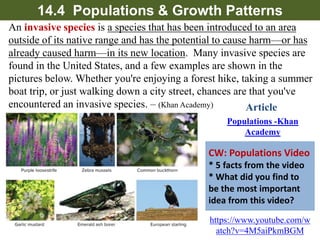
Invasive species is a species that has been introduced to an
area outside of its native range and has the potential to cause
harm—or has already caused harm—in its new
location. ​​Many invasive species are found in the United
States, and a few examples are shown in the pictures below.
HW: Populations Video
1-9. facts from the video
10. What did you find to
be the most important
idea from this video?
https://www.youtube.com/w
atch?v=4M5aiPkmBGM
Article
QUIZ NEXT TIME
Bad news,
quiz next
time. I’m not
yolking.
HW: Ecological Succession
1-9 facts from the article
10. What did you find to be the most important idea from this article?
go to www.mrestrella.com -> biology -> Ch-14 -> Ecological Interactions or
use the link at the bottom.
https://www.khanacademy.org/science/biology/ecology/community-structure-and-
diversity/a/ecological-succession
4. Movement into a population is called ______.
5. What are the four factors that affect a
population size?
6. A farmer wants to cut down part of a jungle to
raise cows. Explain how this may affect the
population of leapords?
7. Sketch the two different popn. growth curves.
Write a brief description next to each sketch.
8. What type of popn. growth curve shows a
carrying capacity?
9. List three examples of density dependent
limiting factors.
10. List three examples of density independent
limiting factors.
CW: 14.4 Review Questions (continued) Stop whining
and get to
work!
Warm Up 14.5
• List 3 open-ended questions about the image and
2 close-ended questions.
14.5 Ecological Succession
KEY CONCEPT
Ecological succession is a process of change in the
species that make up a community.
14.5 Ecological Succession
Succession occurs following a disturbance in an ecosystem.
• Succession regenerates or creates a community after a
disturbance.
– a sequence of biotic changes
– damaged communities are regenerated
– new communities arise in previously uninhabited areas
14.5 Ecological Succession
There are two types of succession.
1. primary succession — started by pioneer species
14.5 Ecological Succession
There are two types of succession.
Pioneer species: species which recolonize an area after there
has been damage or disruption to the ecosystem. Typically hardy
plants that need very little to survive, such as lichen or plants
with very long roots that give them better access to nutrients.
14.5 Ecological Succession
There are two types of succession.
2. secondary succession — started by the surviving
species
Succession After Fire
14.5 Ecological Succession
https://www.youtube.com/watch?v=d7xbyNSxxrI
Ecological succession -
Khan Academy
Mt St Helens
• Test on Chap 14 on…
* Get your Cornell
notes in order with a
cover page – typed.
Full Name
Period
Date
* Ch-14 Notes
* 3-5 Questions on
left side.
* Summary at end of
each section.
This is your conscious
speaking, study for your
test Rover… study
Ch-14 Interactions in Ecosystems
I love Mr. Estrella’s
tests! He’s soooo
cool.
HW: Populations Video
• 10 facts from the video
• What did you find to be the most important idea from this
video?
Study Guide 14.5
1. What is ecological
succession?
2. Sketch four boxes and show
ecological succession as
time progresses.
3. What is the difference
between primary and
secondary succession?
4. Why are the first species to
colonize a disturbed area
called pioneer species?
Ch-14.5 Review
CW or HW: 10 multiple
choice questions on ch-14.
Two from each section.
(3 choices, circle correct
letter, no t/f, yes/no, silly,
ridiculous questions or
answers)
That is your
work today.
Ch-14 Interactions in Ecosystems

Interactions in Ecosystems ch 14

  • 1.
  • 2.
    KEY CONCEPT: Everyorganism has a habitat and a niche. Ch-14.1 Interactions in Ecosystems https://www.khanacademy.org/science/biology/ecology/community- ecosystem-ecology/a/ecological-interactions HW #1: Ecological Interactions Article • 15 facts from the article * What did you find to be the most important idea from this article? go to www.mrestrella.com -> biology -> Ch-14 -> Ecological Interactions or use the link at the bottom. • If you don’t have internet access, pick up an article after-school by 3:15pm.
  • 3.
    A habitat differsfrom a niche. • A habitat is the natural environment where an organism lives. Includes: biotic & abiotic factors • Ecological niche: the role a species has in its environment; how it meets its needs for food, shelter, how it survives, how it reproduces. A species' niche includes all of its interactions with the biotic and abiotic factors of its environment. Ch-14.1 Interactions in Ecosystems
  • 4.
    Resource availability givesstructure to a community. • Species can share habitats and resources. • Competition occurs when two species use resources in the same way (have similar niches). Ch-14.1 Interactions in Ecosystems
  • 5.
    Interspecific Competition hasdifferent outcomes. 1. Competitive Exclusion -Two species that compete for the exact same resources cannot stably coexist and one will be pushed out of the area, or become completely extinct. 2. Niche Differentiation (Partitioning): something has to change for both to coexist! Similar species with similar niches become specialists in specific areas and create more than one specific niche, which allows both to coexist. Ch-14.1 Interactions in Ecosystems
  • 6.
    • Ecological equivalentsare species that occupy similar niches but live in different geographical regions. Madagascar South America Ch-14.1 Interactions in Ecosystems
  • 7.
    1. What isthe difference between an ecological niche and habitat? 2. Using a T-Chart, Place the following words under niche or habitat food, hunting methods, other lions, trees, pond, zebra, sand, temperature, grass, savanna, wildebeest, mating selection, water requirement, prey selection. 3. What is competitive exclusion? 4. What are ecological equivalents? 5. Give an example of how a habitat affects an organism’s niche? Study Guide Review 14.1 T-Chart niche habitat
  • 8.
    1. What isthe difference between an ecological niche and habitat? Niche is the organism’s role, how they affect their habitat and other organisms. 2. Using a T-Chart, Place the following words under niche or habitat food, hunting methods, other lions, trees, pond, zebra, sand, temperature, grass, savanna, wildebeest, mating selection, water requirement, prey selection. 3. What is competitive exclusion? 4. What are two outcomes of interspecific competition? 5. What are ecological equivalents? 6. Give an example of how a habitat affects an organism’s niche? Study Guide Review 14.1 T-Chart Niche Habitat Hunting Food Mating Lions Water Req. Trees Prey Sel. Pond Sand Temp. Grass Sav.
  • 9.
  • 10.
    Warm-Up 14.2 • List3 open ended questions and 2 close ended questions • Put an asterisk by the most important question 14.2 Community Interactions
  • 11.
    KEY CONCEPT Organisms interactas individuals and as populations. 14.2 Community Interactions
  • 12.
    Competition and predationare two important ways in which organisms interact. • Competition occurs when two organisms compete for the same limited resource. – Intraspecific competition: between the same type of species. Ex. Two tigers. – Interspecific competition: between two different types of species. Ex. A lion and a hyena. 14.2 Community Interactions
  • 13.
    • Predation: oneorganism captures and eats another. 14.2 Community Interactions
  • 14.
    • There arethree major types of symbiotic relationships. Symbiosis In The Sea 14.2 Community Interactions
  • 15.
    1. Mutualism: bothorganisms benefit Honey Love Giraffe's Oxpecker 14.2 Community Interactions
  • 16.
    2. Commensalism: oneorganism benefits, the other is unharmed Human Our eyelashes are home to tiny mites that feast on oil secretions and dead skin. Without harming us, up to 20 mites may be living in one eyelash follicle. Demodicids Eyelash mites find all they need to survive in the tiny follicles of eyelashes. Magnified here 225 times, these creatures measure 0.4 mm in length and can be seen only with a microscope. + Organism benefits+ Ø Ø Organism is not affected Commensalism Dust Mite Under Scope 14.2 Community Interactions
  • 17.
    3. Parasitism: oneorganism benefits (parasite), the other is harmed (the host). Host: the organism that is hurt. Organism benefits0 _ Hornworm caterpillar The host hornworm will eventually die as its organs are consumed by wasp larvae. Braconid wasp Braconid larvae feed on their host and release themselves shortly before reaching the pupae stage of development . _ Parasitism + 0 Jewel wasps Leeches 14.2 Community Interactions
  • 18.
    Ectoparasites live outsidethe body of the host, (such as leeches) and endoparasites live inside the host, (such as hookworms) Leech Hookworm 14.2 Community Interactions
  • 19.
  • 20.
    There will bea quiz on this! What?!!! Parasites And Humans HW #2: Niches & Competition Article • 10 facts from the article * What did you find to be the most important idea from this article? go to www.mrestrella.com -> biology -> Ch-14 -> Ecological Interactions or use the link at the bottom. • If you don’t have internet access, pick up an article after-school by 3:15pm. https://www.khanacademy.org/science/biology/ecology/community- ecosystem-ecology/a/niches-competition
  • 21.
    1. Next toeach sentence write either intraspecific or interspecific. Which do you think it is? A. Two squirrels race up a tree to reach a hidden pile of food. B. A hyena chases off a vulture to eat. C. Shrubs and grasses compete for sunlight D. Bears hunting for fish fight for space with each other. E. Male sheep butt heads violently for the females. 2. Mutualism 3. Commensalism 4. Parasitism 5. How is parasitism similar to and how is it different from predation? 6. What is the difference between endoparasites and ectoparasites? 14.2 Review
  • 22.
    KEY CONCEPT Each populationhas a density, a dispersion, and a reproductive strategy. 14.3 Population Density & Distribution
  • 23.
    Population density isthe number of individuals that live in a defined area. • Scientists can calculate population density. 14.3 Population Density & Distribution
  • 24.
    • Population dispersionrefers to how a population is spread in an area. Clumped dispersion Uniform dispersion Random dispersion 14.3 Population Density & Distribution Populations Distribution
  • 25.
    Reproductive Strategies Survivorship curvescan be type I, II or III. Type I low level of infant mortality and an older population. - common to large mammals and humans Type II survivorship rate is equal at all stages of life – common to birds and reptiles Type III very high birth rate, very high infant mortality -common to invertebrates and plants 14.3 Population Density & Distribution
  • 26.
    1. What isthe formula for population density? 2. What might cause the density of deer to increase? 3. Sketch three boxes and in each one draw and label the three types of population dispersion patterns. 4. Give two reasons why a population might live in a clumped dispersion. 5. Give two reasons why a population. might live in a uniform dispersion. 6. What is a reproductive strategy? What makes reproductive strategies different? 7. What is the difference between population dispersion and popn. Density? 14.3 Review
  • 27.
    14.3 quiz nexttime I don’t think I’m ready HW: Niche Video 1-9. facts from the video 10. What did you find to be the most important idea from this video? https://www.youtube.com/watch?v=7twZJ9xDwkY Niches
  • 28.
    Warm-Up 14.4 List 3open-ended and 2 close-ended questions. Place an asterisk to the left of your most important one.
  • 29.
    KEY CONCEPT: Populationsgrow in predictable patterns. 14.4 Populations & Growth Patterns
  • 30.
    • The sizeof a population is always changing. • Four factors affect the size of a population. • Immigration: new members of a species coming into an area. • Births: newborns added to a population. • Emigration: members of a species leaving the area. • Deaths: members of a species that died. 14.4 Populations & Growth Patterns
  • 31.
    Population growth isbased on available resources. Exponential growth is a rapid population increase due to an abundance of resources. (memorize the curve shape) 14.4 Populations & Growth Patterns
  • 32.
    Logistic growth isdue to a population facing limited resources. (Learn the curve) 14.4 Populations & Growth Patterns
  • 33.
    Carrying capacity isthe maximum number of individuals in a population that the environment can support. 14.4 Populations & Growth Patterns CW: 14.4 Review Questions 1. List three things that would limit a population of coyotes living in the wild. 2. Is there a carrying capacity for humans? Explain.
  • 34.
    A population crashis a dramatic decline in the size of a population over a short period of time. 14.4 Populations & Growth Patterns
  • 35.
    Ecological factors limitpopulation growth. A limiting factor is something that keeps the size of a population down. 3. List three limiting factors that would keep caribou populations down. 14.4 Populations & Growth Patterns
  • 36.
    Density-dependent limiting factorsare affected by the number of individuals in a given area. – parasitism and disease – predation – competition 14.4 Populations & Growth Patterns
  • 37.
    Density-independent limiting factorslimit a population’s growth regardless of the density. – unusual weather – natural disasters – human activities 14.4 Populations & Growth Patterns
  • 38.
    14.4 Populations &Growth Patterns Invasive species is a species that has been introduced to an area outside of its native range and has the potential to cause harm—or has already caused harm—in its new location. ​​Many invasive species are found in the United States, and a few examples are shown in the pictures below. HW: Populations Video 1-9. facts from the video 10. What did you find to be the most important idea from this video? https://www.youtube.com/w atch?v=4M5aiPkmBGM Article
  • 39.
    QUIZ NEXT TIME Badnews, quiz next time. I’m not yolking. HW: Ecological Succession 1-9 facts from the article 10. What did you find to be the most important idea from this article? go to www.mrestrella.com -> biology -> Ch-14 -> Ecological Interactions or use the link at the bottom. https://www.khanacademy.org/science/biology/ecology/community-structure-and- diversity/a/ecological-succession
  • 40.
    4. Movement intoa population is called ______. 5. What are the four factors that affect a population size? 6. A farmer wants to cut down part of a jungle to raise cows. Explain how this may affect the population of leapords? 7. Sketch the two different popn. growth curves. Write a brief description next to each sketch. 8. What type of popn. growth curve shows a carrying capacity? 9. List three examples of density dependent limiting factors. 10. List three examples of density independent limiting factors. CW: 14.4 Review Questions (continued) Stop whining and get to work!
  • 41.
    Warm Up 14.5 •List 3 open-ended questions about the image and 2 close-ended questions. 14.5 Ecological Succession
  • 42.
    KEY CONCEPT Ecological successionis a process of change in the species that make up a community. 14.5 Ecological Succession
  • 43.
    Succession occurs followinga disturbance in an ecosystem. • Succession regenerates or creates a community after a disturbance. – a sequence of biotic changes – damaged communities are regenerated – new communities arise in previously uninhabited areas 14.5 Ecological Succession
  • 44.
    There are twotypes of succession. 1. primary succession — started by pioneer species 14.5 Ecological Succession
  • 45.
    There are twotypes of succession. Pioneer species: species which recolonize an area after there has been damage or disruption to the ecosystem. Typically hardy plants that need very little to survive, such as lichen or plants with very long roots that give them better access to nutrients. 14.5 Ecological Succession
  • 46.
    There are twotypes of succession. 2. secondary succession — started by the surviving species Succession After Fire 14.5 Ecological Succession https://www.youtube.com/watch?v=d7xbyNSxxrI Ecological succession - Khan Academy Mt St Helens
  • 47.
    • Test onChap 14 on… * Get your Cornell notes in order with a cover page – typed. Full Name Period Date * Ch-14 Notes * 3-5 Questions on left side. * Summary at end of each section. This is your conscious speaking, study for your test Rover… study Ch-14 Interactions in Ecosystems
  • 48.
    I love Mr.Estrella’s tests! He’s soooo cool.
  • 49.
    HW: Populations Video •10 facts from the video • What did you find to be the most important idea from this video?
  • 50.
    Study Guide 14.5 1.What is ecological succession? 2. Sketch four boxes and show ecological succession as time progresses. 3. What is the difference between primary and secondary succession? 4. Why are the first species to colonize a disturbed area called pioneer species? Ch-14.5 Review
  • 51.
    CW or HW:10 multiple choice questions on ch-14. Two from each section. (3 choices, circle correct letter, no t/f, yes/no, silly, ridiculous questions or answers) That is your work today. Ch-14 Interactions in Ecosystems