X
Author: Janice HoLung February 2009
Note: Unless otherwise stated, photos and diagrams were provided by the author and by Lucy Marolyn Gentles.
Author: Janice HoLung February 2009
Note: Unless otherwise stated, photos and diagrams were provided by the author and by Lucy Marolyn Gentles.
X
Table of Contents
Habitats
X
Introduction
• This lesson focuses on the variety of
habitats that exist, and the different
interactions that occur among species
within certain habitats.
• Food relationships and interactions are
very important, and these will be
considered.
• It will also take a look at the impacts of
man’s activities on the habitats
Habitats
X
Objectives
Students will be able to:
1. Define and give examples of habitats
2. Describe examples of interdependence
and competition among species for
habitats
3. Discuss man’s impacts on habitats
4. Construct and explain food chains and
webs in different habitats
Habitats
X
What is a habitat?
The place where
an organism
lives
The place where
an organism
lives
Can be either
land, water or air
Can be either
land, water or air
The home of any living
thing – whether it is a
plant or an animal
The home of any living
thing – whether it is a
plant or an animal
Habitats
X
Why do organisms live in these places?
Often for many species, there is a combination of different factors
which governs where an organism lives.
Why do whales live in the sea?
How can whales exist in the sea
although they are mammals and
breathe air?
Why do bats live in caves and
not outside in the open?
Habitats
X
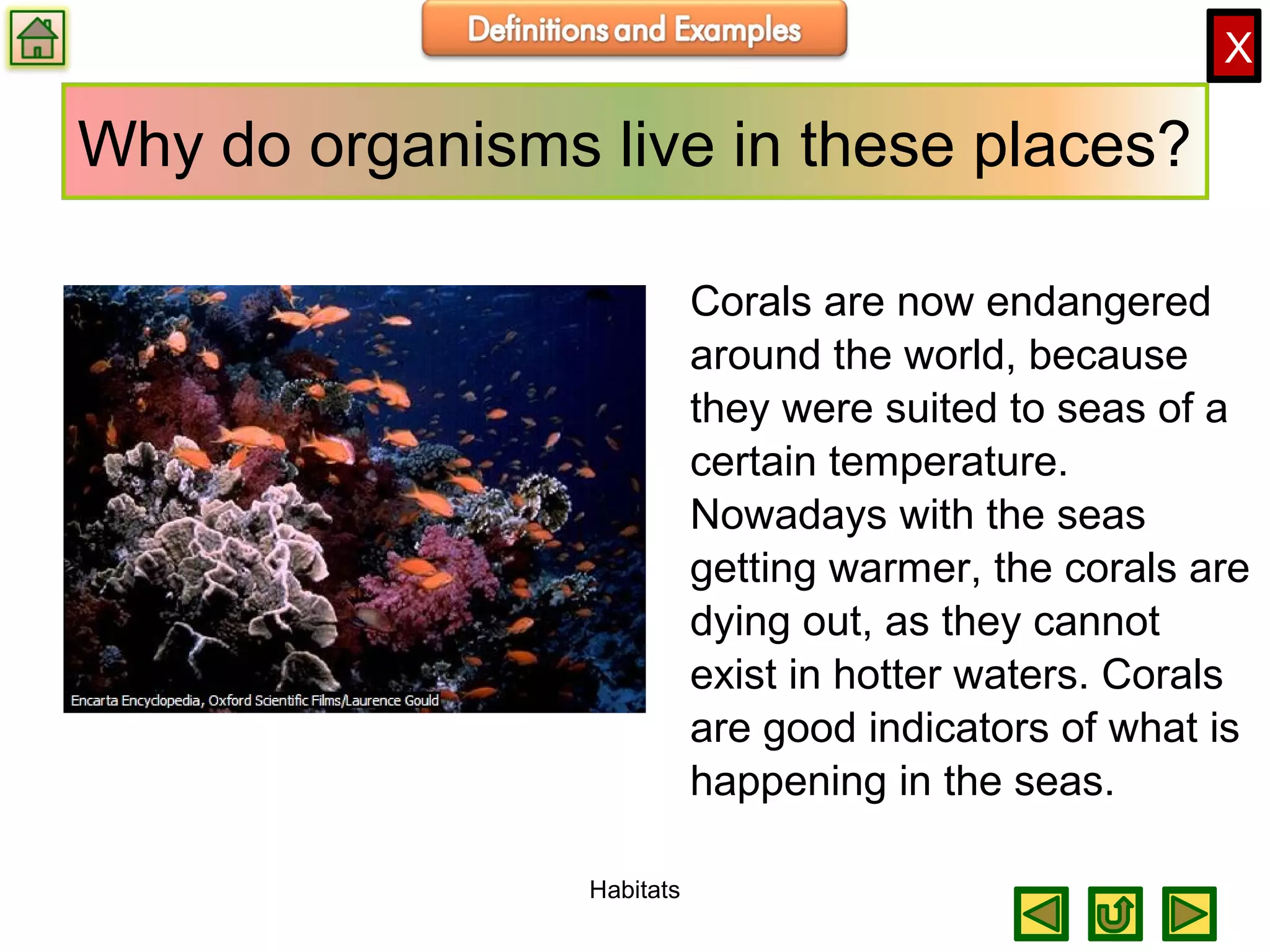
Why do organisms live in these places?
Corals are now endangered
around the world, because
they were suited to seas of a
certain temperature.
Nowadays with the seas
getting warmer, the corals are
dying out, as they cannot
exist in hotter waters. Corals
are good indicators of what is
happening in the seas.
Habitats
X
Types of habitats
Aquatic Area
Aquatic areas can be:
either:
• freshwater or saltwater
(saline);
• be warm water or cool/cold
water.
• still water e.g. ponds,
lakes, or running water
e.g. rivers and streams.
Terrestrial Area
Terrestrial areas can be:
• dry or wet,
• hot or cold,
• on sloping or on level lands
Habitats
X
Micro-habitats
Often, within some habitats there are micro-habitatsmicro-habitats,
which are smaller areas with different characteristics.
For example, a tree has different habitats: the branches,
the bark, the root areas. Another example is the
seaside, which has sandy shorelines with waves, and
also may have shallow areas with rocks, being battered
by the waves
.
Habitats
X
Habitats and Micro-habitats
Let us look at some habitats and micro-habitats
on the next few slides.
1. Decide if they are habitats or micro-habitats first
2. Then consider what are their characteristics: are
they aquatic? On land? Are they hot or cold? Wet or
dry? What organisms do you see there?
3. Do you see how different organisms can exist
together in these habitats?
Habitats
X
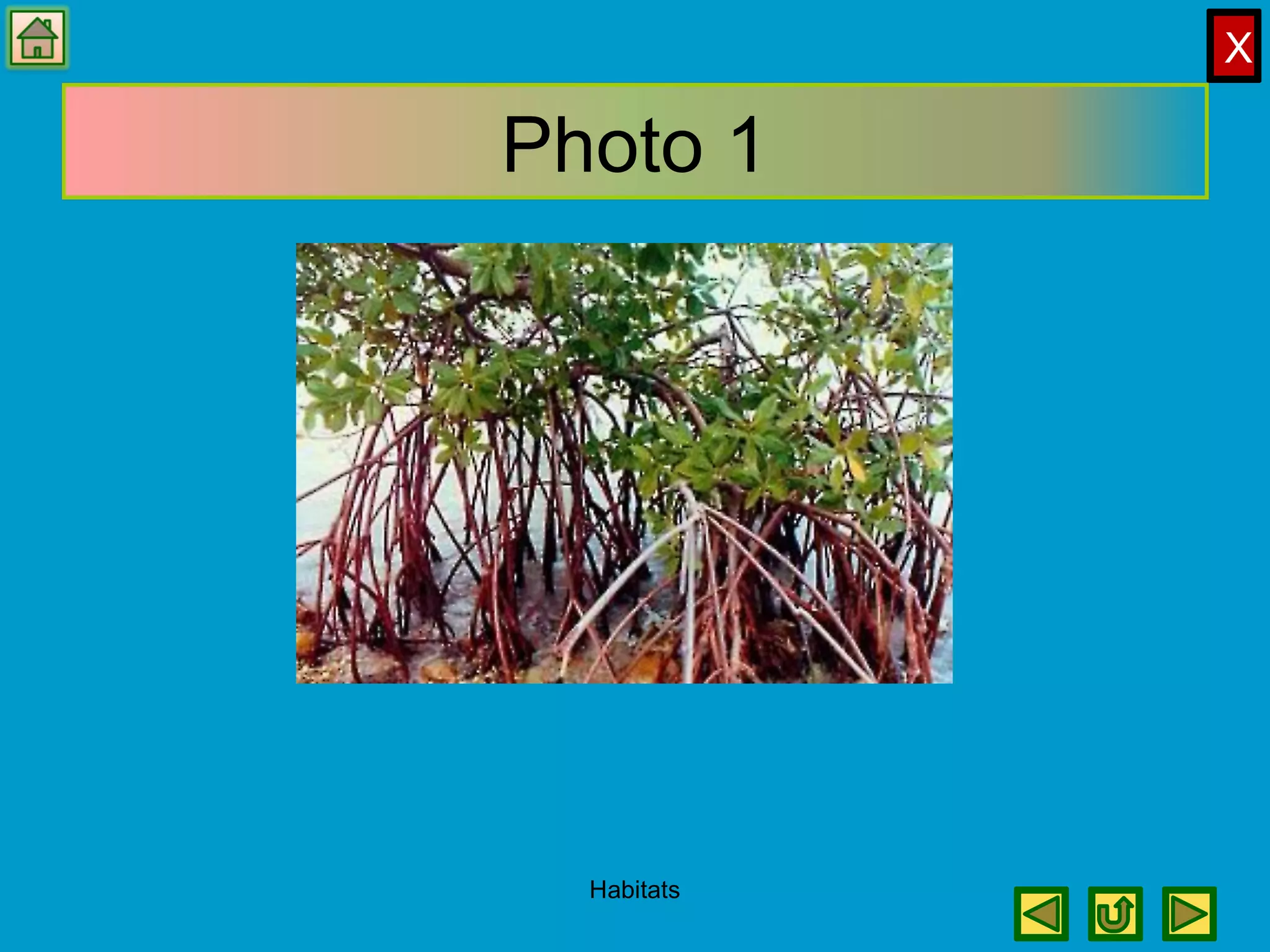
Photo 1
Habitats
X
Photo 2
Habitats
X
Photo 3
Habitats
X
Photo 4
Habitats
X
CHECK !
1. What do you think the mangrove tree in the first photo
represents?
(a) habitat (b) micro-habitat
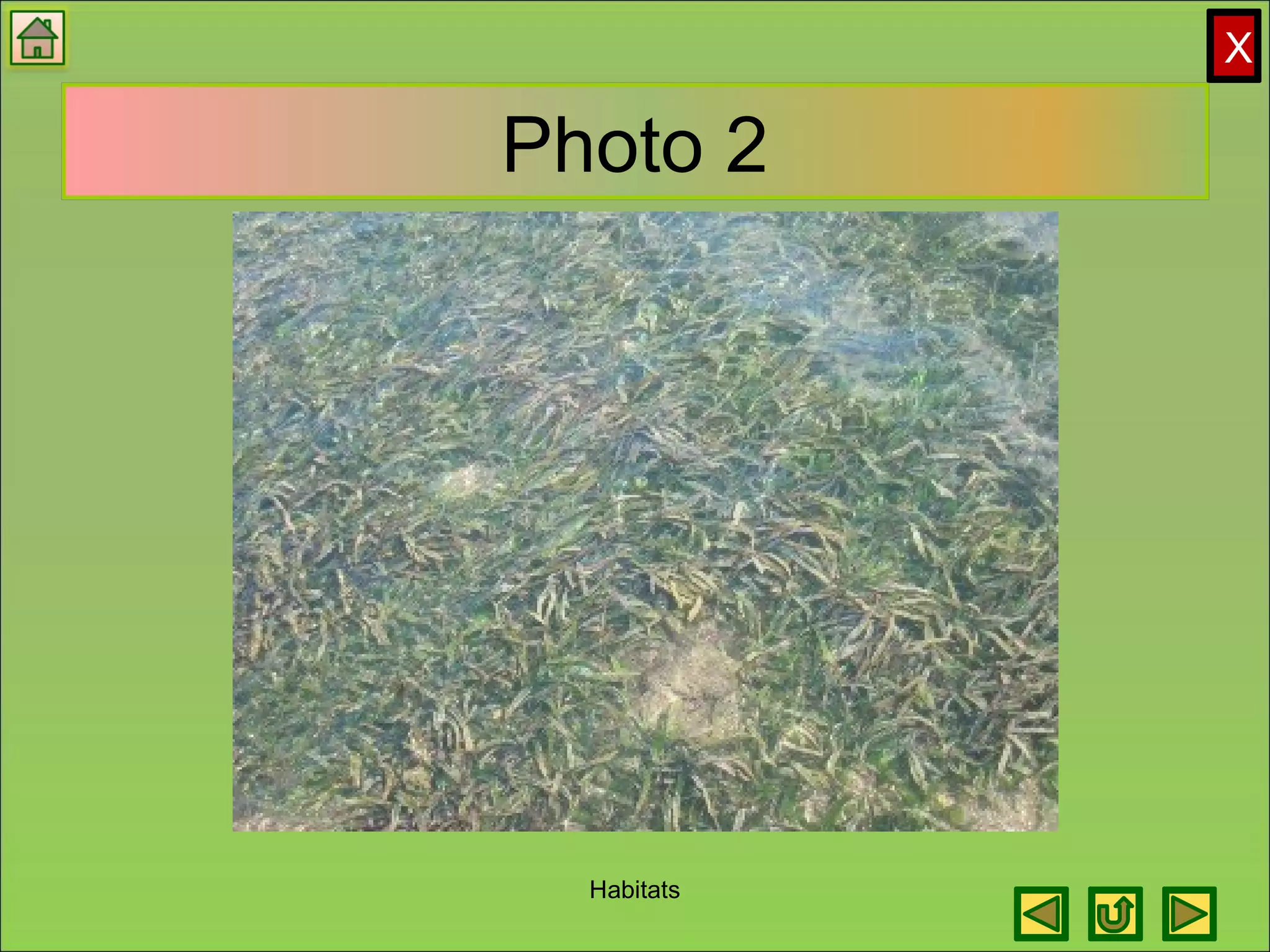
2. What does the second photo, the sea grass bed in
Kingston Harbour represent?
(a) habitat (b) micro-habitat
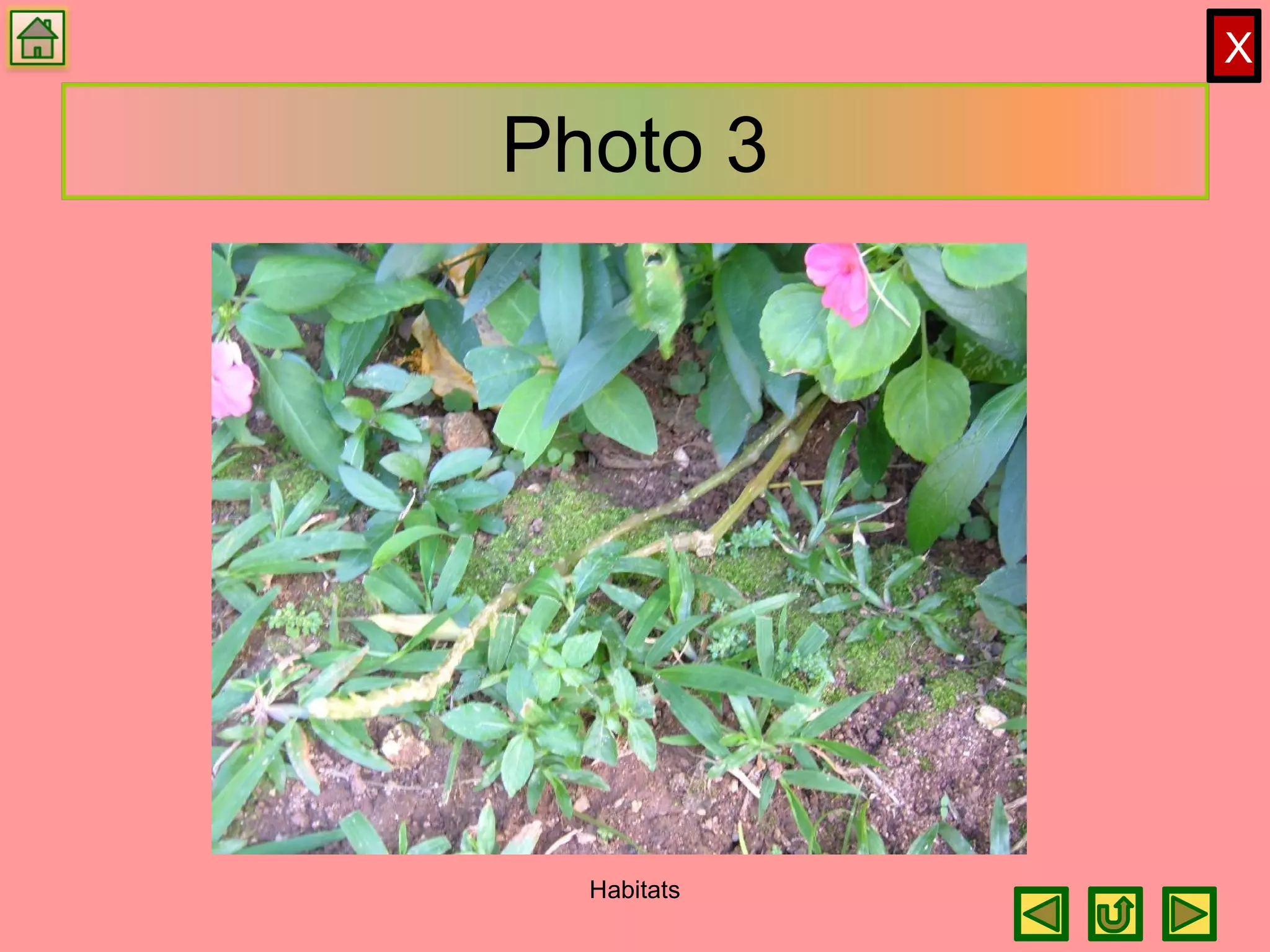
3. The third photo showed some mosses growing
between grasses. What type of habitat is this?
(a) habitat (b) micro-habitat
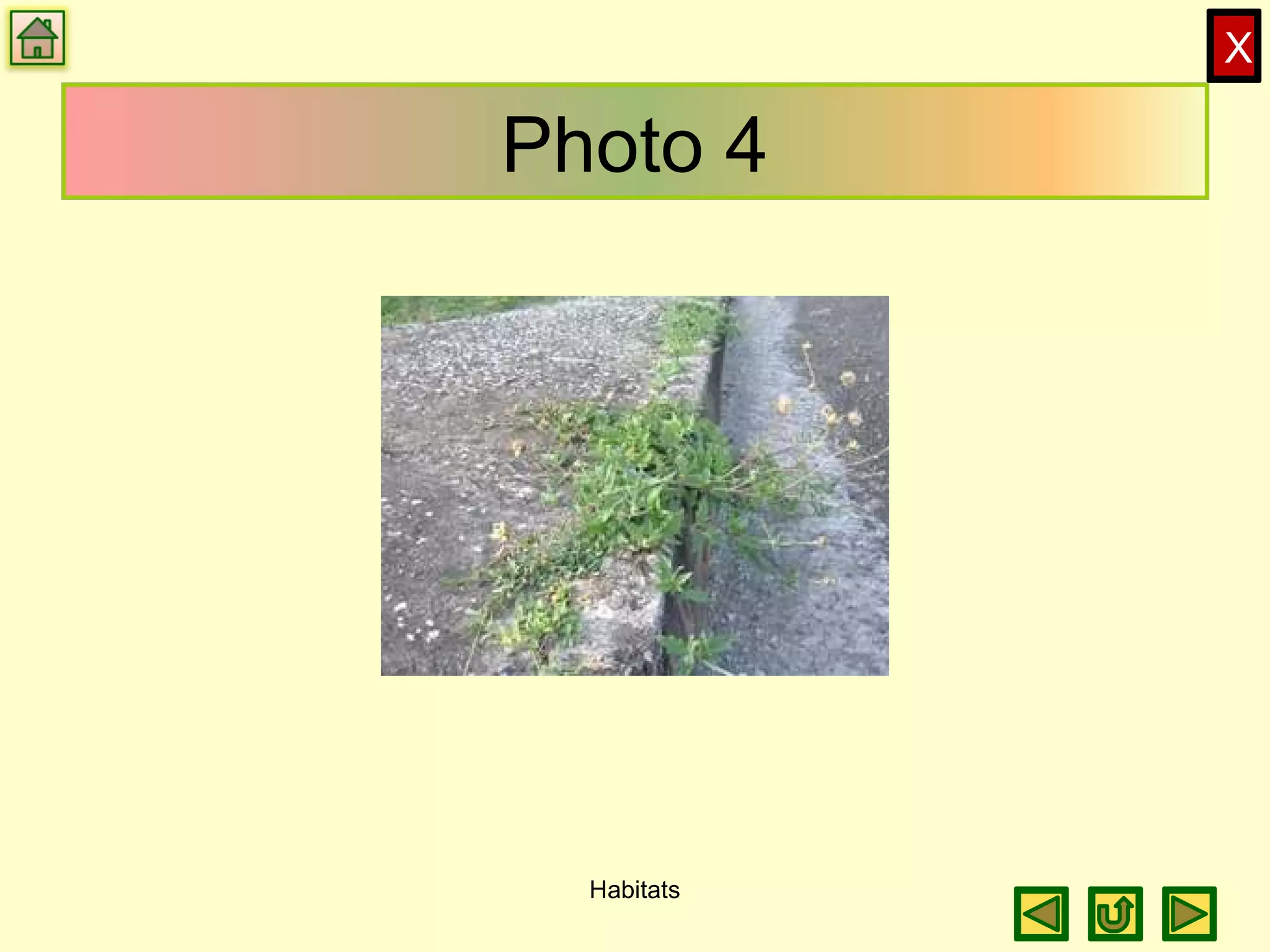
4. What type of habitat does the fourth photo, ‘weed’
growing in the crack of the sidewalk?
(a) habitat (b) micro-habitat
Habitats
X
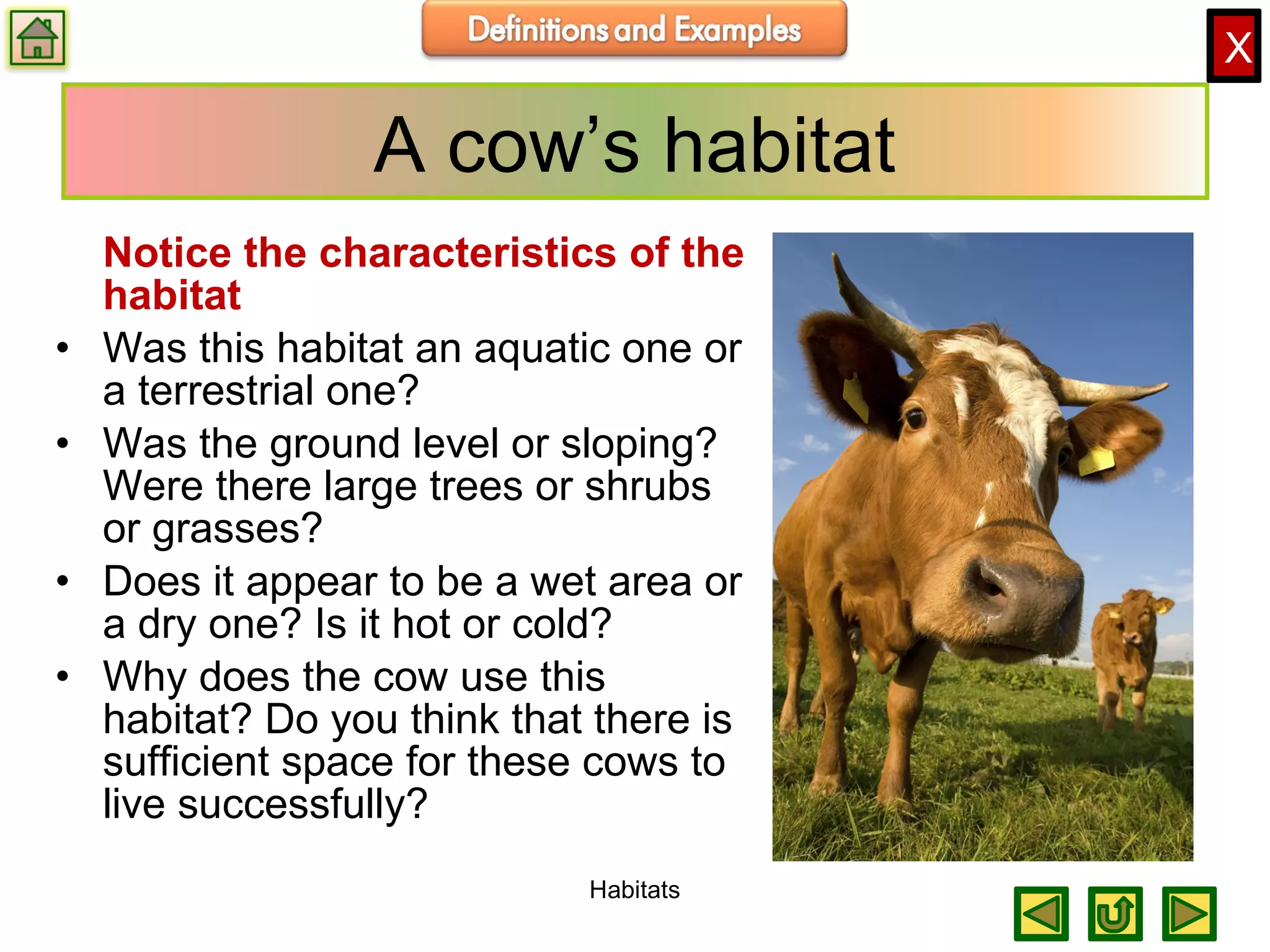
A cow’s habitat
Notice the characteristics of the
habitat
• Was this habitat an aquatic one or
a terrestrial one?
• Was the ground level or sloping?
Were there large trees or shrubs
or grasses?
• Does it appear to be a wet area or
a dry one? Is it hot or cold?
• Why does the cow use this
habitat? Do you think that there is
sufficient space for these cows to
live successfully?
Habitats
X
The habitat of the coffee tree
This is the place where
we find coffee
plantations.
• Notice the high hills
with some steep and
some gentle slopes
• What kind of climate is
found there? Hot?
Dry? Wet?
• What are the
characteristics of the
coffee tree’s habitat?
Habitats
X
Factors Affecting Habitats
• Biotic factors: living organisms, that is, plants
and animals, affect habitats, as they may
destroy them if their numbers are too great; they
may also assist in keeping them stable and
keeping their characteristics the same over time
• Abiotic factors: non-living factors such as
temperature, rainfall, affect habitats, helping to
keep them stable or to change them completely.
Events such as hurricanes, volcanoes, floods
also affect habitats
• Can you think of other factors?
Habitats
X
Photo 5
Habitats
X
Did you see Photo 5?
• What kind of habitat is this? Is it an
aquatic or a terrestrial habitat?
• What are the main factors that affect this
habitat?
• How are these factors or characteristics
influencing the types of organisms that
live in that habitat?
Habitats
X
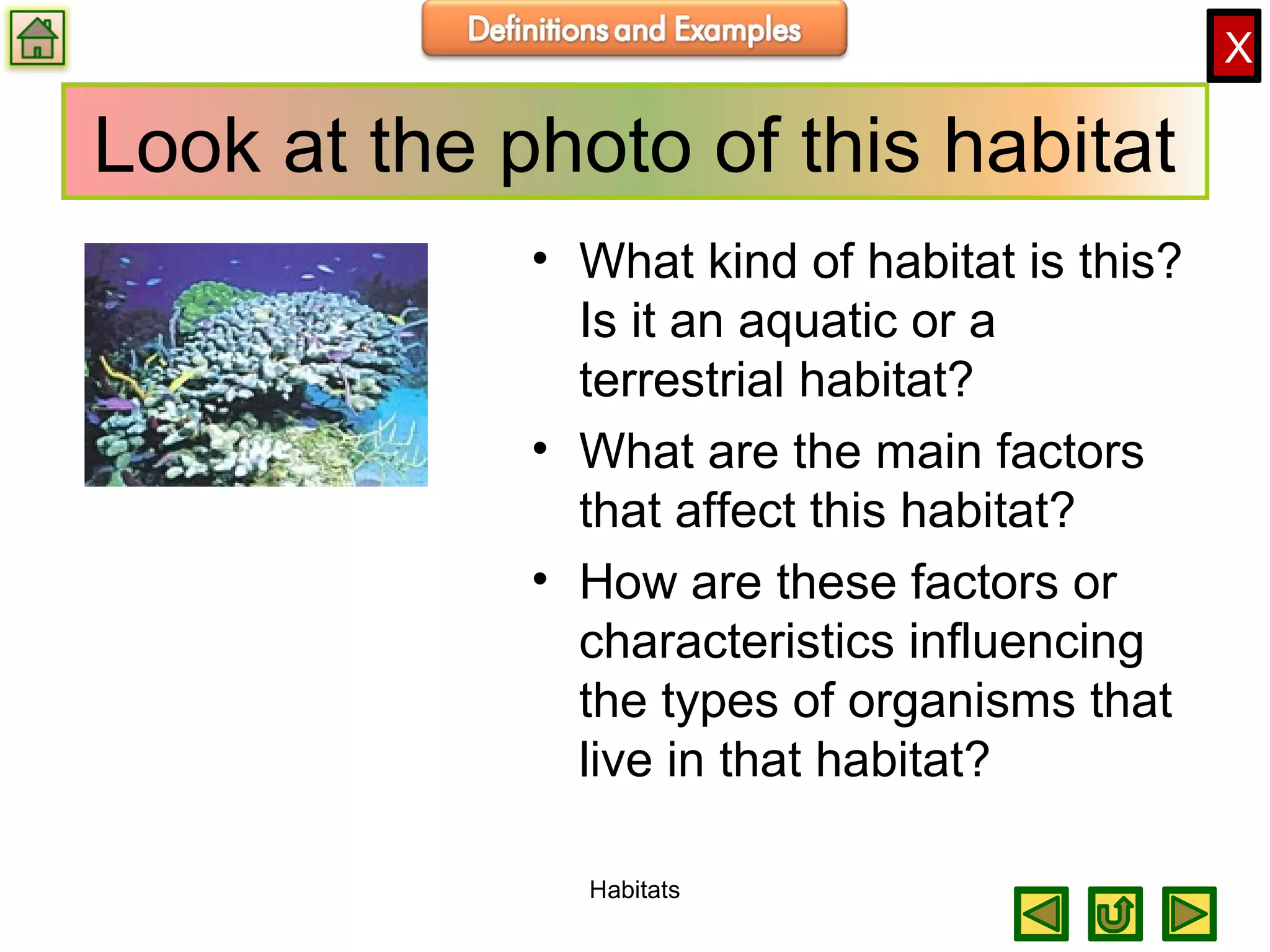
Look at the photo of this habitat
• What kind of habitat is this?
Is it an aquatic or a
terrestrial habitat?
• What are the main factors
that affect this habitat?
• How are these factors or
characteristics influencing
the types of organisms that
live in that habitat?
Habitats
X
Interactions in Habitats
1.Feeding relationships
2.Competition for space, food, mates
3.Interdependence for food, living space
4.Man’s use of the habitat space and resources
for food, living space, water, other resources
5.All organisms also interact with the non-living
parts of the habitat, e.g., with the air, with the
soil, with the type of terrain
Habitats
X
Predation – an interaction
A predatorpredator is an organism which feeds directly on another living
organism. Herbivores can be predators too! They feed on other
living things - plants. Carnivores are animals that eat other
animals.
Predation affects the life of a community, since predators often
eat the slowest or weakest member of the population. This
reduces competition and prevents excess population growth,
which would cause a destruction of the entire habitat. It
sometimes assists in encouraging successful traits to become
dominant in both the predator (one doing eating) and in the prey
(one being eaten).
Species that are preyed on (prey) have developed mechanisms
or adaptations to avoid predation. For example, some plants
have spines to prevent animals eating them; some animals can
run fast or hide (camouflage) to avoid being eaten. Can you
think of any examples?
Habitats
X
Competition – an interaction
What are organisms competing for? Whatever they need for
survival – food, shelter, space for living
Plants compete for space for shoots and roots to grow;
Animals compete for living space, food, water and mates
If you look at the school playfield, you will see many different
types of grasses and weeds there. They are all competing for
nutrients, water and space. The weeds often crowd out the
grasses, as they are both competing for space and sunlight.
Animals usually eat fruit just before they are ripe enough for us
to eat. This ensures that they get their share. Often we don’t get
our share !
Some animals compete with their own species for mates. You
will remember the fights that occur with dogs when the female
up the road is in heat. They are competing for the chance to
mate with the female.
Habitats
X
Symbiosis – an interaction
This can be a useful, friendly
or threatening interaction – it
refers to the living together of
one or more species
There are different types of
symbiosis –
1.commensalism
2.mutualism
3.parasitism
Can you think of examples of
each of these symbiotic
types?
Now look at the photo on the
right.
Habitats
X
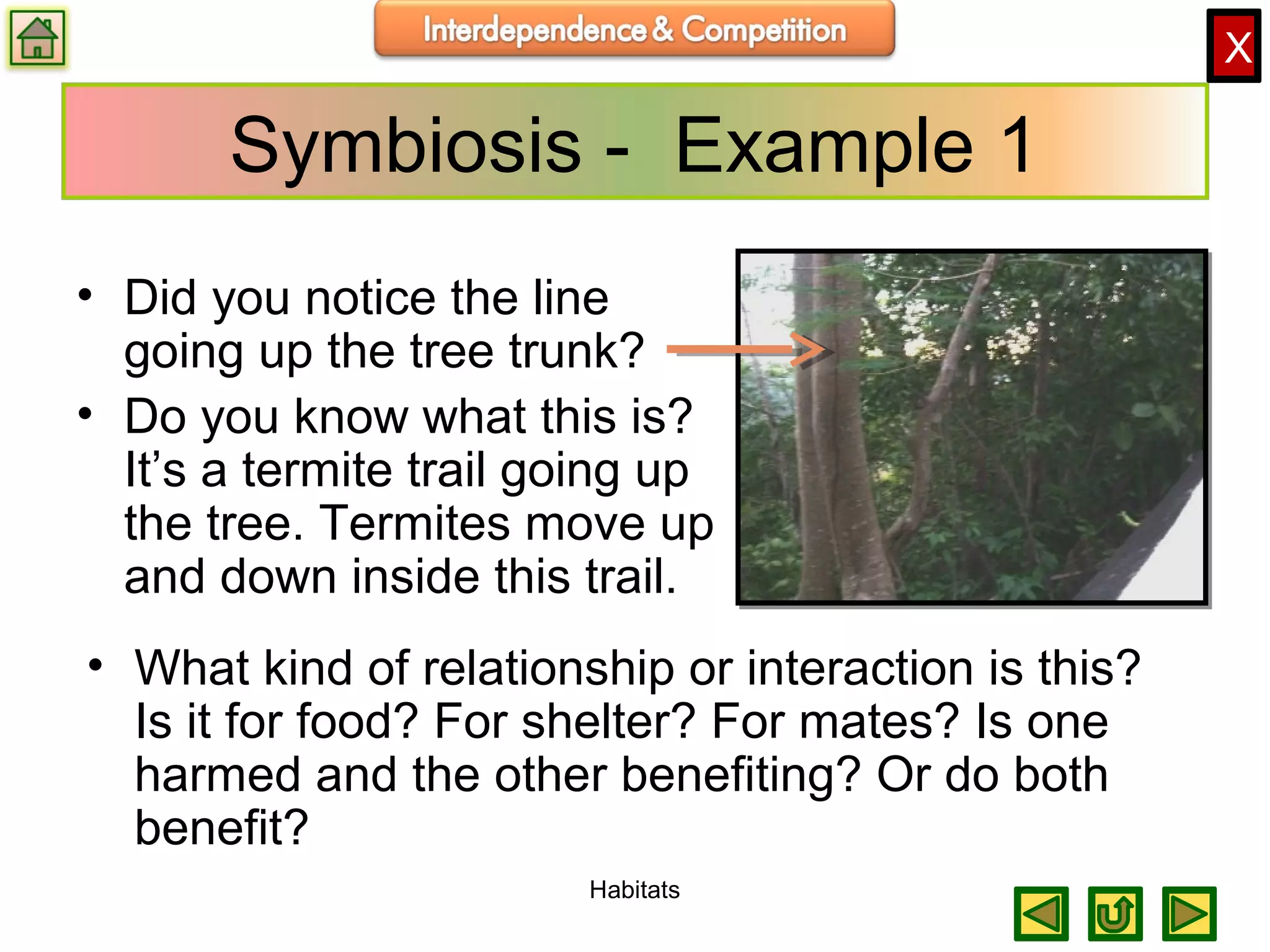
Symbiosis - Example 1
• Did you notice the line
going up the tree trunk?
• Do you know what this is?
It’s a termite trail going up
the tree. Termites move up
and down inside this trail.
• What kind of relationship or interaction is this?
Is it for food? For shelter? For mates? Is one
harmed and the other benefiting? Or do both
benefit?
Habitats
X
Photo taken by: Reynald.d.Chatillon. Retrieved from
http://www.panoramio.com/photo/8089455
Symbiosis – Example 2
• Think of other examples of
these kinds of
relationships.
• Have you ever seen
orchids on trees and “old
man’s beard” on trees.
Look carefully at the
picture on the right to see
the “old man’s beard”
hanging down.
Habitats
X
MAN’S EFFECTS- other interactions!
People of Blue Seas have
been finding crocodiles
often in their community.
They have caught the
animals and some have
even tried to kill them. They
feel that these animals have
no right to invade their
community.
What do you think?
Habitats
X
Man’s effects on habitats
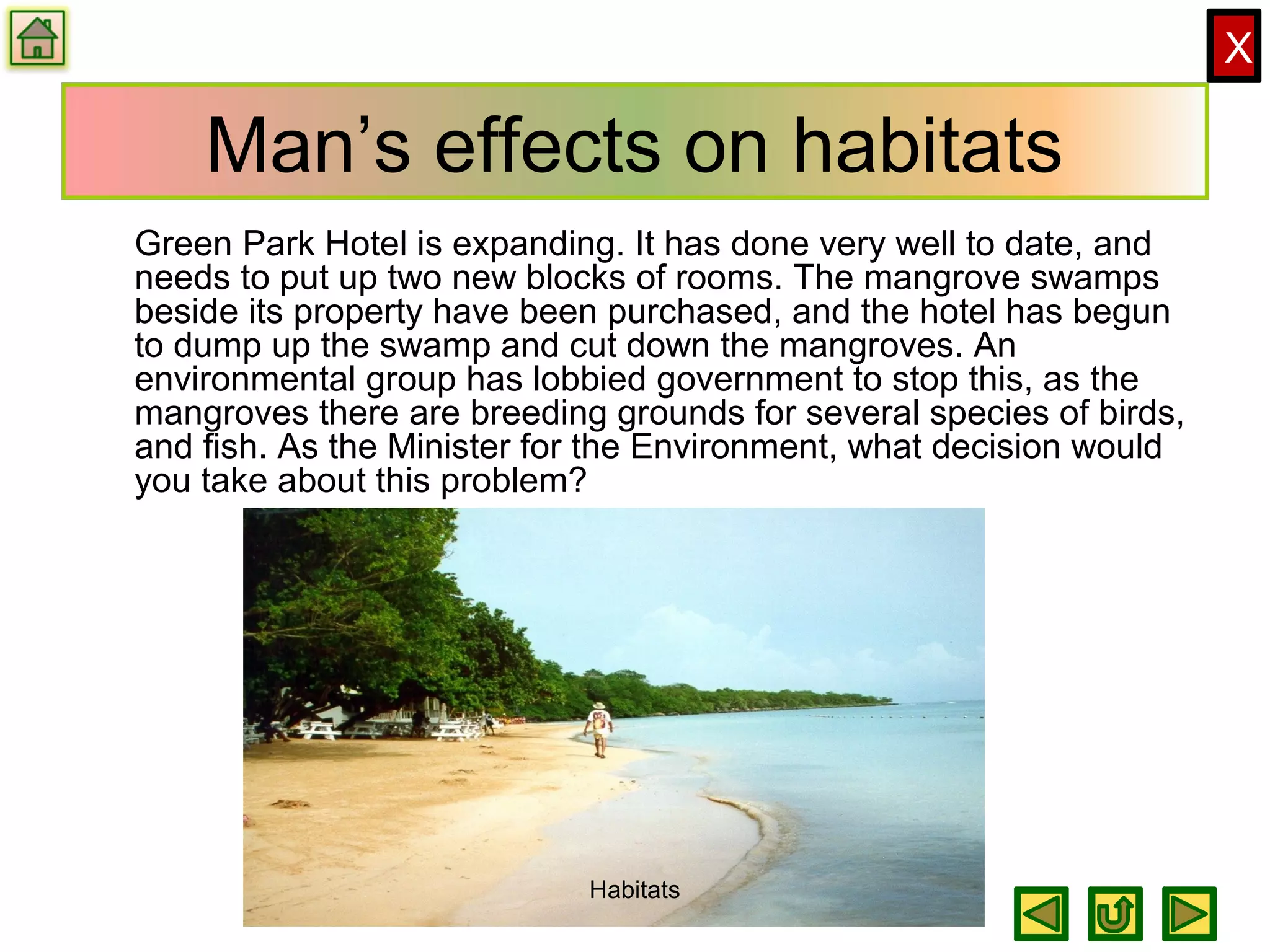
Green Park Hotel is expanding. It has done very well to date, and
needs to put up two new blocks of rooms. The mangrove swamps
beside its property have been purchased, and the hotel has begun
to dump up the swamp and cut down the mangroves. An
environmental group has lobbied government to stop this, as the
mangroves there are breeding grounds for several species of birds,
and fish. As the Minister for the Environment, what decision would
you take about this problem?
Habitats
X
Man’s effects on habitats
In the Green Mountain
village, more people have
come into the area, and
bought forest lands, which
they intend to use to grow
coffee. If you were the head
of the farmers’ cooperative,
what would be your response
to those villagers who do not
approve of your plan?
The villagers feel that their wild pigs will be killed, and have no
homes anymore, that the birds they used to hunt will be there no
more, so that their food supply will be depleted.
Habitats
X
Feeding Interactions are special!
• Feeding interactions or relationships in
habitats are known as food chains.
• Food chains are shown as a series of
living organisms connected by arrows
• Arrows show the movement of energy
from the organism being eaten to the
organism that is eating, for the eater gets
all its energy from eating the other one!
Habitats
X
Can you make a chain of living things, each of
which is eating the other one?
What kind of organism usually begins the chain?
What kind of organism usually ends the chain?
Look at the next slide to see if you thought of any of
these food chains!
Think a little!
What does a lizard
usually eat?
What does a lizard
usually eat?
What does a cockroach
usually eat?
What does a
caterpillar usually
eat?
Habitats
X
Examples of Food Chains
1. Calalloo plants caterpillarsbirdshawks
2. Calalloo plantsperson
3. Grasscowsperson
4. Mangrovesoystersseabirds
5. Nectar of flowersbutterflylizardhawk
Habitats
X
More about Food Chains
Did you notice that arrows were used to join up the
organisms? Back to slide
1.In which direction did the arrows go?
2.What kind of organism begins each food chain?
3.How many levels or layers does the food chain have?
(smallest? largest numbers?)
4.What do we call the organism at the beginning?
5.What do we call the other organisms?
Habitats
CheckCheck
To the right, in the direction that the food energy goes
CheckCheck
CheckCheck
Plants
Producers
Consumers
CheckCheck
X
MORE ABOUT FOOD CHAINS
• Did you notice that in some of the food chains, the organisms ate
plant material, while others ate animal material? The name given to
those that eat plant material is herbivore. The name given to those
that eat animal material is carnivore.
• Do you eat plant material? Or animal material? Or both? Yes,
humans eat both kinds, so they, along with other organisms, are
called omnivores.
• But, you might ask yourself, who eats those organisms at the end
of the food chain? The answer is simple, organisms such as
bacteria, worms, or fungi eat the organisms at the end of the chain
(when they die). Such organisms are called decomposers.
• Sometimes, other organisms eat those at the top of the food chain
when they are still alive. For example, children often get worms
inside their intestines and so they have parasites. At other times,
people get colds or pneumonia, which means that viruses or
bacteria are living inside them. These also are known as
parasites.Often, dogs and cows have ticks living on them that suck
their blood and use it for food. These, too are parasites.
Habitats
X
Review – Food Chains
So, in a food chain, there are three main
types of organisms to be found: producers
(plants that trap the energy from sunlight
in food), consumers (the animals that eat
plants, eat other animals to obtain the
energy from their bodies) and
decomposers (that eat the consumers
bodies and change the proteins, fats and
carbohydrates into simple inorganic
substances, that go into the soil or water)
Habitats
X
Review – Food Chains
• While producers are always plants, consumers can be
of different types: they can either be herbivores,
carnivores or omnivores.
• Sometimes, carnivores or omnivores are even divided
into other types: those that eat others (predator) and
those that are eaten (prey). Do you remember hearing
these words before? Perhaps not in this lesson, but in
your general reading.
• Go outside later and find a lizard. Observe carefully
how he hunts for his prey. If you cannot find a lizard,
look up in the sky for a hawk, and observe how he hunts
for his prey.
• Often, the predator of one organism can become the
prey of another organism. Can you think of an example?
Habitats
X
Food Webs
• You will realize that in any habitat, there cannot
be just one single food chain. There must be
many food chains, since there are many
different organisms living there.
• If many food chains from one habitat are put all
together, then the resulting diagram is called a
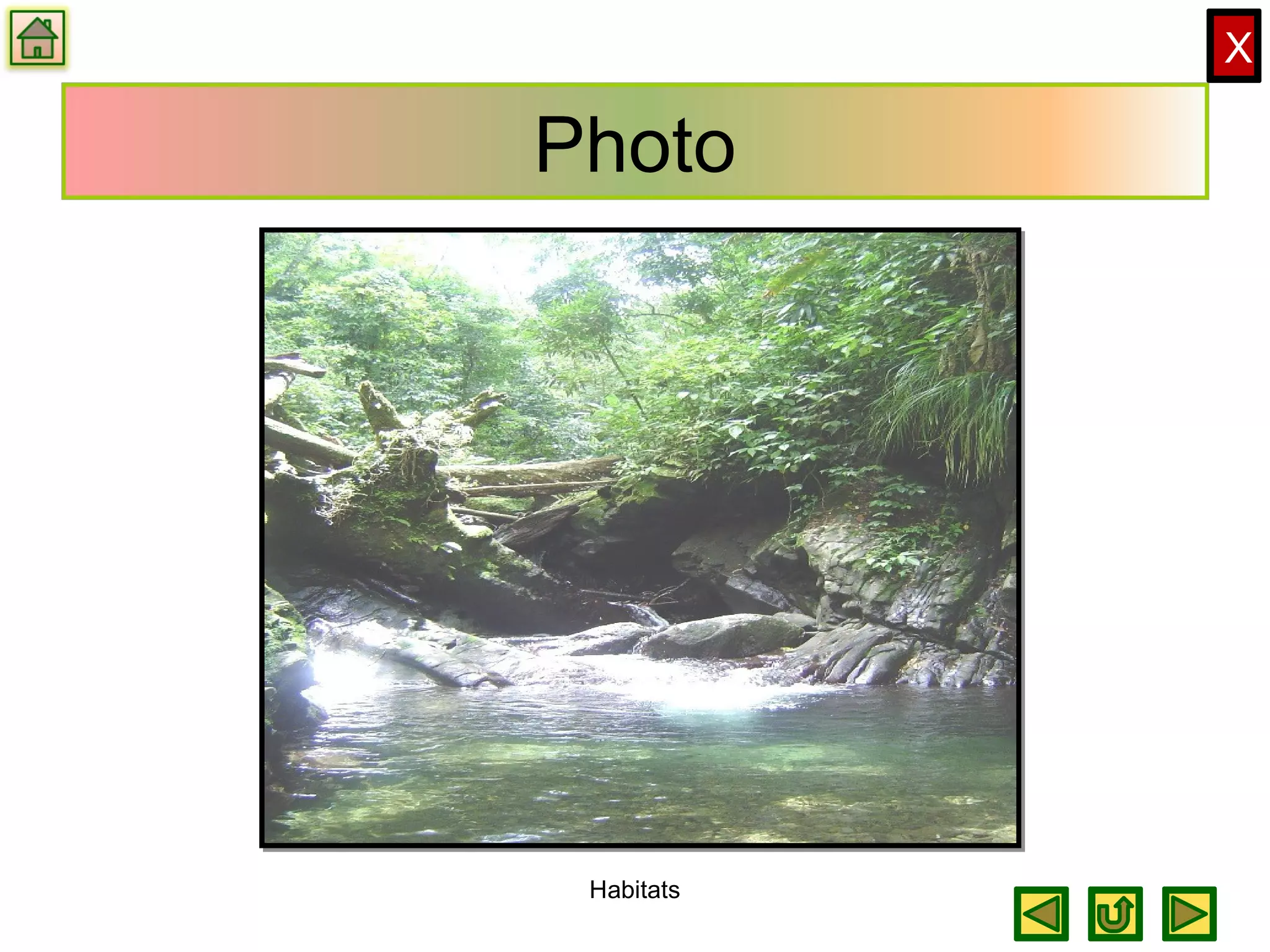
food web. You can see why it is called that,
from looking at the next photo.
Habitats
X
Photo
Habitats
X
Which living things are in this photo?
How many living things can you see?
How many living things might be there that you do not see?
Remember that this photo was taken in the upper Rio Grande valley,
of a small stream, so consider what living things might be present in
that area.
Make a list in your notebook, and check with your teacher to see if you
are right.
Then, make up at least three food chains that might exist in that area.
Did you notice that some of them eat the same things?
This means that they are interacting in several ways.
Can you put all the food chains together now in one diagram? Check
the next slide to see if you are on the right track.
Habitats
X
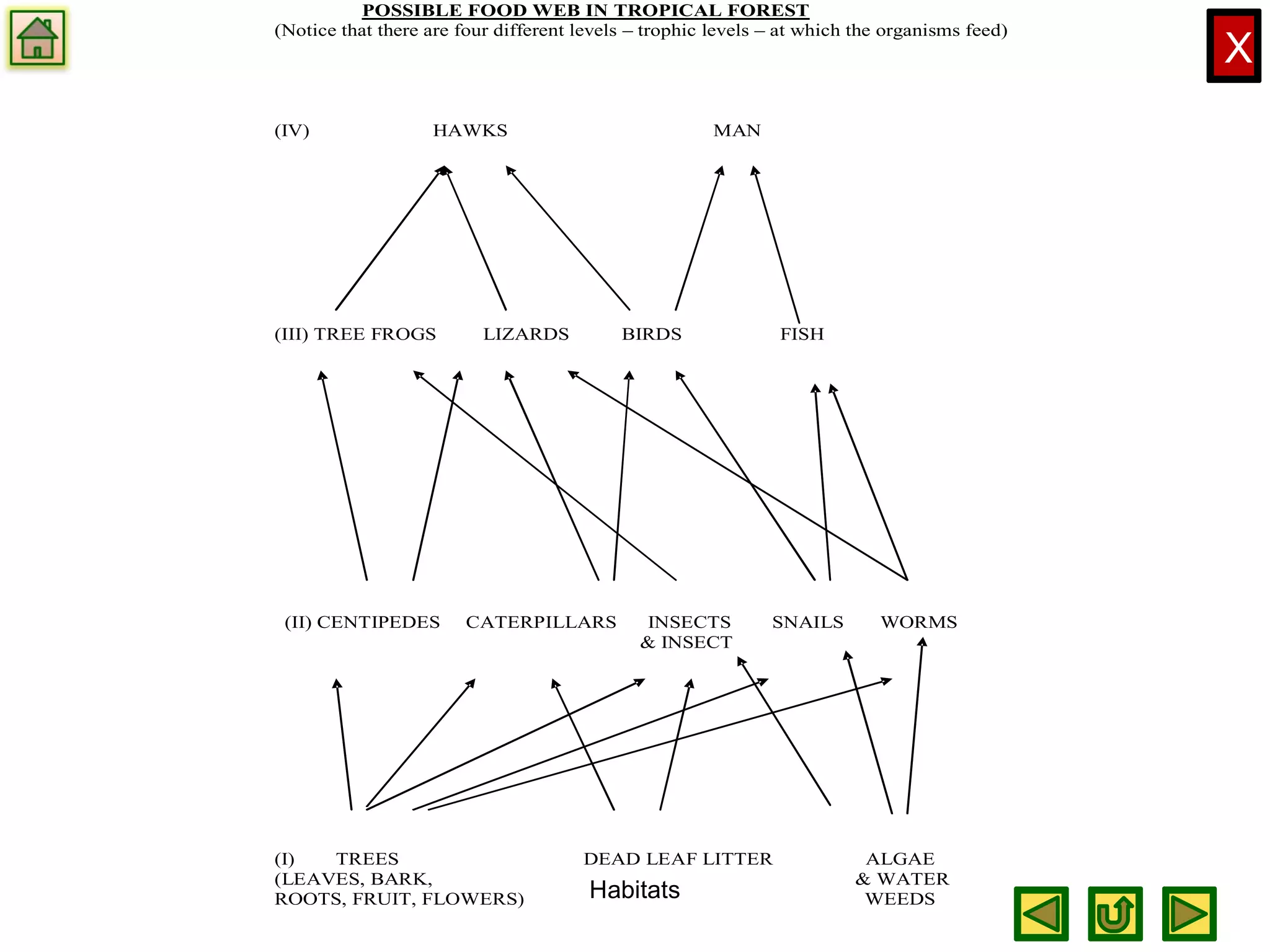
POSSIBLE FOOD WEB IN TROPICAL FOREST
(Notice that there are four different levels – trophic levels – at which the organisms feed)
(IV) HAWKS MAN
(III) TREE FROGS LIZARDS BIRDS FISH
(II) CENTIPEDES CATERPILLARS INSECTS SNAILS WORMS
& INSECT
(I) TREES DEAD LEAF LITTER ALGAE
(LEAVES, BARK, & WATER
ROOTS, FRUIT, FLOWERS) WEEDSHabitats
X
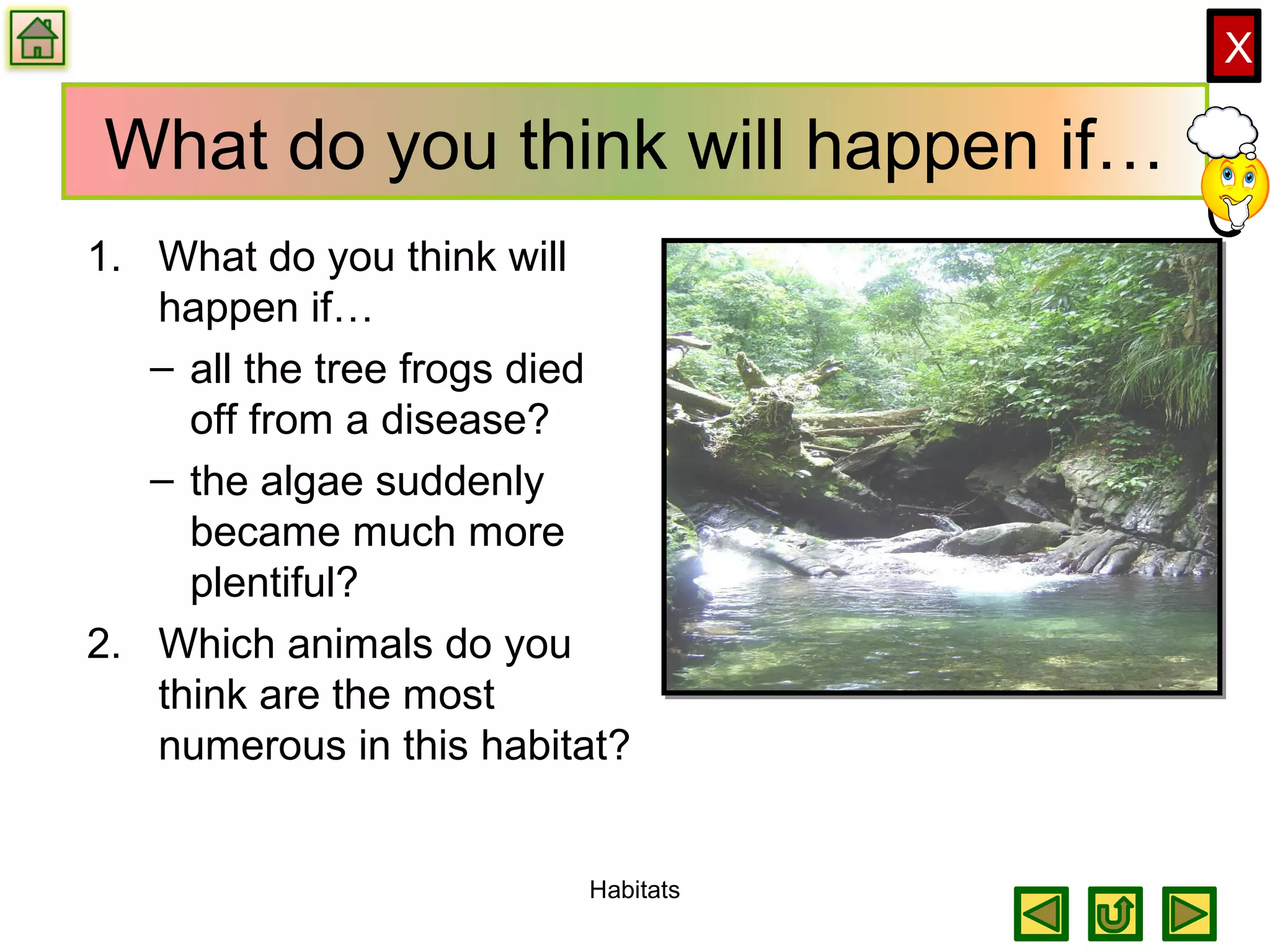
What do you think will happen if…
1. What do you think will
happen if…
– all the tree frogs died
off from a disease?
– the algae suddenly
became much more
plentiful?
2. Which animals do you
think are the most
numerous in this habitat?
Habitats
X
LET’S CHECK!
Maybe you said:
(i) nothing much would happen, since the
hawks feed on other animals
(ii) there would be more worms, insects
and snails to be found, so more of the
organisms that feed on these
There are many more organisms at levels
I, II and III than there are at level IV
Habitats
X
NOW, IT’S TIME FOR YOU TO
DRAW A FOOD WEB !
Make sure you draw the trophic
levels ! (Remember that these
are the feeding levels)
Habitats
X
Comparing Food Webs
• Look at your friend’s food web. Did he/she draw
one from a terrestrial or from an aquatic
habitat? Did either of you consider whether the
same food web would exist in the day and in the
night as well? Or, would the food web in the
night have different organisms than in the day?
• Compare both food webs. Do they contain the
same organisms? Do the two habitats have the
same climate or soil?
• What conclusions can you come to?
Habitats
X
Comparing Food Webs
You are right, if you said that
(i) in different habitats at different times of
day, there will be different food webs! And
(ii) the whole food web, like the food
chains, depends on plants, which are at
the first trophic level
Additionally, (iii) each level depends on
the level below.
Habitats
X
Energy in Food Webs
Remember, it was explained earlier that the arrows in food
chains and webs show the direction in which the energy in
food moves?
In Biology, we say “energy flows from one organism to
another”
However, each time an organism obtains energy from food
a great deal of this energy is used up to do work, or is lost
as heat.
Therefore less energy goes along the chain each time it
meets an organism. So far less energy reaches the
top/end of the food chain than was there at the bottom
end.
Habitats
X
The Movement of Energy
• Plants produce food which contains energy, that
was trapped from sunlight
• Animals consume plants and consume other
animals to obtain that food energy
• Energy gets lost as heat along the chain
Habitats
X
The Movement of Energy
• ENERGY is lost as heat, and is used up
in living things to do work.
So, energy cannot be recycled. It only
flows in one direction.
The number of organisms in a food chain
is therefore dependent on the amount of
energy available from the plants at the
start of the food chain.
Habitats
X
A Pyramid of Numbers
• Sometimes biologists represent what happens in food
chains particularly in each trophic level.
• This is drawn as a pyramid of numbers.
• It represents the numbers of each organism, or each
population at each trophic level.
Habitats
X
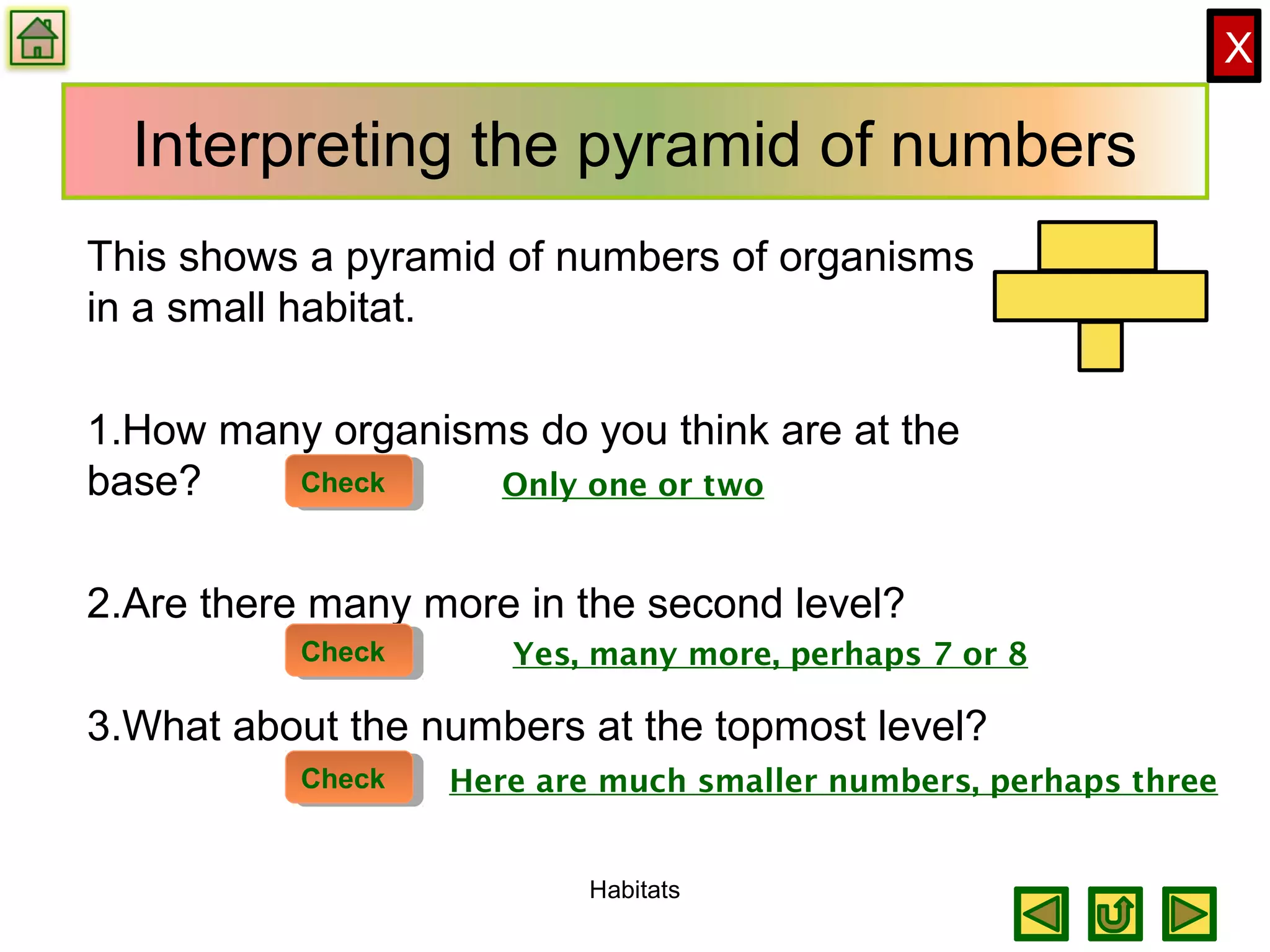
Interpreting the pyramid of numbers
This shows a pyramid of numbers of organisms
in a small habitat.
1.How many organisms do you think are at the
base?
2.Are there many more in the second level?
3.What about the numbers at the topmost level?
Habitats
CheckCheck Only one or two
Yes, many more, perhaps 7 or 8CheckCheck
CheckCheck Here are much smaller numbers, perhaps three
X
Interpreting the pyramid of numbers
Consider if this pyramid represents numbers
of organisms in a tree microhabitat.
•The base might represent the one tree.
•The middle level might represent 8 or 9
caterpillars.
•The topmost level might represent the
two/three birds that eat the caterpillars.
Habitats
X
A Pyramid of Biomass
• Sometimes, instead of using the numbers of
organisms in a pyramid, biologists use the mass
of each population.
• The name ‘biomass’ is a short form of ‘biological
mass’.
Habitats
X
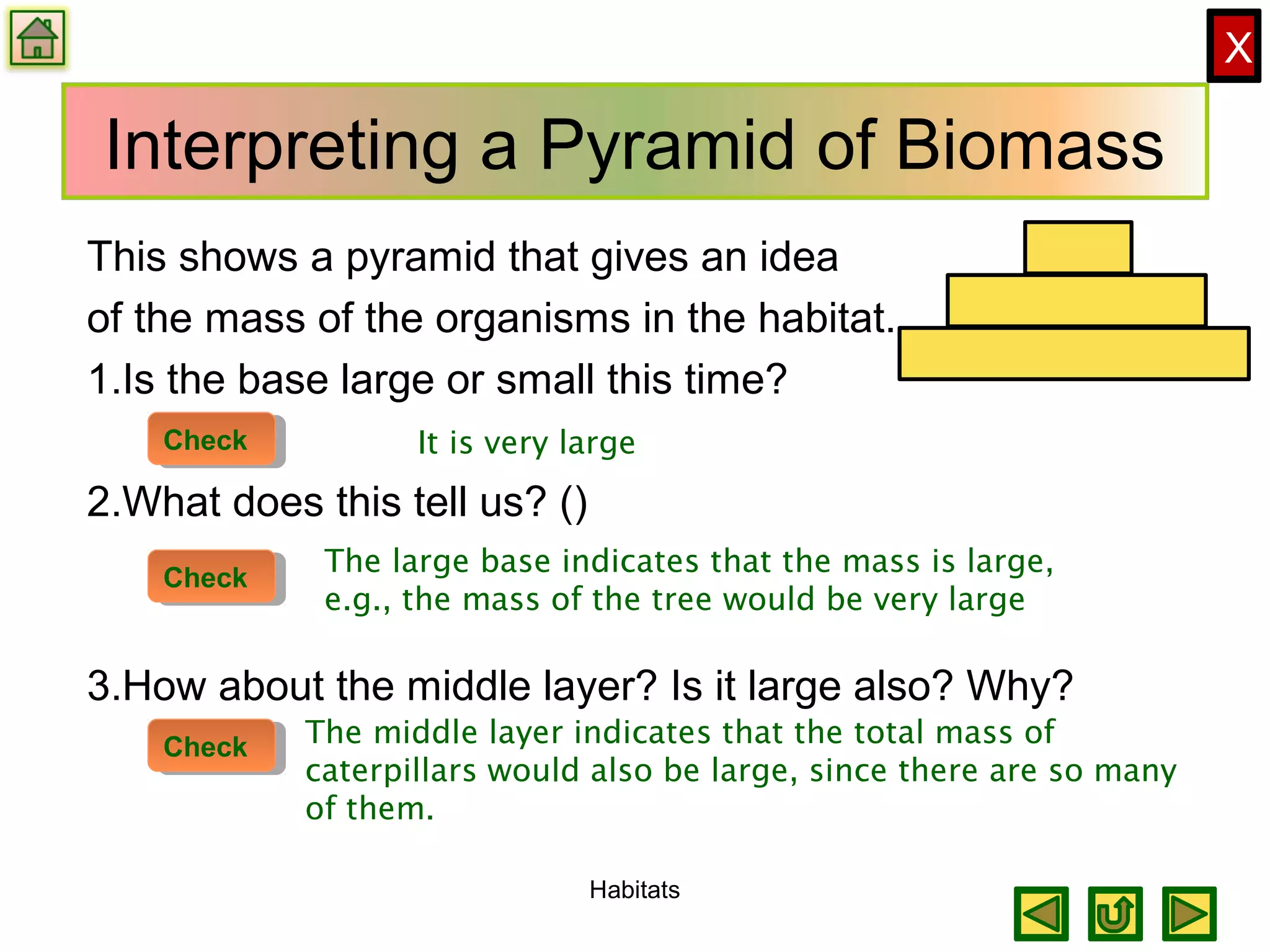
Interpreting a Pyramid of Biomass
This shows a pyramid that gives an idea
of the mass of the organisms in the habitat.
1.Is the base large or small this time?
2.What does this tell us? ()
3.How about the middle layer? Is it large also? Why?
Habitats
CheckCheck It is very large
The large base indicates that the mass is large,
e.g., the mass of the tree would be very large
CheckCheck
CheckCheck The middle layer indicates that the total mass of
caterpillars would also be large, since there are so many
of them.
X
Interpreting a Pyramid of Biomass
4. Now, what of the top layer?
Why does this look so small?
Habitats
CheckCheck It indicates that the mass
of the top layer, i.e. two
birds, would be small in
comparison with the
masses of the other two
layers
X
Introduction to Cycles
In nature, everything does not flow in one direction like the
food/energy chain
In nature, most things are recycled.
It happens like this: simple compounds are taken in by
plants (producers), to make complex compounds. Animals
(consumers) use these complex compounds. Plants and
animals die. These complex compounds are broken up by
the decomposers, and then they are re-used by plants.
We could say that plant food making (photosynthesis) is a
building up process, while digestion and respiration are
breaking down processes.
So things are recycled in nature !
Habitats
X
Looking at cycles
Let us consider the CARBON cycle first.
1. Carbon is part of carbon dioxide which is found in air
2. Plants use carbon dioxide for photosynthesis, and the
carbon atoms become part of the glucose or starch
molecule formed
3. Animals eat the plant and obtain the glucose/starch
which still contains carbon.
4. The glucose is used in respiration to give energy, and
the carbon is released from the plant’s and the animal’s
bodies in respiration as carbon dioxide.
5. So the carbon dioxide goes back out into the air. The
carbon has made a complete cycle !
Habitats
X
The Nitrogen Cycle
This cycle is more complex than the carbon cycle. Nitrogen gas forms
79% of air. But this nitrogen cannot be used by organisms like this. It
has to be changed into a usable form, e.g., nitrates or ammonia.
Lightning changes nitrogen into nitrogen oxide, which dissolves in
rain, enters soil and forms nitrates
Nitrogen fixing bacteria in roots changes nitrogen into nitrates. Now,
it can be used by organisms !!
Plants use it to make proteins. Animals eat these and make their own
proteins. Animals excrete waste nitrogenous materials such as urea.
Then both plants and animals die and are decomposed. Their protein
is changed into ammonia.
Another type of bacteria, nitrifying bacteria, takes ammonia/urea and
changes them into nitrates, that plants can use again.
Finally, some denitrifying bacteria will turn nitrates and ammonia into
nitrogen gas. This is returned to the air.
Habitats
X
Your next task is to use the
information about the carbon and
nitrogen cycles to make your own
cycles in a circular shape !
Ask your teacher to check or look it
up in your textbook to see if you
have done it correctly !
Habitats
X
DO SOMETHING!
Now that you have gone over these two
cycles, see if you can you draw another
cycle.
Can you draw the water cycle?
Think of where water comes from and
where it goes to. Does it go to living
things? Where does it go to afterwards?
How does it cycle?
Habitats
X
What cycles are taking place in this photo?
Are there any food chains taking place?
Is energy flowing in this picture? Describe how this is happening.
Habitats
X
LET’S CHECK…
Energy moves only in one direction through living
organisms in a community or ecosystem (larger
than a habitat). Fresh energy has to come from
the sun every day, for it gets used up.
Food chains show how the energy flows
Other materials such as carbon and nitrogen
move in a circle or cycle through living organisms.
The same material gets used up over and over.
Carbon and nitrogen cycles show how the
materials get recycled.
Habitats
X
Credits
• Photo on Slide __ by Michele Johnson
http://psychology.msu.edu/MichiganJamaicaExchange/jamaican_reptile
s.htm
• Photo by Blissett of Dunn’s River -
http://www.panoramio.com/photo/3061464
• Caterpillar - http://office.microsoft.com/en-us/clipart/results.aspx?
qu=caterpillar&sc=22
• Encarta Encyclopedia CD
Habitats

Biology M1 Ecology Habitats

  • 1.
    X Author: Janice HoLungFebruary 2009 Note: Unless otherwise stated, photos and diagrams were provided by the author and by Lucy Marolyn Gentles. Author: Janice HoLung February 2009 Note: Unless otherwise stated, photos and diagrams were provided by the author and by Lucy Marolyn Gentles.
  • 2.
  • 3.
    X Introduction • This lessonfocuses on the variety of habitats that exist, and the different interactions that occur among species within certain habitats. • Food relationships and interactions are very important, and these will be considered. • It will also take a look at the impacts of man’s activities on the habitats Habitats
  • 4.
    X Objectives Students will beable to: 1. Define and give examples of habitats 2. Describe examples of interdependence and competition among species for habitats 3. Discuss man’s impacts on habitats 4. Construct and explain food chains and webs in different habitats Habitats
  • 5.
    X What is ahabitat? The place where an organism lives The place where an organism lives Can be either land, water or air Can be either land, water or air The home of any living thing – whether it is a plant or an animal The home of any living thing – whether it is a plant or an animal Habitats
  • 6.
    X Why do organismslive in these places? Often for many species, there is a combination of different factors which governs where an organism lives. Why do whales live in the sea? How can whales exist in the sea although they are mammals and breathe air? Why do bats live in caves and not outside in the open? Habitats
  • 7.
    X Why do organismslive in these places? Corals are now endangered around the world, because they were suited to seas of a certain temperature. Nowadays with the seas getting warmer, the corals are dying out, as they cannot exist in hotter waters. Corals are good indicators of what is happening in the seas. Habitats
  • 8.
    X Types of habitats AquaticArea Aquatic areas can be: either: • freshwater or saltwater (saline); • be warm water or cool/cold water. • still water e.g. ponds, lakes, or running water e.g. rivers and streams. Terrestrial Area Terrestrial areas can be: • dry or wet, • hot or cold, • on sloping or on level lands Habitats
  • 9.
    X Micro-habitats Often, within somehabitats there are micro-habitatsmicro-habitats, which are smaller areas with different characteristics. For example, a tree has different habitats: the branches, the bark, the root areas. Another example is the seaside, which has sandy shorelines with waves, and also may have shallow areas with rocks, being battered by the waves . Habitats
  • 10.
    X Habitats and Micro-habitats Letus look at some habitats and micro-habitats on the next few slides. 1. Decide if they are habitats or micro-habitats first 2. Then consider what are their characteristics: are they aquatic? On land? Are they hot or cold? Wet or dry? What organisms do you see there? 3. Do you see how different organisms can exist together in these habitats? Habitats
  • 11.
  • 12.
  • 13.
  • 14.
  • 15.
    X CHECK ! 1. Whatdo you think the mangrove tree in the first photo represents? (a) habitat (b) micro-habitat 2. What does the second photo, the sea grass bed in Kingston Harbour represent? (a) habitat (b) micro-habitat 3. The third photo showed some mosses growing between grasses. What type of habitat is this? (a) habitat (b) micro-habitat 4. What type of habitat does the fourth photo, ‘weed’ growing in the crack of the sidewalk? (a) habitat (b) micro-habitat Habitats
  • 16.
    X A cow’s habitat Noticethe characteristics of the habitat • Was this habitat an aquatic one or a terrestrial one? • Was the ground level or sloping? Were there large trees or shrubs or grasses? • Does it appear to be a wet area or a dry one? Is it hot or cold? • Why does the cow use this habitat? Do you think that there is sufficient space for these cows to live successfully? Habitats
  • 17.
    X The habitat ofthe coffee tree This is the place where we find coffee plantations. • Notice the high hills with some steep and some gentle slopes • What kind of climate is found there? Hot? Dry? Wet? • What are the characteristics of the coffee tree’s habitat? Habitats
  • 18.
    X Factors Affecting Habitats •Biotic factors: living organisms, that is, plants and animals, affect habitats, as they may destroy them if their numbers are too great; they may also assist in keeping them stable and keeping their characteristics the same over time • Abiotic factors: non-living factors such as temperature, rainfall, affect habitats, helping to keep them stable or to change them completely. Events such as hurricanes, volcanoes, floods also affect habitats • Can you think of other factors? Habitats
  • 19.
  • 20.
    X Did you seePhoto 5? • What kind of habitat is this? Is it an aquatic or a terrestrial habitat? • What are the main factors that affect this habitat? • How are these factors or characteristics influencing the types of organisms that live in that habitat? Habitats
  • 21.
    X Look at thephoto of this habitat • What kind of habitat is this? Is it an aquatic or a terrestrial habitat? • What are the main factors that affect this habitat? • How are these factors or characteristics influencing the types of organisms that live in that habitat? Habitats
  • 22.
    X Interactions in Habitats 1.Feedingrelationships 2.Competition for space, food, mates 3.Interdependence for food, living space 4.Man’s use of the habitat space and resources for food, living space, water, other resources 5.All organisms also interact with the non-living parts of the habitat, e.g., with the air, with the soil, with the type of terrain Habitats
  • 23.
    X Predation – aninteraction A predatorpredator is an organism which feeds directly on another living organism. Herbivores can be predators too! They feed on other living things - plants. Carnivores are animals that eat other animals. Predation affects the life of a community, since predators often eat the slowest or weakest member of the population. This reduces competition and prevents excess population growth, which would cause a destruction of the entire habitat. It sometimes assists in encouraging successful traits to become dominant in both the predator (one doing eating) and in the prey (one being eaten). Species that are preyed on (prey) have developed mechanisms or adaptations to avoid predation. For example, some plants have spines to prevent animals eating them; some animals can run fast or hide (camouflage) to avoid being eaten. Can you think of any examples? Habitats
  • 24.
    X Competition – aninteraction What are organisms competing for? Whatever they need for survival – food, shelter, space for living Plants compete for space for shoots and roots to grow; Animals compete for living space, food, water and mates If you look at the school playfield, you will see many different types of grasses and weeds there. They are all competing for nutrients, water and space. The weeds often crowd out the grasses, as they are both competing for space and sunlight. Animals usually eat fruit just before they are ripe enough for us to eat. This ensures that they get their share. Often we don’t get our share ! Some animals compete with their own species for mates. You will remember the fights that occur with dogs when the female up the road is in heat. They are competing for the chance to mate with the female. Habitats
  • 25.
    X Symbiosis – aninteraction This can be a useful, friendly or threatening interaction – it refers to the living together of one or more species There are different types of symbiosis – 1.commensalism 2.mutualism 3.parasitism Can you think of examples of each of these symbiotic types? Now look at the photo on the right. Habitats
  • 26.
    X Symbiosis - Example1 • Did you notice the line going up the tree trunk? • Do you know what this is? It’s a termite trail going up the tree. Termites move up and down inside this trail. • What kind of relationship or interaction is this? Is it for food? For shelter? For mates? Is one harmed and the other benefiting? Or do both benefit? Habitats
  • 27.
    X Photo taken by:Reynald.d.Chatillon. Retrieved from http://www.panoramio.com/photo/8089455 Symbiosis – Example 2 • Think of other examples of these kinds of relationships. • Have you ever seen orchids on trees and “old man’s beard” on trees. Look carefully at the picture on the right to see the “old man’s beard” hanging down. Habitats
  • 28.
    X MAN’S EFFECTS- otherinteractions! People of Blue Seas have been finding crocodiles often in their community. They have caught the animals and some have even tried to kill them. They feel that these animals have no right to invade their community. What do you think? Habitats
  • 29.
    X Man’s effects onhabitats Green Park Hotel is expanding. It has done very well to date, and needs to put up two new blocks of rooms. The mangrove swamps beside its property have been purchased, and the hotel has begun to dump up the swamp and cut down the mangroves. An environmental group has lobbied government to stop this, as the mangroves there are breeding grounds for several species of birds, and fish. As the Minister for the Environment, what decision would you take about this problem? Habitats
  • 30.
    X Man’s effects onhabitats In the Green Mountain village, more people have come into the area, and bought forest lands, which they intend to use to grow coffee. If you were the head of the farmers’ cooperative, what would be your response to those villagers who do not approve of your plan? The villagers feel that their wild pigs will be killed, and have no homes anymore, that the birds they used to hunt will be there no more, so that their food supply will be depleted. Habitats
  • 31.
    X Feeding Interactions arespecial! • Feeding interactions or relationships in habitats are known as food chains. • Food chains are shown as a series of living organisms connected by arrows • Arrows show the movement of energy from the organism being eaten to the organism that is eating, for the eater gets all its energy from eating the other one! Habitats
  • 32.
    X Can you makea chain of living things, each of which is eating the other one? What kind of organism usually begins the chain? What kind of organism usually ends the chain? Look at the next slide to see if you thought of any of these food chains! Think a little! What does a lizard usually eat? What does a lizard usually eat? What does a cockroach usually eat? What does a caterpillar usually eat? Habitats
  • 33.
    X Examples of FoodChains 1. Calalloo plants caterpillarsbirdshawks 2. Calalloo plantsperson 3. Grasscowsperson 4. Mangrovesoystersseabirds 5. Nectar of flowersbutterflylizardhawk Habitats
  • 34.
    X More about FoodChains Did you notice that arrows were used to join up the organisms? Back to slide 1.In which direction did the arrows go? 2.What kind of organism begins each food chain? 3.How many levels or layers does the food chain have? (smallest? largest numbers?) 4.What do we call the organism at the beginning? 5.What do we call the other organisms? Habitats CheckCheck To the right, in the direction that the food energy goes CheckCheck CheckCheck Plants Producers Consumers CheckCheck
  • 35.
    X MORE ABOUT FOODCHAINS • Did you notice that in some of the food chains, the organisms ate plant material, while others ate animal material? The name given to those that eat plant material is herbivore. The name given to those that eat animal material is carnivore. • Do you eat plant material? Or animal material? Or both? Yes, humans eat both kinds, so they, along with other organisms, are called omnivores. • But, you might ask yourself, who eats those organisms at the end of the food chain? The answer is simple, organisms such as bacteria, worms, or fungi eat the organisms at the end of the chain (when they die). Such organisms are called decomposers. • Sometimes, other organisms eat those at the top of the food chain when they are still alive. For example, children often get worms inside their intestines and so they have parasites. At other times, people get colds or pneumonia, which means that viruses or bacteria are living inside them. These also are known as parasites.Often, dogs and cows have ticks living on them that suck their blood and use it for food. These, too are parasites. Habitats
  • 36.
    X Review – FoodChains So, in a food chain, there are three main types of organisms to be found: producers (plants that trap the energy from sunlight in food), consumers (the animals that eat plants, eat other animals to obtain the energy from their bodies) and decomposers (that eat the consumers bodies and change the proteins, fats and carbohydrates into simple inorganic substances, that go into the soil or water) Habitats
  • 37.
    X Review – FoodChains • While producers are always plants, consumers can be of different types: they can either be herbivores, carnivores or omnivores. • Sometimes, carnivores or omnivores are even divided into other types: those that eat others (predator) and those that are eaten (prey). Do you remember hearing these words before? Perhaps not in this lesson, but in your general reading. • Go outside later and find a lizard. Observe carefully how he hunts for his prey. If you cannot find a lizard, look up in the sky for a hawk, and observe how he hunts for his prey. • Often, the predator of one organism can become the prey of another organism. Can you think of an example? Habitats
  • 38.
    X Food Webs • Youwill realize that in any habitat, there cannot be just one single food chain. There must be many food chains, since there are many different organisms living there. • If many food chains from one habitat are put all together, then the resulting diagram is called a food web. You can see why it is called that, from looking at the next photo. Habitats
  • 39.
  • 40.
    X Which living thingsare in this photo? How many living things can you see? How many living things might be there that you do not see? Remember that this photo was taken in the upper Rio Grande valley, of a small stream, so consider what living things might be present in that area. Make a list in your notebook, and check with your teacher to see if you are right. Then, make up at least three food chains that might exist in that area. Did you notice that some of them eat the same things? This means that they are interacting in several ways. Can you put all the food chains together now in one diagram? Check the next slide to see if you are on the right track. Habitats
  • 41.
    X POSSIBLE FOOD WEBIN TROPICAL FOREST (Notice that there are four different levels – trophic levels – at which the organisms feed) (IV) HAWKS MAN (III) TREE FROGS LIZARDS BIRDS FISH (II) CENTIPEDES CATERPILLARS INSECTS SNAILS WORMS & INSECT (I) TREES DEAD LEAF LITTER ALGAE (LEAVES, BARK, & WATER ROOTS, FRUIT, FLOWERS) WEEDSHabitats
  • 42.
    X What do youthink will happen if… 1. What do you think will happen if… – all the tree frogs died off from a disease? – the algae suddenly became much more plentiful? 2. Which animals do you think are the most numerous in this habitat? Habitats
  • 43.
    X LET’S CHECK! Maybe yousaid: (i) nothing much would happen, since the hawks feed on other animals (ii) there would be more worms, insects and snails to be found, so more of the organisms that feed on these There are many more organisms at levels I, II and III than there are at level IV Habitats
  • 44.
    X NOW, IT’S TIMEFOR YOU TO DRAW A FOOD WEB ! Make sure you draw the trophic levels ! (Remember that these are the feeding levels) Habitats
  • 45.
    X Comparing Food Webs •Look at your friend’s food web. Did he/she draw one from a terrestrial or from an aquatic habitat? Did either of you consider whether the same food web would exist in the day and in the night as well? Or, would the food web in the night have different organisms than in the day? • Compare both food webs. Do they contain the same organisms? Do the two habitats have the same climate or soil? • What conclusions can you come to? Habitats
  • 46.
    X Comparing Food Webs Youare right, if you said that (i) in different habitats at different times of day, there will be different food webs! And (ii) the whole food web, like the food chains, depends on plants, which are at the first trophic level Additionally, (iii) each level depends on the level below. Habitats
  • 47.
    X Energy in FoodWebs Remember, it was explained earlier that the arrows in food chains and webs show the direction in which the energy in food moves? In Biology, we say “energy flows from one organism to another” However, each time an organism obtains energy from food a great deal of this energy is used up to do work, or is lost as heat. Therefore less energy goes along the chain each time it meets an organism. So far less energy reaches the top/end of the food chain than was there at the bottom end. Habitats
  • 48.
    X The Movement ofEnergy • Plants produce food which contains energy, that was trapped from sunlight • Animals consume plants and consume other animals to obtain that food energy • Energy gets lost as heat along the chain Habitats
  • 49.
    X The Movement ofEnergy • ENERGY is lost as heat, and is used up in living things to do work. So, energy cannot be recycled. It only flows in one direction. The number of organisms in a food chain is therefore dependent on the amount of energy available from the plants at the start of the food chain. Habitats
  • 50.
    X A Pyramid ofNumbers • Sometimes biologists represent what happens in food chains particularly in each trophic level. • This is drawn as a pyramid of numbers. • It represents the numbers of each organism, or each population at each trophic level. Habitats
  • 51.
    X Interpreting the pyramidof numbers This shows a pyramid of numbers of organisms in a small habitat. 1.How many organisms do you think are at the base? 2.Are there many more in the second level? 3.What about the numbers at the topmost level? Habitats CheckCheck Only one or two Yes, many more, perhaps 7 or 8CheckCheck CheckCheck Here are much smaller numbers, perhaps three
  • 52.
    X Interpreting the pyramidof numbers Consider if this pyramid represents numbers of organisms in a tree microhabitat. •The base might represent the one tree. •The middle level might represent 8 or 9 caterpillars. •The topmost level might represent the two/three birds that eat the caterpillars. Habitats
  • 53.
    X A Pyramid ofBiomass • Sometimes, instead of using the numbers of organisms in a pyramid, biologists use the mass of each population. • The name ‘biomass’ is a short form of ‘biological mass’. Habitats
  • 54.
    X Interpreting a Pyramidof Biomass This shows a pyramid that gives an idea of the mass of the organisms in the habitat. 1.Is the base large or small this time? 2.What does this tell us? () 3.How about the middle layer? Is it large also? Why? Habitats CheckCheck It is very large The large base indicates that the mass is large, e.g., the mass of the tree would be very large CheckCheck CheckCheck The middle layer indicates that the total mass of caterpillars would also be large, since there are so many of them.
  • 55.
    X Interpreting a Pyramidof Biomass 4. Now, what of the top layer? Why does this look so small? Habitats CheckCheck It indicates that the mass of the top layer, i.e. two birds, would be small in comparison with the masses of the other two layers
  • 56.
    X Introduction to Cycles Innature, everything does not flow in one direction like the food/energy chain In nature, most things are recycled. It happens like this: simple compounds are taken in by plants (producers), to make complex compounds. Animals (consumers) use these complex compounds. Plants and animals die. These complex compounds are broken up by the decomposers, and then they are re-used by plants. We could say that plant food making (photosynthesis) is a building up process, while digestion and respiration are breaking down processes. So things are recycled in nature ! Habitats
  • 57.
    X Looking at cycles Letus consider the CARBON cycle first. 1. Carbon is part of carbon dioxide which is found in air 2. Plants use carbon dioxide for photosynthesis, and the carbon atoms become part of the glucose or starch molecule formed 3. Animals eat the plant and obtain the glucose/starch which still contains carbon. 4. The glucose is used in respiration to give energy, and the carbon is released from the plant’s and the animal’s bodies in respiration as carbon dioxide. 5. So the carbon dioxide goes back out into the air. The carbon has made a complete cycle ! Habitats
  • 58.
    X The Nitrogen Cycle Thiscycle is more complex than the carbon cycle. Nitrogen gas forms 79% of air. But this nitrogen cannot be used by organisms like this. It has to be changed into a usable form, e.g., nitrates or ammonia. Lightning changes nitrogen into nitrogen oxide, which dissolves in rain, enters soil and forms nitrates Nitrogen fixing bacteria in roots changes nitrogen into nitrates. Now, it can be used by organisms !! Plants use it to make proteins. Animals eat these and make their own proteins. Animals excrete waste nitrogenous materials such as urea. Then both plants and animals die and are decomposed. Their protein is changed into ammonia. Another type of bacteria, nitrifying bacteria, takes ammonia/urea and changes them into nitrates, that plants can use again. Finally, some denitrifying bacteria will turn nitrates and ammonia into nitrogen gas. This is returned to the air. Habitats
  • 59.
    X Your next taskis to use the information about the carbon and nitrogen cycles to make your own cycles in a circular shape ! Ask your teacher to check or look it up in your textbook to see if you have done it correctly ! Habitats
  • 60.
    X DO SOMETHING! Now thatyou have gone over these two cycles, see if you can you draw another cycle. Can you draw the water cycle? Think of where water comes from and where it goes to. Does it go to living things? Where does it go to afterwards? How does it cycle? Habitats
  • 61.
    X What cycles aretaking place in this photo? Are there any food chains taking place? Is energy flowing in this picture? Describe how this is happening. Habitats
  • 62.
    X LET’S CHECK… Energy movesonly in one direction through living organisms in a community or ecosystem (larger than a habitat). Fresh energy has to come from the sun every day, for it gets used up. Food chains show how the energy flows Other materials such as carbon and nitrogen move in a circle or cycle through living organisms. The same material gets used up over and over. Carbon and nitrogen cycles show how the materials get recycled. Habitats
  • 63.
    X Credits • Photo onSlide __ by Michele Johnson http://psychology.msu.edu/MichiganJamaicaExchange/jamaican_reptile s.htm • Photo by Blissett of Dunn’s River - http://www.panoramio.com/photo/3061464 • Caterpillar - http://office.microsoft.com/en-us/clipart/results.aspx? qu=caterpillar&sc=22 • Encarta Encyclopedia CD Habitats