Use of Psedomonas fluorescens
as biocontrol agent
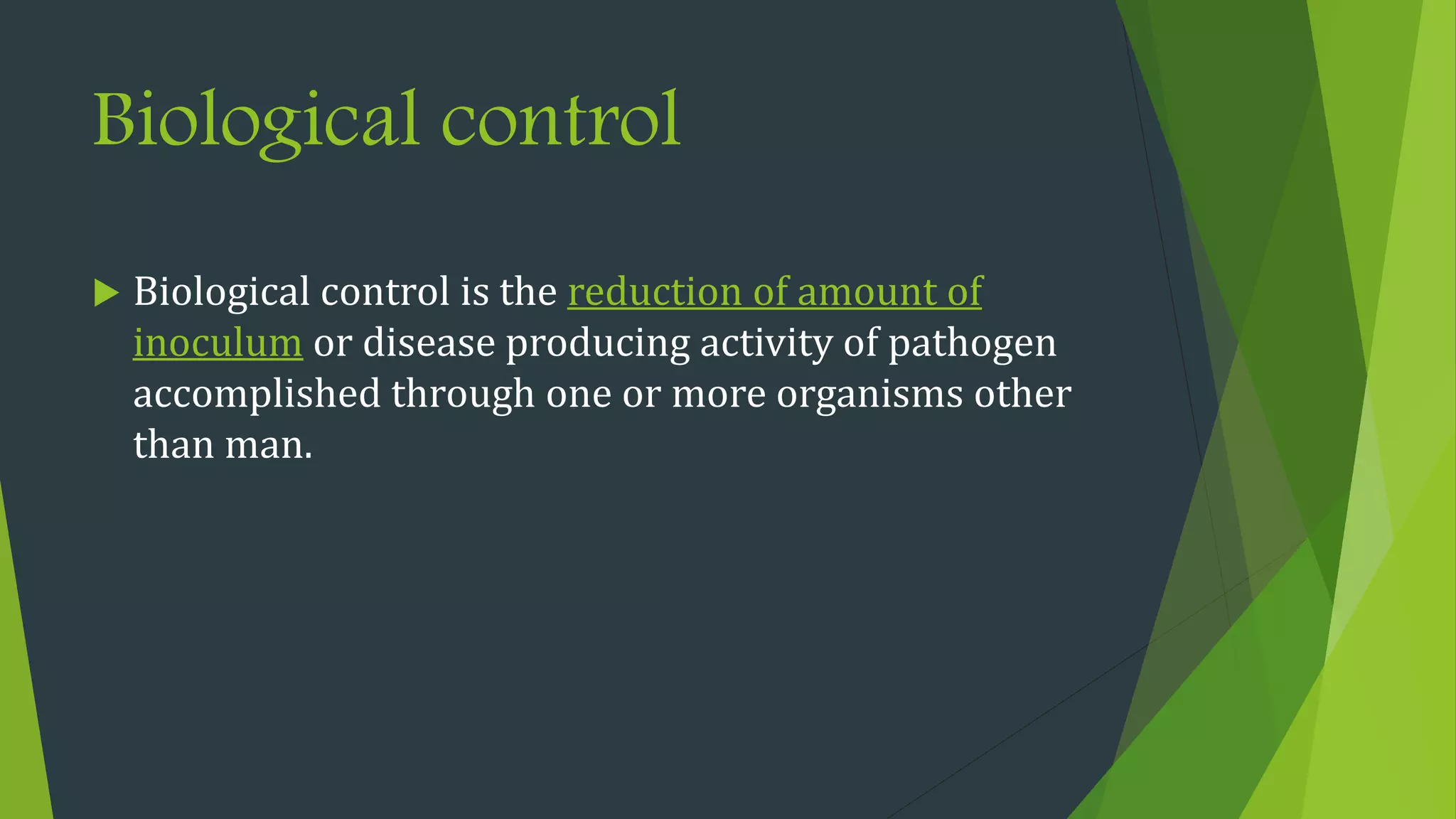
The same plate under UV
light.
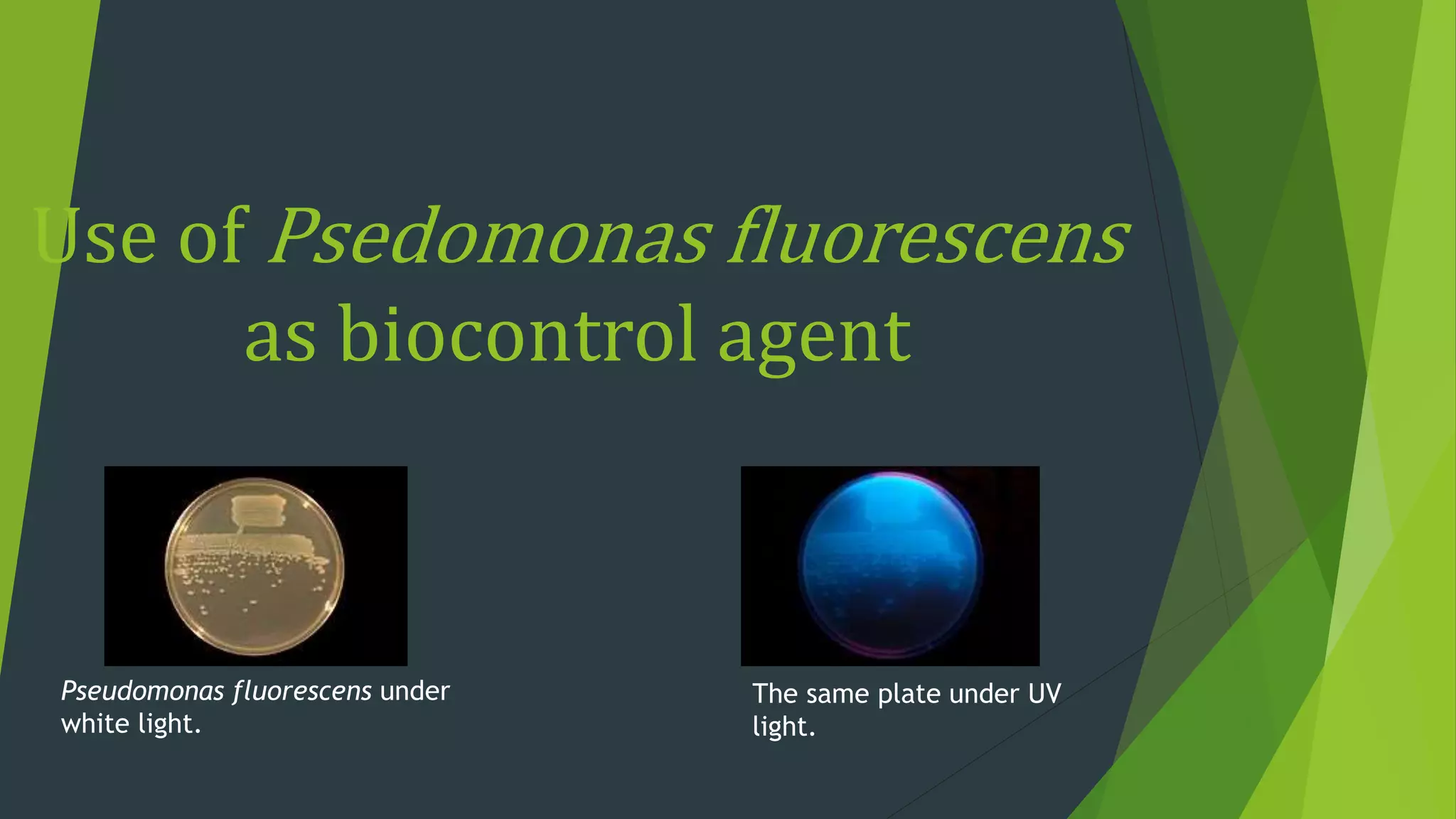
Pseudomonas fluorescens under
white light.
Presented by
 Sandeep Kumar CH
 UG14AGR1989
 College of Agriculture,
 University of Agricultural Sciences, Raichur
Biological control
 Biological control is the reduction of amount of
inoculum or disease producing activity of pathogen
accomplished through one or more organisms other
than man.
Use of microbes as bio control agents
 Many microbes are used as bio control agents for the
control of many diseases, particularly soil borne
diseases.
 Many fungi and bacteria are used as bio control
agents.
 To state among them Trichoderma, Gliocladium,
Ampelomyces are few fungal bioagents and
Agrobacterium radiobacter, Bacillus subtilis and
Pseudomonas fluorescens are few important
bacterial bio control agents.
Importance of Pseudomonas fluorescens
 Biocontrol agents in general
and Pseudomonas fluorescens in particular
have gained importance as a component of
Integrated Pest Management for sustainable
agriculture (Mukhopadhyay, 1987).
Pseudomonas fluorescens
 Pseudomonas fluorescens is a common Gram-
negative, rod-shaped bacterium.
 It belongs to the Pseudomonas genus.
 P. fluorescens has multiple flagella.
 It has an extremely versatile metabolism, and can be
found in the soil and in water.
 It is an obligate aerobe, but certain strains are
capable of using nitrate instead of oxygen as a
final electron acceptor during cellular respiration.
Pseudomonas fluorescens
 Pseudomonas fluorescens belong to Plant
Growth Promoting Rhizobacteria (PGPR), the
important group of bacteria that play a major
role in the plant growth promotion, induced
systemic resistance, biological control of plant
pathogens etc.
P. fluorescens as biocontrol agent
The bacteria P. fluorescens possess many traits that make them
well suited as biocontrol and growth-promoting agents. These
include the ability to-
 Grow rapidly in vitro and to be mass produced.
 Rapidly utilize seed and root exudates.
 Colonize and multiply in the rhizosphere and spermosphere
environments and in the interior of the plants.
P. fluorescens as biocontrol agent
 Produce a wide spectrum of bioactive metabolites.
 Compete aggressively with other microorganisms.
 Adapt to environmental stresses and,
 Inexpensive
Mode of action
 Antibiotic Production
 Siderophores Production
 Induced Systemic Resistance
 Competition
 Hydrogen Cyanide Production
 Plant Growth Promotion Antibiotic Production
Antibiotic production
 The P. fluorescens is very effective antibiotic
producer.
 Many secondary metabolites of P.
fluorescens acts as antibiotics against plant
pathogens.
 The P. fluorescens produces antifungal
compounds which are fungistatic, inhibiting
spore germination and lysis of fungal mycelia.
Antibiotics produced
 Phenazine-1-Carboxylic Acid (PCA)
 2, 4 – Diacetylphloroglucinol (DAPG)
 Pyocinine
 Pyrrolnitrin
 Pyoluteorin
 Oomycin-A
Siderophore production
 Siderophores are extra cellular, low-molecular
weight compounds with very high affinity for
ferric iron.
 As siderophore sequester the limited supply
of iron in the rhizosphere, they limits it’s
availability to pathogens and ultimately
suppress their growth.
Siderophores
 Ferribactin
 Ferrichrome
 Ferroxamine B
 Pseudobactin
 Pyochelin
 Pyoverdine(soluble fluorescent pigment)
Induced systemic resistance
 The P. fluorescens induce systemic resistance in
plants that is phenotypically similar to Systemic
Acquired Resistance (SAR). Induction of resistance
by P. fluorescens is mainly through the:
- Production of phytoalexins.
- Increased lignifications.
- Production of PR-protein in the induced plants.
Phytoalexins
 Phytoalexins are antimicrobial and often
antioxidative substances synthesized de novo(Ln. from
the new or by scratch) by plants that accumulate rapidly at
areas of pathogen infection.
 They are broad spectrum inhibitors and are
chemically diverse with different types characteristic
of particular plant species.
PR- proteins
 Pathogenesis-related (PR) proteins are proteins produced
in plants in the event of a pathogen attack.
 They are induced as part of systemic acquired resistance.
 Infections activate genes that produce PR proteins. Some of
these proteins are antimicrobial, attacking molecules in the
cell wall of a bacterium or fungus.
 Others may function as signals that spread “news” of the
infection to nearby cells. Infections also stimulate the cross-
linking of molecules in the cell wall and the deposition
of lignin, responses that set up a local barricade that slows
spread of the pathogen to other parts of the plant
Competition
 The P. fluorescens pre-empt the establishment
of other rhizosphere microorganisms through
competition for favuored sites on the roots
and in the rhizosphere.
Hydrogen cyanide production
 Hydrogen cyanide (HCN) is representative of
class of volatile inhibitors.
 The P. fluorescens produces HCN which can
check growth of phytopathogens.
Plant Growth Promotion Antibiotic
Production:
 The P. fluorescens promotes plant growth by
prodution of phytohormones such as Auxins
and Gibberrelins and also by Phosphate
solubilization.
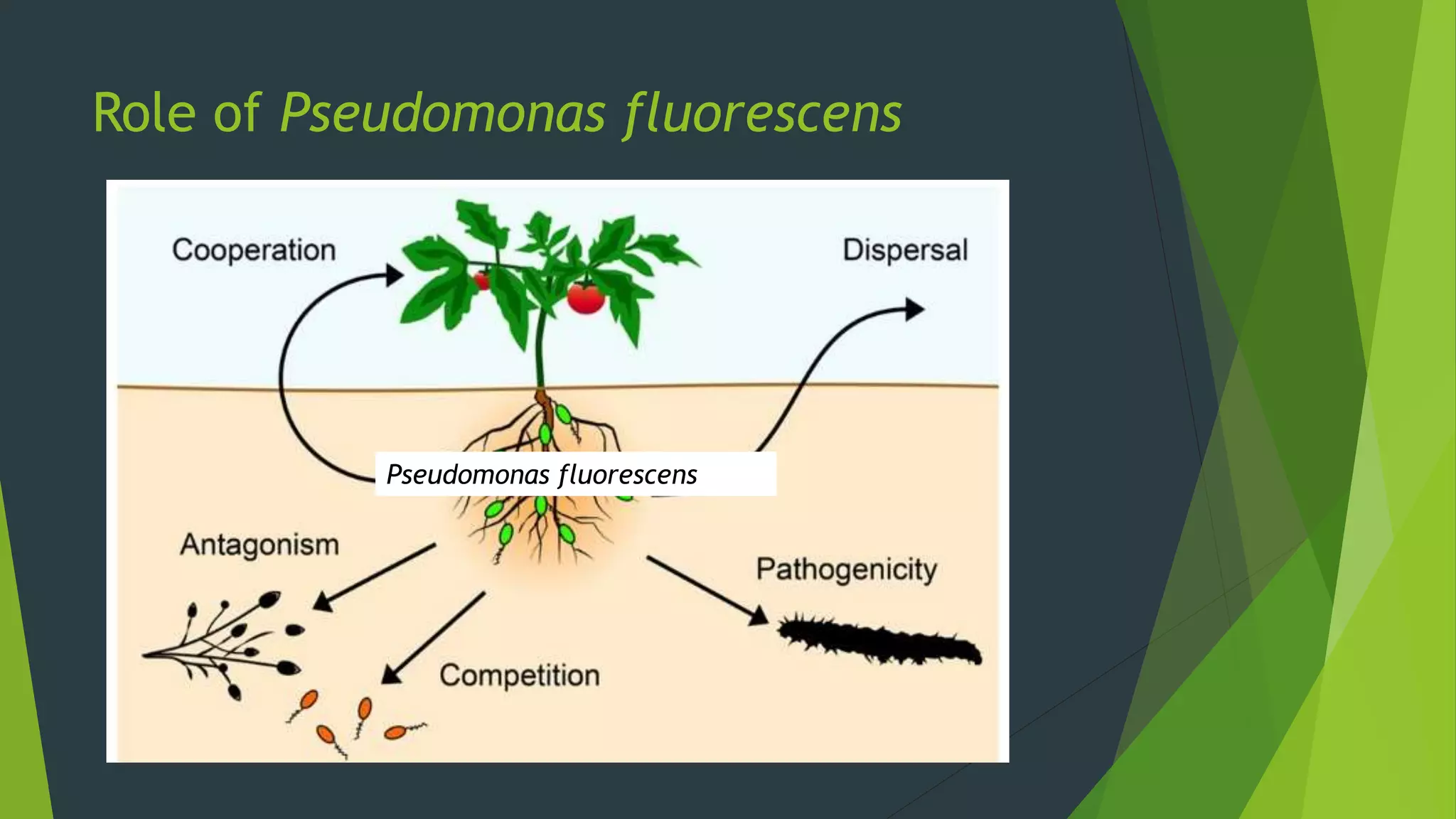
Role of Pseudomonas fluorescens
Pseudomonas fluorescens
Isolation and multiplication
 It is collected from the rhizospheres.
 Serial dilution technique is carried out.
 King’s B medium is used for the culture of
Pseudomonas fluorescens.
 It can be mass multiplied on King’s B broth.
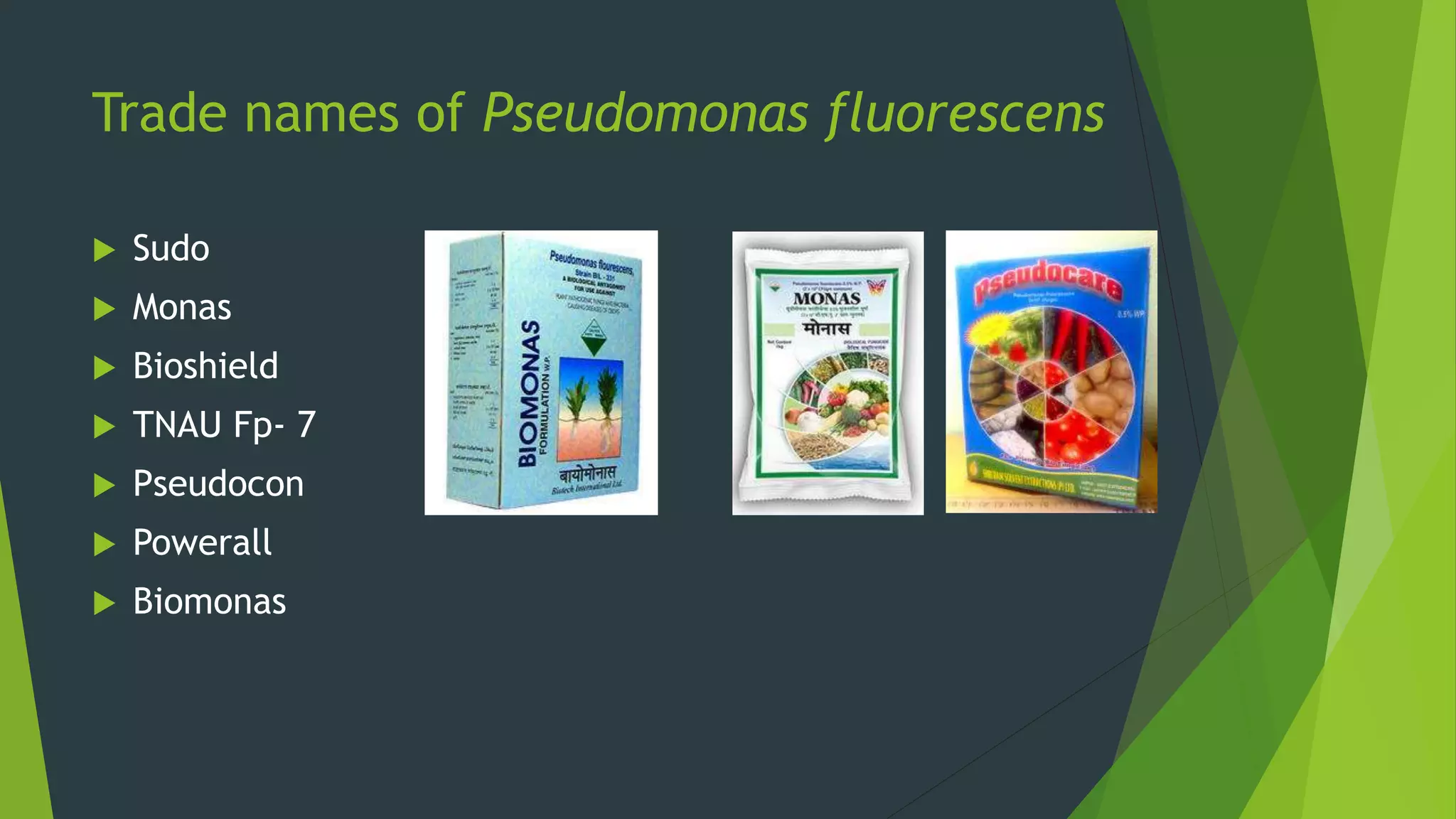
Trade names of Pseudomonas fluorescens
 Sudo
 Monas
 Bioshield
 TNAU Fp- 7
 Pseudocon
 Powerall
 Biomonas
Pathogens controlled by P. fluorescens
 Pythium spp.
 Rhizoctonia solani
 Erwnia caratovora
 Thielaviopsis basicola
 Gaeumannomyces graminis var. tritici

Use of Pseudomonas fluoroscens as biocontrol agent

  • 1.
    Use of Psedomonasfluorescens as biocontrol agent The same plate under UV light. Pseudomonas fluorescens under white light.
  • 2.
    Presented by  SandeepKumar CH  UG14AGR1989  College of Agriculture,  University of Agricultural Sciences, Raichur
  • 3.
    Biological control  Biologicalcontrol is the reduction of amount of inoculum or disease producing activity of pathogen accomplished through one or more organisms other than man.
  • 4.
    Use of microbesas bio control agents  Many microbes are used as bio control agents for the control of many diseases, particularly soil borne diseases.  Many fungi and bacteria are used as bio control agents.  To state among them Trichoderma, Gliocladium, Ampelomyces are few fungal bioagents and Agrobacterium radiobacter, Bacillus subtilis and Pseudomonas fluorescens are few important bacterial bio control agents.
  • 5.
    Importance of Pseudomonasfluorescens  Biocontrol agents in general and Pseudomonas fluorescens in particular have gained importance as a component of Integrated Pest Management for sustainable agriculture (Mukhopadhyay, 1987).
  • 6.
    Pseudomonas fluorescens  Pseudomonasfluorescens is a common Gram- negative, rod-shaped bacterium.  It belongs to the Pseudomonas genus.  P. fluorescens has multiple flagella.  It has an extremely versatile metabolism, and can be found in the soil and in water.  It is an obligate aerobe, but certain strains are capable of using nitrate instead of oxygen as a final electron acceptor during cellular respiration.
  • 7.
    Pseudomonas fluorescens  Pseudomonasfluorescens belong to Plant Growth Promoting Rhizobacteria (PGPR), the important group of bacteria that play a major role in the plant growth promotion, induced systemic resistance, biological control of plant pathogens etc.
  • 8.
    P. fluorescens asbiocontrol agent The bacteria P. fluorescens possess many traits that make them well suited as biocontrol and growth-promoting agents. These include the ability to-  Grow rapidly in vitro and to be mass produced.  Rapidly utilize seed and root exudates.  Colonize and multiply in the rhizosphere and spermosphere environments and in the interior of the plants.
  • 9.
    P. fluorescens asbiocontrol agent  Produce a wide spectrum of bioactive metabolites.  Compete aggressively with other microorganisms.  Adapt to environmental stresses and,  Inexpensive
  • 10.
    Mode of action Antibiotic Production  Siderophores Production  Induced Systemic Resistance  Competition  Hydrogen Cyanide Production  Plant Growth Promotion Antibiotic Production
  • 11.
    Antibiotic production  TheP. fluorescens is very effective antibiotic producer.  Many secondary metabolites of P. fluorescens acts as antibiotics against plant pathogens.  The P. fluorescens produces antifungal compounds which are fungistatic, inhibiting spore germination and lysis of fungal mycelia.
  • 12.
    Antibiotics produced  Phenazine-1-CarboxylicAcid (PCA)  2, 4 – Diacetylphloroglucinol (DAPG)  Pyocinine  Pyrrolnitrin  Pyoluteorin  Oomycin-A
  • 13.
    Siderophore production  Siderophoresare extra cellular, low-molecular weight compounds with very high affinity for ferric iron.  As siderophore sequester the limited supply of iron in the rhizosphere, they limits it’s availability to pathogens and ultimately suppress their growth.
  • 14.
    Siderophores  Ferribactin  Ferrichrome Ferroxamine B  Pseudobactin  Pyochelin  Pyoverdine(soluble fluorescent pigment)
  • 15.
    Induced systemic resistance The P. fluorescens induce systemic resistance in plants that is phenotypically similar to Systemic Acquired Resistance (SAR). Induction of resistance by P. fluorescens is mainly through the: - Production of phytoalexins. - Increased lignifications. - Production of PR-protein in the induced plants.
  • 16.
    Phytoalexins  Phytoalexins areantimicrobial and often antioxidative substances synthesized de novo(Ln. from the new or by scratch) by plants that accumulate rapidly at areas of pathogen infection.  They are broad spectrum inhibitors and are chemically diverse with different types characteristic of particular plant species.
  • 17.
    PR- proteins  Pathogenesis-related(PR) proteins are proteins produced in plants in the event of a pathogen attack.  They are induced as part of systemic acquired resistance.  Infections activate genes that produce PR proteins. Some of these proteins are antimicrobial, attacking molecules in the cell wall of a bacterium or fungus.  Others may function as signals that spread “news” of the infection to nearby cells. Infections also stimulate the cross- linking of molecules in the cell wall and the deposition of lignin, responses that set up a local barricade that slows spread of the pathogen to other parts of the plant
  • 18.
    Competition  The P.fluorescens pre-empt the establishment of other rhizosphere microorganisms through competition for favuored sites on the roots and in the rhizosphere.
  • 19.
    Hydrogen cyanide production Hydrogen cyanide (HCN) is representative of class of volatile inhibitors.  The P. fluorescens produces HCN which can check growth of phytopathogens.
  • 20.
    Plant Growth PromotionAntibiotic Production:  The P. fluorescens promotes plant growth by prodution of phytohormones such as Auxins and Gibberrelins and also by Phosphate solubilization.
  • 21.
    Role of Pseudomonasfluorescens Pseudomonas fluorescens
  • 22.
    Isolation and multiplication It is collected from the rhizospheres.  Serial dilution technique is carried out.  King’s B medium is used for the culture of Pseudomonas fluorescens.  It can be mass multiplied on King’s B broth.
  • 23.
    Trade names ofPseudomonas fluorescens  Sudo  Monas  Bioshield  TNAU Fp- 7  Pseudocon  Powerall  Biomonas
  • 24.
    Pathogens controlled byP. fluorescens  Pythium spp.  Rhizoctonia solani  Erwnia caratovora  Thielaviopsis basicola  Gaeumannomyces graminis var. tritici