KEY CONCEPT All cells need chemical energy.
Starch moleculeGlucose moleculeThe chemical energy used for most cell processes is carried by ATP. Molecules in food store chemical energy in their bonds.
phosphate removedATP transfers energy from the breakdown of food molecules to cell functions.Energy is released when a phosphate group is removed.
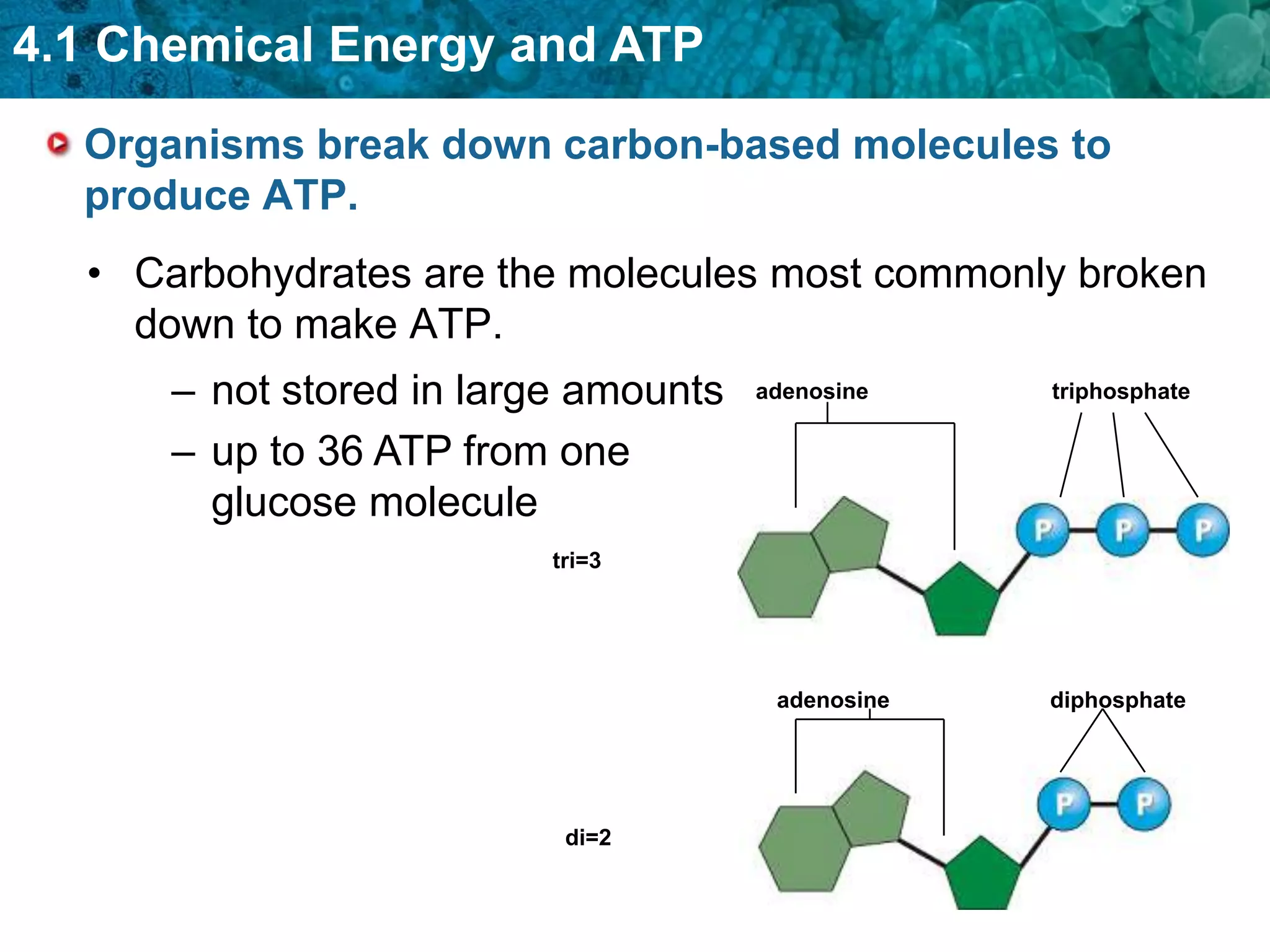
ADP is changed into ATP when a phosphate group is added.triphosphateadenosinetri=3adenosinediphosphatedi=2Organisms break down carbon-based molecules to produce ATP.Carbohydrates are the molecules most commonly broken down to make ATP.not stored in large amounts
up to 36 ATP from one glucose moleculeFats store the most energy.80 percent of the energy in your body
about 146 ATP from a triglyceride
Proteins are least likely to be broken down to make ATP.
amino acids not usually needed for energy
about the same amount of energy as a carbohydrateA few types of organisms do not need sunlight and photosynthesis as a source of energy.Some organisms live in places that never get sunlight.In chemosynthesis, chemical energy is used to build carbon-based molecules.similar to photosynthesisuses chemical energy instead of light energy
KEY CONCEPTThe overall process of photosynthesis produces sugars that store chemical energy.
Photosynthetic organisms are producers.Producers make their own source of chemical energy.Plants use photosynthesis and are producers.Photosynthesis captures energy from sunlight to make sugars.
chloroplastleaf cellleafChlorophyll is a molecule that absorbs light energy.  In plants, chlorophyll is   found in organelles called    chloroplasts.grana (thylakoids)chloroplaststromaPhotosynthesis in plants occurs in chloroplasts.Photosynthesis takes place in two parts of chloroplasts.grana (thylakoids)stroma
The light-dependent reactions capture energy from sunlight.take place in thylakoids
water and sunlight are needed
chlorophyll absorbs energy
energy is transferred along thylakoid membrane then to light-independent reactions
oxygen is releasedThe light-independent reactions make sugars.take place in stroma
needs carbon dioxide from atmosphere
use energy to build a sugar in a cycle of chemical reactionsgranum (stack of thylakoids)chloroplast1sunlight6H2O6O22energythylakoidstroma (fluid outside the thylakoids)6CO21 six-carbon sugarC6H12O643The equation for the overall process is:	6CO2 + 6H2O  C6H12O6 + 6O2
KEY CONCEPT Photosynthesis requires a series of chemical reactions.
The first stage of photosynthesis captures and transfers energy.The light-dependent reactions include groups of molecules called photosystems.
Photosystem II captures and transfers energy.chlorophyll absorbs energy from sunlight
energized electrons enter electron transport chain
water molecules are split
oxygen is released as waste
hydrogen ions are transported across thylakoid membranePhotosystem I captures energy and produces energy-carrying molecules.chlorophyll absorbs energy from sunlight
energized electrons are used to make NADPH
NADPH is transferred to light-independent reactionsThe light-dependent reactions produce ATP.hydrogen ions flow through a channel in the thylakoid membrane
ATP synthase attached to the channel makes ATPThe second stage of photosynthesis uses energy from the first stage to make sugars.Light-independent reactions occur in the stroma and use CO2 molecules.
A molecule of glucose is formed as it stores some of the energy captured from sunlight.carbon dioxide molecules enter the Calvin cycle
energy is added and carbon molecules are rearranged
a high-energy three-carbon molecule leaves the cycleA molecule of glucose is formed as it stores some of the energy captured from sunlight.two three-carbon molecules bond to form a sugar remaining molecules stay in the cycleKEY CONCEPT The overall process of cellular respiration converts sugar into ATP using oxygen.
mitochondrionanimal cellCellular respiration makes ATP by breaking down sugars.Cellular respiration is aerobic, or requires oxygen.Aerobic stages take place in mitochondria.
Glycolysis must take place first.anaerobic process (does not require oxygen)
takes place in cytoplasm
splits glucose into two three-carbon molecules
produces two ATP moleculesATP1mitochondrionmatrix (area enclosedby inner membrane)and6CO 2energy23energy from glycolysisATPinner membraneandand6H  O26O 24Cellular respiration is like a mirror image of photosynthesis.The Krebs cycle transfers energy to an electron transport chain.takes place inmitochondrial matrixbreaks down three-carbonmolecules from glycolysisKrebs Cyclemakes a small amount of ATP
releases carbon dioxide
transfers energy-carrying moleculesATP1mitochondrionmatrix (area enclosedby inner membrane)and6CO 2energy23Electron Transportenergy from glycolysisATPinner membraneandand6H  O26O 24The electron transport chain produces a large amount of ATP.

Unit 4 Chemical Energy And Atp

  • 1.
    KEY CONCEPT Allcells need chemical energy.
  • 2.
    Starch moleculeGlucose moleculeThechemical energy used for most cell processes is carried by ATP. Molecules in food store chemical energy in their bonds.
  • 3.
    phosphate removedATP transfersenergy from the breakdown of food molecules to cell functions.Energy is released when a phosphate group is removed.
  • 4.
    ADP is changedinto ATP when a phosphate group is added.triphosphateadenosinetri=3adenosinediphosphatedi=2Organisms break down carbon-based molecules to produce ATP.Carbohydrates are the molecules most commonly broken down to make ATP.not stored in large amounts
  • 5.
    up to 36ATP from one glucose moleculeFats store the most energy.80 percent of the energy in your body
  • 6.
    about 146 ATPfrom a triglyceride
  • 7.
    Proteins are leastlikely to be broken down to make ATP.
  • 8.
    amino acids notusually needed for energy
  • 9.
    about the sameamount of energy as a carbohydrateA few types of organisms do not need sunlight and photosynthesis as a source of energy.Some organisms live in places that never get sunlight.In chemosynthesis, chemical energy is used to build carbon-based molecules.similar to photosynthesisuses chemical energy instead of light energy
  • 10.
    KEY CONCEPTThe overallprocess of photosynthesis produces sugars that store chemical energy.
  • 11.
    Photosynthetic organisms areproducers.Producers make their own source of chemical energy.Plants use photosynthesis and are producers.Photosynthesis captures energy from sunlight to make sugars.
  • 12.
    chloroplastleaf cellleafChlorophyll isa molecule that absorbs light energy. In plants, chlorophyll is found in organelles called chloroplasts.grana (thylakoids)chloroplaststromaPhotosynthesis in plants occurs in chloroplasts.Photosynthesis takes place in two parts of chloroplasts.grana (thylakoids)stroma
  • 13.
    The light-dependent reactionscapture energy from sunlight.take place in thylakoids
  • 14.
  • 15.
  • 16.
    energy is transferredalong thylakoid membrane then to light-independent reactions
  • 17.
    oxygen is releasedThelight-independent reactions make sugars.take place in stroma
  • 18.
    needs carbon dioxidefrom atmosphere
  • 19.
    use energy tobuild a sugar in a cycle of chemical reactionsgranum (stack of thylakoids)chloroplast1sunlight6H2O6O22energythylakoidstroma (fluid outside the thylakoids)6CO21 six-carbon sugarC6H12O643The equation for the overall process is: 6CO2 + 6H2O  C6H12O6 + 6O2
  • 20.
    KEY CONCEPT Photosynthesisrequires a series of chemical reactions.
  • 21.
    The first stageof photosynthesis captures and transfers energy.The light-dependent reactions include groups of molecules called photosystems.
  • 22.
    Photosystem II capturesand transfers energy.chlorophyll absorbs energy from sunlight
  • 23.
    energized electrons enterelectron transport chain
  • 24.
  • 25.
  • 26.
    hydrogen ions aretransported across thylakoid membranePhotosystem I captures energy and produces energy-carrying molecules.chlorophyll absorbs energy from sunlight
  • 27.
    energized electrons areused to make NADPH
  • 28.
    NADPH is transferredto light-independent reactionsThe light-dependent reactions produce ATP.hydrogen ions flow through a channel in the thylakoid membrane
  • 29.
    ATP synthase attachedto the channel makes ATPThe second stage of photosynthesis uses energy from the first stage to make sugars.Light-independent reactions occur in the stroma and use CO2 molecules.
  • 30.
    A molecule ofglucose is formed as it stores some of the energy captured from sunlight.carbon dioxide molecules enter the Calvin cycle
  • 31.
    energy is addedand carbon molecules are rearranged
  • 32.
    a high-energy three-carbonmolecule leaves the cycleA molecule of glucose is formed as it stores some of the energy captured from sunlight.two three-carbon molecules bond to form a sugar remaining molecules stay in the cycleKEY CONCEPT The overall process of cellular respiration converts sugar into ATP using oxygen.
  • 33.
    mitochondrionanimal cellCellular respirationmakes ATP by breaking down sugars.Cellular respiration is aerobic, or requires oxygen.Aerobic stages take place in mitochondria.
  • 34.
    Glycolysis must takeplace first.anaerobic process (does not require oxygen)
  • 35.
  • 36.
    splits glucose intotwo three-carbon molecules
  • 37.
    produces two ATPmoleculesATP1mitochondrionmatrix (area enclosedby inner membrane)and6CO 2energy23energy from glycolysisATPinner membraneandand6H O26O 24Cellular respiration is like a mirror image of photosynthesis.The Krebs cycle transfers energy to an electron transport chain.takes place inmitochondrial matrixbreaks down three-carbonmolecules from glycolysisKrebs Cyclemakes a small amount of ATP
  • 38.
  • 39.
    transfers energy-carrying moleculesATP1mitochondrionmatrix(area enclosedby inner membrane)and6CO 2energy23Electron Transportenergy from glycolysisATPinner membraneandand6H O26O 24The electron transport chain produces a large amount of ATP.
  • 40.
    takes place ininner membrane
  • 41.
    energy transferred toelectron transport chain
  • 42.
  • 43.
  • 44.
    water released asawaste productThe equation for the overall process is: C6H12O6 + 6O2  6CO2 + 6H2OThe reactants in photosynthesis are the same as the products of cellular respiration.KEY CONCEPT Cellular respiration is an aerobic process with two main stages.
  • 45.
    Glycolysis is neededfor cellular respiration.The products of glycolysis enter cellular respiration when oxygen is available.two ATP molecules are used to split glucosefour ATP molecules are producedtwo molecules of NADH produced
  • 46.
    two molecules ofpyruvate producedThe Krebs cycle is the first main part of cellular respiration.Pyruvate is broken down before the Krebs cycle.carbon dioxide releasedNADH producedcoenzyme A (CoA) bonds to two-carbon molecule
  • 47.
    The Krebs cycleproduces energy-carrying molecules.
  • 48.
    The Krebs cycleproduces energy-carrying molecules.NADH and FADH2 are madeintermediate molecule withCoA enters Krebs cycle
  • 49.
  • 50.
    citric acid isbroken down,carbon dioxide is released,and NADH is made
  • 51.
    five-carbon molecule isbroken down, carbon dioxide is released, NADH and ATP are made
  • 52.
    four-carbon molecule isrearrangedThe electron transport chain is the second main part of cellular respiration.The electron transport chain uses NADH and FADH2 to make ATP.high-energy electrons enter electron transport chainenergy is used to transport hydrogen ions across the inner membranehydrogen ionsflow through achannel in themembrane
  • 53.
    The electron transportchain is the second main part of cellular respiration.The electron transport chain uses NADH and FADH2 to make ATP.The breakdown of one glucose molecule produces up to38 molecules of ATP.ATP synthase produces ATP
  • 54.
    oxygen picks upelectrons and hydrogen ions
  • 55.
    water is releasedas a waste productKEY CONCEPT Fermentation allows the production of a small amount of ATP without oxygen.
  • 56.
    Fermentation allows glycolysisto continue.Fermentation allows glycolysis to continue making ATP when oxygen is unavailable.Fermentation is an anaerobic process.occurs when oxygen is not available for cellular respirationdoes not produce ATP
  • 57.
    Fermentation allows glycolysisto continue making ATP when oxygen is unavailable.NAD+ is recycled to glycolysis
  • 58.
    Lactic acid fermentationoccurs in muscle cells.
  • 59.
    glycolysis splits glucoseinto two pyruvate molecules
  • 60.
    pyruvate and NADHenter fermentation
  • 61.
    energy from NADHconverts pyruvate into lactic acid
  • 62.
    NADH is changedback into NAD+Fermentation and its products are important in several ways.Alcoholic fermentation is similar to lactic acid fermentation.glycolysis splits glucose and the products enter fermentationenergy from NADH is used to split pyruvate into an alcohol and carbon dioxide
  • 63.
    NADH is changedback into NAD+
  • 64.
    NAD+ is recycledto glycolysisFermentation is used in food production.yogurt
  • 65.
  • 66.