Ultrasonic Based Distance Measurement
System
Some basic question:
oWhat is “Ultrasonic”?
oIts existence?
oIs it really possible to use it for distance measurement?
Ultrasonic is the application of ultrasound.
Now What are the ultra sounds?
Ultrasound is an oscillating sound pressure wave with a
frequency greater than the upper limit of the human hearing
range .
Ultrasound is thus not separated from 'normal' (audible) sound
based on differences in physical properties, only the fact
that humans cannot hear it.
Ultrasound devices operate with frequencies from
20 kHz up to several gigahertz.
the molecules of the material in which the waves are
traveling cannot pass the vibration along rapidly
enough.
Some Basic Properties
Ultrasonic as distance sensor
Ultrasonic sensors work on a principle similar
to radar or sonar which evaluate attributes of a target by
interpreting the echoes from radio or sound waves
respectively.
Ultrasonic sensors generate high frequency sound waves and
evaluate the echo which is received back by the sensor.
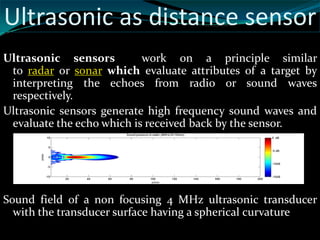
Sound field of a non focusing 4 MHz ultrasonic transducer
with the transducer surface having a spherical curvature
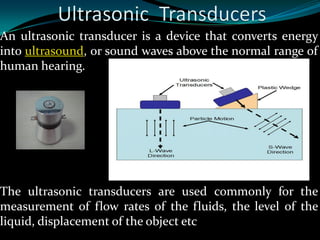
An ultrasonic transducer is a device that converts energy
into ultrasound, or sound waves above the normal range of
human hearing.
The ultrasonic transducers are used commonly for the
measurement of flow rates of the fluids, the level of the
liquid, displacement of the object etc
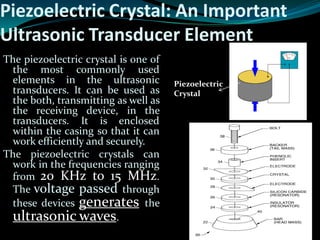
The piezoelectric crystal is one of
the most commonly used
elements in the ultrasonic
transducers. It can be used as
the both, transmitting as well as
the receiving device, in the
transducers. It is enclosed
within the casing so that it can
work efficiently and securely.
The piezoelectric crystals can
work in the frequencies ranging
from 20 KHz to 15 MHz.
The voltage passed through
these devices generates the
ultrasonic waves.
Piezoelectric Crystal: An Important
Ultrasonic Transducer Element
Piezoelectric
Crystal
So at a glance
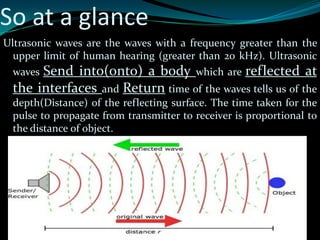
Ultrasonic waves are the waves with a frequency greater than the
upper limit of human hearing (greater than 20 kHz). Ultrasonic
waves Send into(onto) a body which are reflected at
the interfaces and Return time of the waves tells us of the
depth(Distance) of the reflecting surface. The time taken for the
pulse to propagate from transmitter to receiver is proportional to
the distance of object.
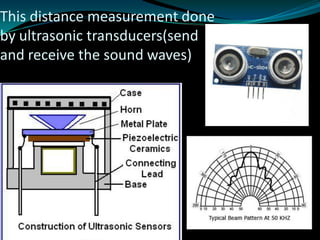
This distance measurement done
by ultrasonic transducers(send
and receive the sound waves)
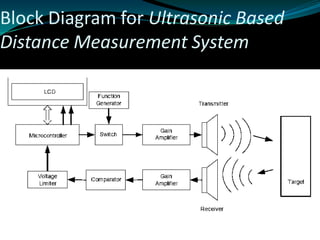
Block Diagram for Ultrasonic Based
Distance Measurement System
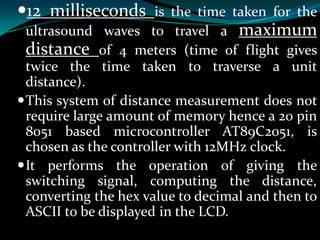
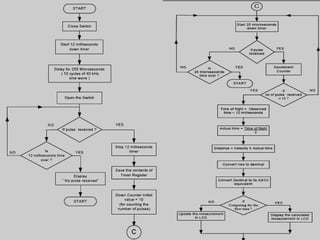
12 milliseconds is the time taken for the
ultrasound waves to travel a maximum
distance of 4 meters (time of flight gives
twice the time taken to traverse a unit
distance).
This system of distance measurement does not
require large amount of memory hence a 20 pin
8051 based microcontroller AT89C2051, is
chosen as the controller with 12MHz clock.
It performs the operation of giving the
switching signal, computing the distance,
converting the hex value to decimal and then to
ASCII to be displayed in the LCD.
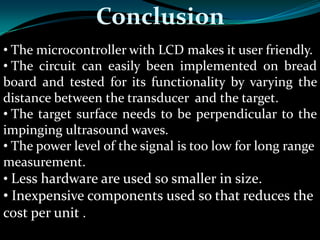
Conclusion
• The microcontroller with LCD makes it user friendly.
• The circuit can easily been implemented on bread
board and tested for its functionality by varying the
distance between the transducer and the target.
• The target surface needs to be perpendicular to the
impinging ultrasound waves.
• The power level of the signal is too low for long range
measurement.
• Less hardware are used so smaller in size.
• Inexpensive components used so that reduces the
cost per unit .
Outcomes
•We have found that this project is effectively useful in
research and development area as well as in Army and civil
area.
• Major outcome is that this project can replaced too many
costly types of equipment which we have to bought from
foreign countries.
• Product is also eco friendly because it does not harm
Earth’s environment.
•Project is less complicated than other, so analysis and
replacement of components is easy.
Thank You

Ultrasonic based distance measurement system

  • 1.
    Ultrasonic Based DistanceMeasurement System Some basic question: oWhat is “Ultrasonic”? oIts existence? oIs it really possible to use it for distance measurement?
  • 2.
    Ultrasonic is theapplication of ultrasound. Now What are the ultra sounds? Ultrasound is an oscillating sound pressure wave with a frequency greater than the upper limit of the human hearing range . Ultrasound is thus not separated from 'normal' (audible) sound based on differences in physical properties, only the fact that humans cannot hear it.
  • 3.
    Ultrasound devices operatewith frequencies from 20 kHz up to several gigahertz. the molecules of the material in which the waves are traveling cannot pass the vibration along rapidly enough. Some Basic Properties
  • 4.
    Ultrasonic as distancesensor Ultrasonic sensors work on a principle similar to radar or sonar which evaluate attributes of a target by interpreting the echoes from radio or sound waves respectively. Ultrasonic sensors generate high frequency sound waves and evaluate the echo which is received back by the sensor. Sound field of a non focusing 4 MHz ultrasonic transducer with the transducer surface having a spherical curvature
  • 5.
    An ultrasonic transduceris a device that converts energy into ultrasound, or sound waves above the normal range of human hearing. The ultrasonic transducers are used commonly for the measurement of flow rates of the fluids, the level of the liquid, displacement of the object etc
  • 6.
    The piezoelectric crystalis one of the most commonly used elements in the ultrasonic transducers. It can be used as the both, transmitting as well as the receiving device, in the transducers. It is enclosed within the casing so that it can work efficiently and securely. The piezoelectric crystals can work in the frequencies ranging from 20 KHz to 15 MHz. The voltage passed through these devices generates the ultrasonic waves. Piezoelectric Crystal: An Important Ultrasonic Transducer Element Piezoelectric Crystal
  • 7.
    So at aglance Ultrasonic waves are the waves with a frequency greater than the upper limit of human hearing (greater than 20 kHz). Ultrasonic waves Send into(onto) a body which are reflected at the interfaces and Return time of the waves tells us of the depth(Distance) of the reflecting surface. The time taken for the pulse to propagate from transmitter to receiver is proportional to the distance of object.
  • 8.
    This distance measurementdone by ultrasonic transducers(send and receive the sound waves)
  • 9.
    Block Diagram forUltrasonic Based Distance Measurement System
  • 10.
    12 milliseconds isthe time taken for the ultrasound waves to travel a maximum distance of 4 meters (time of flight gives twice the time taken to traverse a unit distance). This system of distance measurement does not require large amount of memory hence a 20 pin 8051 based microcontroller AT89C2051, is chosen as the controller with 12MHz clock. It performs the operation of giving the switching signal, computing the distance, converting the hex value to decimal and then to ASCII to be displayed in the LCD.
  • 12.
    Conclusion • The microcontrollerwith LCD makes it user friendly. • The circuit can easily been implemented on bread board and tested for its functionality by varying the distance between the transducer and the target. • The target surface needs to be perpendicular to the impinging ultrasound waves. • The power level of the signal is too low for long range measurement. • Less hardware are used so smaller in size. • Inexpensive components used so that reduces the cost per unit .
  • 13.
    Outcomes •We have foundthat this project is effectively useful in research and development area as well as in Army and civil area. • Major outcome is that this project can replaced too many costly types of equipment which we have to bought from foreign countries. • Product is also eco friendly because it does not harm Earth’s environment. •Project is less complicated than other, so analysis and replacement of components is easy.
  • 14.