International Research Journal of Engineering and Technology (IRJET) e-ISSN: 2395-0056
Volume: 05 Issue: 03 | Mar-2018 www.irjet.net p-ISSN: 2395-0072
© 2018, IRJET | Impact Factor value: 6.171 | ISO 9001:2008 Certified Journal | Page 1347
Distance Measurement with the Help of Ultrasonic Sensor
Sandeep Kumar Gupta
Student, Dept. of Electrical & Electronics, Pranveer Singh Institute of Technology, Kanpur, Uttar Pradesh, India
---------------------------------------------------------------------***---------------------------------------------------------------------
Abstract - Ultrasonic detection is most commonly used in
industrial applications to detect hidden tracks,
discontinuities in metals, composites, plastics, ceramics,and
for water level detection. For this purpose the lawsofphysics
which are indicating the propagation of sound waves
through solid materials have been used since ultrasonic
sensors using sound instead of light for detection.
Key Words: Ultrasonic sensor, Radiation, Transducer,
1. INTRODUCTION
An ultrasonic sensor transmit ultrasonic wavesintotheair
and detects reflected waves from an object. There are
many applications for ultrasonic sensors, such as in
intrusion alarm systems, automatic door openers and
backup sensors for automobiles. Accompaniedbytherapid
development of information processing technology, new
fieldsof application, such asfactoryautomationequipment
and car electronics, are increasing and should continue to
do so. Using its unique piezoelectric ceramics
manufacturing technology developed over many years,
Murata has developed various types of ultrasonic sensors
which are compact and yet have very high performance.
The information contained in this catalog will help you to
make effective use of our ultrasonic sensors.
1.1 Principle of ultrasonic detection
Sound is a mechanical wave travelling through the
mediums, which may be a solid, or liquid or gas. Sound
waves can travel through the mediums with specific
velocity depends on the mediumofpropagation.Thesound
waves which are having high frequency reflect from
boundaries and producesdistinctive echo patterns. Sound
is a mechanical wave travelling through the mediums,
which may be a solid, or liquid or gas. Sound waves can
travel through the mediumswith specific velocitydepends
on the medium of propagation. The sound waves which
are having high frequency reflect from boundaries and
produces distinctive echo patterns.
1.2 Operation of ultrasonic sensors:
Open Structure Type Ultrasonic Sensors
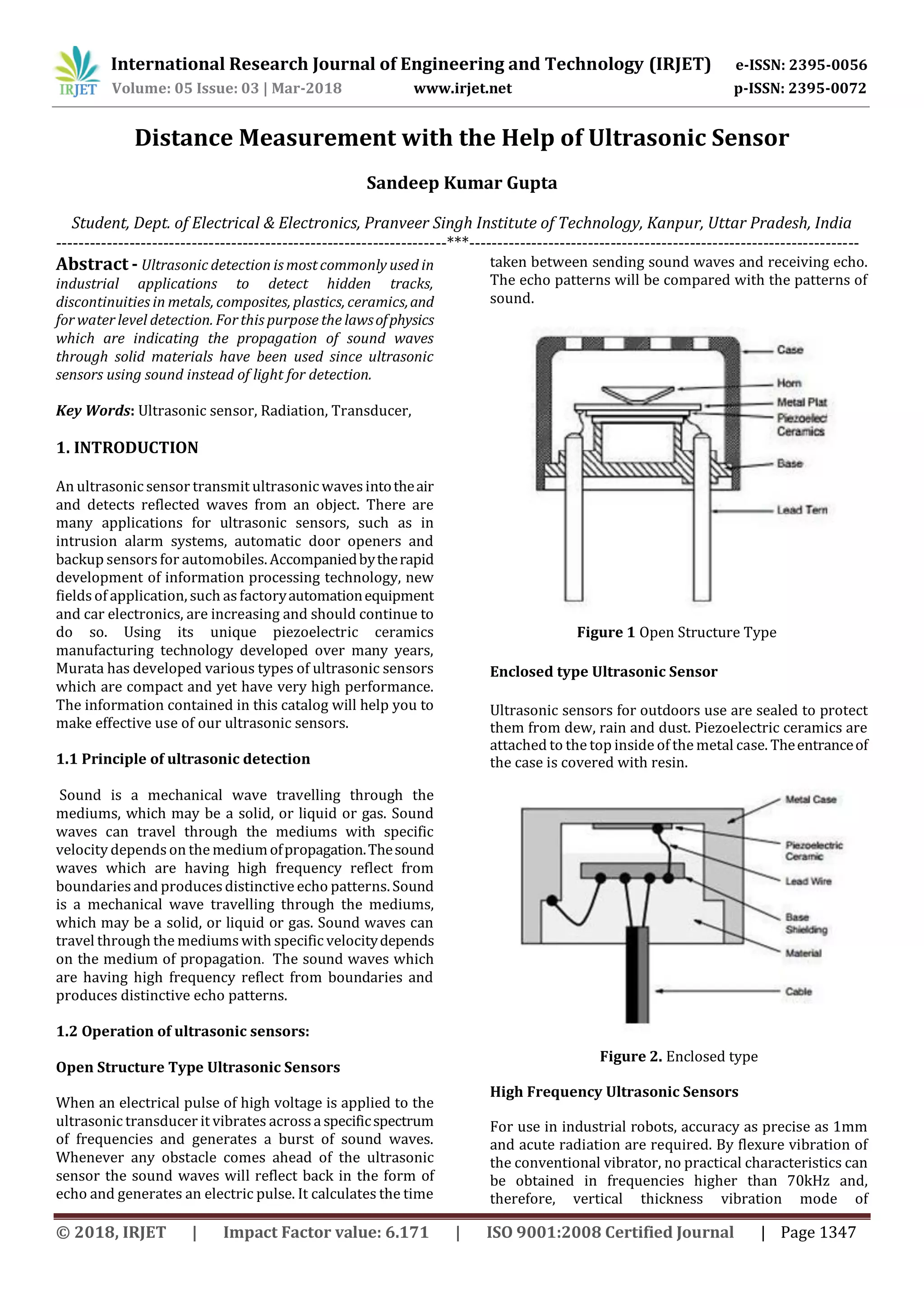
When an electrical pulse of high voltage is applied to the
ultrasonic transducer it vibrates acrossa specificspectrum
of frequencies and generates a burst of sound waves.
Whenever any obstacle comes ahead of the ultrasonic
sensor the sound waves will reflect back in the form of
echo and generates an electric pulse. It calculates the time
taken between sending sound waves and receiving echo.
The echo patterns will be compared with the patterns of
sound.
Figure 1 Open Structure Type
Enclosed type Ultrasonic Sensor
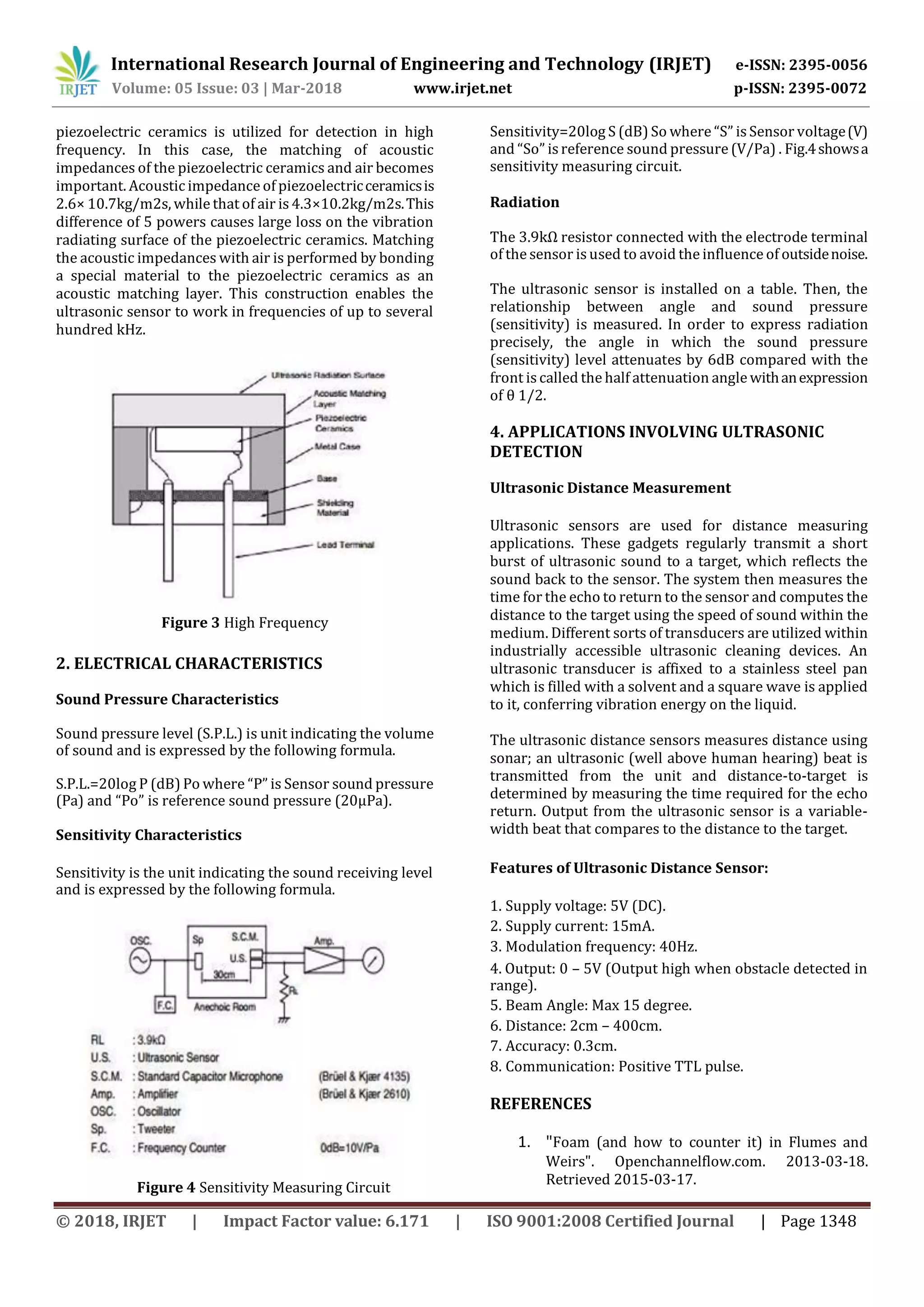
Ultrasonic sensors for outdoors use are sealed to protect
them from dew, rain and dust. Piezoelectric ceramics are
attached to the top inside of the metal case. Theentranceof
the case is covered with resin.
Figure 2. Enclosed type
High Frequency Ultrasonic Sensors
For use in industrial robots, accuracy as precise as 1mm
and acute radiation are required. By flexure vibration of
the conventional vibrator, no practical characteristics can
be obtained in frequencies higher than 70kHz and,
therefore, vertical thickness vibration mode of
International Research Journal of Engineering and Technology (IRJET) e-ISSN: 2395-0056
Volume: 05 Issue: 03 | Mar-2018 www.irjet.net p-ISSN: 2395-0072
© 2018, IRJET | Impact Factor value: 6.171 | ISO 9001:2008 Certified Journal | Page 1348
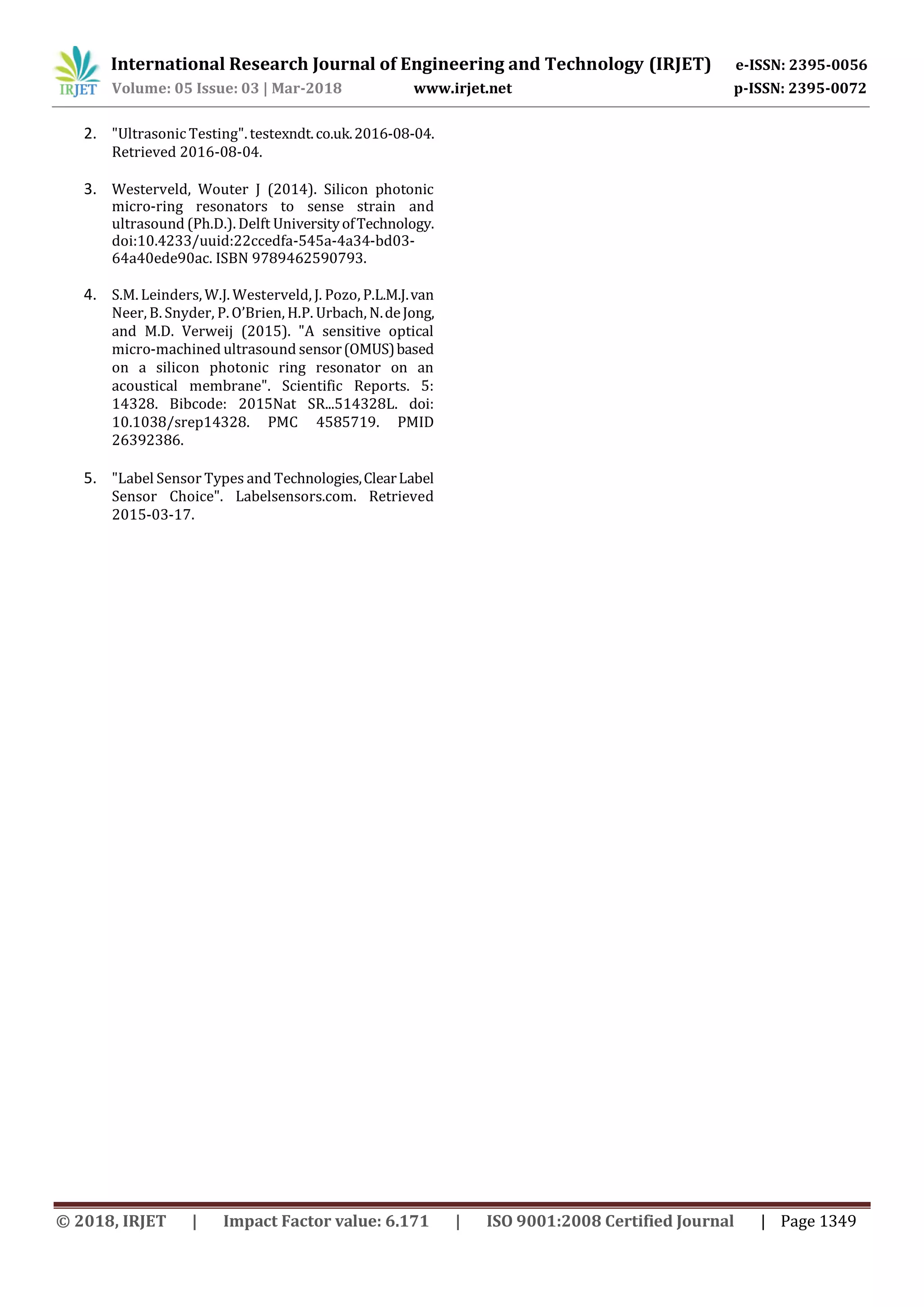
piezoelectric ceramics is utilized for detection in high
frequency. In this case, the matching of acoustic
impedances of the piezoelectric ceramics and air becomes
important. Acoustic impedance of piezoelectricceramicsis
2.6× 10.7kg/m2s, while that of air is 4.3×10.2kg/m2s.This
difference of 5 powers causes large loss on the vibration
radiating surface of the piezoelectric ceramics. Matching
the acoustic impedances with air is performed by bonding
a special material to the piezoelectric ceramics as an
acoustic matching layer. This construction enables the
ultrasonic sensor to work in frequencies of up to several
hundred kHz.
Figure 3 High Frequency
2. ELECTRICAL CHARACTERISTICS
Sound Pressure Characteristics
Sound pressure level (S.P.L.) is unit indicating the volume
of sound and is expressed by the following formula.
S.P.L.=20log P (dB) Po where “P” is Sensor sound pressure
(Pa) and “Po” is reference sound pressure (20μPa).
Sensitivity Characteristics
Sensitivity is the unit indicating the sound receiving level
and is expressed by the following formula.
Figure 4 Sensitivity Measuring Circuit
Sensitivity=20log S (dB) So where “S” is Sensor voltage(V)
and “So” is reference sound pressure (V/Pa) . Fig.4showsa
sensitivity measuring circuit.
Radiation
The 3.9kΩ resistor connected with the electrode terminal
of the sensor is used to avoid the influence of outsidenoise.
The ultrasonic sensor is installed on a table. Then, the
relationship between angle and sound pressure
(sensitivity) is measured. In order to express radiation
precisely, the angle in which the sound pressure
(sensitivity) level attenuates by 6dB compared with the
front is called the half attenuation angle withanexpression
of θ 1/2.
4. APPLICATIONS INVOLVING ULTRASONIC
DETECTION
Ultrasonic Distance Measurement
Ultrasonic sensors are used for distance measuring
applications. These gadgets regularly transmit a short
burst of ultrasonic sound to a target, which reflects the
sound back to the sensor. The system then measures the
time for the echo to return to the sensor and computes the
distance to the target using the speed of sound within the
medium. Different sorts of transducers are utilized within
industrially accessible ultrasonic cleaning devices. An
ultrasonic transducer is affixed to a stainless steel pan
which is filled with a solvent and a square wave is applied
to it, conferring vibration energy on the liquid.
The ultrasonic distance sensors measures distance using
sonar; an ultrasonic (well above human hearing) beat is
transmitted from the unit and distance-to-target is
determined by measuring the time required for the echo
return. Output from the ultrasonic sensor is a variable-
width beat that compares to the distance to the target.
Features of Ultrasonic Distance Sensor:
1. Supply voltage: 5V (DC).
2. Supply current: 15mA.
3. Modulation frequency: 40Hz.
4. Output: 0 – 5V (Output high when obstacle detected in
range).
5. Beam Angle: Max 15 degree.
6. Distance: 2cm – 400cm.
7. Accuracy: 0.3cm.
8. Communication: Positive TTL pulse.
REFERENCES
1. "Foam (and how to counter it) in Flumes and
Weirs". Openchannelflow.com. 2013-03-18.
Retrieved 2015-03-17.
International Research Journal of Engineering and Technology (IRJET) e-ISSN: 2395-0056
Volume: 05 Issue: 03 | Mar-2018 www.irjet.net p-ISSN: 2395-0072
© 2018, IRJET | Impact Factor value: 6.171 | ISO 9001:2008 Certified Journal | Page 1349
2. "Ultrasonic Testing". testexndt.co.uk.2016-08-04.
Retrieved 2016-08-04.
3. Westerveld, Wouter J (2014). Silicon photonic
micro-ring resonators to sense strain and
ultrasound (Ph.D.). Delft UniversityofTechnology.
doi:10.4233/uuid:22ccedfa-545a-4a34-bd03-
64a40ede90ac. ISBN 9789462590793.
4. S.M. Leinders, W.J. Westerveld, J. Pozo, P.L.M.J.van
Neer, B. Snyder, P. O’Brien, H.P. Urbach, N.deJong,
and M.D. Verweij (2015). "A sensitive optical
micro-machined ultrasound sensor(OMUS)based
on a silicon photonic ring resonator on an
acoustical membrane". Scientific Reports. 5:
14328. Bibcode: 2015Nat SR...514328L. doi:
10.1038/srep14328. PMC 4585719. PMID
26392386.
5. "Label Sensor Types and Technologies,ClearLabel
Sensor Choice". Labelsensors.com. Retrieved
2015-03-17.

IRJET- Distance Measurement with the Help of Ultrasonic Sensor

  • 1.
    International Research Journalof Engineering and Technology (IRJET) e-ISSN: 2395-0056 Volume: 05 Issue: 03 | Mar-2018 www.irjet.net p-ISSN: 2395-0072 © 2018, IRJET | Impact Factor value: 6.171 | ISO 9001:2008 Certified Journal | Page 1347 Distance Measurement with the Help of Ultrasonic Sensor Sandeep Kumar Gupta Student, Dept. of Electrical & Electronics, Pranveer Singh Institute of Technology, Kanpur, Uttar Pradesh, India ---------------------------------------------------------------------***--------------------------------------------------------------------- Abstract - Ultrasonic detection is most commonly used in industrial applications to detect hidden tracks, discontinuities in metals, composites, plastics, ceramics,and for water level detection. For this purpose the lawsofphysics which are indicating the propagation of sound waves through solid materials have been used since ultrasonic sensors using sound instead of light for detection. Key Words: Ultrasonic sensor, Radiation, Transducer, 1. INTRODUCTION An ultrasonic sensor transmit ultrasonic wavesintotheair and detects reflected waves from an object. There are many applications for ultrasonic sensors, such as in intrusion alarm systems, automatic door openers and backup sensors for automobiles. Accompaniedbytherapid development of information processing technology, new fieldsof application, such asfactoryautomationequipment and car electronics, are increasing and should continue to do so. Using its unique piezoelectric ceramics manufacturing technology developed over many years, Murata has developed various types of ultrasonic sensors which are compact and yet have very high performance. The information contained in this catalog will help you to make effective use of our ultrasonic sensors. 1.1 Principle of ultrasonic detection Sound is a mechanical wave travelling through the mediums, which may be a solid, or liquid or gas. Sound waves can travel through the mediums with specific velocity depends on the mediumofpropagation.Thesound waves which are having high frequency reflect from boundaries and producesdistinctive echo patterns. Sound is a mechanical wave travelling through the mediums, which may be a solid, or liquid or gas. Sound waves can travel through the mediumswith specific velocitydepends on the medium of propagation. The sound waves which are having high frequency reflect from boundaries and produces distinctive echo patterns. 1.2 Operation of ultrasonic sensors: Open Structure Type Ultrasonic Sensors When an electrical pulse of high voltage is applied to the ultrasonic transducer it vibrates acrossa specificspectrum of frequencies and generates a burst of sound waves. Whenever any obstacle comes ahead of the ultrasonic sensor the sound waves will reflect back in the form of echo and generates an electric pulse. It calculates the time taken between sending sound waves and receiving echo. The echo patterns will be compared with the patterns of sound. Figure 1 Open Structure Type Enclosed type Ultrasonic Sensor Ultrasonic sensors for outdoors use are sealed to protect them from dew, rain and dust. Piezoelectric ceramics are attached to the top inside of the metal case. Theentranceof the case is covered with resin. Figure 2. Enclosed type High Frequency Ultrasonic Sensors For use in industrial robots, accuracy as precise as 1mm and acute radiation are required. By flexure vibration of the conventional vibrator, no practical characteristics can be obtained in frequencies higher than 70kHz and, therefore, vertical thickness vibration mode of
  • 2.
    International Research Journalof Engineering and Technology (IRJET) e-ISSN: 2395-0056 Volume: 05 Issue: 03 | Mar-2018 www.irjet.net p-ISSN: 2395-0072 © 2018, IRJET | Impact Factor value: 6.171 | ISO 9001:2008 Certified Journal | Page 1348 piezoelectric ceramics is utilized for detection in high frequency. In this case, the matching of acoustic impedances of the piezoelectric ceramics and air becomes important. Acoustic impedance of piezoelectricceramicsis 2.6× 10.7kg/m2s, while that of air is 4.3×10.2kg/m2s.This difference of 5 powers causes large loss on the vibration radiating surface of the piezoelectric ceramics. Matching the acoustic impedances with air is performed by bonding a special material to the piezoelectric ceramics as an acoustic matching layer. This construction enables the ultrasonic sensor to work in frequencies of up to several hundred kHz. Figure 3 High Frequency 2. ELECTRICAL CHARACTERISTICS Sound Pressure Characteristics Sound pressure level (S.P.L.) is unit indicating the volume of sound and is expressed by the following formula. S.P.L.=20log P (dB) Po where “P” is Sensor sound pressure (Pa) and “Po” is reference sound pressure (20μPa). Sensitivity Characteristics Sensitivity is the unit indicating the sound receiving level and is expressed by the following formula. Figure 4 Sensitivity Measuring Circuit Sensitivity=20log S (dB) So where “S” is Sensor voltage(V) and “So” is reference sound pressure (V/Pa) . Fig.4showsa sensitivity measuring circuit. Radiation The 3.9kΩ resistor connected with the electrode terminal of the sensor is used to avoid the influence of outsidenoise. The ultrasonic sensor is installed on a table. Then, the relationship between angle and sound pressure (sensitivity) is measured. In order to express radiation precisely, the angle in which the sound pressure (sensitivity) level attenuates by 6dB compared with the front is called the half attenuation angle withanexpression of θ 1/2. 4. APPLICATIONS INVOLVING ULTRASONIC DETECTION Ultrasonic Distance Measurement Ultrasonic sensors are used for distance measuring applications. These gadgets regularly transmit a short burst of ultrasonic sound to a target, which reflects the sound back to the sensor. The system then measures the time for the echo to return to the sensor and computes the distance to the target using the speed of sound within the medium. Different sorts of transducers are utilized within industrially accessible ultrasonic cleaning devices. An ultrasonic transducer is affixed to a stainless steel pan which is filled with a solvent and a square wave is applied to it, conferring vibration energy on the liquid. The ultrasonic distance sensors measures distance using sonar; an ultrasonic (well above human hearing) beat is transmitted from the unit and distance-to-target is determined by measuring the time required for the echo return. Output from the ultrasonic sensor is a variable- width beat that compares to the distance to the target. Features of Ultrasonic Distance Sensor: 1. Supply voltage: 5V (DC). 2. Supply current: 15mA. 3. Modulation frequency: 40Hz. 4. Output: 0 – 5V (Output high when obstacle detected in range). 5. Beam Angle: Max 15 degree. 6. Distance: 2cm – 400cm. 7. Accuracy: 0.3cm. 8. Communication: Positive TTL pulse. REFERENCES 1. "Foam (and how to counter it) in Flumes and Weirs". Openchannelflow.com. 2013-03-18. Retrieved 2015-03-17.
  • 3.
    International Research Journalof Engineering and Technology (IRJET) e-ISSN: 2395-0056 Volume: 05 Issue: 03 | Mar-2018 www.irjet.net p-ISSN: 2395-0072 © 2018, IRJET | Impact Factor value: 6.171 | ISO 9001:2008 Certified Journal | Page 1349 2. "Ultrasonic Testing". testexndt.co.uk.2016-08-04. Retrieved 2016-08-04. 3. Westerveld, Wouter J (2014). Silicon photonic micro-ring resonators to sense strain and ultrasound (Ph.D.). Delft UniversityofTechnology. doi:10.4233/uuid:22ccedfa-545a-4a34-bd03- 64a40ede90ac. ISBN 9789462590793. 4. S.M. Leinders, W.J. Westerveld, J. Pozo, P.L.M.J.van Neer, B. Snyder, P. O’Brien, H.P. Urbach, N.deJong, and M.D. Verweij (2015). "A sensitive optical micro-machined ultrasound sensor(OMUS)based on a silicon photonic ring resonator on an acoustical membrane". Scientific Reports. 5: 14328. Bibcode: 2015Nat SR...514328L. doi: 10.1038/srep14328. PMC 4585719. PMID 26392386. 5. "Label Sensor Types and Technologies,ClearLabel Sensor Choice". Labelsensors.com. Retrieved 2015-03-17.