SONET
(Synchronous Optical Network)
What is SONET?
Synchronous Optical Networking (SONET) and Synchronous
Digital Hierarchy (SDH) are standardized protocols that
transfer multiple digital bit streams synchronously over
optical fiber using lasers or highly coherent light from light-
emitting diodes (LEDs).
At low transmission rates data can also be transferred via an
electrical interface.
The method was developed to replace the Plesiochronous
Digital Hierarchy (PDH) system for transporting large
amounts of telephone calls and data traffic over the same
fiber without synchronization problems.
Introduction
 SONET was originally designed for the public telephone network.
 Independently developed in USA & Europe
 SONET (Synchronous Optical Network)
 SDH (Synchronous Digital Hierarchy)
 Synchronous network using synchronous TDM multiplexing
 All clocks in the system are locked to a master clock
 It contains the standards for fiber-optic equipments
 A bit-way implementation providing end-to-end transport of bit streams.
 Multiplexing done by byte interleaving.
 SONET commonly transmits data at speeds between 155 megabits per
second (Mbps) and 2.5 gigabits per second (Gbps).
 One of SONET’s most interesting characteristics is its support for a ring
topology .
SONET
LAYERS
SONET defines four layers: path, line, section, and photonic
 Path layer is responsible for the movement of a signal from its
optical source to its optical destination
 Line layers is for the movement of a signal across a physical line
 Section layer is for the movement of a signal across a physical
section, handling framing, scrambling, and error control
 Photonic layer corresponds to the physical layer of OSI model
Path
Termination
Path
Termination
Line
Termination
Line
Termination
Section
Termination
path
line line line
ADM ADMregenerator
section section sectionsection
SONET ARCHITECTURE
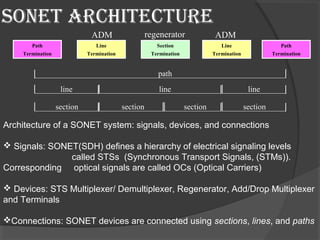
Architecture of a SONET system: signals, devices, and connections
 Signals: SONET(SDH) defines a hierarchy of electrical signaling levels
called STSs (Synchronous Transport Signals, (STMs)).
Corresponding optical signals are called OCs (Optical Carriers)
 Devices: STS Multiplexer/ Demultiplexer, Regenerator, Add/Drop Multiplexer
and Terminals
Connections: SONET devices are connected using sections, lines, and paths
SONET FRAMES
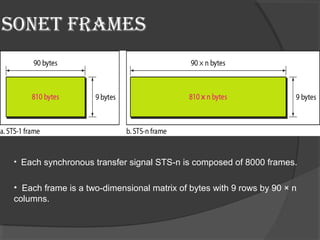
• Each synchronous transfer signal STS-n is composed of 8000 frames.
• Each frame is a two-dimensional matrix of bytes with 9 rows by 90 × n
columns.
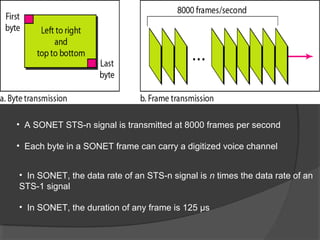
• A SONET STS-n signal is transmitted at 8000 frames per second
• Each byte in a SONET frame can carry a digitized voice channel
• In SONET, the data rate of an STS-n signal is n times the data rate of an
STS-1 signal
• In SONET, the duration of any frame is 125 μs
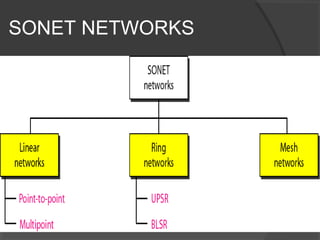
SONET NETWORKS
1. Point-to-point network :
2. Multipoint network :
Ring Network:
Unidirectional Path Switching Ring (UPSR)
Ring Network:
Bidirectional Line Switching Ring (BLSR)
Mesh Network
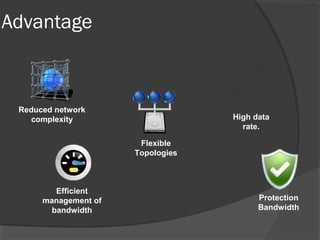
Reduced network
complexity
Protection
Bandwidth
High data
rate.
Flexible
Topologies
Efficient
management of
bandwidth
Advantage
Disadvantages
 Strict synchronization schemes required
 Complex and costly equipment as compared to
cheaper Ethernet

Sonet

  • 1.
  • 2.
    What is SONET? SynchronousOptical Networking (SONET) and Synchronous Digital Hierarchy (SDH) are standardized protocols that transfer multiple digital bit streams synchronously over optical fiber using lasers or highly coherent light from light- emitting diodes (LEDs). At low transmission rates data can also be transferred via an electrical interface. The method was developed to replace the Plesiochronous Digital Hierarchy (PDH) system for transporting large amounts of telephone calls and data traffic over the same fiber without synchronization problems.
  • 3.
    Introduction  SONET wasoriginally designed for the public telephone network.  Independently developed in USA & Europe  SONET (Synchronous Optical Network)  SDH (Synchronous Digital Hierarchy)  Synchronous network using synchronous TDM multiplexing  All clocks in the system are locked to a master clock  It contains the standards for fiber-optic equipments  A bit-way implementation providing end-to-end transport of bit streams.  Multiplexing done by byte interleaving.  SONET commonly transmits data at speeds between 155 megabits per second (Mbps) and 2.5 gigabits per second (Gbps).  One of SONET’s most interesting characteristics is its support for a ring topology .
  • 4.
    SONET LAYERS SONET defines fourlayers: path, line, section, and photonic  Path layer is responsible for the movement of a signal from its optical source to its optical destination  Line layers is for the movement of a signal across a physical line  Section layer is for the movement of a signal across a physical section, handling framing, scrambling, and error control  Photonic layer corresponds to the physical layer of OSI model
  • 5.
    Path Termination Path Termination Line Termination Line Termination Section Termination path line line line ADMADMregenerator section section sectionsection SONET ARCHITECTURE Architecture of a SONET system: signals, devices, and connections  Signals: SONET(SDH) defines a hierarchy of electrical signaling levels called STSs (Synchronous Transport Signals, (STMs)). Corresponding optical signals are called OCs (Optical Carriers)  Devices: STS Multiplexer/ Demultiplexer, Regenerator, Add/Drop Multiplexer and Terminals Connections: SONET devices are connected using sections, lines, and paths
  • 6.
    SONET FRAMES • Eachsynchronous transfer signal STS-n is composed of 8000 frames. • Each frame is a two-dimensional matrix of bytes with 9 rows by 90 × n columns.
  • 7.
    • A SONETSTS-n signal is transmitted at 8000 frames per second • Each byte in a SONET frame can carry a digitized voice channel • In SONET, the data rate of an STS-n signal is n times the data rate of an STS-1 signal • In SONET, the duration of any frame is 125 μs
  • 8.
  • 9.
    1. Point-to-point network: 2. Multipoint network :
  • 10.
    Ring Network: Unidirectional PathSwitching Ring (UPSR)
  • 11.
    Ring Network: Bidirectional LineSwitching Ring (BLSR)
  • 12.
  • 13.
  • 14.
    Disadvantages  Strict synchronizationschemes required  Complex and costly equipment as compared to cheaper Ethernet