ME7120 - SENSORS FOR INTELLIGENT MANUFACTURING
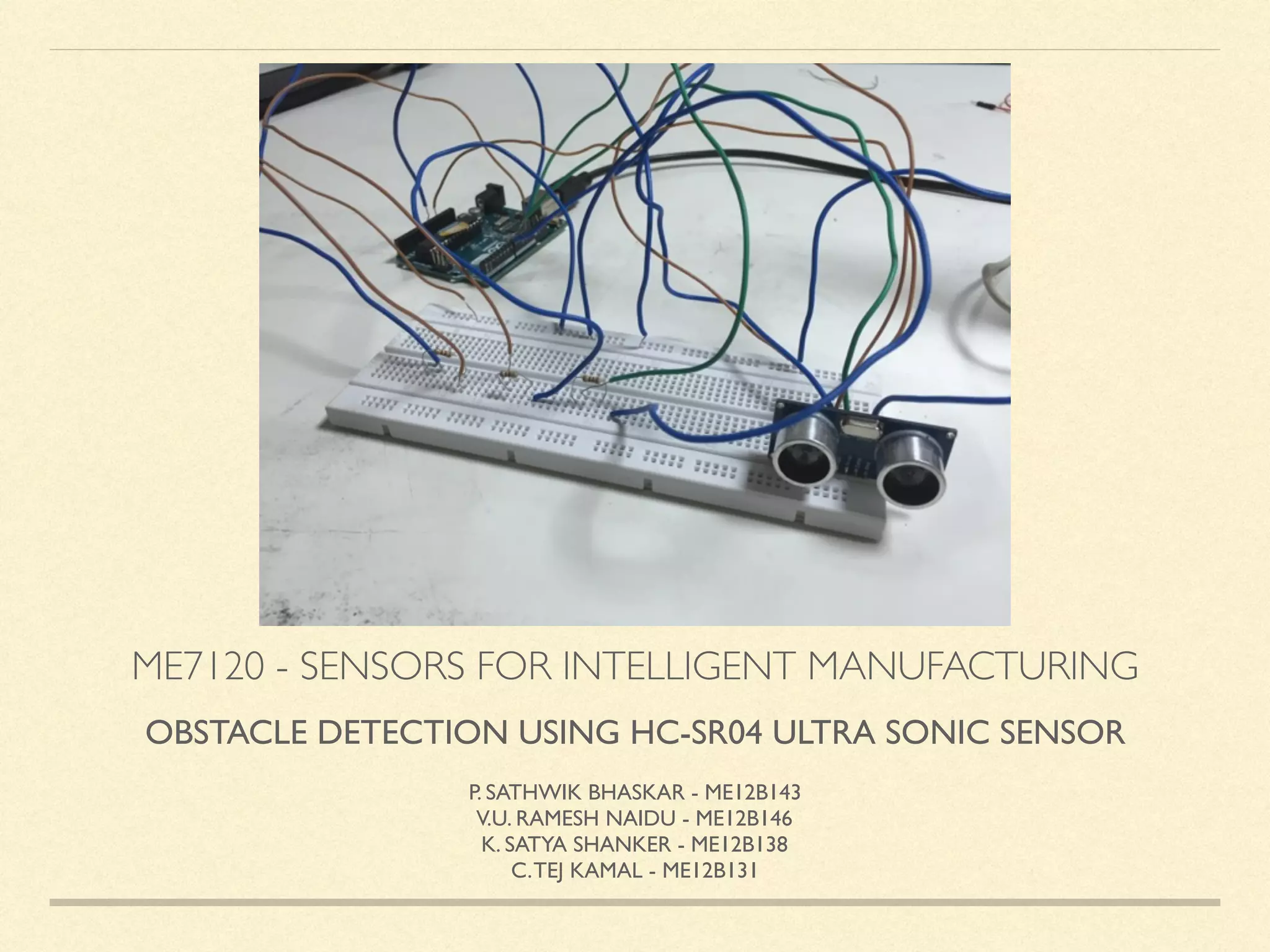
OBSTACLE DETECTION USING HC-SR04 ULTRA SONIC SENSOR
P. SATHWIK BHASKAR - ME12B143
V.U. RAMESH NAIDU - ME12B146
K. SATYA SHANKER - ME12B138
C.TEJ KAMAL - ME12B131
WORKING PRINCIPLE OF ULTRA SONIC SENSOR
Ultrasonic sensors are devices that use electrical–mechanical energy transformation to
measure distance from the sensor to the target object.
Ultrasonic waves are longitudinal mechanical waves which travel as a sequence of
compressions and rarefactions along the direction of wave propagation through the medium.
Apart from distance measurement, they are also used in ultrasonic material testing (to
detect cracks, air bubbles, and other flaws in the products), Object detection, position
detection, ultrasonic mouse, etc.
These sensors are categorised in two types according to their working phenomenon –
piezoelectric sensors and electrostatic sensors. Here we are discussing the ultrasonic sensor
using the piezoelectric principle. Piezoelectric ultrasonic sensors use a piezoelectric material
to generate the ultrasonic waves.
ABOUT THE HC-SR04 SENSOR
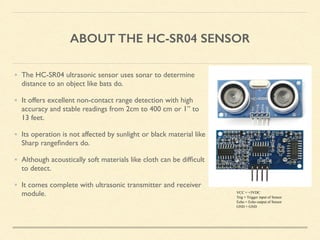
• The HC-SR04 ultrasonic sensor uses sonar to determine
distance to an object like bats do.
• It offers excellent non-contact range detection with high
accuracy and stable readings from 2cm to 400 cm or 1” to
13 feet.
• Its operation is not affected by sunlight or black material like
Sharp rangefinders do.
• Although acoustically soft materials like cloth can be difficult
to detect.
• It comes complete with ultrasonic transmitter and receiver
module. VCC = +5VDC
Trig = Trigger input of Sensor
Echo = Echo output of Sensor
GND = GND
FEATURES OF HC-SR04 SENSOR
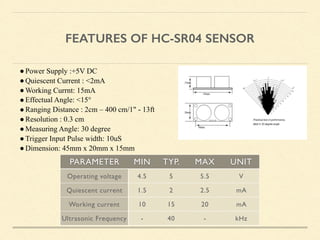
●Power Supply :+5V DC
●Quiescent Current : <2mA
●Working Currnt: 15mA
●Effectual Angle: <15°
●Ranging Distance : 2cm – 400 cm/1" - 13ft
●Resolution : 0.3 cm
●Measuring Angle: 30 degree
●Trigger Input Pulse width: 10uS
●Dimension: 45mm x 20mm x 15mm
PARAMETER MIN TYP. MAX UNIT
Operating voltage 4.5 5 5.5 V
Quiescent current 1.5 2 2.5 mA
Working current 10 15 20 mA
Ultrasonic Frequency - 40 - kHz
OPERATION OF THE SENSOR
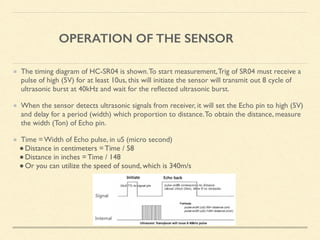
The timing diagram of HC-SR04 is shown.To start measurement,Trig of SR04 must receive a
pulse of high (5V) for at least 10us, this will initiate the sensor will transmit out 8 cycle of
ultrasonic burst at 40kHz and wait for the reflected ultrasonic burst.
When the sensor detects ultrasonic signals from receiver, it will set the Echo pin to high (5V)
and delay for a period (width) which proportion to distance.To obtain the distance, measure
the width (Ton) of Echo pin.
Time = Width of Echo pulse, in uS (micro second)
●Distance in centimeters = Time / 58
●Distance in inches = Time / 148
●Or you can utilize the speed of sound, which is 340m/s
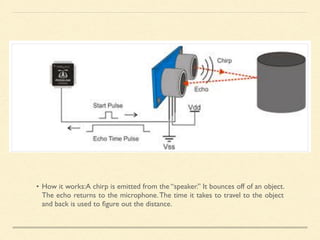
• How it works:A chirp is emitted from the “speaker.” It bounces off of an object.
The echo returns to the microphone.The time it takes to travel to the object
and back is used to figure out the distance.
ARDUINO IDE PROGRAM
APPLICATIONS
Ultrasonic sensors can detect movement of targets and measure the distance to
them in many automated factories and process plants. Sensors can have an on
or off digital output for detecting the movement of objects, or an analog output
proportional to distance.They can sense the edge of material as part of a web
guiding system.
They are being used for a number of other automotive uses including ultrasonic
people detection and assisting in autonomous UAV navigation.
Passive ultrasonic sensors may be used to detect high-pressure gas or liquid
leaks, or other hazardous conditions that generate ultrasonic sound. In these
devices, audio from the transducer (microphone) is converted down to human
hearing range.
Ultrasonic sensors use sound rather than light for detection, they work in
applications where photoelectric sensors may not.
Ultrasonics are a great solution for clear object detection, clear label detection
and for liquid level measurement, applications that photoelectric struggle with
because of target translucence.As well, target colour and/or reflectivity do not
affect ultrasonic sensors, which can operate reliably in high-glare environments.
High-power ultrasonic emitters are used in commercially available ultrasonic
cleaning devices.An ultrasonic transducer is affixed to a stainless steel pan which
is filled with a solvent (frequently water or isopropanol).An electrical square
wave feeds the transducer, creating sound in the solvent strong enough to cause
cavitation.
Thank you

Obstacle detection using ultra sonic sensor

  • 1.
    ME7120 - SENSORSFOR INTELLIGENT MANUFACTURING OBSTACLE DETECTION USING HC-SR04 ULTRA SONIC SENSOR P. SATHWIK BHASKAR - ME12B143 V.U. RAMESH NAIDU - ME12B146 K. SATYA SHANKER - ME12B138 C.TEJ KAMAL - ME12B131
  • 2.
    WORKING PRINCIPLE OFULTRA SONIC SENSOR Ultrasonic sensors are devices that use electrical–mechanical energy transformation to measure distance from the sensor to the target object. Ultrasonic waves are longitudinal mechanical waves which travel as a sequence of compressions and rarefactions along the direction of wave propagation through the medium. Apart from distance measurement, they are also used in ultrasonic material testing (to detect cracks, air bubbles, and other flaws in the products), Object detection, position detection, ultrasonic mouse, etc. These sensors are categorised in two types according to their working phenomenon – piezoelectric sensors and electrostatic sensors. Here we are discussing the ultrasonic sensor using the piezoelectric principle. Piezoelectric ultrasonic sensors use a piezoelectric material to generate the ultrasonic waves.
  • 3.
    ABOUT THE HC-SR04SENSOR • The HC-SR04 ultrasonic sensor uses sonar to determine distance to an object like bats do. • It offers excellent non-contact range detection with high accuracy and stable readings from 2cm to 400 cm or 1” to 13 feet. • Its operation is not affected by sunlight or black material like Sharp rangefinders do. • Although acoustically soft materials like cloth can be difficult to detect. • It comes complete with ultrasonic transmitter and receiver module. VCC = +5VDC Trig = Trigger input of Sensor Echo = Echo output of Sensor GND = GND
  • 4.
    FEATURES OF HC-SR04SENSOR ●Power Supply :+5V DC ●Quiescent Current : <2mA ●Working Currnt: 15mA ●Effectual Angle: <15° ●Ranging Distance : 2cm – 400 cm/1" - 13ft ●Resolution : 0.3 cm ●Measuring Angle: 30 degree ●Trigger Input Pulse width: 10uS ●Dimension: 45mm x 20mm x 15mm PARAMETER MIN TYP. MAX UNIT Operating voltage 4.5 5 5.5 V Quiescent current 1.5 2 2.5 mA Working current 10 15 20 mA Ultrasonic Frequency - 40 - kHz
  • 5.
    OPERATION OF THESENSOR The timing diagram of HC-SR04 is shown.To start measurement,Trig of SR04 must receive a pulse of high (5V) for at least 10us, this will initiate the sensor will transmit out 8 cycle of ultrasonic burst at 40kHz and wait for the reflected ultrasonic burst. When the sensor detects ultrasonic signals from receiver, it will set the Echo pin to high (5V) and delay for a period (width) which proportion to distance.To obtain the distance, measure the width (Ton) of Echo pin. Time = Width of Echo pulse, in uS (micro second) ●Distance in centimeters = Time / 58 ●Distance in inches = Time / 148 ●Or you can utilize the speed of sound, which is 340m/s
  • 6.
    • How itworks:A chirp is emitted from the “speaker.” It bounces off of an object. The echo returns to the microphone.The time it takes to travel to the object and back is used to figure out the distance.
  • 7.
  • 9.
    APPLICATIONS Ultrasonic sensors candetect movement of targets and measure the distance to them in many automated factories and process plants. Sensors can have an on or off digital output for detecting the movement of objects, or an analog output proportional to distance.They can sense the edge of material as part of a web guiding system. They are being used for a number of other automotive uses including ultrasonic people detection and assisting in autonomous UAV navigation. Passive ultrasonic sensors may be used to detect high-pressure gas or liquid leaks, or other hazardous conditions that generate ultrasonic sound. In these devices, audio from the transducer (microphone) is converted down to human hearing range.
  • 10.
    Ultrasonic sensors usesound rather than light for detection, they work in applications where photoelectric sensors may not. Ultrasonics are a great solution for clear object detection, clear label detection and for liquid level measurement, applications that photoelectric struggle with because of target translucence.As well, target colour and/or reflectivity do not affect ultrasonic sensors, which can operate reliably in high-glare environments. High-power ultrasonic emitters are used in commercially available ultrasonic cleaning devices.An ultrasonic transducer is affixed to a stainless steel pan which is filled with a solvent (frequently water or isopropanol).An electrical square wave feeds the transducer, creating sound in the solvent strong enough to cause cavitation.
  • 11.