An Introduction to Universal Design for Learning (UDL) Tai Lynch, Ed.S. University of South Carolina
Overview of the Presentation This presentation is an introduction to Universal Design for Learning (UDL).  All of the information in the presentation was taken from the Center for Applied Special Technology (CAST), specifically within the  Teaching Every Student  (TES) www.cast.org/teachingeverystudent/section.  For copyright information and references, please refer to the  CAST  website www.cast.org.
What is Universal Design for Learning (UDL) Universal Design for Learning (UDL) is a research-based framework for designing curricula—that is, educational goals, methods, materials, and assessments—that enable all individuals to gain knowledge, skills, and enthusiasm for learning. This is accomplished by simultaneously providing rich supports for learning and reducing barriers to the curriculum, while maintaining high achievement standards for all students.
Where did UDL come from? UDL originated from the concept of  Universal Design    (UD) coined by Ron Mace of the University of North Carolina. Universal Design applies to the architecture that is conceived, designed, and constructed to meet the needs of all individuals who require access.
UD vs. UDL ULD builds upon the concept of UD in 2 key ways: First- UDL includes flexibility within the educational curriculum Second- UDL includes not only access to information but also access to learning. Access to learning is driven by knowing the instructional goal within the balance of support, resistance, and challenges.
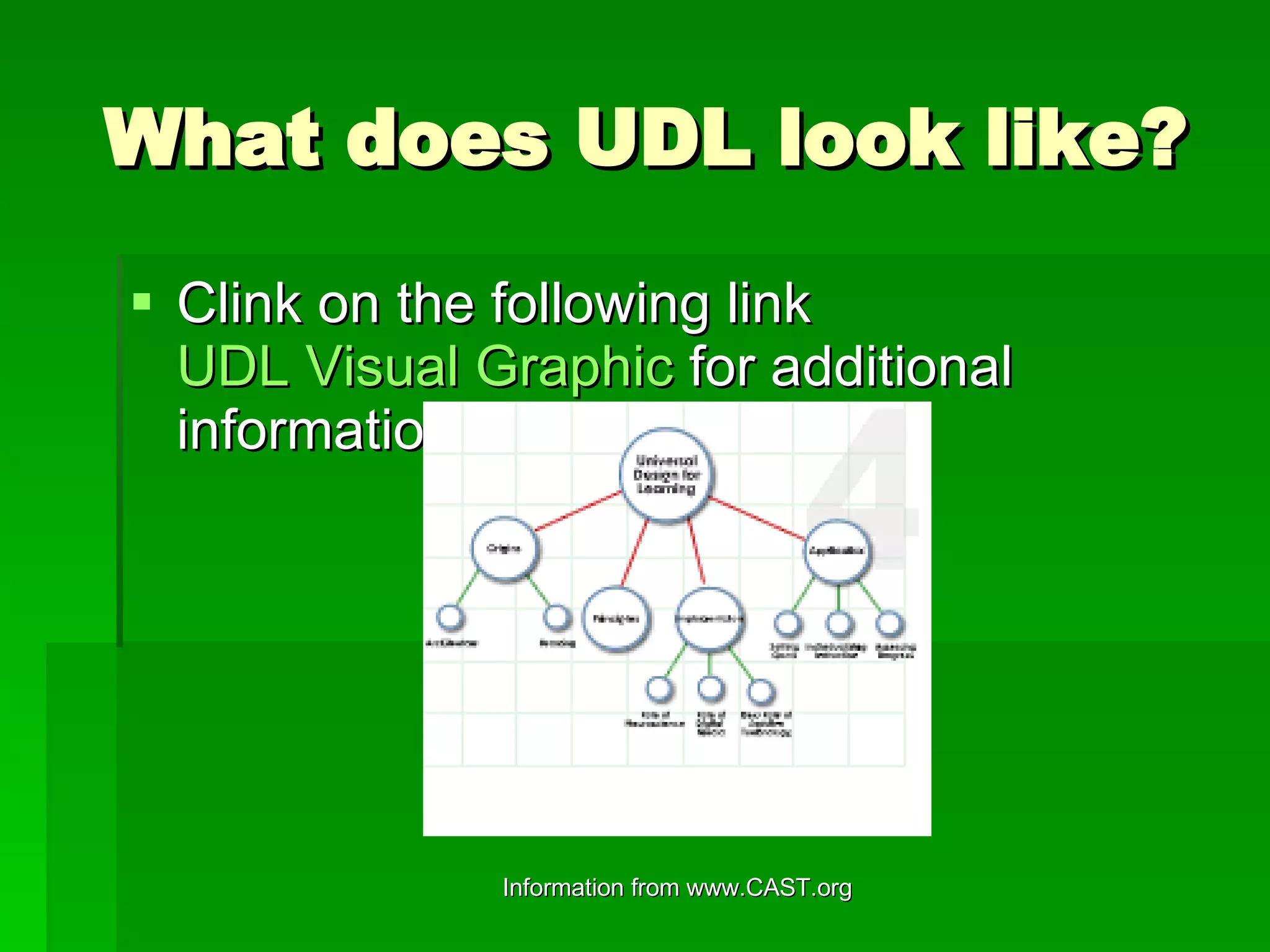
What does UDL look like? Clink on the following link  UDL Visual Graphic  for additional information.
How does brain research impact UDL and learning? The  brain  is the most powerful tool that a student brings into the classroom. Learning about the brain and it’s functions has provided guidelines for determining the kinds of teaching and learning alternatives that are most useful for students in educational situations. Learning is distributed across three neural networks: the recognition, strategic, and affective networks
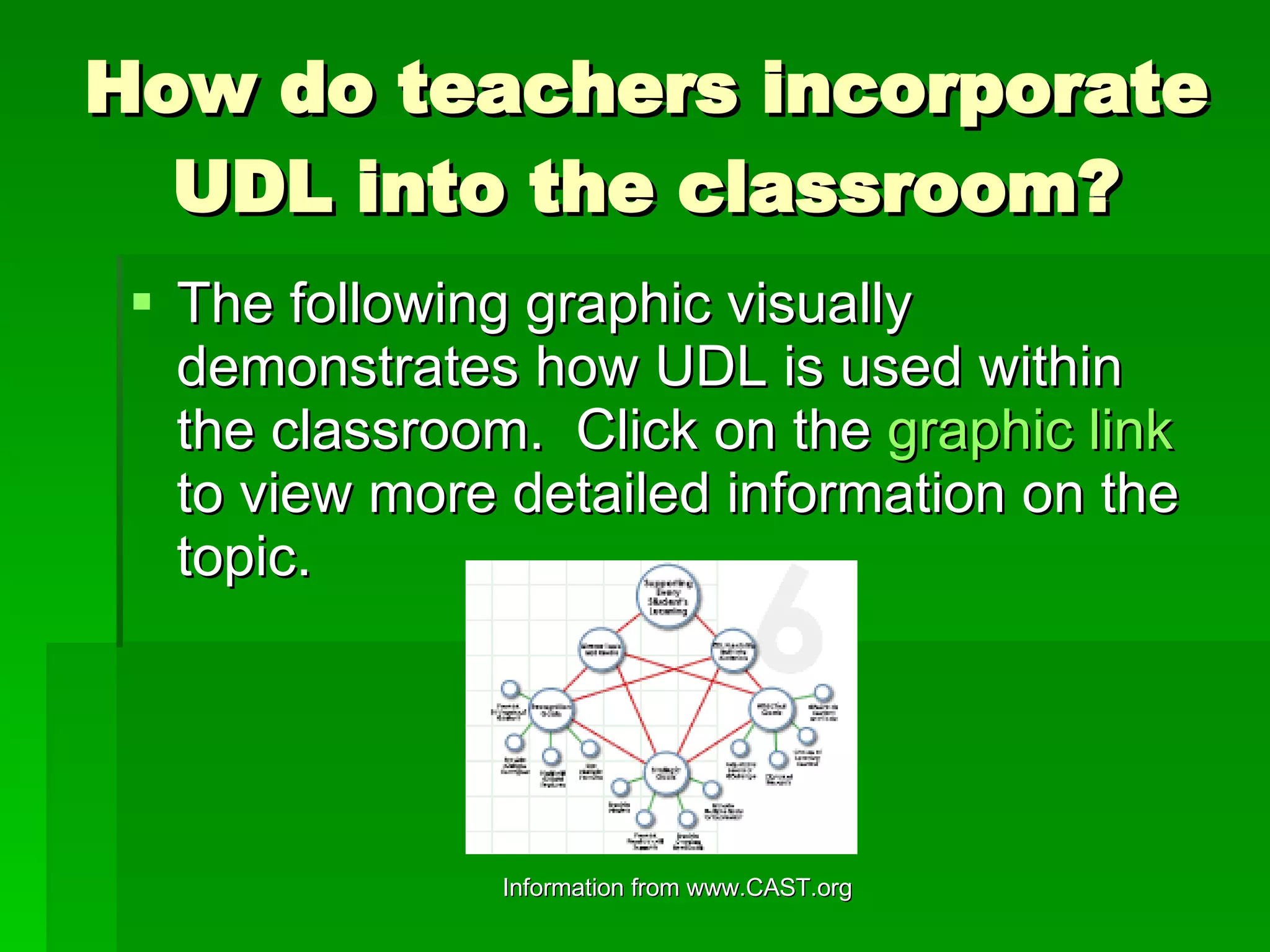
How do teachers incorporate UDL into the classroom? The following graphic visually demonstrates how UDL is used within the classroom.  Click on the  graphic link  to view more detailed information on the topic.
What about standards and instruction? UDL incorporates individualized learning through flexibility within a standards-based environment. Flexibility means that teachers build in instructional methods and materials that accommodate every student in the classroom. Traditional tools, multimedia, and networked resources can be utilized to provide diverse pathways to recognition learning and to meet the needs of all students.
Finally, how are assessments conducted? UDL uses embedded, flexible, and on-going assessments to evaluate each students’ skills, knowledge, and learning. These embedded assessments provide on-going feedback to help students improve their learning while they are learning the materials and concepts.
UDL Resources The CAST organization, with the assistance of the Access Center:  Improving Outcomes for All Students K-8 at the American Institute for Research, has created a UDL Toolkit that includes helpful additional information on UDL. UDL  ToolKit   www.cast.org/teachingeverystudent/toolkits/tk_introduction.cfm?tk_id=61

Udl Powerpoint

  • 1.
    An Introduction toUniversal Design for Learning (UDL) Tai Lynch, Ed.S. University of South Carolina
  • 2.
    Overview of thePresentation This presentation is an introduction to Universal Design for Learning (UDL). All of the information in the presentation was taken from the Center for Applied Special Technology (CAST), specifically within the Teaching Every Student (TES) www.cast.org/teachingeverystudent/section. For copyright information and references, please refer to the CAST website www.cast.org.
  • 3.
    What is UniversalDesign for Learning (UDL) Universal Design for Learning (UDL) is a research-based framework for designing curricula—that is, educational goals, methods, materials, and assessments—that enable all individuals to gain knowledge, skills, and enthusiasm for learning. This is accomplished by simultaneously providing rich supports for learning and reducing barriers to the curriculum, while maintaining high achievement standards for all students.
  • 4.
    Where did UDLcome from? UDL originated from the concept of Universal Design (UD) coined by Ron Mace of the University of North Carolina. Universal Design applies to the architecture that is conceived, designed, and constructed to meet the needs of all individuals who require access.
  • 5.
    UD vs. UDLULD builds upon the concept of UD in 2 key ways: First- UDL includes flexibility within the educational curriculum Second- UDL includes not only access to information but also access to learning. Access to learning is driven by knowing the instructional goal within the balance of support, resistance, and challenges.
  • 6.
    What does UDLlook like? Clink on the following link UDL Visual Graphic for additional information.
  • 7.
    How does brainresearch impact UDL and learning? The brain is the most powerful tool that a student brings into the classroom. Learning about the brain and it’s functions has provided guidelines for determining the kinds of teaching and learning alternatives that are most useful for students in educational situations. Learning is distributed across three neural networks: the recognition, strategic, and affective networks
  • 8.
    How do teachersincorporate UDL into the classroom? The following graphic visually demonstrates how UDL is used within the classroom. Click on the graphic link to view more detailed information on the topic.
  • 9.
    What about standardsand instruction? UDL incorporates individualized learning through flexibility within a standards-based environment. Flexibility means that teachers build in instructional methods and materials that accommodate every student in the classroom. Traditional tools, multimedia, and networked resources can be utilized to provide diverse pathways to recognition learning and to meet the needs of all students.
  • 10.
    Finally, how areassessments conducted? UDL uses embedded, flexible, and on-going assessments to evaluate each students’ skills, knowledge, and learning. These embedded assessments provide on-going feedback to help students improve their learning while they are learning the materials and concepts.
  • 11.
    UDL Resources TheCAST organization, with the assistance of the Access Center: Improving Outcomes for All Students K-8 at the American Institute for Research, has created a UDL Toolkit that includes helpful additional information on UDL. UDL ToolKit www.cast.org/teachingeverystudent/toolkits/tk_introduction.cfm?tk_id=61