National UDL Task Force
UDL Task Force More than 30 national education and civil rights organizations Complete list:  www.udl4allstudents.org
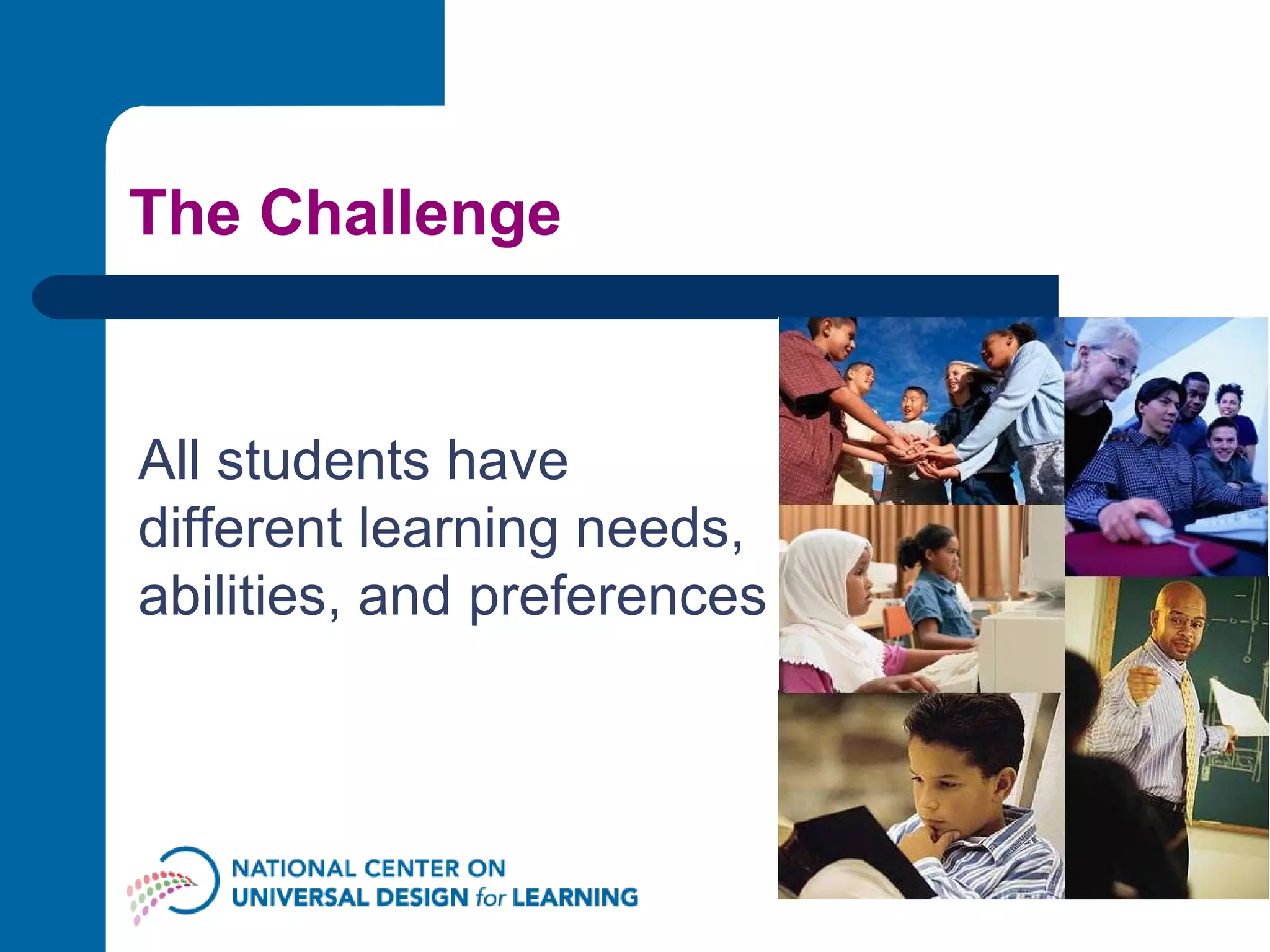
The Challenge All students have different learning needs, abilities, and preferences
The Need Provide learning opportunities  in the general education curriculum that are: INCLUSIVE   and  EFFECTIVE   FOR ALL
Universal Design for learning “ A scientifically valid framework for guiding educational practice” (Source: Higher Education Opportunity Act of 2008)
Universal design for learning… “ provides flexibility in the ways information is presented Students respond or demonstrate  knowledge and skills Students are engaged” (Source: Higher Education Opportunity Act of 2008)
Universal design for learning… reduces barriers in instruction provides appropriate accommodations [and]  supports … maintains high achievement expectations (Source: Higher Education Opportunity Act of 2008)
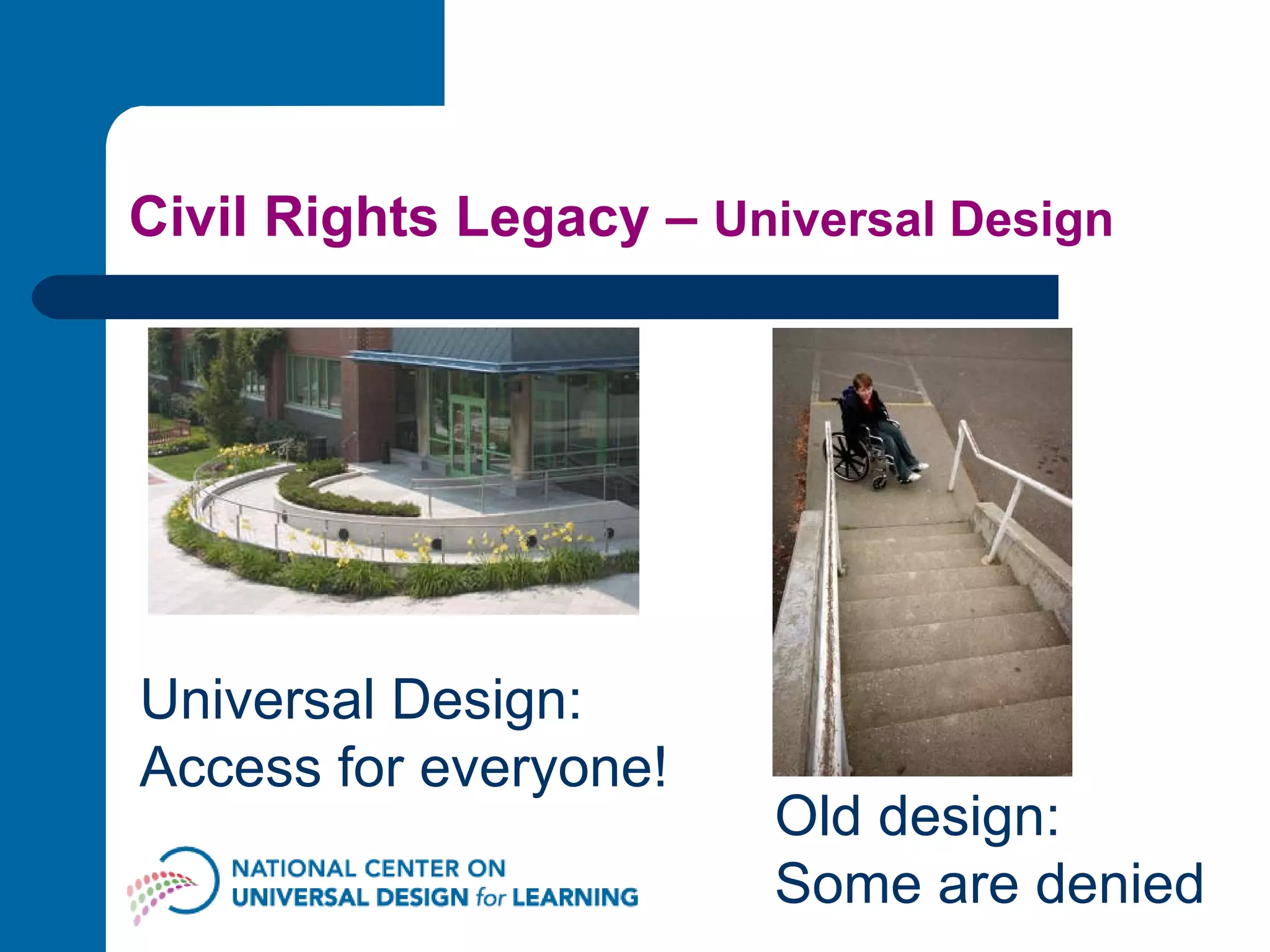
Civil Rights Legacy –  Universal Design Universal Design: Access for everyone! Old design: Some are denied
Universal Design “ Consider the needs of the broadest possible range of users from the beginning”  --  Ron Mace
Universal design principles Not an afterthought:  Full access is designed from the outset  More cost-effective than retrofitting More elegant and easy-to-use
Universal design (UD) examples Ramps and curb cuts Digital books with text-to-speech TV and video captioning Easy-grip tools Electric doors
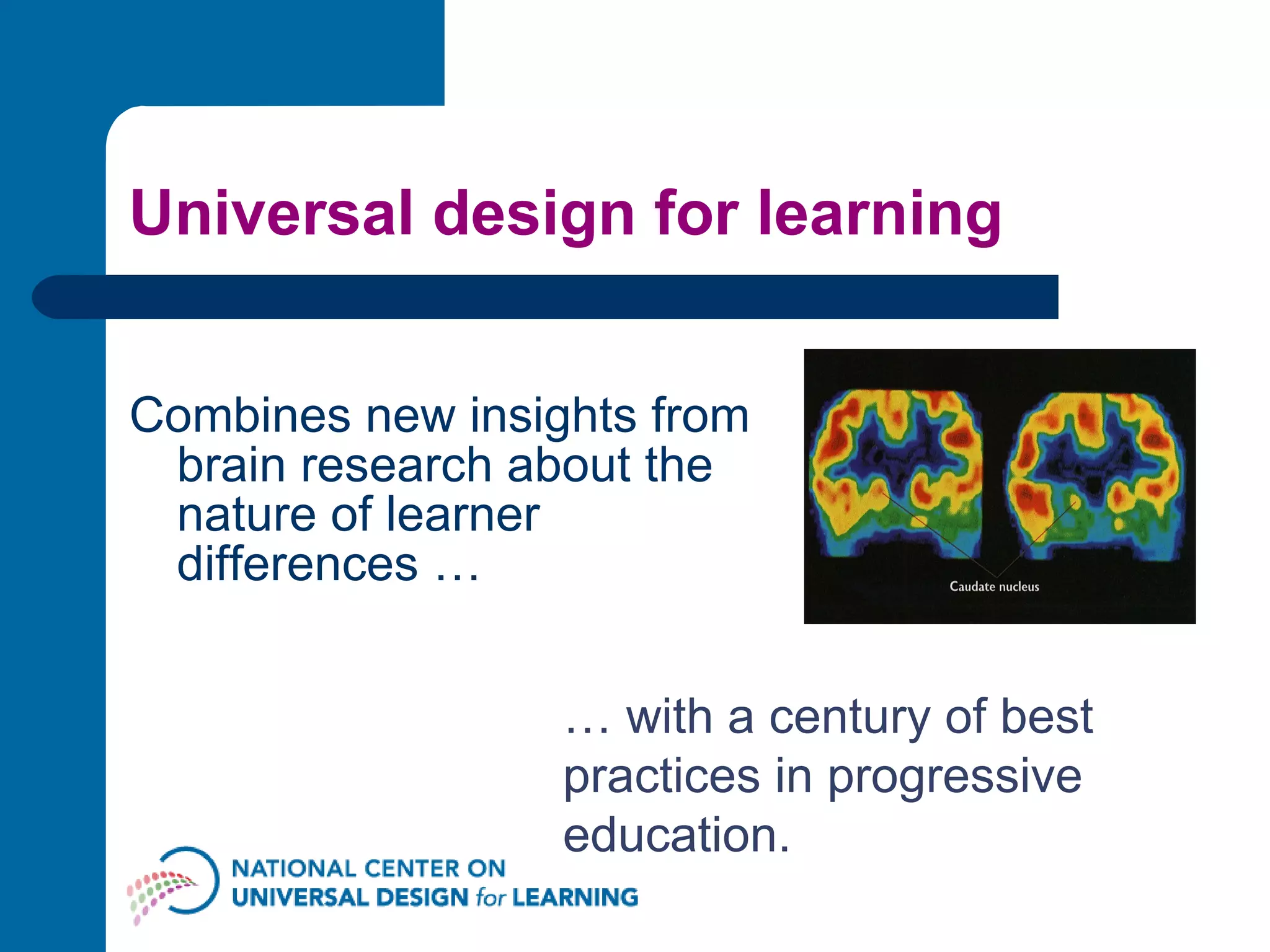
Universal design for learning Combines new insights from brain research about the nature of learner differences … …  with a century of best practices in progressive education.
Defining UDL Principles laid down by CAST in the 1990s Federal support for UDL research, dissemination since 1999 Defined by federal statute in 2008 Higher Education Opportunity Act
Universal design for learning Eliminating or reducing barriers to  academic  success for all students Valuing diversity in the classroom through proactive design of inclusive curriculum
Why UDL? Schools are working to improve academic performance; Today’s classrooms include many diverse learners; THUS, schools need to find ways to better meet the needs of all students!
UDL offers all students… More ways to access … More ways to participate … More ways to demonstrate learning…
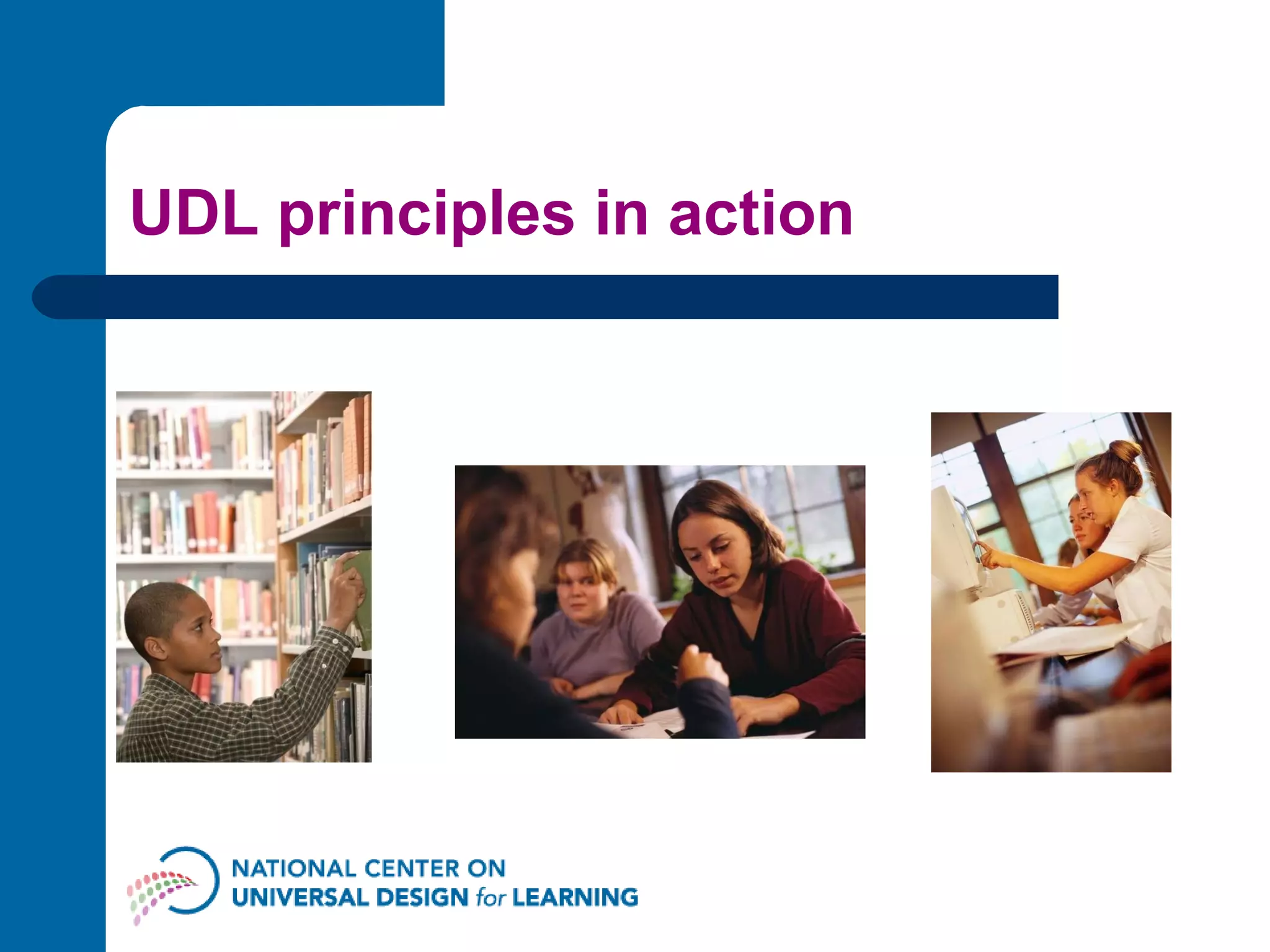
UDL principles in action
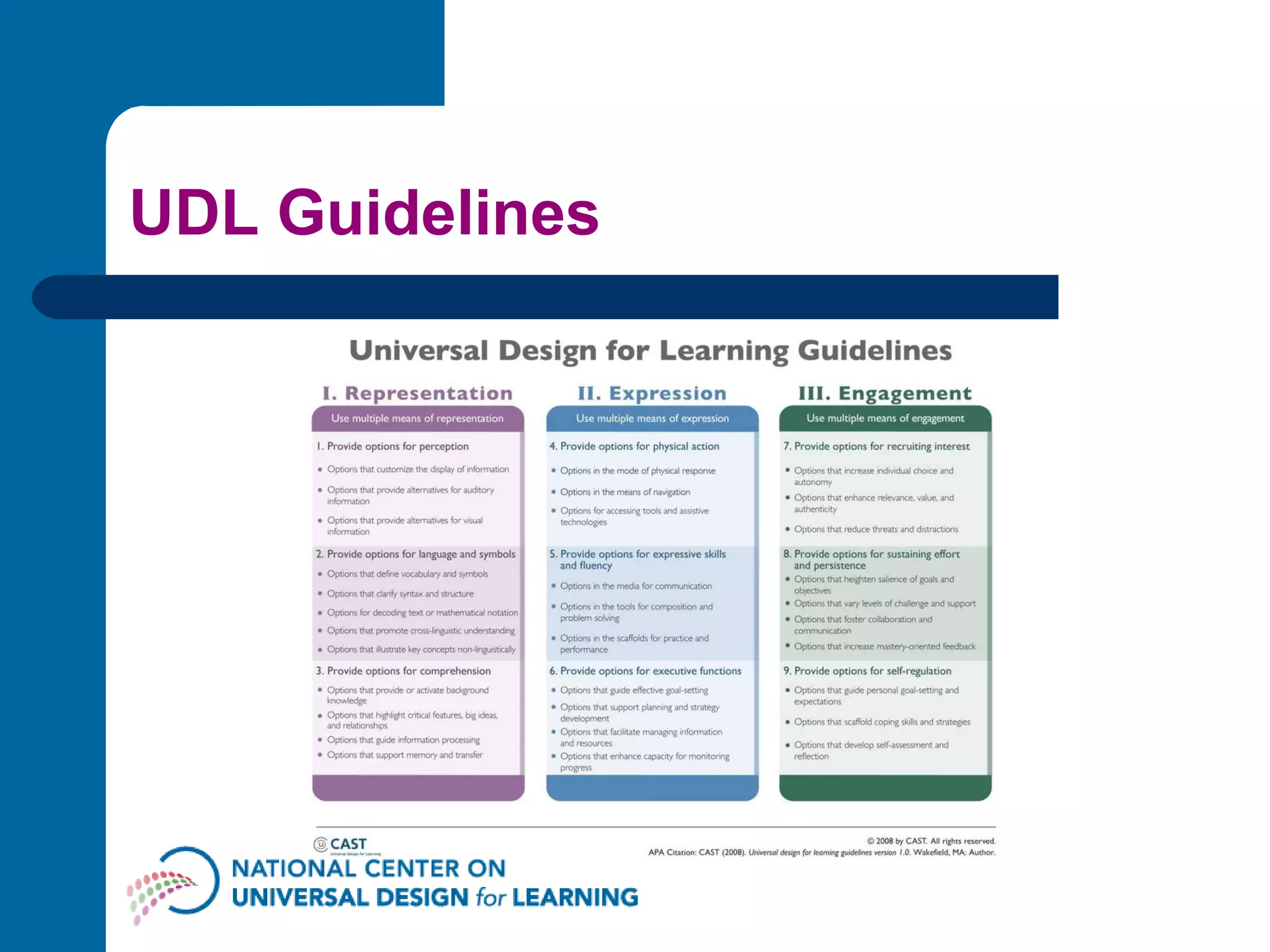
What are the UDL Principles? In each area of the curriculum provide  varied  and  flexible options  for: Representing information Action and expression Engagement
Multiple Representations of Information Examples Offer text-to-speech, video, audio, and other multimedia; integrate assistive technologies into learning environment  Provide vocabulary support and background knowledge  Highlight critical features & main ideas
Multiple Means of Action and Expression Examples Let students show what they know with voice recording, graphic displays, performance, etc.  Provide models of expert performance Offer executive-function supports such as graphic organizers, outlines, etc.
Multiple Means of Engagement Examples Vary levels of challenge and support to prevent frustration or boredom Tie work to real-world examples Where possible, give choices  Teach self-assessment and reflection
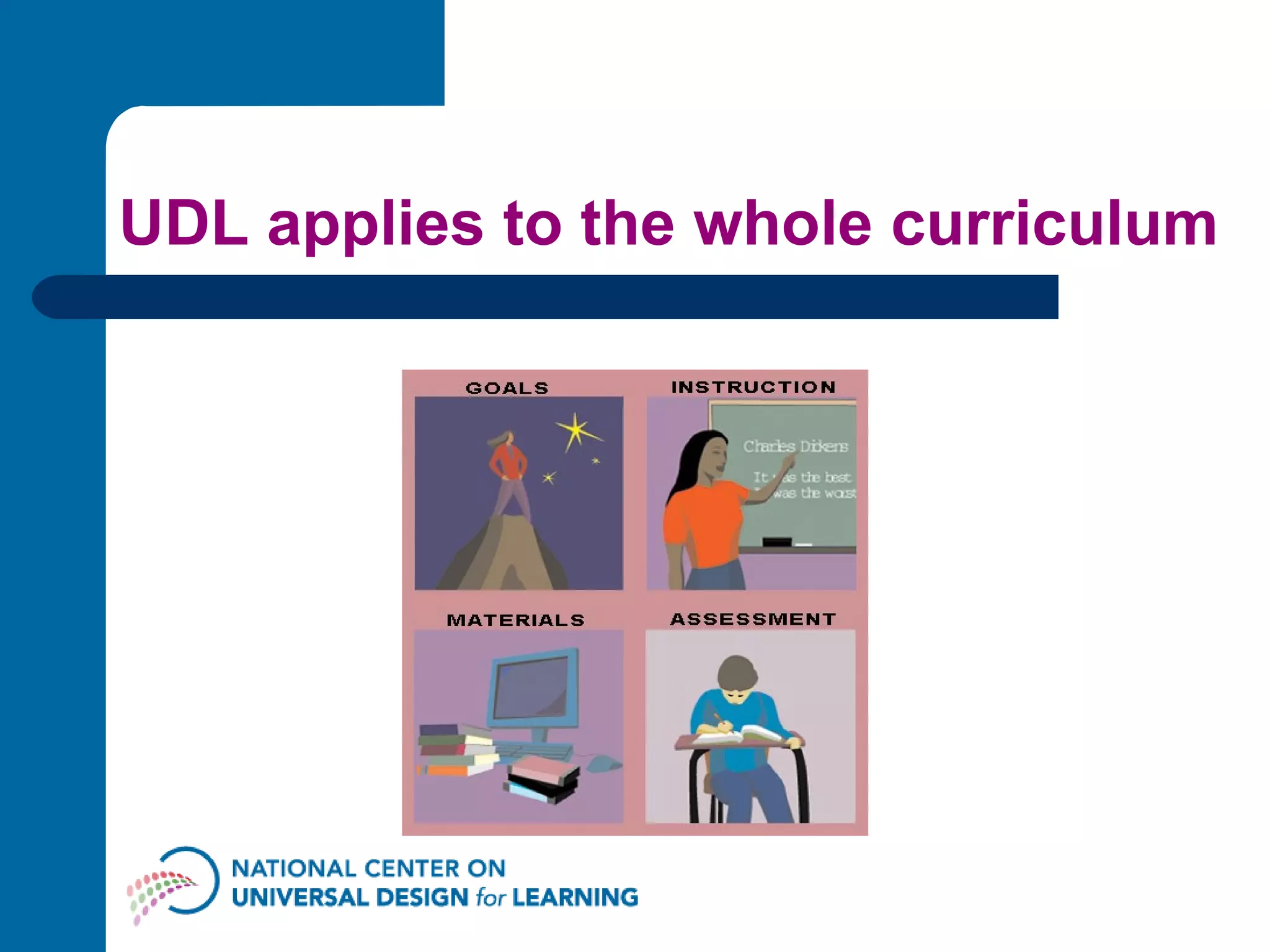
UDL applies to the whole curriculum
Goals Traditional Learning goals may get skewed by the inflexible ways and  means of achieving them. UDL Learning goals are attained in many individualized ways, by many customized means.
Materials Traditional   Mostly print and everyone gets the same materials. Few options UDL Variety of materials, media, and formats to reach learners with diverse abilities, styles, and needs equally well.
Methods Traditional   Teacher-centered (lecture) Homogeneous grouping Burden on student to adapt to “get it” UDL Interactivity Heterogeneous grouping Rich supports for understanding, independent learning
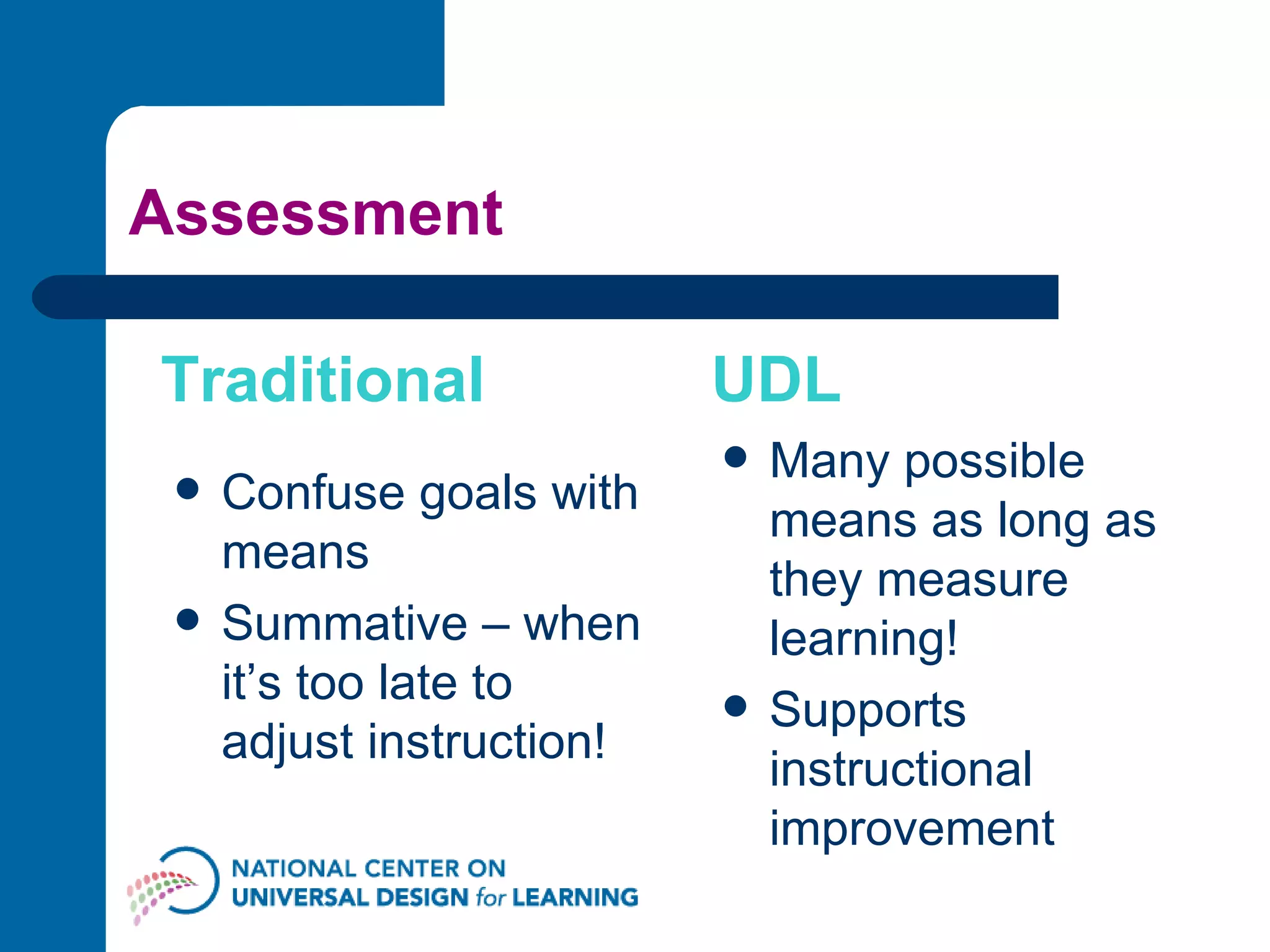
Assessment Traditional Confuse goals with means  Summative – when it’s too late to adjust instruction!  UDL Many possible means as long as they measure learning!  Supports  instructional improvement
UDL Guidelines
UDL Guidelines In-depth guide for practical application Resource for curriculum developers Checklists for teachers Go to  www.udlcenter.org
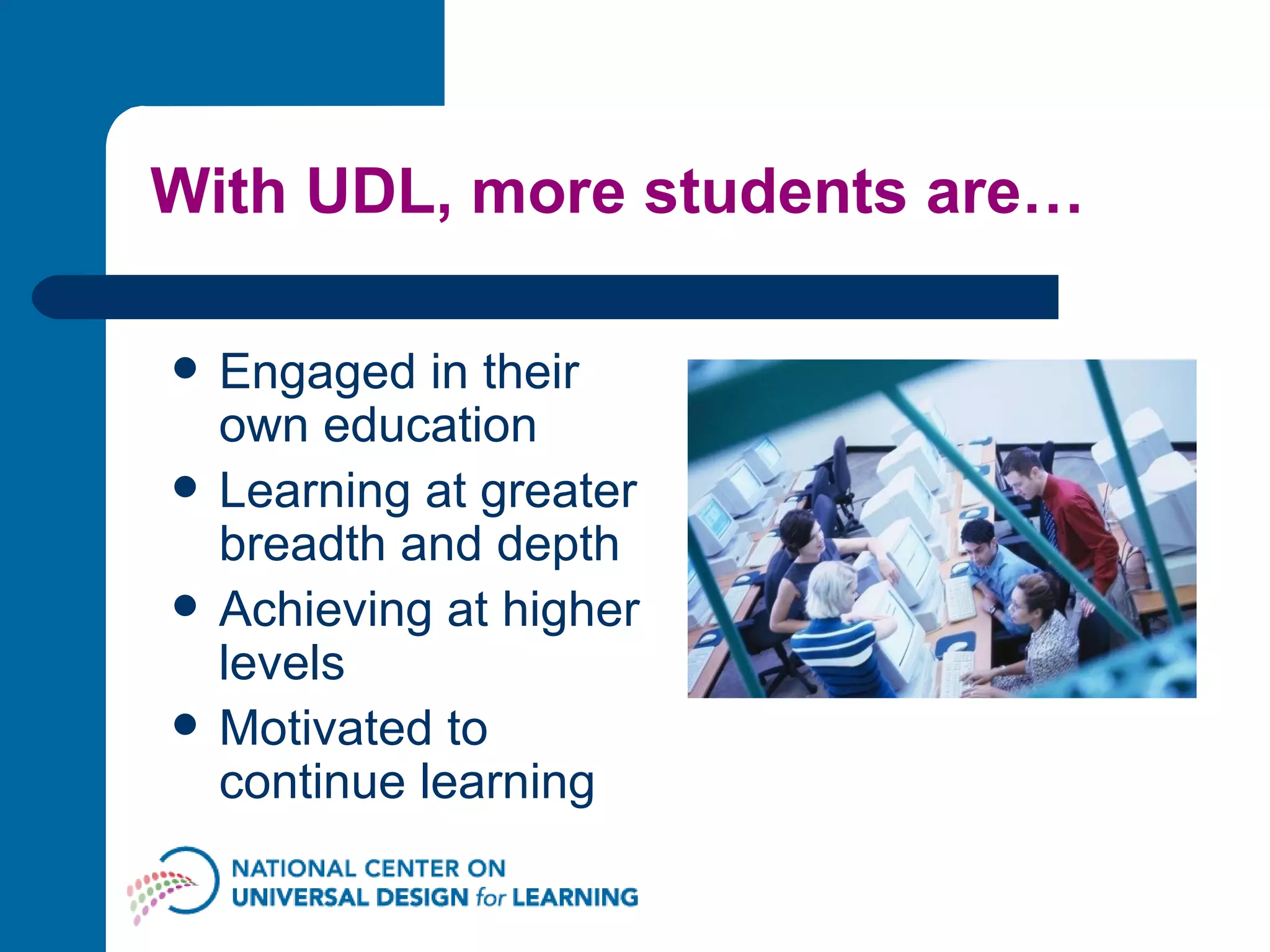
With UDL, more students are… Engaged in their own education Learning at greater breadth and depth Achieving at higher levels Motivated to continue learning
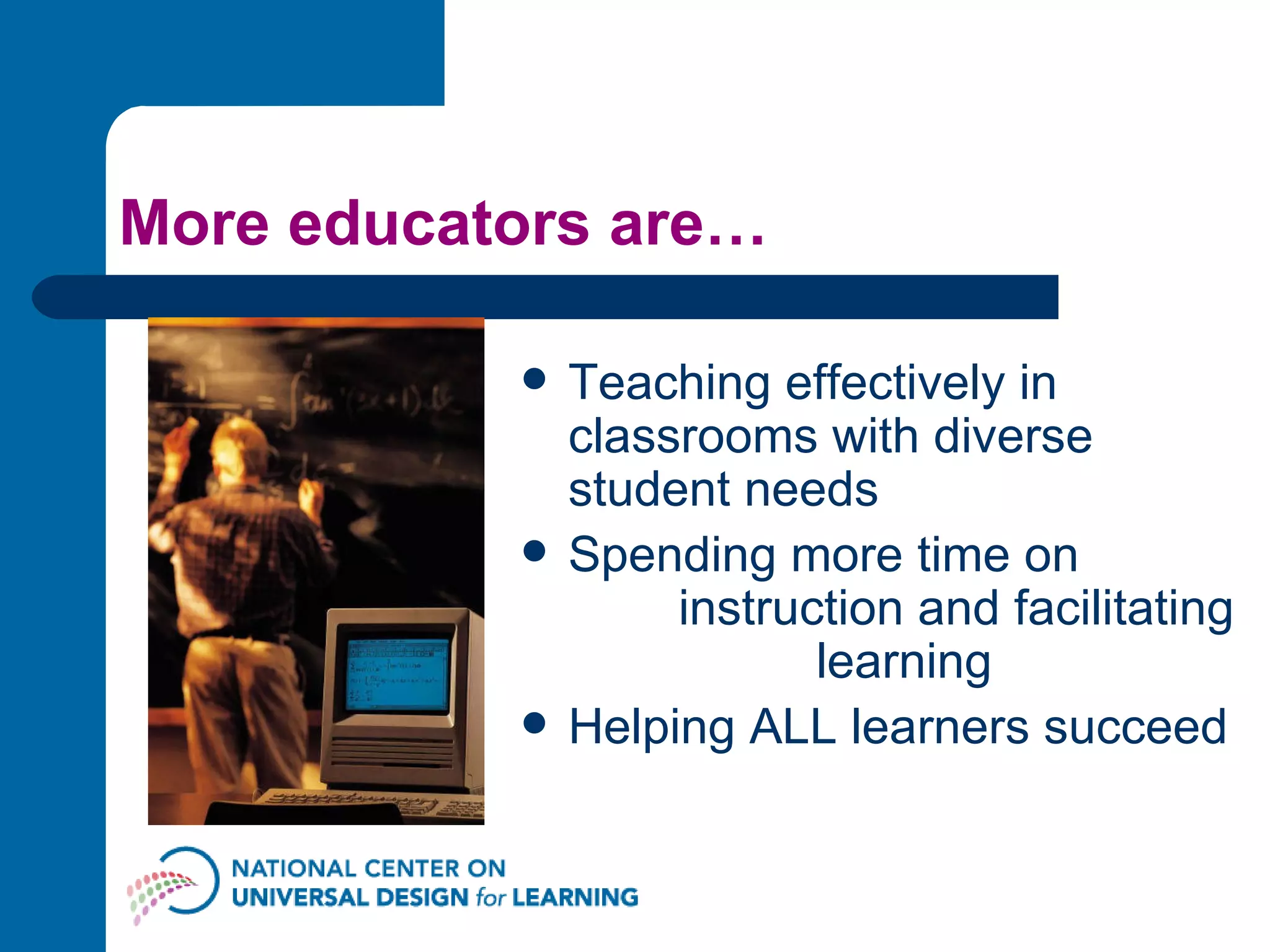
More educators are… Teaching effectively in classrooms with diverse student needs Spending more time on  instruction and facilitating  learning Helping ALL learners succeed
Local and state supports for UDL Local Evolution of general educator and special educator roles State State standards and benchmarks  Curriculum adoption policies Professional development initiatives
Federal supports for UDL Statutes and regulations No Child Left Behind Act (NCLB) Individuals with Disabilities Education Act (IDEA) National Instructional Materials Accessibility Standard (NIMAS) Higher Education Opportunity Act (HEOA)
Higher Education Opportunity Act  Defines UDL Technical assistance for UDL practice Infuses K-12 teacher prep  with UDL Report cards by States and IHEs on UDL implementation
Federal investment in UDL US Department of Education Office of Special Education Programs Institute for Education Sciences Office of Postsecondary Education National Science Foundation
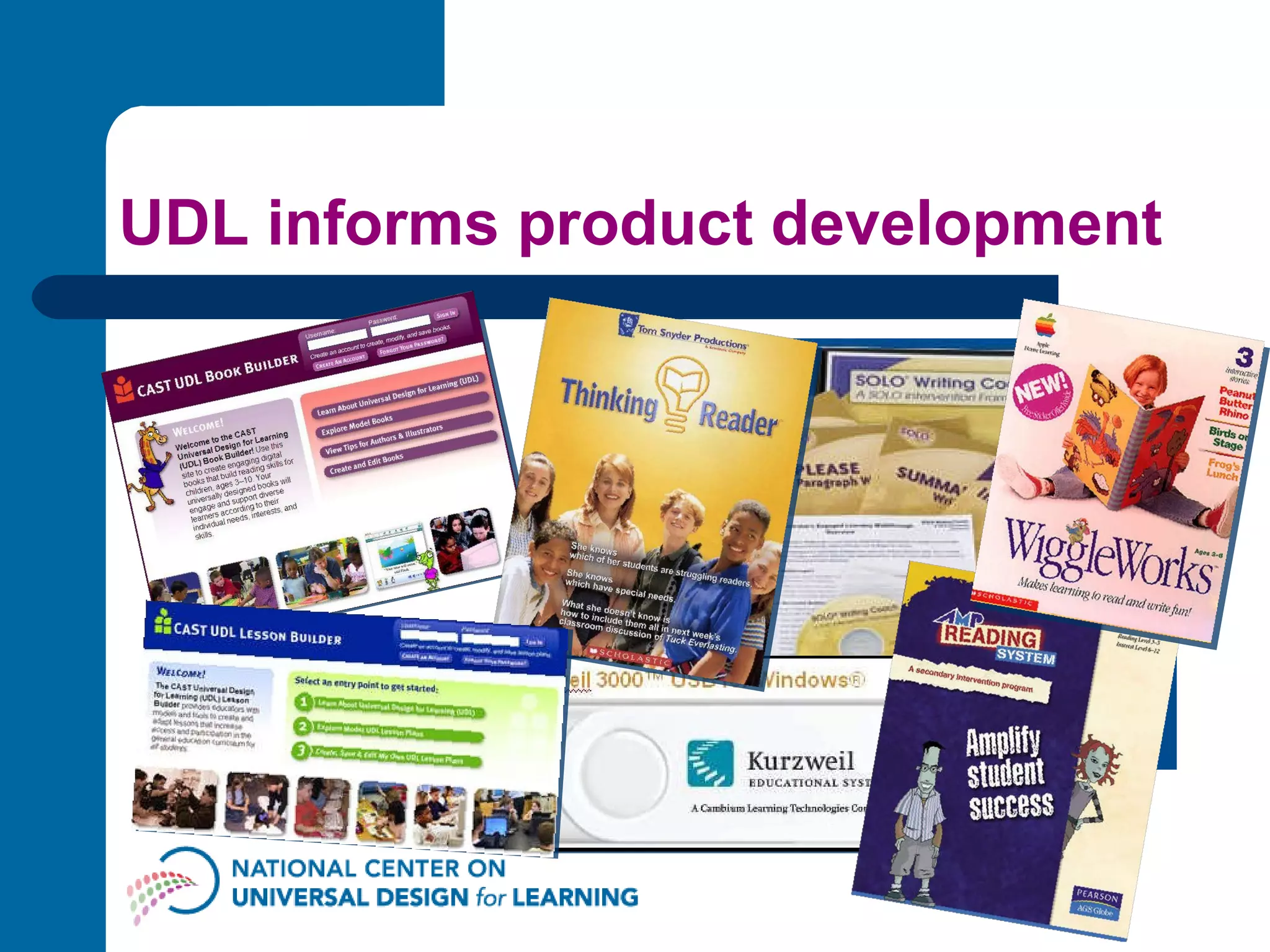
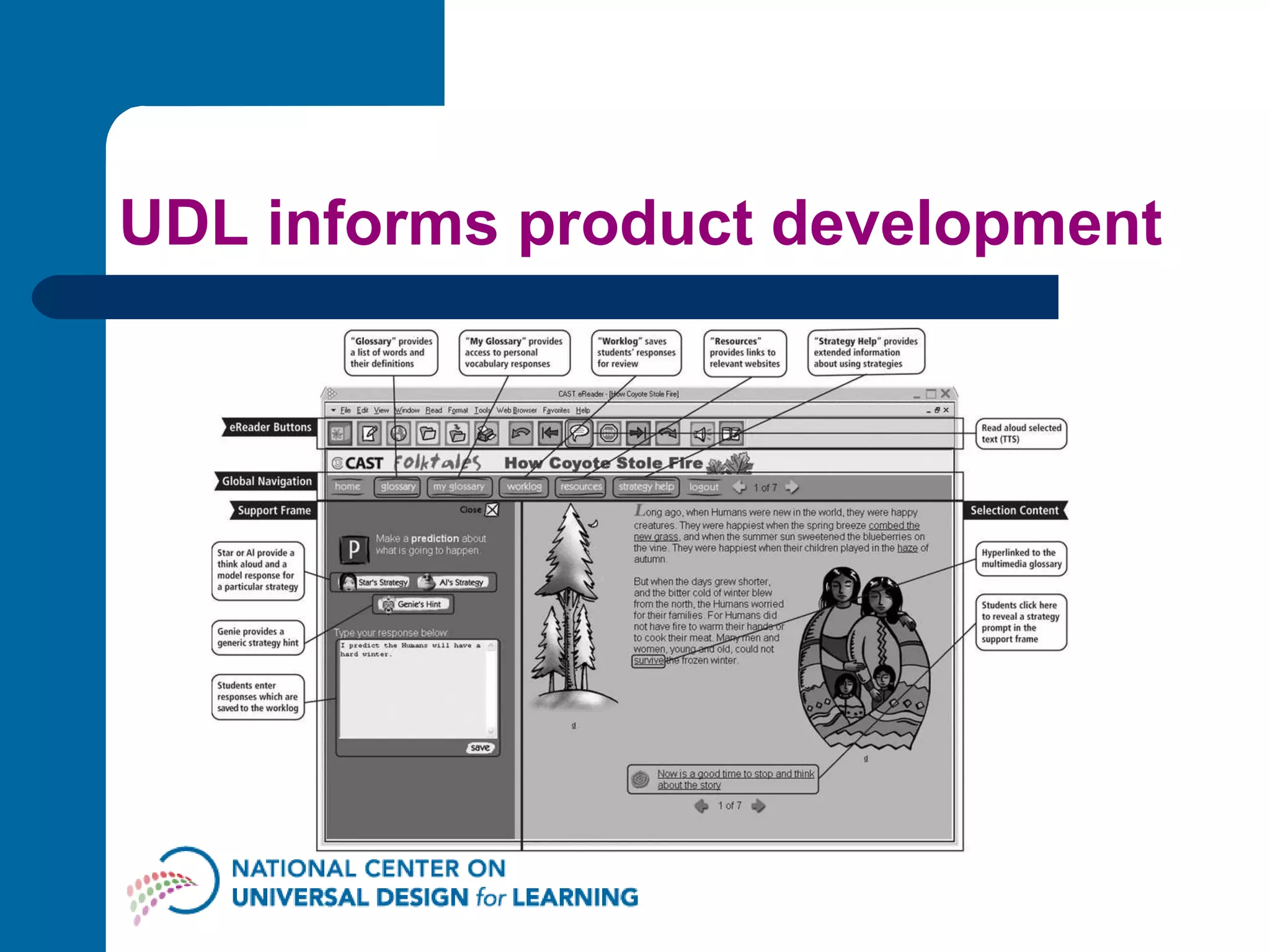
UDL informs product development
What can you do now? Apply UDL to your instruction Demand universally-designed products Share your UDL resources and lesson plans with others Advocate curriculum adoption policies that require UDL principles
For More Information National UDL Task Force www.udl4allstudents.org   CAST  www.cast.org   National UDL Center  www.udlcenter.org
For more information (add your information here)

National UDL Taskforce

  • 1.
  • 2.
    UDL Task ForceMore than 30 national education and civil rights organizations Complete list: www.udl4allstudents.org
  • 3.
    The Challenge Allstudents have different learning needs, abilities, and preferences
  • 4.
    The Need Providelearning opportunities in the general education curriculum that are: INCLUSIVE and EFFECTIVE FOR ALL
  • 5.
    Universal Design forlearning “ A scientifically valid framework for guiding educational practice” (Source: Higher Education Opportunity Act of 2008)
  • 6.
    Universal design forlearning… “ provides flexibility in the ways information is presented Students respond or demonstrate knowledge and skills Students are engaged” (Source: Higher Education Opportunity Act of 2008)
  • 7.
    Universal design forlearning… reduces barriers in instruction provides appropriate accommodations [and] supports … maintains high achievement expectations (Source: Higher Education Opportunity Act of 2008)
  • 8.
    Civil Rights Legacy– Universal Design Universal Design: Access for everyone! Old design: Some are denied
  • 9.
    Universal Design “Consider the needs of the broadest possible range of users from the beginning” -- Ron Mace
  • 10.
    Universal design principlesNot an afterthought: Full access is designed from the outset More cost-effective than retrofitting More elegant and easy-to-use
  • 11.
    Universal design (UD)examples Ramps and curb cuts Digital books with text-to-speech TV and video captioning Easy-grip tools Electric doors
  • 12.
    Universal design forlearning Combines new insights from brain research about the nature of learner differences … … with a century of best practices in progressive education.
  • 13.
    Defining UDL Principleslaid down by CAST in the 1990s Federal support for UDL research, dissemination since 1999 Defined by federal statute in 2008 Higher Education Opportunity Act
  • 14.
    Universal design forlearning Eliminating or reducing barriers to academic success for all students Valuing diversity in the classroom through proactive design of inclusive curriculum
  • 15.
    Why UDL? Schoolsare working to improve academic performance; Today’s classrooms include many diverse learners; THUS, schools need to find ways to better meet the needs of all students!
  • 16.
    UDL offers allstudents… More ways to access … More ways to participate … More ways to demonstrate learning…
  • 17.
  • 18.
    What are theUDL Principles? In each area of the curriculum provide varied and flexible options for: Representing information Action and expression Engagement
  • 19.
    Multiple Representations ofInformation Examples Offer text-to-speech, video, audio, and other multimedia; integrate assistive technologies into learning environment Provide vocabulary support and background knowledge Highlight critical features & main ideas
  • 20.
    Multiple Means ofAction and Expression Examples Let students show what they know with voice recording, graphic displays, performance, etc. Provide models of expert performance Offer executive-function supports such as graphic organizers, outlines, etc.
  • 21.
    Multiple Means ofEngagement Examples Vary levels of challenge and support to prevent frustration or boredom Tie work to real-world examples Where possible, give choices Teach self-assessment and reflection
  • 22.
    UDL applies tothe whole curriculum
  • 23.
    Goals Traditional Learninggoals may get skewed by the inflexible ways and means of achieving them. UDL Learning goals are attained in many individualized ways, by many customized means.
  • 24.
    Materials Traditional Mostly print and everyone gets the same materials. Few options UDL Variety of materials, media, and formats to reach learners with diverse abilities, styles, and needs equally well.
  • 25.
    Methods Traditional Teacher-centered (lecture) Homogeneous grouping Burden on student to adapt to “get it” UDL Interactivity Heterogeneous grouping Rich supports for understanding, independent learning
  • 26.
    Assessment Traditional Confusegoals with means Summative – when it’s too late to adjust instruction! UDL Many possible means as long as they measure learning! Supports instructional improvement
  • 27.
  • 28.
    UDL Guidelines In-depthguide for practical application Resource for curriculum developers Checklists for teachers Go to www.udlcenter.org
  • 29.
    With UDL, morestudents are… Engaged in their own education Learning at greater breadth and depth Achieving at higher levels Motivated to continue learning
  • 30.
    More educators are…Teaching effectively in classrooms with diverse student needs Spending more time on instruction and facilitating learning Helping ALL learners succeed
  • 31.
    Local and statesupports for UDL Local Evolution of general educator and special educator roles State State standards and benchmarks Curriculum adoption policies Professional development initiatives
  • 32.
    Federal supports forUDL Statutes and regulations No Child Left Behind Act (NCLB) Individuals with Disabilities Education Act (IDEA) National Instructional Materials Accessibility Standard (NIMAS) Higher Education Opportunity Act (HEOA)
  • 33.
    Higher Education OpportunityAct Defines UDL Technical assistance for UDL practice Infuses K-12 teacher prep with UDL Report cards by States and IHEs on UDL implementation
  • 34.
    Federal investment inUDL US Department of Education Office of Special Education Programs Institute for Education Sciences Office of Postsecondary Education National Science Foundation
  • 35.
  • 36.
  • 37.
    What can youdo now? Apply UDL to your instruction Demand universally-designed products Share your UDL resources and lesson plans with others Advocate curriculum adoption policies that require UDL principles
  • 38.
    For More InformationNational UDL Task Force www.udl4allstudents.org CAST www.cast.org National UDL Center www.udlcenter.org
  • 39.
    For more information(add your information here)