summative
assessment
Prepared by:
Love Joy L. Amargo
BSEd- 4A
 Definition of
Summative Assessment
 Formative vs.
Summative Assessment
 Examples
 Advantages and
Disadvantages
WHAT’S INSIDE?
 refers to the assessment of participants, and
summarizes their development at a particular
time.
 used to evaluate student learning, skill
acquisition, and academic achievement at the
conclusion of a defined instructional
period—typically at the end of a project, unit,
course, semester, program, or school year.
SUMMATIVE ASSESSMENT
Formative vs.
Summative
Formative:
When the cook tastes the soup.
Summative:
When the customer tastes the
soup.
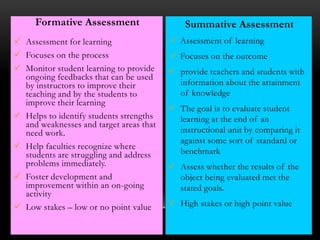
Formative Assessment
 Assessment for learning
 Focuses on the process
 Monitor student learning to provide
ongoing feedbacks that can be used
by instructors to improve their
teaching and by the students to
improve their learning
 Helps to identify students strengths
and weaknesses and target areas that
need work.
 Help faculties recognize where
students are struggling and address
problems immediately.
 Foster development and
improvement within an on-going
activity
 Low stakes – low or no point value
Summative Assessment
 Assessment of learning
 Focuses on the outcome
 provide teachers and students with
information about the attainment
of knowledge
 The goal is to evaluate student
learning at the end of an
instructional unit by comparing it
against some sort of standard or
benchmark
 Assess whether the results of the
object being evaluated met the
stated goals.
 High stakes or high point value
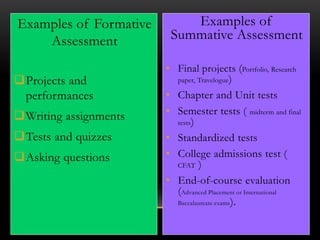
EXAMPLES
Examples of Formative
Assessment
Projects and
performances
Writing assignments
Tests and quizzes
Asking questions
Examples of
Summative Assessment
• Final projects (Portfolio, Research
paper, Travelogue)
• Chapter and Unit tests
• Semester tests ( midterm and final
tests)
• Standardized tests
• College admissions test (
CFAT )
• End-of-course evaluation
(Advanced Placement or International
Baccalaureate exams).
PROS AND CONS OF
SUMMATIVE
ASSESSMENT
PROS OF S.A
 used to determine whether
and to what degree students
have learned the lesson they
have been taught;
 generally evaluative, rather
than diagnostic—i.e., they
are more appropriately used
to determine learning
progress and achievement;
 evaluate the effectiveness of
educational programs;
 measure progress toward
improvement goals;
 make course-placement
decisions, among other
possible applications.
CONS OF S.A
 not always the most accurate
reflection of learning.
 they do nothing to identify
and remedy instructional
problems before they
become critical.
 having one big test makes
everyone anxious, and is
disruptive to school life.
Thank you

Summative assessment( advantages vs. disadvantages)

  • 1.
  • 2.
     Definition of SummativeAssessment  Formative vs. Summative Assessment  Examples  Advantages and Disadvantages WHAT’S INSIDE?
  • 3.
     refers tothe assessment of participants, and summarizes their development at a particular time.  used to evaluate student learning, skill acquisition, and academic achievement at the conclusion of a defined instructional period—typically at the end of a project, unit, course, semester, program, or school year. SUMMATIVE ASSESSMENT
  • 4.
  • 5.
    Formative: When the cooktastes the soup. Summative: When the customer tastes the soup.
  • 6.
    Formative Assessment  Assessmentfor learning  Focuses on the process  Monitor student learning to provide ongoing feedbacks that can be used by instructors to improve their teaching and by the students to improve their learning  Helps to identify students strengths and weaknesses and target areas that need work.  Help faculties recognize where students are struggling and address problems immediately.  Foster development and improvement within an on-going activity  Low stakes – low or no point value Summative Assessment  Assessment of learning  Focuses on the outcome  provide teachers and students with information about the attainment of knowledge  The goal is to evaluate student learning at the end of an instructional unit by comparing it against some sort of standard or benchmark  Assess whether the results of the object being evaluated met the stated goals.  High stakes or high point value
  • 7.
  • 8.
    Examples of Formative Assessment Projectsand performances Writing assignments Tests and quizzes Asking questions Examples of Summative Assessment • Final projects (Portfolio, Research paper, Travelogue) • Chapter and Unit tests • Semester tests ( midterm and final tests) • Standardized tests • College admissions test ( CFAT ) • End-of-course evaluation (Advanced Placement or International Baccalaureate exams).
  • 9.
    PROS AND CONSOF SUMMATIVE ASSESSMENT
  • 10.
    PROS OF S.A used to determine whether and to what degree students have learned the lesson they have been taught;  generally evaluative, rather than diagnostic—i.e., they are more appropriately used to determine learning progress and achievement;  evaluate the effectiveness of educational programs;  measure progress toward improvement goals;  make course-placement decisions, among other possible applications. CONS OF S.A  not always the most accurate reflection of learning.  they do nothing to identify and remedy instructional problems before they become critical.  having one big test makes everyone anxious, and is disruptive to school life.
  • 11.