Universal Design for LearningCreated by Lynn Matthews
 Universal Design for Learning….Just what is that and what does it mean?
Universal Design for Learning (UDL) is a framework for designing curricula that enable all individuals to gain knowledge, skills, and enthusiasm for learning. UDL provides rich supports for learning and reduces barriers to the curriculum while maintaining high achievement standards for all.
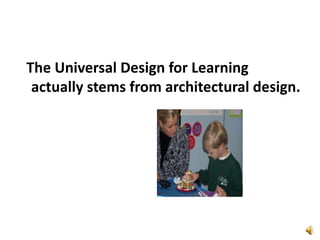
  The Universal Design for Learning actually stems from architectural design.
There are three main principles of UDL.Each principle provides for flexible ways to haveMultiple means of representation:  to give learners various ways of acquiring information and knowledge,2. Multiple means of action and expression: to provide learners variation in ways to  demonstrate what they know,3. Multiple means of engagement:  to tap into learners' interests, offer appropriate challenges, and increase motivation through creative and meaningful ways.
The UDL principles are based on brain research that shows that all learners process things differently.  Researchers have focused on three brain networks and the way they process information.Recognition Networks
Strategic Networks
Affective NetworksRecognition Network This network represents how learners identify or recognize what we see, hear, and read. This is where we identify letters, words, or ideas.
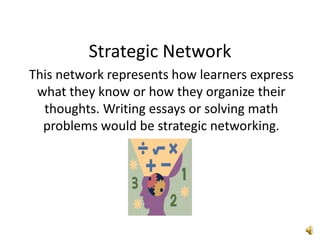
Strategic NetworkThis network represents how learners express what they know or how they organize their thoughts. Writing essays or solving math problems would be strategic networking.
Affective NetworkThis network represents how learners are motivated, engaged, excited or interested about what they are learning. Providing creative options for lessons and assessments helps students demonstrate mastery in nontraditional ways.
The Center for Applied Special Technology (CAST)  is the foundation for UDL. This center offers ideas, tools, and support to educators, parents, students, and others who aim to help learners.Dr. David Rose,  one of the co-founders offers a great Webinar here:http://teacher.scholastic.com/products/ReadAbout/research/webinars_rose.htmThese tools listed below offer avenues for educators to utilize the CAST philosophy.UDL Book Builder: Build your own digital books with rich learning supports – This tool could be so useful to English as second language learners!UDL Lesson Builder: Craft lessons that reach and engage all learners This tool could be used for all learners, from accelerated to lower level learners to have individualized lessons available for  them!UDL Editions By CAST: Read classic texts from world literature in highly supported digital environments Ensure that all learners can participate in literacy based learning!CAST Strategy Tutor: Develop and manage Web-based lessons and projects
Where can I go to learn more?To begin to understand more and to implement more UDL principles, look here to increase your knowledge base.http://www.cast.org/index.htmlhttp://www.advocacyinstitute.org/UDL/http://www.paec.org/fdlrstech/udl.htmlhttp://udl4all.pbworks.com/What+is+UDL

A P P4 Matthews L

  • 1.
    Universal Design forLearningCreated by Lynn Matthews
  • 2.
     Universal Design forLearning….Just what is that and what does it mean?
  • 3.
    Universal Design forLearning (UDL) is a framework for designing curricula that enable all individuals to gain knowledge, skills, and enthusiasm for learning. UDL provides rich supports for learning and reduces barriers to the curriculum while maintaining high achievement standards for all.
  • 4.
    TheUniversal Design for Learning actually stems from architectural design.
  • 5.
    There are threemain principles of UDL.Each principle provides for flexible ways to haveMultiple means of representation: to give learners various ways of acquiring information and knowledge,2. Multiple means of action and expression: to provide learners variation in ways to demonstrate what they know,3. Multiple means of engagement: to tap into learners' interests, offer appropriate challenges, and increase motivation through creative and meaningful ways.
  • 6.
    The UDL principlesare based on brain research that shows that all learners process things differently. Researchers have focused on three brain networks and the way they process information.Recognition Networks
  • 7.
  • 8.
    Affective NetworksRecognition NetworkThis network represents how learners identify or recognize what we see, hear, and read. This is where we identify letters, words, or ideas.
  • 9.
    Strategic NetworkThis networkrepresents how learners express what they know or how they organize their thoughts. Writing essays or solving math problems would be strategic networking.
  • 10.
    Affective NetworkThis networkrepresents how learners are motivated, engaged, excited or interested about what they are learning. Providing creative options for lessons and assessments helps students demonstrate mastery in nontraditional ways.
  • 11.
    The Center forApplied Special Technology (CAST) is the foundation for UDL. This center offers ideas, tools, and support to educators, parents, students, and others who aim to help learners.Dr. David Rose, one of the co-founders offers a great Webinar here:http://teacher.scholastic.com/products/ReadAbout/research/webinars_rose.htmThese tools listed below offer avenues for educators to utilize the CAST philosophy.UDL Book Builder: Build your own digital books with rich learning supports – This tool could be so useful to English as second language learners!UDL Lesson Builder: Craft lessons that reach and engage all learners This tool could be used for all learners, from accelerated to lower level learners to have individualized lessons available for them!UDL Editions By CAST: Read classic texts from world literature in highly supported digital environments Ensure that all learners can participate in literacy based learning!CAST Strategy Tutor: Develop and manage Web-based lessons and projects
  • 12.
    Where can Igo to learn more?To begin to understand more and to implement more UDL principles, look here to increase your knowledge base.http://www.cast.org/index.htmlhttp://www.advocacyinstitute.org/UDL/http://www.paec.org/fdlrstech/udl.htmlhttp://udl4all.pbworks.com/What+is+UDL