Universal Design for Learning (UDL)By: Sara Yavorsky
Universal Design for Learning“UDL provides a blueprint for creating instructional goals, methods, materials, and assessments that work for everyone--not a single, one-size-fits-all solution but rather flexible approaches that can be customized and adjusted for individual needs.”(http://www.cast.org/udl/index.html)
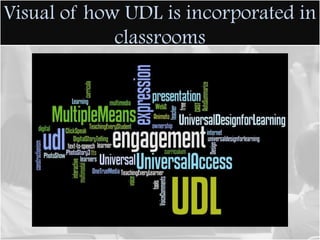
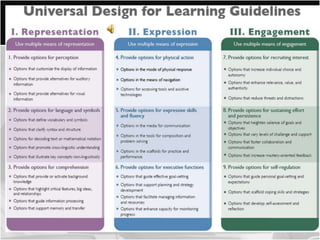
Visual of how UDL is incorporated in classrooms
3 Principles of UDLPrinciple l: Provide Multiple Means of RepresentationPrinciple ll: Provide Multiple Means of Action and ExpressionPrinciple lll: Provide Multiple Means of Engagement http://www.udlcenter.org/aboutudl/udlguidelines
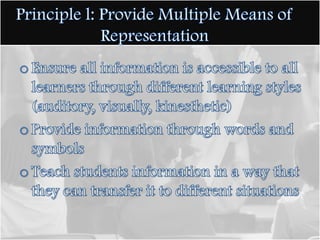
Ensure all information is accessible to all learners through different learning styles (auditory, visually, kinesthetic)
Provide information through words and symbols
Teach students information in a way that they can transfer it to different situationsPrinciple l: Provide Multiple Means of Representation
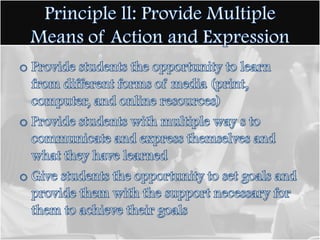
Principle ll: Provide Multiple Means of Action and ExpressionProvide students the opportunity to learn from different forms of media (print, computer, and online resources)
Provide students with multiple way s to communicate and express themselves and what they have learned
Give students the opportunity to set goals and provide them with the support necessary for them to achieve their goalsPrinciple lll: Provide Multiple Means of Engagement Connect students interest with the curriculum in order for students to remain interested and engaged
Support students in all aspects of their learning process
Inspire students to learn for intrinsic purposes  not always for extrinsic rewards Instructional MethodsClick below for examples of instructional methods that correlate with each principle of UDL http://www.udlcenter.org/implementation/examples
Technology in UDL Technology  makes designing curriculum to meet the needs of individual students easier
Technology needs to be planned and implemented carefully adhering to content standards and indicators
Assistive and adaptive technologies can be an important aspect of UDL for specific students
Click below to read an article from the National Center on UDLhttp://www.udlcenter.org/resource_library/articles/udlunplugged
Potential Impact of UDL on my StudentsMy students learning plans will be focused on their individual needs and learning styles
Technology will be incorporated into their learning plans in order to assist them in mastering the state science content standards and indicatorsUDL Resources for Teachershttp://www.cast.org/teachingeverystudent/tools/
http://www.youtube.com/watch?v=bDvKnY0g6e4
Basham, J. and Gardner, J. (2010). Measuring Universal Design for Learning. Special Education Technology Practice , 15-20.Retrieved from the Walden University Library using the Education Research Complete database.

Universal Design for Learning (UDL)

  • 1.
    Universal Design forLearning (UDL)By: Sara Yavorsky
  • 2.
    Universal Design forLearning“UDL provides a blueprint for creating instructional goals, methods, materials, and assessments that work for everyone--not a single, one-size-fits-all solution but rather flexible approaches that can be customized and adjusted for individual needs.”(http://www.cast.org/udl/index.html)
  • 3.
    Visual of howUDL is incorporated in classrooms
  • 4.
    3 Principles ofUDLPrinciple l: Provide Multiple Means of RepresentationPrinciple ll: Provide Multiple Means of Action and ExpressionPrinciple lll: Provide Multiple Means of Engagement http://www.udlcenter.org/aboutudl/udlguidelines
  • 6.
    Ensure all informationis accessible to all learners through different learning styles (auditory, visually, kinesthetic)
  • 7.
  • 8.
    Teach students informationin a way that they can transfer it to different situationsPrinciple l: Provide Multiple Means of Representation
  • 9.
    Principle ll: ProvideMultiple Means of Action and ExpressionProvide students the opportunity to learn from different forms of media (print, computer, and online resources)
  • 10.
    Provide students withmultiple way s to communicate and express themselves and what they have learned
  • 11.
    Give students theopportunity to set goals and provide them with the support necessary for them to achieve their goalsPrinciple lll: Provide Multiple Means of Engagement Connect students interest with the curriculum in order for students to remain interested and engaged
  • 12.
    Support students inall aspects of their learning process
  • 13.
    Inspire students tolearn for intrinsic purposes not always for extrinsic rewards Instructional MethodsClick below for examples of instructional methods that correlate with each principle of UDL http://www.udlcenter.org/implementation/examples
  • 14.
    Technology in UDLTechnology makes designing curriculum to meet the needs of individual students easier
  • 15.
    Technology needs tobe planned and implemented carefully adhering to content standards and indicators
  • 16.
    Assistive and adaptivetechnologies can be an important aspect of UDL for specific students
  • 17.
    Click below toread an article from the National Center on UDLhttp://www.udlcenter.org/resource_library/articles/udlunplugged
  • 18.
    Potential Impact ofUDL on my StudentsMy students learning plans will be focused on their individual needs and learning styles
  • 19.
    Technology will beincorporated into their learning plans in order to assist them in mastering the state science content standards and indicatorsUDL Resources for Teachershttp://www.cast.org/teachingeverystudent/tools/
  • 20.
  • 21.
    Basham, J. andGardner, J. (2010). Measuring Universal Design for Learning. Special Education Technology Practice , 15-20.Retrieved from the Walden University Library using the Education Research Complete database.