An Introduction to   Universal Design for Learning Dawna Schultz Rutgers University- CMSCE
“ DO NOW” Personal Statue Using the pipe cleaners, create a personal sculpture that represents something about you.  It could be how you feel, a hobby, what you value, etc. Be ready to share your personal statue with the group.
Agenda 8:30-9:00 Welcome & Introductions 9:00-12:00 Universal Design for Learning (UDL) LUNCH 12:30-2:00  Social Bookmarking 2:00-3:00 UDLatRutgers.edublogs.org  &    Evaluations
Goals Understand the concepts of Universal Design for Learning Apply the concepts of Universal Design for Learning to classroom practice
Introductions Who are you? What subject(s) and grade level(s) do you teach? How long have you been teaching? Share your personal statue.
Differentiating Instruction Take a few minutes and just list all of the strategies, techniques and tools you currently use to differentiate Instruction. With your team share and discuss your lists. Make a new combined list. Share your list with the class.
The Challenge Access, participation, and progress in the general education curriculum for all learners IDEA ‘97
Think-Pair-Share What are some of your challenges ? Think and list challenges (1 min) Pair with your neighbor and share our list with each other (2 min) Share your pair discussion with the larger group (3 min)
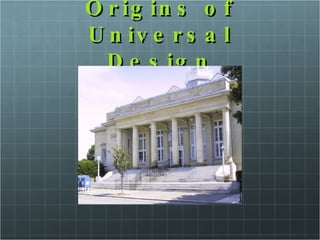
Origins of Universal Design
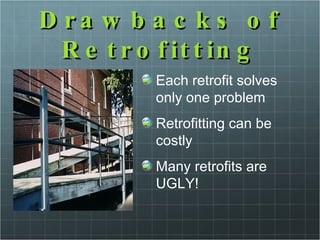
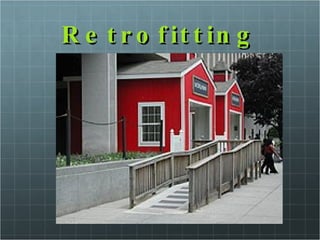
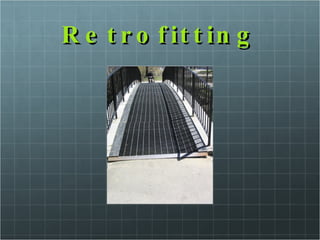
Drawbacks of Retrofitting Each retrofit solves only one problem Retrofitting can be costly Many retrofits are UGLY!
Retrofitting
Retrofitting
Universal Design “ Consider the needs of the broadest possible range of users from the beginning” Architect, Ron Mace
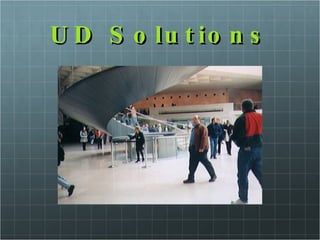
UD Solutions
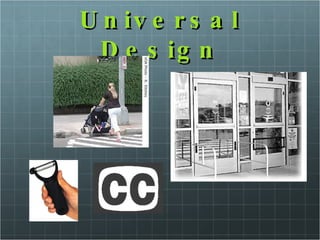
Universal Design Not one size fits all – but alternatives. Designed from the beginning, not added on later. Increases access opportunities for everyone
Universal Design
Pair-Share Pair up and brainstorm for couple of minutes other examples of Universal Design Share with the class.
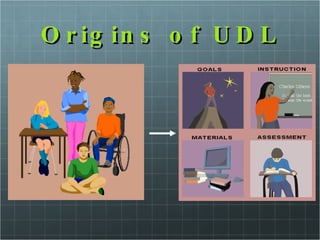
Origins of UDL CAST believes that “barriers to learning are not, in fact, inherent in the capacities of learners, but instead arise in learners' interactions with inflexible educational goals, materials, methods, and assessments.”  Teaching Every Student in the Digital Age , p. vi http://lessonbuilder.cast.org/window.php?src=videos
Origins of UDL
UDL Definition UDL is an educational approach to teaching, learning, and assessment, drawing on new brain research and new media technologies to respond to individual learner differences.
UDL & the Learning Brain
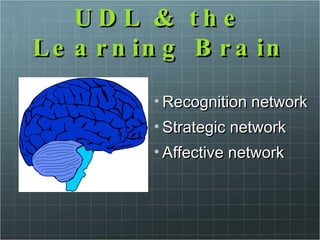
UDL & the Learning Brain Recognition network Strategic network Affective network
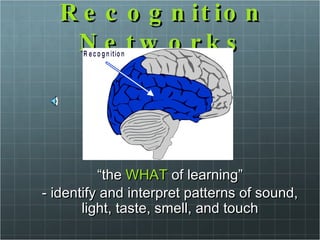
Recognition Networks “ the  WHAT  of learning” -  identify and interpret patterns of sound, light, taste, smell, and touch
 
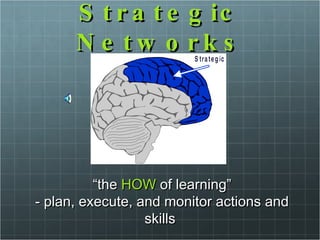
Strategic Networks “ the  HOW  of learning” -  plan, execute, and monitor actions and skills
 
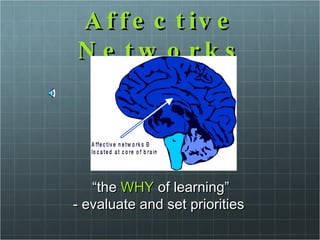
Affective Networks “ the  WHY  of learning” -  evaluate and set priorities
 
Prerequisites for Learning One must recognize information, ideas, and concepts (Recognition) One must be able to apply  strategies to process the information (Strategic) One must be engaged (Affective) Vygotsky
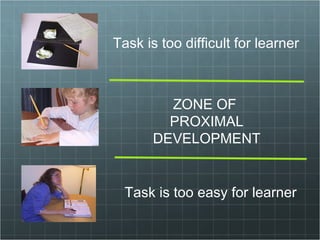
Task is too difficult for learner ZONE OF  PROXIMAL DEVELOPMENT Task is too easy for learner
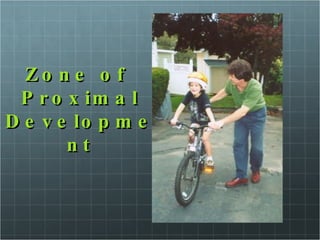
Zone of  Proximal Development
All learners are unique and universal does not mean “one size fits all”
The Framework for UDL
Principles of UDL Provide multiple, flexible methods of: Presentation to support _______ learning Expression and apprenticeship to support _______ learning. Engagement to support_________ learning http://lessonbuilder.cast.org/window.php?src=videos
New Assumptions: UDL Students with disabilities fall along multiple continua Typical classes are highly diverse Teacher adjustments benefit all learners Curriculum needs fixing, not the students Curriculum materials must be flexible, varied, and diverse General Education and Special Education teachers plan curriculum
Questions  Which  methods  of teaching are most effective with the ways that each brain network functions?  What kinds of flexibility must instructional  materials  have to address the uniqueness of each learner?
Jigsaw Each team of 3 will become experts on their  brain network.  By meeting with all the other members from the other teams who are learning about the same brain network, and discussing the classroom examples you will become an expert on that brain network. Meet with your team and share what you learned. As a teams, share with the class key thoughts, feeling, ideas, etc. based on your team dialogue on the three brain networks. Be creative with how you present.
The UDL Approach Diversity is the norm in today’s classrooms Applying the UDL principles in education is enabled by: Appropriate goals  Flexible and supportive digital materials  Flexible and diverse methods, and Accessible and flexible assessments
Social Bookmarking http://www.commoncraft.com/bookmarking-plain-english
 
 
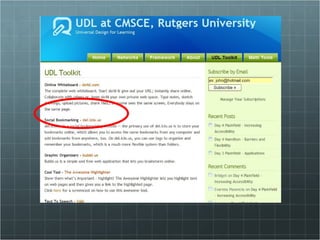
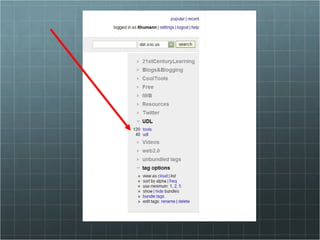
Social Bookmarking www.delicious.com www.diigo.com www.portaportal.com
http://udlatrutgers.edublogs.org/

Day1 Udl Overview

  • 1.
    An Introduction to Universal Design for Learning Dawna Schultz Rutgers University- CMSCE
  • 2.
    “ DO NOW”Personal Statue Using the pipe cleaners, create a personal sculpture that represents something about you. It could be how you feel, a hobby, what you value, etc. Be ready to share your personal statue with the group.
  • 3.
    Agenda 8:30-9:00 Welcome& Introductions 9:00-12:00 Universal Design for Learning (UDL) LUNCH 12:30-2:00 Social Bookmarking 2:00-3:00 UDLatRutgers.edublogs.org & Evaluations
  • 4.
    Goals Understand theconcepts of Universal Design for Learning Apply the concepts of Universal Design for Learning to classroom practice
  • 5.
    Introductions Who areyou? What subject(s) and grade level(s) do you teach? How long have you been teaching? Share your personal statue.
  • 6.
    Differentiating Instruction Takea few minutes and just list all of the strategies, techniques and tools you currently use to differentiate Instruction. With your team share and discuss your lists. Make a new combined list. Share your list with the class.
  • 7.
    The Challenge Access,participation, and progress in the general education curriculum for all learners IDEA ‘97
  • 8.
    Think-Pair-Share What aresome of your challenges ? Think and list challenges (1 min) Pair with your neighbor and share our list with each other (2 min) Share your pair discussion with the larger group (3 min)
  • 9.
  • 10.
    Drawbacks of RetrofittingEach retrofit solves only one problem Retrofitting can be costly Many retrofits are UGLY!
  • 11.
  • 12.
  • 13.
    Universal Design “Consider the needs of the broadest possible range of users from the beginning” Architect, Ron Mace
  • 14.
  • 15.
    Universal Design Notone size fits all – but alternatives. Designed from the beginning, not added on later. Increases access opportunities for everyone
  • 16.
  • 17.
    Pair-Share Pair upand brainstorm for couple of minutes other examples of Universal Design Share with the class.
  • 18.
    Origins of UDLCAST believes that “barriers to learning are not, in fact, inherent in the capacities of learners, but instead arise in learners' interactions with inflexible educational goals, materials, methods, and assessments.” Teaching Every Student in the Digital Age , p. vi http://lessonbuilder.cast.org/window.php?src=videos
  • 19.
  • 20.
    UDL Definition UDLis an educational approach to teaching, learning, and assessment, drawing on new brain research and new media technologies to respond to individual learner differences.
  • 21.
    UDL & theLearning Brain
  • 22.
    UDL & theLearning Brain Recognition network Strategic network Affective network
  • 23.
    Recognition Networks “the WHAT of learning” - identify and interpret patterns of sound, light, taste, smell, and touch
  • 24.
  • 25.
    Strategic Networks “the HOW of learning” - plan, execute, and monitor actions and skills
  • 26.
  • 27.
    Affective Networks “the WHY of learning” - evaluate and set priorities
  • 28.
  • 29.
    Prerequisites for LearningOne must recognize information, ideas, and concepts (Recognition) One must be able to apply strategies to process the information (Strategic) One must be engaged (Affective) Vygotsky
  • 30.
    Task is toodifficult for learner ZONE OF PROXIMAL DEVELOPMENT Task is too easy for learner
  • 31.
    Zone of Proximal Development
  • 32.
    All learners areunique and universal does not mean “one size fits all”
  • 33.
  • 34.
    Principles of UDLProvide multiple, flexible methods of: Presentation to support _______ learning Expression and apprenticeship to support _______ learning. Engagement to support_________ learning http://lessonbuilder.cast.org/window.php?src=videos
  • 35.
    New Assumptions: UDLStudents with disabilities fall along multiple continua Typical classes are highly diverse Teacher adjustments benefit all learners Curriculum needs fixing, not the students Curriculum materials must be flexible, varied, and diverse General Education and Special Education teachers plan curriculum
  • 36.
    Questions Which methods of teaching are most effective with the ways that each brain network functions? What kinds of flexibility must instructional materials have to address the uniqueness of each learner?
  • 37.
    Jigsaw Each teamof 3 will become experts on their brain network. By meeting with all the other members from the other teams who are learning about the same brain network, and discussing the classroom examples you will become an expert on that brain network. Meet with your team and share what you learned. As a teams, share with the class key thoughts, feeling, ideas, etc. based on your team dialogue on the three brain networks. Be creative with how you present.
  • 38.
    The UDL ApproachDiversity is the norm in today’s classrooms Applying the UDL principles in education is enabled by: Appropriate goals Flexible and supportive digital materials Flexible and diverse methods, and Accessible and flexible assessments
  • 39.
  • 40.
  • 41.
  • 42.
    Social Bookmarking www.delicious.comwww.diigo.com www.portaportal.com
  • 43.

Editor's Notes

  • #2 Overview: The introduction provides a framework for applying Universal Design for Learning (UDL) principles to meeting the instructional needs of all learners, especially those with disabilities. Presenter Instructions: Welcome participants and present the overall goals and structure of the UDL Toolkit. Ask participants to register for a TES account at http://www.cast.org/tes to gain full access to online TES materials and resources. UDL is an approach to teaching, learning, and assessment, drawing on new brain research and new media technologies to respond to individual learner differences. Icebreaker: http://www.iearn.org/handbook/workshop/worldfigureslides/