Valenta J.Wade
Walden University
Week 2
Summer 2014
Universal Design for Learning (UDL) is the
design of instruction for all student use,
without need for adaptation or specialized
design. UDL promotes a strong, yet flexible,
foundation to meet a broader range of
diverse abilities, disabilities, ethnicities,
language skills and learning styles.
http://www.cedwvu.org/publications/everyonecanlearn/udl.php#sthash.ZS
Rwqhy3.dpuf
UDL derived from UD which was originated
from architects perspective on creating
building plans that were universally accessible
for everyone.
(Laureate Education, 2009)
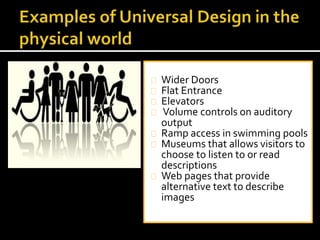
Wider Doors
Flat Entrance
Elevators
Volume controls on auditory
output
Ramp access in swimming pools
Museums that allows visitors to
choose to listen to or read
descriptions
Web pages that provide
alternative text to describe
images
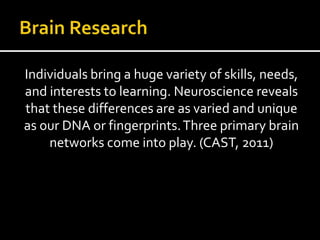
Individuals bring a huge variety of skills, needs,
and interests to learning. Neuroscience reveals
that these differences are as varied and unique
as our DNA or fingerprints.Three primary brain
networks come into play. (CAST, 2011)
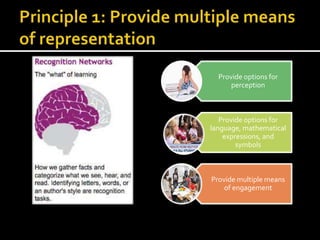
Provide options for
perception
Provide options for
language, mathematical
expressions, and
symbols
Provide multiple means
of engagement
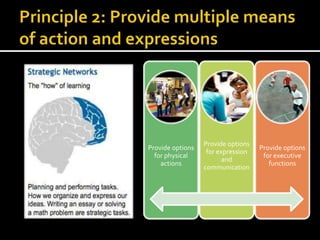
Provide options
for physical
actions
Provide options
for expression
and
communication
Provide options
for executive
functions
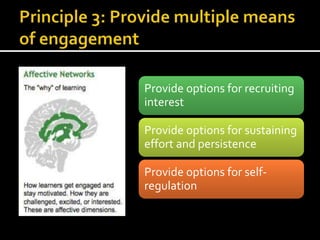
Provide options for recruiting
interest
Provide options for sustaining
effort and persistence
Provide options for self-
regulation
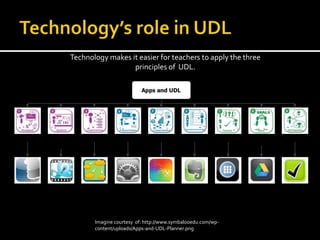
Imagine courtesy of: http://www.symbalooedu.com/wp-
content/uploads/Apps-and-UDL-Planner.png
Technology makes it easier for teachers to apply the three
principles of UDL.
Students will have an equal opportunities to learn
The educational gap for students with disabilities will decrease
Behavioral issues in the class will decline
Students will be more engaged in the lesson
Builds flexibility into the curriculum
Increase Creativity
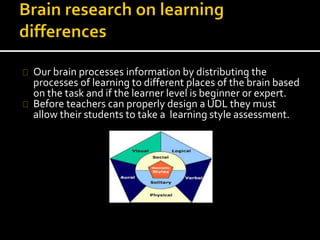
Our brain processes information by distributing the
processes of learning to different places of the brain based
on the task and if the learner level is beginner or expert.
Before teachers can properly design a UDL they must
allow their students to take a learning style assessment.
Reduces barrier in instruction
Engages all students
Ensures that all student can learn
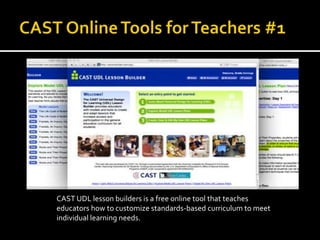
CAST UDL lesson builders is a free online tool that teaches
educators how to customize standards-based curriculum to meet
individual learning needs.
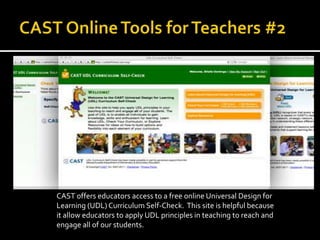
CAST offers educators access to a free online Universal Design for
Learning (UDL) Curriculum Self-Check. This site is helpful because
it allow educators to apply UDL principles in teaching to reach and
engage all of our students.
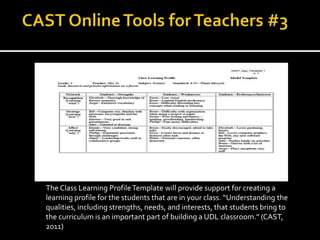
The Class Learning ProfileTemplate will provide support for creating a
learning profile for the students that are in your class. “Understanding the
qualities, including strengths, needs, and interests, that students bring to
the curriculum is an important part of building a UDL classroom.” (CAST,
2011)
Center for AppliedTechnology, Inc. (2011). UDL – Universal Design
for Learning. Retrieved from http://www.cast.org/udl/
Center for AppliedTechnology, Inc. (2011). UDL Guidelines 2.0
Retrieved from http://www.udlcenter.org/aboutudl/udlguidelines
Laureate Education, Inc. (Executive Producer). (2009). Universal
Design for Learning. Reaching and engaging all learners through
technology. Baltimore, MD: Author
Rose, D. H., & Meyer, A. (2002).Teaching every student in the digital
age: Universal design for learning. Retrieved from
http://www.cast.org/teachingeverystudent/ideas/tes/

Mod3 assiign wade_udl_presentation7109

  • 1.
  • 2.
    Universal Design forLearning (UDL) is the design of instruction for all student use, without need for adaptation or specialized design. UDL promotes a strong, yet flexible, foundation to meet a broader range of diverse abilities, disabilities, ethnicities, language skills and learning styles. http://www.cedwvu.org/publications/everyonecanlearn/udl.php#sthash.ZS Rwqhy3.dpuf
  • 3.
    UDL derived fromUD which was originated from architects perspective on creating building plans that were universally accessible for everyone. (Laureate Education, 2009)
  • 4.
    Wider Doors Flat Entrance Elevators Volumecontrols on auditory output Ramp access in swimming pools Museums that allows visitors to choose to listen to or read descriptions Web pages that provide alternative text to describe images
  • 5.
    Individuals bring ahuge variety of skills, needs, and interests to learning. Neuroscience reveals that these differences are as varied and unique as our DNA or fingerprints.Three primary brain networks come into play. (CAST, 2011)
  • 6.
    Provide options for perception Provideoptions for language, mathematical expressions, and symbols Provide multiple means of engagement
  • 7.
    Provide options for physical actions Provideoptions for expression and communication Provide options for executive functions
  • 8.
    Provide options forrecruiting interest Provide options for sustaining effort and persistence Provide options for self- regulation
  • 9.
    Imagine courtesy of:http://www.symbalooedu.com/wp- content/uploads/Apps-and-UDL-Planner.png Technology makes it easier for teachers to apply the three principles of UDL.
  • 10.
    Students will havean equal opportunities to learn The educational gap for students with disabilities will decrease Behavioral issues in the class will decline Students will be more engaged in the lesson Builds flexibility into the curriculum Increase Creativity
  • 11.
    Our brain processesinformation by distributing the processes of learning to different places of the brain based on the task and if the learner level is beginner or expert. Before teachers can properly design a UDL they must allow their students to take a learning style assessment.
  • 12.
    Reduces barrier ininstruction Engages all students Ensures that all student can learn
  • 13.
    CAST UDL lessonbuilders is a free online tool that teaches educators how to customize standards-based curriculum to meet individual learning needs.
  • 14.
    CAST offers educatorsaccess to a free online Universal Design for Learning (UDL) Curriculum Self-Check. This site is helpful because it allow educators to apply UDL principles in teaching to reach and engage all of our students.
  • 15.
    The Class LearningProfileTemplate will provide support for creating a learning profile for the students that are in your class. “Understanding the qualities, including strengths, needs, and interests, that students bring to the curriculum is an important part of building a UDL classroom.” (CAST, 2011)
  • 17.
    Center for AppliedTechnology,Inc. (2011). UDL – Universal Design for Learning. Retrieved from http://www.cast.org/udl/ Center for AppliedTechnology, Inc. (2011). UDL Guidelines 2.0 Retrieved from http://www.udlcenter.org/aboutudl/udlguidelines Laureate Education, Inc. (Executive Producer). (2009). Universal Design for Learning. Reaching and engaging all learners through technology. Baltimore, MD: Author Rose, D. H., & Meyer, A. (2002).Teaching every student in the digital age: Universal design for learning. Retrieved from http://www.cast.org/teachingeverystudent/ideas/tes/