A closer look at
what, how, and
why
Universal Design
for Learning
What is UDL?
Research-based framework
Removes learning barriers
Anticipates the needs of all students
How does UDL look?
Flexibility in:
 Information
presentation
 Student response
 Student engagement
Why is UDL effective?
Provides
Flexibility
+
Reduces
Barriers in
Instruction
=
High
Achievement
For All
Students
UDL is what, how, and why!
Classroom instruction should include:
UDL is what, how, and why
UDL in the Classroom
Teacher Provides:
 Multiple ways of
presenting the lesson
 Multiple means of
expression, and
assessment
 Multiple means of
student engagement
Students have:
 Options for how they
learn
 Choices for how they
demonstrate learning
 Choices which will
engage student interest
Classroom Before UDL
 Teacher dominating
discussion
 Limited variety of
materials
 One type of final
product required for
all students
Classroom After UDL
 Teacher provides choices
 Lessons incorporate a variety of technology or
examples
 Variety of routines and systems are set up
 Variety of materials are accessible allowing student use
 Technology is available for students
References
 CAST Master Reference: http://www.cast.org/pd/initiatives/masterref.html
 The Teaching Every Student (TES) section of the CAST Web site supports
educators in learning about and practicing Universal Design for Learning
(UDL). http://www.cast.org/teachingeverystudent/
 Rose, D.H., Meyer, A., & Hitchcock, C. (Eds.). (2005). The universally designed
classroom: Accessible curriculum and digital technologies. Cambridge, MA:
Harvard University Press.
 Rose, D. H., Hasselbring, T. S., Stahl, S., and Zabala, J. S. (2004). Assistive
technology and universal design for learning: Two sides of the same coin, In D.
Edyburn, K. Higgins, R. Boone (Eds), Handbook of Special Education
Technology Research and Practice. Knowledge by Design, Inc.,
http://www.knowledge-by-design.com/

Udl powerpoint

  • 1.
    A closer lookat what, how, and why Universal Design for Learning
  • 2.
    What is UDL? Research-basedframework Removes learning barriers Anticipates the needs of all students
  • 3.
    How does UDLlook? Flexibility in:  Information presentation  Student response  Student engagement
  • 4.
    Why is UDLeffective? Provides Flexibility + Reduces Barriers in Instruction = High Achievement For All Students
  • 5.
    UDL is what,how, and why! Classroom instruction should include:
  • 6.
    UDL is what,how, and why
  • 7.
    UDL in theClassroom Teacher Provides:  Multiple ways of presenting the lesson  Multiple means of expression, and assessment  Multiple means of student engagement Students have:  Options for how they learn  Choices for how they demonstrate learning  Choices which will engage student interest
  • 8.
    Classroom Before UDL Teacher dominating discussion  Limited variety of materials  One type of final product required for all students
  • 9.
    Classroom After UDL Teacher provides choices  Lessons incorporate a variety of technology or examples  Variety of routines and systems are set up  Variety of materials are accessible allowing student use  Technology is available for students
  • 10.
    References  CAST MasterReference: http://www.cast.org/pd/initiatives/masterref.html  The Teaching Every Student (TES) section of the CAST Web site supports educators in learning about and practicing Universal Design for Learning (UDL). http://www.cast.org/teachingeverystudent/  Rose, D.H., Meyer, A., & Hitchcock, C. (Eds.). (2005). The universally designed classroom: Accessible curriculum and digital technologies. Cambridge, MA: Harvard University Press.  Rose, D. H., Hasselbring, T. S., Stahl, S., and Zabala, J. S. (2004). Assistive technology and universal design for learning: Two sides of the same coin, In D. Edyburn, K. Higgins, R. Boone (Eds), Handbook of Special Education Technology Research and Practice. Knowledge by Design, Inc., http://www.knowledge-by-design.com/

Editor's Notes

  • #2 Introduction slide: Display this audience enters. Begin teaching session by polling what teachers know about UDL.
  • #3 These answers are the general principles that should be pointed out.
  • #4 The key to UDL is flexibility in all aspects. The comic provided shows that one size does not fit all, which is why we must plan and allow for UDL.
  • #5 This slide provides a general overview of why UDL is so effective in the classroom.
  • #6 The research behind UDL shows that students must have have access to multiple means of representation, expression, and engagement. This is easily seen in the classroom as the what, how and why to learning.
  • #7 The key to planning is given students choices. This includes while the teacher is providing instruction all the way to the end product that represents student learning.
  • #8 Here is a quick way to check and see if a lesson is following UDL principles. You can see what the teacher should be providing and what options the student has.
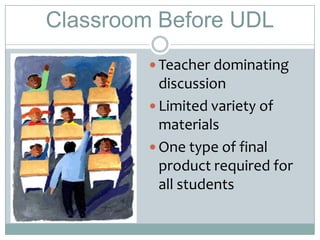
  • #9 The old fashion, everyone sits in a desk and raises his or her hand to answer the question, is a great example of what the classroom looked like before UDL was incorporated.
  • #10 Here is a look at what a classroom looks like with UDL incorporated to provide for student success.
  • #11 Reference slide which does not need to be read, but all information contained here can be found in elaboration on these sites.