Individualized
Education Plan
Asst. Prof. Ketan Kamble
Dnyan Ganga Education Trust’s College
of Education(B.Ed)
Thane
Creating an Inclusive School
Individualized education program
The individualized education program is also called as IEP
This plan is developed for children with special needs.
IEP is a written plan for program developed by school’s special
education team with input from parents and specifies the students
academic goals and the methods to obtain these goals.
IEP is reviewed periodically.
IEP defines the individualized objectives of a child who has been
determined to have disability or requires specialized
accommodation as defined by a federal regulations.
Individualized Education Plan by Assistant Professor Ketan Kamble 2
IEP is intended to help children to reach educational goals easily.
The four component goals are-conditions, learner, behaviour and
criteria.
IEP must be tailored according to individual student’s need, help
teacher to understand special childs need and cater the same and also
design his or her evaluation process.
IEP helps teacher to communicate student's progress to parents and
student.
It is updated regularly to record any changes in student's special
education program and services as per necessity.
IEP is regularly maintained and updated till student's High School
graduation or prior to 21st or 22nd birthday.
Individualized Education Plan by Assistant Professor Ketan Kamble 3
Individualized education program
If a student in special education attends University, then
university’s system and procedure takes over.
Admission is open done in general education, mainstream classes
and specialised classes or sub/semi specialise classes taught by
special education teacher.
It is meant to give student a chance to participate in regular school
culture and academics with regular students.
Special students are provided assistance where there is absolute
necessity.
Individualized Education Plan by Assistant Professor Ketan Kamble 4
Individualized education program
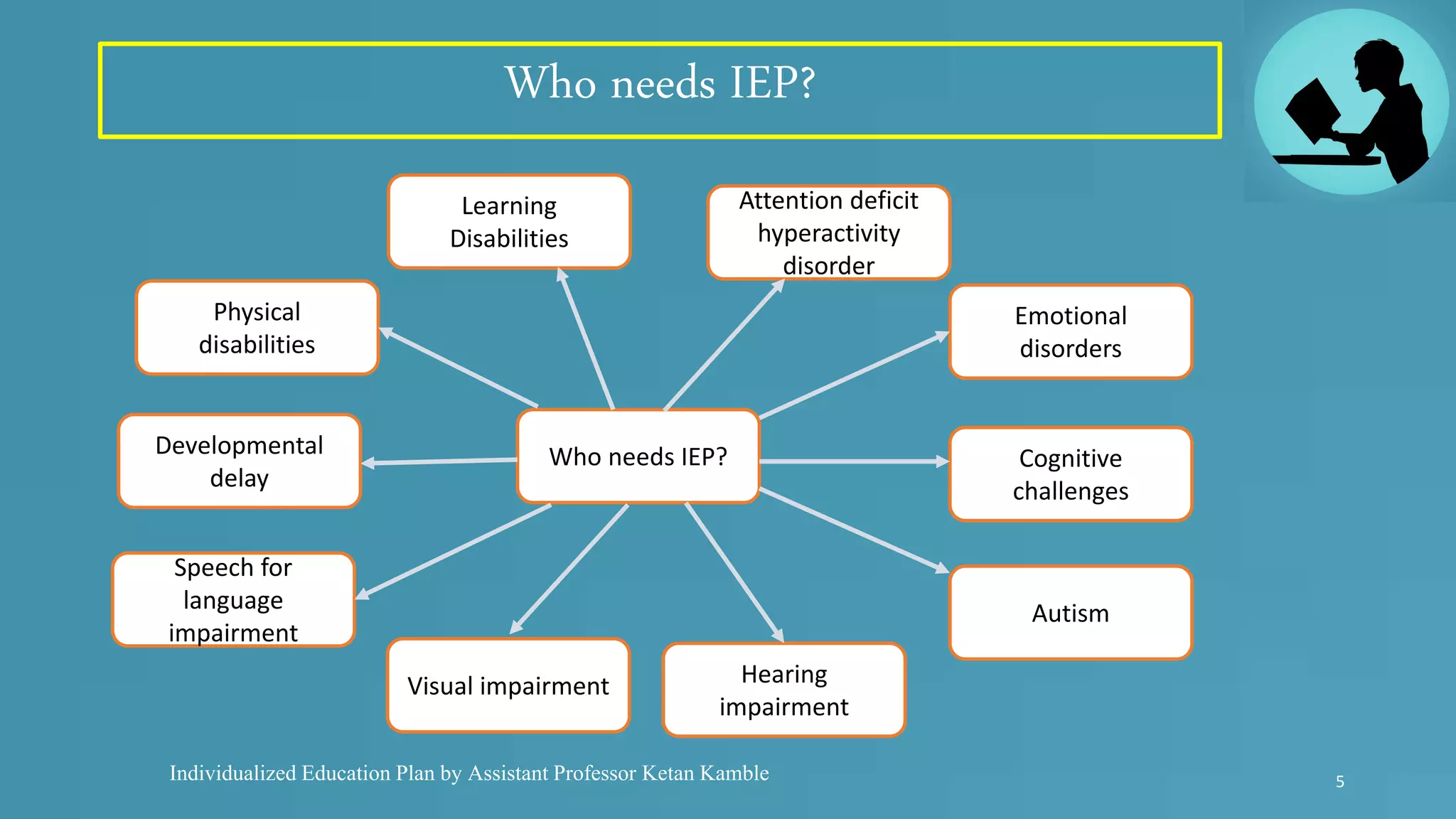
Who needs IEP?
Individualized Education Plan by Assistant Professor Ketan Kamble 5
Who needs IEP?
Hearing
impairment
Learning
Disabilities
Visual impairment
Autism
Cognitive
challenges
Emotional
disorders
Attention deficit
hyperactivity
disorder
Speech for
language
impairment
Developmental
delay
Physical
disabilities
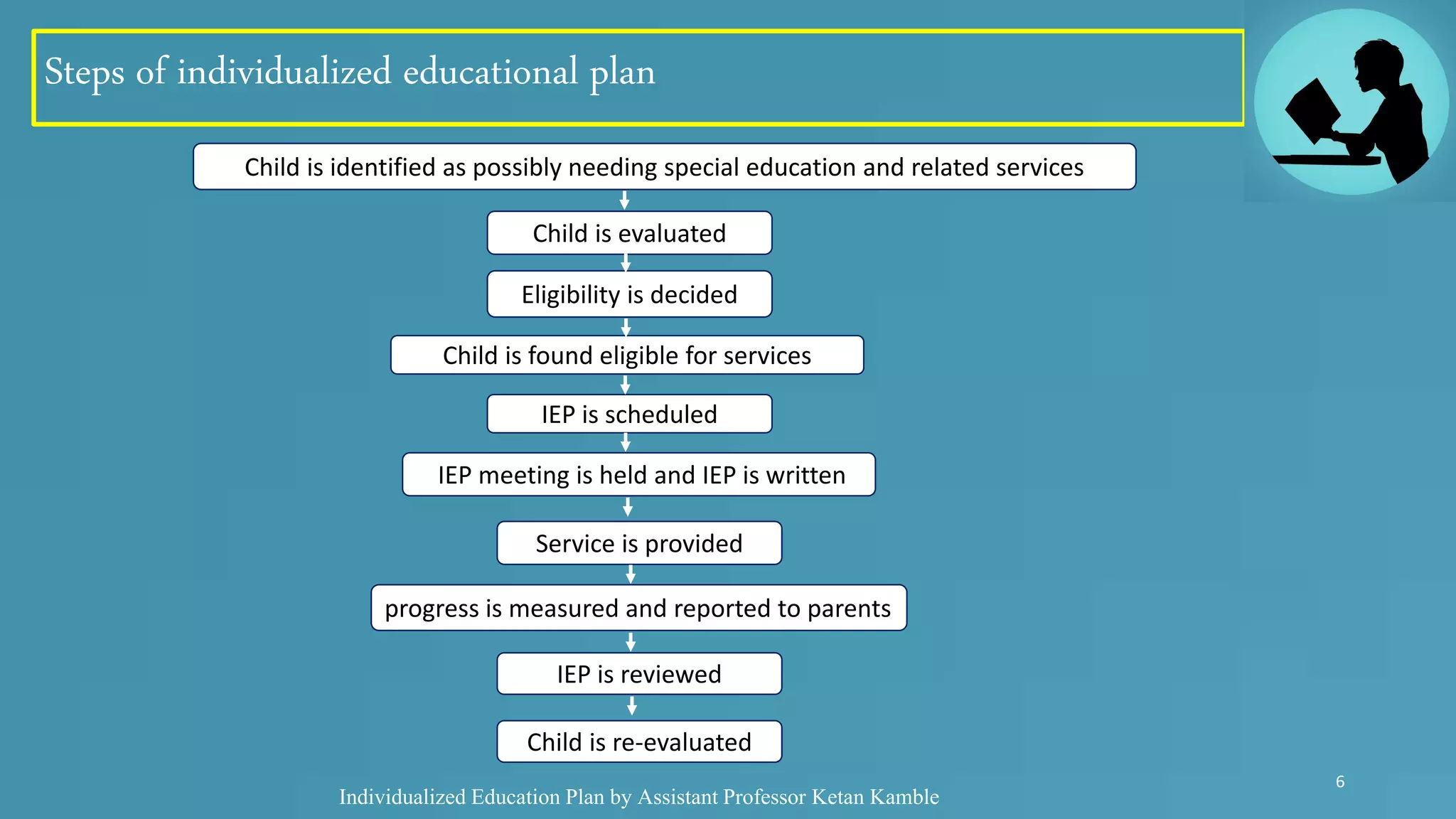
Steps of individualized educational plan
Individualized Education Plan by Assistant Professor Ketan Kamble
6
Child is identified as possibly needing special education and related services
Child is evaluated
Eligibility is decided
Child is found eligible for services
IEP is scheduled
IEP meeting is held and IEP is written
Service is provided
progress is measured and reported to parents
IEP is reviewed
Child is re-evaluated
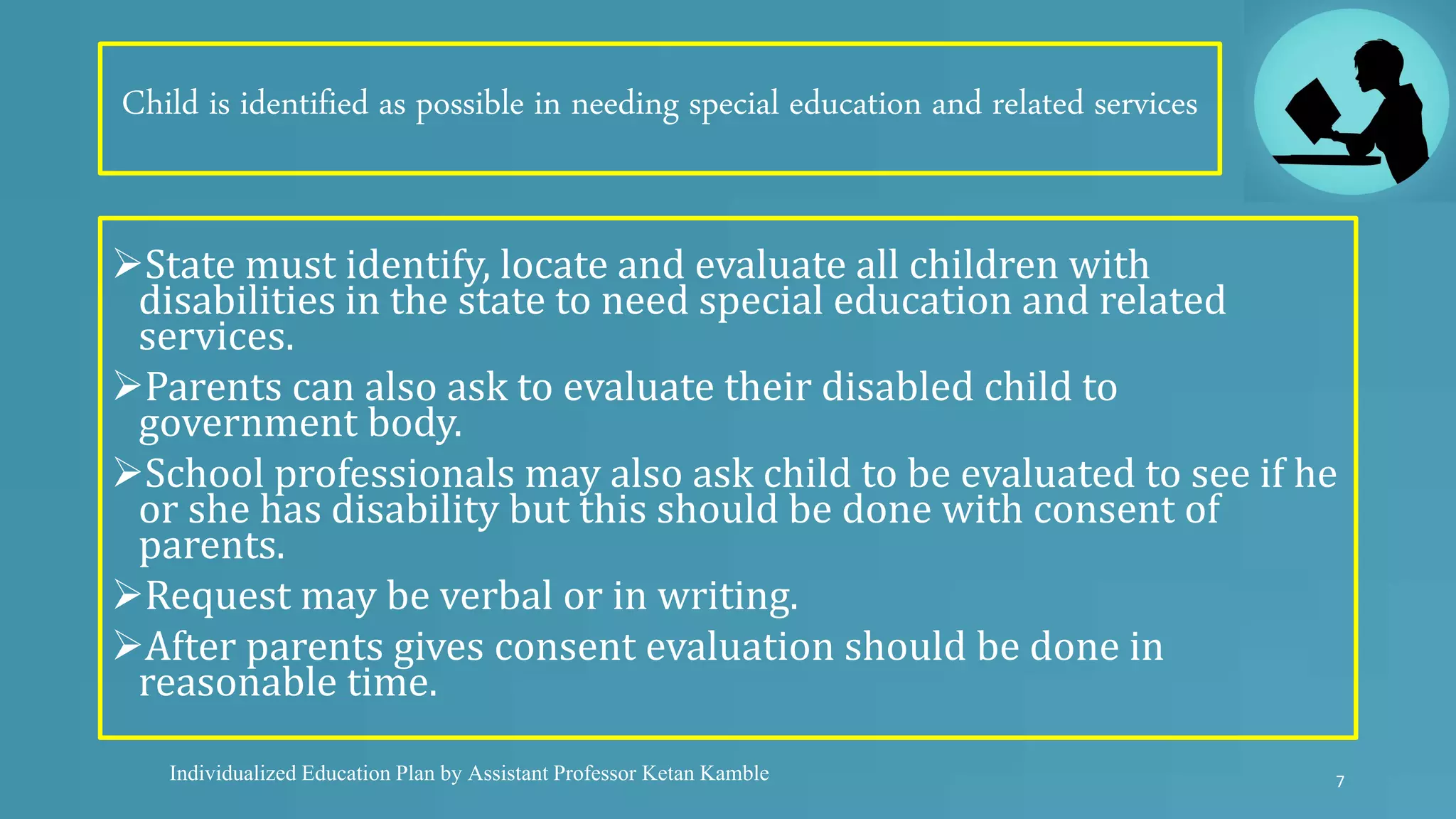
Child is identified as possible in needing special education and related services
State must identify, locate and evaluate all children with
disabilities in the state to need special education and related
services.
Parents can also ask to evaluate their disabled child to
government body.
School professionals may also ask child to be evaluated to see if he
or she has disability but this should be done with consent of
parents.
Request may be verbal or in writing.
After parents gives consent evaluation should be done in
reasonable time.
Individualized Education Plan by Assistant Professor Ketan Kamble 7
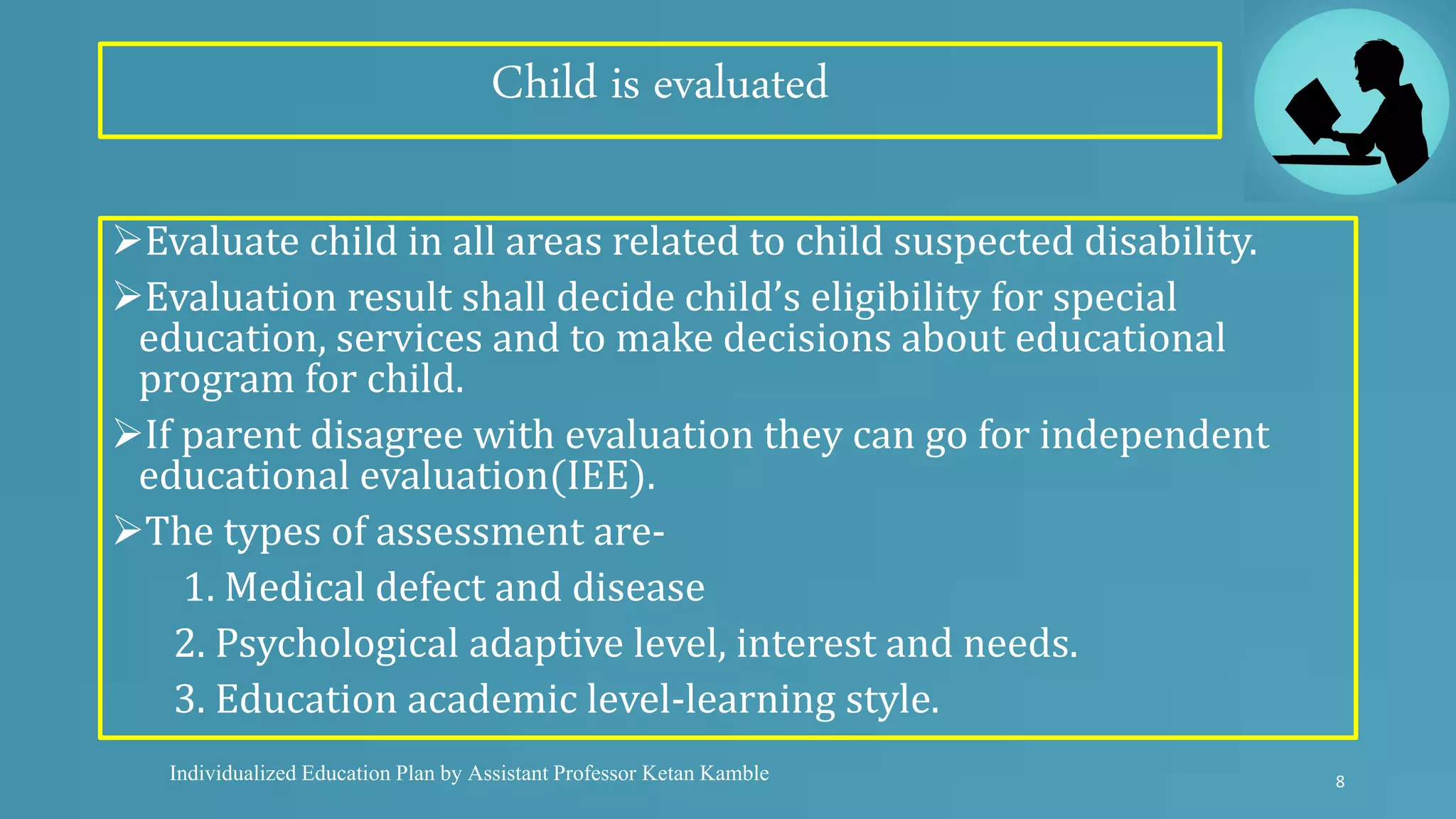
Child is evaluated
Evaluate child in all areas related to child suspected disability.
Evaluation result shall decide child’s eligibility for special
education, services and to make decisions about educational
program for child.
If parent disagree with evaluation they can go for independent
educational evaluation(IEE).
The types of assessment are-
1. Medical defect and disease
2. Psychological adaptive level, interest and needs.
3. Education academic level-learning style.
Individualized Education Plan by Assistant Professor Ketan Kamble 8
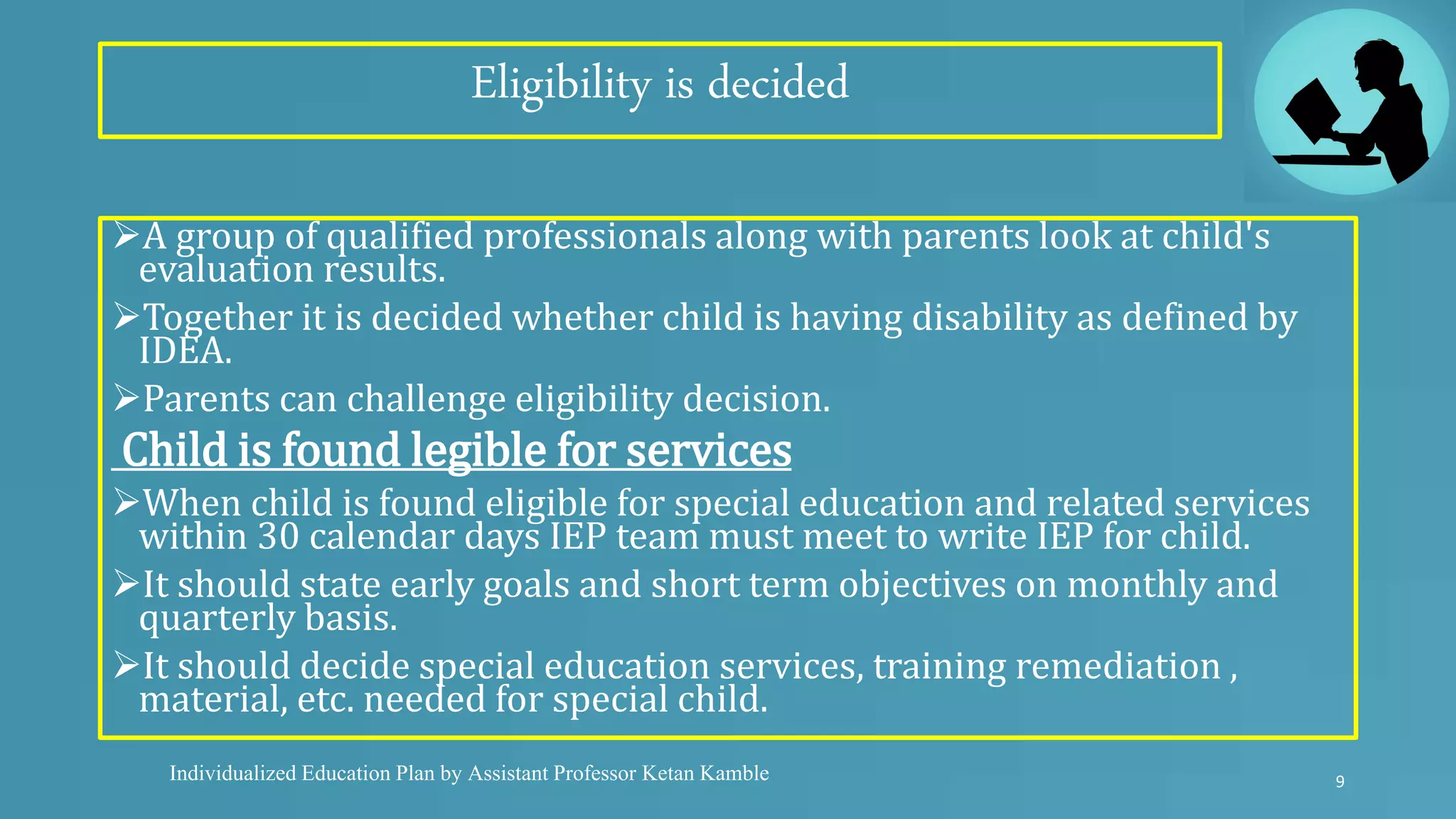
Eligibility is decided
A group of qualified professionals along with parents look at child's
evaluation results.
Together it is decided whether child is having disability as defined by
IDEA.
Parents can challenge eligibility decision.
Child is found legible for services
When child is found eligible for special education and related services
within 30 calendar days IEP team must meet to write IEP for child.
It should state early goals and short term objectives on monthly and
quarterly basis.
It should decide special education services, training remediation ,
material, etc. needed for special child.
Individualized Education Plan by Assistant Professor Ketan Kamble 9
IEP meeting is scheduled
School system schedules and conduct the IEP meeting.
School staff must contact participants including parents.
Parents must be informed about time, place and purpose about
the meeting.
Parents may also invite people who have knowledge or special
expertise about the child.
Individualized Education Plan by Assistant Professor Ketan Kamble 10
IEP meeting is held and IEP is written
The IEP team gathers to talk about child’s need and write the
child's IEP.
If appropriate, child is also part of the team.
Parents must be the part of the group in which child is placed.
Parents must give their consent to write IEP.
The child begins to get service immediately after the meeting.
Parents can express their disagreement with IEP and placement.
Individualized Education Plan by Assistant Professor Ketan Kamble 11
Services are provided
School must ensure that child IEP is been carried out as it was written.
Parents, teachers and service providers should have access to IEP.
Accommodations, modifications and support must be provided
according to IEP.
Progress must be measured and reported to parents
The child's progress towards the annual goal is measured.
Parents are informed whether the progress of the child was enough to
achieve goals at the end of the year.
This progress report must be given to the parents as often as possible.
Individualized Education Plan by Assistant Professor Ketan Kamble 12
IEP is reviewed
Child's IEP is reviewed at least once a year or more often if parents or school
request so.
Sometimes IEP is also revised.
Parents are invited to attend this meetings and can also suggest for changes in IEP.
Parents can express their disagreement with IEP and can go for independent
education program or may also file a complaint with state education agency.
Child is re-evaluated
Child must be re-evaluated at least every three years, this evaluation is often called
triennial.
Its purpose is to find out if child continues to be e a child with disability as defined
by IDEA.
But child can be Re evaluated on the request of his parents or teachers.
Individualized Education Plan by Assistant Professor Ketan Kamble 13
Significance of IEP
1. Individual need- it ensures to some degree of accountability for teachers to meet the
needs of the individual child.
2. Appropriate communication-it provides adequate communication among all
persons
within the school and between school and home with respect to the child.
3. Beneficial to the child-it helps in addressing and reducing the deficiencies of the
child.
4. Develop innate capacities-IEP helps in developing the competency of the child in
focused area.
5. Modify behaviour- behaviour modification is prominent through IEP as it focuses on
crucial areas of modification towards desirable behaviour.
6. Awareness of program-it enables families, students and educators to
Monitor students progress in general curriculum.
Individualized Education Plan by Assistant Professor Ketan Kamble 14
Significance of IEP
7. Matches or improves a student's previous progress.
8. Ensures access to the curriculum.
9. Demonstrates increased independence, behaviour or social or personal
skills.
10. The child benefits from additional support, in whatever their IEP is.
11. Allows the teacher to see progression in an area where the child may
struggle with.
12. They are easy to maintain and review.
13. The IEP measures how is the child's progress.
14. Parents get informed of that progress.
Individualized Education Plan by Assistant Professor Ketan Kamble 15
Individualized Education Plan by Assistant Professor Ketan Kamble 16
Reference
Francis, R(2020). Creating an Inclusive School(1st edition)
Mumbai, Maharashtra : Himalaya Publishing House
Individualized Education Plan by Assistant Professor Ketan Kamble 17
Acknowledgement : Janhavi Kulkarni ( Typewriting)

Individualized Education Plan

  • 1.
    Individualized Education Plan Asst. Prof.Ketan Kamble Dnyan Ganga Education Trust’s College of Education(B.Ed) Thane Creating an Inclusive School
  • 2.
    Individualized education program Theindividualized education program is also called as IEP This plan is developed for children with special needs. IEP is a written plan for program developed by school’s special education team with input from parents and specifies the students academic goals and the methods to obtain these goals. IEP is reviewed periodically. IEP defines the individualized objectives of a child who has been determined to have disability or requires specialized accommodation as defined by a federal regulations. Individualized Education Plan by Assistant Professor Ketan Kamble 2
  • 3.
    IEP is intendedto help children to reach educational goals easily. The four component goals are-conditions, learner, behaviour and criteria. IEP must be tailored according to individual student’s need, help teacher to understand special childs need and cater the same and also design his or her evaluation process. IEP helps teacher to communicate student's progress to parents and student. It is updated regularly to record any changes in student's special education program and services as per necessity. IEP is regularly maintained and updated till student's High School graduation or prior to 21st or 22nd birthday. Individualized Education Plan by Assistant Professor Ketan Kamble 3 Individualized education program
  • 4.
    If a studentin special education attends University, then university’s system and procedure takes over. Admission is open done in general education, mainstream classes and specialised classes or sub/semi specialise classes taught by special education teacher. It is meant to give student a chance to participate in regular school culture and academics with regular students. Special students are provided assistance where there is absolute necessity. Individualized Education Plan by Assistant Professor Ketan Kamble 4 Individualized education program
  • 5.
    Who needs IEP? IndividualizedEducation Plan by Assistant Professor Ketan Kamble 5 Who needs IEP? Hearing impairment Learning Disabilities Visual impairment Autism Cognitive challenges Emotional disorders Attention deficit hyperactivity disorder Speech for language impairment Developmental delay Physical disabilities
  • 6.
    Steps of individualizededucational plan Individualized Education Plan by Assistant Professor Ketan Kamble 6 Child is identified as possibly needing special education and related services Child is evaluated Eligibility is decided Child is found eligible for services IEP is scheduled IEP meeting is held and IEP is written Service is provided progress is measured and reported to parents IEP is reviewed Child is re-evaluated
  • 7.
    Child is identifiedas possible in needing special education and related services State must identify, locate and evaluate all children with disabilities in the state to need special education and related services. Parents can also ask to evaluate their disabled child to government body. School professionals may also ask child to be evaluated to see if he or she has disability but this should be done with consent of parents. Request may be verbal or in writing. After parents gives consent evaluation should be done in reasonable time. Individualized Education Plan by Assistant Professor Ketan Kamble 7
  • 8.
    Child is evaluated Evaluatechild in all areas related to child suspected disability. Evaluation result shall decide child’s eligibility for special education, services and to make decisions about educational program for child. If parent disagree with evaluation they can go for independent educational evaluation(IEE). The types of assessment are- 1. Medical defect and disease 2. Psychological adaptive level, interest and needs. 3. Education academic level-learning style. Individualized Education Plan by Assistant Professor Ketan Kamble 8
  • 9.
    Eligibility is decided Agroup of qualified professionals along with parents look at child's evaluation results. Together it is decided whether child is having disability as defined by IDEA. Parents can challenge eligibility decision. Child is found legible for services When child is found eligible for special education and related services within 30 calendar days IEP team must meet to write IEP for child. It should state early goals and short term objectives on monthly and quarterly basis. It should decide special education services, training remediation , material, etc. needed for special child. Individualized Education Plan by Assistant Professor Ketan Kamble 9
  • 10.
    IEP meeting isscheduled School system schedules and conduct the IEP meeting. School staff must contact participants including parents. Parents must be informed about time, place and purpose about the meeting. Parents may also invite people who have knowledge or special expertise about the child. Individualized Education Plan by Assistant Professor Ketan Kamble 10
  • 11.
    IEP meeting isheld and IEP is written The IEP team gathers to talk about child’s need and write the child's IEP. If appropriate, child is also part of the team. Parents must be the part of the group in which child is placed. Parents must give their consent to write IEP. The child begins to get service immediately after the meeting. Parents can express their disagreement with IEP and placement. Individualized Education Plan by Assistant Professor Ketan Kamble 11
  • 12.
    Services are provided Schoolmust ensure that child IEP is been carried out as it was written. Parents, teachers and service providers should have access to IEP. Accommodations, modifications and support must be provided according to IEP. Progress must be measured and reported to parents The child's progress towards the annual goal is measured. Parents are informed whether the progress of the child was enough to achieve goals at the end of the year. This progress report must be given to the parents as often as possible. Individualized Education Plan by Assistant Professor Ketan Kamble 12
  • 13.
    IEP is reviewed Child'sIEP is reviewed at least once a year or more often if parents or school request so. Sometimes IEP is also revised. Parents are invited to attend this meetings and can also suggest for changes in IEP. Parents can express their disagreement with IEP and can go for independent education program or may also file a complaint with state education agency. Child is re-evaluated Child must be re-evaluated at least every three years, this evaluation is often called triennial. Its purpose is to find out if child continues to be e a child with disability as defined by IDEA. But child can be Re evaluated on the request of his parents or teachers. Individualized Education Plan by Assistant Professor Ketan Kamble 13
  • 14.
    Significance of IEP 1.Individual need- it ensures to some degree of accountability for teachers to meet the needs of the individual child. 2. Appropriate communication-it provides adequate communication among all persons within the school and between school and home with respect to the child. 3. Beneficial to the child-it helps in addressing and reducing the deficiencies of the child. 4. Develop innate capacities-IEP helps in developing the competency of the child in focused area. 5. Modify behaviour- behaviour modification is prominent through IEP as it focuses on crucial areas of modification towards desirable behaviour. 6. Awareness of program-it enables families, students and educators to Monitor students progress in general curriculum. Individualized Education Plan by Assistant Professor Ketan Kamble 14
  • 15.
    Significance of IEP 7.Matches or improves a student's previous progress. 8. Ensures access to the curriculum. 9. Demonstrates increased independence, behaviour or social or personal skills. 10. The child benefits from additional support, in whatever their IEP is. 11. Allows the teacher to see progression in an area where the child may struggle with. 12. They are easy to maintain and review. 13. The IEP measures how is the child's progress. 14. Parents get informed of that progress. Individualized Education Plan by Assistant Professor Ketan Kamble 15
  • 16.
    Individualized Education Planby Assistant Professor Ketan Kamble 16 Reference Francis, R(2020). Creating an Inclusive School(1st edition) Mumbai, Maharashtra : Himalaya Publishing House
  • 17.
    Individualized Education Planby Assistant Professor Ketan Kamble 17 Acknowledgement : Janhavi Kulkarni ( Typewriting)