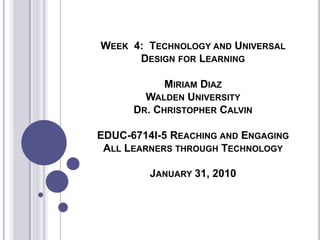
Week  4:  Technology and Universal Design for Learning Miriam DiazWalden UniversityDr. Christopher Calvin EDUC-6714I-5 Reaching and Engaging All Learners through Technology January 31, 2010
Inspiration for Universal Design for Learning “ Universal Design for Learning (UDL) is a  research-based framework for designing curricula—that is, educational goals, methods, materials, and assessments—that enable all individuals to gain knowledge, skills, and enthusiasm for learning. This is accomplished by simultaneously providing rich supports for learning and reducing barriers to the curriculum, while maintaining high achievement standards for all students.”Center for Applied Special Technology (CAST) website: http://www.cast.org
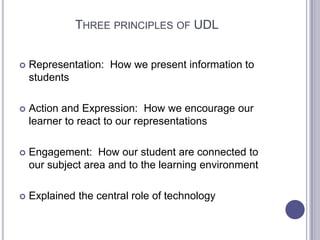
Three principles of UDL Representation:  How we present information to studentsAction and Expression:  How we encourage our learner to react to our representationsEngagement:  How our student are connected to our subject area and to the learning environmentExplained the central role of technology
Central Role of Technology in UDLUniversal Design for Learning takes the power and flexibility of technology to make education inclusive for all students.
Impact of UDL on student learning my schoolIncrease student achievementPersonalized assignments, evaluations and assessmentsFlexibility for students and teachers
UDL and Brain Research     Recent research in neuroscience shows that each brain processes information differently. The way we learn is as individual as DNA or fingerprints. In its research, CAST has identified three primary brain networks and the roles they play in learning.Recognition networksStrategic networksAffective networks
Implications of Differences for Instruction and Learning Cultural, ethnic, linguistic and academic diversity is supported through the Internet and technological resources that are used to personalized lessons.
CAST Online Tools UDL Solutions Finder (paper backup available in textbook)http://www.cast.org/teachingeverystudent/tools/udlsolutionsfinder.cfmCurriculum Content Resourceshttp://udlselfcheck.cast.org/resources.php#curriculumUDL Lesson Builderhttp://lessonbuilder.cast.org/
References:Laureate Education, Inc. (Executive Producer). (2009). Brain Research and Universal Design for Learning. Baltimore: Author., D., & Meyer, A. (2002). Teaching every student in the digital age: Universal design for learning. Retrieved fromhttp://www.cast.org/teachingeverystudent/ideas/tes/UDL Tools and ResourcesUDL Solutions Finder (paper backup available in textbook)http://www.cast.org/teachingeverystudent/tools/udlsolutionsfinder.cfmUDL Curriculum Barriers Finder (paper backup available in textbook) http://www.cast.org/teachingeverystudent/tools/curriculumbarriers.cfmUDL Class Profile Maker (paper backup available in textbook)http://www.cast.org/teachingeverystudent/tools/classprofile.cfmUDL Goal Setterhttp://www.cast.org/teachingeverystudent/tools/udlgoalsetter.cfmCurriculum Content Resourceshttp://udlselfcheck.cast.org/resources.php#curriculumUDL Lesson Builderhttp://lessonbuilder.cast.org/UDL Book Builderhttp://bookbuilder.cast.org/

App4 Diaz M

  • 1.
    Week  4:  Technology andUniversal Design for Learning Miriam DiazWalden UniversityDr. Christopher Calvin EDUC-6714I-5 Reaching and Engaging All Learners through Technology January 31, 2010
  • 2.
    Inspiration for UniversalDesign for Learning “ Universal Design for Learning (UDL) is a research-based framework for designing curricula—that is, educational goals, methods, materials, and assessments—that enable all individuals to gain knowledge, skills, and enthusiasm for learning. This is accomplished by simultaneously providing rich supports for learning and reducing barriers to the curriculum, while maintaining high achievement standards for all students.”Center for Applied Special Technology (CAST) website: http://www.cast.org
  • 3.
    Three principles ofUDL Representation: How we present information to studentsAction and Expression: How we encourage our learner to react to our representationsEngagement: How our student are connected to our subject area and to the learning environmentExplained the central role of technology
  • 4.
    Central Role ofTechnology in UDLUniversal Design for Learning takes the power and flexibility of technology to make education inclusive for all students.
  • 5.
    Impact of UDLon student learning my schoolIncrease student achievementPersonalized assignments, evaluations and assessmentsFlexibility for students and teachers
  • 6.
    UDL and BrainResearch Recent research in neuroscience shows that each brain processes information differently. The way we learn is as individual as DNA or fingerprints. In its research, CAST has identified three primary brain networks and the roles they play in learning.Recognition networksStrategic networksAffective networks
  • 7.
    Implications of Differencesfor Instruction and Learning Cultural, ethnic, linguistic and academic diversity is supported through the Internet and technological resources that are used to personalized lessons.
  • 8.
    CAST Online ToolsUDL Solutions Finder (paper backup available in textbook)http://www.cast.org/teachingeverystudent/tools/udlsolutionsfinder.cfmCurriculum Content Resourceshttp://udlselfcheck.cast.org/resources.php#curriculumUDL Lesson Builderhttp://lessonbuilder.cast.org/
  • 9.
    References:Laureate Education, Inc.(Executive Producer). (2009). Brain Research and Universal Design for Learning. Baltimore: Author., D., & Meyer, A. (2002). Teaching every student in the digital age: Universal design for learning. Retrieved fromhttp://www.cast.org/teachingeverystudent/ideas/tes/UDL Tools and ResourcesUDL Solutions Finder (paper backup available in textbook)http://www.cast.org/teachingeverystudent/tools/udlsolutionsfinder.cfmUDL Curriculum Barriers Finder (paper backup available in textbook) http://www.cast.org/teachingeverystudent/tools/curriculumbarriers.cfmUDL Class Profile Maker (paper backup available in textbook)http://www.cast.org/teachingeverystudent/tools/classprofile.cfmUDL Goal Setterhttp://www.cast.org/teachingeverystudent/tools/udlgoalsetter.cfmCurriculum Content Resourceshttp://udlselfcheck.cast.org/resources.php#curriculumUDL Lesson Builderhttp://lessonbuilder.cast.org/UDL Book Builderhttp://bookbuilder.cast.org/