Mary Tolson
mary.tolson@waldenu.edu
EDUC7109
Diverse Learners and Technology
Dr. McPherson
Objectives
• Define UDL
• Describe what UDL looks like in a classroom
• Describe the role of technology
• Identify resources available to educators
What is UDL?
• According to CAST (2015), “UDL is a set of
principles for curriculum development that give all
individuals equal opportunities to learn.”
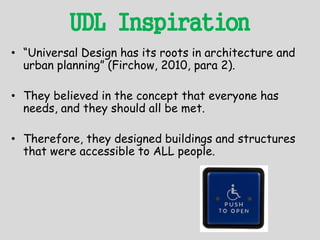
UDL Inspiration
• “Universal Design has its roots in architecture and
urban planning” (Firchow, 2010, para 2).
• They believed in the concept that everyone has
needs, and they should all be met.
• Therefore, they designed buildings and structures
that were accessible to ALL people.
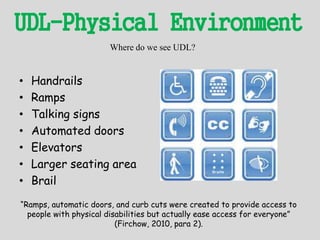
UDL-Physical Environment
• Handrails
• Ramps
• Talking signs
• Automated doors
• Elevators
• Larger seating area
• Brail
Where do we see UDL?
“Ramps, automatic doors, and curb cuts were created to provide access to
people with physical disabilities but actually ease access for everyone”
(Firchow, 2010, para 2).
UDL–Learning Environment
• Electronic Textbooks
• Audio Recorded Tests
• Larger print size
• Accessible websites
• Closed Captioning
• Audio Books
• Adjustable speed controls
• Controllable time
UDL In The Classroom
• Creates a flexible learning environment
– Assignments are aligned with students skills
• Accommodates to students to help them succeed
• Removes barriers
• Implements a variety of teaching methods
• Higher level of student engagement
Think About It. . .
• Take a second to think about your classroom. . .
• What is your current instructional style?
• Are you currently implementing any UDL
strategies?
UDL Implications
• Support cultural, ethnical, linguistic, and academic
diversity by using a variety of technology and
methods to present information.
– Individual and collaborative
• Regardless of a students disability, they will learn
and succeed.
• Too much focus on one area can hinder other areas
of learning.
• There is no such thing as a “normal” student.
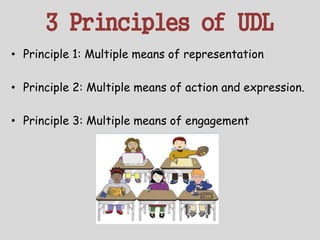
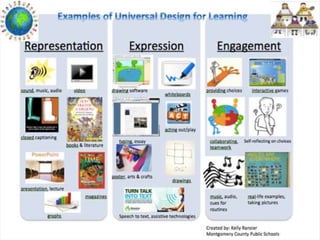
3 Principles of UDL
• Principle 1: Multiple means of representation
• Principle 2: Multiple means of action and expression.
• Principle 3: Multiple means of engagement
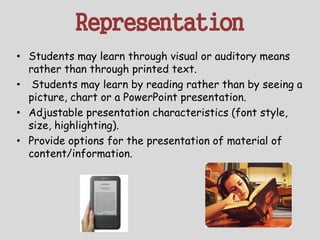
Representation
• Students may learn through visual or auditory means
rather than through printed text.
• Students may learn by reading rather than by seeing a
picture, chart or a PowerPoint presentation.
• Adjustable presentation characteristics (font style,
size, highlighting).
• Provide options for the presentation of material of
content/information.
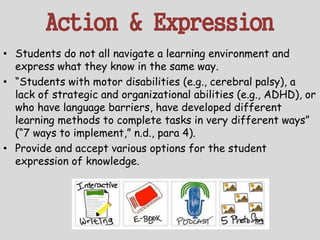
Action & Expression
• Students do not all navigate a learning environment and
express what they know in the same way.
• “Students with motor disabilities (e.g., cerebral palsy), a
lack of strategic and organizational abilities (e.g., ADHD), or
who have language barriers, have developed different
learning methods to complete tasks in very different ways”
(“7 ways to implement,” n.d., para 4).
• Provide and accept various options for the student
expression of knowledge.
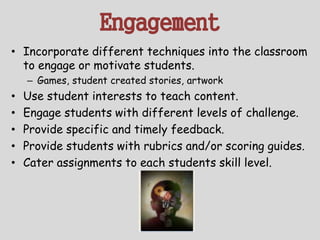
Engagement
• Incorporate different techniques into the classroom
to engage or motivate students.
– Games, student created stories, artwork
• Use student interests to teach content.
• Engage students with different levels of challenge.
• Provide specific and timely feedback.
• Provide students with rubrics and/or scoring guides.
• Cater assignments to each students skill level.
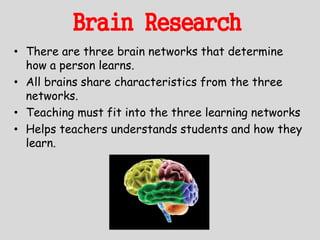
Brain Research
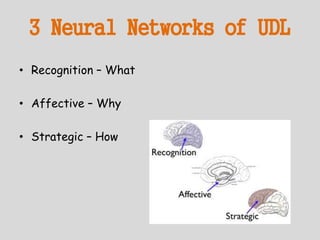
• There are three brain networks that determine
how a person learns.
• All brains share characteristics from the three
networks.
• Teaching must fit into the three learning networks
• Helps teachers understands students and how they
learn.
3 Neural Networks of UDL
• Recognition – What
• Affective – Why
• Strategic – How
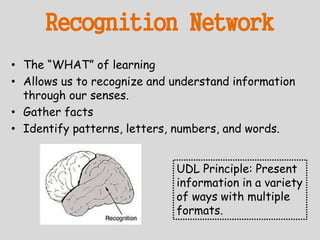
Recognition Network
• The “WHAT” of learning
• Allows us to recognize and understand information
through our senses.
• Gather facts
• Identify patterns, letters, numbers, and words.
UDL Principle: Present
information in a variety
of ways with multiple
formats.
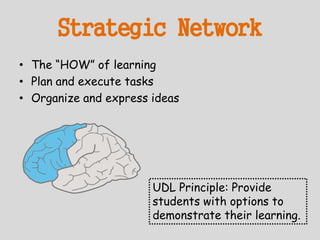
Strategic Network
• The “HOW” of learning
• Plan and execute tasks
• Organize and express ideas
UDL Principle: Provide
students with options to
demonstrate their learning.
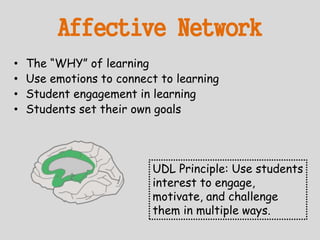
Affective Network
• The “WHY” of learning
• Use emotions to connect to learning
• Student engagement in learning
• Students set their own goals
UDL Principle: Use students
interest to engage,
motivate, and challenge
them in multiple ways.
Role of Technology
• Remove barriers/adaptive to the learners’ needs
– Accessible websites, E-books
• Scaffolding
– Websites that automatically scaffold based on students
responses.
• Provide options for presenting information
– PowerPoint, video, podcasts
• Provide varied choices for student expression
– Skits, comic strips, blogs
“UDL uses computer technology to create an educational environment that
allows all students, including those with learning disabilities, to succeed
in general education classrooms with minimal use of assistive technology”
(Firchow, 2010, para 1).
Technology Examples
• Thinking Blocks (http://thinkingblocks.com/ )
– A creative, interactive math resource to help students understand
how to solve word problems.
– Benefits students who may need extra practice and time.
• Ghotit (http://www.ghotit.com/)
– An online spelling and grammar checking service, specifically
designed for students with a learning disability.
• Natural Reader (http://www.naturalreaders.com/index.html)
– free text-to-speech software program which converts any written
text to speech (Word, PDF, websites, emails)
– Benefits students with dyslexia, vision impairments, or motor control
issues. These students may struggle taking notes.
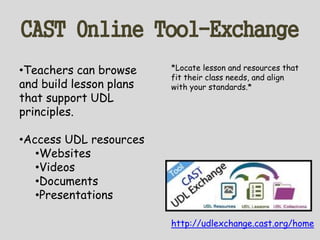
CAST Online Tool-Exchange
http://udlexchange.cast.org/home
•Teachers can browse
and build lesson plans
that support UDL
principles.
•Access UDL resources
•Websites
•Videos
•Documents
•Presentations
*Locate lesson and resources that
fit their class needs, and align
with your standards.*
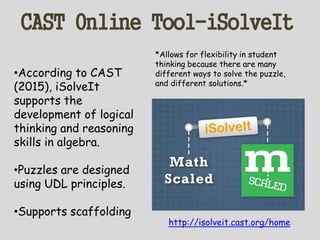
CAST Online Tool-iSolveIt
http://isolveit.cast.org/home
•According to CAST
(2015), iSolveIt
supports the
development of logical
thinking and reasoning
skills in algebra.
•Puzzles are designed
using UDL principles.
•Supports scaffolding
*Allows for flexibility in student
thinking because there are many
different ways to solve the puzzle,
and different solutions.*
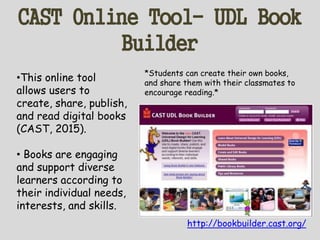
CAST Online Tool- UDL Book
Builder
http://bookbuilder.cast.org/
•This online tool
allows users to
create, share, publish,
and read digital books
(CAST, 2015).
• Books are engaging
and support diverse
learners according to
their individual needs,
interests, and skills.
*Students can create their own books,
and share them with their classmates to
encourage reading.*
Resources
CAST (2015). About universal design for learning? Retrieved from http://www.cast.org/our-work/about-udl.html#q1
CAST (2008). Universal design for learning guidelines version 1.0. Wakefield, MA: Author.
Firchow, N. (2010, February). Universal design for for learning-improved access for all.
Retrieved from http://www.greatschools.org/gk/articles/universal-design-for-learning-improved-access-for-all/
Rose, D. H., Meyer, A., Strangman, N., & Rappolt, G. (2002). Teaching every student in the digital age: Universal
design for learning. Alexandria, VA: Association for Curriculum and Student Development. Retrieved from
http://www.ascd.org/publications/books/101042.aspx
UDL and technology (2014, July 31). Retrieved from http://www.udlcenter.org/aboutudl/udltechnology
Universal design for learning: 7 ways to implement universal design for learning. (n.d.) Retrieved from
https://www.sc.edu/cte/guide/universaldesign/index.shtml#representation

EDUC7109 UDL Presentation

  • 1.
  • 2.
    Objectives • Define UDL •Describe what UDL looks like in a classroom • Describe the role of technology • Identify resources available to educators
  • 3.
    What is UDL? •According to CAST (2015), “UDL is a set of principles for curriculum development that give all individuals equal opportunities to learn.”
  • 4.
    UDL Inspiration • “UniversalDesign has its roots in architecture and urban planning” (Firchow, 2010, para 2). • They believed in the concept that everyone has needs, and they should all be met. • Therefore, they designed buildings and structures that were accessible to ALL people.
  • 5.
    UDL-Physical Environment • Handrails •Ramps • Talking signs • Automated doors • Elevators • Larger seating area • Brail Where do we see UDL? “Ramps, automatic doors, and curb cuts were created to provide access to people with physical disabilities but actually ease access for everyone” (Firchow, 2010, para 2).
  • 6.
    UDL–Learning Environment • ElectronicTextbooks • Audio Recorded Tests • Larger print size • Accessible websites • Closed Captioning • Audio Books • Adjustable speed controls • Controllable time
  • 7.
    UDL In TheClassroom • Creates a flexible learning environment – Assignments are aligned with students skills • Accommodates to students to help them succeed • Removes barriers • Implements a variety of teaching methods • Higher level of student engagement
  • 8.
    Think About It.. . • Take a second to think about your classroom. . . • What is your current instructional style? • Are you currently implementing any UDL strategies?
  • 9.
    UDL Implications • Supportcultural, ethnical, linguistic, and academic diversity by using a variety of technology and methods to present information. – Individual and collaborative • Regardless of a students disability, they will learn and succeed. • Too much focus on one area can hinder other areas of learning. • There is no such thing as a “normal” student.
  • 10.
    3 Principles ofUDL • Principle 1: Multiple means of representation • Principle 2: Multiple means of action and expression. • Principle 3: Multiple means of engagement
  • 11.
    Representation • Students maylearn through visual or auditory means rather than through printed text. • Students may learn by reading rather than by seeing a picture, chart or a PowerPoint presentation. • Adjustable presentation characteristics (font style, size, highlighting). • Provide options for the presentation of material of content/information.
  • 12.
    Action & Expression •Students do not all navigate a learning environment and express what they know in the same way. • “Students with motor disabilities (e.g., cerebral palsy), a lack of strategic and organizational abilities (e.g., ADHD), or who have language barriers, have developed different learning methods to complete tasks in very different ways” (“7 ways to implement,” n.d., para 4). • Provide and accept various options for the student expression of knowledge.
  • 13.
    Engagement • Incorporate differenttechniques into the classroom to engage or motivate students. – Games, student created stories, artwork • Use student interests to teach content. • Engage students with different levels of challenge. • Provide specific and timely feedback. • Provide students with rubrics and/or scoring guides. • Cater assignments to each students skill level.
  • 15.
    Brain Research • Thereare three brain networks that determine how a person learns. • All brains share characteristics from the three networks. • Teaching must fit into the three learning networks • Helps teachers understands students and how they learn.
  • 16.
    3 Neural Networksof UDL • Recognition – What • Affective – Why • Strategic – How
  • 17.
    Recognition Network • The“WHAT” of learning • Allows us to recognize and understand information through our senses. • Gather facts • Identify patterns, letters, numbers, and words. UDL Principle: Present information in a variety of ways with multiple formats.
  • 18.
    Strategic Network • The“HOW” of learning • Plan and execute tasks • Organize and express ideas UDL Principle: Provide students with options to demonstrate their learning.
  • 19.
    Affective Network • The“WHY” of learning • Use emotions to connect to learning • Student engagement in learning • Students set their own goals UDL Principle: Use students interest to engage, motivate, and challenge them in multiple ways.
  • 20.
    Role of Technology •Remove barriers/adaptive to the learners’ needs – Accessible websites, E-books • Scaffolding – Websites that automatically scaffold based on students responses. • Provide options for presenting information – PowerPoint, video, podcasts • Provide varied choices for student expression – Skits, comic strips, blogs “UDL uses computer technology to create an educational environment that allows all students, including those with learning disabilities, to succeed in general education classrooms with minimal use of assistive technology” (Firchow, 2010, para 1).
  • 21.
    Technology Examples • ThinkingBlocks (http://thinkingblocks.com/ ) – A creative, interactive math resource to help students understand how to solve word problems. – Benefits students who may need extra practice and time. • Ghotit (http://www.ghotit.com/) – An online spelling and grammar checking service, specifically designed for students with a learning disability. • Natural Reader (http://www.naturalreaders.com/index.html) – free text-to-speech software program which converts any written text to speech (Word, PDF, websites, emails) – Benefits students with dyslexia, vision impairments, or motor control issues. These students may struggle taking notes.
  • 22.
    CAST Online Tool-Exchange http://udlexchange.cast.org/home •Teacherscan browse and build lesson plans that support UDL principles. •Access UDL resources •Websites •Videos •Documents •Presentations *Locate lesson and resources that fit their class needs, and align with your standards.*
  • 23.
    CAST Online Tool-iSolveIt http://isolveit.cast.org/home •Accordingto CAST (2015), iSolveIt supports the development of logical thinking and reasoning skills in algebra. •Puzzles are designed using UDL principles. •Supports scaffolding *Allows for flexibility in student thinking because there are many different ways to solve the puzzle, and different solutions.*
  • 24.
    CAST Online Tool-UDL Book Builder http://bookbuilder.cast.org/ •This online tool allows users to create, share, publish, and read digital books (CAST, 2015). • Books are engaging and support diverse learners according to their individual needs, interests, and skills. *Students can create their own books, and share them with their classmates to encourage reading.*
  • 25.
    Resources CAST (2015). Aboutuniversal design for learning? Retrieved from http://www.cast.org/our-work/about-udl.html#q1 CAST (2008). Universal design for learning guidelines version 1.0. Wakefield, MA: Author. Firchow, N. (2010, February). Universal design for for learning-improved access for all. Retrieved from http://www.greatschools.org/gk/articles/universal-design-for-learning-improved-access-for-all/ Rose, D. H., Meyer, A., Strangman, N., & Rappolt, G. (2002). Teaching every student in the digital age: Universal design for learning. Alexandria, VA: Association for Curriculum and Student Development. Retrieved from http://www.ascd.org/publications/books/101042.aspx UDL and technology (2014, July 31). Retrieved from http://www.udlcenter.org/aboutudl/udltechnology Universal design for learning: 7 ways to implement universal design for learning. (n.d.) Retrieved from https://www.sc.edu/cte/guide/universaldesign/index.shtml#representation