Types of Thermodynamics
systems
Presentation done by
 Abrar Sharieff
 Dheeraj
 Ajeeth
 Rohith reddy
 Nithin
What is Thermodynamics?
OThermodynamics: A set of of mathematical
models and concepts that allow us to describe
the way changes in the system state
(temperature, pressure, and composition)
affect equilibrium.
O Can be used to predict how rock-forming systems
will respond to changes in state
O Invert observed chemical compositions of minerals
and melts to infer the pressure and temperature
conditions or origin
Types of Thermodynamic
System:
O Thermodynamic systems can be broadly
classified into three types. They are:
O Open system
O Closed system
O Isolated system
1. Open System:
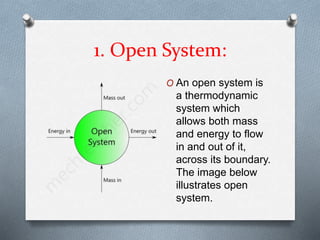
O An open system is
a thermodynamic
system which
allows both mass
and energy to flow
in and out of it,
across its boundary.
The image below
illustrates open
system.
Example of Open system:
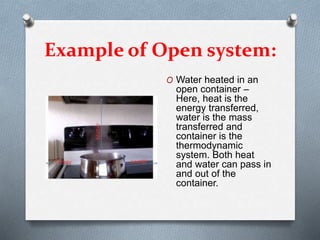
O Water heated in an
open container –
Here, heat is the
energy transferred,
water is the mass
transferred and
container is the
thermodynamic
system. Both heat
and water can pass in
and out of the
container.
2. Closed System:
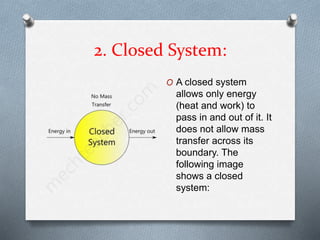
O A closed system
allows only energy
(heat and work) to
pass in and out of it. It
does not allow mass
transfer across its
boundary. The
following image
shows a closed
system:
Example of Closed system:
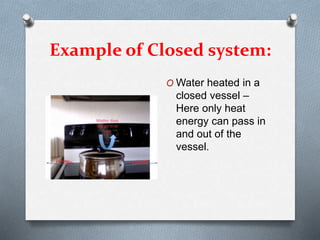
O Water heated in a
closed vessel –
Here only heat
energy can pass in
and out of the
vessel.
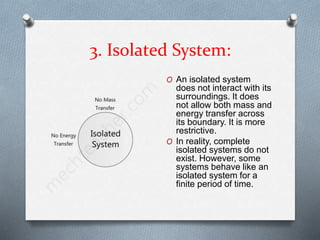
3. Isolated System:
O An isolated system
does not interact with its
surroundings. It does
not allow both mass and
energy transfer across
its boundary. It is more
restrictive.
O In reality, complete
isolated systems do not
exist. However, some
systems behave like an
isolated system for a
finite period of time.
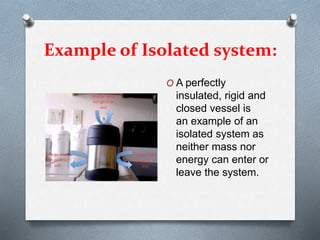
Example of Isolated system:
O A perfectly
insulated, rigid and
closed vessel is
an example of an
isolated system as
neither mass nor
energy can enter or
leave the system.
Thank You

types of systems

  • 1.
    Types of Thermodynamics systems Presentationdone by  Abrar Sharieff  Dheeraj  Ajeeth  Rohith reddy  Nithin
  • 2.
    What is Thermodynamics? OThermodynamics:A set of of mathematical models and concepts that allow us to describe the way changes in the system state (temperature, pressure, and composition) affect equilibrium. O Can be used to predict how rock-forming systems will respond to changes in state O Invert observed chemical compositions of minerals and melts to infer the pressure and temperature conditions or origin
  • 3.
    Types of Thermodynamic System: OThermodynamic systems can be broadly classified into three types. They are: O Open system O Closed system O Isolated system
  • 4.
    1. Open System: OAn open system is a thermodynamic system which allows both mass and energy to flow in and out of it, across its boundary. The image below illustrates open system.
  • 5.
    Example of Opensystem: O Water heated in an open container – Here, heat is the energy transferred, water is the mass transferred and container is the thermodynamic system. Both heat and water can pass in and out of the container.
  • 6.
    2. Closed System: OA closed system allows only energy (heat and work) to pass in and out of it. It does not allow mass transfer across its boundary. The following image shows a closed system:
  • 7.
    Example of Closedsystem: O Water heated in a closed vessel – Here only heat energy can pass in and out of the vessel.
  • 8.
    3. Isolated System: OAn isolated system does not interact with its surroundings. It does not allow both mass and energy transfer across its boundary. It is more restrictive. O In reality, complete isolated systems do not exist. However, some systems behave like an isolated system for a finite period of time.
  • 9.
    Example of Isolatedsystem: O A perfectly insulated, rigid and closed vessel is an example of an isolated system as neither mass nor energy can enter or leave the system.
  • 10.