Objectives
To know how to calculate enthalpies
To know how to solve problems on
 calorimetry
To know how to solve problems on Hess’ Law
How to Calculate
   Enthalpies


       How?
Let’s redefine some terms
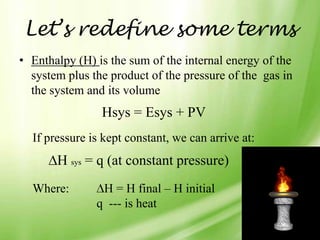
• Enthalpy (H) is the sum of the internal energy of the
  system plus the product of the pressure of the gas in
  the system and its volume
                Hsys = Esys + PV
  If pressure is kept constant, we can arrive at:
       H sys = q (at constant pressure)
  Where:        H = H final – H initial
               q --- is heat
Let’s redefine some terms


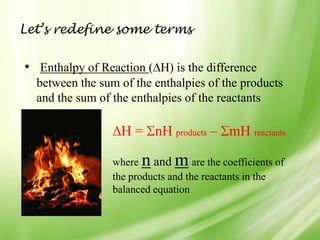
• Enthalpy of Reaction ( H) is the difference
  between the sum of the enthalpies of the products
  and the sum of the enthalpies of the reactants

                   H = nH products – mH reactants

                        n
                 where and      m   are the coefficients of
                 the products and the reactants in the
                 balanced equation
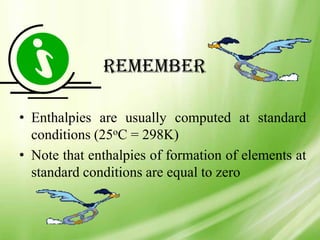
Remember

• Enthalpies are usually computed at standard
  conditions (25oC = 298K)
• Note that enthalpies of formation of elements at
  standard conditions are equal to zero
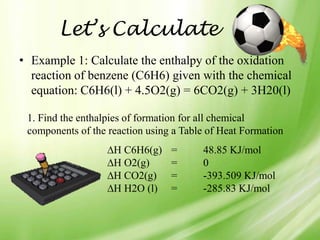
Let’s Calculate
• Example 1: Calculate the enthalpy of the oxidation
  reaction of benzene (C6H6) given with the chemical
  equation: C6H6(l) + 4.5O2(g) = 6CO2(g) + 3H20(l)

 1. Find the enthalpies of formation for all chemical
 components of the reaction using a Table of Heat Formation
                    H C6H6(g)    =      48.85 KJ/mol
                    H O2(g)      =      0
                    H CO2(g)     =      -393.509 KJ/mol
                    H H2O (l)    =      -285.83 KJ/mol
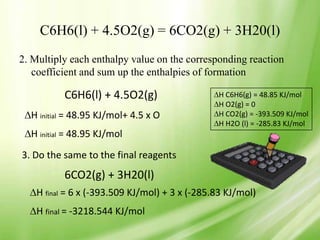
C6H6(l) + 4.5O2(g) = 6CO2(g) + 3H20(l)
2. Multiply each enthalpy value on the corresponding reaction
   coefficient and sum up the enthalpies of formation

          C6H6(l) + 4.5O2(g)                   H C6H6(g) = 48.85 KJ/mol
                                               H O2(g) = 0
  H initial = 48.95 KJ/mol+ 4.5 x O            H CO2(g) = -393.509 KJ/mol
                                               H H2O (l) = -285.83 KJ/mol
  H initial = 48.95 KJ/mol
3. Do the same to the final reagents
          6CO2(g) + 3H20(l)
   H final = 6 x (-393.509 KJ/mol) + 3 x (-285.83 KJ/mol)
   H final = -3218.544 KJ/mol
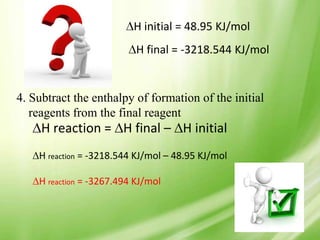
H initial = 48.95 KJ/mol
                           H final = -3218.544 KJ/mol


4. Subtract the enthalpy of formation of the initial
   reagents from the final reagent
     H reaction = H final – H initial
    H reaction = -3218.544 KJ/mol – 48.95 KJ/mol

    H reaction = -3267.494 KJ/mol
Some Important Enthalpy Changes

1. Enthalpy Change of Combustion
       - the enthalpy change which
       occurs when one mole of the
       substance is completely burnt
       in oxygen under standard
       conditions
Eg. C (graphite) + ½ O2 (g)  CO2 (g)
     C (graphite) + O2 (g)  CO2 (g)

    chemist’s shorthand:
          H   c,m   [(graphite)] = -393.5 kJ/mol
Some Important Enthalpy Changes


2. Enthalpy Change of Formation
    Eg. The SECF of methane, CH4, refersone mole of
      - the enthalpy change when to the change:
      the compound is formed from its elements
    C (graphite) + 2 H2 (g) ---->CH4 (g) H = -74.8 kJ/mol
      under standard conditions
              H f,m [CH4(g)] = -74.8 kJ/mol
      - may also be called Heats of Formation.
                    3. Enthalpy Change of Atomisation

                     Eg. C (graphite  C of an element is kJ/mol
                         The SMECA (g)                H = 716.7 the
                         enthalpy change when one mole of its
                         atoms in the gaseous 716.7is formed from
                          H at,m [(graphite)] = state kJ/mol
                         the element under standard conditions .
                         * Atomisation is always endothermic.
Some Important Enthalpy Changes


 4. Enthalpy Change of Fusion
       - The enthalpy change when 1 mole of solid is
       converted to one mole of liquid at its melting point at
       standard pressure
       H   fus,m [(H20)] =   716.7 kJ/mol   H = 6.01 kJ/mol
Some Important Enthalpy Changes


5. Enthalpy Change of Vaporisation
      - The enthalpy change when 1 mole of liquid is
      converted to one mole of gas at its boiling point at
      standard pressure
         H vap,m [(H20)] = 716.7 kJ/mol   H = 41.09 kJ/mol
Calorimetry
What is it?
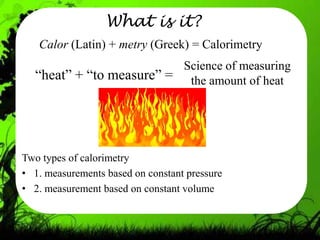
   Calor (Latin) + metry (Greek) = Calorimetry
                          Science of measuring
  “heat” + “to measure” = the amount of heat


Two types of calorimetry
• 1. measurements based on constant pressure
• 2. measurement based on constant volume
Other terms
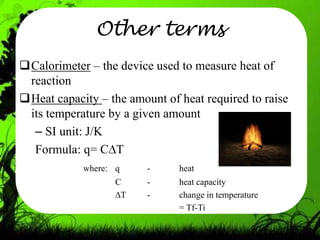
Calorimeter – the device used to measure heat of
 reaction
Heat capacity – the amount of heat required to raise
 its temperature by a given amount
  – SI unit: J/K
  Formula: q= C T
            where: q     -     heat
                   C     -     heat capacity
                    T    -     change in temperature
                               = Tf-Ti
Other terms

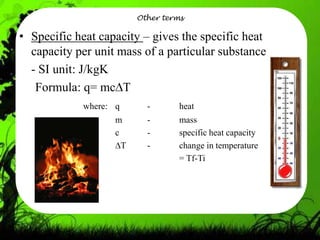
• Specific heat capacity – gives the specific heat
  capacity per unit mass of a particular substance
  - SI unit: J/kgK
   Formula: q= mc T
            where: q       -       heat
                   m       -       mass
                   c       -       specific heat capacity
                     T     -       change in temperature
                                   = Tf-Ti
Other terms

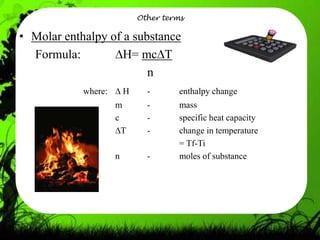
• Molar enthalpy of a substance
  Formula:          H= mc T
                         n
            where:       H     -       enthalpy change
                     m         -       mass
                     c         -       specific heat capacity
                       T       -       change in temperature
                                       = Tf-Ti
                     n         -       moles of substance
Hess’s Law of Heat
    Summation
By Germain Henri Hess
What is it?
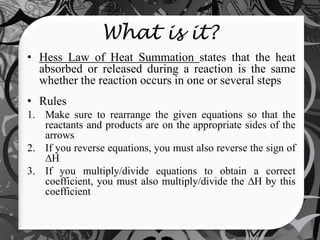
• Hess Law of Heat Summation states that the heat
  absorbed or released during a reaction is the same
  whether the reaction occurs in one or several steps
• Rules
1. Make sure to rearrange the given equations so that the
   reactants and products are on the appropriate sides of the
   arrows
2. If you reverse equations, you must also reverse the sign of
     H
3. If you multiply/divide equations to obtain a correct
   coefficient, you must also multiply/divide the H by this
   coefficient
Get ready
 now for
some brain
exercises

Enthalpy, Calorimetry, Hess's Law

  • 2.
    Objectives To know howto calculate enthalpies To know how to solve problems on calorimetry To know how to solve problems on Hess’ Law
  • 3.
    How to Calculate Enthalpies How?
  • 4.
    Let’s redefine someterms • Enthalpy (H) is the sum of the internal energy of the system plus the product of the pressure of the gas in the system and its volume Hsys = Esys + PV If pressure is kept constant, we can arrive at: H sys = q (at constant pressure) Where: H = H final – H initial q --- is heat
  • 5.
    Let’s redefine someterms • Enthalpy of Reaction ( H) is the difference between the sum of the enthalpies of the products and the sum of the enthalpies of the reactants H = nH products – mH reactants n where and m are the coefficients of the products and the reactants in the balanced equation
  • 6.
    Remember • Enthalpies areusually computed at standard conditions (25oC = 298K) • Note that enthalpies of formation of elements at standard conditions are equal to zero
  • 7.
    Let’s Calculate • Example1: Calculate the enthalpy of the oxidation reaction of benzene (C6H6) given with the chemical equation: C6H6(l) + 4.5O2(g) = 6CO2(g) + 3H20(l) 1. Find the enthalpies of formation for all chemical components of the reaction using a Table of Heat Formation H C6H6(g) = 48.85 KJ/mol H O2(g) = 0 H CO2(g) = -393.509 KJ/mol H H2O (l) = -285.83 KJ/mol
  • 8.
    C6H6(l) + 4.5O2(g)= 6CO2(g) + 3H20(l) 2. Multiply each enthalpy value on the corresponding reaction coefficient and sum up the enthalpies of formation C6H6(l) + 4.5O2(g) H C6H6(g) = 48.85 KJ/mol H O2(g) = 0 H initial = 48.95 KJ/mol+ 4.5 x O H CO2(g) = -393.509 KJ/mol H H2O (l) = -285.83 KJ/mol H initial = 48.95 KJ/mol 3. Do the same to the final reagents 6CO2(g) + 3H20(l) H final = 6 x (-393.509 KJ/mol) + 3 x (-285.83 KJ/mol) H final = -3218.544 KJ/mol
  • 9.
    H initial =48.95 KJ/mol H final = -3218.544 KJ/mol 4. Subtract the enthalpy of formation of the initial reagents from the final reagent H reaction = H final – H initial H reaction = -3218.544 KJ/mol – 48.95 KJ/mol H reaction = -3267.494 KJ/mol
  • 10.
    Some Important EnthalpyChanges 1. Enthalpy Change of Combustion - the enthalpy change which occurs when one mole of the substance is completely burnt in oxygen under standard conditions Eg. C (graphite) + ½ O2 (g)  CO2 (g) C (graphite) + O2 (g)  CO2 (g) chemist’s shorthand: H c,m [(graphite)] = -393.5 kJ/mol
  • 11.
    Some Important EnthalpyChanges 2. Enthalpy Change of Formation Eg. The SECF of methane, CH4, refersone mole of - the enthalpy change when to the change: the compound is formed from its elements C (graphite) + 2 H2 (g) ---->CH4 (g) H = -74.8 kJ/mol under standard conditions H f,m [CH4(g)] = -74.8 kJ/mol - may also be called Heats of Formation.  3. Enthalpy Change of Atomisation Eg. C (graphite  C of an element is kJ/mol The SMECA (g) H = 716.7 the enthalpy change when one mole of its atoms in the gaseous 716.7is formed from H at,m [(graphite)] = state kJ/mol the element under standard conditions . * Atomisation is always endothermic.
  • 12.
    Some Important EnthalpyChanges 4. Enthalpy Change of Fusion - The enthalpy change when 1 mole of solid is converted to one mole of liquid at its melting point at standard pressure H fus,m [(H20)] = 716.7 kJ/mol H = 6.01 kJ/mol
  • 13.
    Some Important EnthalpyChanges 5. Enthalpy Change of Vaporisation - The enthalpy change when 1 mole of liquid is converted to one mole of gas at its boiling point at standard pressure H vap,m [(H20)] = 716.7 kJ/mol H = 41.09 kJ/mol
  • 14.
  • 15.
    What is it? Calor (Latin) + metry (Greek) = Calorimetry Science of measuring “heat” + “to measure” = the amount of heat Two types of calorimetry • 1. measurements based on constant pressure • 2. measurement based on constant volume
  • 16.
    Other terms Calorimeter –the device used to measure heat of reaction Heat capacity – the amount of heat required to raise its temperature by a given amount – SI unit: J/K Formula: q= C T where: q - heat C - heat capacity T - change in temperature = Tf-Ti
  • 17.
    Other terms • Specificheat capacity – gives the specific heat capacity per unit mass of a particular substance - SI unit: J/kgK Formula: q= mc T where: q - heat m - mass c - specific heat capacity T - change in temperature = Tf-Ti
  • 18.
    Other terms • Molarenthalpy of a substance Formula: H= mc T n where: H - enthalpy change m - mass c - specific heat capacity T - change in temperature = Tf-Ti n - moles of substance
  • 19.
    Hess’s Law ofHeat Summation By Germain Henri Hess
  • 20.
    What is it? •Hess Law of Heat Summation states that the heat absorbed or released during a reaction is the same whether the reaction occurs in one or several steps • Rules 1. Make sure to rearrange the given equations so that the reactants and products are on the appropriate sides of the arrows 2. If you reverse equations, you must also reverse the sign of H 3. If you multiply/divide equations to obtain a correct coefficient, you must also multiply/divide the H by this coefficient
  • 21.
    Get ready nowfor some brain exercises